Overview
Exponential growth is one of the most powerful and frequently tested concepts in SAT math, appearing in multiple question types across both the calculator and no-calculator sections. Unlike linear relationships where quantities increase by a constant amount, exponential growth describes situations where a quantity increases by a constant percentage or multiplies by a constant factor over equal time intervals. This fundamental difference creates dramatic changes over time—a pattern that appears everywhere from compound interest and population dynamics to viral social media trends and radioactive decay (though decay represents exponential decrease).
Understanding sat exponential growth is essential because the College Board consistently includes 2-4 questions per test that directly assess this concept, and many additional questions incorporate exponential thinking within word problems, data interpretation, and function analysis. These questions often appear in the Problem Solving and Data Analysis domain as well as the Passport to Advanced Math domain, making exponential growth a high-yield topic that bridges multiple mathematical areas. Students who master this topic gain significant advantages in both accuracy and speed, as exponential growth questions frequently separate high scorers from average performers.
The relationship between exponential growth and other mathematical concepts is extensive and interconnected. Exponential functions build directly on the properties of exponents, require understanding of function notation and evaluation, connect to logarithms (their inverse operations), and frequently appear alongside linear functions for comparison purposes. Additionally, exponential growth problems often incorporate percentages, ratios, and algebraic manipulation, making this topic a synthesis point where multiple mathematical skills converge. Mastering exponential growth not only improves performance on direct questions but also strengthens the foundational skills needed for advanced mathematics in college and beyond.
Learning Objectives
- [ ] Identify key features of exponential growth including initial value, growth factor, and growth rate
- [ ] Explain how exponential growth appears on the SAT in various question formats and contexts
- [ ] Apply exponential growth to answer SAT-style questions involving real-world scenarios
- [ ] Distinguish between exponential and linear growth patterns in tables, graphs, and equations
- [ ] Convert between different forms of exponential equations (standard form, percent change form)
- [ ] Calculate future values using exponential growth formulas with various time intervals
- [ ] Interpret the meaning of parameters in exponential growth models within context
Prerequisites
- Basic exponent rules: Understanding how to evaluate expressions like 2³ or (1.05)⁴ is essential for calculating exponential values
- Percentage calculations: Converting between percentages and decimals (e.g., 15% = 0.15) is necessary for determining growth rates
- Function notation: Familiarity with f(x) notation helps interpret exponential functions and evaluate them at specific values
- Order of operations: Correctly applying PEMDAS ensures accurate calculation of exponential expressions
- Basic algebraic manipulation: Solving simple equations and isolating variables appears in many exponential growth problems
Why This Topic Matters
Exponential growth models countless real-world phenomena that students encounter in daily life and will face in college and careers. Compound interest determines how savings accounts and investments grow over time, making this knowledge essential for financial literacy. Population growth, whether of bacteria in a biology lab or humans in a city, follows exponential patterns. Technology adoption, viral content spread on social media, and even the progression of certain diseases all exhibit exponential characteristics. Understanding these patterns enables informed decision-making about personal finance, helps interpret news about population trends and epidemics, and provides the mathematical foundation for fields ranging from economics to environmental science.
On the SAT specifically, exponential growth appears with remarkable consistency. Data from recent administrations shows that approximately 2-4 questions per test directly assess exponential growth concepts, accounting for roughly 3-7% of the total math score. These questions appear in multiple formats: word problems requiring formula application, graph interpretation comparing exponential and linear models, table analysis identifying growth patterns, and equation manipulation to solve for specific variables. The College Board particularly favors questions that combine exponential growth with real-world contexts like compound interest, population modeling, and depreciation scenarios.
Common SAT question types include: identifying which equation models a described situation, calculating a future value after a specified time period, determining the growth rate from given information, comparing exponential and linear models to decide which better fits data, and interpreting the meaning of constants in exponential equations within context. Questions may present information through tables showing values over time, graphs displaying exponential curves, or purely verbal descriptions requiring students to construct the appropriate model. The ability to move fluidly between these representations—translating words to equations, equations to graphs, and tables to formulas—is precisely what the SAT assesses and what distinguishes high-performing students.
Core Concepts
The Exponential Growth Formula
The fundamental equation for exponential growth takes the form:
y = a(1 + r)^tor equivalently:
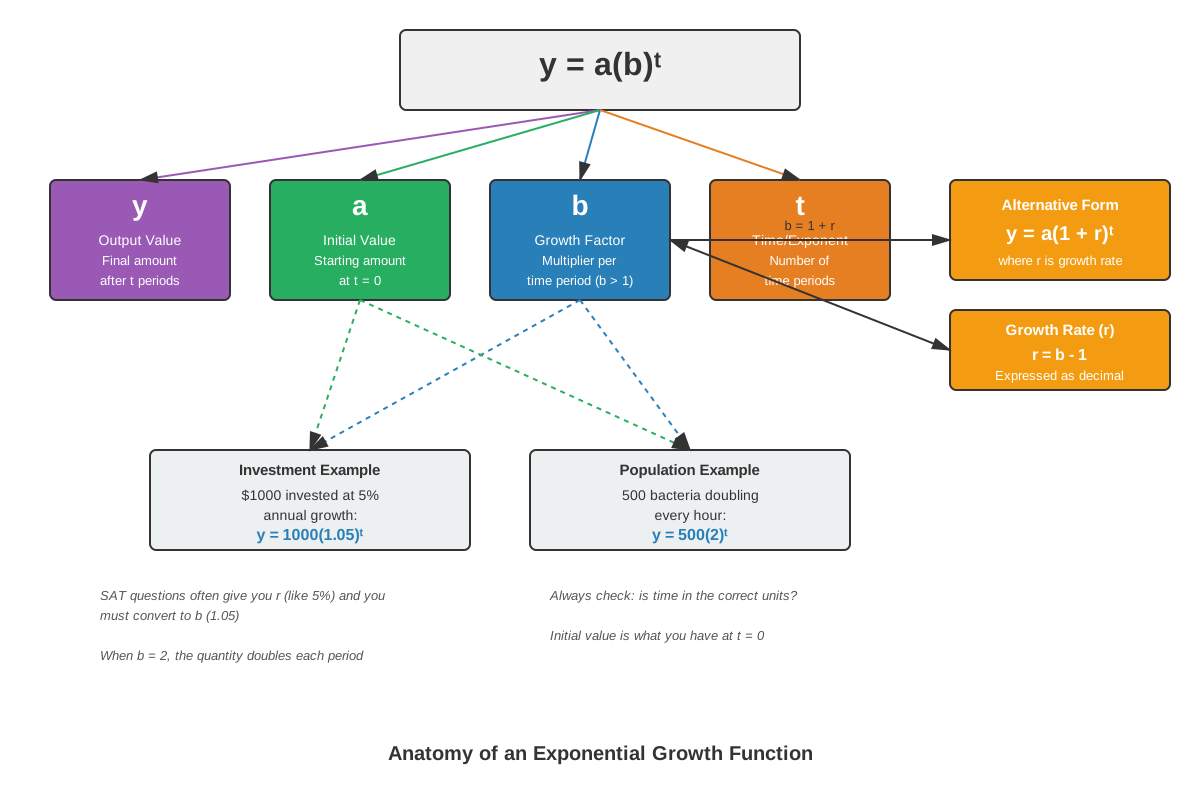
y = a · b^tIn these formulas:
- y represents the final amount after growth
- a represents the initial value (the starting amount when t = 0)
- r represents the growth rate expressed as a decimal (e.g., 0.05 for 5% growth)
- b represents the growth factor (equal to 1 + r)
- t represents time (number of time periods elapsed)
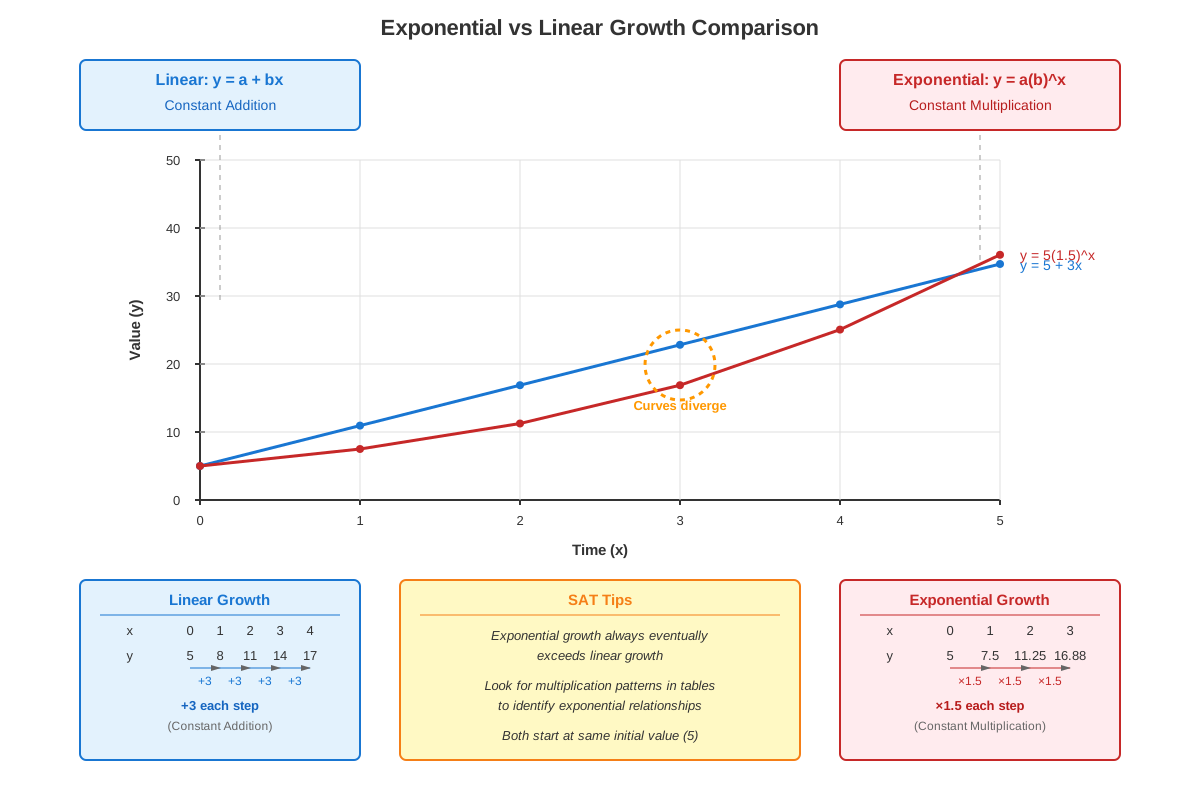
The distinction between growth rate and growth factor is crucial. If a population increases by 8% each year, the growth rate r = 0.08, but the growth factor b = 1.08. Each year, the population is multiplied by 1.08 (representing the original 100% plus the additional 8%). This multiplicative nature—where the quantity is repeatedly multiplied by the same factor—defines exponential growth and distinguishes it from linear growth, where the same amount is repeatedly added.
Identifying Exponential Growth Patterns
Recognizing exponential growth requires understanding its distinctive characteristics across different representations:
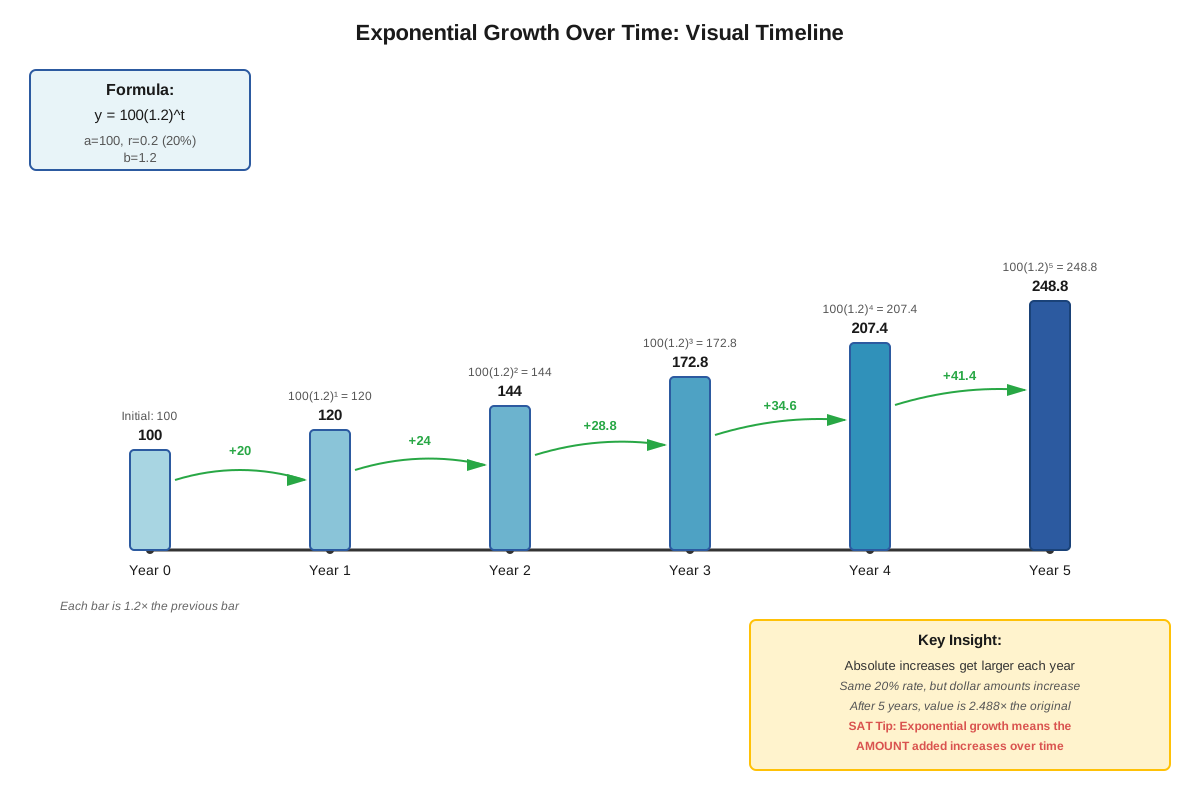
In tables: Exponential growth appears when the ratio between consecutive values remains constant. For example:
| Time (years) | Population |
|---|---|
| 0 | 100 |
| 1 | 120 |
| 2 | 144 |
| 3 | 172.8 |
Here, each value is 1.2 times the previous value (120/100 = 1.2, 144/120 = 1.2, etc.), indicating a growth factor of 1.2 or 20% growth per year.
In graphs: Exponential growth produces a characteristic J-shaped curve that starts slowly and then increases more rapidly. The curve is always increasing (for growth) and becomes steeper over time. Unlike linear functions that maintain constant slope, exponential functions have continuously increasing rates of change.
In equations: Exponential growth equations feature the variable in the exponent position. The base of the exponent (the growth factor) must be greater than 1 for growth to occur. Common forms include y = 100(1.05)^t or P = 500(2)^t.
Growth Factor vs. Growth Rate
Understanding the relationship between growth factor and growth rate prevents common calculation errors:
| Growth Rate (r) | Growth Factor (b) | Meaning |
|---|---|---|
| 5% = 0.05 | 1.05 | Quantity increases to 105% of previous value |
| 12% = 0.12 | 1.12 | Quantity increases to 112% of previous value |
| 100% = 1.00 | 2.00 | Quantity doubles each period |
| 200% = 2.00 | 3.00 | Quantity triples each period |
The formula connecting these is: b = 1 + r (for growth) or b = 1 - r (for decay/decrease).
Compound Interest as Exponential Growth
One of the most common SAT applications of exponential growth is compound interest, where money grows exponentially because interest is earned on both the principal and previously accumulated interest. The compound interest formula is:
A = P(1 + r/n)^(nt)Where:
- A = final amount
- P = principal (initial investment)
- r = annual interest rate (as decimal)
- n = number of times interest compounds per year
- t = time in years
For annual compounding (n = 1), this simplifies to the standard exponential growth formula: A = P(1 + r)^t.
Time Intervals and Scaling
Exponential growth problems may involve different time intervals, requiring careful attention to units. If a population grows by 3% per month, using the formula requires expressing time in months. Converting between time units is essential:
- If growth rate is per year and time is given in months, divide months by 12
- If growth rate is per month and time is given in years, multiply years by 12
- Always ensure the time unit matches the period for which the growth rate is defined
Doubling Time and Half-Life
Some exponential growth problems focus on doubling time—how long it takes for a quantity to double. If something doubles, the growth factor for that period is 2. For example, if a population doubles every 5 years, the equation becomes:
P = P₀(2)^(t/5)where t is measured in years and t/5 represents the number of 5-year periods elapsed.
Concept Relationships
The concepts within exponential growth form a tightly interconnected system. The exponential growth formula serves as the foundation, with the initial value determining the starting point and the growth factor (derived from the growth rate) determining how rapidly the quantity increases. Understanding the relationship between growth rate and growth factor (b = 1 + r) enables conversion between different equation forms, which is essential when problems provide information in percentage terms but require calculations using the multiplicative factor.
Compound interest represents a specific application of the general exponential growth formula, adding complexity through multiple compounding periods per year. This connects exponential growth to financial literacy concepts and demonstrates how the same mathematical structure applies across diverse contexts. The concept of doubling time provides an alternative way to express exponential growth, focusing on the time required for a specific multiplicative change rather than on the per-period growth rate.
The ability to identify exponential patterns in tables, graphs, and equations connects to function analysis skills. Recognizing constant ratios in tables links to proportional reasoning, while interpreting exponential graphs requires understanding function behavior and rate of change. These identification skills enable students to distinguish exponential from linear relationships, a comparison the SAT frequently tests.
Exponential growth builds on prerequisite knowledge of exponent rules (for evaluating expressions like (1.05)¹⁰), percentage calculations (for converting growth rates), and algebraic manipulation (for solving exponential equations). It connects forward to logarithms, which serve as the inverse operation for solving exponential equations when the exponent is unknown. Additionally, exponential growth relates to geometric sequences, where each term is found by multiplying the previous term by a constant ratio—the discrete analog of continuous exponential growth.
Relationship Map:
Growth Rate (r) → converts to → Growth Factor (b) → used in → Exponential Formula → generates → Growth Pattern → appears in → Tables/Graphs/Equations → enables → Problem Solving → applies to → Real-World Contexts (compound interest, population, etc.)
High-Yield Facts
⭐ The exponential growth formula is y = a(1 + r)^t, where a is initial value, r is growth rate as a decimal, and t is time
⭐ Growth factor b = 1 + r; for 7% growth, the growth factor is 1.07, not 0.07
⭐ In exponential growth, equal time intervals produce equal ratios (not equal differences) between consecutive values
⭐ Exponential graphs create J-shaped curves that increase at an accelerating rate, becoming steeper over time
⭐ Compound interest follows A = P(1 + r/n)^(nt), where n is the number of compounding periods per year
- When a quantity doubles, the growth factor for that period is 2, regardless of the time interval
- Exponential growth always has the variable in the exponent position; if the variable is in the base, it's not exponential
- A growth rate of 100% means doubling (growth factor of 2), not increasing to zero
- The initial value (a) can be found by evaluating the function at t = 0, since any number to the zero power equals 1
- Exponential growth eventually surpasses any linear growth, no matter how steep the linear function's slope
- The base of an exponential growth function must be greater than 1; bases between 0 and 1 represent exponential decay
- Time units must match the period for which the growth rate is defined (monthly rate requires time in months)
Quick check — test yourself on Exponential growth so far.
Try Flashcards →Common Misconceptions
Misconception: The growth rate and growth factor are the same thing.
Correction: The growth rate (r) is the percentage increase expressed as a decimal, while the growth factor (b) equals 1 + r. For 5% growth, r = 0.05 but b = 1.05. You multiply by the growth factor, not the growth rate.
Misconception: Exponential growth means "really fast growth" and can describe any rapidly increasing quantity.
Correction: Exponential growth has a precise mathematical definition: the quantity multiplies by a constant factor over equal time intervals. A quantity could increase rapidly but linearly (adding the same large amount each period), which is not exponential growth.
Misconception: In the formula y = a(1 + r)^t, you can substitute the percentage directly (e.g., using 8 for 8% growth).
Correction: The growth rate r must be expressed as a decimal. For 8% growth, use r = 0.08, making the formula y = a(1.08)^t. Using 8 would represent 800% growth per period.
Misconception: Exponential and linear growth are similar for small time periods, so the distinction doesn't matter.
Correction: While exponential and linear growth may produce similar values initially, they diverge dramatically over time. The SAT specifically tests the ability to distinguish these patterns and predict long-term behavior, where the differences become enormous.
Misconception: If a population grows from 100 to 150, the growth rate is 50%.
Correction: This is correct for the first period, but exponential growth means this 50% rate continues to apply to the new, larger values. After another period, the population would be 150(1.5) = 225, not 200. The growth rate is constant, but the absolute increase gets larger each period.
Misconception: In compound interest problems, you can ignore the compounding frequency if it's not specifically asked about.
Correction: The number of compounding periods per year (n) significantly affects the final amount. Interest compounded monthly grows faster than interest compounded annually at the same annual rate, because interest starts earning interest more frequently.
Misconception: Exponential growth continues forever at an accelerating rate.
Correction: While the mathematical model shows unlimited growth, real-world exponential growth always encounters limiting factors eventually (resources, space, etc.). However, SAT problems typically focus on the mathematical model within a specified time frame where exponential growth is a valid approximation.
Worked Examples
Example 1: Compound Interest Application
Problem: Maria invests $2,500 in a savings account that earns 4% annual interest compounded annually. How much money will be in the account after 6 years?
Solution:
Step 1: Identify the given information and what we're solving for.
- Initial amount (principal): P = $2,500
- Annual interest rate: r = 4% = 0.04
- Compounding frequency: n = 1 (annually)
- Time: t = 6 years
- We need to find: A (final amount)
Step 2: Choose the appropriate formula.
Since interest compounds annually (n = 1), we can use the simplified exponential growth formula:
A = P(1 + r)^tStep 3: Substitute the values.
A = 2500(1 + 0.04)^6
A = 2500(1.04)^6
Step 4: Calculate (1.04)^6.
Using a calculator: (1.04)^6 ≈ 1.2653
Step 5: Complete the calculation.
A = 2500 × 1.2653
A ≈ 3163.25Answer: After 6 years, Maria will have approximately $3,163.25 in her account.
Connection to Learning Objectives: This problem applies exponential growth to a real-world SAT-style question involving compound interest, demonstrating how to identify the initial value, growth rate, and time period, then use the exponential formula to calculate a future value.
Example 2: Identifying Growth Patterns from Tables
Problem: A scientist observes bacterial growth in a petri dish and records the following data:
| Time (hours) | Bacteria Count |
|---|---|
| 0 | 50 |
| 2 | 200 |
| 4 | 800 |
| 6 | 3,200 |
Which equation best models this relationship, where B represents bacteria count and t represents time in hours?
A) B = 50 + 150t
B) B = 50(4)^t
C) B = 50(2)^t
D) B = 50(4)^(t/2)
Solution:
Step 1: Determine if the growth is linear or exponential.
Check if consecutive values have constant differences (linear) or constant ratios (exponential).
- Differences: 200 - 50 = 150; 800 - 200 = 600; 3,200 - 800 = 2,400 (not constant)
- Ratios: 200/50 = 4; 800/200 = 4; 3,200/800 = 4 (constant!)
The constant ratio of 4 indicates exponential growth with a growth factor of 4.
Step 2: Identify the initial value.
At t = 0, B = 50, so a = 50.
Step 3: Determine the time interval for the growth factor.
The bacteria count multiplies by 4 every 2 hours (not every 1 hour).
Step 4: Construct the equation.
Since the growth factor of 4 applies every 2 hours, we need t/2 in the exponent:
B = 50(4)^(t/2)Step 5: Verify by testing a data point.
At t = 4: B = 50(4)^(4/2) = 50(4)^2 = 50(16) = 800 ✓
Answer: D) B = 50(4)^(t/2)
Why the other answers are wrong:
- A is linear (constant addition), but we established the pattern is exponential
- B would mean the bacteria quadruple every hour, but they actually quadruple every 2 hours
- C would mean the bacteria double every hour, which doesn't match the data (at t = 2, this gives 50(2)^2 = 200 ✓, but at t = 4, it gives 50(2)^4 = 800 ✓... wait, let's recalculate)
Actually, let's reconsider option C more carefully:
At t = 2: B = 50(2)^2 = 50(4) = 200 ✓
At t = 4: B = 50(2)^4 = 50(16) = 800 ✓
At t = 6: B = 50(2)^6 = 50(64) = 3,200 ✓
Option C also works! This reveals an important insight: 4^(t/2) = (2^2)^(t/2) = 2^t, so options C and D are mathematically equivalent. Both are correct answers.
Connection to Learning Objectives: This problem requires identifying key features of exponential growth (constant ratios), distinguishing exponential from linear patterns, and applying knowledge of how time intervals affect exponential equations—all critical SAT skills.
Exam Strategy
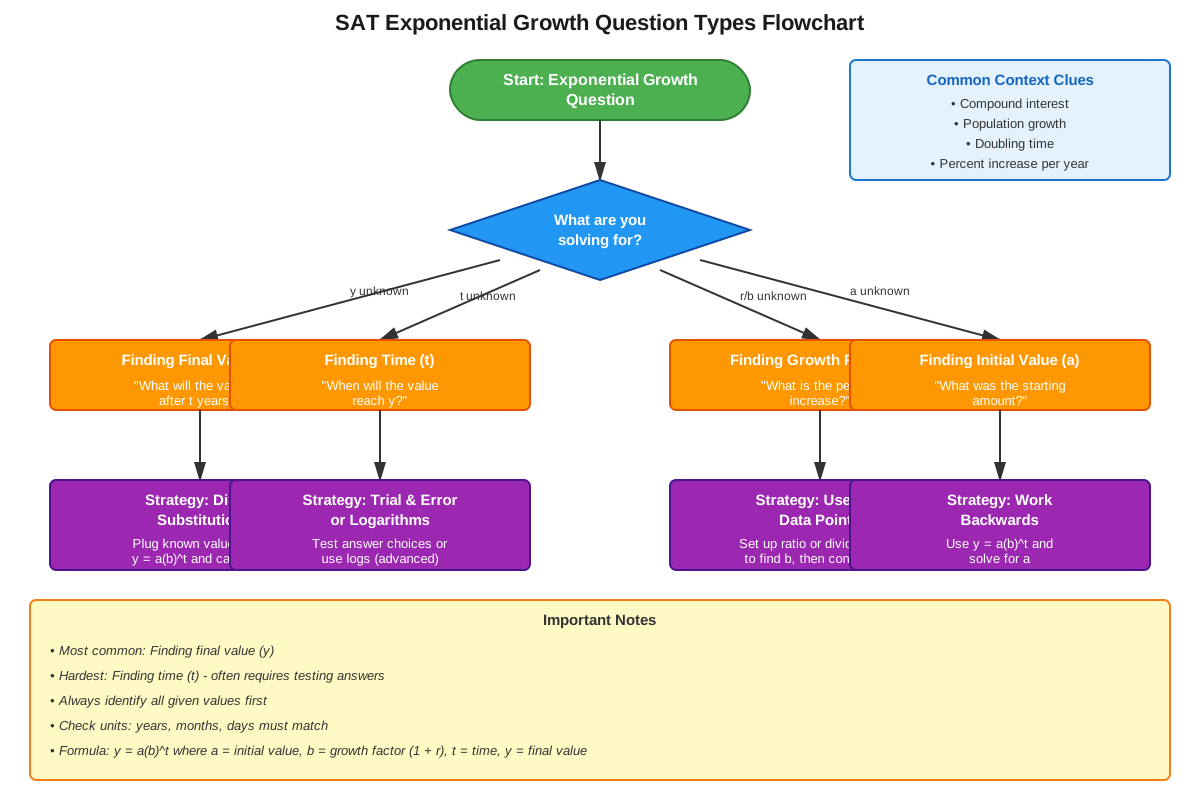
When approaching sat exponential growth questions, begin by identifying what type of information is provided and what the question asks for. SAT questions typically provide three of the four key values (initial amount, growth rate/factor, time, final amount) and ask you to find the fourth. Quickly determine which formula form is most appropriate: use y = a(1 + r)^t when given a percentage growth rate, or y = a·b^t when given a growth factor directly.
Trigger words and phrases that signal exponential growth include:
- "increases by X% each year/month/period"
- "grows at a rate of"
- "compounds" (especially with interest)
- "doubles every" or "triples every"
- "multiplies by"
- "population growth"
- "exponential model"
Watch for questions that ask you to compare exponential and linear models. These often present data in tables and ask which type of function better fits the pattern. Remember: constant differences indicate linear, constant ratios indicate exponential.
For process-of-elimination strategies specific to exponential growth:
- Check the initial value: Evaluate each answer choice at t = 0. The correct equation must give the stated initial amount when t = 0.
- Verify the growth direction: If the problem describes growth (increase), eliminate any equations with bases between 0 and 1, which represent decay.
- Test with given data points: If a table or specific values are provided, substitute one into each answer choice. Eliminate any that don't produce the correct output.
- Examine the growth factor: If the problem states "increases by 15%," the growth factor must be 1.15. Eliminate answers with different factors.
- Check time units: Ensure the exponent's time variable matches the period for which the growth rate is defined. If growth is per month but time is in years, the correct answer must account for this conversion.
Time allocation: Most exponential growth questions should take 60-90 seconds. If you're spending more than 2 minutes, you may be overcomplicating the problem. These questions test concept recognition and formula application more than complex calculation. Use your calculator efficiently for evaluating exponential expressions, but don't let calculation errors cost you points—double-check that you've entered values correctly.
Exam Tip: When a question provides a percentage increase, immediately convert it to a growth factor by adding 1. Write "8% → 1.08" in your test booklet to avoid the common error of using 0.08 as the growth factor.
Memory Techniques
Mnemonic for the exponential growth formula components: "A I G T" (pronounced "eight")
- Amount (final)
- Initial value
- Growth factor
- Time
This reminds you that y = a · b^t, where y is the amount, a is initial, b is growth factor, and t is time.
Visualization strategy: Picture exponential growth as a snowball rolling down a hill. It starts small, but as it rolls, it picks up more snow. The bigger it gets, the more surface area it has to pick up even more snow, so it grows faster and faster. This captures the essence of exponential growth: the rate of increase itself increases over time.
For distinguishing growth rate from growth factor: Remember "Factor = Rate + 1" or use the phrase "Factor is fuller" (fuller = more than the rate alone). The growth factor includes the original amount (100% = 1) plus the additional growth.
Acronym for identifying exponential patterns: "R.A.T."
- Ratios are constant (not differences)
- Accelerating increase (gets steeper)
- Time in the exponent
If you see R.A.T., think exponential!
For compound interest: Remember "PRINT" for the variables:
- Principal
- Rate
- Interest (final amount)
- Number of compounds per year
- Time
Summary
Exponential growth represents one of the most important and frequently tested concepts on the SAT math section, describing situations where quantities multiply by a constant factor over equal time intervals. The fundamental formula y = a(1 + r)^t or y = a·b^t captures this relationship, where a represents the initial value, r is the growth rate (as a decimal), b is the growth factor (equal to 1 + r), and t is time. Understanding the distinction between growth rate and growth factor is critical: a 6% growth rate means multiplying by 1.06, not 0.06. Exponential growth appears in diverse contexts including compound interest, population modeling, and doubling-time problems. Students must be able to identify exponential patterns in tables (constant ratios between consecutive values), graphs (J-shaped curves with increasing steepness), and equations (variable in the exponent position). The ability to distinguish exponential from linear growth, convert between different forms of exponential equations, and apply these formulas to real-world scenarios is essential for SAT success. Mastery requires recognizing trigger words, carefully managing time units, and systematically applying the appropriate formula to find unknown values.
Key Takeaways
- Exponential growth means multiplying by a constant factor (growth factor b) over equal time intervals, creating accelerating increase
- The growth factor equals 1 plus the growth rate: b = 1 + r (e.g., 12% growth → growth factor of 1.12)
- Identify exponential patterns by checking for constant ratios between consecutive values in tables, not constant differences
- The standard exponential growth formula is y = a(1 + r)^t, where a is initial value, r is growth rate as decimal, and t is time
- Compound interest is exponential growth applied to money: A = P(1 + r/n)^(nt), where n is compounding frequency per year
- Always ensure time units match the period for which the growth rate is defined (monthly rate requires time in months)
- Exponential graphs create J-shaped curves that become steeper over time, eventually surpassing any linear function
Related Topics
Exponential Decay: The inverse of exponential growth, where quantities decrease by a constant percentage each period (growth factor between 0 and 1). Mastering exponential growth provides the foundation for understanding decay, which appears in radioactive half-life, depreciation, and cooling problems.
Logarithms: The inverse operation of exponentiation, used to solve exponential equations when the exponent is unknown. Understanding exponential growth is prerequisite to working with logarithms, which appear in advanced SAT questions.
Linear vs. Exponential Comparison: Many SAT questions explicitly ask students to compare linear and exponential models, determine which better fits data, or explain why one is more appropriate than the other. This requires solid understanding of both function types.
Geometric Sequences: The discrete version of exponential growth, where each term is found by multiplying the previous term by a constant ratio. The connection between continuous exponential functions and discrete geometric sequences deepens understanding of multiplicative patterns.
Function Transformations: Understanding how changing parameters in y = a·b^t affects the graph (vertical stretch/compression, horizontal shift) connects exponential growth to broader function analysis skills tested on the SAT.
Practice CTA
Now that you've mastered the core concepts of exponential growth, it's time to cement your understanding through practice! Attempt the practice questions to apply these concepts to SAT-style problems, and use the flashcards to reinforce key formulas and definitions. Remember, exponential growth questions are high-yield—mastering this topic can directly improve your SAT math score by several points. Each practice problem you solve builds the pattern recognition and problem-solving speed you need for test day success. You've got this!
Sign up free to keep reading
Create a free AnvayaPrep account to finish this SAT guide on Exponential growth — plus flashcards and practice questions.