Overview
SAT exponent traps represent one of the most frequently tested—and commonly missed—categories of questions in the math section of the SAT. These questions are deliberately designed to exploit common student errors and misconceptions about exponent rules. Unlike straightforward exponent problems that simply test whether students know the basic rules, trap questions incorporate subtle twists, negative bases, zero exponents, or multi-step reasoning that can lead even well-prepared students astray if they work too quickly or rely on pattern recognition without careful analysis.
Understanding these traps is essential for achieving a competitive SAT math score because exponent questions appear in both the calculator and no-calculator sections, often embedded within algebra problems, function questions, or even geometry contexts. The College Board strategically places these questions at medium to hard difficulty levels, where they serve as effective discriminators between students who have memorized rules and those who truly understand the underlying principles. A single exponent trap question can mean the difference between a 700 and a 750+ on the math section.
Exponent traps connect to broader mathematical concepts including algebraic manipulation, equation solving, function behavior, and exponential growth models. Mastering these traps requires not just memorization of exponent rules but also careful attention to detail, systematic problem-solving approaches, and the ability to recognize when the test writers are attempting to induce a specific error. This guide will equip students with the pattern recognition skills and strategic approaches needed to identify and avoid these common pitfalls.
Learning Objectives
- [ ] Identify key features of SAT exponent traps
- [ ] Explain how SAT exponent traps appears on the SAT
- [ ] Apply SAT exponent traps to answer SAT-style questions
- [ ] Distinguish between correct and incorrect applications of exponent rules in trap scenarios
- [ ] Recognize the most common trap patterns involving negative bases, zero exponents, and fractional exponents
- [ ] Develop systematic checking procedures to avoid careless errors on exponent problems
- [ ] Analyze multi-step problems where exponent traps are embedded within larger algebraic contexts
Prerequisites
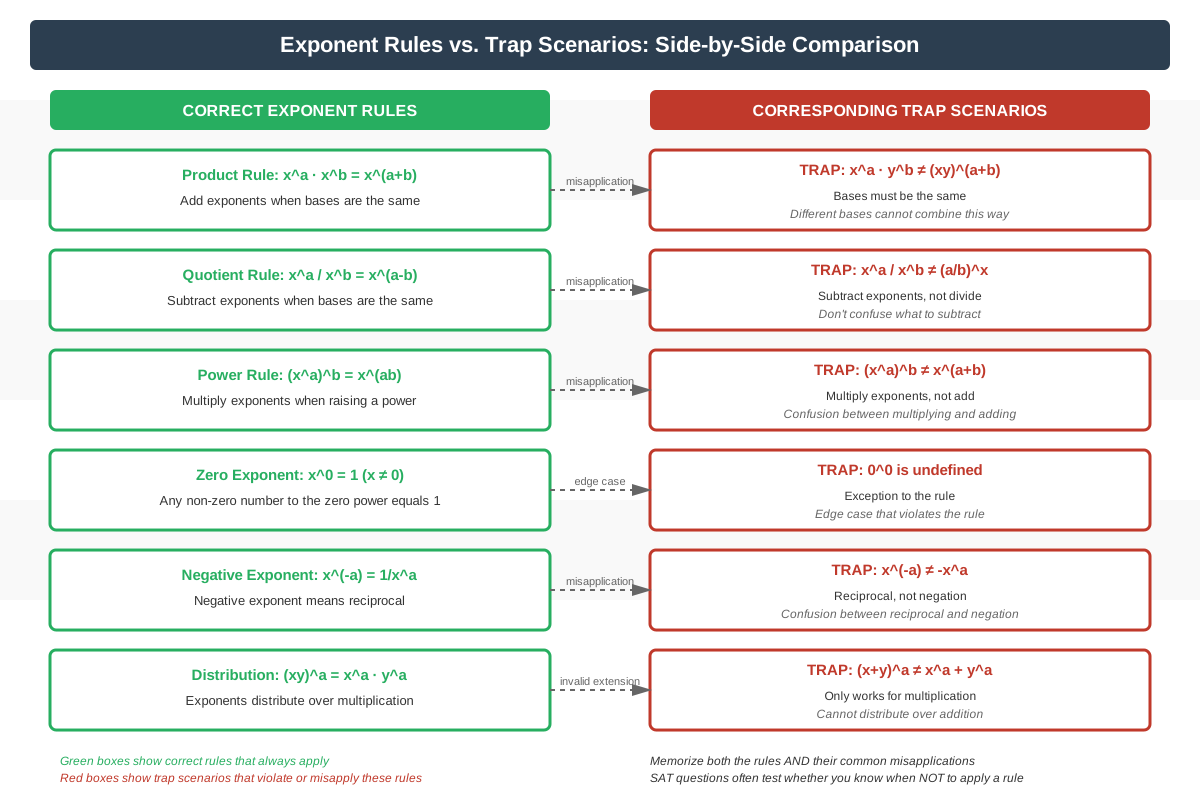
- Basic exponent rules: Students must know the product rule (x^a · x^b = x^(a+b)), quotient rule (x^a / x^b = x^(a-b)), and power rule ((x^a)^b = x^(ab)) as these form the foundation for recognizing when trap answers violate these principles
- Order of operations: Understanding PEMDAS is critical because many exponent traps exploit confusion about whether exponents are evaluated before or after negation
- Negative number arithmetic: Facility with multiplying and dividing negative numbers is essential since many traps involve negative bases raised to various powers
- Algebraic manipulation: Basic equation-solving skills are necessary because exponent traps often appear within equations requiring multiple steps to solve
Why This Topic Matters
In real-world applications, exponents appear in compound interest calculations, population growth models, radioactive decay, computer science algorithms (particularly time complexity), and scientific notation used across all STEM fields. Understanding exponent behavior is fundamental to fields ranging from finance to epidemiology, where exponential growth and decay models predict everything from investment returns to disease spread.
On the SAT specifically, exponent questions appear in approximately 10-15% of all math questions, making them one of the highest-yield topics for focused study. These questions typically appear as both multiple-choice and grid-in formats, with difficulty ratings ranging from medium to hard. The College Board particularly favors exponent traps in questions 10-20 of each math section—the "middle difficulty" range where they can effectively separate students scoring in the 600s from those reaching 700+.
Common SAT question formats include: simplifying expressions with multiple exponent rules applied sequentially; solving exponential equations where both sides must be expressed with the same base; comparing values of expressions with negative or fractional exponents; and word problems involving exponential growth or decay. The trap elements are typically embedded as wrong answer choices that represent common student errors, making it crucial to work carefully rather than selecting the first answer that "looks right."
Core Concepts
The Negative Base Trap
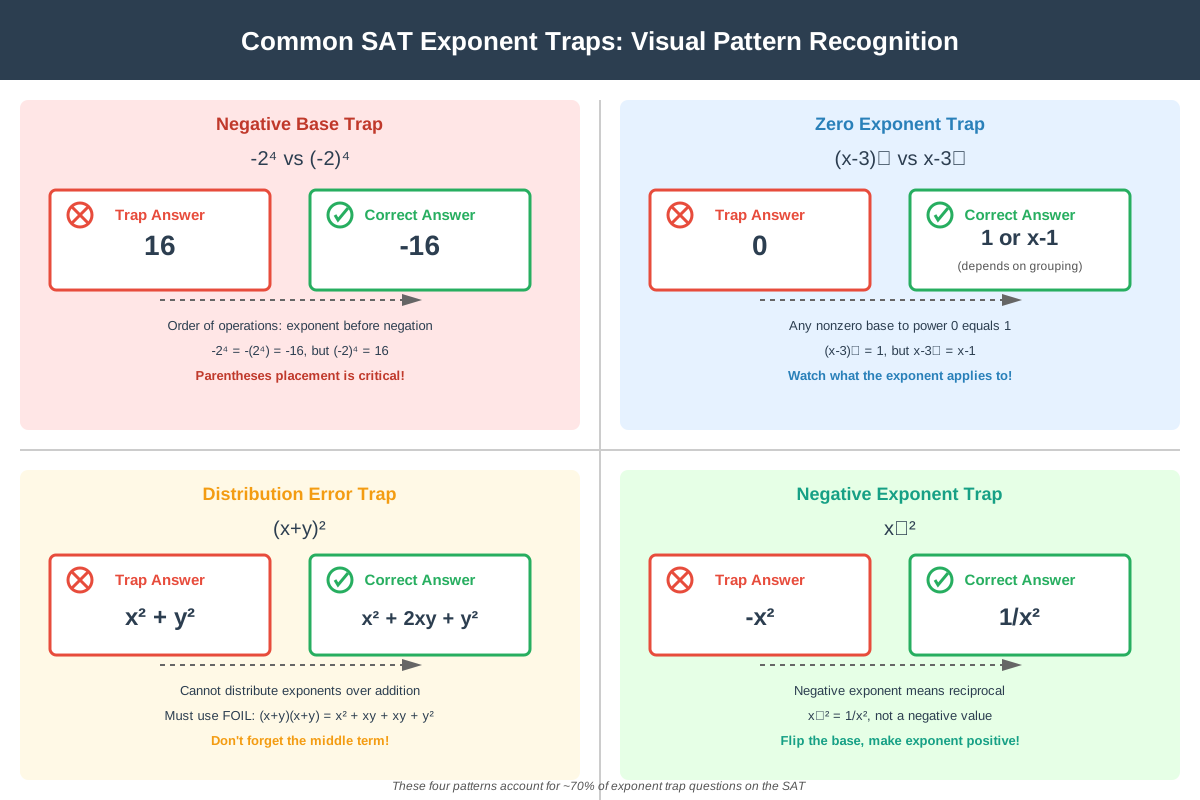
The most prevalent sat exponent trap involves confusion about negative bases and the role of parentheses. The critical distinction is between (-x)^n and -x^n. When parentheses enclose the negative sign with the base, the negative is included in what gets raised to the power. Without parentheses, only the variable is raised to the power, and the negative sign is applied afterward.
Consider these examples:
- (-2)^4 = (-2)(-2)(-2)(-2) = 16
- -2^4 = -(2·2·2·2) = -16
The SAT exploits this by presenting answer choices that differ only in sign, knowing that students working quickly will often miss the parentheses. This trap becomes especially insidious when variables are involved: (-x)^2 = x^2 for all real x, but -x^2 is always negative or zero when x is real.
The Zero Exponent Trap
Any nonzero base raised to the zero power equals 1, but the SAT creates traps around this rule in several ways. First, students sometimes incorrectly believe that x^0 = 0, leading to wrong answers. Second, the test presents expressions like (x-3)^0 where students must recognize that the entire quantity (x-3) is the base, so the expression equals 1 for all x ≠ 3.
The restriction that the base must be nonzero is itself a trap source. When solving equations that lead to x^0 = 1, students must verify that x doesn't make the base zero. For example, if (x-5)^0 = 1, the solution is "all real numbers except x = 5," not "all real numbers."
The Negative Exponent Trap
Negative exponents indicate reciprocals: x^(-n) = 1/(x^n). The SAT creates traps by presenting problems where students must recognize that negative exponents don't make the result negative. For instance, 2^(-3) = 1/8, which is positive. Additionally, when negative exponents appear in fractions, students often flip incorrectly: (a/b)^(-n) = (b/a)^n, not -(a/b)^n.
A particularly subtle trap involves expressions like (x^(-2))^(-3). Students sometimes incorrectly multiply the exponents without considering the signs carefully, getting x^6 instead of the correct x^6. While the answer is the same in this case, similar problems with different exponents can lead to errors.
The Fractional Exponent Trap
Fractional exponents represent roots: x^(1/n) = ⁿ√x and x^(m/n) = ⁿ√(x^m) = (ⁿ√x)^m. The SAT creates traps by testing whether students understand that x^(1/2) means the principal (positive) square root, not ±√x. When solving equations like x^2 = 16, both x = 4 and x = -4 are solutions, but 16^(1/2) = 4 only.
Another common trap involves comparing fractional exponents. Students must recognize that when 0 < x < 1, larger exponents produce smaller results: (1/2)^(1/2) > (1/2)^(1/3) > (1/2)^1. This counterintuitive behavior (opposite to what happens when x > 1) frequently appears in comparison questions.
The Distribution Trap
Students often incorrectly "distribute" exponents over addition or subtraction: (x + y)^2 ≠ x^2 + y^2. This is one of the most common algebraic errors, and the SAT reliably includes wrong answer choices based on this mistake. The correct expansion is (x + y)^2 = x^2 + 2xy + y^2.
However, exponents do distribute over multiplication and division: (xy)^n = x^n · y^n and (x/y)^n = x^n / y^n. The SAT tests whether students can distinguish when distribution is valid and when it isn't.
The Base Confusion Trap
When solving exponential equations, both sides must be expressed with the same base before equating exponents. The SAT creates traps by presenting equations like 2^x = 8 alongside wrong answer choices that result from incorrectly equating exponents without first recognizing that 8 = 2^3.
More sophisticated versions involve expressions like 4^x = 2^(x+6). Students must recognize that 4 = 2^2, so 4^x = (2^2)^x = 2^(2x). Then 2^(2x) = 2^(x+6) implies 2x = x + 6, giving x = 6. Wrong answer choices often include x = 3 (from incorrectly treating 4 and 2 as if they were the same base) or x = 12 (from other algebraic errors).
The Compound Exponent Trap
When exponents appear in both the base and the power position, students must carefully apply the power rule. For (x^a)^b, the exponents multiply: (x^a)^b = x^(ab). However, for x^(a^b), the exponents don't multiply—this expression means x raised to the power (a^b), which is calculated by first evaluating a^b.
For example, (2^3)^2 = 2^6 = 64, but 2^(3^2) = 2^9 = 512. The SAT includes wrong answers that result from confusing these two situations.
Concept Relationships
The various sat exponent traps are interconnected through the fundamental exponent rules, with each trap representing a specific way that rule can be misapplied or misunderstood. The negative base trap connects directly to order of operations (prerequisite knowledge), as it hinges on whether the negative sign is inside or outside the scope of the exponent operation. This trap also relates to the distribution trap, since both involve understanding what the base actually is.
The zero and negative exponent traps both stem from the quotient rule: x^a / x^a = x^(a-a) = x^0 = 1 (since any nonzero number divided by itself equals 1), and x^a / x^b = x^(a-b), which produces negative exponents when b > a. Understanding these connections helps students remember the rules rather than memorizing them in isolation.
Fractional exponents connect to radical expressions (a related topic in the Exponents and Radicals unit), providing an alternative notation for roots. This relationship becomes important in more complex problems where students must convert between radical and exponential notation to simplify expressions.
The relationship map flows as follows: Basic exponent rules (product, quotient, power) → Application contexts (negative bases, zero exponents, negative exponents, fractional exponents) → Common misapplications (distribution trap, base confusion trap, compound exponent trap) → SAT trap questions that exploit these misapplications. Mastering this topic requires moving backward through this chain: recognizing the trap pattern, identifying which rule is being tested, and applying that rule correctly.
Quick check — test yourself on SAT exponent traps so far.
Try Flashcards →High-Yield Facts
⭐ (-x)^n and -x^n are different: The first includes the negative in the base; the second applies the negative after exponentiation
⭐ Any nonzero number raised to the zero power equals 1: x^0 = 1 for all x ≠ 0, including when x is replaced by an expression like (2x-5)
⭐ Negative exponents create reciprocals, not negative numbers: x^(-n) = 1/(x^n), and the result's sign depends on the base and exponent, not on the negative exponent itself
⭐ Exponents do NOT distribute over addition or subtraction: (x + y)^n ≠ x^n + y^n; this is the most common algebraic error on the SAT
⭐ When 0 < x < 1, larger exponents make the result smaller: This counterintuitive behavior is frequently tested in comparison questions
- Fractional exponents represent roots: x^(1/n) = ⁿ√x, and x^(m/n) = ⁿ√(x^m)
- The power rule multiplies exponents: (x^a)^b = x^(ab), but this only applies when the entire power expression is raised to another power
- To solve exponential equations, express both sides with the same base: Then equate the exponents and solve the resulting equation
- Even exponents always produce non-negative results: x^(2n) ≥ 0 for all real x and positive integer n
- The product rule adds exponents only when bases are identical: x^a · x^b = x^(a+b), but x^a · y^a = (xy)^a
- Order of operations matters critically with exponents: Exponents are evaluated before multiplication and division but after parentheses
- 1 raised to any power equals 1: 1^n = 1 for all real n, making it a special case in many problems
Common Misconceptions
Misconception: x^0 = 0 for any value of x → Correction: x^0 = 1 for all nonzero x. The zero exponent rule is one of the most counterintuitive but most important exponent properties. Only 0^0 is undefined (or defined as 1 in some contexts), but any other base raised to the zero power equals 1.
Misconception: Negative exponents make the result negative → Correction: Negative exponents indicate reciprocals, not negative values. The sign of the result depends on the base and whether the exponent is even or odd. For example, 2^(-3) = 1/8 (positive), while (-2)^(-3) = 1/(-8) = -1/8 (negative).
Misconception: (x + y)^2 = x^2 + y^2 → Correction: (x + y)^2 = x^2 + 2xy + y^2. Exponents do not distribute over addition or subtraction. This error is so common that the SAT includes it as a wrong answer choice in nearly every problem where it could plausibly apply. Always expand binomials fully or use the FOIL method.
Misconception: When solving x^2 = 16, the answer is x = 4^(1/2) = 2 → Correction: This misconception confuses the equation x^2 = 16 (which has solutions x = ±4) with the expression 16^(1/2) (which equals 4 only, the principal square root). Equations can have multiple solutions, but fractional exponents represent only the principal root.
Misconception: -3^2 = 9 → Correction: -3^2 = -9 because the exponent applies only to the 3, not to the negative sign. The expression means -(3^2) = -9. To get 9, you need parentheses: (-3)^2 = 9. This is the single most common source of sign errors on SAT exponent questions.
Misconception: x^a · x^b = x^(a·b) → Correction: x^a · x^b = x^(a+b). When multiplying powers with the same base, add the exponents, don't multiply them. The multiplication of exponents occurs with the power rule: (x^a)^b = x^(a·b).
Misconception: (2x)^3 = 2x^3 → Correction: (2x)^3 = 2^3 · x^3 = 8x^3. When a product is raised to a power, the exponent applies to each factor. The coefficient must also be raised to the power, not just the variable.
Worked Examples
Example 1: Negative Base with Multiple Operations
Problem: If x = -2, what is the value of -x^3 + (-x)^3?
Solution:
Step 1: Identify the trap. This problem tests the negative base trap by including both -x^3 and (-x)^3 in the same expression.
Step 2: Evaluate -x^3 with x = -2.
- First substitute: -(-2)^3
- The exponent applies only to the -2, not to the leading negative: -((-2)^3)
- Calculate (-2)^3 = (-2)(-2)(-2) = -8
- Apply the leading negative: -(-8) = 8
Step 3: Evaluate (-x)^3 with x = -2.
- First substitute: (-(-2))^3 = (2)^3
- Calculate: 2^3 = 8
Step 4: Add the results.
- -x^3 + (-x)^3 = 8 + 8 = 16
Key insight: The parentheses make all the difference. Without them, the exponent applies only to the variable, and the negative is applied afterward. With them, the negative is part of the base being cubed. This problem would likely include 0, -16, and 16 as answer choices to trap students who make various sign errors.
Example 2: Exponential Equation with Base Conversion
Problem: If 9^(x+1) = 27^(x-2), what is the value of x?
Solution:
Step 1: Recognize that this tests the base confusion trap. The bases are different (9 and 27), so we cannot directly equate the exponents.
Step 2: Express both bases as powers of 3.
- 9 = 3^2
- 27 = 3^3
Step 3: Rewrite the equation using base 3.
- 9^(x+1) = (3^2)^(x+1) = 3^(2(x+1)) = 3^(2x+2)
- 27^(x-2) = (3^3)^(x-2) = 3^(3(x-2)) = 3^(3x-6)
Step 4: Now that both sides have the same base, equate the exponents.
- 3^(2x+2) = 3^(3x-6)
- 2x + 2 = 3x - 6
Step 5: Solve for x.
- 2 + 6 = 3x - 2x
- 8 = x
Step 6: Verify (optional but recommended on the SAT when time permits).
- Left side: 9^(8+1) = 9^9 = (3^2)^9 = 3^18
- Right side: 27^(8-2) = 27^6 = (3^3)^6 = 3^18 ✓
Key insight: The SAT would include wrong answers like x = 3 (from incorrectly setting x+1 = x-2 without converting bases) or x = -8 (from sign errors). Always convert to a common base before equating exponents, and consider verifying your answer if time allows.
Exam Strategy
When approaching sat exponent traps questions, begin by carefully reading the problem and identifying which exponent rules are relevant. Look specifically for red flags: negative signs near bases, zero exponents, negative exponents, fractional exponents, and expressions where exponents might be incorrectly distributed. These are the most common trap locations.
Trigger words and phrases to watch for include: "simplified form," "equivalent to," "value of," and "which of the following." When you see "simplified form," the test is likely checking whether you'll incorrectly distribute exponents or make sign errors. "Equivalent to" questions often test whether you can recognize that different-looking expressions are actually equal after applying exponent rules correctly. "Value of" questions with negative bases almost always test the parentheses distinction.
For process of elimination, immediately eliminate answer choices that violate basic exponent rules. If the problem involves even exponents, eliminate negative answer choices (since even powers of real numbers are non-negative). If the problem involves a zero exponent, eliminate any answer that equals zero. If you're comparing expressions with fractional exponents and bases between 0 and 1, remember that larger exponents produce smaller results—use this to eliminate impossible comparisons.
Time allocation for exponent problems should be approximately 45-60 seconds for straightforward applications and 90-120 seconds for multi-step problems involving equation solving or multiple exponent rules. If you find yourself spending more than 2 minutes on an exponent problem, mark it and move on—you can return to it after completing easier questions. However, don't rush through these problems, as the traps are specifically designed to catch students who work too quickly.
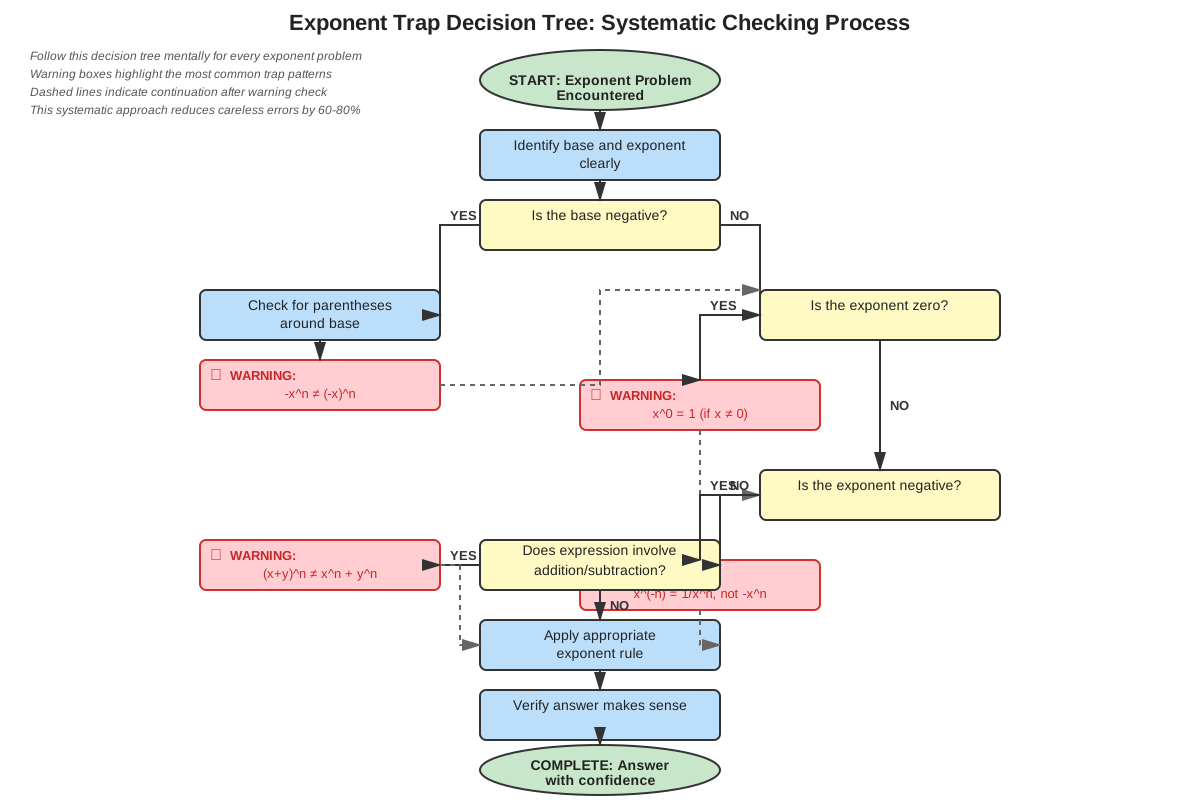
A systematic approach helps avoid traps: (1) Identify what exponent rules apply, (2) Check for parentheses around negative bases, (3) Simplify step-by-step rather than trying to do multiple operations mentally, (4) Write out intermediate steps, especially for complex expressions, and (5) Verify that your answer makes sense (e.g., if you're raising a positive number to a power, your answer should be positive).
Memory Techniques
PEMDAS-E: Remember that Exponents come before Multiplication, Division, Addition, and Subtraction, but after Parentheses. When you see -x^2, think "Parentheses first (none), Exponents second (x^2), then apply the negative."
"Parentheses Protect the Negative": Use this phrase to remember that (-x)^n includes the negative in the base, while -x^n does not. Visualize the parentheses as a shield that protects the negative sign, keeping it with the base.
"Negative Exponents Never Make Negatives": This alliterative phrase helps remember that negative exponents create reciprocals, not negative numbers. The sign of the result depends on the base, not on whether the exponent is negative.
"Zero Power = One Power": Any nonzero base to the zero power equals one. Visualize x^0 = x^(1-1) = x^1/x^1 = 1 to understand why this rule makes sense.
"Multiply Powers, Add Products": When you see (x^a)^b, multiply the exponents (power rule). When you see x^a · x^b, add the exponents (product rule). The word "power" contains "multiply" sounds (pow-er, mult-i-ply), while "product" contains "add" sounds (prod-uct, add).
The "FOIL Reminder": For (x + y)^2, remember "FOIL" (First, Outer, Inner, Last) to avoid the distribution trap. Visualize a big red X through "x^2 + y^2" to remind yourself this is wrong.
"Fraction Exponents = Root-tion": The denominator of a fractional exponent indicates the root: x^(1/n) = ⁿ√x. Visualize the fraction bar as a radical symbol rotated 90 degrees.
Summary
SAT exponent traps represent a high-yield category of questions that test whether students truly understand exponent rules or merely have them memorized. The most common traps involve negative bases (where parentheses determine whether the negative is included in the base), zero exponents (which always equal 1 for nonzero bases), negative exponents (which create reciprocals, not negative numbers), and the distribution trap (where students incorrectly apply exponents to sums or differences). Success on these questions requires careful attention to detail, systematic problem-solving, and recognition of the specific patterns the SAT uses to induce errors. Students must distinguish between similar-looking expressions like (-x)^n and -x^n, remember that exponents don't distribute over addition, and convert exponential equations to common bases before equating exponents. By understanding these trap patterns and developing careful checking habits, students can consistently avoid these common pitfalls and secure points on questions that trip up less-prepared test-takers.
Key Takeaways
- Parentheses matter critically: (-x)^n ≠ -x^n; the parentheses determine whether the negative is part of the base
- Zero exponents equal one: x^0 = 1 for all nonzero x, even when x is a complex expression
- Negative exponents mean reciprocals: x^(-n) = 1/(x^n), and don't make the result negative
- Never distribute exponents over addition: (x + y)^n ≠ x^n + y^n; always expand fully or use FOIL
- Convert to common bases: Before equating exponents in equations like 4^x = 2^y, express both sides with the same base
- Check answer reasonableness: Even powers of real numbers are non-negative; use this to eliminate impossible answers
- Work systematically, not quickly: SAT exponent traps specifically target students who rush; careful step-by-step work prevents errors
Related Topics
Radical Expressions and Equations: Since fractional exponents are equivalent to radicals (x^(1/n) = ⁿ√x), mastering exponent traps provides the foundation for simplifying radical expressions and solving radical equations. Students who understand fractional exponents can convert between forms to choose the most convenient representation.
Exponential Functions and Growth: Understanding exponent behavior is essential for working with exponential functions like f(x) = a·b^x, which appear in both algebra and data analysis questions on the SAT. The rules for manipulating exponents directly apply to analyzing and comparing exponential growth rates.
Polynomial Operations: The distribution trap connects directly to polynomial multiplication and the difference of squares pattern. Students who master when exponents do and don't distribute will more easily factor and expand polynomial expressions.
Logarithms: Though less common on the SAT, logarithms are the inverse of exponential functions. Understanding exponential equations with common bases prepares students for logarithmic thinking, where the question becomes "to what power must we raise the base to get this result?"
Practice CTA
Now that you've mastered the patterns behind SAT exponent traps, it's time to put your knowledge into action. Work through the practice questions to reinforce these concepts and build the pattern recognition skills that will help you spot traps instantly on test day. Use the flashcards to drill the key rules until they become automatic. Remember: the SAT rewards careful, systematic thinking over speed. Every trap you learn to avoid is a point you've secured toward your target score. You've got this!
Sign up free to keep reading
Create a free AnvayaPrep account to finish this SAT guide on SAT exponent traps — plus flashcards and practice questions.