Overview
Comparing functions is a critical skill tested on the SAT math section that requires students to analyze multiple function representations simultaneously and determine relationships between their key features. This topic appears in approximately 8-12% of SAT math questions and serves as a bridge between basic function understanding and advanced problem-solving. Students must be able to work fluidly across different function representations—including equations, tables, graphs, and verbal descriptions—while identifying which function has a greater rate of change, higher maximum value, larger y-intercept, or other distinguishing characteristics.
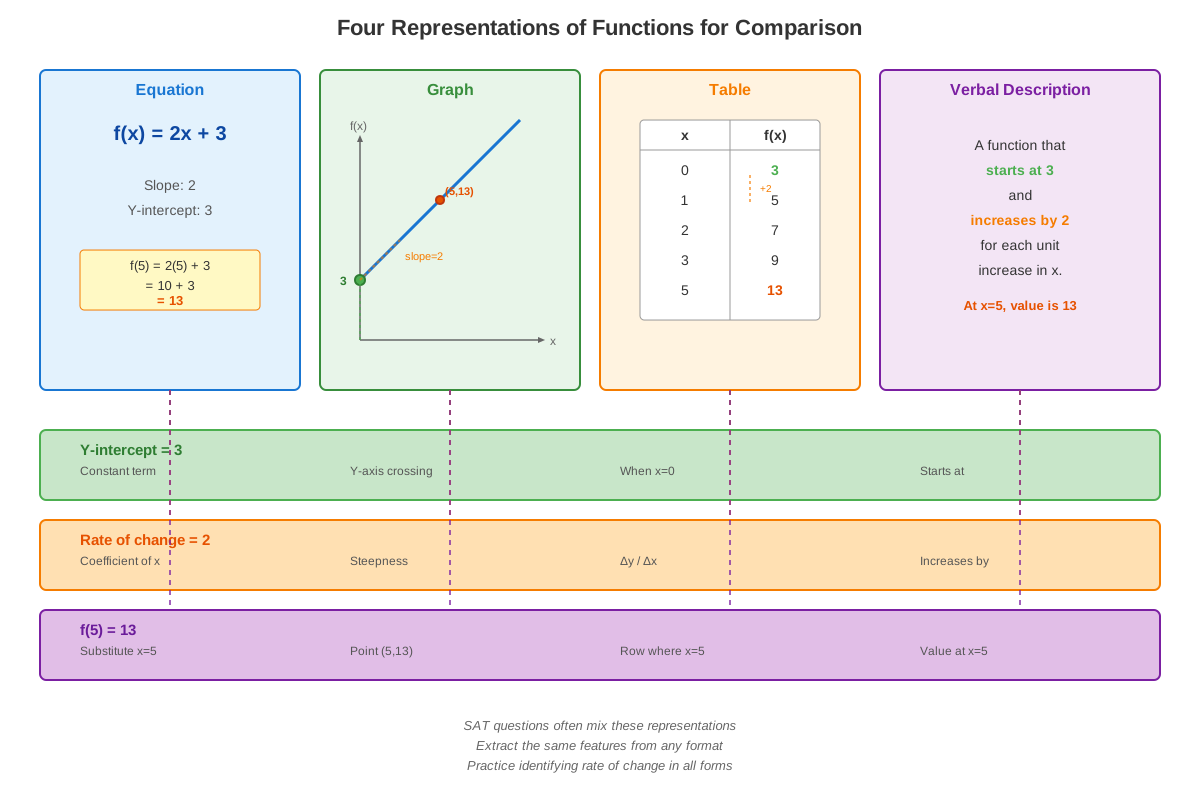
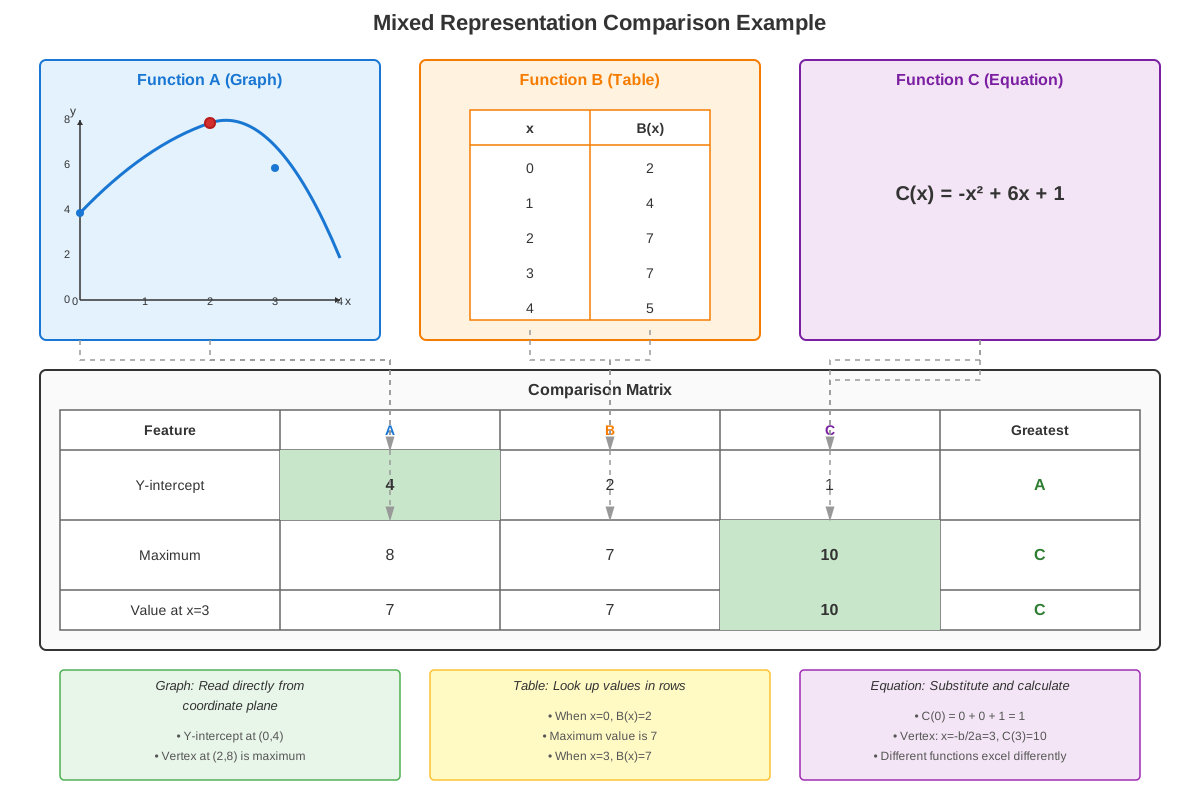
The SAT frequently presents comparing functions questions in formats that deliberately use different representations for each function being compared. For example, one function might be given as a graph while another appears as an equation or table. This intentional design tests whether students truly understand the underlying mathematical relationships rather than simply memorizing procedures. Success on these questions requires both conceptual understanding and the ability to extract key features from any representation quickly and accurately.
Mastery of comparing functions builds directly on foundational knowledge of linear and nonlinear functions, rates of change, and coordinate geometry. This topic connects to broader SAT math concepts including systems of equations, modeling real-world scenarios, and interpreting data from multiple sources. Students who excel at comparing functions demonstrate mathematical flexibility and analytical thinking—skills that appear throughout the entire math section and are essential for achieving top scores.
Learning Objectives
- [ ] Identify key features of comparing functions including rates of change, intercepts, maxima, and minima
- [ ] Explain how comparing functions appears on the SAT across different question formats and difficulty levels
- [ ] Apply comparing functions to answer SAT-style questions involving multiple representations
- [ ] Extract equivalent information from equations, graphs, tables, and verbal descriptions of functions
- [ ] Determine which function has greater values over specific intervals or domains
- [ ] Analyze the behavior of multiple functions to identify intersection points and relative growth rates
- [ ] Synthesize information from mixed representations to make accurate comparisons
Prerequisites
- Linear functions and slope: Understanding rate of change is fundamental to comparing how quickly functions increase or decrease
- Function notation and evaluation: Students must be able to find f(x) values from any representation to make direct comparisons
- Coordinate plane interpretation: Reading and extracting information from graphs is essential since many comparison questions involve graphical representations
- Basic algebraic manipulation: Solving equations and isolating variables helps when comparing functions given in equation form
- Exponential and quadratic functions: Many SAT comparison questions involve nonlinear functions, requiring recognition of their characteristic behaviors
Why This Topic Matters
In real-world applications, comparing functions models countless practical scenarios: businesses comparing profit models, scientists analyzing competing theories with different data sets, or consumers choosing between pricing plans with different structures. The ability to analyze multiple options presented in different formats is a fundamental life skill that extends far beyond mathematics.
On the SAT, comparing functions questions appear in both the calculator and no-calculator sections, typically accounting for 3-5 questions per test. These questions often appear as medium-to-hard difficulty problems, making them crucial for students aiming for scores above 650. The College Board frequently uses this topic to test mathematical reasoning rather than computational skill, making it a high-yield area for strategic preparation.
Common SAT question formats include: comparing linear and exponential growth over time, determining which function has a greater average rate of change over an interval, identifying which function reaches a specific value first, comparing y-intercepts or x-intercepts when functions are given in different forms, and analyzing which function better models a real-world scenario based on given constraints. Questions often embed comparisons within word problems about business, science, or social science contexts, requiring students to translate verbal descriptions into mathematical analysis.
Core Concepts
Understanding Function Representations
The foundation of sat comparing functions problems lies in recognizing that the same function can be represented in multiple ways: algebraically (as an equation), graphically (as a curve or line on a coordinate plane), numerically (as a table of values), or verbally (as a written description). Each representation highlights different features, and SAT questions deliberately mix representations to test deep understanding.
When comparing functions given as equations, students must identify key features algebraically. For linear functions in the form y = mx + b, the slope m represents the rate of change and b represents the y-intercept. For exponential functions like y = a(b)^x, the base b determines the growth or decay rate, while a represents the initial value. Quadratic functions in the form y = ax² + bx + c reveal their y-intercept directly as c, while the vertex and axis of symmetry require additional calculation.
When comparing functions given as graphs, students must extract numerical information from visual representations. The y-intercept is where the curve crosses the y-axis (when x = 0). The rate of change for linear functions is the slope, calculated by rise over run between any two points. For nonlinear functions, the average rate of change over an interval [a, b] is calculated as [f(b) - f(a)] / (b - a). Maximum and minimum values can be read directly from the highest and lowest points on the graph within the relevant domain.
When comparing functions given as tables, students must calculate rates of change between consecutive points and identify patterns. For linear functions, the rate of change remains constant between all pairs of points. For exponential functions, the ratio between consecutive y-values remains constant. Students should check multiple intervals to confirm the function type and calculate average rates of change over specified intervals.
Key Features for Comparison
Y-intercepts represent the starting value or initial condition of a function when x = 0. On the SAT, questions frequently ask which function has a greater y-intercept when functions are given in different forms. From an equation in slope-intercept form (y = mx + b), the y-intercept is b. From a graph, it's where the curve crosses the y-axis. From a table, it's the y-value when x = 0 (if that point is included). From a verbal description, look for phrases like "initial value," "starting amount," or "when x is zero."
Rates of change measure how quickly a function's output changes relative to its input. For linear functions, this is the constant slope. For nonlinear functions, the rate of change varies, so SAT questions typically ask about the average rate of change over a specific interval. The formula is:
Average Rate of Change = [f(b) - f(a)] / (b - a)This calculation works regardless of the function's representation—simply find the y-values at the endpoints of the interval and apply the formula.
Maximum and minimum values are critical for comparing functions over bounded domains. A function's maximum is its highest output value, while its minimum is its lowest output value. For linear functions on unbounded domains, there typically are no maxima or minima (the function continues indefinitely). For quadratic functions, the vertex represents either a maximum (if the parabola opens downward) or minimum (if it opens upward). When comparing functions, students must pay careful attention to the specified domain, as a function might have a maximum value over a restricted interval even if it continues indefinitely beyond that interval.
Comparing Across Different Function Types
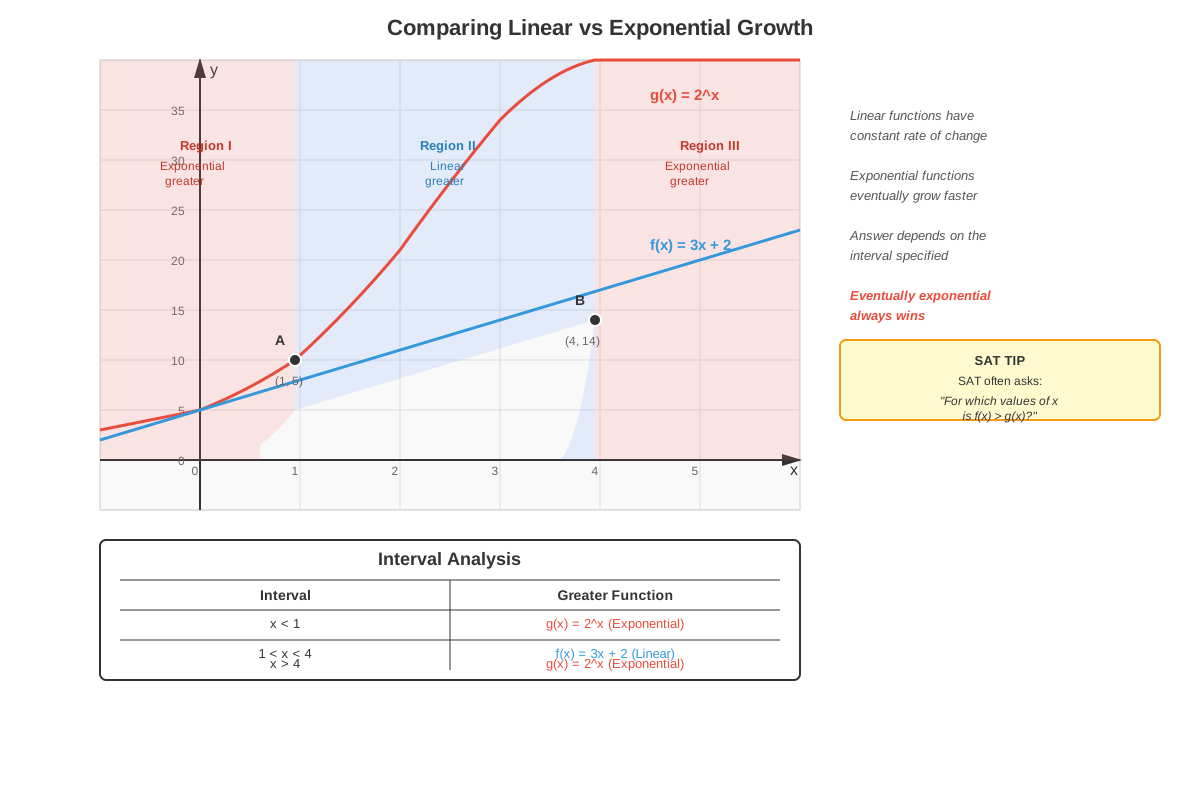
When comparing linear and exponential functions, a crucial concept is that exponential functions eventually exceed linear functions, regardless of their initial values or the linear function's slope. However, over limited intervals, the linear function might have greater values. SAT questions exploit this by asking about comparisons over specific domains. Students must evaluate both functions at key points within the given interval rather than making assumptions about long-term behavior.
When comparing two linear functions, the comparison reduces to examining slopes and y-intercepts. If one function has both a greater slope and a greater y-intercept, it will always be greater than the other. If one has a greater slope but smaller y-intercept (or vice versa), the functions will intersect at some point, and which function is greater depends on the x-value being considered.
When comparing quadratic functions, students must consider the vertex location, direction of opening (upward or downward), and the width of the parabola. Two parabolas might intersect at zero, one, or two points. The comparison of their values depends on the specific x-values being examined and requires careful analysis of their equations or graphs.
Intersection Points and Intervals
Functions are equal at their intersection points, where their output values are identical for the same input. To find intersection points algebraically, set the two function equations equal and solve for x. Graphically, intersection points are where the curves cross. These points are crucial for comparison questions because they mark where one function transitions from being greater to being less than the other.
When asked which function is greater over an interval, students should:
- Identify any intersection points within the interval
- Test values in each sub-interval created by intersection points
- Consider the endpoints of the interval
- Account for the behavior of each function type (increasing, decreasing, constant)
Concept Relationships
The core concepts within comparing functions build upon each other in a logical progression. Understanding function representations → enables extraction of key features → which allows for meaningful comparisons → leading to analysis of intersection points and intervals → culminating in the ability to determine which function is greater under specific conditions.
Comparing functions connects directly to prerequisite knowledge of linear functions (providing the foundation for understanding constant rates of change), exponential functions (introducing variable rates of change), and coordinate geometry (enabling graphical interpretation). This topic also links forward to systems of equations (where intersection points represent solutions), optimization problems (where maximum and minimum values become decision criteria), and mathematical modeling (where choosing between competing models requires comparison skills).
The relationship between different representations forms a cycle: equations can be graphed, graphs can be converted to tables, tables can reveal patterns that lead to equations, and all forms can be described verbally. Mastery requires moving fluidly around this cycle, extracting the same information regardless of starting point. This flexibility is precisely what SAT questions test through mixed-representation problems.
High-Yield Facts
- ⭐ When comparing functions given in different representations, convert key features (y-intercept, rate of change) to numerical values before making comparisons
- ⭐ The average rate of change formula [f(b) - f(a)] / (b - a) works for any function type and any representation
- ⭐ Exponential functions eventually exceed linear functions, but not necessarily over short intervals
- ⭐ For linear functions in y = mx + b form, m is the rate of change and b is the y-intercept
- ⭐ Intersection points mark where one function transitions from being greater to less than another function
- The y-intercept is always the function's value when x = 0, regardless of representation
- For tables showing linear functions, the rate of change is constant between all consecutive points
- For tables showing exponential functions, the ratio between consecutive y-values is constant
- A function can have a maximum or minimum over a restricted domain even if it continues indefinitely
- When comparing at a specific x-value, simply evaluate both functions at that point and compare the results
- The slope of a line on a graph can be calculated using any two points: (y₂ - y₁) / (x₂ - x₁)
- Quadratic functions in vertex form y = a(x - h)² + k have their vertex at (h, k)
- If two linear functions have the same slope but different y-intercepts, they are parallel and never intersect
Quick check — test yourself on Comparing functions so far.
Try Flashcards →Common Misconceptions
Misconception: A function with a greater y-intercept is always greater than another function for all x-values. → Correction: The y-intercept only tells you which function is greater at x = 0. Functions with different rates of change will intersect, and which is greater depends on the specific x-value being examined.
Misconception: Exponential functions are always greater than linear functions. → Correction: While exponential functions eventually exceed linear functions, over limited intervals (especially for small x-values), the linear function may be greater. Always check the specific domain given in the question.
Misconception: The rate of change and slope are different concepts. → Correction: For linear functions, the rate of change and slope are identical—both measure the constant change in y per unit change in x. For nonlinear functions, "rate of change" typically refers to the average rate of change over an interval.
Misconception: If a table shows a function increasing, it must be exponential. → Correction: Both linear and exponential functions can increase. Linear functions increase by adding a constant amount, while exponential functions increase by multiplying by a constant factor. Check whether consecutive differences (linear) or consecutive ratios (exponential) are constant.
Misconception: When comparing functions at x = 5, you need to know the entire function equation. → Correction: You only need to determine each function's value at x = 5. This can be done by reading a graph, finding x = 5 in a table, or substituting x = 5 into an equation. The comparison requires only these two values.
Misconception: A steeper line on a graph always represents a greater function. → Correction: Steepness (slope) indicates a greater rate of change, not necessarily greater values. A line with a smaller slope but larger y-intercept can have greater values than a steeper line, depending on the x-value being considered.
Misconception: Maximum and minimum values are always at the endpoints of an interval. → Correction: For linear functions, extrema occur at endpoints. However, for quadratic and other nonlinear functions, the maximum or minimum might occur at an interior point (like the vertex of a parabola).
Worked Examples
Example 1: Comparing Linear Functions in Different Representations
Problem: Function f is defined by f(x) = 3x + 5. Function g is represented by the graph of a line passing through points (0, 8) and (2, 10). Which function has a greater rate of change?
Solution:
Step 1: Identify the rate of change for function f.
Since f(x) = 3x + 5 is in slope-intercept form (y = mx + b), the rate of change (slope) is the coefficient of x, which is 3.
Step 2: Calculate the rate of change for function g from the graph.
Using the two given points (0, 8) and (2, 10), apply the slope formula:
Rate of change = (y₂ - y₁) / (x₂ - x₁) = (10 - 8) / (2 - 0) = 2 / 2 = 1
Step 3: Compare the rates of change.
Function f has a rate of change of 3, while function g has a rate of change of 1.
Therefore, function f has a greater rate of change.
Connection to Learning Objectives: This example demonstrates extracting key features from different representations (equation and graph) and applying comparison skills to determine which function changes more rapidly.
Example 2: Comparing Linear and Exponential Functions Over an Interval
Problem: Function h is defined by h(x) = 10x + 20. Function k is defined by k(x) = 5(2)^x. Over the interval 0 ≤ x ≤ 3, which function has the greater average rate of change?
Solution:
Step 1: Calculate the average rate of change for function h over [0, 3].
Find h(0): h(0) = 10(0) + 20 = 20
Find h(3): h(3) = 10(3) + 20 = 30
Average rate of change = [h(3) - h(0)] / (3 - 0) = (30 - 20) / 3 = 10/3 ≈ 3.33
Step 2: Calculate the average rate of change for function k over [0, 3].
Find k(0): k(0) = 5(2)^0 = 5(1) = 5
Find k(3): k(3) = 5(2)^3 = 5(8) = 40
Average rate of change = [k(3) - k(0)] / (3 - 0) = (40 - 5) / 3 = 35/3 ≈ 11.67
Step 3: Compare the average rates of change.
Function h has an average rate of change of approximately 3.33, while function k has an average rate of change of approximately 11.67 over the interval [0, 3].
Therefore, function k has the greater average rate of change over this interval.
Connection to Learning Objectives: This example shows how to apply the average rate of change formula to both linear and exponential functions, demonstrating that even though linear functions have constant rates of change, an exponential function can have a greater average rate over a specific interval.
Example 3: Comparing Functions Using a Table and Equation
Problem: Function m is represented by the table below. Function n is defined by n(x) = -2x + 15. For what value of x do the functions have the same value?
| x | m(x) |
|---|---|
| 0 | 3 |
| 1 | 6 |
| 2 | 9 |
| 3 | 12 |
Solution:
Step 1: Determine the equation for function m from the table.
Check if m is linear by examining if the rate of change is constant:
From x = 0 to x = 1: (6 - 3) / (1 - 0) = 3
From x = 1 to x = 2: (9 - 6) / (2 - 1) = 3
From x = 2 to x = 3: (12 - 9) / (3 - 2) = 3
The rate of change is constant at 3, so m is linear with slope 3.
The y-intercept is 3 (when x = 0, m(x) = 3).
Therefore, m(x) = 3x + 3.
Step 2: Set the two functions equal to find where they intersect.
m(x) = n(x)
3x + 3 = -2x + 15
Step 3: Solve for x.
3x + 2x = 15 - 3
5x = 12
x = 12/5 = 2.4
Connection to Learning Objectives: This example demonstrates converting a table to an equation, then using algebraic methods to find intersection points where functions have equal values.
Exam Strategy
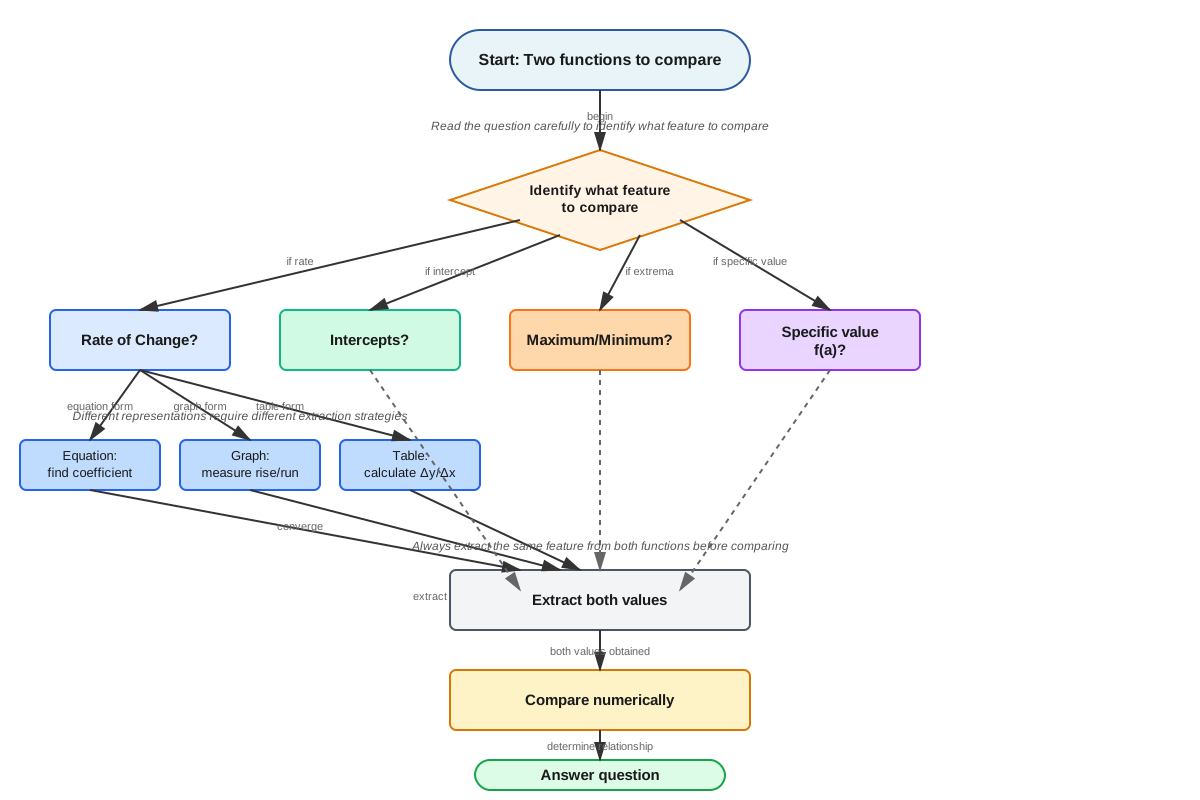
When approaching SAT comparing functions questions, begin by identifying what feature is being compared: y-intercept, rate of change, maximum/minimum value, or function value at a specific point. This focus prevents wasting time extracting irrelevant information from the given representations.
Trigger words to watch for include: "greater rate of change" (calculate slopes or average rates of change), "initial value" or "y-intercept" (find the value when x = 0), "over the interval" (calculate average rate of change using endpoints), "maximum value" (find the highest point in the given domain), and "same value" or "equal" (find intersection points).
For process of elimination, when comparing two functions and answer choices give specific numerical comparisons, test the boundary cases first. If asked which function is greater over an interval, check the endpoints and any obvious interior points (like x = 0 or intersection points). Eliminate answers that contradict these test values. When answer choices describe relationships (like "Function A is always greater"), look for a single counterexample to eliminate that choice.
Time allocation for these questions should be approximately 1-2 minutes. If a question requires extensive calculation, consider whether there's a more efficient approach—SAT questions usually have elegant solutions. If comparing functions given as graphs, extract numerical information quickly by reading coordinates directly rather than trying to derive equations. If stuck, mark the question and return to it after completing easier problems.
When functions are given in different representations, standardize by converting to the same form if time permits, or simply extract the specific feature being compared. For example, if comparing y-intercepts, you don't need to know the entire equation—just find where each function crosses the y-axis.
Memory Techniques
RICE - Remember the key features to compare:
- Rate of change (slope for linear, average rate for intervals)
- Intercepts (especially y-intercept at x = 0)
- Crossing points (intersections where functions are equal)
- Extrema (maximum and minimum values)
"Every Line Eventually Loses" - Exponential functions eventually exceed linear functions, but not necessarily over short intervals. This reminds students to check the specific domain given in the question.
"Table to Equation: Differences for Lines, Ratios for Exponential" - When analyzing tables, check if consecutive y-value differences are constant (linear) or consecutive y-value ratios are constant (exponential).
Visualization strategy: When comparing functions, sketch a quick mental or physical graph showing the key features. Even rough sketches help visualize which function is greater over different intervals and where they might intersect.
The "Zero Test": When comparing y-intercepts, always think "what happens at x = 0?" This simple question works regardless of how the function is represented.
Summary
Comparing functions is a high-yield SAT math topic that tests students' ability to analyze multiple function representations simultaneously and identify relationships between key features. Success requires fluency in extracting information from equations, graphs, tables, and verbal descriptions, then making accurate comparisons of rates of change, intercepts, maximum and minimum values, and function values at specific points. The SAT deliberately presents functions in different formats to test conceptual understanding rather than procedural memorization. Students must recognize that while exponential functions eventually exceed linear functions, the comparison over limited intervals depends on specific values and requires calculation rather than assumption. The average rate of change formula provides a universal tool for comparing how quickly functions change over intervals, regardless of function type. Intersection points mark critical transitions where one function becomes greater than another. Mastery of this topic requires both computational accuracy and strategic thinking about which features matter for each specific comparison question.
Key Takeaways
- Functions can be represented as equations, graphs, tables, or verbal descriptions—SAT questions mix these formats to test deep understanding
- The average rate of change formula [f(b) - f(a)] / (b - a) works universally for comparing how quickly functions change over intervals
- Y-intercepts, rates of change, and maximum/minimum values are the most commonly compared features on the SAT
- Exponential functions eventually exceed linear functions, but not necessarily over short intervals—always check the specified domain
- Intersection points mark where functions have equal values and where one transitions from being greater to less than another
- Extract only the specific feature being compared rather than deriving complete equations for both functions
- When functions are given in different representations, convert key features to numerical values before comparing
Related Topics
Systems of Equations: Comparing functions naturally extends to solving systems, where intersection points represent simultaneous solutions. Mastering function comparison provides the conceptual foundation for understanding why systems have zero, one, or multiple solutions.
Function Transformations: Understanding how functions shift, stretch, and reflect helps predict how transformations affect comparisons. A vertical shift changes y-intercepts, while a vertical stretch affects rates of change.
Modeling with Functions: Real-world SAT problems often require choosing which function better models a scenario, requiring comparison of how well different functions fit given constraints and data points.
Polynomial Functions: Extending comparison skills to higher-degree polynomials involves analyzing multiple turning points, end behavior, and more complex intersection patterns.
Practice CTA
Now that you've mastered the core concepts of comparing functions, it's time to solidify your understanding through practice. Attempt the practice questions to apply these strategies to SAT-style problems, and use the flashcards to reinforce key features and formulas. Remember, comparing functions appears on virtually every SAT, making this one of the highest-yield topics for your preparation. Each practice problem you complete builds the pattern recognition and analytical skills that will help you work quickly and accurately on test day. You've got this!
Sign up free to keep reading
Create a free AnvayaPrep account to finish this SAT guide on Comparing functions — plus flashcards and practice questions.