Overview
Function transformations represent one of the most frequently tested concepts in SAT math, appearing in approximately 10-15% of all function-related questions on the exam. Understanding how functions shift, stretch, compress, and reflect on the coordinate plane is essential for success on both the calculator and no-calculator portions of the test. These transformations allow students to predict how changes to a function's equation will affect its graph, and conversely, how to write equations that match transformed graphs.
The SAT tests function transformations through multiple question formats: identifying transformed graphs, writing equations for transformed functions, determining specific coordinate changes, and analyzing real-world scenarios where transformations model practical situations. Mastery of this topic provides a foundation for understanding more complex function behavior, including polynomial, exponential, and trigonometric functions that appear throughout the exam.
Function transformations connect directly to coordinate geometry, algebraic manipulation, and problem-solving strategies that extend beyond functions alone. Students who thoroughly understand transformations gain powerful tools for visualizing mathematical relationships and can often solve complex problems more efficiently by recognizing transformation patterns rather than performing lengthy calculations. This topic bridges algebraic and geometric thinking, making it a cornerstone of the SAT Math section's emphasis on multiple representations of mathematical concepts.
Learning Objectives
- [ ] Identify key features of function transformations including translations, reflections, stretches, and compressions
- [ ] Explain how function transformations appears on the SAT through graph analysis, equation manipulation, and coordinate prediction
- [ ] Apply function transformations to answer SAT-style questions involving multiple transformation types
- [ ] Determine the equation of a transformed function given its parent function and transformation description
- [ ] Predict the coordinates of specific points after one or more transformations have been applied
- [ ] Distinguish between transformations that affect the input (x-values) versus the output (y-values)
- [ ] Combine multiple transformations in the correct order to achieve a desired result
Prerequisites
- Basic function notation: Understanding f(x) notation is essential because transformations are written as modifications to this notation (e.g., f(x+2) or 2f(x))
- Coordinate plane familiarity: Students must be able to plot points and visualize how coordinates change, as transformations move points systematically across the plane
- Parent function graphs: Recognition of basic function shapes (linear, quadratic, absolute value, exponential) provides the baseline for identifying how transformations alter these graphs
- Algebraic substitution: The ability to substitute values and simplify expressions enables students to calculate transformed coordinates and verify transformation effects
Why This Topic Matters
Function transformations appear in real-world applications across multiple disciplines. Engineers use transformations to model how systems respond to changes in input parameters. Economists apply transformations when adjusting data for inflation or scaling economic models. Medical researchers use transformations to normalize data sets and compare results across different scales. Understanding transformations provides a mathematical framework for analyzing how changes in one variable systematically affect another.
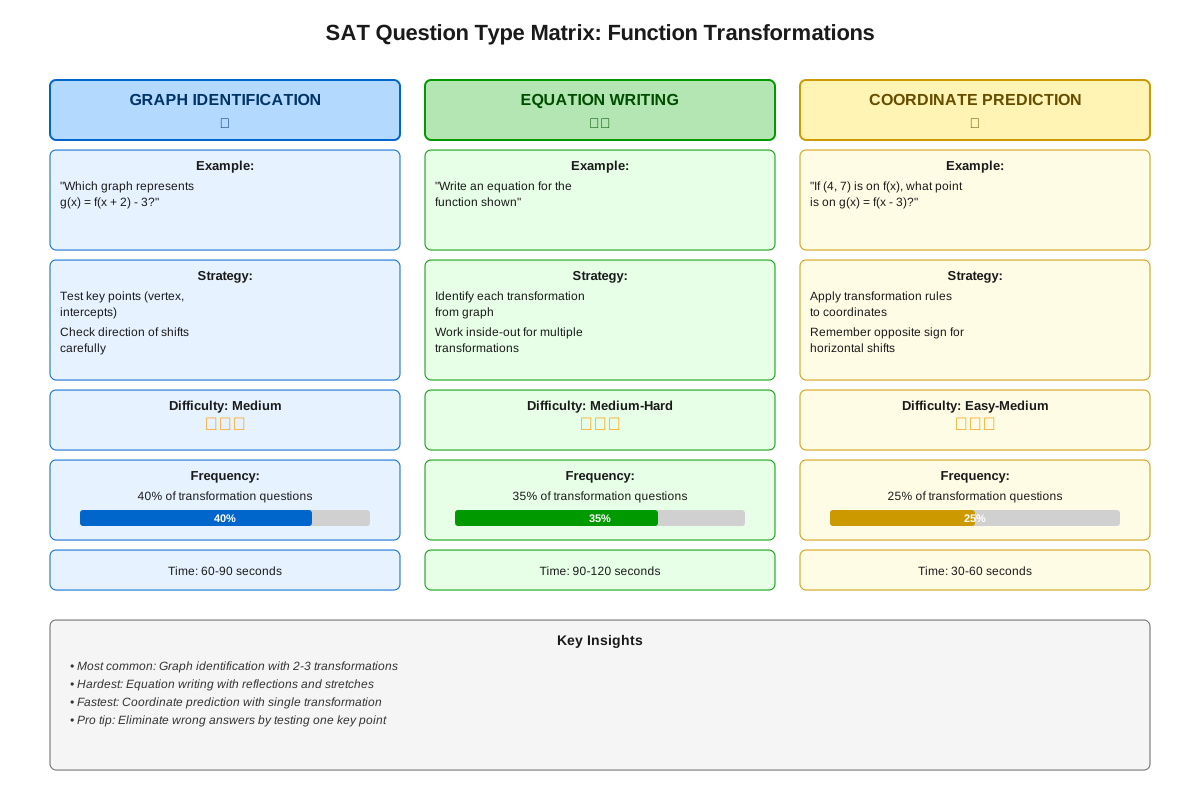
On the SAT, function transformations appear in approximately 3-5 questions per test, making them a high-yield topic for focused study. Questions typically fall into three categories: graph identification (matching transformed graphs to equations), coordinate prediction (determining where specific points move after transformation), and equation writing (creating equations for transformed functions). The College Board frequently combines transformations with other topics like quadratic functions, absolute value functions, and real-world modeling scenarios.
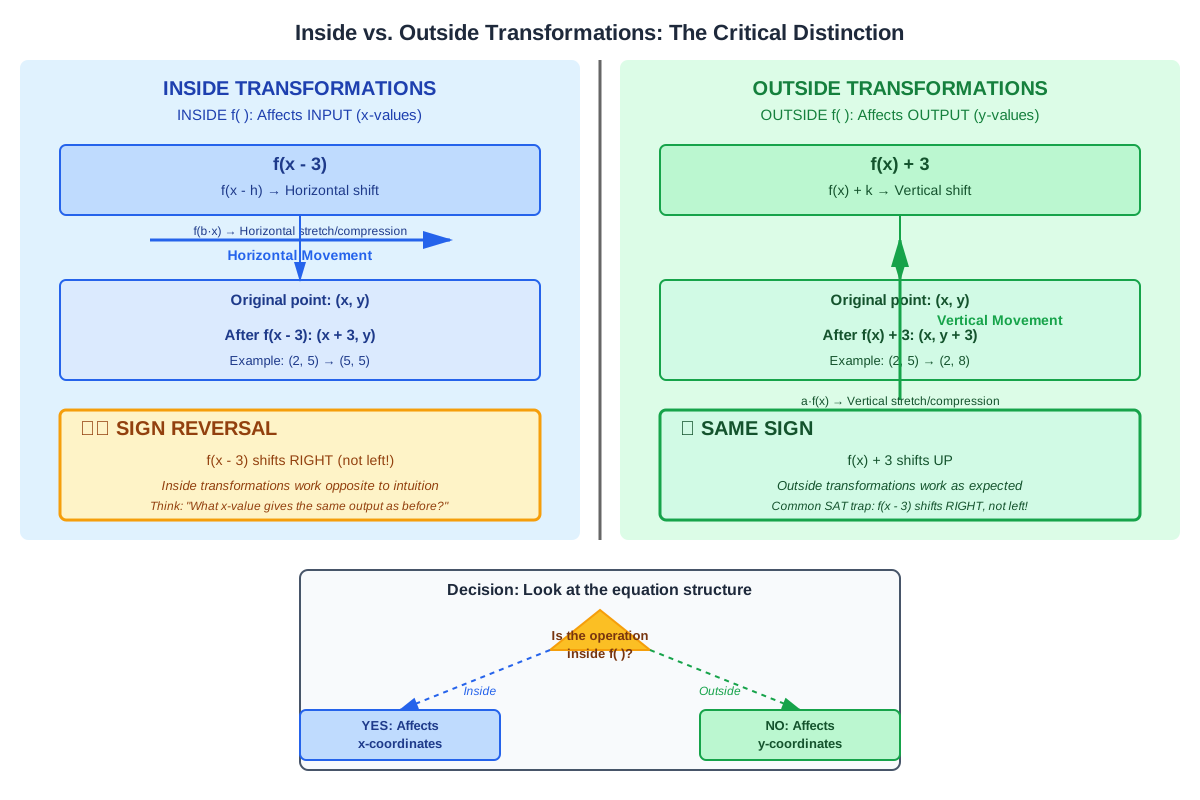
The SAT particularly favors questions that test whether students understand the difference between transformations inside the function (affecting x-values) versus outside the function (affecting y-values). This distinction trips up many test-takers and represents a key discriminator between average and high-scoring students. Additionally, questions often present transformations in context, requiring students to translate verbal descriptions into mathematical operations—a skill that demonstrates both conceptual understanding and practical application ability.
Core Concepts
Vertical Translations
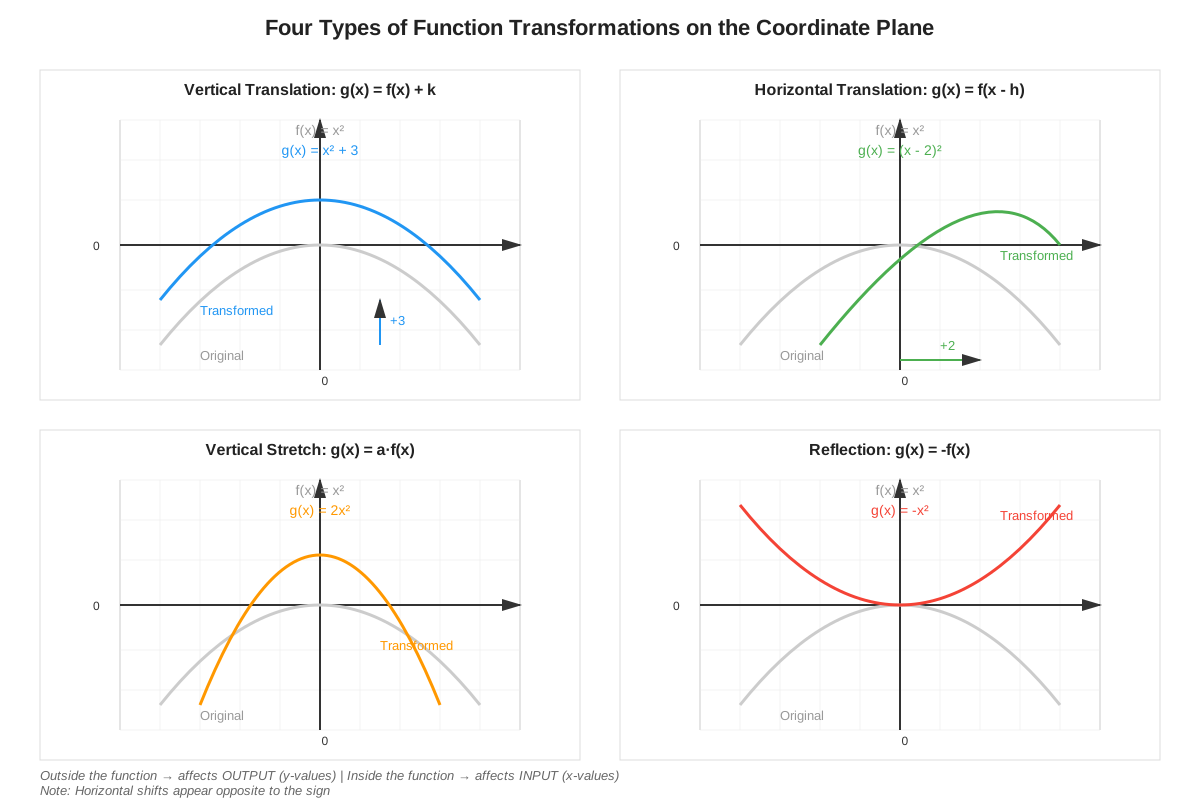
A vertical translation shifts a function up or down on the coordinate plane without changing its shape. When a constant is added to or subtracted from the entire function, every point on the graph moves vertically by that amount. The transformation takes the form g(x) = f(x) + k, where k represents the vertical shift.
If k is positive, the graph shifts upward by k units. If k is negative, the graph shifts downward by |k| units. For example, if f(x) = x², then g(x) = x² + 3 shifts the parabola up 3 units, while h(x) = x² - 2 shifts it down 2 units. Every point (a, b) on the original function becomes (a, b + k) on the transformed function.
Horizontal Translations
A horizontal translation shifts a function left or right on the coordinate plane. This transformation occurs when a constant is added to or subtracted from the input variable before the function is applied. The form is g(x) = f(x - h), where h represents the horizontal shift.
Crucially, the direction of horizontal shifts appears counterintuitive to many students: f(x - h) shifts the graph h units to the right, while f(x + h) shifts it h units to the left. This occurs because the transformation affects the input—to maintain the same output value, the input must change in the opposite direction. For instance, if f(x) = x², then g(x) = (x - 4)² shifts the parabola 4 units right, while h(x) = (x + 2)² shifts it 2 units left. Every point (a, b) becomes (a + h, b) when using the f(x - h) notation.
Vertical Stretches and Compressions
Vertical stretches and compressions change the steepness or height of a function by multiplying the output by a constant factor. The transformation takes the form g(x) = a · f(x), where a is the stretch/compression factor.
When |a| > 1, the function undergoes a vertical stretch, making it taller and steeper. When 0 < |a| < 1, the function experiences a vertical compression, making it shorter and flatter. For example, if f(x) = x², then g(x) = 3x² stretches the parabola vertically by a factor of 3, while h(x) = (1/2)x² compresses it to half its original height. Every point (a, b) becomes (a, ab) under this transformation. The x-intercepts remain unchanged because multiplying zero by any factor still yields zero.
Horizontal Stretches and Compressions
Horizontal stretches and compressions change the width of a function by multiplying the input by a constant factor. The transformation is written as g(x) = f(bx), where b is the stretch/compression factor.
When |b| > 1, the function undergoes a horizontal compression, making it narrower. When 0 < |b| < 1, the function experiences a horizontal stretch, making it wider. This direction also appears counterintuitive: larger values of b compress the graph, while smaller values stretch it. For instance, if f(x) = x², then g(x) = (2x)² compresses the parabola horizontally by a factor of 1/2, while h(x) = (x/2)² stretches it horizontally by a factor of 2. Every point (a, b) becomes (a/b, b) under this transformation. The y-intercept remains unchanged.
Reflections Across the X-Axis
A reflection across the x-axis flips a function upside down, creating a mirror image below the horizontal axis. This transformation is written as g(x) = -f(x), where the negative sign multiplies the entire output.
Every point (a, b) on the original function becomes (a, -b) on the reflected function. Positive y-values become negative, and negative y-values become positive. For example, if f(x) = x² has a minimum point at (0, 0) and passes through (2, 4), then g(x) = -x² has a maximum point at (0, 0) and passes through (2, -4). This reflection is particularly important for understanding how parabolas can open downward and how absolute value functions can form inverted V-shapes.
Reflections Across the Y-Axis
A reflection across the y-axis flips a function horizontally, creating a mirror image across the vertical axis. This transformation is written as g(x) = f(-x), where the negative sign is applied to the input variable.
Every point (a, b) on the original function becomes (-a, b) on the reflected function. Points on the right side of the y-axis move to the left side, and vice versa. For example, if f(x) = 2^x passes through (1, 2) and (2, 4), then g(x) = 2^(-x) passes through (-1, 2) and (-2, 4). Functions that are symmetric about the y-axis (even functions) remain unchanged under this transformation.
Combining Multiple Transformations
The SAT frequently tests the ability to apply multiple transformations in sequence. The order of operations matters significantly when combining transformations. The general form for a fully transformed function is:
g(x) = a · f(b(x - h)) + k
Where:
- h represents horizontal translation (right if positive)
- k represents vertical translation (up if positive)
- a represents vertical stretch/compression and x-axis reflection
- b represents horizontal stretch/compression and y-axis reflection
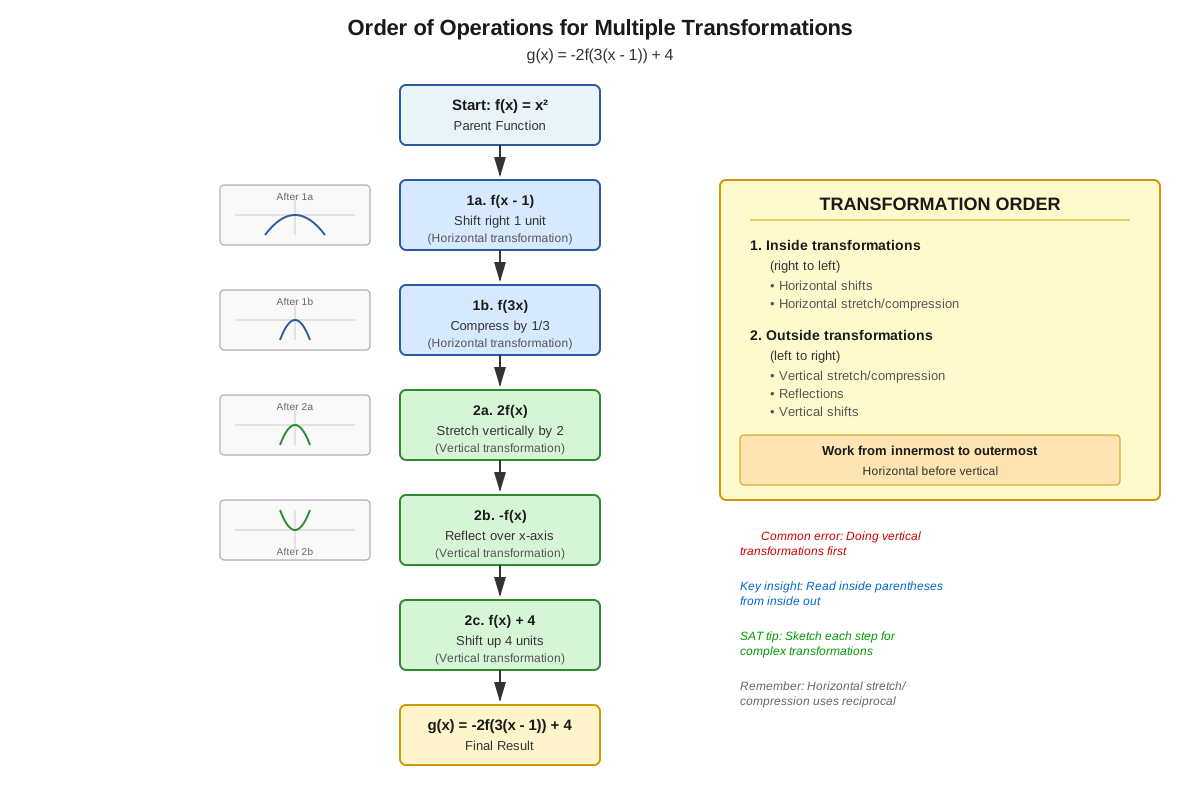
To apply multiple transformations correctly, work from the inside out: first apply transformations to x (horizontal shifts, stretches, reflections), then apply transformations to the entire function (vertical stretches, reflections, shifts). For example, to transform f(x) = x² into g(x) = -2(x + 3)² - 1, the sequence is: shift left 3 units, stretch vertically by factor of 2, reflect across x-axis, shift down 1 unit.
Transformation Summary Table
| Transformation Type | Notation | Effect on Point (a, b) | Direction Note | ||
|---|---|---|---|---|---|
| Vertical translation up | f(x) + k | (a, b + k) | Intuitive: + means up | ||
| Vertical translation down | f(x) - k | (a, b - k) | Intuitive: - means down | ||
| Horizontal translation right | f(x - h) | (a + h, b) | Counterintuitive: - means right | ||
| Horizontal translation left | f(x + h) | (a - h, b) | Counterintuitive: + means left | ||
| Vertical stretch | a·f(x), \ | a\ | > 1 | (a, ab) | Multiplies y-coordinate |
| Vertical compression | a·f(x), 0 < \ | a\ | < 1 | (a, ab) | Multiplies y-coordinate |
| Horizontal compression | f(bx), \ | b\ | > 1 | (a/b, b) | Divides x-coordinate |
| Horizontal stretch | f(bx), 0 < \ | b\ | < 1 | (a/b, b) | Divides x-coordinate |
| Reflection over x-axis | -f(x) | (a, -b) | Negates y-coordinate | ||
| Reflection over y-axis | f(-x) | (-a, b) | Negates x-coordinate |
Concept Relationships
Function transformations build upon each other in a hierarchical structure. Translations (both vertical and horizontal) represent the simplest transformations, moving functions without changing their shape or orientation. These serve as the foundation for understanding more complex transformations.
Stretches and compressions add complexity by changing the scale of functions while maintaining their basic shape and orientation. Vertical stretches/compressions connect directly to vertical translations because both affect y-values, though in different ways. Similarly, horizontal stretches/compressions relate to horizontal translations through their shared impact on x-values.
Reflections represent a special case of stretches where the stretch factor is -1, creating the unique property of flipping the function across an axis. Understanding reflections requires solid grasp of both coordinate plane geometry and the distinction between input and output transformations.
The relationship map flows as follows:
Parent Function → Horizontal Transformations (shifts, stretches, reflections applied to x) → Vertical Transformations (stretches, reflections applied to f(x)) → Vertical Shifts (added to entire function) → Fully Transformed Function
This sequence matters because transformations applied in different orders can produce different results. The SAT exploits this by presenting questions where students must either apply transformations in the correct sequence or work backward from a transformed function to identify the original.
Function transformations also connect to the prerequisite topic of parent functions by providing a systematic method for generating entire families of related functions from a single basic form. They extend to future topics including trigonometric transformations (amplitude, period, phase shift), exponential growth and decay (scaling and shifting), and polynomial behavior (understanding how leading coefficients affect graph shape).
Quick check — test yourself on Function transformations so far.
Try Flashcards →High-Yield Facts
⭐ Horizontal transformations affect the input (x) and work opposite to intuition: f(x - 3) shifts RIGHT 3 units, f(x + 3) shifts LEFT 3 units
⭐ Vertical transformations affect the output (y) and work intuitively: f(x) + 3 shifts UP 3 units, f(x) - 3 shifts DOWN 3 units
⭐ The coefficient a in a·f(x) causes vertical stretch if |a| > 1 and vertical compression if 0 < |a| < 1
⭐ The coefficient b in f(bx) causes horizontal compression if |b| > 1 and horizontal stretch if 0 < |b| < 1 (opposite of vertical)
⭐ Reflections occur when the stretch factor is negative: -f(x) reflects over x-axis, f(-x) reflects over y-axis
- X-intercepts remain unchanged under vertical stretches, compressions, and reflections across the x-axis
- Y-intercepts remain unchanged under horizontal stretches, compressions, and reflections across the y-axis
- The order of transformations matters: apply horizontal transformations before vertical transformations when working inside-out from the function notation
- Multiple transformations can be combined in the form g(x) = a·f(b(x - h)) + k, where transformations are applied in the order: horizontal shift, horizontal stretch, vertical stretch, vertical shift
- Even functions (symmetric about y-axis) are unchanged by f(-x), while odd functions (symmetric about origin) satisfy f(-x) = -f(x)
- When a point (a, b) is on f(x), the point (a - h, ab + k) is on the transformed function g(x) = a·f(x + h) + k
- The vertex of a parabola in the form f(x) = a(x - h)² + k is located at (h, k), directly showing the horizontal and vertical translations
Common Misconceptions
Misconception: f(x + 3) shifts the graph 3 units to the right because the expression contains "+3"
Correction: f(x + 3) actually shifts the graph 3 units to the LEFT. The transformation affects the input, so to get the same output value, x must be 3 units smaller than before. Think of it as "x needs to be 3 less to produce the same result," which means moving left.
Misconception: Multiplying a function by 2 (creating 2f(x)) makes the graph twice as wide
Correction: Multiplying by 2 creates a vertical stretch, making the graph twice as TALL, not twice as wide. The graph becomes steeper and narrower-looking, but the actual width (horizontal extent) doesn't change. To make a graph wider, you need a horizontal stretch using f(x/2).
Misconception: The transformations in g(x) = -2(x + 1)² - 3 can be applied in any order
Correction: Transformations must be applied in a specific order to achieve the correct result. Following the inside-out rule: first shift left 1 unit (x + 1), then apply the vertical stretch by 2 and reflection over x-axis (the -2 coefficient), finally shift down 3 units (the -3 at the end).
Misconception: A negative sign always means a reflection
Correction: The location of the negative sign determines its effect. A negative sign multiplying the entire function (-f(x)) causes reflection over the x-axis. A negative sign inside the function (f(-x)) causes reflection over the y-axis. A negative sign in a translation (f(x - 3) or f(x) - 3) simply indicates direction, not reflection.
Misconception: If a point (2, 5) is on f(x), then the point (2, 10) is on 2f(x)
Correction: This is actually CORRECT, but students often doubt themselves. When multiplying the entire function by 2, the y-coordinate is multiplied by 2 while the x-coordinate stays the same. The misconception is doubting this straightforward relationship and overcomplicating the transformation.
Misconception: Horizontal and vertical stretches work the same way
Correction: These transformations work in opposite directions. For vertical stretches, a larger coefficient (like 3 in 3f(x)) makes the graph taller/steeper. For horizontal stretches, a larger coefficient (like 3 in f(3x)) makes the graph narrower/compressed. The coefficient b in f(bx) compresses by a factor of b, not stretches by a factor of b.
Worked Examples
Example 1: Multiple Transformations on a Quadratic Function
Problem: The function f(x) = x² has a point at (2, 4). The function g(x) = -2f(x + 1) + 3 is a transformation of f(x). What are the coordinates of the corresponding point on g(x)?
Solution:
Step 1: Identify all transformations in order (inside-out)
- f(x + 1): horizontal shift left 1 unit
- -2f(x + 1): vertical stretch by factor of 2 AND reflection over x-axis
- -2f(x + 1) + 3: vertical shift up 3 units
Step 2: Apply horizontal shift to the x-coordinate
- Original point: (2, 4)
- f(x + 1) shifts left 1: x-coordinate becomes 2 - 1 = 1
- After horizontal shift: (1, 4)
Step 3: Apply vertical stretch and reflection to the y-coordinate
- The coefficient -2 multiplies the y-coordinate
- New y-coordinate: 4 × (-2) = -8
- After stretch and reflection: (1, -8)
Step 4: Apply vertical shift to the y-coordinate
- Add 3 to the y-coordinate: -8 + 3 = -5
- Final point: (1, -5)
Answer: The corresponding point on g(x) is (1, -5)
Connection to Learning Objectives: This example demonstrates applying multiple transformations in the correct sequence and predicting coordinates after transformation, directly addressing the third and fifth learning objectives.
Example 2: Writing an Equation from a Transformation Description
Problem: The graph of f(x) = |x| is transformed by shifting it 4 units to the right, compressing it vertically by a factor of 1/2, and then shifting it down 2 units. Write the equation of the transformed function g(x).
Solution:
Step 1: Start with the parent function
- f(x) = |x|
Step 2: Apply the horizontal shift (affects the input)
- "4 units to the right" means we use (x - 4)
- After horizontal shift: f(x - 4) = |x - 4|
Step 3: Apply the vertical compression (affects the output)
- "Compress vertically by a factor of 1/2" means multiply by 1/2
- After compression: (1/2)f(x - 4) = (1/2)|x - 4|
Step 4: Apply the vertical shift (added to the entire function)
- "Shift down 2 units" means subtract 2
- After vertical shift: (1/2)f(x - 4) - 2 = (1/2)|x - 4| - 2
Answer: g(x) = (1/2)|x - 4| - 2
Verification: We can check by testing a point. The vertex of f(x) = |x| is at (0, 0). After shifting right 4, it moves to (4, 0). After compressing vertically by 1/2, it stays at (4, 0) because 0 × 1/2 = 0. After shifting down 2, it moves to (4, -2). Substituting x = 4 into our equation: g(4) = (1/2)|4 - 4| - 2 = 0 - 2 = -2 ✓
Connection to Learning Objectives: This example addresses the fourth learning objective of determining equations for transformed functions and demonstrates how to translate verbal descriptions into mathematical notation.
Exam Strategy
When approaching SAT function transformations questions, begin by identifying whether the question provides an equation and asks for the graph, or provides a graph and asks for the equation. This determines your strategy: forward application of transformations versus reverse engineering.
Trigger words and phrases to watch for include:
- "Shifted," "translated," or "moved" → indicates translation
- "Stretched," "compressed," "narrower," or "wider" → indicates stretch/compression
- "Reflected," "flipped," or "mirror image" → indicates reflection
- "Vertical" or "horizontal" → specifies which type of transformation
- "Factor of" → indicates the magnitude of stretch/compression
For graph identification questions, use the process of elimination strategically. First, check the easiest feature to identify: vertical shifts (look at y-intercepts or key points). Eliminate graphs that don't match. Next, check horizontal shifts (look at x-intercepts or vertex positions). Finally, verify stretches and reflections. This systematic approach prevents careless errors and saves time.
For coordinate prediction questions, write down the original point and apply transformations one at a time, updating the coordinates after each step. Don't try to do multiple transformations mentally—the SAT designs these questions to punish mental math errors. Show your work in the test booklet.
When writing equations, work inside-out from the function notation. Start with horizontal transformations (inside the function), then vertical transformations (multiplying the function), then vertical shifts (added to everything). Remember the counterintuitive nature of horizontal transformations: if the graph moves right, you subtract inside the function.
Time allocation: Most transformation questions should take 60-90 seconds. If you're spending more than 2 minutes, you may be overcomplicating the problem. Look for shortcuts: sometimes you can eliminate wrong answers by testing a single point rather than fully analyzing the transformation.
For questions combining transformations with other topics (like finding maximum values or solving equations), handle the transformation component first to simplify the function, then apply the additional concept. This sequential approach reduces cognitive load and minimizes errors.
Memory Techniques
Mnemonic for transformation order: "HSVS" - Horizontal Shift, Stretch/compression, Vertical shift
- Think: "Has Several Valuable Skills" to remember the inside-out order of operations
Acronym for horizontal transformation direction: "SOAP" - Subtract Opposite, Add Positive
- f(x - h): Subtract means Opposite direction (right)
- f(x + h): Add means Positive direction... wait, that's left! (The mnemonic reminds you it's opposite)
- Better version: "Subtract = Right" (just memorize this direct relationship)
Visualization for vertical vs. horizontal stretches:
- Vertical stretch: Imagine grabbing the top of the graph and pulling UP (makes it taller)
- Horizontal compression: Imagine pushing the sides of the graph TOGETHER (makes it narrower)
- Remember: larger coefficient in f(bx) = narrower graph (compression)
Reflection memory device: "Negative Outside = X-axis, Negative Inside = Y-axis"
- -f(x): negative is OUTSIDE the function, reflects over X-axis
- f(-x): negative is INSIDE the function, reflects over Y-axis
- Think: "OUT-X, IN-Y"
The "opposite rule" for horizontal transformations:
- Create a mental image of a function "chasing" its output
- If you add 3 to x (making x + 3), the function has to move LEFT to catch the same output value
- If you subtract 3 from x (making x - 3), the function has to move RIGHT to catch the same output value
Summary
Function transformations represent systematic changes to parent functions through translations, stretches, compressions, and reflections. Vertical transformations (affecting output) work intuitively: adding shifts up, multiplying by values greater than 1 stretches, and negative signs reflect over the x-axis. Horizontal transformations (affecting input) work counterintuitively: subtracting shifts right, multiplying by values greater than 1 compresses, and negative signs reflect over the y-axis. The SAT tests these concepts through graph matching, coordinate prediction, and equation writing, often combining multiple transformations in a single question. Success requires understanding the inside-out order of operations: horizontal shifts first, then stretches/compressions and reflections, finally vertical shifts. Students must distinguish between transformations that affect x-values versus y-values and recognize that the location of coefficients and constants in function notation directly determines the type and magnitude of transformation applied.
Key Takeaways
- Horizontal transformations (inside the function) work opposite to intuition: f(x - h) shifts RIGHT h units, while vertical transformations work intuitively: f(x) + k shifts UP k units
- The general transformation form g(x) = a·f(b(x - h)) + k contains all transformation types: h (horizontal shift), b (horizontal stretch/compression), a (vertical stretch/compression and x-axis reflection), k (vertical shift)
- Apply transformations in inside-out order: horizontal shifts, horizontal stretches, vertical stretches/reflections, vertical shifts—this sequence prevents errors when combining multiple transformations
- Vertical stretches/compressions multiply y-coordinates and are caused by coefficients outside the function (a·f(x)), while horizontal stretches/compressions divide x-coordinates and are caused by coefficients inside the function (f(bx))
- Reflections occur when stretch factors are negative: -f(x) reflects over the x-axis (flips vertically), while f(-x) reflects over the y-axis (flips horizontally)
- The SAT frequently tests whether students can distinguish between input transformations (affecting x) and output transformations (affecting y), making this distinction the highest-yield concept to master
- When predicting transformed coordinates, apply each transformation sequentially to avoid errors—write down intermediate results rather than attempting mental calculations
Related Topics
Quadratic Functions in Vertex Form: The equation f(x) = a(x - h)² + k directly incorporates function transformations, where (h, k) represents the vertex location through horizontal and vertical shifts, and a represents vertical stretch and potential reflection. Mastering transformations makes vertex form intuitive rather than formulaic.
Absolute Value Functions: These functions demonstrate transformations clearly because their V-shape makes shifts, stretches, and reflections visually obvious. Understanding transformations enables quick graphing of any absolute value function without plotting multiple points.
Exponential and Logarithmic Functions: These functions undergo the same transformation rules, with additional considerations for asymptotes that shift along with the function. Transformation mastery extends directly to these more advanced function types.
Trigonometric Functions: Sine and cosine transformations introduce amplitude (vertical stretch), period (horizontal stretch), phase shift (horizontal translation), and vertical shift—all direct applications of the transformation principles learned here.
Piecewise Functions: Understanding how transformations affect individual pieces of piecewise functions requires solid grasp of transformation fundamentals, as each piece transforms independently while maintaining continuity conditions.
Practice CTA
Now that you've mastered the core concepts of function transformations, it's time to solidify your understanding through active practice. The practice questions will challenge you to apply these transformation principles in various SAT-style contexts, from graph matching to coordinate prediction to equation writing. Each question is designed to reinforce the high-yield concepts and test your ability to avoid common misconceptions. The flashcards will help you memorize the key facts and transformation rules that appear most frequently on the exam. Remember: transformation questions are highly predictable once you understand the patterns—consistent practice will make these points some of the easiest to earn on test day. You've got this!
Sign up free to keep reading
Create a free AnvayaPrep account to finish this SAT guide on Function transformations — plus flashcards and practice questions.