Overview
Nonlinear graphs represent one of the most frequently tested concepts in SAT math, appearing in approximately 15-20% of all questions in the Math section. Unlike linear relationships that form straight lines, nonlinear graphs include quadratic functions (parabolas), exponential functions, absolute value functions, and other curves that change direction or have varying rates of change. Mastering nonlinear graphs is essential because the SAT tests not only the ability to recognize these functions visually but also to interpret their key features, understand transformations, and apply them to real-world modeling scenarios.
The importance of sat nonlinear graphs extends beyond simple identification. Students must be able to analyze vertex points, intercepts, intervals of increase and decrease, maximum and minimum values, and end behavior. These skills connect directly to problem-solving in contexts ranging from projectile motion to population growth, making this topic both mathematically rigorous and practically relevant. The SAT frequently presents nonlinear graphs alongside tables of values, equations, or word problems, requiring students to move fluidly between multiple representations.
Understanding nonlinear graphs serves as a foundation for more advanced mathematical concepts and connects to numerous other SAT topics including systems of equations, function transformations, and data interpretation. This topic bridges algebraic manipulation with visual reasoning, requiring students to develop both computational skills and graphical intuition. Success with nonlinear graphs often determines performance on some of the highest-point-value questions in the calculator and no-calculator sections of the SAT Math test.
Learning Objectives
- [ ] Identify key features of nonlinear graphs including vertices, intercepts, and axes of symmetry
- [ ] Explain how nonlinear graphs appears on the SAT in various question formats and contexts
- [ ] Apply nonlinear graphs to answer SAT-style questions involving real-world scenarios
- [ ] Distinguish between different types of nonlinear functions based on their graphical characteristics
- [ ] Determine the equation of a nonlinear function from its graph or key features
- [ ] Analyze transformations of parent nonlinear functions and predict their effects on graphs
- [ ] Interpret the meaning of key features in context-based problems
Prerequisites
- Linear functions and their graphs: Understanding straight-line relationships provides the contrast needed to recognize nonlinear behavior and rates of change
- Coordinate plane fundamentals: Plotting points and reading coordinates is essential for interpreting any graph on the SAT
- Basic algebraic manipulation: Solving equations and substituting values enables verification of graph features and equation matching
- Function notation: Understanding f(x) notation is necessary for working with function transformations and evaluations
- Exponent rules: Many nonlinear functions involve squared terms or exponential expressions that require fluency with exponent operations
Why This Topic Matters
Nonlinear graphs appear throughout real-world applications in physics, economics, biology, and engineering. Projectile motion follows parabolic paths, population growth often exhibits exponential behavior, and optimization problems frequently involve finding maximum or minimum values on curved graphs. The SAT leverages these authentic contexts to test mathematical reasoning, making nonlinear graphs one of the most practical topics on the exam.
On the SAT, nonlinear graphs appear in approximately 6-8 questions per test, distributed across both the calculator and no-calculator sections. Questions typically fall into several categories: identifying graphs from equations, determining equations from graphs, interpreting key features in context, solving systems involving nonlinear functions, and analyzing transformations. The College Board specifically emphasizes the "Heart of Algebra" and "Passport to Advanced Math" content domains, where nonlinear functions play a central role.
Common question formats include matching a quadratic equation to its parabola, determining the vertex of a function representing maximum profit or minimum cost, identifying x-intercepts as solutions to real-world problems, and comparing multiple nonlinear models. The SAT also frequently tests whether students can recognize that a table of values represents a nonlinear relationship and select the appropriate graph or equation. Understanding these patterns helps students approach questions strategically and efficiently.
Core Concepts
Types of Nonlinear Graphs
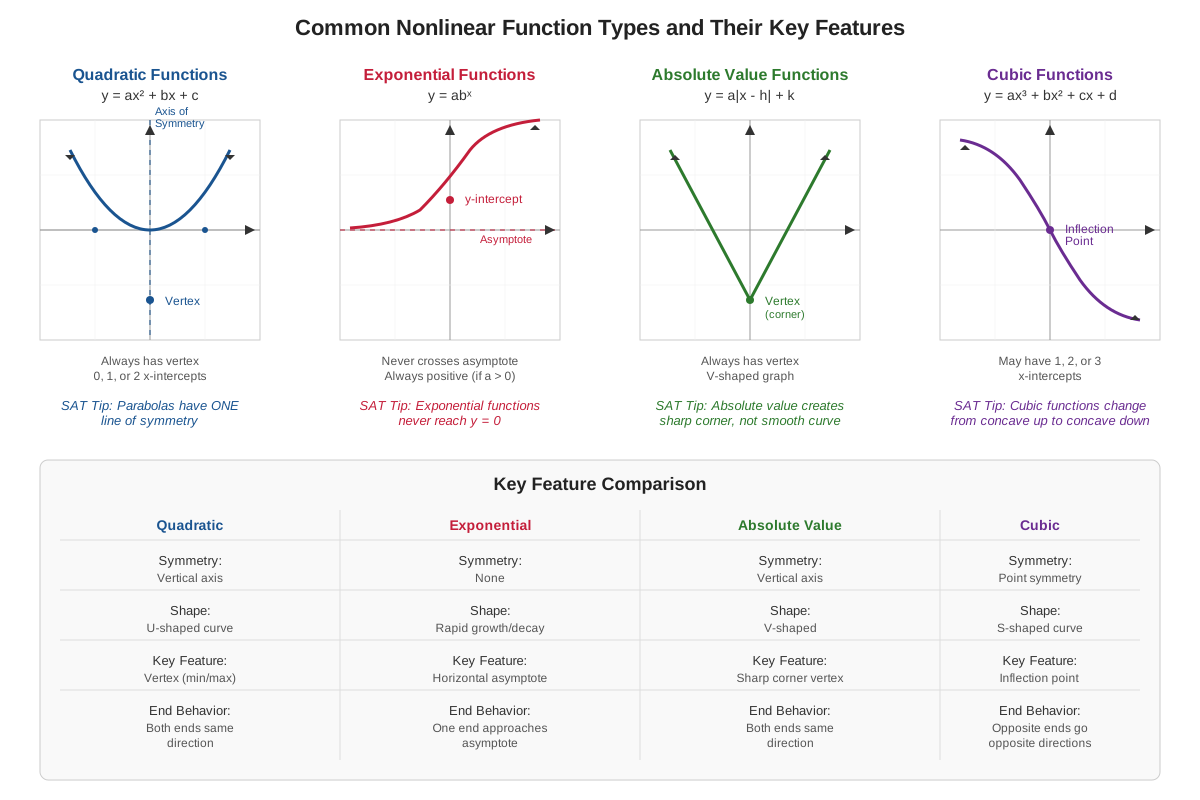
Quadratic functions form parabolas and represent the most common nonlinear graphs on the SAT. The standard form is f(x) = ax² + bx + c, where a ≠ 0. When a > 0, the parabola opens upward with a minimum point at the vertex; when a < 0, it opens downward with a maximum point. The vertex form f(x) = a(x - h)² + k directly reveals the vertex at point (h, k), making it particularly useful for SAT questions about maximum and minimum values.
Exponential functions follow the form f(x) = a·bˣ where b > 0 and b ≠ 1. These graphs show rapid growth (when b > 1) or decay (when 0 < b < 1). Unlike parabolas, exponential graphs never cross the x-axis, approaching it asymptotically. The SAT frequently uses exponential functions to model population growth, compound interest, or radioactive decay scenarios.
Absolute value functions create V-shaped graphs with the basic form f(x) = |x|. The vertex represents the point where the function changes direction, and the graph consists of two linear pieces meeting at this point. These functions appear less frequently than quadratics but are tested in transformation and piecewise function contexts.
Cubic and higher-degree polynomial functions occasionally appear on the SAT, typically in questions about end behavior or the number of x-intercepts. A cubic function f(x) = ax³ + bx² + cx + d can have up to three x-intercepts and exhibits different end behavior on each side of the graph.
Key Features of Nonlinear Graphs
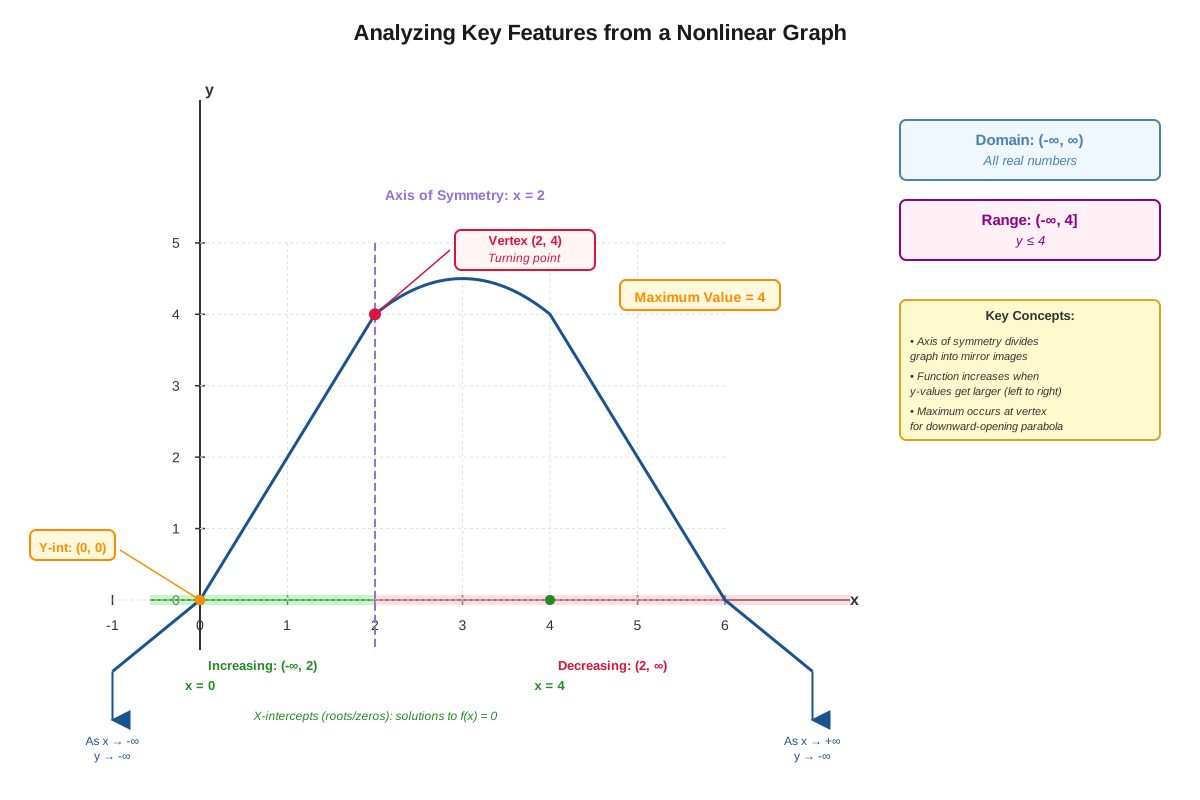
The vertex of a parabola represents either the maximum or minimum value of the function, depending on whether the parabola opens downward or upward. For a quadratic in standard form f(x) = ax² + bx + c, the x-coordinate of the vertex is x = -b/(2a). This feature is crucial for optimization problems where students must find maximum profit, minimum cost, or optimal dimensions.
X-intercepts (also called zeros, roots, or solutions) occur where the graph crosses the x-axis, meaning f(x) = 0. For quadratics, these can be found by factoring, using the quadratic formula, or completing the square. The number of x-intercepts provides information about the number of real solutions to an equation. A parabola can have zero, one, or two x-intercepts depending on its position relative to the x-axis.
The y-intercept occurs where x = 0, giving the point (0, f(0)). For any function in the form f(x) = ax² + bx + c, the y-intercept is simply (0, c). This feature often represents an initial value in real-world contexts, such as starting population or initial height.
The axis of symmetry for a parabola is a vertical line passing through the vertex, with equation x = h (where h is the x-coordinate of the vertex). This line divides the parabola into two mirror-image halves. Understanding symmetry helps students verify graph features and solve problems more efficiently.
Intervals of increase and decrease describe where the function values are rising or falling as x increases. For a parabola opening upward, the function decreases on the interval (-∞, h) and increases on (h, ∞), where h is the x-coordinate of the vertex. The SAT often asks students to identify these intervals from a graph or determine them from an equation.
Transformations of Nonlinear Functions
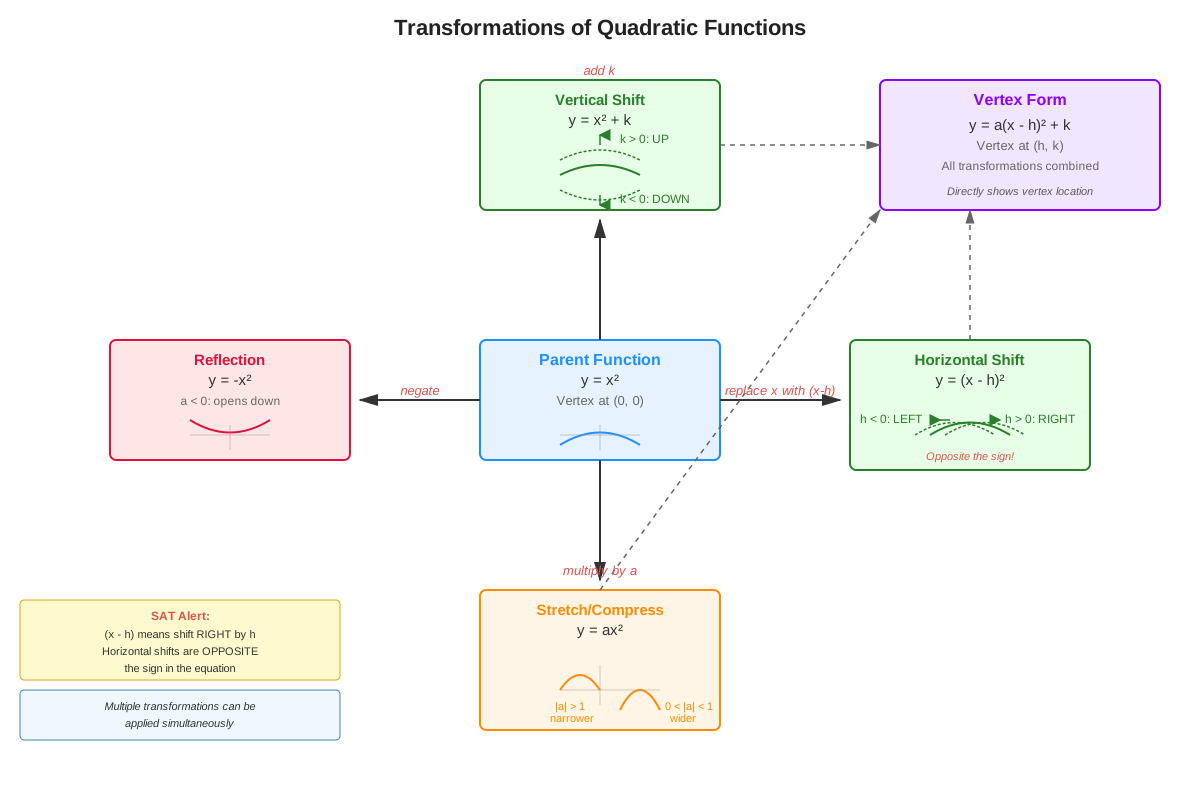
Vertical shifts occur when a constant is added to or subtracted from a function: g(x) = f(x) + k shifts the graph up k units (if k > 0) or down |k| units (if k < 0). This transformation affects the y-coordinate of every point but preserves the shape of the graph.
Horizontal shifts result from replacing x with (x - h): g(x) = f(x - h) shifts the graph right h units (if h > 0) or left |h| units (if h < 0). This counterintuitive direction is a common source of SAT questions and student errors.
Vertical stretches and compressions multiply the function by a constant: g(x) = a·f(x). When |a| > 1, the graph stretches vertically, becoming narrower for parabolas. When 0 < |a| < 1, the graph compresses vertically, becoming wider. If a < 0, the graph also reflects across the x-axis.
Horizontal stretches and compressions replace x with bx: g(x) = f(bx). When |b| > 1, the graph compresses horizontally; when 0 < |b| < 1, it stretches horizontally. These transformations are less common on the SAT but appear in advanced questions.
Comparing Linear and Nonlinear Graphs
| Feature | Linear Graphs | Nonlinear Graphs |
|---|---|---|
| Shape | Straight line | Curved (parabola, exponential curve, etc.) |
| Rate of change | Constant | Variable |
| Equation degree | First degree (x¹) | Second degree or higher (x², x³, etc.) or exponential |
| Number of direction changes | Zero | One or more |
| Intercepts | At most one x-intercept | Can have multiple x-intercepts |
| Symmetry | None (unless vertical/horizontal) | Often symmetric (parabolas, absolute value) |
Matching Equations to Graphs
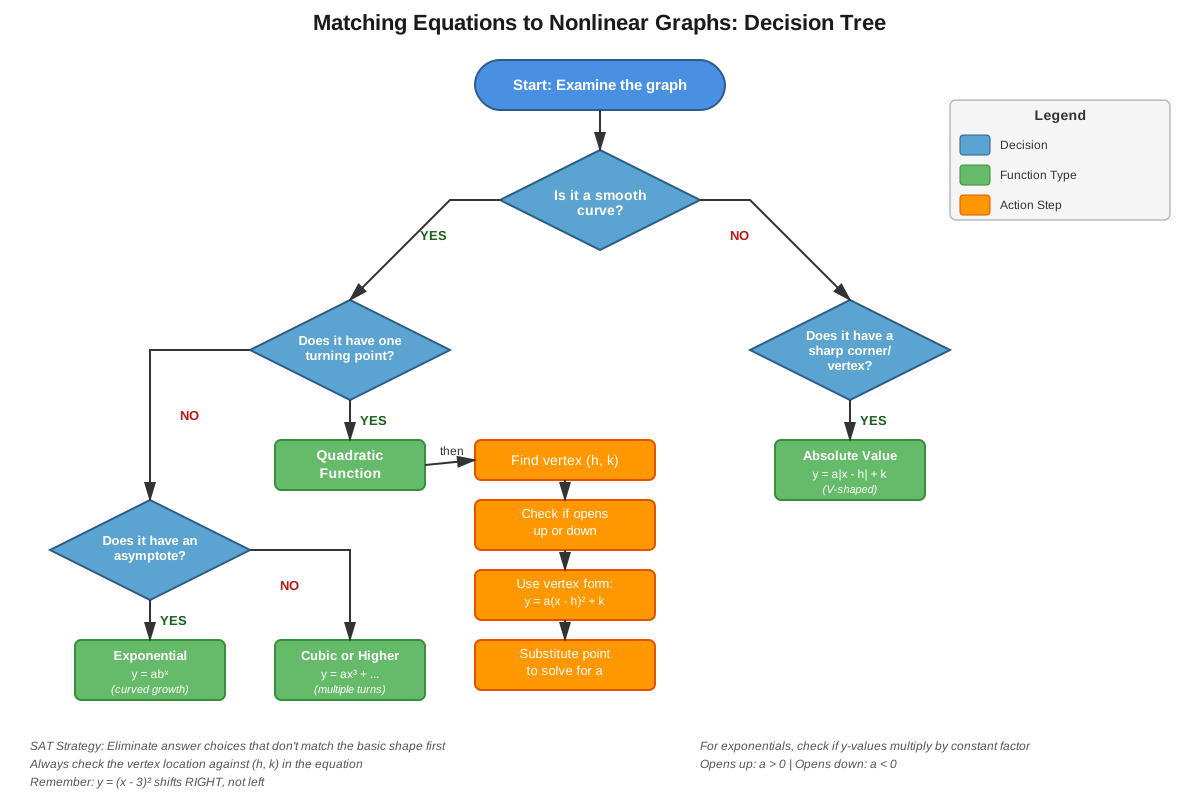
The SAT frequently presents four graphs and asks which matches a given equation, or vice versa. Key strategies include:
- Check the y-intercept: Substitute x = 0 into the equation to find where the graph crosses the y-axis
- Determine the direction: For quadratics, check if the coefficient of x² is positive (opens up) or negative (opens down)
- Find the vertex: Use vertex form or the formula x = -b/(2a) to locate the turning point
- Test specific points: Substitute easy x-values (like x = 1 or x = -1) to verify the graph passes through the resulting points
- Count x-intercepts: Factor or use the discriminant (b² - 4ac) to determine how many times the graph crosses the x-axis
Concept Relationships
The core concepts of nonlinear graphs build upon each other in a logical progression. Understanding the basic parent functions (y = x², y = |x|, y = 2ˣ) provides the foundation for recognizing transformations, which in turn enables students to match equations to graphs efficiently. The ability to identify key features (vertex, intercepts, axis of symmetry) connects directly to solving real-world optimization problems where these features have practical meaning.
Quadratic functions serve as the central hub connecting multiple concepts. The relationship between standard form (ax² + bx + c), vertex form (a(x - h)² + k), and factored form (a(x - r₁)(x - r₂)) demonstrates how different representations highlight different features: standard form reveals the y-intercept, vertex form shows the vertex, and factored form displays the x-intercepts. This multi-representational understanding is crucial for SAT success.
The connection to prerequisite topics is equally important. Linear functions provide the contrast that defines nonlinear behavior—where linear functions have constant rates of change, nonlinear functions have variable rates. Algebraic manipulation skills enable students to convert between forms and solve for key features. Coordinate plane knowledge allows interpretation of graphs and verification of solutions.
Concept flow: Parent Functions → Transformations → Key Features → Equation Forms → Graph Matching → Real-World Applications. Each step builds on the previous, creating a comprehensive understanding that enables students to tackle any SAT question format involving nonlinear graphs.
Quick check — test yourself on Nonlinear graphs so far.
Try Flashcards →High-Yield Facts
⭐ The vertex of a parabola f(x) = ax² + bx + c has x-coordinate x = -b/(2a)
⭐ A positive leading coefficient (a > 0) means the parabola opens upward; negative (a < 0) means downward
⭐ The y-intercept of any function f(x) is found by evaluating f(0)
⭐ In vertex form f(x) = a(x - h)² + k, the vertex is located at point (h, k)
⭐ The number of x-intercepts of a quadratic can be determined by the discriminant: b² - 4ac > 0 (two), = 0 (one), < 0 (zero)
- The axis of symmetry for a parabola is always a vertical line passing through the vertex
- Exponential functions of the form f(x) = a·bˣ never touch or cross the x-axis
- Absolute value functions create V-shaped graphs with a vertex where the expression inside the absolute value equals zero
- A parabola is symmetric about its axis of symmetry, meaning points equidistant from this line have equal y-values
- The domain of most nonlinear functions on the SAT is all real numbers unless restricted by context
- Horizontal shifts in transformations work opposite to intuition: f(x - 3) shifts right 3 units, not left
- The range of a parabola opening upward is [k, ∞) where k is the y-coordinate of the vertex
- Exponential growth functions increase slowly at first, then rapidly, while exponential decay functions decrease rapidly at first, then slowly
- The width of a parabola is determined by the absolute value of the leading coefficient: larger |a| means narrower
Common Misconceptions
Misconception: The vertex of f(x) = (x - 3)² + 2 is at (-3, 2) → Correction: The vertex is at (3, 2) because the transformation is x - h, so h = 3. The signs in vertex form work opposite to what many students expect.
Misconception: All parabolas have two x-intercepts → Correction: Parabolas can have zero, one, or two x-intercepts depending on their vertical position. A parabola with vertex above the x-axis (opening upward) or below the x-axis (opening downward) has no x-intercepts.
Misconception: The y-intercept and vertex are the same point → Correction: The y-intercept occurs at x = 0, while the vertex occurs at x = -b/(2a). These are only the same when the axis of symmetry is the y-axis (when b = 0).
Misconception: Exponential functions can have negative y-values → Correction: For exponential functions of the form f(x) = a·bˣ where a > 0 and b > 0, the function values are always positive. The graph approaches but never reaches the x-axis.
Misconception: A wider parabola has a larger leading coefficient → Correction: A wider parabola has a smaller absolute value of the leading coefficient. For example, f(x) = 0.5x² is wider than f(x) = 2x².
Misconception: The axis of symmetry is always the y-axis → Correction: The axis of symmetry is x = h, where h is the x-coordinate of the vertex. It only coincides with the y-axis when h = 0.
Misconception: Nonlinear means the graph is not a function → Correction: Most nonlinear graphs on the SAT are functions (they pass the vertical line test). Nonlinear simply means the graph is not a straight line.
Worked Examples
Example 1: Finding Maximum Value from Context
Problem: A company's profit P (in thousands of dollars) from selling x hundred units of a product is modeled by P(x) = -2x² + 16x - 24. What is the maximum profit the company can achieve, and how many units should be sold to achieve it?
Solution:
Step 1: Recognize this is a quadratic function with a = -2 (negative), so the parabola opens downward and has a maximum value at the vertex.
Step 2: Find the x-coordinate of the vertex using x = -b/(2a):
- x = -16/(2(-2)) = -16/(-4) = 4
Step 3: The company should sell 4 hundred units (400 units) to maximize profit.
Step 4: Find the maximum profit by substituting x = 4 into the equation:
- P(4) = -2(4)² + 16(4) - 24
- P(4) = -2(16) + 64 - 24
- P(4) = -32 + 64 - 24
- P(4) = 8
Step 5: Since P is measured in thousands of dollars, the maximum profit is $8,000.
Answer: The maximum profit is $8,000, achieved by selling 400 units.
Connection to Learning Objectives: This example demonstrates identifying key features (vertex as maximum), explaining how nonlinear graphs appear in real-world SAT contexts (profit optimization), and applying the concept to solve an SAT-style question.
Example 2: Matching Equation to Graph
Problem: Which of the following equations matches a parabola that opens downward, has a vertex at (2, 5), and passes through the point (0, 1)?
A) f(x) = -(x - 2)² + 5
B) f(x) = (x - 2)² + 5
C) f(x) = -(x + 2)² + 5
D) f(x) = -2(x - 2)² + 5
Solution:
Step 1: Since the parabola opens downward, the leading coefficient must be negative. This eliminates choice B.
Step 2: The vertex is at (2, 5), so the equation must be in the form f(x) = a(x - 2)² + 5. This eliminates choice C (which has vertex at (-2, 5)).
Step 3: We're left with choices A and D. Both have the correct vertex and open downward. We need to test which passes through (0, 1).
Step 4: Test choice A:
- f(0) = -(0 - 2)² + 5
- f(0) = -(4) + 5
- f(0) = 1 ✓
Step 5: Verify choice D doesn't work:
- f(0) = -2(0 - 2)² + 5
- f(0) = -2(4) + 5
- f(0) = -3 ✗
Answer: Choice A is correct.
Connection to Learning Objectives: This example shows how to identify key features from a description, distinguish between similar equations using vertex form, and apply systematic elimination strategies typical of SAT questions.
Exam Strategy
When approaching SAT questions on nonlinear graphs, begin by identifying what type of function is involved. Look for trigger words such as "maximum," "minimum," "vertex," "parabola," or "quadratic" that signal a parabola question. Words like "exponential growth," "doubles," or "decay" indicate exponential functions. The phrase "absolute value" or descriptions of V-shaped graphs point to absolute value functions.
For graph-matching questions, use the process of elimination systematically. First, check the y-intercept by looking at where x = 0. This single check often eliminates two or three answer choices immediately. Second, determine whether the graph opens upward or downward (for parabolas) or increases/decreases (for exponentials). Third, verify the vertex location or other key features. Finally, if needed, test a specific point to confirm your answer.
Time allocation is crucial. Simple identification questions (matching a graph to an equation when the vertex is clearly visible) should take 30-45 seconds. Problems requiring calculation of the vertex or solving for specific values typically need 60-90 seconds. Complex word problems involving optimization or multiple steps may require up to 2 minutes. If a question requires more than 2 minutes, mark it and return later.
For questions asking about real-world contexts, translate the mathematical features into practical meaning. The vertex represents the maximum or minimum of whatever quantity is being modeled. X-intercepts represent when the quantity equals zero (break-even points, when an object hits the ground, etc.). The y-intercept represents the initial value at time zero or when the independent variable is zero.
When working with transformations, write down the parent function first, then apply each transformation step-by-step. This prevents confusion about the direction of horizontal shifts and the effects of negative coefficients. Remember that horizontal transformations work opposite to intuition.
Memory Techniques
Vertex Formula Mnemonic: "Negative Boy Two Apples" for x = -b/(2a). The negative sign comes first, then b, then 2a in the denominator.
Parabola Direction: "Positive Up, Negative Down" (PUND). If the leading coefficient is positive, the parabola opens up like a U; if negative, it opens down.
Transformation Direction: For horizontal shifts, think "Opposite Day" (OD). The transformation f(x - 3) goes the opposite direction from what the sign suggests—it shifts right 3, not left.
Vertex Form Visualization: Picture the vertex form f(x) = a(x - h)² + k as a treasure map: (h, k) marks the spot where the treasure (vertex) is buried. The 'a' tells you whether to dig up (positive) or down (negative).
Discriminant Memory: "Big Discriminant, Two Solutions" (b² - 4ac). When the discriminant is positive (big), you get two x-intercepts. When it's zero, you get one. When it's negative, you get none (the parabola doesn't reach the x-axis).
Exponential Growth vs. Decay: For f(x) = a·bˣ, remember "Bigger than One Grows" (BOG). If the base b > 1, the function grows. If 0 < b < 1, it decays.
Summary
Nonlinear graphs represent curved relationships that appear frequently on the SAT Math section, with quadratic functions (parabolas) being the most common type tested. Success requires mastering three interconnected skills: identifying key features such as vertices, intercepts, and axes of symmetry; understanding transformations and how they affect graph position and shape; and applying these concepts to real-world optimization problems. The vertex of a parabola, found at x = -b/(2a) for standard form or directly visible as (h, k) in vertex form, represents the maximum or minimum value and is central to most SAT questions. Students must be able to move fluidly between equations and graphs, using strategic approaches like checking y-intercepts first and testing specific points to match functions with their visual representations. Understanding that the leading coefficient determines both the direction (positive opens up, negative opens down) and width (larger absolute value means narrower) of parabolas enables quick analysis of answer choices. The ability to interpret these mathematical features in context—recognizing that a vertex might represent maximum profit or minimum cost, and that x-intercepts might represent break-even points—distinguishes high-scoring students from those who only memorize formulas.
Key Takeaways
- The vertex formula x = -b/(2a) is essential for finding maximum and minimum values of quadratic functions in standard form
- A positive leading coefficient means the parabola opens upward (has a minimum), while negative means downward (has a maximum)
- Vertex form f(x) = a(x - h)² + k directly reveals the vertex at (h, k), making it the most efficient form for optimization problems
- The y-intercept is always found by evaluating f(0), which equals c in standard form ax² + bx + c
- Horizontal transformations work opposite to intuition: f(x - h) shifts right h units, not left
- The discriminant b² - 4ac determines the number of x-intercepts: positive gives two, zero gives one, negative gives none
- Systematic elimination using y-intercepts, direction, and vertex location efficiently solves graph-matching questions on the SAT
Related Topics
Systems of Equations with Nonlinear Functions: Building on nonlinear graphs, this topic explores finding intersection points between parabolas and lines or between two nonlinear functions, which represents solving systems algebraically and graphically.
Function Transformations in Depth: Extends the transformation concepts introduced here to include reflections, combinations of transformations, and more complex function families, enabling analysis of any transformed function.
Polynomial Functions of Higher Degree: Progresses from quadratic functions to cubic and quartic functions, examining how degree affects the number of turning points and x-intercepts.
Rational Functions and Asymptotes: Introduces functions with variables in denominators, building on the asymptotic behavior seen in exponential functions and adding vertical asymptotes.
Modeling with Functions: Applies nonlinear graphs to complex real-world scenarios, requiring students to select appropriate function types, interpret parameters, and make predictions based on models.
Practice CTA
Now that you've mastered the core concepts of nonlinear graphs, it's time to solidify your understanding through practice. Attempt the practice questions designed specifically for this topic, focusing on applying the vertex formula, matching equations to graphs, and solving real-world optimization problems. Use the flashcards to reinforce key formulas and features until they become automatic. Remember, the SAT rewards both accuracy and speed—consistent practice with these high-yield concepts will build the confidence and efficiency you need to excel on test day. Every practice question you complete brings you one step closer to your target score!
Sign up free to keep reading
Create a free AnvayaPrep account to finish this SAT guide on Nonlinear graphs — plus flashcards and practice questions.