Overview
Nonlinear word problems represent a critical category of questions on the SAT math section that test students' ability to translate real-world scenarios into mathematical models involving quadratic, exponential, or other non-linear relationships. Unlike linear problems where relationships maintain constant rates of change, nonlinear word problems involve situations where quantities change at varying rates—such as projectile motion, compound interest, area optimization, or population growth. These problems require students to recognize patterns, select appropriate mathematical models, and interpret solutions within practical contexts.
Mastering nonlinear word problems is essential for SAT success because they appear frequently throughout both the calculator and no-calculator portions of the exam, often accounting for 15-20% of all math questions. These problems assess multiple competencies simultaneously: reading comprehension, mathematical modeling, algebraic manipulation, and logical reasoning. The SAT specifically designs these questions to evaluate whether students can move beyond rote memorization to apply mathematical concepts in authentic problem-solving situations.
Within the broader landscape of SAT math, nonlinear word problems serve as a bridge between pure algebraic manipulation and practical application. They connect foundational concepts like solving quadratic equations, understanding exponential growth, and working with polynomial functions to real-world contexts that students might encounter in science, economics, or engineering. Success with these problems demonstrates mathematical maturity and the ability to think critically about how mathematical relationships model physical phenomena.
Learning Objectives
- [ ] Identify key features of nonlinear word problems, including the type of function involved and relevant variables
- [ ] Explain how nonlinear word problems appear on the SAT, including common contexts and question formats
- [ ] Apply nonlinear word problems strategies to answer SAT-style questions accurately and efficiently
- [ ] Distinguish between linear and nonlinear relationships in word problem contexts
- [ ] Construct appropriate nonlinear equations or functions from verbal descriptions
- [ ] Interpret solutions to nonlinear equations within the context of real-world constraints
- [ ] Evaluate which nonlinear model (quadratic, exponential, or other) best fits a given scenario
Prerequisites
- Solving quadratic equations: Essential for finding solutions to problems involving parabolic relationships, such as projectile motion or area optimization
- Understanding function notation: Necessary to interpret and manipulate expressions like f(x) and evaluate functions at specific values
- Basic exponential properties: Required to work with growth and decay problems involving repeated multiplication
- Algebraic manipulation skills: Fundamental for rearranging equations, factoring, and isolating variables in complex expressions
- Reading and interpreting graphs: Important for visualizing nonlinear relationships and extracting information from parabolas and exponential curves
Why This Topic Matters
Nonlinear word problems bridge the gap between abstract mathematical concepts and tangible real-world applications. In everyday life, nonlinear relationships are far more common than linear ones: the distance a car travels after braking follows a quadratic relationship with speed, investment returns compound exponentially over time, and the optimal dimensions for fencing a garden involve quadratic optimization. Understanding these relationships empowers students to make informed decisions about finances, interpret scientific data, and solve practical engineering problems.
On the SAT, nonlinear word problems appear with remarkable consistency, typically comprising 4-6 questions per test administration. These questions most frequently involve quadratic functions (approximately 60% of nonlinear problems), followed by exponential functions (approximately 30%), with the remainder involving other polynomial or rational functions. The College Board strategically places these problems throughout the exam to assess sustained problem-solving ability rather than simple recall.
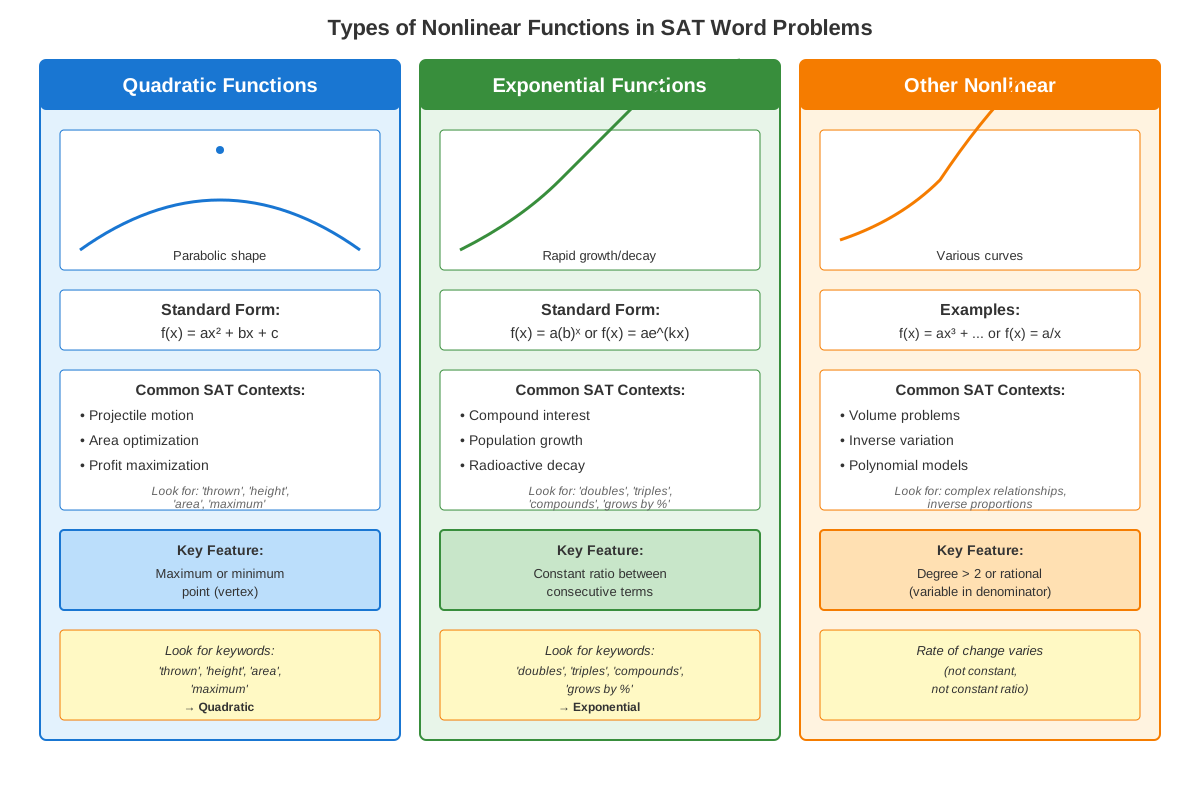
Common SAT contexts for nonlinear word problems include: projectile motion scenarios (height of a thrown object over time), business applications (profit maximization, revenue models), geometric optimization (maximizing area with fixed perimeter), population dynamics (exponential growth or decay), and financial calculations (compound interest, depreciation). Questions typically provide either a verbal description requiring students to construct a model, or present an equation and ask students to interpret parameters or solutions within context. The SAT particularly favors questions that require students to identify maximum or minimum values, determine when a quantity reaches a specific threshold, or compare different nonlinear models.
Core Concepts
Recognizing Nonlinear Relationships
The foundation of solving sat nonlinear word problems begins with identifying when a relationship is nonlinear. A relationship is nonlinear when the rate of change between variables is not constant. Key indicators include:
- Squared or higher-power terms: Words like "area," "squared," or descriptions involving two dimensions multiplied together
- Exponential language: Phrases such as "doubles every," "increases by a factor of," "compounds," or "decays by a percentage"
- Curved graphs: Any parabola, exponential curve, or other non-straight-line representation
- Changing rates: Descriptions where the rate of increase or decrease itself changes over time
For example, if a problem states "the population increases by 500 people each year," this suggests a linear relationship. However, if it states "the population increases by 5% each year," this indicates exponential growth—a nonlinear relationship.
Quadratic Word Problems
Quadratic relationships appear most frequently in SAT nonlinear word problems and follow the general form:
f(x) = ax² + bx + cCommon quadratic contexts include:
| Context | Typical Form | Key Feature |
|---|---|---|
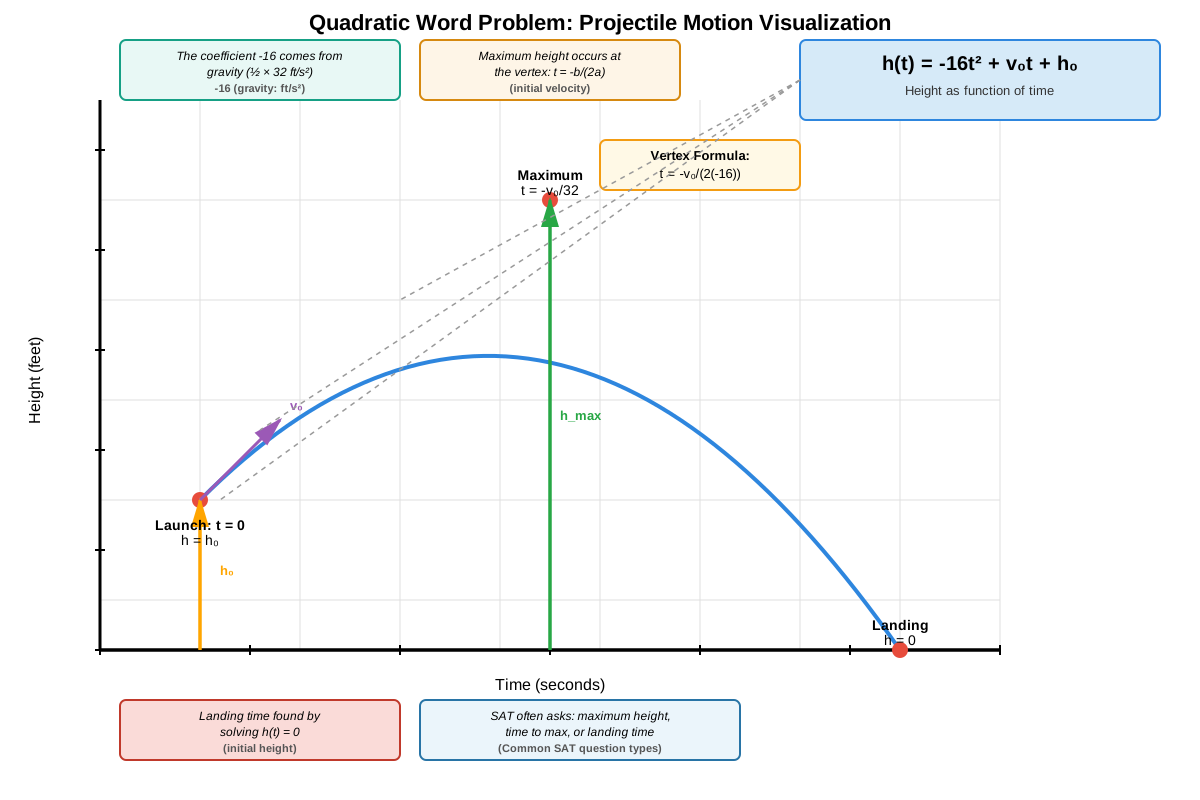
| Projectile motion | h(t) = -16t² + v₀t + h₀ | Maximum height at vertex |
| Area problems | A(x) = x(constant - x) | Optimization scenarios |
| Revenue models | R(x) = x · p(x) | Price times quantity |
| Geometric relationships | Various | Products of dimensions |
Vertex form is particularly useful for optimization problems:
f(x) = a(x - h)² + kwhere (h, k) represents the vertex—the maximum or minimum point of the parabola. When a < 0, the parabola opens downward and k represents the maximum value. When a > 0, the parabola opens upward and k represents the minimum value.
Critical steps for quadratic word problems:
- Identify the variables and what they represent
- Determine what quantity the problem asks you to find
- Construct or interpret the quadratic equation
- Find the vertex for optimization problems (x = -b/2a in standard form)
- Evaluate the function at critical points
- Interpret the solution within the problem's constraints
Exponential Word Problems
Exponential relationships model situations involving repeated multiplication and follow the form:
f(x) = a · b^x or f(x) = a · e^(kx)where:
- a represents the initial value
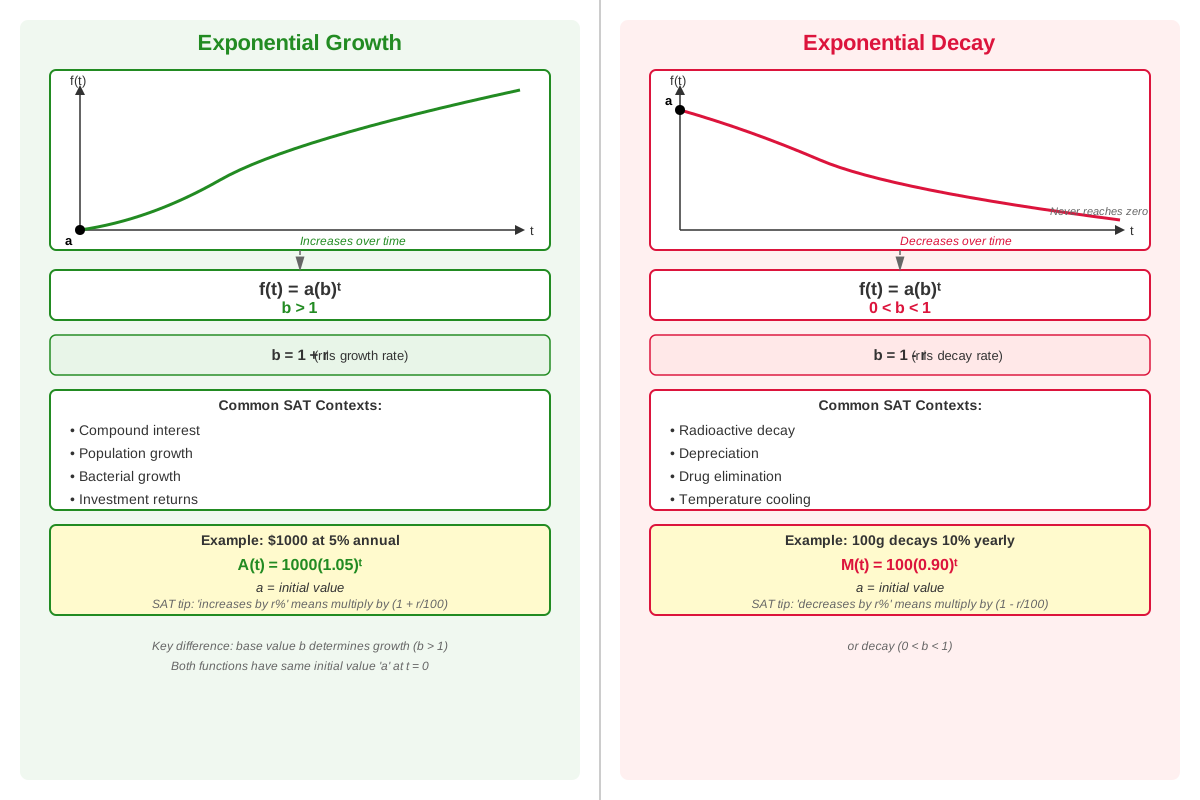
- b represents the growth factor (b > 1 for growth, 0 < b < 1 for decay)
- k represents the continuous growth/decay rate
- x represents time or the number of periods
Common exponential contexts:
- Compound interest: A(t) = P(1 + r)^t, where P is principal, r is rate, t is time
- Population growth: P(t) = P₀(1 + r)^t, where P₀ is initial population
- Radioactive decay: N(t) = N₀(1/2)^(t/h), where h is half-life
- Bacterial growth: B(t) = B₀ · 2^(t/d), where d is doubling time
Key distinction: In exponential growth, equal time intervals produce equal percentage changes (not equal absolute changes). If a population grows from 100 to 110 (10% increase), the next period it grows from 110 to 121 (also 10% increase, but an absolute increase of 11).
Interpreting Parameters in Context
The SAT frequently asks students to interpret what specific parameters mean within a word problem context. For a quadratic function h(t) = -16t² + 64t + 80 representing the height of a projectile:
- The coefficient -16 represents half the acceleration due to gravity (in feet per second squared)
- The coefficient 64 represents the initial upward velocity (in feet per second)
- The constant 80 represents the initial height (in feet)
For an exponential function P(t) = 5000(1.08)^t representing a population:
- The value 5000 represents the initial population at t = 0
- The base 1.08 indicates 8% growth per time period (1 + 0.08)
- The exponent t represents the number of time periods elapsed
Solving for Specific Values
Many SAT problems require finding when a quantity reaches a particular value. This involves:
- Setting the function equal to the target value
- Solving the resulting equation
- Checking whether solutions are physically meaningful
For example, if h(t) = -16t² + 64t + 80 and you need to find when the height is 96 feet:
96 = -16t² + 64t + 80
0 = -16t² + 64t - 16
0 = -t² + 4t - 1
Using the quadratic formula or factoring yields two solutions, both of which may be valid (the object reaches that height twice: once going up, once coming down).
Optimization Problems
Optimization involves finding maximum or minimum values, which occur at the vertex of a quadratic function. The SAT commonly presents scenarios like:
- Maximizing area with a fixed perimeter
- Maximizing revenue given a price-demand relationship
- Finding the maximum height of a projectile
Strategy: Convert the problem to vertex form or use x = -b/(2a) to find the x-coordinate of the vertex, then evaluate the function at that point to find the optimal value.
Concept Relationships
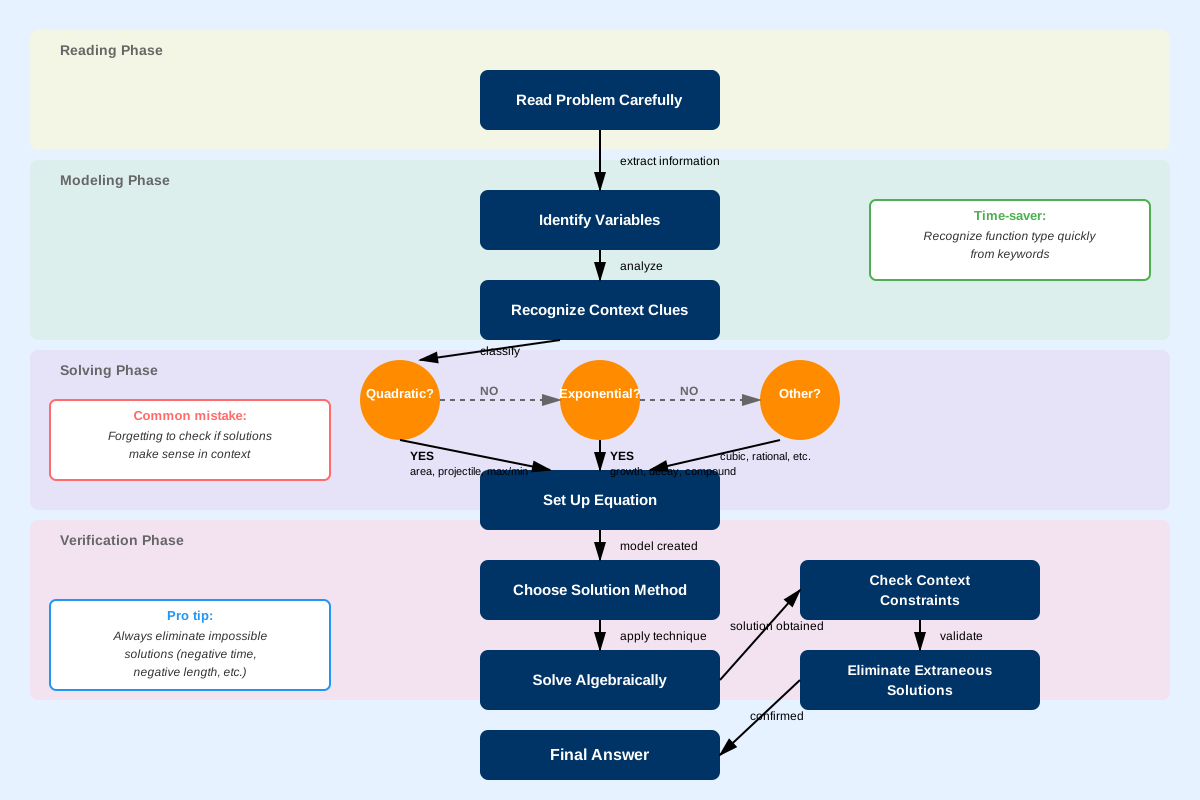
The concepts within nonlinear word problems form an interconnected web of mathematical reasoning. Recognition of nonlinear relationships serves as the entry point, leading to selection of appropriate models (quadratic vs. exponential vs. other). Once a model is selected, students must interpret parameters to understand what each component represents in context. This interpretation enables solving for specific values when the problem asks "when does X equal Y?" or requires optimization when seeking maximum or minimum values.
The relationship flows: Recognition → Model Selection → Parameter Interpretation → Solution/Optimization → Contextual Validation
These concepts connect to prerequisite knowledge in essential ways. Solving quadratic equations (factoring, quadratic formula, completing the square) provides the algebraic tools needed once a quadratic model is established. Understanding exponential properties enables manipulation of exponential models. Function notation allows precise communication about relationships between variables.
Looking forward, mastery of nonlinear word problems prepares students for more advanced topics in precalculus and calculus, where optimization becomes formalized through derivatives, and exponential functions expand to include logarithmic inverses. The modeling skills developed here transfer directly to statistics (curve fitting), physics (motion equations), and economics (supply-demand curves).
Quick check — test yourself on Nonlinear word problems so far.
Try Flashcards →High-Yield Facts
⭐ Quadratic functions have exactly one maximum or minimum value, occurring at the vertex
⭐ In projectile motion problems, the coefficient of t² is always -16 (feet) or -4.9 (meters) due to gravity
⭐ Exponential growth means equal time periods produce equal percentage changes, not equal absolute changes
⭐ The vertex of a parabola in standard form f(x) = ax² + bx + c occurs at x = -b/(2a)
⭐ When a quadratic opens downward (a < 0), the vertex represents a maximum; when it opens upward (a > 0), the vertex represents a minimum
- In compound interest problems, the base of the exponential function equals (1 + rate) for growth or (1 - rate) for decay
- Area optimization problems typically produce quadratic functions because area involves multiplying two dimensions
- The y-intercept of a function (when x = 0) often represents an initial value or starting condition
- Exponential decay functions approach but never reach zero (they have a horizontal asymptote at y = 0)
- When solving quadratic equations in context, negative solutions or solutions outside the domain may be mathematically correct but contextually meaningless
- The discriminant (b² - 4ac) determines the number of real solutions: positive means two solutions, zero means one, negative means none
- Doubling time in exponential growth can be found by solving 2 = b^t, where b is the growth factor
Common Misconceptions
Misconception: All word problems involving time are linear functions.
Correction: Many time-based relationships are nonlinear, particularly projectile motion (quadratic) and compound growth (exponential). The key is whether the rate of change is constant (linear) or variable (nonlinear).
Misconception: The maximum value of a quadratic function is always the y-intercept.
Correction: The maximum (or minimum) occurs at the vertex, not the y-intercept. The y-intercept simply shows the function's value when x = 0, which may or may not be the extreme value.
Misconception: In exponential growth problems, if something doubles every 3 years, it quadruples every 6 years.
Correction: This is actually correct! However, students often mistakenly think it would triple or use addition instead of multiplication. After 6 years (two doubling periods), the quantity is 2 × 2 = 4 times the original.
Misconception: When a quadratic equation has two solutions, only one is correct.
Correction: Both solutions may be valid depending on context. For projectile motion, an object may reach a certain height twice (ascending and descending). However, negative time values or values outside the problem's domain should be rejected.
Misconception: The coefficient 'a' in a quadratic function represents the maximum or minimum value.
Correction: The coefficient 'a' determines the direction (upward or downward) and width of the parabola, but the maximum or minimum value is the y-coordinate of the vertex (k in vertex form), not 'a'.
Misconception: Exponential functions and quadratic functions are the same because both involve exponents.
Correction: These are fundamentally different. In quadratic functions, the variable is the base (x²); in exponential functions, the variable is the exponent (2^x). They model completely different types of growth and have different graphical shapes.
Worked Examples
Example 1: Quadratic Optimization Problem
Problem: A farmer has 200 feet of fencing to enclose a rectangular garden along a river. The river side requires no fencing. What dimensions maximize the garden's area, and what is that maximum area?
Solution:
Step 1: Define variables. Let x = width of the garden (perpendicular to river), and let y = length (parallel to river).
Step 2: Set up constraints. The fencing equation is: x + y + x = 200 (two widths and one length), which simplifies to 2x + y = 200.
Step 3: Solve for one variable: y = 200 - 2x
Step 4: Create the area function. Area = length × width:
A(x) = x · y = x(200 - 2x) = 200x - 2x²This is a quadratic function in standard form: A(x) = -2x² + 200x
Step 5: Find the vertex. Since a = -2 (negative), the parabola opens downward, so the vertex represents maximum area.
x = -b/(2a) = -200/(2(-2)) = -200/(-4) = 50Step 6: Find the corresponding y-value:
y = 200 - 2(50) = 200 - 100 = 100
Step 7: Calculate maximum area:
A(50) = 50 × 100 = 5,000 square feet
Answer: The dimensions that maximize area are 50 feet (width) by 100 feet (length), producing a maximum area of 5,000 square feet.
Connection to learning objectives: This problem demonstrates identifying key features (quadratic relationship between dimensions and area), applying problem-solving strategies (converting constraints to a single-variable function), and interpreting the solution in context (dimensions must be positive and satisfy the fencing constraint).
Example 2: Exponential Growth Problem
Problem: A bacterial culture contains 500 bacteria initially and doubles every 4 hours. The function P(t) = 500 · 2^(t/4) models the population after t hours. How many hours will it take for the population to reach 8,000 bacteria?
Solution:
Step 1: Understand the given function. P(t) = 500 · 2^(t/4) where:
- 500 is the initial population
- 2 is the growth factor (doubling)
- t/4 means the exponent increases by 1 every 4 hours (one doubling period)
Step 2: Set up the equation with the target value:
8000 = 500 · 2^(t/4)Step 3: Isolate the exponential term:
8000/500 = 2^(t/4)
16 = 2^(t/4)
Step 4: Recognize that 16 = 2^4, so:
2^4 = 2^(t/4)Step 5: Since the bases are equal, the exponents must be equal:
4 = t/4
t = 16
Step 6: Verify the answer makes sense. In 16 hours, there are 16/4 = 4 doubling periods. Starting with 500: 500 → 1000 → 2000 → 4000 → 8000 ✓
Answer: It will take 16 hours for the population to reach 8,000 bacteria.
Connection to learning objectives: This problem requires recognizing exponential growth patterns, interpreting parameters (understanding what t/4 means), and applying algebraic techniques to solve exponential equations—all critical skills for SAT nonlinear word problems.
Exam Strategy
When approaching sat nonlinear word problems, employ this systematic strategy:
1. Read carefully and identify the relationship type. Look for trigger words:
- Quadratic triggers: "area," "squared," "projectile," "height over time," "revenue," "maximum," "minimum"
- Exponential triggers: "doubles," "triples," "percent increase/decrease," "compounds," "grows by a factor," "half-life"
2. Extract and organize given information. Create a quick list of:
- What you know (given values)
- What you need to find (the question)
- Any constraints (domain restrictions, physical limitations)
3. Determine whether you need to construct a model or interpret a given one. The SAT presents both types:
- Construction problems: "Write an equation that represents..."
- Interpretation problems: "Given the equation f(x) = ..., what does the 5 represent?"
4. Use process of elimination strategically:
- For optimization problems, eliminate answers that are outside the feasible domain
- For exponential problems, test whether answer choices produce the correct growth pattern
- For interpretation questions, substitute x = 0 or other simple values to check if answers make contextual sense
5. Check units and reasonableness. If a problem asks for time in hours and your answer is 0.5, verify whether "30 minutes" makes sense in context. If finding a maximum height of 10,000 feet for a thrown baseball, reconsider your calculation.
6. Time allocation: Spend approximately 1.5-2 minutes on straightforward nonlinear word problems, up to 3 minutes on complex multi-step problems. If stuck after 90 seconds, mark for review and move on.
Exam Tip: When a problem provides an equation and asks what a parameter represents, substitute x = 0 to find the initial value, or examine how the function changes as x increases to understand growth/decay rates.
Common trap answers to watch for:
- Confusing the x-coordinate and y-coordinate of the vertex
- Selecting the coefficient 'a' instead of the actual maximum/minimum value
- Choosing the growth rate instead of the growth factor (0.05 vs. 1.05)
- Accepting negative time or other contextually impossible solutions
Memory Techniques
VERTEX mnemonic for quadratic optimization:
- Vertex location: x = -b/(2a)
- Evaluate function at that x
- Reject impossible solutions
- Test whether maximum or minimum (check sign of a)
- Examine context for constraints
- X-coordinate first, then find y
"PAID" for exponential functions:
- Principal/initial value (the coefficient)
- Amount after time (what you're solving for)
- Increase factor (1 + rate for growth)
- Decrease factor (1 - rate for decay)
Visualization strategy for projectiles: Picture the parabola as a thrown ball's path. The vertex is the highest point (maximum height), the y-intercept is the starting height, and the positive x-intercept is when it hits the ground. This mental image helps interpret all parameters correctly.
"Square means QUAD": When you see area, squared terms, or two dimensions multiplied, think QUADRATIC. The word "square" itself contains "quad."
Exponential growth rule of thumb: If something grows by r% per period, multiply by (1 + r/100). If it decays by r%, multiply by (1 - r/100). The "1" represents keeping the original amount.
Summary
Nonlinear word problems on the SAT require students to recognize, model, and solve real-world scenarios involving quadratic and exponential relationships. Success depends on identifying relationship types through context clues, understanding that quadratic functions model situations involving products of variables (like area) or acceleration (like projectile motion), while exponential functions model repeated percentage changes (like compound interest or population growth). The vertex of a quadratic function, found at x = -b/(2a), represents the maximum or minimum value—critical for optimization problems. Exponential functions are characterized by their initial value and growth/decay factor, with the key insight that equal time intervals produce equal percentage changes. Students must interpret parameters within context, solve equations algebraically, and validate solutions against real-world constraints. Mastery requires both computational skill and conceptual understanding of how mathematical models represent physical phenomena.
Key Takeaways
- Nonlinear word problems primarily involve quadratic functions (for optimization and projectile motion) and exponential functions (for growth and decay)
- The vertex of a quadratic function represents the maximum or minimum value, located at x = -b/(2a) in standard form
- Exponential growth means multiplying by a constant factor each period, not adding a constant amount
- Always interpret solutions within context—reject negative times, impossible dimensions, or values outside the stated domain
- Parameter interpretation questions require understanding what each component of an equation represents in the real-world scenario
- Trigger words like "area," "maximum," "height," and "squared" indicate quadratic relationships, while "doubles," "compounds," and "percent increase" indicate exponential relationships
- Both mathematical accuracy and contextual reasoning are essential for earning full credit on SAT nonlinear word problems
Related Topics
Systems of Nonlinear Equations: Building on single nonlinear equations, this topic explores finding intersection points between parabolas, circles, and other curves—essential for advanced problem-solving.
Polynomial Functions Beyond Quadratics: Cubic and higher-degree polynomials extend the concepts learned here, introducing multiple turning points and more complex optimization scenarios.
Logarithmic Functions: As the inverse of exponential functions, logarithms provide tools for solving exponential equations when the exponent is unknown—directly applicable to growth and decay problems.
Rational Functions: These functions involve ratios of polynomials and model scenarios like average cost, concentration, or rates that change based on quantity.
Transformations of Functions: Understanding how changing parameters affects graphs deepens comprehension of how real-world changes (like increased initial velocity) affect mathematical models.
Mastering nonlinear word problems creates a foundation for all these advanced topics while providing immediately applicable skills for SAT success.
Practice CTA
Now that you've thoroughly reviewed nonlinear word problems, it's time to solidify your understanding through active practice. Attempt the practice questions designed specifically for this topic, focusing on applying the strategies and concepts covered in this guide. Use the flashcards to reinforce key formulas, trigger words, and common problem types. Remember: recognizing patterns and building problem-solving confidence comes through repeated, deliberate practice. Each problem you solve strengthens your ability to quickly identify relationship types and select efficient solution strategies. You've built the knowledge foundation—now transform it into test-day performance through focused practice!
Sign up free to keep reading
Create a free AnvayaPrep account to finish this SAT guide on Nonlinear word problems — plus flashcards and practice questions.