Overview
SAT function traps represent one of the most strategically important categories of math questions on the SAT. These are carefully designed questions that exploit common student errors, misconceptions, and hasty reasoning when working with functions. Unlike straightforward function evaluation problems, function traps deliberately include answer choices that correspond to predictable mistakes—such as confusing function notation, misinterpreting domain and range, or incorrectly applying transformations. The College Board consistently includes these trap questions because they effectively differentiate between students who have surface-level understanding and those who have mastered the underlying concepts.
Understanding function traps is essential for achieving a competitive SAT score because these questions appear with high frequency across both the calculator and no-calculator sections. Students who can identify and avoid these traps gain a significant advantage, as each avoided trap can mean the difference between a good score and an exceptional one. Function trap questions typically appear in the middle-to-difficult range of the test, making them critical for students aiming for scores above 650 in the math section.
Function traps connect to broader mathematical concepts including function composition, transformations, inverse functions, and the relationship between algebraic and graphical representations. Mastery of function traps requires solid understanding of function notation, coordinate geometry, and algebraic manipulation. These skills form the foundation for more advanced topics in precalculus and calculus, making this topic valuable beyond the SAT itself.
Learning Objectives
- [ ] Identify key features of SAT function traps
- [ ] Explain how SAT function traps appears on the SAT
- [ ] Apply SAT function traps to answer SAT-style questions
- [ ] Distinguish between correct function evaluations and common trap answers
- [ ] Analyze function graphs to avoid visual interpretation traps
- [ ] Recognize patterns in how the College Board constructs distractor answer choices
- [ ] Execute systematic verification strategies to confirm answers before selecting them
Prerequisites
- Function notation and evaluation: Understanding f(x) notation is fundamental because function traps exploit confusion about what the notation means and how to substitute values correctly
- Coordinate plane and graphing: Reading and interpreting graphs is essential since many function traps involve misreading coordinates or confusing x and y values
- Basic algebraic manipulation: Simplifying expressions and solving equations is necessary because trap questions often require multi-step algebraic work where errors compound
- Domain and range concepts: Knowing which values are valid inputs and outputs helps avoid traps related to undefined expressions or impossible function values
- Function transformations: Understanding how functions shift, reflect, and stretch is critical since transformation traps are among the most common on the SAT
Why This Topic Matters
Function traps appear on virtually every SAT administration, typically accounting for 3-5 questions across the entire math section. These questions are strategically placed to challenge students who rush through problems or rely on pattern recognition without deep understanding. The College Board uses function traps as a quality control mechanism—students who consistently avoid these traps demonstrate the analytical thinking and attention to detail that colleges value.
In real-world applications, the skills developed through mastering function traps translate directly to fields requiring precise mathematical reasoning: computer programming (where function calls must be exact), engineering (where input-output relationships must be correctly modeled), economics (where functional relationships between variables drive predictions), and data science (where misinterpreting functions leads to flawed analyses). The habit of checking work systematically and questioning initial answers serves students well beyond standardized testing.
On the SAT, function traps most commonly appear as multiple-choice questions in these formats: function evaluation with complex expressions, graphical interpretation questions asking about specific coordinates or features, composition of functions questions, and transformation questions involving shifts or reflections. Calculator-permitted sections often include function traps embedded in word problems, while no-calculator sections tend to feature more abstract algebraic function traps. Understanding the anatomy of these traps enables students to work more efficiently and accurately under time pressure.
Core Concepts
Understanding Function Notation Traps
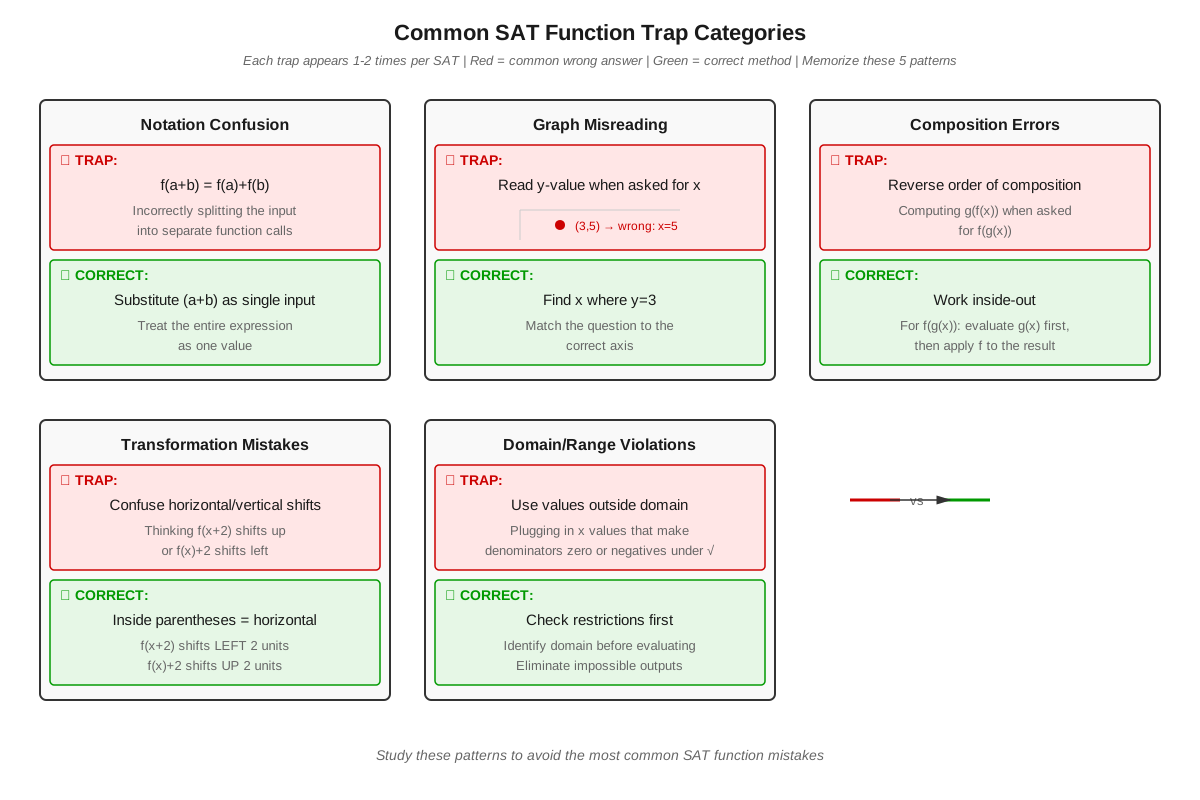
Function notation represents one of the most fertile grounds for SAT traps. The notation f(x) means "the output of function f when the input is x," but trap questions exploit several common confusions. Students often mistakenly treat f(x) as multiplication (f times x) or confuse f(a) with f(x) = a. The SAT deliberately constructs wrong answer choices that match these errors.
When evaluating f(3) for a function f(x) = 2x² - 5, the correct process involves substituting 3 for every instance of x: f(3) = 2(3)² - 5 = 2(9) - 5 = 18 - 5 = 13. Common trap answers include 13 (correct), 11 (from calculating 2(3²) - 5 incorrectly as 2·3·3 - 5 = 11), 31 (from calculating 2·3² - 5 as 2·9 - 5 but making an arithmetic error), and 1 (from substituting incorrectly as 2·3 - 5).
Composition Function Traps
Function composition, written as f(g(x)) or (f ∘ g)(x), means "apply g first, then apply f to that result." The SAT creates traps by offering answer choices that represent g(f(x)) instead, or that represent f(x) + g(x), or that show only one function applied. The order matters critically: f(g(3)) means evaluate g(3) first to get a number, then evaluate f at that number.
For example, if f(x) = x + 4 and g(x) = 2x, then f(g(3)) requires first calculating g(3) = 2(3) = 6, then calculating f(6) = 6 + 4 = 10. Trap answers include 10 (correct), 11 (from calculating g(f(3)) in reverse order: f(3) = 7, then g(7) = 14, with an arithmetic error), 14 (from correctly calculating g(f(3)) but in the wrong order), and 7 (from only applying one function).
Graphical Interpretation Traps
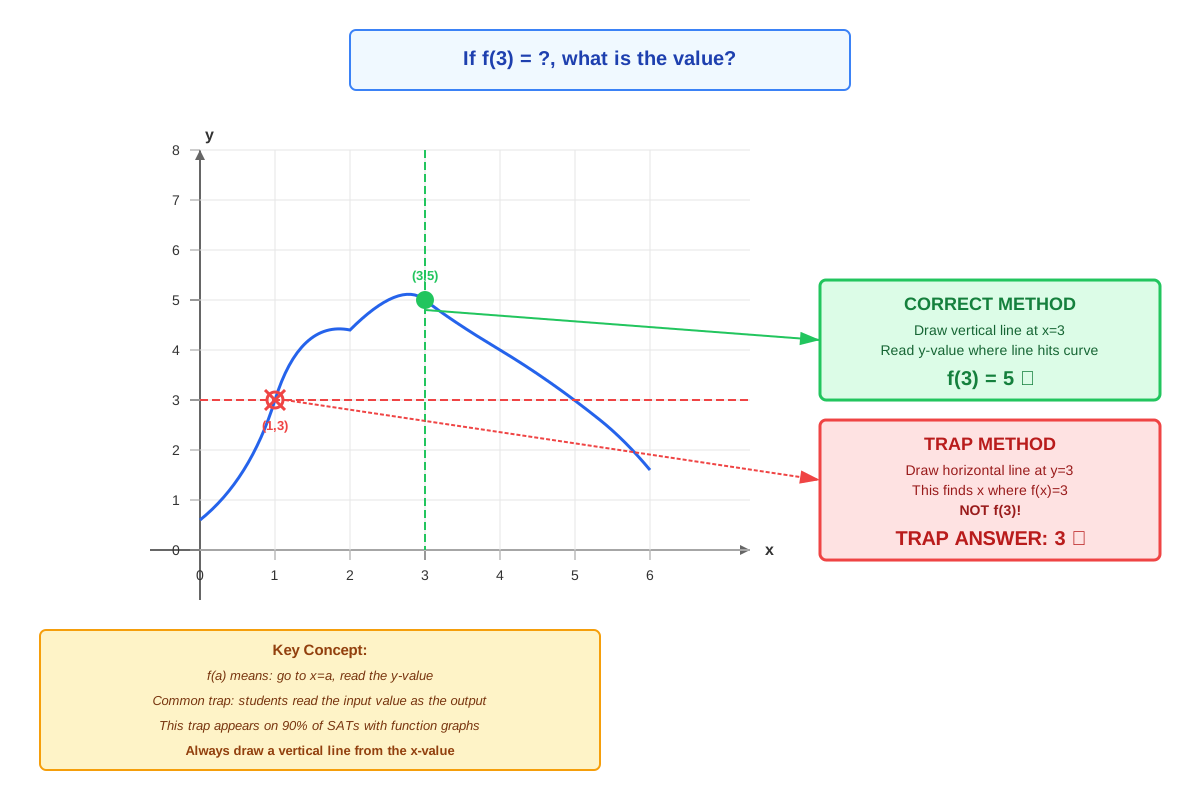
When functions are presented graphically, the SAT exploits visual confusion and coordinate misreading. The most common trap involves confusing x-coordinates with y-coordinates. If a question asks "What is f(2)?" students must find x = 2 on the horizontal axis, trace up or down to the function curve, then read the y-coordinate—but trap answers will include the x-coordinate itself or coordinates from nearby points.
Another graphical trap involves confusing the concepts of "f(x) = 3" versus "f(3)." The question "For what value of x does f(x) = 3?" asks where the function's output equals 3 (find y = 3, trace to the curve, read the x-coordinate), while "What is f(3)?" asks for the output when input is 3 (find x = 3, trace to the curve, read the y-coordinate). These are inverse operations, and the SAT deliberately includes both values as answer choices.
Domain and Range Traps
Domain (possible input values) and range (possible output values) questions create traps through boundary confusion and inequality misinterpretation. When a function is defined as f(x) = √(x - 2), the domain is x ≥ 2 (since square roots of negative numbers aren't real). Trap answers include x > 2 (missing the boundary point), x ≥ -2 (sign error), or x ≤ 2 (inequality direction reversed).
Graphical domain and range questions create additional traps. If a graph shows a function defined from x = -3 to x = 5 with a closed dot at -3 and an open dot at 5, the domain is -3 ≤ x < 5. Trap answers include -3 < x < 5 (missing that -3 is included), -3 ≤ x ≤ 5 (missing that 5 is excluded), or -3 < x ≤ 5 (reversing which endpoint is included).
Transformation Traps
Function transformations generate some of the highest-yield traps on the SAT. The function g(x) = f(x - 3) represents a horizontal shift right by 3 units (not left!), while g(x) = f(x) + 3 represents a vertical shift up by 3 units. The SAT exploits the counterintuitive nature of horizontal shifts: subtracting inside the function shifts right, adding shifts left.
| Transformation | Notation | Direction | Common Trap |
|---|---|---|---|
| Horizontal shift right | f(x - h) where h > 0 | Right h units | Thinking it shifts left |
| Horizontal shift left | f(x + h) where h > 0 | Left h units | Thinking it shifts right |
| Vertical shift up | f(x) + k where k > 0 | Up k units | Confusing with horizontal |
| Vertical shift down | f(x) - k where k > 0 | Down k units | Sign error |
| Vertical stretch | a·f(x) where a > 1 | Stretch by factor a | Confusing with horizontal |
| Horizontal stretch | f(x/b) where b > 1 | Stretch by factor b | Getting reciprocal wrong |
| Reflection over x-axis | -f(x) | Flip vertically | Confusing with y-axis reflection |
| Reflection over y-axis | f(-x) | Flip horizontally | Confusing with x-axis reflection |
Inverse Function Traps
When dealing with inverse functions, denoted f⁻¹(x), students must remember that f⁻¹(f(x)) = x and f(f⁻¹(x)) = x. The trap lies in confusing inverse functions with reciprocal functions: f⁻¹(x) does NOT mean 1/f(x). If f(3) = 7, then f⁻¹(7) = 3 (the inverse "undoes" the function). Trap answers include 1/7 (treating it as reciprocal), -7 (sign error), or 3/7 (combining both errors).
Graphically, inverse functions are reflections over the line y = x. If point (a, b) is on the graph of f(x), then point (b, a) is on the graph of f⁻¹(x). The SAT creates traps by offering coordinates that represent other transformations or by including the original point unchanged.
Concept Relationships
The core concepts of function traps interconnect in a hierarchical structure. Function notation mastery forms the foundation → enabling correct function evaluation → which is prerequisite for function composition → which combines with transformation understanding to enable analysis of complex function relationships.
Graphical interpretation connects bidirectionally with all other concepts: algebraic function notation can be visualized graphically, transformations can be understood both algebraically and visually, and domain/range restrictions appear both in algebraic constraints and graphical boundaries. Domain and range analysis depends on function notation understanding and often requires graphical interpretation skills.
Inverse functions represent the synthesis of multiple concepts: they require solid function notation understanding, connect to graphical interpretation through reflection over y = x, and relate to composition through the identity property f(f⁻¹(x)) = x. Transformation traps often appear in combination with inverse function questions, creating multi-layered challenges.
The relationship to prerequisite topics flows as follows: Basic algebra → Function notation → Function evaluation → Function traps. Similarly, Coordinate geometry → Graphical interpretation → Graphical function traps. These parallel tracks converge in comprehensive function trap questions that test multiple skills simultaneously.
Quick check — test yourself on SAT function traps so far.
Try Flashcards →High-Yield Facts
⭐ Function notation f(a) means substitute a for x in the function expression, not multiply f by a
⭐ For composition f(g(x)), always evaluate the inner function g first, then apply f to that result
⭐ On a graph, f(a) is found by locating x = a and reading the y-coordinate, not the x-coordinate
⭐ The transformation f(x - h) shifts the graph RIGHT by h units, not left (counterintuitive but critical)
⭐ The inverse function f⁻¹(x) is NOT the same as the reciprocal 1/f(x)
- Domain restrictions from square roots require the expression inside to be non-negative (≥ 0)
- Domain restrictions from denominators require the denominator to be non-zero (≠ 0)
- A closed dot on a graph means that point IS included in the domain/range (≤ or ≥)
- An open dot on a graph means that point is NOT included in the domain/range (< or >)
- Vertical line test determines if a graph represents a function: any vertical line intersects at most once
- The transformation -f(x) reflects over the x-axis, while f(-x) reflects over the y-axis
- If f(a) = b, then f⁻¹(b) = a (inverse functions swap inputs and outputs)
- Horizontal stretches and compressions work opposite to intuition: f(x/2) stretches by factor 2
- The range of f(x) becomes the domain of f⁻¹(x), and vice versa
- When multiple transformations apply, order matters: work inside parentheses first, then outside operations
Common Misconceptions
Misconception: f(x + 2) means add 2 to the function's output → Correction: f(x + 2) means substitute (x + 2) for every x in the function definition, which shifts the graph left by 2 units, not up by 2 units
Misconception: f(g(x)) and g(f(x)) give the same result because multiplication is commutative → Correction: Function composition is NOT commutative; the order matters critically because you're applying operations in sequence, not multiplying numbers
Misconception: On a graph, to find f(3), locate the point where y = 3 → Correction: To find f(3), locate where x = 3 on the horizontal axis, then read the corresponding y-value; you're looking for the output when input is 3
Misconception: The domain of f(x) = 1/(x - 5) is x = 5 → Correction: The domain is all real numbers EXCEPT x = 5, written as x ≠ 5 or (-∞, 5) ∪ (5, ∞); the value that makes the denominator zero is excluded, not included
Misconception: f⁻¹(x) = 1/f(x) because the negative exponent means reciprocal → Correction: The superscript -1 in function notation indicates the inverse function (which "undoes" f), not the reciprocal; this is completely different notation from numerical exponents
Misconception: If a graph has an open dot at x = 2, then 2 is in the domain → Correction: An open dot means that specific point is NOT included; the function approaches but never reaches that point, so 2 is excluded from the domain
Misconception: The transformation 2f(x) shifts the graph up by 2 → Correction: The transformation 2f(x) vertically stretches the graph by a factor of 2 (multiplies all y-values by 2); to shift up by 2, the transformation would be f(x) + 2
Misconception: When finding where f(x) = 5 on a graph, read the x-coordinate at the point where the graph crosses x = 5 → Correction: To find where f(x) = 5, locate y = 5 on the vertical axis, trace horizontally to the graph, then read the x-coordinate; you're finding which input produces output 5
Worked Examples
Example 1: Composition and Evaluation Trap
Problem: If f(x) = x² - 3 and g(x) = 2x + 1, what is the value of f(g(2))?
Step 1 - Identify what's being asked: This is a composition problem asking for f(g(2)), which means evaluate g(2) first, then apply f to that result.
Step 2 - Evaluate the inner function:
g(2) = 2(2) + 1 = 4 + 1 = 5
Step 3 - Evaluate the outer function using the result from Step 2:
f(5) = (5)² - 3 = 25 - 3 = 22
Step 4 - Verify by checking trap answers:
- Correct answer: 22
- Trap answer (reversing order): g(f(2)) = g(2² - 3) = g(1) = 2(1) + 1 = 3
- Trap answer (adding functions): f(2) + g(2) = (4 - 3) + 5 = 6
- Trap answer (multiplying): f(2) × g(2) = 1 × 5 = 5
The correct answer is 22. This problem tests whether students understand composition order and can resist the temptation to reverse the order or combine functions incorrectly.
Example 2: Graphical Transformation Trap
Problem: The graph of y = f(x) passes through the point (4, -2). Through which point must the graph of y = f(x - 3) + 1 pass?
Step 1 - Understand the transformations:
- f(x - 3) represents a horizontal shift RIGHT by 3 units
- Adding 1 represents a vertical shift UP by 1 unit
Step 2 - Apply horizontal transformation to x-coordinate:
Original x-coordinate: 4
After shifting right 3 units: 4 + 3 = 7
Step 3 - Apply vertical transformation to y-coordinate:
Original y-coordinate: -2
After shifting up 1 unit: -2 + 1 = -1
Step 4 - State the new point and identify traps:
New point: (7, -1)
Trap answers that would appear:
- (1, -1): From shifting LEFT 3 instead of right (falling for the counterintuitive horizontal shift)
- (7, -3): From shifting DOWN 1 instead of up (sign error)
- (1, -3): From making both errors
- (4, -1): From only applying the vertical shift
The correct answer is (7, -1). This problem tests understanding of transformation direction, particularly the counterintuitive horizontal shift, and whether students can apply multiple transformations correctly.
Exam Strategy
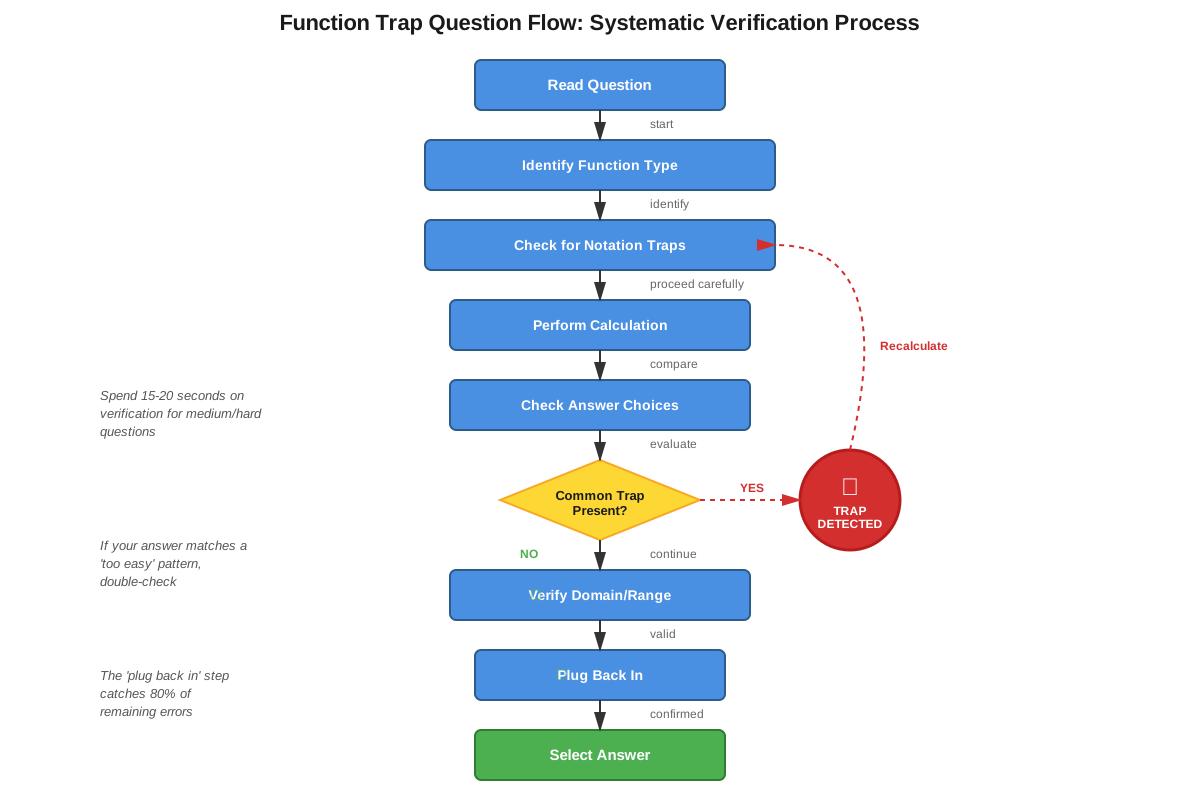
When approaching SAT function trap questions, implement a systematic verification process before selecting an answer. First, read the question twice to identify exactly what's being asked—distinguish between "find f(3)" versus "find x when f(x) = 3" versus "find f(g(3))." These sound similar but require completely different approaches.
Trigger words and phrases to watch for:
- "composed with" or "composition" → signals f(g(x)) or g(f(x))
- "inverse function" → signals f⁻¹(x), not reciprocal
- "shifted" or "translated" → signals transformation, check direction carefully
- "for what value of x" → you're solving for input, not output
- "what is the value of f(x)" → you're finding output, not input
Process of elimination strategy: Before calculating, predict what trap answers will look like. If evaluating f(g(3)), expect wrong answers to include g(f(3)) (reversed order), f(3) + g(3) (added instead of composed), and f(3) × g(3) (multiplied). Calculate your answer, then verify it's not one of the predictable traps. If your answer matches a trap pattern, recalculate.
Time allocation: Spend 15-20 seconds reading and understanding what's being asked, 30-45 seconds calculating, and 10-15 seconds verifying. Rushing through function trap questions costs more time in the long run because wrong answers require returning to the problem later. For graphical questions, physically point to coordinates on the graph to avoid visual confusion.
Graphical question strategy: When working with graphs, use your pencil to mark points clearly. For f(3), draw a vertical line at x = 3, mark where it intersects the function, then draw a horizontal line to the y-axis. This physical process prevents coordinate confusion. For transformation questions, sketch the transformation if time permits—visual confirmation catches errors.
Calculator usage: On calculator-permitted sections, verify function evaluations by entering the function into Y1 and checking the table or graph. However, be cautious with composition—calculate the inner function first, write down that value, then evaluate the outer function. Don't try to compose functions in a single calculator entry unless you're extremely confident.
Memory Techniques
INSIDE-OUTSIDE for composition: When you see f(g(x)), remember "Inside Out"—evaluate the Inside function (g) first, then work Outward to f. Visualize peeling an onion from the inside out.
OPPOSITE for horizontal shifts: Horizontal transformations work OPPOSITE to intuition. Remember "Opposite Parentheses": f(x - 3) goes Opposite direction → right, not left. Create a mental image of a stubborn function that does the opposite of what you tell it horizontally.
SWAP for inverse functions: Inverse functions SWAP inputs and outputs. If f(a) = b, then f⁻¹(b) = a. Visualize two people swapping positions—the input becomes the output, the output becomes the input.
X-MARKS-INPUT, Y-YIELDS-OUTPUT: When reading graphs, remember "X marks the input" (find x first) and "Y yields the output" (read y second). This prevents coordinate confusion.
NEGATIVE-LOCATION mnemonic: For reflections, remember where the negative appears:
- -f(x): negative Outside → flip Over x-axis
- f(-x): negative Inside → flip In the y-axis direction
DOMAIN-DENOMINATOR-DANGER: For domain restrictions, remember "Denominator Danger"—denominators can't be zero. For square roots, remember "Root Requires non-negative"—the expression inside must be ≥ 0.
Summary
SAT function traps represent strategically designed questions that exploit common errors in function notation, composition, graphical interpretation, transformations, and inverse functions. Success requires understanding that f(a) means substituting a into the function (not multiplication), that composition f(g(x)) requires evaluating g first then f (order matters), and that graphical questions demand careful attention to which coordinate is being requested. Transformation traps particularly exploit the counterintuitive nature of horizontal shifts—f(x - h) shifts right, not left. Domain and range questions create traps through boundary confusion and inequality misinterpretation, while inverse function questions exploit confusion between f⁻¹(x) and 1/f(x). The key to avoiding these traps lies in systematic verification: predict what trap answers will look like, calculate carefully using proper order of operations, and verify the answer makes sense before selecting it. Students who master function traps gain significant competitive advantage because these questions appear frequently and effectively differentiate between surface-level and deep understanding.
Key Takeaways
- Function notation f(a) means substitute a for every x in the function definition, and f(g(x)) requires evaluating the inner function g first before applying f
- Graphical interpretation requires finding the correct coordinate: f(3) means locate x = 3 and read the y-value, while f(x) = 3 means locate y = 3 and read the x-value
- Horizontal transformations work opposite to intuition: f(x - h) shifts RIGHT by h units, while f(x + h) shifts LEFT by h units
- Inverse functions f⁻¹(x) swap inputs and outputs and are NOT the same as reciprocals 1/f(x)
- Domain restrictions come from denominators (can't be zero) and square roots (expression inside must be non-negative)
- Trap answers are predictable: expect reversed composition, wrong transformation direction, swapped coordinates, and boundary errors
- Systematic verification prevents trap errors: read carefully, calculate methodically, and check that your answer isn't a predictable trap before selecting
Related Topics
Function Modeling and Word Problems: After mastering function traps, students can tackle complex word problems where functions model real-world situations, applying trap-avoidance skills to interpret context correctly and avoid misreading what quantities represent inputs versus outputs.
Quadratic Functions and Parabolas: Understanding function transformations enables deeper analysis of how quadratic functions shift, stretch, and reflect, building on transformation concepts to analyze vertex form and standard form relationships.
Exponential and Logarithmic Functions: Inverse function concepts extend naturally to logarithms (which are inverses of exponentials), and composition skills apply to solving complex exponential equations.
Systems of Equations with Functions: Function trap skills enable accurate interpretation of systems where functions intersect, requiring students to distinguish between solving f(x) = g(x) versus evaluating f(g(x)).
Rational Functions and Asymptotes: Domain restriction concepts from function traps extend to analyzing vertical asymptotes, holes, and horizontal asymptotes in rational functions, where denominator restrictions create critical features.
Practice CTA
Now that you've mastered the concepts behind SAT function traps, it's time to put your knowledge into action! Work through the practice questions to reinforce your understanding and build the pattern recognition that leads to automatic trap detection. Each practice problem you solve strengthens your ability to spot these traps instantly on test day. Remember, the students who score highest aren't necessarily the fastest calculators—they're the ones who recognize traps before falling into them. Review the flashcards to cement the high-yield facts and transformation rules in your memory. You've built the foundation; now practice makes permanent!
Sign up free to keep reading
Create a free AnvayaPrep account to finish this SAT guide on SAT function traps — plus flashcards and practice questions.