Overview
Coordinate angles represent one of the most frequently tested intersections of algebra and geometry on the SAT math section. This topic requires students to work with angles formed by lines, rays, and segments within the coordinate plane, combining knowledge of slope, linear equations, and angle relationships. Unlike traditional geometry problems that present angles in isolated diagrams, sat coordinate angles questions embed angular relationships within the x-y coordinate system, requiring students to translate between algebraic representations (equations of lines) and geometric properties (angle measures).
Mastering coordinate angles is essential for SAT success because these questions appear in both the calculator and no-calculator sections, often as medium-to-hard difficulty problems worth crucial points. Students must recognize when a question about lines, slopes, or intersections is actually testing angle relationships, and vice versa. The topic bridges pure coordinate geometry with angle theorems, making it a high-yield area that rewards students who can fluidly move between algebraic and geometric thinking.
This topic connects directly to fundamental concepts including slope calculation, parallel and perpendicular lines, linear equations, and basic angle relationships (complementary, supplementary, vertical angles). Strong performance on coordinate angles questions demonstrates mathematical maturity and the ability to synthesize multiple concepts simultaneously—exactly what the SAT is designed to assess. Students who master this material gain confidence tackling complex multi-step problems that integrate various mathematical domains.
Learning Objectives
- [ ] Identify key features of coordinate angles, including angles formed by intersecting lines and angles between lines and axes
- [ ] Explain how coordinate angles appears on the SAT, including question formats and common problem types
- [ ] Apply coordinate angles to answer SAT-style questions involving slope relationships and angle measures
- [ ] Calculate angle measures using slope relationships and inverse trigonometric functions
- [ ] Determine whether lines are parallel, perpendicular, or neither using angle and slope criteria
- [ ] Solve multi-step problems combining coordinate geometry with angle theorems
- [ ] Interpret geometric relationships algebraically and translate algebraic information into geometric conclusions
Prerequisites
- Slope calculation and interpretation: Essential for determining angle relationships between lines, as slope directly relates to the angle a line makes with the x-axis
- Linear equations in various forms: Necessary to extract slope information and identify parallel/perpendicular relationships from equations
- Basic angle relationships: Understanding of complementary, supplementary, and vertical angles provides the foundation for analyzing angles in the coordinate plane
- Properties of parallel and perpendicular lines: Critical for recognizing when lines form specific angle relationships based on their slopes
- Basic trigonometry (tangent function): Helpful for connecting slope values to actual angle measures when required
Why This Topic Matters
Coordinate angles questions appear on virtually every SAT administration, typically comprising 2-4 questions across both math sections. These problems test mathematical reasoning at a higher level than simple computation, requiring students to recognize patterns, apply multiple concepts simultaneously, and work efficiently under time pressure. The College Board frequently uses coordinate angles to differentiate between students scoring in the 600s versus those achieving 700+ scores.
In real-world applications, coordinate angles underpin fields ranging from computer graphics and game design to engineering and architecture. Navigation systems use coordinate angles to calculate bearings and directions. Architects employ these concepts when designing structures with specific angular requirements. Computer programmers working with graphics must constantly translate between coordinate positions and angular rotations. Understanding how angles behave in coordinate systems is fundamental to spatial reasoning in countless technical careers.
On the SAT, coordinate angles typically appear in several formats: direct questions asking for angle measures given line equations, problems requiring students to find slopes that create specific angle relationships, questions about parallel or perpendicular lines disguised as angle problems, and complex scenarios combining multiple geometric and algebraic concepts. These questions often appear in the latter half of each math section, positioned as medium-to-hard difficulty problems that separate high scorers from the rest.
Core Concepts
Angles and Slope Relationship
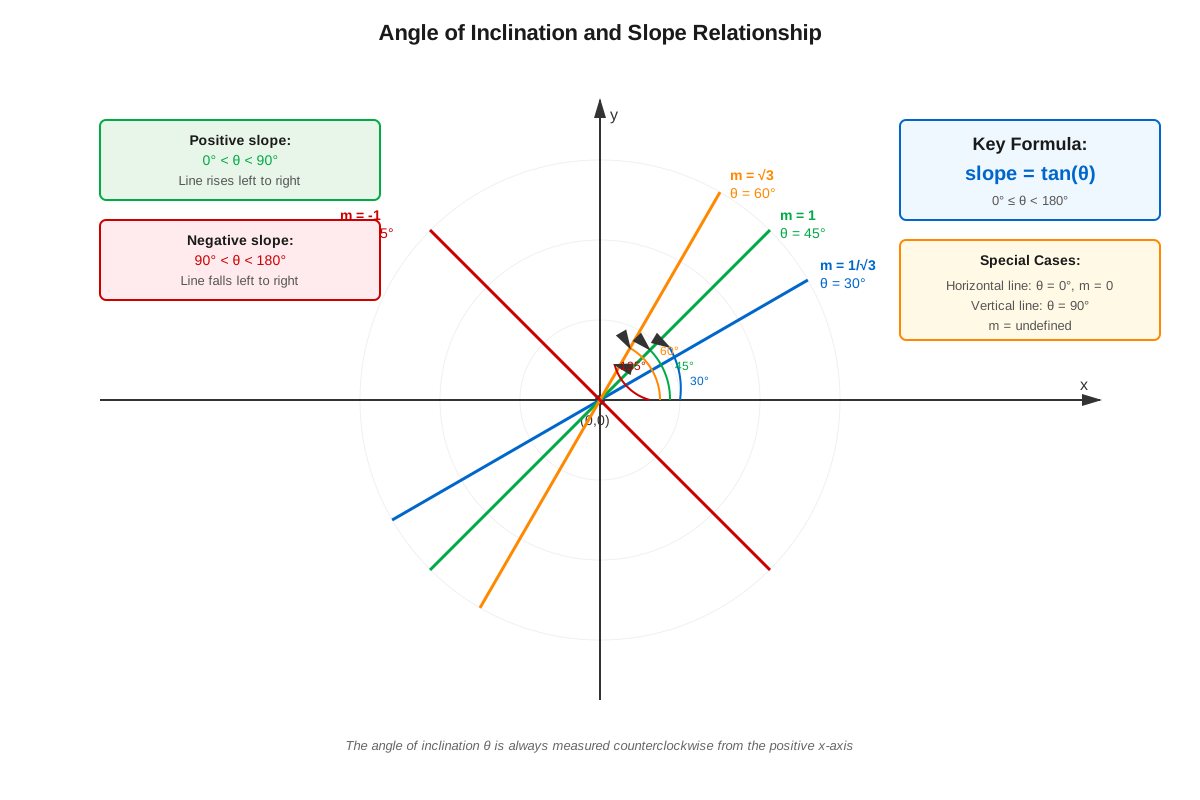
The fundamental connection in coordinate angles is between a line's slope and the angle it forms with the positive x-axis. When a line has slope m, the angle θ (theta) that the line makes with the positive x-axis satisfies the relationship:
tan(θ) = mThis means that if you know a line's slope, you can determine the angle it makes with the x-axis using the inverse tangent function (arctan or tan⁻¹). Conversely, if you know the angle, you can find the slope. For example, a line with slope 1 makes a 45° angle with the x-axis because tan(45°) = 1. A line with slope √3 makes a 60° angle with the x-axis because tan(60°) = √3.
Understanding this relationship allows students to move fluidly between algebraic descriptions (slope) and geometric properties (angle measures). The SAT rarely requires calculator-intensive trigonometry but frequently tests whether students recognize these fundamental connections.
Angles Between Two Lines
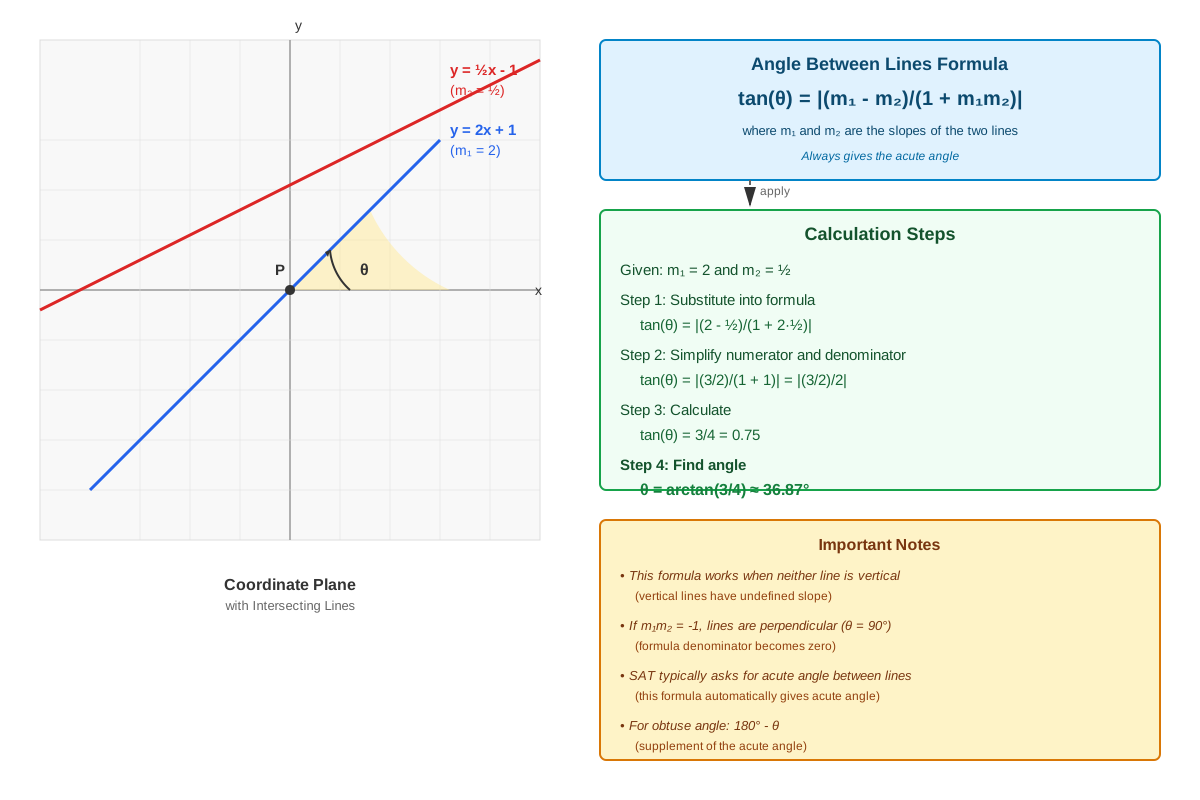
When two lines intersect in the coordinate plane, they form four angles. If the lines have slopes m₁ and m₂, the acute angle α between them can be found using the formula:
tan(α) = |m₁ - m₂| / (1 + m₁m₂)However, the SAT more commonly tests this concept through special cases rather than requiring direct application of this formula. The most important special cases involve parallel lines and perpendicular lines.
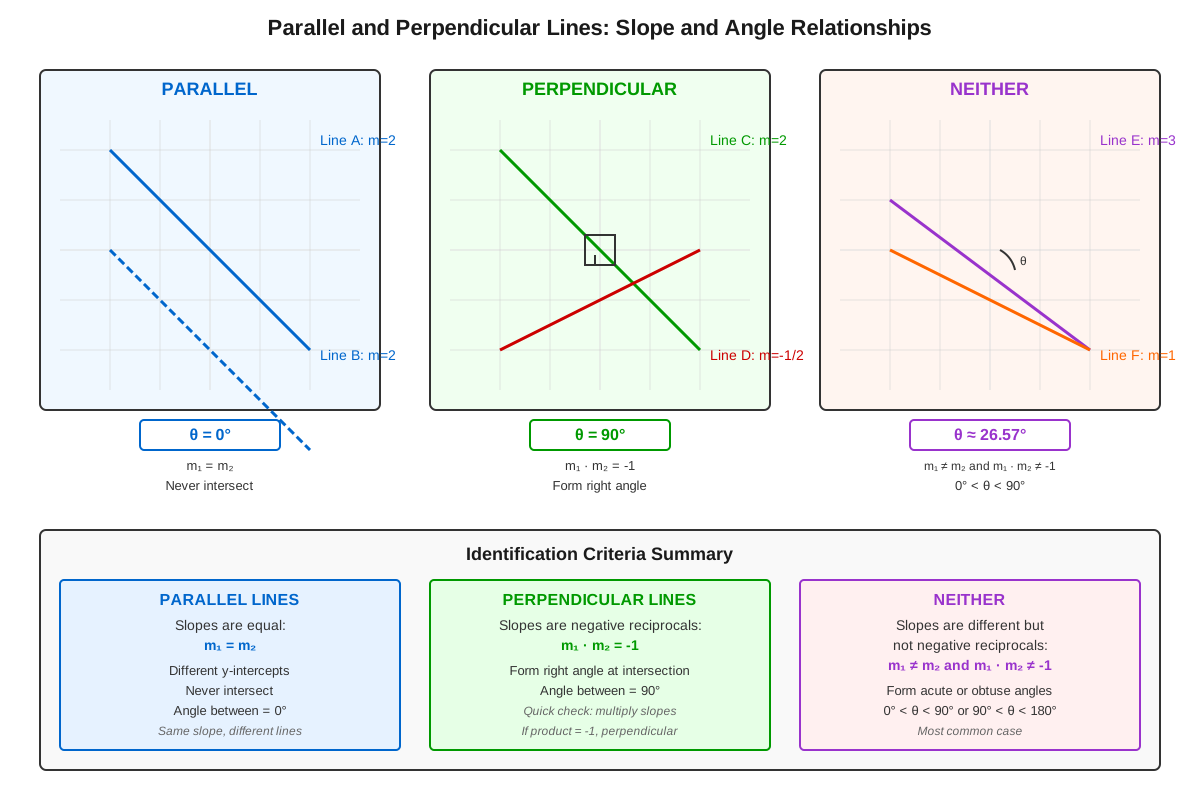
Parallel lines have equal slopes (m₁ = m₂) and form 0° angles with each other. When two lines are parallel, they never intersect, and any transversal crossing them creates predictable angle relationships (corresponding angles equal, alternate interior angles equal, etc.).
Perpendicular lines have slopes that are negative reciprocals of each other (m₁ = -1/m₂, or equivalently, m₁ × m₂ = -1). Perpendicular lines form 90° angles where they intersect. For example, if one line has slope 2/3, a perpendicular line must have slope -3/2.
Horizontal and Vertical Lines
Special attention must be paid to horizontal and vertical lines in coordinate angles problems:
- Horizontal lines (form y = k) have slope 0 and run parallel to the x-axis, forming 0° angles with it
- Vertical lines (form x = h) have undefined slope and run parallel to the y-axis, forming 90° angles with the x-axis
- Horizontal and vertical lines are always perpendicular to each other
These special cases frequently appear in SAT problems because they test whether students truly understand slope as a concept rather than just memorizing formulas.
Angle Relationships in Coordinate Geometry
When lines intersect in the coordinate plane, all standard angle relationships apply:
| Angle Type | Definition | Key Property |
|---|---|---|
| Vertical angles | Opposite angles formed by intersecting lines | Always equal in measure |
| Linear pairs | Adjacent angles on a straight line | Sum to 180° (supplementary) |
| Complementary angles | Two angles summing to 90° | Often formed with perpendicular lines |
| Supplementary angles | Two angles summing to 180° | Formed by linear pairs |
The SAT frequently combines these relationships with coordinate geometry by providing line equations and asking students to determine angle measures or relationships. Success requires recognizing which angle theorem applies and correctly extracting slope information from the given equations.
Finding Angles from Line Equations
To solve coordinate angles problems efficiently, students must quickly extract slope information from various equation forms:
- Slope-intercept form (y = mx + b): slope is m
- Point-slope form (y - y₁ = m(x - x₁)): slope is m
- Standard form (Ax + By = C): slope is -A/B
- Two points (x₁, y₁) and (x₂, y₂): slope is (y₂ - y₁)/(x₂ - x₁)
Once slopes are identified, students can determine angle relationships using the perpendicular and parallel line criteria, or calculate specific angle measures when needed.
Angles with Coordinate Axes
Lines in the coordinate plane form specific angles with both the x-axis and y-axis. Understanding these relationships helps solve problems efficiently:
- A line with positive slope forms an acute angle with the positive x-axis (0° < θ < 90°)
- A line with negative slope forms an obtuse angle with the positive x-axis (90° < θ < 180°), or equivalently, an acute angle measured from the negative x-axis
- The angle a line makes with the y-axis is complementary to the angle it makes with the x-axis (they sum to 90°)
These relationships allow students to quickly estimate angle measures and eliminate unreasonable answer choices.
Concept Relationships
The concepts within coordinate angles form an interconnected web where each element supports and reinforces the others. The foundational relationship is: Slope → Angle with x-axis → Angle relationships between lines. Understanding slope as the tangent of an angle provides the bridge between algebra and geometry.
This foundation connects to parallel lines (equal slopes, zero angle between them) and perpendicular lines (negative reciprocal slopes, 90° angle between them), which are the most frequently tested special cases. These special cases then connect to broader angle theorems (vertical angles, linear pairs, supplementary angles) that apply whenever lines intersect.
The prerequisite knowledge of linear equations feeds into coordinate angles by providing multiple ways to represent lines, each requiring slope extraction. Similarly, basic angle relationships from pure geometry transfer directly into the coordinate plane, with the added complexity of algebraic representations.
Coordinate angles also connects forward to more advanced topics including vectors (which can be described by angles and magnitudes), trigonometric functions (which formalize the angle-slope relationship), and transformations (rotations are described by angles in the coordinate plane). Mastering coordinate angles thus serves as a gateway to higher-level mathematical thinking.
High-Yield Facts
⭐ If two lines are perpendicular, the product of their slopes equals -1 (m₁ × m₂ = -1), assuming neither line is vertical
⭐ If two lines are parallel, their slopes are equal (m₁ = m₂)
⭐ The slope of a line equals the tangent of the angle it makes with the positive x-axis (m = tan θ)
⭐ Vertical angles formed by intersecting lines are always equal in measure
⭐ A line with slope 1 makes a 45° angle with the x-axis, and a line with slope -1 makes a 135° angle (or -45°)
- Horizontal lines have slope 0 and are perpendicular to all vertical lines
- The angle between a line and the x-axis is always measured counterclockwise from the positive x-axis
- When two lines intersect, they form two pairs of vertical angles and four linear pairs
- The slopes of perpendicular lines are negative reciprocals: if one slope is a/b, the perpendicular slope is -b/a
- Lines with positive slopes rise from left to right; lines with negative slopes fall from left to right
- The steeper a line appears, the greater the absolute value of its slope
- Complementary angles sum to 90°; supplementary angles sum to 180°
- The angle a line makes with the y-axis equals 90° minus the angle it makes with the x-axis
Quick check — test yourself on Coordinate angles so far.
Try Flashcards →Common Misconceptions
Misconception: Perpendicular lines always have slopes that are opposite in sign and equal in magnitude (like 2 and -2).
Correction: Perpendicular lines have slopes that are negative reciprocals, not just negatives. If one slope is 2, the perpendicular slope is -1/2, not -2. The product of perpendicular slopes must equal -1.
Misconception: The angle between two lines is found by simply subtracting their slopes.
Correction: Angle measures cannot be found by subtracting slopes directly. You must use the relationship tan(θ) = m to convert slopes to angles, or use the angle-between-lines formula. Alternatively, recognize special cases (parallel or perpendicular) without calculating specific angle measures.
Misconception: A line with slope 2 makes a 2° angle with the x-axis.
Correction: Slope is the tangent of the angle, not the angle itself. A line with slope 2 makes an angle θ where tan(θ) = 2, which is approximately 63.4°, not 2°. The slope value and angle measure are related but not equal.
Misconception: Vertical lines have slope 0.
Correction: Vertical lines have undefined slope (division by zero), not slope 0. Horizontal lines have slope 0. This distinction is critical when determining perpendicularity: horizontal and vertical lines are perpendicular, but their slopes don't satisfy m₁ × m₂ = -1 because you cannot multiply by undefined.
Misconception: If two lines form a 45° angle, one must have slope 1.
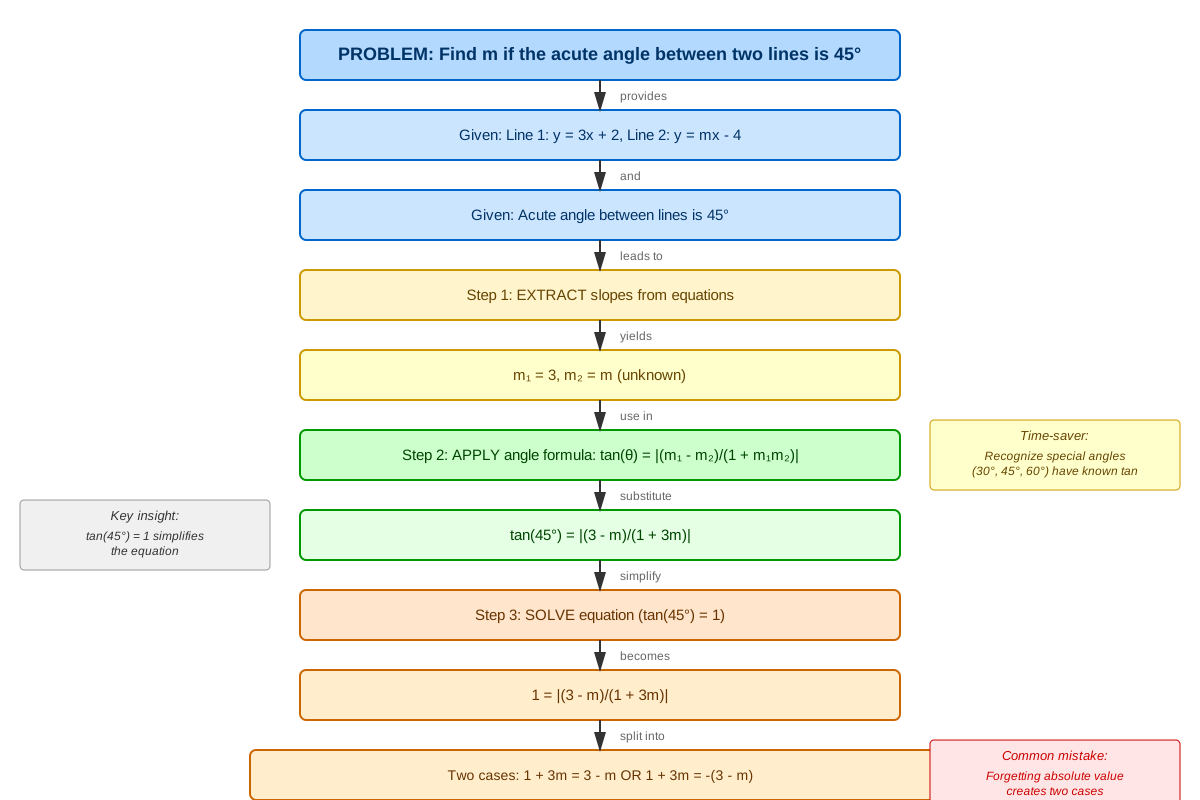
Correction: The 45° angle could be the angle between the two lines, not necessarily the angle either line makes with the x-axis. Two lines with slopes 0 and 1 form a 45° angle, but so do lines with slopes 2 and -1/3 (approximately). The angle between lines depends on both slopes, not just one.
Misconception: Parallel lines never form angles.
Correction: Parallel lines form 0° angles with each other, but they still form angles with the coordinate axes and with any transversal that crosses them. When a transversal crosses parallel lines, it creates eight angles with specific relationships (corresponding angles equal, alternate interior angles equal, etc.).
Worked Examples
Example 1: Finding Perpendicular Line Slope
Problem: Line ℓ passes through points (-2, 5) and (4, 8). Line m is perpendicular to line ℓ. What is the slope of line m?
Solution:
Step 1: Find the slope of line ℓ using the two given points.
m_ℓ = (y₂ - y₁)/(x₂ - x₁) = (8 - 5)/(4 - (-2)) = 3/6 = 1/2Step 2: Recognize that perpendicular lines have slopes that are negative reciprocals.
Step 3: Find the negative reciprocal of 1/2.
- The reciprocal of 1/2 is 2/1 = 2
- The negative reciprocal is -2
Step 4: Verify using the perpendicularity condition.
m_ℓ × m_m = (1/2) × (-2) = -1 ✓Answer: The slope of line m is -2.
Connection to learning objectives: This problem requires identifying the key feature of perpendicular lines (negative reciprocal slopes) and applying the coordinate angles concept to find an unknown slope. This type of question appears frequently on the SAT, testing whether students understand the relationship between perpendicularity and slope.
Example 2: Angle Relationships with Line Equations
Problem: In the xy-plane, line p has equation y = 3x + 7 and line q has equation 6x + 2y = 10. Lines p and q intersect at point R. What is the measure of one of the acute angles formed at point R?
Solution:
Step 1: Find the slope of line p from its equation.
- Line p: y = 3x + 7 is in slope-intercept form
- Slope of p: m_p = 3
Step 2: Find the slope of line q by converting to slope-intercept form.
6x + 2y = 10
2y = -6x + 10
y = -3x + 5- Slope of q: m_q = -3
Step 3: Check if the lines are perpendicular.
m_p × m_q = 3 × (-3) = -9 ≠ -1The lines are not perpendicular, so they don't form 90° angles.
Step 4: Recognize the relationship between the slopes.
- Notice that m_q = -1/m_p is not true, but m_p and m_q are negative reciprocals if we consider 3 and -1/3
- Actually, m_p = 3 and m_q = -3 means these slopes are negatives of each other, not negative reciprocals
Step 5: Use the angle-between-lines formula or recognize the pattern.
- Since the slopes are 3 and -3, we can use: tan(α) = |m₁ - m₂|/(1 + m₁m₂)
tan(α) = |3 - (-3)|/(1 + 3(-3)) = |6|/(1 - 9) = 6/(-8) = -3/4- The negative result indicates we should use the absolute value: |tan(α)| = 3/4
- However, this approach is complex for the SAT
Step 6: Alternative approach using angle with x-axis.
- Line p makes angle θ₁ where tan(θ₁) = 3, so θ₁ ≈ 71.6°
- Line q makes angle θ₂ where tan(θ₂) = -3, so θ₂ ≈ 108.4° (or -71.6° from positive x-axis)
- The acute angle between them: 180° - 71.6° - 71.6° = 36.8° or using supplementary relationship
Answer: Without a calculator, the SAT would likely provide answer choices or ask for a relationship rather than a specific degree measure. The key recognition is that the lines are neither parallel nor perpendicular, and they form acute and obtuse angle pairs.
Connection to learning objectives: This problem demonstrates how SAT coordinate angles questions combine multiple concepts: extracting slopes from different equation forms, testing perpendicularity, and understanding angle relationships. It shows why recognizing special cases (parallel and perpendicular) is more efficient than calculating exact angle measures.
Exam Strategy
When approaching SAT coordinate angles questions, begin by identifying what information is given and what is being asked. Look for trigger words like "perpendicular," "parallel," "angle," "slope," and "intersect." These signal that you need to connect geometric relationships with algebraic representations.
Process-of-elimination strategy: If a question asks about perpendicular lines, immediately eliminate any answer choice where the product of slopes doesn't equal -1 (or where slopes aren't negative reciprocals). For parallel lines, eliminate choices where slopes aren't equal. This often narrows options before any calculation is needed.
Time allocation: Coordinate angles questions typically require 1-2 minutes. If you find yourself spending more than 2 minutes, you may be overcomplicating the problem. Look for special cases (perpendicular or parallel lines) rather than trying to calculate exact angle measures. The SAT rarely requires complex trigonometric calculations; instead, it tests conceptual understanding.
Common question patterns to recognize:
- Given two line equations, determine if they're parallel, perpendicular, or neither
- Given one line and a relationship (perpendicular or parallel), find the slope of another line
- Given points or equations, find angle measures using special angle values (30°, 45°, 60°, 90°)
- Given a geometric description, write an equation or find a slope
Red flags that indicate you might be on the wrong track:
- Needing to use inverse tangent functions with non-standard angles
- Getting slope products that are close to but not exactly -1 (check your arithmetic)
- Confusing slope with angle measure directly
- Forgetting that vertical lines have undefined slope, not zero slope
Efficient approach sequence:
- Extract all slope information from given equations or points (15-30 seconds)
- Check for special relationships: parallel (equal slopes) or perpendicular (product = -1) (10-15 seconds)
- Apply relevant angle theorems if lines intersect (vertical angles, linear pairs) (20-30 seconds)
- Verify your answer makes geometric sense (does a positive slope line actually rise left to right?) (10 seconds)
Memory Techniques
Mnemonic for perpendicular slopes: "Negative Reciprocals Produce Perpendiculars" - Remember that perpendicular slopes are Negative Reciprocals, and their Product is -1 (NRPP).
Visualization for slope-angle relationship: Picture a line rotating counterclockwise from the x-axis. As it rotates from 0° to 90°, the slope increases from 0 to infinity (undefined). This mental image helps remember that steeper lines have larger slopes and that vertical lines (90°) have undefined slope.
Acronym for parallel/perpendicular: PEPS - Parallel Equals, Perpendicular Slopes multiply to negative one. Parallel lines have Equal slopes; Perpendicular Slopes multiply to -1.
Memory hook for special angles: Remember "1-1-√2" for 45° angles and "1-√3-2" for 30-60-90 triangles. A line with slope 1 makes a 45° angle; a line with slope √3 makes a 60° angle. These special values appear frequently on the SAT.
Rhyme for horizontal/vertical: "Horizontal is zero, vertical's not there" - Horizontal lines have slope zero; vertical lines have undefined (not there) slope.
Visual memory technique: Draw a quick coordinate plane and sketch lines with slopes 1, -1, 2, -2, 1/2, -1/2. Notice which pairs are perpendicular (1 and -1, 2 and -1/2). This visual reference helps internalize the negative reciprocal relationship.
Summary
Coordinate angles represents the crucial intersection of algebraic and geometric thinking on the SAT, requiring students to translate between line equations and angle relationships. The core principle connecting all coordinate angles concepts is that slope equals the tangent of the angle a line makes with the positive x-axis. From this foundation, two critical special cases emerge: parallel lines have equal slopes and form 0° angles, while perpendicular lines have slopes that are negative reciprocals (product equals -1) and form 90° angles. Success on SAT coordinate angles questions depends on quickly extracting slope information from various equation forms, recognizing parallel and perpendicular relationships, and applying standard angle theorems (vertical angles, linear pairs, supplementary angles) within the coordinate plane. Students must avoid common pitfalls like confusing slope values with angle measures, forgetting that perpendicular slopes are negative reciprocals rather than just negatives, and misidentifying horizontal lines (slope 0) with vertical lines (undefined slope). The SAT tests these concepts through direct questions about angle measures, problems requiring identification of parallel or perpendicular lines, and complex scenarios combining multiple geometric and algebraic ideas.
Key Takeaways
- Slope and angle are connected through the tangent function: m = tan(θ), where θ is the angle with the positive x-axis
- Perpendicular lines have slopes that multiply to -1 (negative reciprocals), which is the most frequently tested relationship
- Parallel lines have equal slopes and never intersect, forming 0° angles with each other
- Extract slope efficiently from any equation form: slope-intercept (m is the coefficient of x), standard form (slope = -A/B), or two points (rise over run)
- Special cases dominate SAT questions: focus on recognizing perpendicular and parallel relationships rather than calculating exact angle measures
- Vertical angles are equal; linear pairs are supplementary - these theorems apply in the coordinate plane just as in pure geometry
- Horizontal lines (slope 0) and vertical lines (undefined slope) are perpendicular to each other and represent important special cases
Related Topics
Transformations in the Coordinate Plane: Building on coordinate angles, transformations (especially rotations) require understanding how angles change when figures are moved. Rotations are described by angle measures around a center point, directly applying coordinate angles concepts.
Vectors and Direction: Vectors in the coordinate plane are described by both magnitude and direction, where direction is expressed as an angle. Mastering coordinate angles provides the foundation for understanding vector components and operations.
Trigonometric Functions: The relationship between slope and angle (m = tan θ) is just the beginning of trigonometry. Further study explores sine, cosine, and their applications to coordinate geometry and periodic functions.
Circles in the Coordinate Plane: Understanding angles becomes crucial when working with circles, including central angles, inscribed angles, and tangent lines (which form 90° angles with radii at the point of tangency).
Parametric Equations: Advanced coordinate geometry uses parametric equations where angles often serve as parameters, describing curves and motion in the plane.
Practice CTA
Now that you've mastered the core concepts of coordinate angles, it's time to solidify your understanding through practice! Attempt the practice questions to test your ability to recognize parallel and perpendicular relationships, extract slopes from various equation forms, and apply angle theorems in the coordinate plane. Use the flashcards to reinforce the key relationships, especially the perpendicular slope criterion and special angle values. Remember, coordinate angles questions are high-yield on the SAT—every minute spent practicing this topic directly translates to points on test day. You've built a strong foundation; now prove your mastery through application!
Sign up free to keep reading
Create a free AnvayaPrep account to finish this SAT guide on Coordinate angles — plus flashcards and practice questions.