Overview
The coordinate plane is one of the most fundamental and frequently tested concepts in SAT math. This two-dimensional grid system, formed by the intersection of a horizontal x-axis and a vertical y-axis, serves as the foundation for visualizing relationships between numbers, graphing equations, and solving geometric problems. On the SAT, coordinate plane questions appear in both the calculator and no-calculator sections, accounting for approximately 10-15% of all math questions. Mastery of this topic is non-negotiable for students aiming for competitive scores.
Understanding the coordinate plane extends far beyond simply plotting points. Students must develop fluency in calculating distances between points, finding midpoints, determining slopes of lines, and analyzing geometric figures positioned on the grid. The SAT frequently integrates coordinate plane concepts with algebra, geometry, and data analysis, making it a bridge topic that connects multiple mathematical domains. Questions may ask students to identify coordinates of vertices, calculate areas of polygons, or determine equations of lines—all requiring solid coordinate plane fundamentals.
The coordinate plane's importance on the SAT stems from its versatility as a problem-solving tool. It transforms abstract algebraic relationships into visual representations, making complex problems more accessible. Additionally, coordinate geometry questions often appear as medium-to-hard difficulty problems worth valuable points. Students who master this topic gain a significant strategic advantage, as these questions become reliable point-earners rather than time-consuming obstacles. The coordinate plane also serves as prerequisite knowledge for more advanced topics including transformations, functions, and conic sections.
Learning Objectives
- [ ] Identify key features of the coordinate plane including axes, quadrants, and origin
- [ ] Explain how coordinate plane concepts appear on the SAT across different question types
- [ ] Apply coordinate plane formulas to answer SAT-style questions involving distance, midpoint, and slope
- [ ] Calculate the distance between any two points using the distance formula
- [ ] Determine the midpoint of a line segment given two endpoints
- [ ] Analyze geometric figures on the coordinate plane to find perimeter, area, and other properties
- [ ] Interpret and plot points accurately in all four quadrants
Prerequisites
- Basic arithmetic operations: Addition, subtraction, multiplication, and division are essential for calculating coordinates, distances, and slopes
- Understanding of positive and negative numbers: The coordinate plane uses both positive and negative values to represent positions in different quadrants
- Square roots and exponents: The distance formula requires computing squares and square roots
- Basic geometry concepts: Knowledge of triangles, rectangles, and other polygons helps when analyzing shapes on the coordinate plane
- Algebraic manipulation: Simplifying expressions and solving equations appears frequently in coordinate plane problems
Why This Topic Matters
The sat coordinate plane serves as a universal language for representing spatial relationships mathematically. In real-world applications, coordinate systems appear in GPS navigation, computer graphics, architecture, engineering, physics simulations, and data visualization. Every time someone uses a map application or plays a video game, coordinate plane principles are at work behind the scenes. Understanding this system develops spatial reasoning skills that extend far beyond mathematics.
On the SAT, coordinate plane questions appear with remarkable consistency. Approximately 4-6 questions per test directly involve coordinate plane concepts, and many additional questions incorporate these ideas indirectly. These questions typically fall into several categories: plotting and identifying points (10-15% of coordinate questions), calculating distance and midpoint (25-30%), finding slopes and equations of lines (30-35%), and analyzing geometric figures on the plane (20-25%). The College Board particularly favors questions that combine coordinate geometry with algebraic reasoning or real-world contexts.
Common SAT question formats include: identifying coordinates of points on a graph, determining which point satisfies a given condition, calculating the area of a triangle or quadrilateral with vertices at specific coordinates, finding the distance a point must move to reach a certain location, and determining relationships between multiple points. The coordinate plane also appears in data interpretation questions where students must read values from scatter plots or analyze trends. Recognizing these patterns helps students approach questions strategically and allocate study time effectively.
Core Concepts
The Coordinate Plane Structure
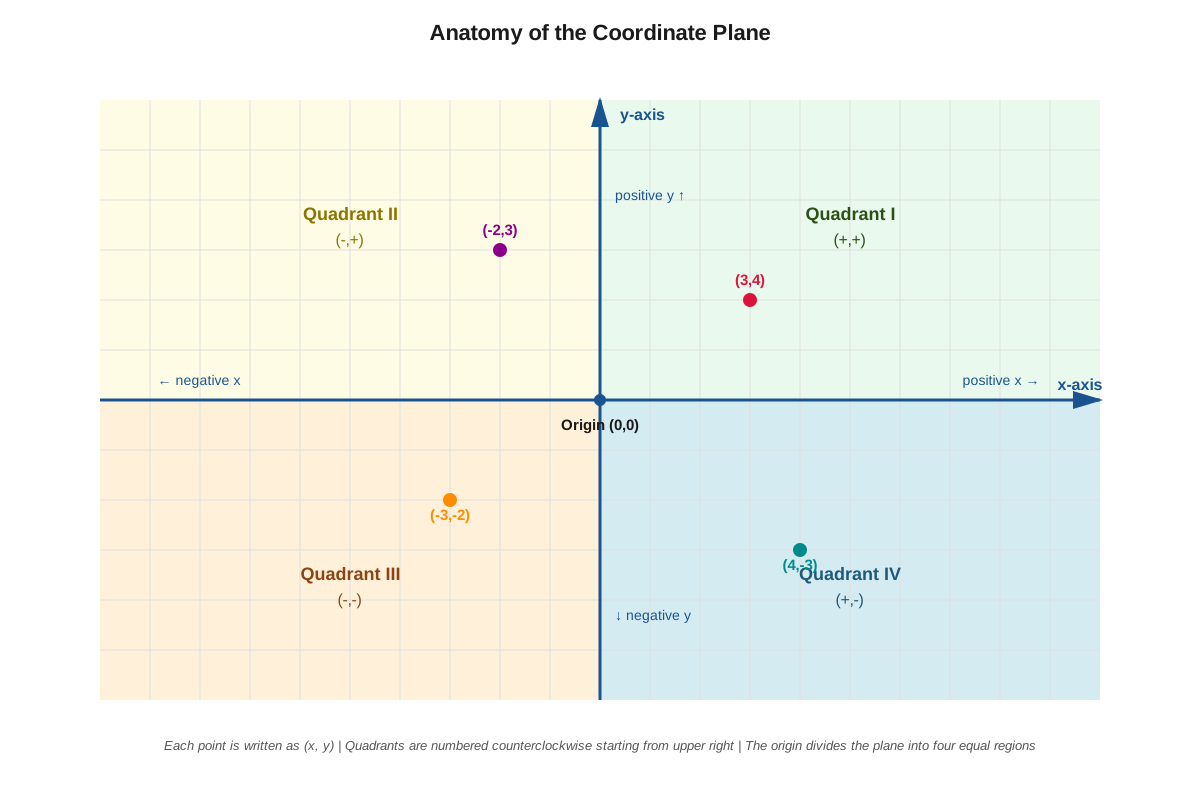
The coordinate plane, also called the Cartesian plane, consists of two perpendicular number lines that intersect at a point called the origin. The horizontal number line is the x-axis, and the vertical number line is the y-axis. The origin has coordinates (0, 0) and serves as the reference point for all other locations on the plane.
Every point on the coordinate plane is identified by an ordered pair (x, y), where x represents the horizontal distance from the origin and y represents the vertical distance from the origin. The x-coordinate is always listed first, followed by the y-coordinate. Positive x-values extend to the right of the origin, negative x-values extend to the left, positive y-values extend upward, and negative y-values extend downward.
The Four Quadrants
The axes divide the coordinate plane into four regions called quadrants, numbered counterclockwise starting from the upper right:
| Quadrant | x-coordinate | y-coordinate | Example Point |
|---|---|---|---|
| I | Positive (+) | Positive (+) | (3, 5) |
| II | Negative (−) | Positive (+) | (−2, 4) |
| III | Negative (−) | Negative (−) | (−6, −3) |
| IV | Positive (+) | Negative (−) | (7, −2) |
Points located directly on the axes do not belong to any quadrant. For example, (5, 0) lies on the x-axis, and (0, −3) lies on the y-axis. Understanding quadrant signs is crucial for quickly eliminating incorrect answer choices on the SAT.
Distance Formula
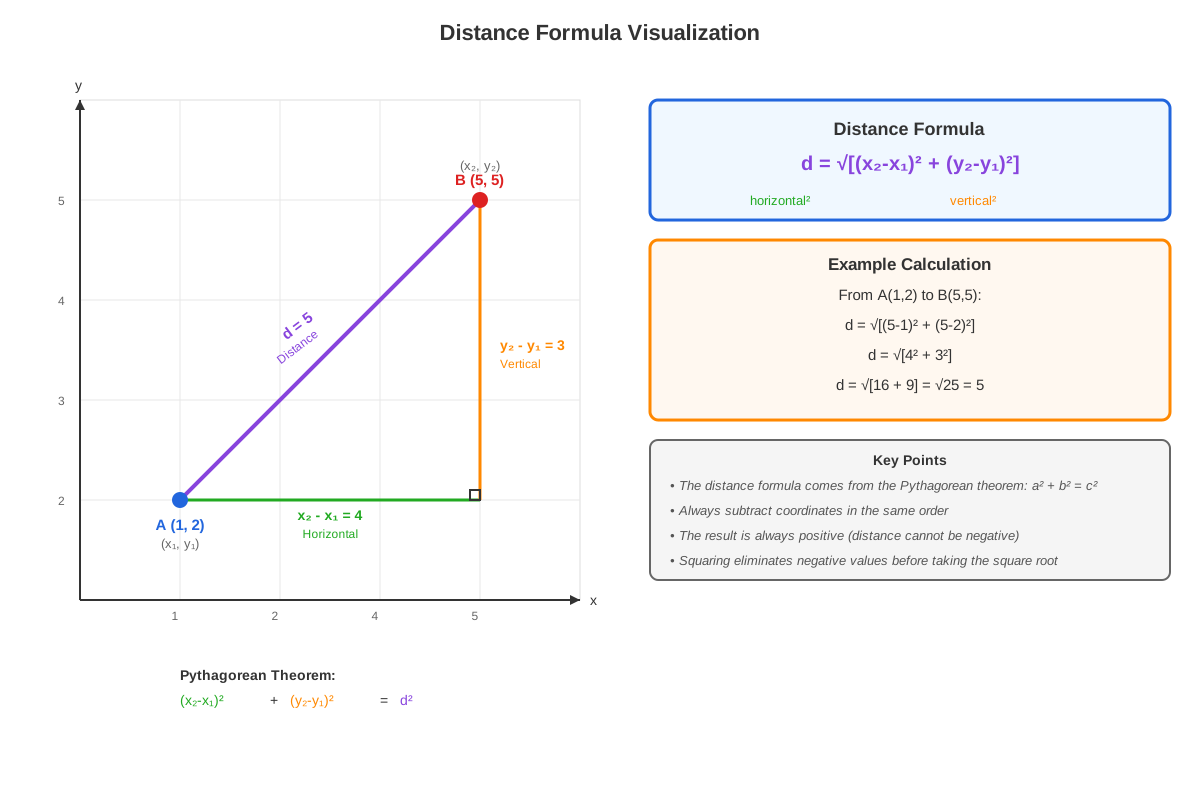
The distance formula calculates the straight-line distance between any two points on the coordinate plane. Given points (x₁, y₁) and (x₂, y₂), the distance d is:
d = √[(x₂ − x₁)² + (y₂ − y₁)²]This formula derives from the Pythagorean theorem. The horizontal distance between points forms one leg of a right triangle (|x₂ − x₁|), the vertical distance forms the other leg (|y₂ − y₁|), and the distance between the points is the hypotenuse.
Example: Find the distance between points A(2, 3) and B(6, 6).
d = √[(6 − 2)² + (6 − 3)²]
d = √[4² + 3²]
d = √[16 + 9]
d = √25 = 5
The distance is 5 units. On the SAT, distance formula questions may ask for the exact distance (leaving the answer in radical form) or an approximate decimal value.
Midpoint Formula
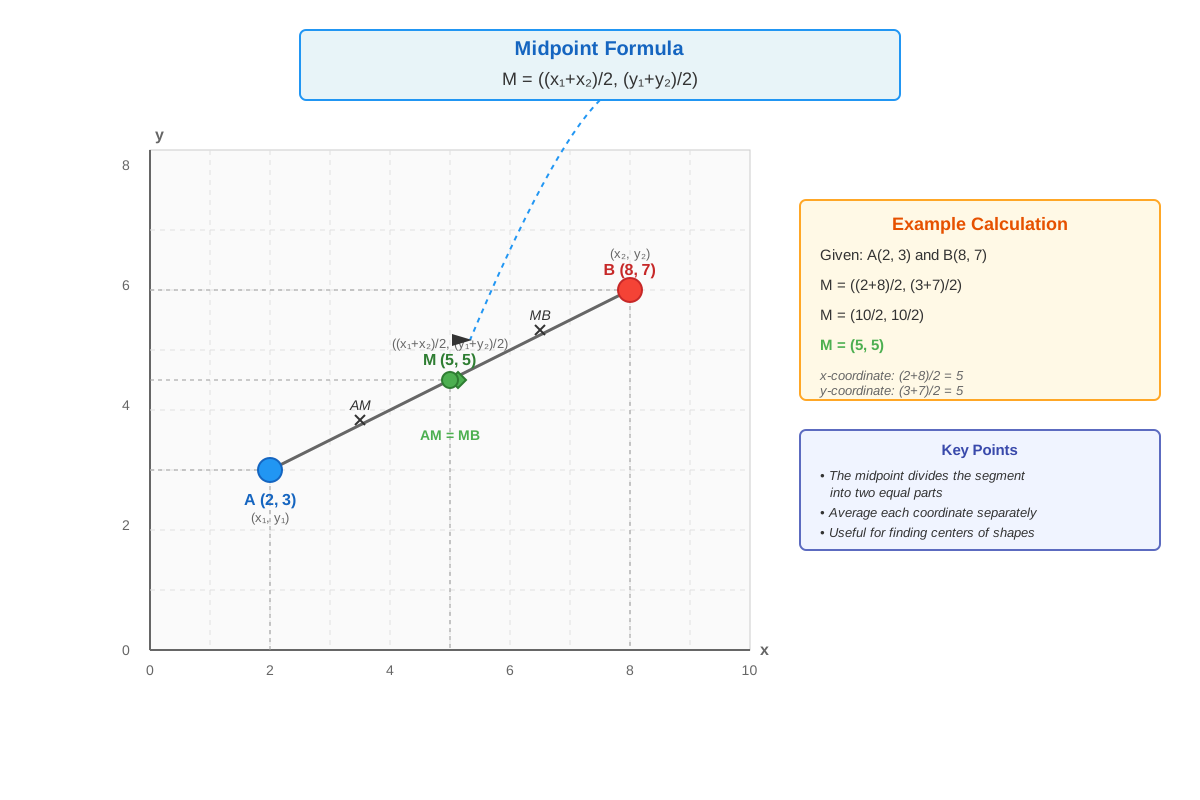
The midpoint formula finds the point exactly halfway between two given points. For points (x₁, y₁) and (x₂, y₂), the midpoint M is:
M = ((x₁ + x₂)/2, (y₁ + y₂)/2)This formula simply averages the x-coordinates and y-coordinates separately. The midpoint concept appears frequently in SAT questions involving line segments, geometric figures, and optimization problems.
Example: Find the midpoint of the segment connecting P(−4, 7) and Q(2, −3).
M = ((−4 + 2)/2, (7 + (−3))/2)
M = (−2/2, 4/2)
M = (−1, 2)
The midpoint is (−1, 2). Students should verify their work by checking that this point is equidistant from both endpoints.
Slope
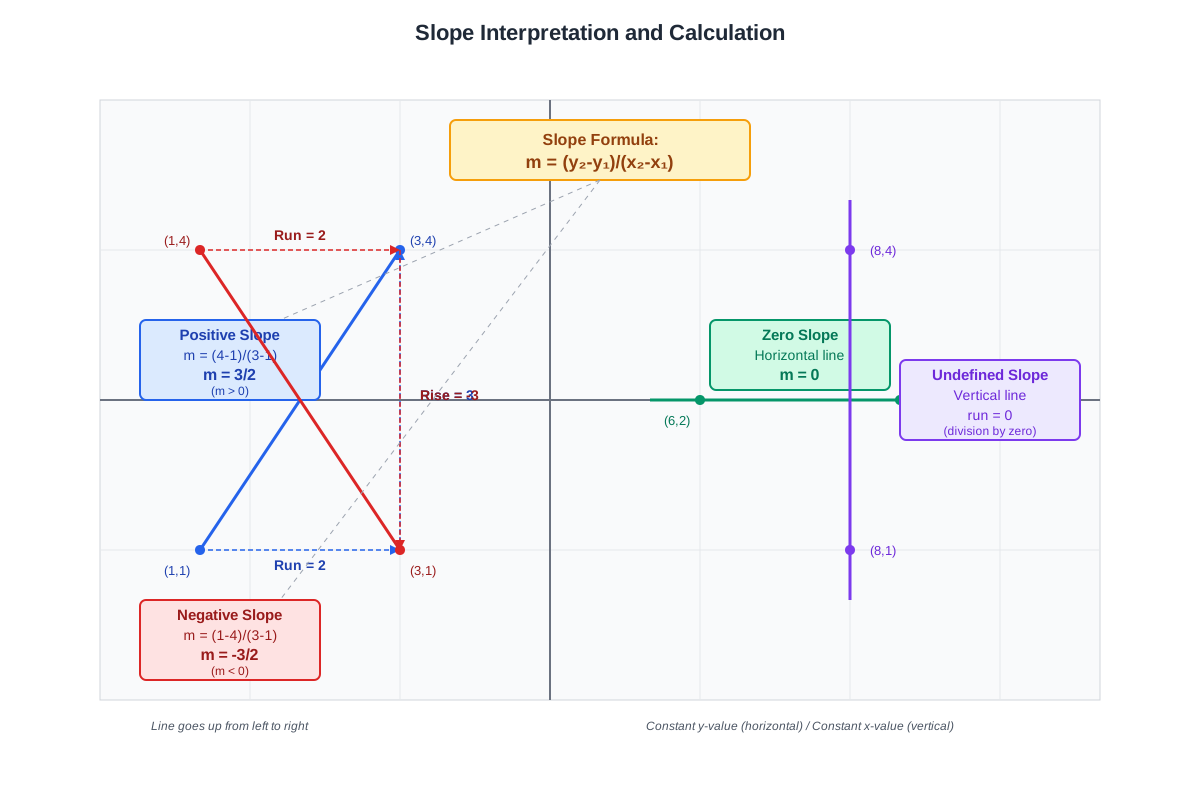
Slope measures the steepness and direction of a line, representing the rate of change between two points. Given points (x₁, y₁) and (x₂, y₂), the slope m is:
m = (y₂ − y₁)/(x₂ − x₁) = rise/runSlope interpretation:
- Positive slope: Line rises from left to right (upward trend)
- Negative slope: Line falls from left to right (downward trend)
- Zero slope: Horizontal line (no vertical change)
- Undefined slope: Vertical line (no horizontal change, division by zero)
The SAT frequently tests slope in context, such as interpreting the meaning of slope in a real-world scenario or determining whether a slope is positive, negative, zero, or undefined from a graph.
Geometric Figures on the Coordinate Plane
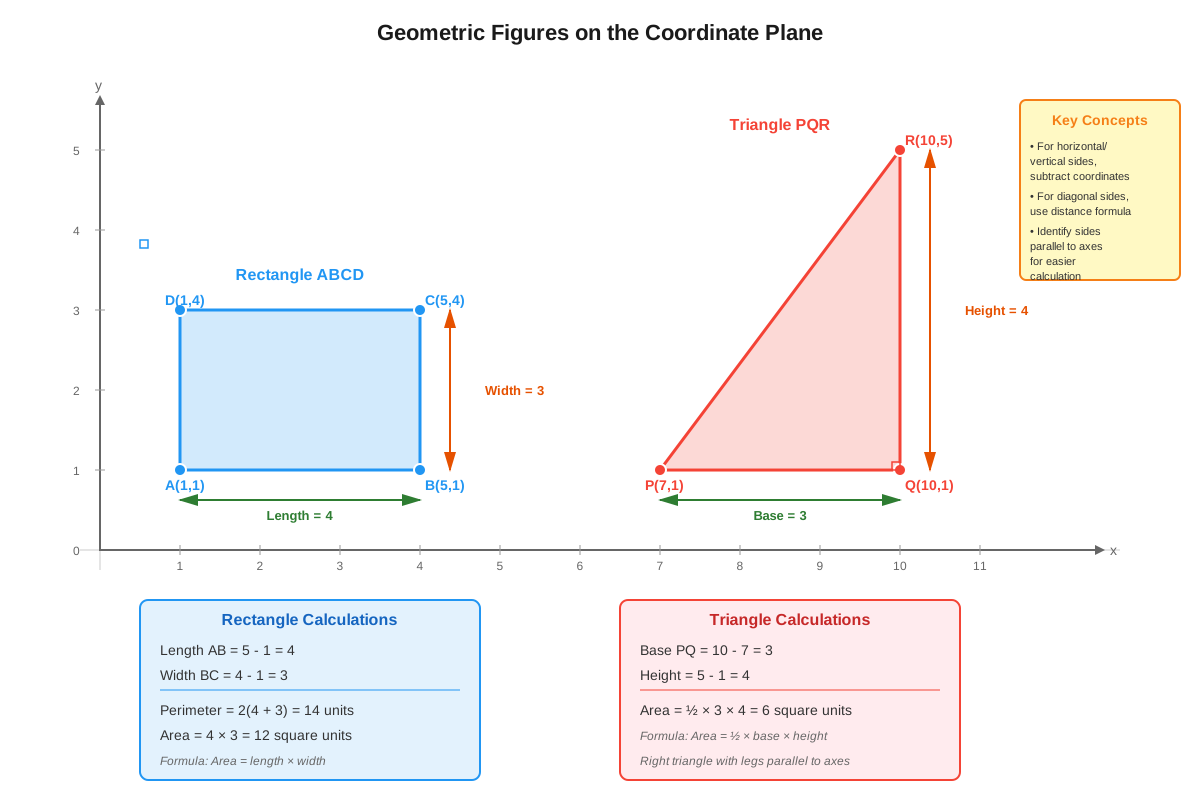
Many SAT questions involve analyzing polygons positioned on the coordinate plane. Common tasks include:
- Finding perimeter: Calculate the distance of each side using the distance formula, then sum all sides
- Finding area: Use appropriate area formulas (rectangle: length × width; triangle: ½ × base × height) or the Shoelace formula for irregular polygons
- Identifying shape properties: Determine if a quadrilateral is a rectangle, square, parallelogram, or trapezoid by analyzing side lengths and slopes
For triangles with vertices at (x₁, y₁), (x₂, y₂), and (x₃, y₃), a useful area formula is:
Area = ½|x₁(y₂ − y₃) + x₂(y₃ − y₁) + x₃(y₁ − y₂)|This Shoelace formula eliminates the need to identify base and height explicitly, making it particularly valuable for triangles in unusual orientations.
Reflections and Symmetry
The SAT occasionally tests reflections across axes or the origin:
- Reflection across x-axis: (x, y) → (x, −y)
- Reflection across y-axis: (x, y) → (−x, y)
- Reflection across origin: (x, y) → (−x, −y)
- Reflection across line y = x: (x, y) → (y, x)
Understanding these transformations helps students quickly identify symmetric points and solve problems involving geometric transformations.
Concept Relationships
The coordinate plane serves as the foundational framework that connects multiple mathematical concepts. Plotting points → enables → calculating distances → which relies on → the Pythagorean theorem. Similarly, identifying coordinates → leads to → finding midpoints → which supports → analyzing geometric figures.
The distance formula and midpoint formula work together in many problems. For instance, verifying that a point is the midpoint of a segment requires calculating distances from that point to both endpoints and confirming they are equal. The slope concept connects directly to linear equations, as slope is the coefficient of x in slope-intercept form (y = mx + b).
Coordinate plane concepts also bridge to prerequisite knowledge. Basic arithmetic enables coordinate calculations, negative number understanding allows work across all quadrants, and geometric shape properties (from basic geometry) help identify figures on the plane. Moving forward, coordinate plane mastery enables study of functions and their graphs, transformations, systems of equations (graphical solutions), and conic sections (circles, parabolas, ellipses).
The relationship map: Coordinate System → Point Plotting → Distance/Midpoint Calculations → Slope Analysis → Linear Equations → Geometric Figure Analysis → Advanced Functions
Quick check — test yourself on Coordinate plane so far.
Try Flashcards →High-Yield Facts
⭐ The origin has coordinates (0, 0) and is the intersection point of the x-axis and y-axis
⭐ In Quadrant I, both coordinates are positive; in Quadrant II, x is negative and y is positive; in Quadrant III, both are negative; in Quadrant IV, x is positive and y is negative
⭐ The distance formula is d = √[(x₂ − x₁)² + (y₂ − y₁)²], derived from the Pythagorean theorem
⭐ The midpoint formula averages the x-coordinates and y-coordinates: M = ((x₁ + x₂)/2, (y₁ + y₂)/2)
⭐ Slope is calculated as m = (y₂ − y₁)/(x₂ − x₁), representing rise over run
- Points on the x-axis have a y-coordinate of 0; points on the y-axis have an x-coordinate of 0
- A horizontal line has a slope of 0; a vertical line has an undefined slope
- The order of coordinates matters: (3, 5) and (5, 3) represent different points
- Parallel lines have equal slopes; perpendicular lines have slopes that are negative reciprocals (m₁ × m₂ = −1)
- The distance from any point to the origin can be calculated using d = √(x² + y²)
- When reflecting across the x-axis, only the y-coordinate changes sign
- The area of a rectangle with sides parallel to the axes equals (length)(width), where length and width are differences in coordinates
- Equidistant points from a given point form a circle centered at that point
Common Misconceptions
Misconception: The x-coordinate is always listed second in an ordered pair.
→ Correction: The x-coordinate is always listed first, followed by the y-coordinate. The notation (x, y) is standard, and reversing this order leads to plotting the wrong point.
Misconception: Points in Quadrant III have positive coordinates.
→ Correction: Points in Quadrant III have both negative x-coordinates and negative y-coordinates. Only Quadrant I contains points with both coordinates positive.
Misconception: The distance formula requires subtracting in a specific order (larger minus smaller).
→ Correction: Because the differences are squared in the distance formula, the order of subtraction doesn't matter. (x₂ − x₁)² equals (x₁ − x₂)², so either order produces the correct result.
Misconception: A vertical line has a slope of zero.
→ Correction: A vertical line has an undefined slope (not zero) because the denominator in the slope formula becomes zero. A horizontal line has a slope of zero because the numerator (change in y) is zero.
Misconception: The midpoint formula requires using the distance formula first.
→ Correction: The midpoint formula is independent of the distance formula. Simply average the x-coordinates and average the y-coordinates—no distance calculation needed.
Misconception: All points on the coordinate plane belong to one of the four quadrants.
→ Correction: Points located on either axis do not belong to any quadrant. For example, (0, 5) is on the y-axis and (−3, 0) is on the x-axis; neither is in a quadrant.
Misconception: When calculating slope, you can use (x₂ − x₁)/(y₂ − y₁).
→ Correction: Slope is always change in y divided by change in x, never the reverse. Using (x₂ − x₁)/(y₂ − y₁) calculates the reciprocal of the slope, leading to incorrect answers.
Worked Examples
Example 1: Multi-Step Coordinate Geometry Problem
Question: Triangle ABC has vertices at A(1, 2), B(7, 2), and C(4, 8). Find the perimeter of the triangle.
Solution:
To find the perimeter, we need to calculate the length of all three sides using the distance formula.
Step 1: Find the length of side AB.
Since both points have the same y-coordinate (2), this is a horizontal segment.
AB = √[(7 − 1)² + (2 − 2)²]
AB = √[6² + 0²]
AB = √36 = 6
Step 2: Find the length of side BC.
BC = √[(4 − 7)² + (8 − 2)²]
BC = √[(−3)² + 6²]
BC = √[9 + 36]
BC = √45 = 3√5
Step 3: Find the length of side AC.
AC = √[(4 − 1)² + (8 − 2)²]
AC = √[3² + 6²]
AC = √[9 + 36]
AC = √45 = 3√5
Step 4: Calculate the perimeter.
Perimeter = AB + BC + AC
Perimeter = 6 + 3√5 + 3√5
Perimeter = 6 + 6√5
Since √5 ≈ 2.236, the perimeter is approximately 6 + 6(2.236) = 6 + 13.416 = 19.416 units.
Connection to Learning Objectives: This problem applies the distance formula (a key coordinate plane concept) to solve a geometric problem, demonstrating how coordinate plane skills integrate with geometry.
Example 2: Midpoint and Distance Combined
Question: Point M(3, 5) is the midpoint of segment PQ. If point P has coordinates (−1, 2), what are the coordinates of point Q?
Solution:
Step 1: Use the midpoint formula with known values.
The midpoint formula states: M = ((x₁ + x₂)/2, (y₁ + y₂)/2)
We know M(3, 5) and P(−1, 2). Let Q have coordinates (x, y).
Step 2: Set up equations for each coordinate.
For the x-coordinate:
3 = (−1 + x)/2
6 = −1 + x
x = 7
For the y-coordinate:
5 = (2 + y)/2
10 = 2 + y
y = 8
Step 3: State the answer.
Point Q has coordinates (7, 8).
Step 4: Verify the answer.
Check that M is equidistant from P and Q:
PM = √[(3 − (−1))² + (5 − 2)²] = √[16 + 9] = √25 = 5
MQ = √[(7 − 3)² + (8 − 5)²] = √[16 + 9] = √25 = 5
Since PM = MQ = 5, our answer is correct.
Connection to Learning Objectives: This problem demonstrates applying the midpoint formula in reverse (working backward from the midpoint to find an endpoint) and verifying results using the distance formula—both essential SAT skills.
Exam Strategy
When approaching sat coordinate plane questions, begin by quickly sketching the coordinate plane and plotting any given points. This visual representation often reveals patterns, symmetries, or geometric relationships that aren't obvious from coordinates alone. Even a rough sketch can prevent sign errors and help verify that your answer makes spatial sense.
Trigger words and phrases to watch for include: "distance between," "midpoint of," "coordinates of," "lies in which quadrant," "slope of the line," "area of the triangle/rectangle," "equidistant from," "reflection across," and "perpendicular/parallel to." Each phrase signals a specific formula or concept. For instance, "equidistant from" typically requires the distance formula applied to multiple point pairs.
Process-of-elimination strategies are particularly effective for coordinate plane questions. If asked which point lies in Quadrant II, immediately eliminate any answer choice with both coordinates positive or both negative. When calculating distance, eliminate answer choices that are negative (distance is always positive) or unreasonably large/small compared to the coordinate differences. For midpoint questions, the midpoint coordinates must fall between the endpoint coordinates—use this to eliminate impossible answers before calculating.
Time allocation for coordinate plane questions should average 60-90 seconds for straightforward plotting or quadrant identification, 90-120 seconds for single-formula applications (distance or midpoint), and 2-3 minutes for multi-step problems involving multiple calculations or geometric figure analysis. If a problem requires more than three minutes, mark it for review and move on—you can return with fresh perspective after completing easier questions.
Always check your work by verifying that your answer makes geometric sense. If you calculated a midpoint, ensure it falls between the two endpoints. If you found a distance, confirm it's positive and reasonable given the coordinate differences. For slope calculations, verify the sign matches the line's visual direction (positive for upward-sloping, negative for downward-sloping).
Memory Techniques
Quadrant Signs Mnemonic: "All Students Take Calculus" helps remember which coordinates are positive in each quadrant:
- All (Quadrant I): All coordinates positive
- Students (Quadrant II): Sine positive (y-coordinate positive, x negative)
- Take (Quadrant III): Tangent positive (both negative)
- Calculus (Quadrant IV): Cosine positive (x-coordinate positive, y negative)
Distance Formula Visualization: Picture a right triangle connecting two points. The horizontal leg is the x-difference, the vertical leg is the y-difference, and the hypotenuse is the distance you're finding. This mental image reinforces that the distance formula is just the Pythagorean theorem: a² + b² = c².
Midpoint Memory Aid: "Midpoint Means Middle" → Average the coordinates. The word "average" contains the letter "a" twice, reminding you to average both the x's and the y's.
Slope Direction Acronym: "Positive Up, Negative Down" (PUND). A positive slope goes up from left to right; a negative slope goes down from left to right.
Axis Memory: "x goes across" (both words start with 'a'). The x-axis is horizontal, running across the page. By elimination, the y-axis must be vertical.
Summary
The coordinate plane is a two-dimensional grid system formed by perpendicular x and y axes intersecting at the origin (0, 0). Every point is identified by an ordered pair (x, y), and the plane is divided into four quadrants with distinct sign patterns. Mastery of coordinate plane concepts requires fluency with three essential formulas: the distance formula d = √[(x₂ − x₁)² + (y₂ − y₁)²] for finding the length between points, the midpoint formula M = ((x₁ + x₂)/2, (y₁ + y₂)/2) for locating the center of a segment, and the slope formula m = (y₂ − y₁)/(x₂ − x₁) for measuring line steepness. SAT questions frequently combine these concepts with geometric figure analysis, requiring students to calculate perimeters, areas, and other properties of shapes positioned on the plane. Success demands both computational accuracy and spatial reasoning—the ability to visualize relationships between points and verify that calculated answers make geometric sense. Students who develop strong coordinate plane skills gain access to reliable points on the SAT, as these questions follow predictable patterns and reward systematic problem-solving approaches.
Key Takeaways
- The coordinate plane consists of perpendicular x and y axes dividing space into four quadrants with distinct positive/negative sign patterns
- The distance formula √[(x₂ − x₁)² + (y₂ − y₁)²] derives from the Pythagorean theorem and calculates straight-line distance between any two points
- The midpoint formula ((x₁ + x₂)/2, (y₁ + y₂)/2) finds the point exactly halfway between two endpoints by averaging coordinates
- Slope m = (y₂ − y₁)/(x₂ − x₁) measures line steepness; positive slopes rise, negative slopes fall, zero slopes are horizontal, and undefined slopes are vertical
- Always sketch the coordinate plane when solving problems—visual representation prevents errors and reveals geometric relationships
- Coordinate plane questions account for 10-15% of SAT math questions and frequently integrate with algebra and geometry concepts
- Verify answers by checking that they make spatial sense: midpoints fall between endpoints, distances are positive, and coordinates match the expected quadrant
Related Topics
Linear Equations and Graphing: Building on coordinate plane fundamentals, this topic explores how to graph linear equations, find equations from points or slopes, and interpret slope and y-intercept in context. Mastering the coordinate plane makes graphing linear relationships straightforward.
Systems of Equations: Graphical solutions to systems involve finding intersection points of lines on the coordinate plane. Strong coordinate skills enable students to verify algebraic solutions visually and solve systems graphically when appropriate.
Functions and Their Graphs: Functions are graphed on the coordinate plane, with x-values as inputs and y-values as outputs. Understanding coordinate plane structure is essential for analyzing function behavior, identifying domain and range, and recognizing transformations.
Circles and Parabolas: These conic sections are defined using coordinate plane concepts. The equation of a circle uses the distance formula, while parabolas involve vertex coordinates and axis of symmetry—all requiring coordinate plane fluency.
Transformations: Translations, reflections, rotations, and dilations of geometric figures are described using coordinate notation. Mastering basic coordinate plane concepts enables understanding how transformations affect point positions systematically.
Practice CTA
Now that you've mastered the fundamental concepts of the coordinate plane, it's time to solidify your understanding through active practice. Challenge yourself with the practice questions designed specifically to mirror SAT question formats and difficulty levels. Work through each problem systematically, applying the formulas and strategies you've learned. Don't just aim for correct answers—focus on developing efficient problem-solving approaches that will serve you well under timed test conditions. Use the flashcards to reinforce key formulas and concepts until they become automatic. Remember, coordinate plane questions are high-yield opportunities on the SAT—every minute you invest in practice translates directly to points on test day. You've built the foundation; now build the confidence through deliberate practice!
Sign up free to keep reading
Create a free AnvayaPrep account to finish this SAT guide on Coordinate plane — plus flashcards and practice questions.