Overview
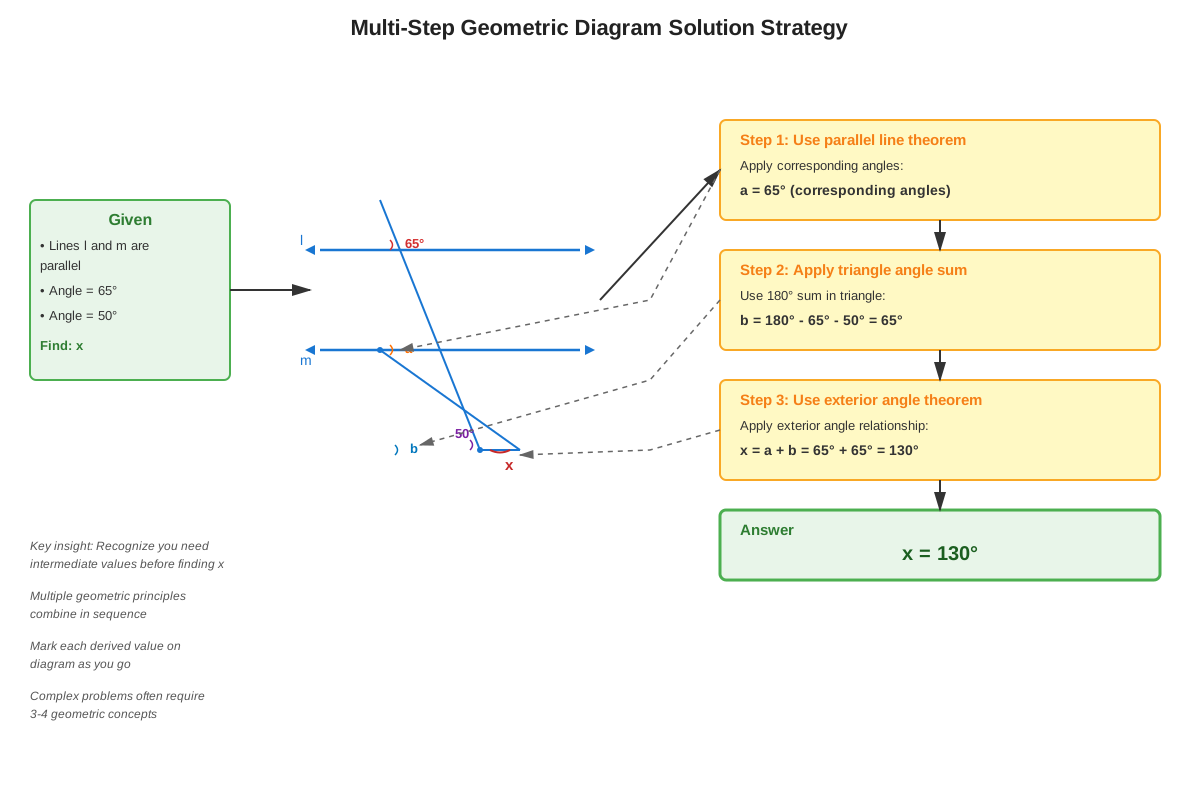
Geometric diagrams are visual representations of shapes, angles, lines, and spatial relationships that form the foundation of many SAT geometric diagrams questions. These diagrams appear throughout the math section and require students to extract information, identify relationships, and apply geometric principles to solve problems. Unlike pure algebraic questions, geometric diagram problems test spatial reasoning, the ability to recognize unstated relationships, and the skill of translating visual information into mathematical equations.
Mastering geometric diagrams is essential for SAT success because approximately 15-20% of all math questions involve geometric reasoning, with the majority presenting information through diagrams. These questions assess whether students can identify angle relationships, recognize congruent or similar figures, apply properties of parallel lines and transversals, and determine missing measurements. The SAT frequently tests students' ability to work with diagrams that are "not drawn to scale," requiring reliance on stated facts rather than visual estimation.
Geometric diagrams connect to broader mathematical concepts including algebraic reasoning (setting up equations from geometric relationships), proportional reasoning (similar figures and scale), and logical deduction (deriving unstated information from given facts). Success with geometric diagrams requires integrating knowledge of angle properties, triangle theorems, polygon characteristics, and circle properties—making this topic a critical junction point where multiple geometric concepts converge in practical problem-solving contexts.
Learning Objectives
- [ ] Identify key features of geometric diagrams including labeled angles, sides, parallel lines, and special markings
- [ ] Explain how geometric diagrams appears on the SAT, including question formats and common diagram types
- [ ] Apply geometric diagrams to answer SAT-style questions by extracting information and using geometric principles
- [ ] Distinguish between information that can be assumed from a diagram versus information that must be explicitly stated
- [ ] Synthesize multiple geometric properties to solve multi-step problems involving complex diagrams
- [ ] Evaluate when diagrams are "not drawn to scale" and adjust problem-solving strategies accordingly
Prerequisites
- Basic angle relationships: Understanding complementary, supplementary, and vertical angles is essential for identifying angle measures in diagrams
- Properties of triangles: Knowledge of triangle angle sum, exterior angles, and special triangles enables solving triangle-based diagram problems
- Parallel line theorems: Recognizing corresponding, alternate interior, and alternate exterior angles is crucial for multi-line diagrams
- Algebraic equation solving: Setting up and solving equations from geometric relationships requires algebraic fluency
- Basic polygon properties: Understanding quadrilaterals, regular polygons, and their angle measures supports complex diagram interpretation
Why This Topic Matters
Geometric diagrams represent one of the most practical applications of mathematical reasoning in everyday life. Architects use geometric diagrams to design buildings, engineers rely on them for structural analysis, graphic designers apply geometric principles in visual composition, and navigation systems depend on geometric relationships to calculate distances and directions. The ability to interpret visual spatial information and extract mathematical relationships is a fundamental skill across STEM fields and many professional contexts.
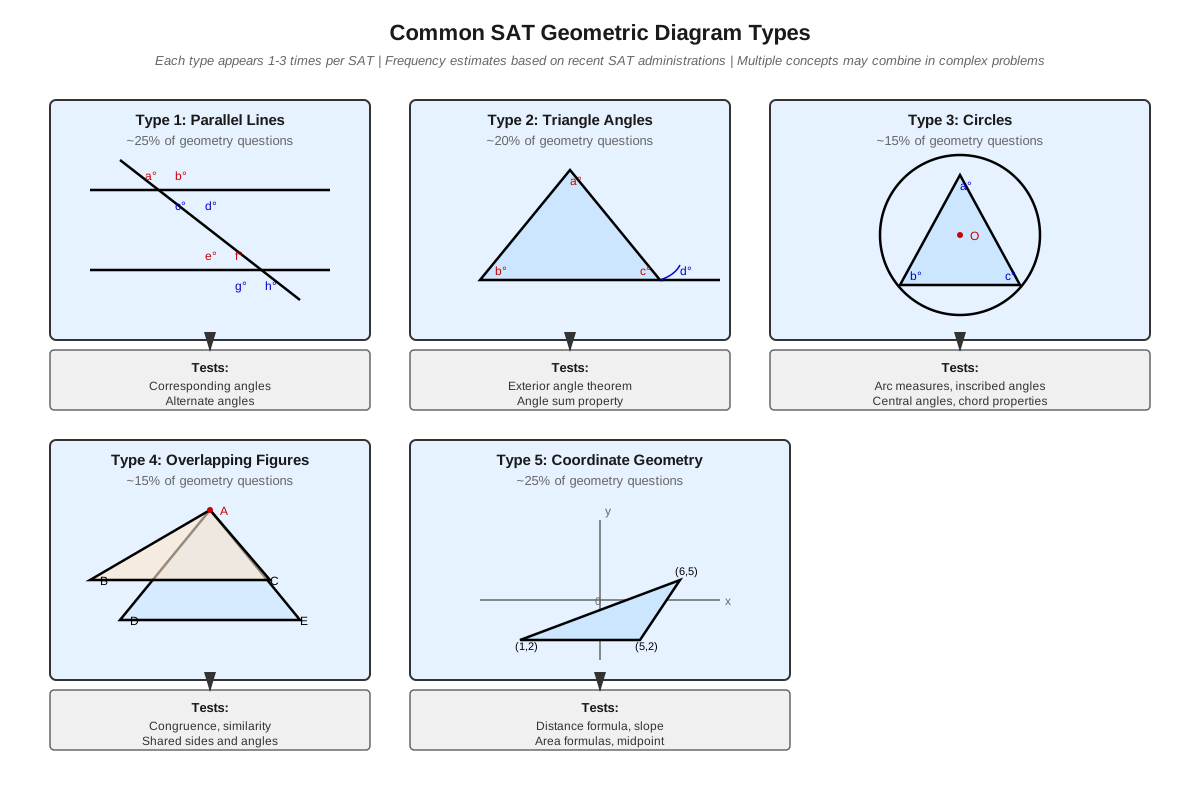
On the SAT, geometric diagram questions appear in both the calculator and no-calculator sections, typically comprising 6-8 questions per test. These questions range from straightforward angle calculations to complex multi-step problems requiring integration of several geometric principles. The College Board frequently presents diagrams involving intersecting lines, triangles within larger figures, circles with inscribed polygons, and coordinate geometry representations. Approximately 60% of geometry questions include a diagram, making visual interpretation skills absolutely critical for test success.
Common question formats include: finding missing angle measures in figures with parallel lines and transversals, determining side lengths in similar triangles, calculating areas of composite figures, identifying angle relationships in inscribed polygons, and solving for variables that represent geometric measurements. The SAT particularly favors questions where students must recognize unstated relationships—such as identifying that two angles are vertical angles or that a line segment is both an altitude and a median—making diagram analysis skills essential for accessing these "hidden" pieces of information.
Core Concepts
Understanding Diagram Notation and Markings
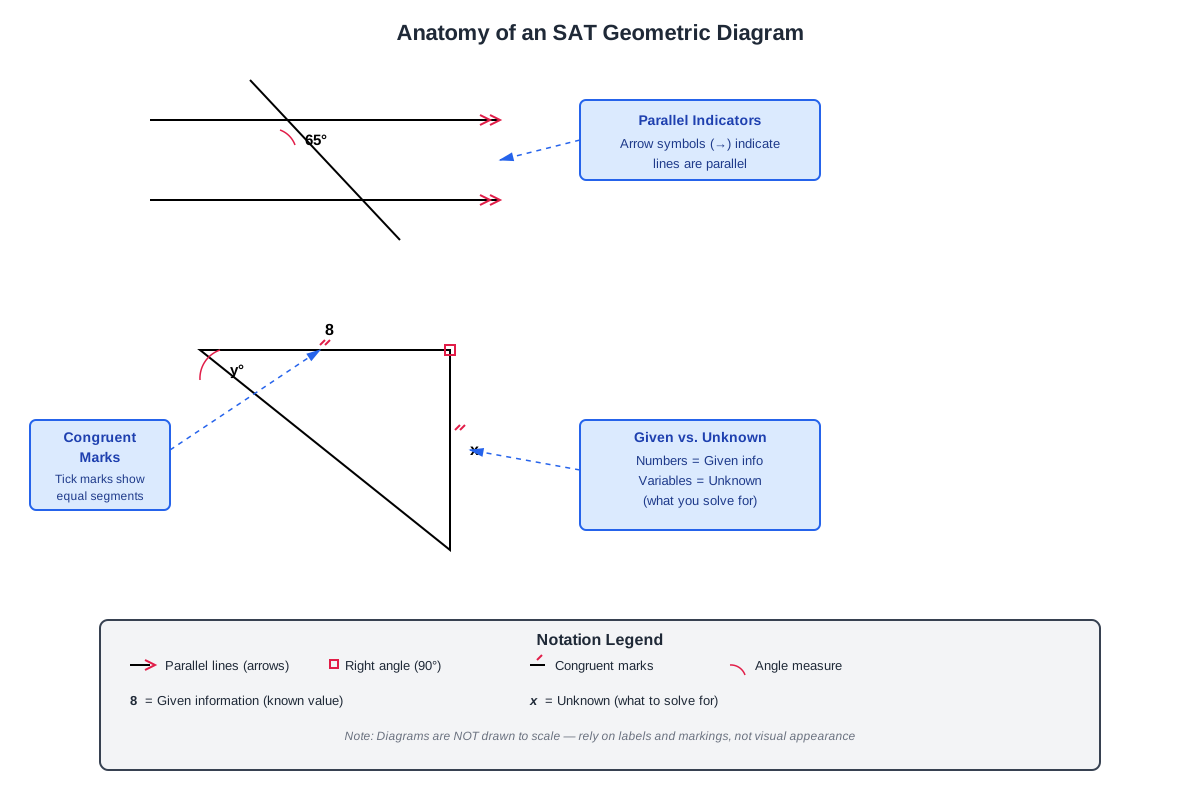
Geometric diagrams on the SAT use standardized notation to convey information efficiently. Single tick marks on line segments indicate congruent (equal length) segments, while double or triple tick marks show different sets of congruent segments. Arc marks on angles serve the same purpose for angle congruence. Right angles are indicated by small squares at the vertex, and parallel lines are shown with matching arrow symbols (single arrows for one pair, double arrows for another pair).
Variables in diagrams represent unknown measurements that students must solve for, while numerical labels provide given information. When a diagram shows an expression like "2x + 10" labeling an angle, this indicates the angle measure in degrees as a function of x. Points are labeled with capital letters, and the order of letters in angle notation matters: ∠ABC means the angle at vertex B formed by rays BA and BC.
The "Not Drawn to Scale" Principle
The SAT frequently includes the disclaimer "Note: Figure not drawn to scale" beneath diagrams. This critical notation means students cannot rely on visual appearance to estimate measurements or relationships. A triangle that appears obtuse might actually be acute; a line segment that looks longer might be shorter. This forces students to use only the stated numerical information and geometric properties to solve problems.
When a diagram IS drawn to scale (no disclaimer appears), students can make reasonable visual estimates and use spatial intuition as a checking mechanism. However, even with scaled diagrams, precise calculations should rely on mathematical relationships rather than visual approximation. The "not drawn to scale" feature tests whether students truly understand geometric principles versus simply measuring or estimating from the figure.
Extracting Stated vs. Implied Information
Effective diagram analysis requires distinguishing between three types of information:
- Explicitly stated information: Numerical values, variable expressions, and special markings (right angles, congruence marks, parallel indicators) shown in the diagram
- Implied geometric relationships: Properties that follow from definitions (opposite angles in a parallelogram are congruent, base angles of an isosceles triangle are equal)
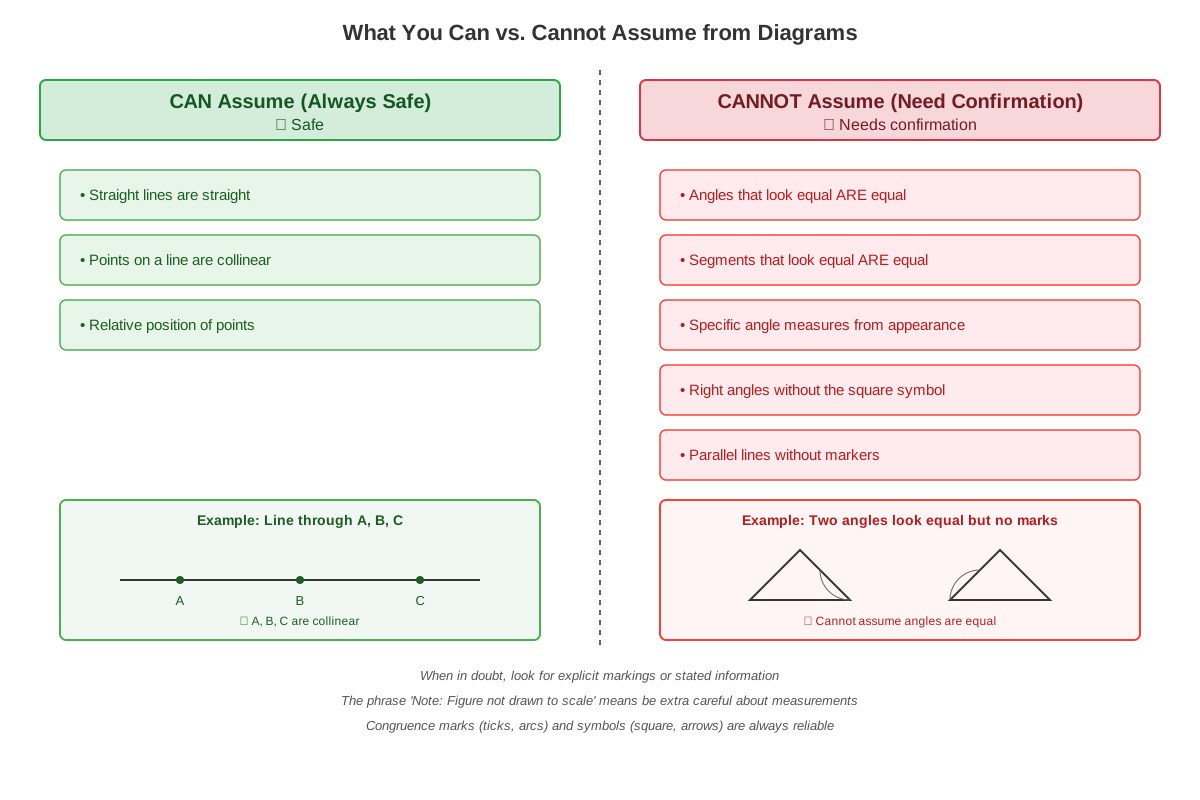
- Assumptions that cannot be made: Relationships that appear true visually but aren't confirmed by markings or stated facts
For example, if two line segments appear equal in length but lack congruence marks, their equality cannot be assumed. If two lines appear perpendicular but no right angle symbol appears, perpendicularity cannot be assumed. However, if a figure is labeled as a "square," all properties of squares (four right angles, four congruent sides, congruent diagonals) can be applied even if not all are marked.
Angle Relationships in Diagrams
When lines intersect in diagrams, several angle relationships emerge:
- Vertical angles are congruent (opposite angles formed by intersecting lines)
- Linear pairs are supplementary (adjacent angles on a straight line sum to 180°)
- Angles around a point sum to 360°
When parallel lines are cut by a transversal, eight angles are formed with specific relationships:
| Angle Pair Type | Relationship | Example |
|---|---|---|
| Corresponding angles | Congruent | Angles in the same relative position |
| Alternate interior angles | Congruent | Interior angles on opposite sides of transversal |
| Alternate exterior angles | Congruent | Exterior angles on opposite sides of transversal |
| Consecutive interior angles | Supplementary | Interior angles on same side of transversal |
Triangle Properties in Diagrams
Triangles in SAT diagrams frequently involve:
- Angle sum property: Interior angles always sum to 180°
- Exterior angle theorem: An exterior angle equals the sum of the two non-adjacent interior angles
- Isosceles triangle properties: Base angles are congruent; altitude to the base bisects the base and the vertex angle
- Similar triangles: Corresponding angles are congruent; corresponding sides are proportional
When a diagram shows a triangle with an altitude, median, or angle bisector, these segments create additional relationships. An altitude creates right angles with the base. A median divides the opposite side into two equal segments. An angle bisector divides the vertex angle into two congruent angles.
Polygon Properties in Diagrams
For polygons with n sides:
- Sum of interior angles = (n - 2) × 180°
- Each interior angle of a regular polygon = [(n - 2) × 180°] ÷ n
- Sum of exterior angles = 360° (for any polygon)
Special quadrilaterals have specific properties that can be applied when the figure is labeled:
- Parallelograms: Opposite sides parallel and congruent; opposite angles congruent; consecutive angles supplementary; diagonals bisect each other
- Rectangles: All parallelogram properties plus four right angles and congruent diagonals
- Rhombuses: All parallelogram properties plus four congruent sides and perpendicular diagonals
- Squares: All properties of rectangles and rhombuses combined
Composite Figures and Overlapping Shapes
SAT diagrams frequently show figures within figures—triangles inside rectangles, circles inscribed in squares, or overlapping polygons. These composite figures require identifying shared elements:
- A side of one figure may be a side of another
- An angle in one figure may be part of an angle in another
- Segments may be divided into parts by intersection points
When analyzing composite figures, label all known information, identify all geometric relationships, and look for ways to connect the inner and outer figures through shared measurements.
Circle Diagrams
When circles appear in diagrams, key elements include:
- Radius: Distance from center to any point on the circle (all radii are congruent)
- Diameter: Distance across the circle through the center (equals 2r)
- Chord: Line segment connecting two points on the circle
- Central angle: Angle with vertex at the center
- Inscribed angle: Angle with vertex on the circle
Critical relationships: An inscribed angle measures half the central angle that subtends the same arc. A radius drawn to a point of tangency is perpendicular to the tangent line.
Concept Relationships
The concepts within geometric diagrams form an interconnected web of relationships. Diagram notation and markings serve as the foundation → enabling extraction of stated versus implied information → which allows application of angle relationships and polygon properties → leading to solutions for composite figures that integrate multiple concepts.
Angle relationships connect directly to parallel line properties (prerequisite knowledge), as parallel lines cut by transversals create the angle pairs that appear in many SAT diagrams. Triangle properties build upon angle relationships, since triangles are formed by intersecting lines and their angles must sum to 180°. Polygon properties extend triangle concepts, as any polygon can be divided into triangles.
The "not drawn to scale" principle affects all other concepts by requiring students to rely on mathematical relationships rather than visual estimation. This connects to algebraic reasoning (prerequisite), as students must set up equations based on geometric properties rather than measuring from the figure.
Circle diagrams integrate with triangle and angle concepts, as inscribed angles, central angles, and radii create triangular relationships within circular figures. Composite figures represent the synthesis of all concepts, requiring students to identify multiple geometric relationships simultaneously and determine which properties apply to which parts of the diagram.
Quick check — test yourself on Geometric diagrams so far.
Try Flashcards →High-Yield Facts
⭐ Vertical angles formed by intersecting lines are always congruent—this relationship holds regardless of the angle measures or line orientations.
⭐ When parallel lines are cut by a transversal, corresponding angles are congruent and alternate interior angles are congruent—these are the most frequently tested parallel line relationships.
⭐ The sum of interior angles in any triangle is always 180°—this is the foundation for most triangle-based diagram problems.
⭐ An exterior angle of a triangle equals the sum of the two non-adjacent interior angles—this provides a shortcut for many angle calculations.
⭐ Congruence marks (tick marks on sides, arc marks on angles) indicate equal measurements—these visual cues provide crucial information even when numerical values aren't given.
- The sum of angles around a point is 360°, and angles on a straight line sum to 180°.
- In an isosceles triangle, the base angles (opposite the congruent sides) are always congruent.
- When a diagram states "Note: Figure not drawn to scale," visual appearance cannot be trusted for measurements or relationships.
- Consecutive interior angles formed by parallel lines and a transversal are supplementary (sum to 180°).
- The sum of interior angles in a quadrilateral is always 360°, regardless of the quadrilateral type.
- A radius drawn to a point of tangency on a circle is perpendicular to the tangent line at that point.
- In similar triangles, corresponding angles are congruent and corresponding sides are proportional.
- An inscribed angle in a circle measures half the central angle that subtends the same arc.
Common Misconceptions
Misconception: If two line segments appear equal in length in a diagram, they can be assumed to be equal. → Correction: Equal lengths can only be assumed if the segments have congruence marks (tick marks) or if the equality follows from stated properties (like opposite sides of a parallelogram). Visual appearance without confirmation cannot be trusted, especially in "not drawn to scale" diagrams.
Misconception: All angles that look like right angles are 90°. → Correction: Right angles must be indicated by a small square symbol at the vertex or explicitly stated in the problem. An angle that appears to be 90° might actually be 89° or 91° if not marked as a right angle.
Misconception: When two lines intersect, all four angles formed are equal. → Correction: Only vertical angles (opposite angles) are congruent. Adjacent angles form linear pairs and are supplementary (sum to 180°), but they are not equal unless each measures 90°.
Misconception: The longest-looking side in a triangle diagram is always the longest side. → Correction: In "not drawn to scale" diagrams, visual length is unreliable. The longest side is opposite the largest angle, which must be determined from given angle measures or calculated values, not visual appearance.
Misconception: If a quadrilateral has four equal-looking sides, it's a square. → Correction: A quadrilateral with four congruent sides is a rhombus, which only becomes a square if it also has right angles. Without right angle markers or explicit statement, the figure should be treated as a rhombus, not a square.
Misconception: Parallel lines must be horizontal or vertical. → Correction: Parallel lines can have any orientation—they simply never intersect and maintain constant distance. Parallel lines are indicated by matching arrow symbols, regardless of their angle of inclination.
Misconception: An angle bisector in a triangle always creates two congruent triangles. → Correction: An angle bisector divides the vertex angle into two congruent angles but does not necessarily create congruent triangles. Only in isosceles triangles does the angle bisector from the vertex angle also serve as a perpendicular bisector of the base, creating congruent triangles.
Worked Examples
Example 1: Parallel Lines and Angle Relationships
Problem: In the diagram below, lines l and m are parallel, and line t is a transversal. If angle 1 measures (3x + 20)° and angle 2 measures (5x - 40)°, where angle 1 and angle 2 are consecutive interior angles, what is the measure of angle 1?
Solution:
Step 1: Identify the relationship between the angles.
Consecutive interior angles (also called co-interior or same-side interior angles) formed by parallel lines and a transversal are supplementary, meaning they sum to 180°.
Step 2: Set up an equation.
(3x + 20) + (5x - 40) = 180
Step 3: Solve for x.
3x + 20 + 5x - 40 = 180
8x - 20 = 180
8x = 200
x = 25
Step 4: Find the measure of angle 1.
Angle 1 = 3x + 20 = 3(25) + 20 = 75 + 20 = 95°
Step 5: Verify the answer.
Angle 2 = 5(25) - 40 = 125 - 40 = 85°
Check: 95° + 85° = 180° ✓
Answer: 95°
This problem demonstrates the application of parallel line properties (Learning Objective 3) and requires identifying the key feature that angles 1 and 2 are consecutive interior angles (Learning Objective 1).
Example 2: Triangle with Multiple Angle Relationships
Problem: In triangle ABC, angle A measures 40°. An exterior angle at vertex C measures 110°. The diagram shows that side AB is congruent to side AC (indicated by tick marks). What is the measure of angle B?
Solution:
Step 1: Identify what type of triangle this is.
The congruence marks indicate AB ≅ AC, so triangle ABC is isosceles with vertex angle at A.
Step 2: Use the isosceles triangle property.
In an isosceles triangle, base angles are congruent. Since AB ≅ AC, angles B and C (the base angles) are equal.
Let angle B = angle C = y
Step 3: Apply the exterior angle theorem.
An exterior angle of a triangle equals the sum of the two non-adjacent interior angles.
Exterior angle at C = angle A + angle B
110° = 40° + y
y = 70°
Step 4: Verify using the triangle angle sum.
Angle A + angle B + angle C = 180°
40° + 70° + 70° = 180° ✓
Answer: 70°
Alternative approach using triangle angle sum:
Since angle B = angle C = y, and angle A = 40°:
40° + y + y = 180°
40° + 2y = 180°
2y = 140°
y = 70°
This problem integrates multiple concepts: identifying congruence marks in diagrams (Learning Objective 1), applying triangle properties, and using the exterior angle theorem. It demonstrates how SAT questions often require synthesizing several geometric principles (Learning Objective 5).
Exam Strategy
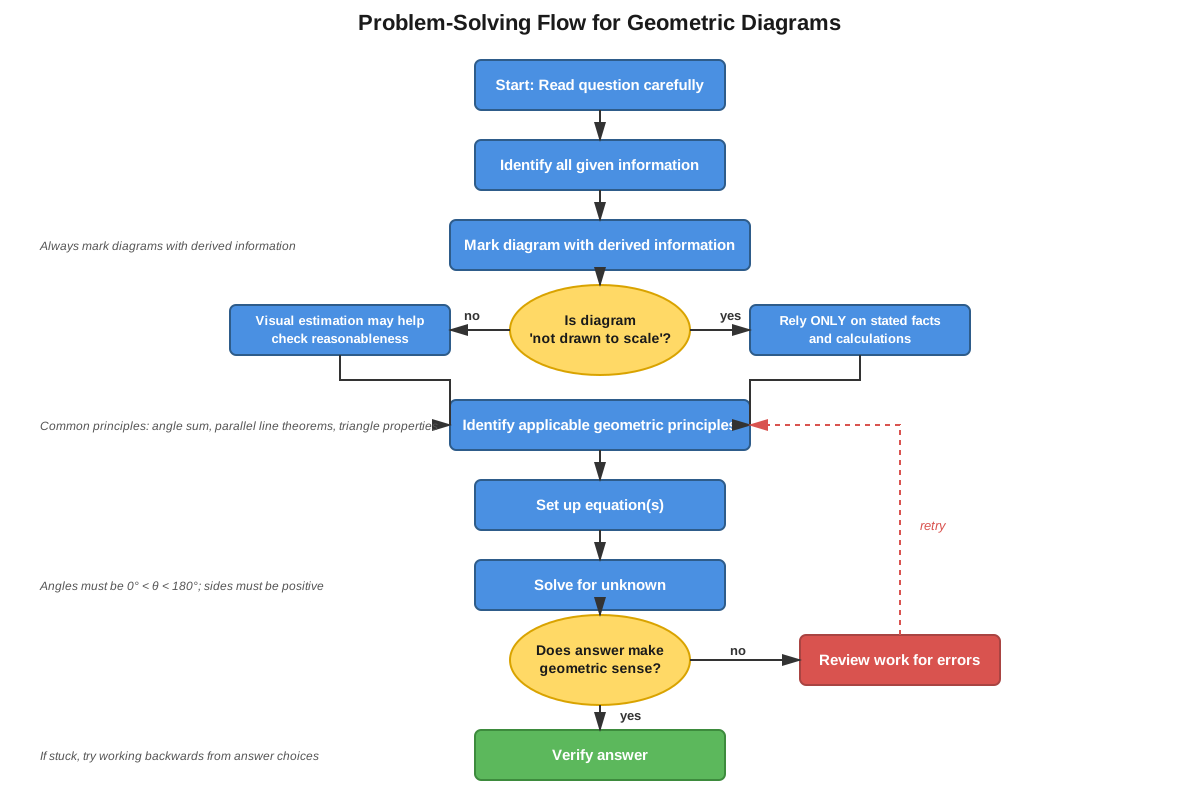
When approaching geometric diagram questions on the SAT, follow this systematic process:
Step 1: Read the question first before analyzing the diagram in detail. Understanding what you're solving for helps focus your diagram analysis on relevant information.
Step 2: Check for the "not drawn to scale" disclaimer. If present, rely exclusively on stated facts and geometric properties, not visual appearance. If absent, the diagram is proportionally accurate and can guide intuition.
Step 3: Mark up the diagram with all given information. Write in known angle measures, label congruent segments, and note special properties. Transfer information from the question text directly onto the diagram.
Step 4: Identify all geometric relationships present in the diagram: parallel lines, congruent segments, special triangles, angle relationships. Look for both explicitly marked relationships and those implied by figure labels (e.g., "rectangle ABCD" implies four right angles).
Step 5: Look for "hidden" information—relationships not explicitly marked but derivable from given facts. Vertical angles, supplementary angles, and properties of special figures often provide the key to solving problems.
Trigger words and phrases to watch for:
- "Note: Figure not drawn to scale" → Ignore visual appearance
- "Parallel lines" → Apply corresponding, alternate interior, or consecutive interior angle relationships
- "Isosceles triangle" → Base angles are congruent
- "Regular polygon" → All sides and angles are congruent
- "Perpendicular" → Right angles are formed
- "Bisects" → Divides into two equal parts
Process of elimination tips:
- Eliminate answers that violate basic geometric principles (e.g., triangle angles summing to more than 180°)
- If the diagram is drawn to scale, eliminate answers that seem visually unreasonable
- Check extreme cases: if x could be 0, what would the answer be? If x is very large, what happens?
Time allocation: Spend 30-45 seconds analyzing the diagram and identifying relationships before attempting calculations. This upfront investment prevents false starts and reduces overall solving time. For complex multi-step problems, budget 2-3 minutes total.
Memory Techniques
CPAC for parallel line angle pairs:
- Corresponding angles are Congruent
- Parallel lines create Pairs
- Alternate interior angles are Also congruent
- Consecutive interior angles are Complementary to 180° (supplementary)
"Tick marks = Same": Whenever you see tick marks (single, double, or triple) on segments or arc marks on angles, those measurements are identical. One tick = one group of equal measures, two ticks = another group.
The "180 Family": Three key angle sums all equal 180°:
- Triangle interior angles
- Linear pair (angles on a straight line)
- Consecutive interior angles with parallel lines
"VAN" for intersecting lines:
- Vertical angles are equal
- Adjacent angles are supplementary
- No other relationships can be assumed
Visualization strategy for composite figures: Imagine "peeling apart" overlapping shapes. Mentally separate the inner figure from the outer figure, identify what they share (a side, an angle, a vertex), then determine how measurements transfer between them.
The "Square Symbol = 90°" rule: The small square at an angle vertex is the universal symbol for a right angle. No square = cannot assume 90°, even if it looks perpendicular.
Summary
Geometric diagrams form the visual foundation for SAT geometry questions, requiring students to extract information from figures, identify stated and implied relationships, and apply geometric principles to solve problems. Success depends on understanding diagram notation (congruence marks, right angle symbols, parallel indicators), recognizing when diagrams are "not drawn to scale," and systematically identifying angle relationships, triangle properties, and polygon characteristics. The most critical skills include distinguishing between information that can be assumed versus information that must be explicitly stated, applying angle relationships from parallel lines and transversals, using triangle angle sum and exterior angle theorems, and synthesizing multiple geometric properties in composite figures. Students must mark up diagrams with given information, look for "hidden" relationships derivable from stated facts, and rely on mathematical principles rather than visual estimation when diagrams are not drawn to scale. Mastery requires integrating knowledge of vertical angles, linear pairs, corresponding and alternate interior angles, isosceles triangle properties, and special quadrilateral characteristics into a cohesive problem-solving approach.
Key Takeaways
- Congruence marks (tick marks on segments, arc marks on angles) indicate equal measurements and provide crucial information even without numerical values
- When diagrams state "Note: Figure not drawn to scale," rely exclusively on stated facts and geometric properties, never on visual appearance
- Vertical angles are always congruent; consecutive interior angles formed by parallel lines and a transversal are always supplementary
- Triangle interior angles always sum to 180°, and an exterior angle equals the sum of the two non-adjacent interior angles
- Mark up diagrams with all given information and actively search for implied relationships based on figure labels and geometric properties
- Distinguish carefully between explicitly stated information, relationships implied by geometric definitions, and assumptions that cannot be made without confirmation
- Systematic diagram analysis—identifying angle relationships, special triangle properties, and polygon characteristics—is more reliable than attempting to solve problems through visual estimation
Related Topics
Coordinate Geometry: Geometric diagrams extend into the coordinate plane, where points, lines, and shapes are defined by coordinates. Mastering diagram interpretation enables analysis of slopes, distances, and geometric relationships in coordinate systems.
Circle Theorems: Advanced circle problems build on diagram interpretation skills, requiring identification of radii, chords, tangent lines, inscribed angles, and central angles within circular diagrams.
Similar Triangles and Proportions: Diagram analysis skills are essential for identifying similar triangles within complex figures and setting up proportions based on corresponding sides.
Three-Dimensional Geometry: Understanding two-dimensional geometric diagrams provides the foundation for interpreting three-dimensional figures, which are represented through two-dimensional projections on the SAT.
Trigonometry: Right triangle diagrams form the basis for trigonometric ratios, and diagram interpretation skills transfer directly to identifying opposite, adjacent, and hypotenuse sides relative to given angles.
Practice CTA
Now that you've mastered the core concepts of geometric diagrams, it's time to put your knowledge into action! Work through the practice questions to reinforce your understanding of diagram notation, angle relationships, and problem-solving strategies. The flashcards will help you memorize key properties and relationships that appear repeatedly on the SAT. Remember: geometric diagram questions reward systematic analysis and careful attention to stated versus implied information. With focused practice, you'll develop the pattern recognition and spatial reasoning skills that lead to quick, confident solutions on test day. You've got this!
Sign up free to keep reading
Create a free AnvayaPrep account to finish this SAT guide on Geometric diagrams — plus flashcards and practice questions.