Overview
Similar triangles are one of the most powerful and frequently tested concepts in SAT geometry. These triangles share the same shape but differ in size, maintaining identical angle measures while their corresponding sides are proportional. Understanding similar triangles unlocks the ability to solve complex geometric problems by establishing relationships between different parts of figures, making it an essential tool for success on the math section of the SAT.
The concept of similar triangles appears in approximately 10-15% of SAT geometry questions, making it a high-yield topic that deserves focused attention. Questions involving similar triangles often integrate multiple geometric principles, including proportional reasoning, the Pythagorean theorem, and properties of special right triangles. Mastering this topic provides a foundation for solving problems involving indirect measurement, scale factors, and geometric proofs—all common question types on the exam.
Beyond its direct application, similar triangles connect to broader mathematical reasoning skills tested throughout the SAT. The proportional relationships inherent in similar triangles reinforce algebraic thinking, while the visual-spatial reasoning required to identify similar triangles strengthens problem-solving abilities across multiple question formats. This topic serves as a bridge between pure geometry and algebraic manipulation, making it central to the integrated approach the SAT takes toward mathematical assessment.
Learning Objectives
- [ ] Identify key features of similar triangles
- [ ] Explain how similar triangles appears on the SAT
- [ ] Apply similar triangles to answer SAT-style questions
- [ ] Determine whether two triangles are similar using AA, SAS, and SSS similarity criteria
- [ ] Calculate unknown side lengths using proportional relationships in similar triangles
- [ ] Solve multi-step problems involving similar triangles within complex geometric figures
- [ ] Apply scale factors to determine perimeter and area relationships between similar triangles
Prerequisites
- Basic triangle properties: Understanding angle sum theorem (angles sum to 180°) is essential for identifying corresponding angles in similar triangles
- Ratio and proportion: Facility with setting up and solving proportions is necessary for finding unknown side lengths in similar triangles
- Algebraic equation solving: Ability to solve linear equations and cross-multiply is required for working with proportional relationships
- Basic angle relationships: Knowledge of vertical angles, corresponding angles with parallel lines, and complementary/supplementary angles helps identify equal angles
- Pythagorean theorem: Often combined with similar triangle problems to find missing side lengths
Why This Topic Matters
Similar triangles have profound real-world applications that extend far beyond the classroom. Architects and engineers use similar triangles to create scale models and blueprints, ensuring that proportions remain accurate when translating designs from paper to reality. Surveyors employ similar triangle principles to measure distances that would be impossible to measure directly, such as the width of a river or the height of a mountain. Navigation systems, computer graphics, and even photography rely on the mathematical relationships inherent in similar triangles.
On the SAT, similar triangles appear in multiple question formats with notable frequency. Approximately 2-4 questions per test directly involve similar triangles, while many additional questions incorporate similar triangle reasoning as part of multi-step solutions. These questions typically appear in both the calculator and no-calculator sections, with difficulty levels ranging from medium to hard. The College Board particularly favors questions that embed similar triangles within more complex figures, requiring students to identify the similar triangles before applying proportional reasoning.
Common SAT presentations include: triangles sharing a common angle with a line segment parallel to one side creating similar triangles; overlapping triangles where students must identify corresponding parts; problems involving shadows or indirect measurement; coordinate geometry questions where similar triangles help find slopes or distances; and word problems requiring students to set up proportions based on similar triangle relationships. The ability to quickly recognize these patterns and apply the appropriate solution strategy significantly impacts both accuracy and time management on test day.
Core Concepts
Definition and Properties of Similar Triangles
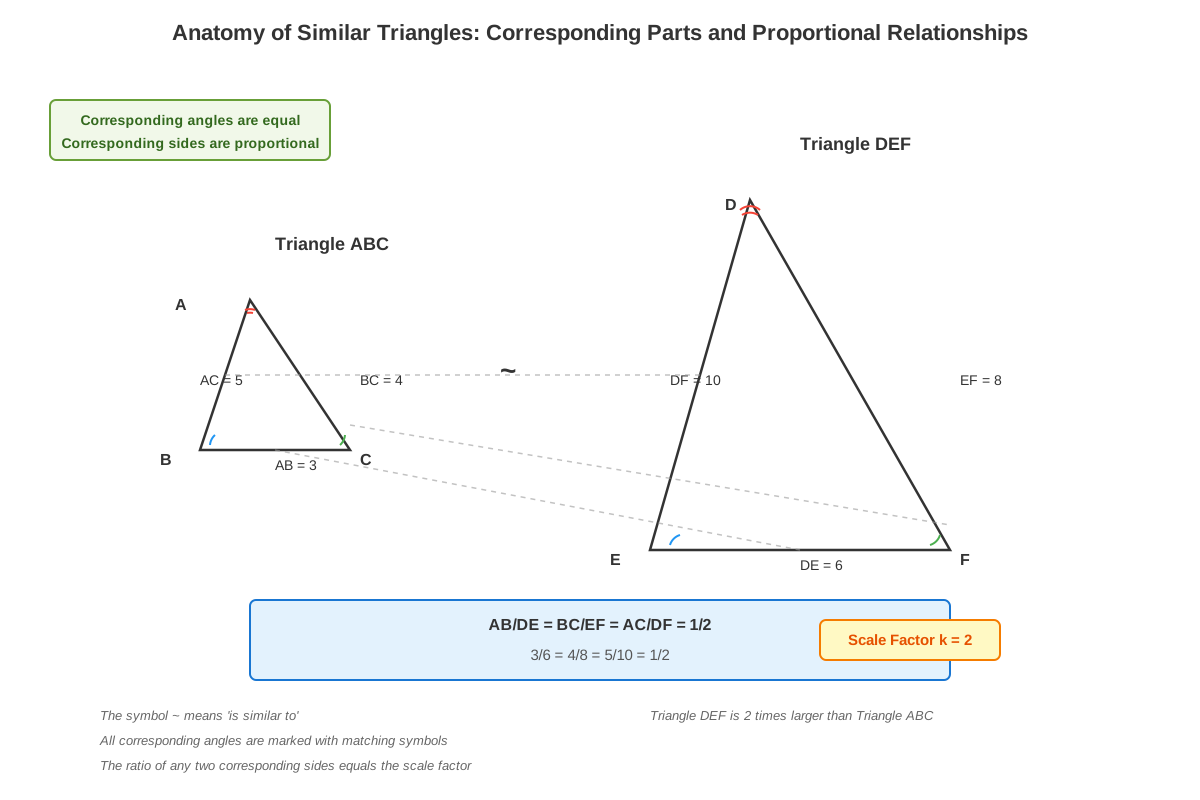
Similar triangles are triangles that have the same shape but not necessarily the same size. Two triangles are similar if and only if their corresponding angles are congruent (equal in measure) and their corresponding sides are proportional. The symbol for similarity is ~, so if triangle ABC is similar to triangle DEF, we write △ABC ~ △DEF.
The fundamental properties of similar triangles include:
- All corresponding angles are congruent
- All corresponding sides are in the same ratio (called the scale factor)
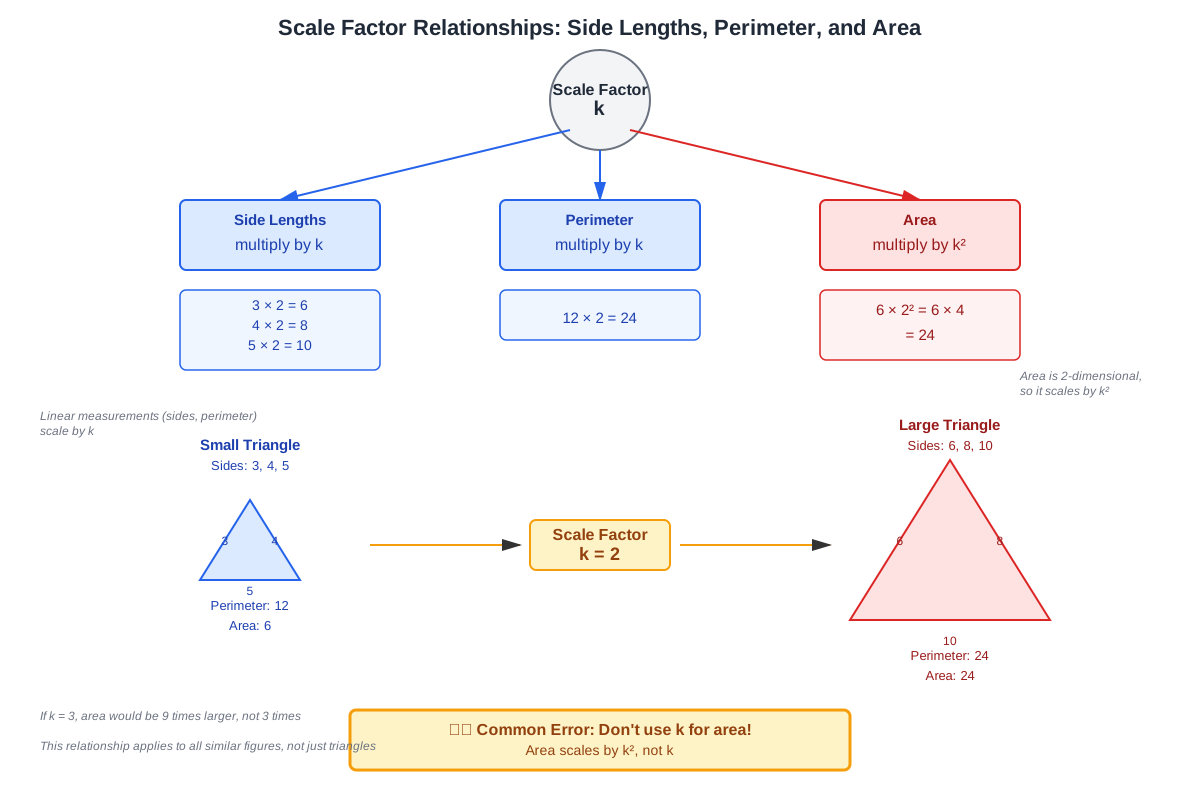
- The ratio of perimeters equals the scale factor
- The ratio of areas equals the square of the scale factor
- Corresponding altitudes, medians, and angle bisectors are also proportional
Similarity Criteria
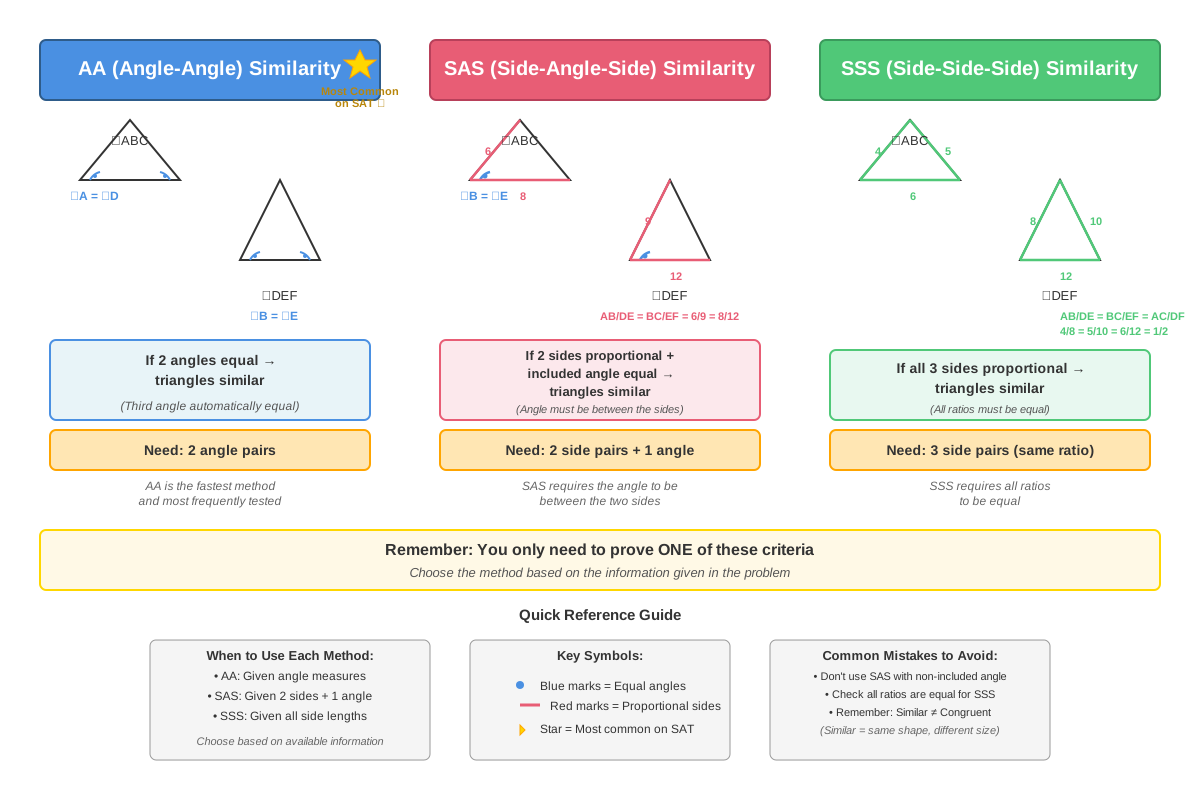
There are three primary methods to prove that two triangles are similar, each requiring different information:
Angle-Angle (AA) Similarity: If two angles of one triangle are congruent to two angles of another triangle, then the triangles are similar. This is the most commonly used criterion on the SAT because knowing two angles automatically determines the third angle (since angles in a triangle sum to 180°). For example, if triangle ABC has angles measuring 50° and 60°, and triangle DEF has angles measuring 50° and 60°, then △ABC ~ △DEF.
Side-Angle-Side (SAS) Similarity: If two sides of one triangle are proportional to two sides of another triangle, and the included angles (the angles between those sides) are congruent, then the triangles are similar. For instance, if AB/DE = AC/DF and ∠A ≅ ∠D, then △ABC ~ △DEF.
Side-Side-Side (SSS) Similarity: If all three sides of one triangle are proportional to the three sides of another triangle, then the triangles are similar. If AB/DE = BC/EF = AC/DF, then △ABC ~ △DEF.
Proportional Relationships and Scale Factor
When triangles are similar, the ratio of any two corresponding sides is constant and is called the scale factor. If △ABC ~ △DEF with a scale factor of k, then:
AB/DE = BC/EF = AC/DF = kThis proportional relationship allows us to find unknown side lengths by setting up and solving proportions. For example, if we know three sides and need to find a fourth, we can write:
known side 1 / corresponding side 1 = known side 2 / unknown side 2The scale factor has important implications:
- If k = 1, the triangles are congruent (identical in size and shape)
- If k > 1, the first triangle is larger than the second
- If k < 1, the first triangle is smaller than the second
Similar Triangles in Complex Figures
The SAT frequently presents similar triangles embedded within larger geometric figures. Common configurations include:
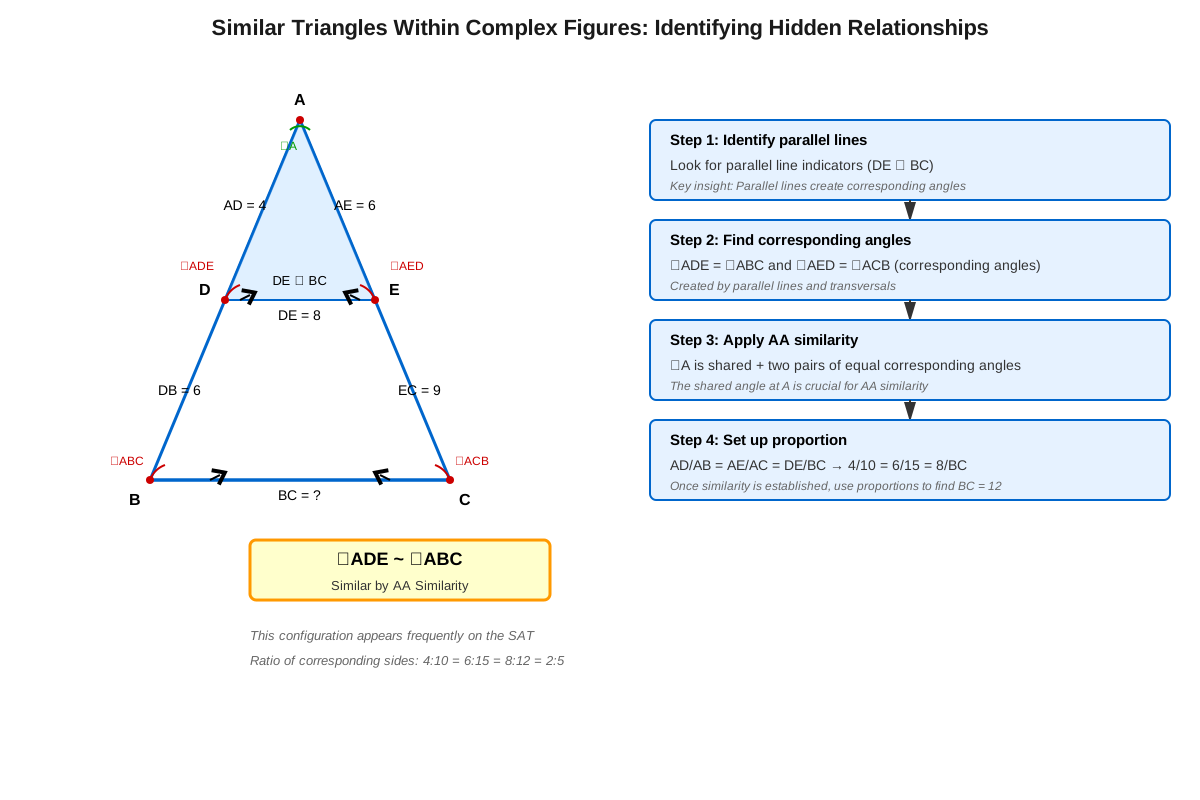
Triangles with Parallel Lines: When a line segment is drawn parallel to one side of a triangle, it creates a smaller triangle similar to the original. This configuration appears frequently because it combines similar triangles with properties of parallel lines and transversals.
Overlapping Triangles: Two triangles may share a common vertex or side while having different orientations. Identifying corresponding parts requires careful analysis of which angles and sides match between the triangles.
Nested Triangles: A smaller triangle may be completely contained within a larger triangle, sharing angles but having different side lengths. These problems often involve altitude lines or angle bisectors.
Corresponding Parts
Correctly identifying corresponding parts is crucial for setting up accurate proportions. Corresponding parts are matched based on their position relative to equal angles. The order of vertices in the similarity statement indicates correspondence: if △ABC ~ △DEF, then:
- ∠A corresponds to ∠D
- ∠B corresponds to ∠E
- ∠C corresponds to ∠F
- Side AB corresponds to side DE
- Side BC corresponds to side EF
- Side AC corresponds to side DF
Area and Perimeter Relationships
The relationship between similar triangles extends beyond side lengths:
| Measurement | Relationship | Formula |
|---|---|---|
| Side lengths | Linear (scale factor k) | side₁/side₂ = k |
| Perimeter | Linear (scale factor k) | perimeter₁/perimeter₂ = k |
| Area | Quadratic (scale factor squared) | area₁/area₂ = k² |
| Altitude/Median | Linear (scale factor k) | altitude₁/altitude₂ = k |
This means if the scale factor between two similar triangles is 3, the larger triangle has sides 3 times as long, a perimeter 3 times as large, but an area 9 times as large (3² = 9).
Concept Relationships
The concepts within similar triangles form an interconnected web of geometric reasoning. The definition of similar triangles (equal angles and proportional sides) serves as the foundation → which leads to → similarity criteria (AA, SAS, SSS) that provide methods for proving similarity → which enables → setting up proportional relationships to find unknown measurements → which connects to → scale factor calculations that describe the size relationship → which extends to → area and perimeter relationships that follow predictable patterns.
Similar triangles connect directly to prerequisite knowledge of ratios and proportions from algebra, as every similar triangle problem requires setting up and solving proportional equations. The concept also builds upon angle relationships, particularly when parallel lines create corresponding angles that establish AA similarity. The Pythagorean theorem frequently combines with similar triangles, where proportional reasoning finds one side length and the Pythagorean theorem finds another.
Looking forward, mastery of similar triangles enables progression to trigonometry, where ratios of sides in similar right triangles define sine, cosine, and tangent. Similar triangles also provide the foundation for understanding coordinate geometry concepts like slope (rise over run creates similar right triangles) and geometric transformations, particularly dilations that create similar figures. The proportional reasoning developed through similar triangles transfers directly to scale drawings, probability with geometric figures, and optimization problems that appear in advanced SAT questions.
Quick check — test yourself on Similar triangles so far.
Try Flashcards →High-Yield Facts
⭐ Two triangles are similar if they have two pairs of congruent corresponding angles (AA similarity)—this is the most commonly tested criterion on the SAT
⭐ Corresponding sides of similar triangles are proportional, allowing you to set up equations like a/b = c/d to find unknown lengths
⭐ A line parallel to one side of a triangle creates a smaller similar triangle within the original triangle
⭐ The ratio of areas of similar triangles equals the square of the scale factor (if sides are in ratio 2:1, areas are in ratio 4:1)
⭐ The ratio of perimeters of similar triangles equals the scale factor (if sides are in ratio 3:1, perimeters are in ratio 3:1)
- Vertical angles and shared angles are common ways the SAT establishes angle congruence for AA similarity
- When setting up proportions, corresponding sides must be in the same position in both ratios (both numerators from one triangle, both denominators from the other)
- Similar triangles preserve angle measures but not side lengths—all angles stay the same while all sides scale by the same factor
- Right triangles with the same acute angle are always similar because they share a right angle and one other angle
- The altitude to the hypotenuse of a right triangle creates two smaller triangles that are similar to each other and to the original triangle
- If two triangles are similar with scale factor k, then their corresponding altitudes, medians, and angle bisectors are also in ratio k
- Similar triangles can have different orientations (rotated or reflected) but still maintain their proportional relationships
Common Misconceptions
Misconception: Triangles that "look similar" are actually similar. → Correction: Visual appearance is not sufficient; you must verify that corresponding angles are equal or that corresponding sides are proportional using one of the three similarity criteria (AA, SAS, or SSS).
Misconception: If two triangles have one pair of equal angles, they are similar. → Correction: You need at least two pairs of equal angles (AA similarity) to prove triangles are similar. One equal angle is insufficient because the other angles could differ.
Misconception: Corresponding sides in similar triangles must be set up as "small over large" or "large over small" in proportions. → Correction: What matters is consistency—both ratios must follow the same pattern. You can write small/large = small/large OR large/small = large/small, but not small/large = large/small.
Misconception: If the scale factor is 2, then the area of the larger triangle is also 2 times the area of the smaller triangle. → Correction: The area ratio equals the square of the scale factor. If the scale factor is 2, the area ratio is 2² = 4, meaning the larger triangle has 4 times the area.
Misconception: Similar triangles must have the same orientation or position. → Correction: Similar triangles can be rotated, reflected, or positioned differently. The key is matching corresponding parts based on angle measures, not visual orientation.
Misconception: All right triangles are similar to each other. → Correction: Right triangles are only similar if they share another pair of equal angles (beyond the right angle). Having one right angle is not sufficient for similarity.
Misconception: The order of vertices in a similarity statement doesn't matter. → Correction: The order is crucial because it indicates which parts correspond. △ABC ~ △DEF means A↔D, B↔E, and C↔F; writing △ABC ~ △EDF would indicate different correspondences.
Worked Examples
Example 1: Finding Unknown Sides with Parallel Lines
Problem: In triangle ABC, point D lies on side AB and point E lies on side AC such that DE is parallel to BC. If AD = 6, DB = 3, and BC = 15, find the length of DE.
Solution:
Step 1: Identify the similar triangles. Since DE || BC, we know that △ADE ~ △ABC by AA similarity (they share angle A, and the parallel lines create equal corresponding angles).
Step 2: Determine the scale factor. The total length of AB = AD + DB = 6 + 3 = 9. The ratio of corresponding sides is AD/AB = 6/9 = 2/3.
Step 3: Set up a proportion using corresponding sides. Since the triangles are similar:
DE/BC = AD/AB
DE/15 = 6/9
DE/15 = 2/3
Step 4: Solve for DE by cross-multiplying:
3 × DE = 2 × 15
3 × DE = 30
DE = 10Answer: DE = 10
This problem demonstrates the high-yield concept that parallel lines create similar triangles and requires applying proportional relationships to find unknown sides—both frequently tested on the SAT.
Example 2: Multi-Step Problem with Overlapping Triangles
Problem: In the figure, △ABC and △DEC share vertex C. If ∠ABC = ∠DEC = 90°, ∠BAC = 35°, AB = 12, DE = 8, and BC = 9, find the length of EC.
Solution:
Step 1: Determine if the triangles are similar. Both triangles have a right angle (90°). In △ABC, since ∠BAC = 35° and ∠ABC = 90°, then ∠BCA = 180° - 90° - 35° = 55°. In △DEC, since ∠DEC = 90° and angles in a triangle sum to 180°, we need to find if ∠DCE = 55°. If ∠BCA and ∠DCE are vertical angles or the same angle, then ∠EDC = 35°. With two pairs of equal angles, △ABC ~ △DEC by AA similarity.
Step 2: Identify corresponding parts. Based on equal angles:
- ∠ABC (90°) corresponds to ∠DEC (90°)
- ∠BAC (35°) corresponds to ∠EDC (35°)
- ∠BCA (55°) corresponds to ∠DCE (55°)
Therefore: AB corresponds to DE, BC corresponds to EC, and AC corresponds to DC.
Step 3: Set up a proportion using known corresponding sides:
AB/DE = BC/EC
12/8 = 9/EC
Step 4: Solve for EC by cross-multiplying:
12 × EC = 8 × 9
12 × EC = 72
EC = 6Answer: EC = 6
This example illustrates how the SAT tests similar triangles in complex configurations where students must first prove similarity, then carefully identify corresponding parts before setting up proportions.
Exam Strategy
When approaching SAT similar triangles questions, begin by scanning the figure for common similarity indicators: parallel lines, shared angles, or right angles. Circle or mark equal angles immediately, as identifying two pairs of equal angles (AA similarity) is the fastest path to proving similarity. If the problem involves a line parallel to one side of a triangle, you can immediately conclude that similar triangles exist.
Trigger words and phrases to watch for include: "parallel to," "corresponding," "proportional," "scale factor," "similar," and "ratio." Questions asking you to "find the length of" typically require setting up a proportion, while questions asking "what is the ratio" focus on scale factors. Phrases like "a line segment connects the midpoints" or "divides the sides proportionally" signal similar triangle applications.
For process of elimination, remember these strategies:
- Eliminate answer choices that would create impossible triangle configurations (like a side longer than the sum of the other two sides)
- If you've identified a scale factor of 2, eliminate any answer that doesn't reflect doubling for linear measurements
- For area problems, eliminate answers that show linear scaling instead of quadratic scaling
- Check if answer choices are in simplified form; SAT answers are typically reduced ratios
Time allocation is critical: spend 30-45 seconds identifying the similar triangles and marking equal angles, then 45-60 seconds setting up and solving the proportion. If you cannot identify similar triangles within 30 seconds, mark the question and return to it later. Don't waste time trying to prove similarity using SSS or SAS when AA similarity is usually faster and more obvious.
Always write out your proportion clearly, ensuring corresponding sides are in matching positions. A common time-saving technique is to simplify the scale factor before cross-multiplying—if you have 12/8 = x/6, recognize that 12/8 simplifies to 3/2, making the calculation easier. Finally, after finding an answer, do a quick reasonableness check: if the scale factor suggests the triangle is larger, your answer should be larger than the given corresponding side.
Memory Techniques
"AA is A-OK": Remember that Angle-Angle similarity is the most useful criterion because two angles automatically determine the third. When you see two equal angles, you're "A-OK" to conclude similarity.
"Parallel = Similar": Create a mental image of a triangle with a line parallel to the base cutting through it. This visual instantly reminds you that parallel lines create similar triangles—one of the highest-yield patterns on the SAT.
"Square the Scale for Area": Use the phrase "Square the Scale" to remember that area ratios equal the square of the scale factor. If sides are in ratio 3:1, areas are in ratio 3²:1² = 9:1.
Corresponding Parts Matching: Visualize the similarity statement as a matching game: △ABC ~ △DEF means A matches D, B matches E, C matches F. The order of letters is your guide—first matches first, second matches second, third matches third.
"Set up Shop": When setting up proportions, think "Same Over Same, Homies Over Homies"—keep sides from the same triangle together (both in numerators or both in denominators). This prevents the most common proportion setup error.
The Three S's of Similarity: SSS, SAS, and AA (okay, two S's and two A's) can be remembered as "Some Students Always Ace" geometry—connecting the criteria to success.
Summary
Similar triangles represent a cornerstone concept in SAT geometry, appearing frequently in various question formats and difficulty levels. These triangles maintain identical angle measures while their corresponding sides exist in constant proportion, defined by a scale factor. The three methods for proving similarity—AA (two pairs of equal angles), SAS (two proportional sides with an equal included angle), and SSS (three proportional sides)—provide different pathways to establishing similarity, with AA being most common on the SAT. Once similarity is established, proportional relationships allow calculation of unknown side lengths, while the scale factor determines perimeter ratios (linear relationship) and area ratios (quadratic relationship). Success with similar triangles requires recognizing common configurations (especially parallel lines creating similar triangles), correctly identifying corresponding parts, accurately setting up proportions, and understanding how scale factors affect different measurements. The integration of similar triangles with other geometric concepts makes this topic essential for achieving high scores on the SAT math section.
Key Takeaways
- Similar triangles have equal corresponding angles and proportional corresponding sides, with the constant ratio called the scale factor
- AA similarity (two pairs of equal angles) is the fastest and most common method for proving triangles are similar on the SAT
- A line parallel to one side of a triangle always creates a smaller similar triangle, making this the highest-yield configuration to recognize
- Corresponding sides must be matched correctly when setting up proportions—the order of vertices in the similarity statement indicates which parts correspond
- The ratio of perimeters equals the scale factor k, but the ratio of areas equals k²—linear measurements scale linearly, but area scales quadratically
- Mark equal angles immediately when analyzing figures, as identifying two pairs of equal angles proves similarity and unlocks proportional relationships
- Similar triangles can appear in complex figures through overlapping, nesting, or sharing vertices, requiring careful analysis to identify corresponding parts
Related Topics
Congruent Triangles: While similar triangles have the same shape, congruent triangles have both the same shape and size (scale factor = 1). Understanding the distinction between similarity and congruence clarifies when triangles are identical versus proportional.
Trigonometric Ratios: The sine, cosine, and tangent functions are defined using ratios of sides in similar right triangles. Mastering similar triangles provides the conceptual foundation for understanding why these ratios remain constant for a given angle.
Coordinate Geometry and Slope: The slope of a line creates similar right triangles along its length, with rise and run maintaining constant proportions. Similar triangle reasoning explains why slope is consistent throughout a linear function.
Geometric Transformations: Dilations create similar figures by scaling all dimensions by a constant factor. Understanding similar triangles helps predict how dilations affect perimeter, area, and other measurements.
Circle Theorems: Several circle theorems involve similar triangles, particularly those relating to tangent lines, secants, and inscribed angles. Similar triangle reasoning often provides elegant solutions to circle problems.
Practice CTA
Now that you've mastered the core concepts of similar triangles, it's time to solidify your understanding through active practice. Work through the practice questions to apply these principles to SAT-style problems, and use the flashcards to reinforce the high-yield facts and formulas. Remember, similar triangles appear on virtually every SAT, making this one of the highest-return topics for your study time. Each practice problem you solve builds pattern recognition that will save you valuable seconds on test day. You've got this—let's turn this knowledge into points!
Sign up free to keep reading
Create a free AnvayaPrep account to finish this SAT guide on Similar triangles — plus flashcards and practice questions.