Overview
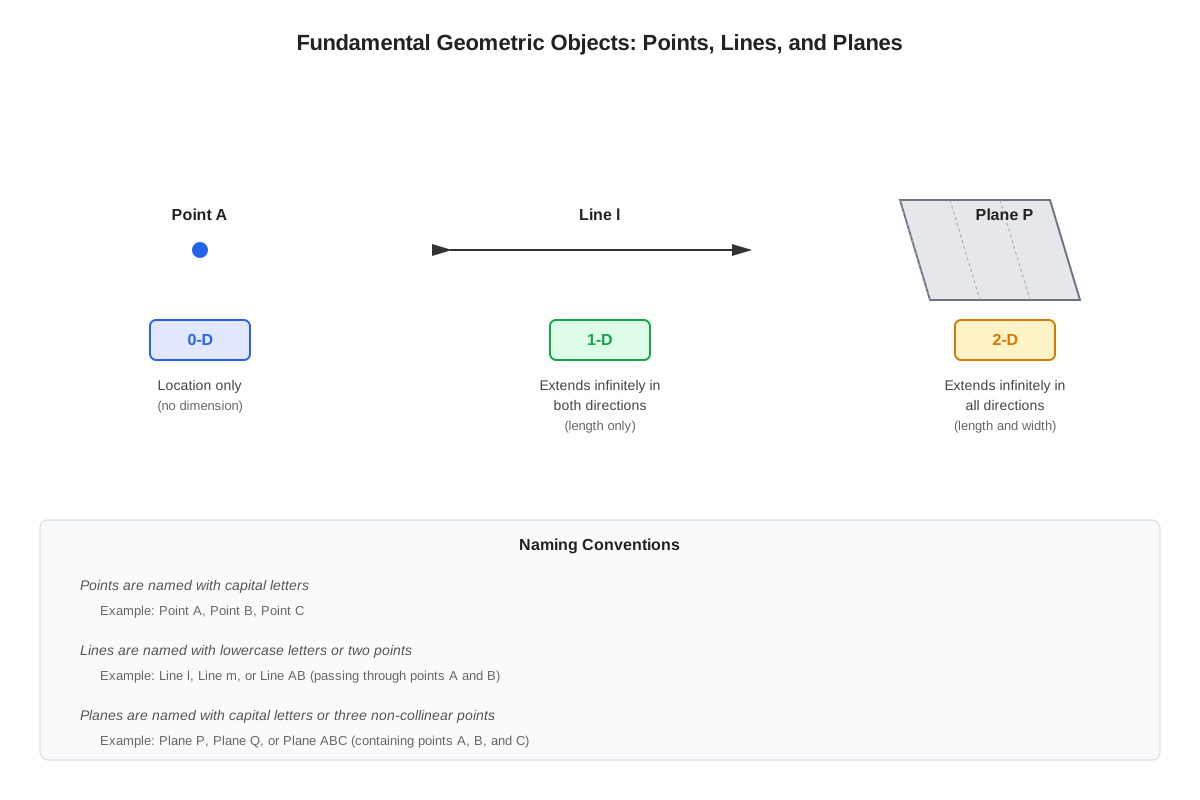
Points, lines, and planes form the foundational building blocks of geometry and appear regularly throughout the SAT Math section. These fundamental geometric objects define how we understand space, position, and relationships in mathematics. A point represents a specific location with no dimension, a line extends infinitely in both directions with one dimension, and a plane is a flat, two-dimensional surface extending infinitely in all directions. Understanding these basic elements is crucial because they underpin virtually every geometric concept tested on the SAT, from angle relationships to coordinate geometry to three-dimensional figures.
The SAT frequently tests students' ability to recognize and apply properties of points lines planes in various contexts. Questions may ask about collinear points (points on the same line), coplanar points (points on the same plane), the number of lines determined by given points, or the intersection properties of lines and planes. These concepts often appear integrated within larger geometry problems involving triangles, circles, coordinate geometry, and spatial reasoning. Mastery of this topic enables students to visualize geometric relationships accurately and solve complex problems efficiently.
This topic connects directly to nearly every other geometry concept on the SAT. Understanding how points define lines, how lines intersect to form angles, and how planes contain geometric figures provides the framework for analyzing polygons, circles, and three-dimensional solids. The coordinate plane itself is an application of these fundamental concepts, where ordered pairs represent points and equations represent lines. Strong comprehension of points, lines, and planes creates a solid foundation for tackling the approximately 15-20% of SAT Math questions that involve geometric reasoning.
Learning Objectives
- [ ] Identify key features of points, lines, and planes
- [ ] Explain how points, lines, and planes appear on the SAT
- [ ] Apply points, lines, and planes concepts to answer SAT-style questions
- [ ] Determine the number of lines that can be drawn through given points
- [ ] Analyze intersection properties of lines and planes in two and three dimensions
- [ ] Distinguish between collinear, coplanar, and non-coplanar points
- [ ] Apply postulates about points, lines, and planes to solve multi-step problems
Prerequisites
- Basic arithmetic operations: Necessary for calculating distances and counting geometric objects
- Understanding of variables and equations: Required for representing lines algebraically and working with coordinate geometry
- Spatial visualization skills: Essential for mentally manipulating geometric figures and understanding three-dimensional relationships
- Set notation and logic: Helpful for understanding intersection and union of geometric objects
Why This Topic Matters
Understanding points, lines, and planes has practical applications far beyond the SAT. Architects use these concepts to design buildings and create blueprints, engineers apply them in structural analysis and CAD software, computer graphics programmers rely on them for rendering three-dimensional images, and navigation systems use coordinate planes to determine positions and routes. The ability to visualize and manipulate spatial relationships is fundamental to fields ranging from physics and chemistry to art and design.
On the SAT, questions involving points, lines, and planes appear in approximately 3-5 questions per test, representing roughly 5-8% of the Math section. These questions typically appear in both the calculator and no-calculator portions and range from straightforward identification problems to complex multi-step reasoning questions. The College Board frequently integrates these concepts with other topics, such as asking students to find the equation of a line passing through two points, determine angle relationships formed by intersecting lines, or analyze three-dimensional figures composed of planes.
Common question formats include: determining how many lines can be drawn through a set of points; identifying whether points are collinear or coplanar; finding intersection points of lines; analyzing parallel and perpendicular relationships; and applying properties of planes to three-dimensional geometry problems. The SAT also tests these concepts through coordinate geometry questions where students must work with points as ordered pairs and lines as equations. Understanding the fundamental properties of these geometric objects enables students to approach these varied question types with confidence and accuracy.
Core Concepts
Points
A point is the most basic geometric object, representing a specific location in space with no dimension—no length, width, or height. Points are typically labeled with capital letters (A, B, C) and represented visually as dots, though the dot is merely a representation since a true point has no size. In coordinate geometry, points are expressed as ordered pairs (x, y) in two dimensions or ordered triples (x, y, z) in three dimensions.
Key properties of points include:
- A point has no measurable size or dimension
- A point defines a precise position in space
- Any number of points can exist in space
- Points are the building blocks from which all other geometric figures are constructed
Lines
A line is a one-dimensional geometric object that extends infinitely in both directions without curving. Lines are perfectly straight and have infinite length but no width or thickness. Lines can be named in several ways: by a single lowercase letter (line m), by two points on the line with a line symbol above them (line AB or AB with a double-headed arrow), or by their equation in coordinate geometry.
Fundamental properties of lines include:
- Two points determine a unique line: Given any two distinct points, exactly one line passes through both points
- Infinite points on a line: A line contains infinitely many points
- Infinite extent: Lines extend forever in both directions
- Straightness: Lines never curve or bend
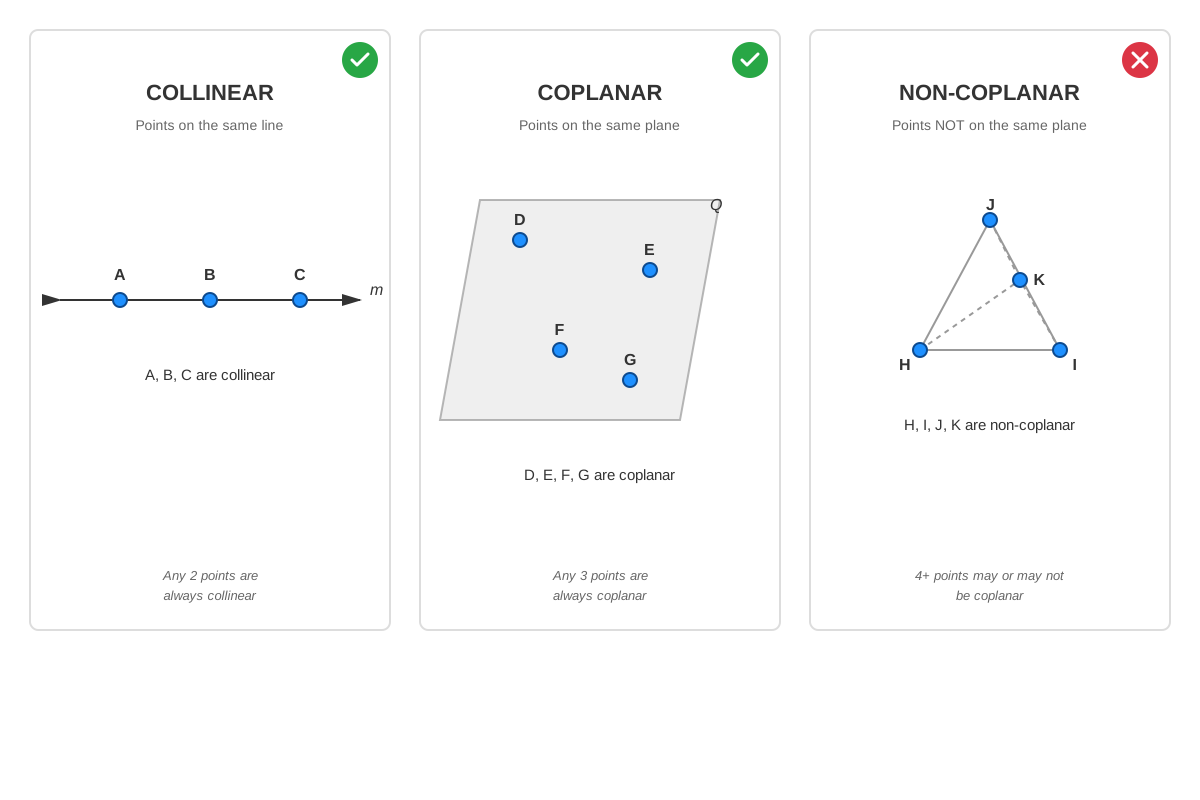
Collinear points are points that lie on the same line. For example, if points A, B, and C all lie on line m, they are collinear. Three or more points are collinear if and only if they can all be connected by a single straight line. On the SAT, determining whether points are collinear often involves checking if the slope between any two pairs of points is identical.
Line Segments and Rays
While not lines themselves, line segments and rays are important related concepts. A line segment is the portion of a line between two endpoints, including those endpoints. It has finite, measurable length. A ray is a portion of a line that starts at one endpoint and extends infinitely in one direction. Understanding the distinction between these objects is crucial for SAT questions.
| Geometric Object | Symbol | Extent | Endpoints |
|---|---|---|---|
| Line | ↔AB | Infinite both directions | None |
| Ray | →AB | Infinite one direction | One (starting point) |
| Line Segment | AB or AB̅ | Finite | Two |
Planes
A plane is a flat, two-dimensional surface that extends infinitely in all directions. Think of a plane as an infinitely large, perfectly flat sheet. Planes are typically represented by parallelograms in diagrams (though they extend beyond the drawn boundaries) and named by a single capital letter (plane P) or by three non-collinear points in the plane (plane ABC).
Essential properties of planes include:
- Three non-collinear points determine a unique plane: Any three points not on the same line define exactly one plane
- Infinite extent: Planes extend forever in all directions within their two dimensions
- Flatness: Planes have no curvature
- Infinite points and lines: A plane contains infinitely many points and infinitely many lines
Coplanar points are points that lie on the same plane. Any two or three points are always coplanar (you can always find a plane containing them), but four or more points may or may not be coplanar. For example, the four corners of a square are coplanar, but the five vertices of a square pyramid are not all coplanar.
Intersection Properties
Understanding how geometric objects intersect is crucial for SAT problems:
Line-Line Intersections:
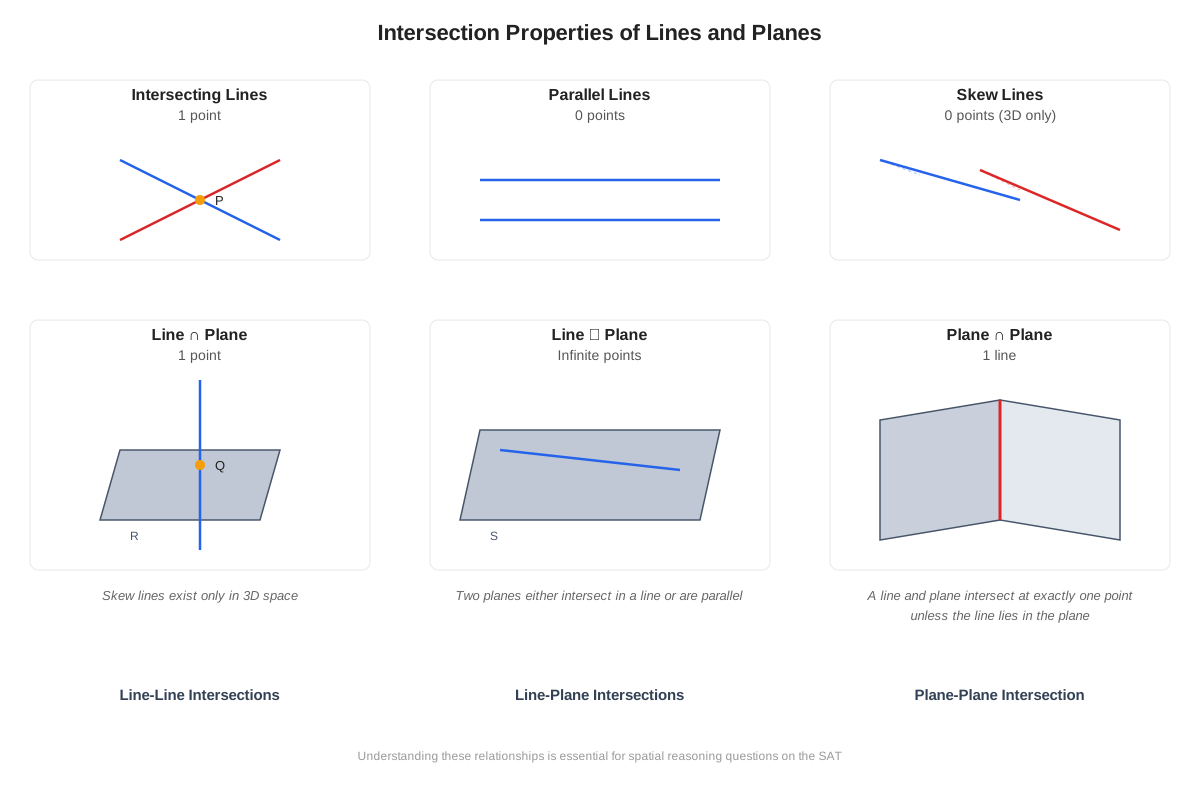
- Two distinct lines in a plane either intersect at exactly one point or are parallel (never intersect)
- Two lines in three-dimensional space can also be skew lines—lines that don't intersect and aren't parallel because they don't lie in the same plane
Line-Plane Intersections:
- A line intersects a plane at exactly one point (unless the line lies entirely within the plane)
- A line parallel to a plane never intersects it
- A line contained in a plane intersects it at infinitely many points (all points on the line)
Plane-Plane Intersections:
- Two distinct planes either intersect in a line or are parallel
- Three planes can intersect in various ways: at a single point, along a line, or not at all
Postulates and Theorems
Several fundamental postulates govern points, lines, and planes:
- Through any two points, there exists exactly one line
- A line contains at least two points
- If two lines intersect, their intersection is exactly one point
- Through any three non-collinear points, there exists exactly one plane
- A plane contains at least three non-collinear points
- If two points lie in a plane, the line containing them lies in the plane
- If two planes intersect, their intersection is a line
These postulates form the logical foundation for geometric reasoning and frequently appear in SAT problems, either explicitly or implicitly.
Concept Relationships
The concepts within this topic build upon each other in a hierarchical structure. Points serve as the foundation → Lines are defined by points (two points determine a line) → Planes are defined by points or lines (three non-collinear points or a line and a point not on the line determine a plane) → Intersection properties describe how these objects relate in space.
The concept of collinearity connects directly to the definition of lines, while coplanarity connects to the definition of planes. Both concepts are essential for understanding more complex geometric relationships. The distinction between line segments and rays versus infinite lines connects to measurement and distance concepts, which appear throughout SAT geometry.
These fundamental concepts connect to prerequisite knowledge of spatial reasoning and extend forward to virtually every geometry topic on the SAT. Understanding points in coordinate geometry enables work with distance formulas and midpoint formulas. Line properties lead directly to slope, parallel and perpendicular lines, and linear equations. Plane concepts underpin polygon properties, area calculations, and three-dimensional geometry. The intersection properties explored here form the basis for understanding angle relationships, systems of equations (where solutions represent intersection points), and geometric proofs.
Quick check — test yourself on Points lines planes so far.
Try Flashcards →High-Yield Facts
⭐ Exactly one line passes through any two distinct points—this is fundamental to determining unique lines
⭐ Three non-collinear points determine exactly one plane—crucial for three-dimensional geometry problems
⭐ Two distinct lines in a plane either intersect at one point or are parallel—essential for analyzing line relationships
⭐ Collinear points lie on the same line—tested frequently through coordinate geometry and slope calculations
⭐ The intersection of two planes is a line—important for three-dimensional visualization problems
- A point has zero dimensions, a line has one dimension, and a plane has two dimensions
- Any two points are always collinear (they define a line)
- Any three points are always coplanar (they define a plane)
- Four or more points may or may not be coplanar
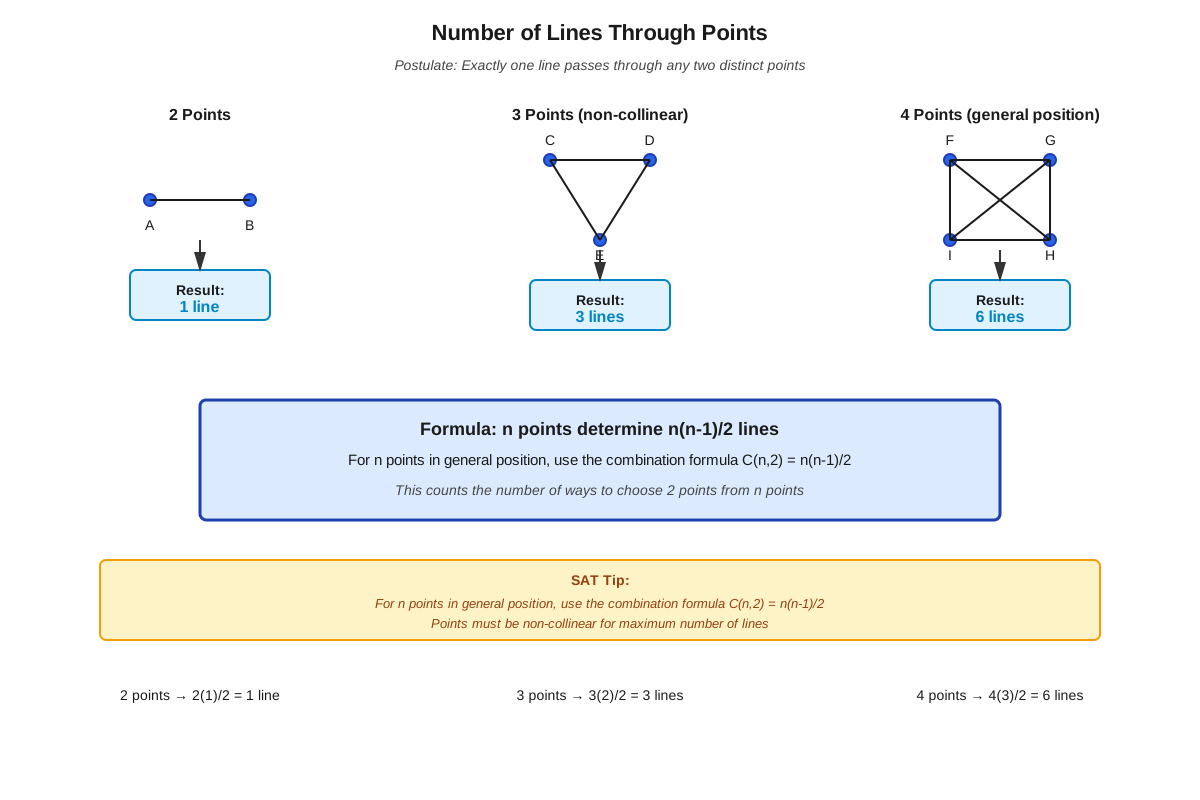
- Through n points, the maximum number of lines that can be drawn is n(n-1)/2 when no three points are collinear
- Skew lines exist only in three dimensions and are neither parallel nor intersecting
- A line segment has two endpoints and finite length, while a line has no endpoints and infinite length
- If two lines intersect, they must be coplanar
- The minimum number of points needed to define a line is two
- The minimum number of non-collinear points needed to define a plane is three
Common Misconceptions
Misconception: All lines that don't intersect are parallel.
Correction: In three-dimensional space, lines can be skew—they don't intersect and aren't parallel because they don't lie in the same plane. Parallel lines must be coplanar.
Misconception: A line segment and a line are the same thing.
Correction: A line segment is a finite portion of a line with two endpoints and measurable length, while a line extends infinitely in both directions with no endpoints.
Misconception: Four points always determine a unique plane.
Correction: Four points determine a unique plane only if they are coplanar. If one point doesn't lie in the plane determined by the other three, no single plane contains all four points (like the vertices of a tetrahedron).
Misconception: If three points are given, they must be collinear or form a triangle.
Correction: Three points can be collinear (lying on the same line), in which case they don't form a triangle. Only three non-collinear points form a triangle.
Misconception: Points have a small size that can be measured.
Correction: Points are dimensionless—they have no length, width, or height. The dots we draw to represent points are merely visual aids; true geometric points have no measurable size.
Misconception: Two lines can intersect at more than one point.
Correction: If two distinct lines intersect, they intersect at exactly one point. If they share two or more points, they are actually the same line, not two distinct lines.
Misconception: A plane has edges or boundaries.
Correction: Planes extend infinitely in all directions within their two dimensions. The parallelograms drawn to represent planes in diagrams are just visual representations; actual planes have no edges or boundaries.
Worked Examples
Example 1: Determining the Number of Lines
Problem: Points A, B, C, and D are positioned such that no three points are collinear. How many distinct lines can be drawn through pairs of these points?
Solution:
Step 1: Understand what we're looking for. We need to count all possible lines that can be drawn by connecting any two of the four points.
Step 2: Recall that exactly one line passes through any two distinct points.
Step 3: Count the number of ways to choose 2 points from 4 points. This is a combination problem: C(4,2) = 4!/(2!(4-2)!) = 6.
Step 4: List all possible pairs to verify:
- Line through A and B
- Line through A and C
- Line through A and D
- Line through B and C
- Line through B and D
- Line through C and D
Step 5: Since no three points are collinear, each pair determines a unique line.
Answer: 6 distinct lines can be drawn.
Connection to Learning Objectives: This problem applies the fundamental postulate that two points determine exactly one line and demonstrates how to count geometric objects systematically—a common SAT problem type.
Example 2: Analyzing Collinearity in Coordinate Geometry
Problem: Points P(2, 3), Q(4, 7), and R(5, 9) are plotted on a coordinate plane. Determine whether these points are collinear.
Solution:
Step 1: Recall that points are collinear if they lie on the same line. In coordinate geometry, this means the slope between any two pairs of points must be equal.
Step 2: Calculate the slope between P and Q:
slope(PQ) = (7 - 3)/(4 - 2) = 4/2 = 2Step 3: Calculate the slope between Q and R:
slope(QR) = (9 - 7)/(5 - 4) = 2/1 = 2Step 4: Calculate the slope between P and R (to verify):
slope(PR) = (9 - 3)/(5 - 2) = 6/3 = 2Step 5: Since all three slopes are equal (all equal 2), the points are collinear.
Answer: Yes, points P, Q, and R are collinear.
Alternative Method: We could also find the equation of the line through P and Q, then check if R satisfies that equation:
- Using point-slope form with P(2, 3) and slope 2: y - 3 = 2(x - 2)
- Simplifying: y = 2x - 1
- Testing R(5, 9): 9 = 2(5) - 1 = 10 - 1 = 9 ✓
Connection to Learning Objectives: This problem demonstrates how the abstract concept of collinearity appears in SAT coordinate geometry questions and shows two methods for verification.
Exam Strategy
When approaching SAT points lines planes questions, begin by carefully reading what the question asks and identifying which geometric objects are involved. Draw a diagram if one isn't provided—visual representation is crucial for spatial reasoning problems. Label all given information clearly on your diagram.
Trigger words and phrases to watch for include:
- "Collinear" or "lie on the same line" → check if points share a common line
- "Coplanar" or "lie in the same plane" → determine if points share a common plane
- "Distinct" → objects are different, not the same
- "Determine" or "define" → use postulates about minimum requirements
- "Intersection" → find where objects meet
- "How many lines..." → count systematically using combinations
For process-of-elimination on multiple-choice questions:
- Eliminate answers that violate fundamental postulates (e.g., if an answer suggests two distinct lines through the same two points)
- Check extreme cases (e.g., what if all points were collinear? what if no three points were collinear?)
- Use the answer choices to guide your approach—if they're all small numbers, count carefully; if they're formulas, look for a pattern
- Verify your answer makes logical sense (e.g., you can't have more lines than possible pairs of points)
Time allocation: Most points, lines, and planes questions should take 30-60 seconds if you recognize the concept immediately. If a problem requires drawing a three-dimensional figure or counting many possibilities, allocate up to 90 seconds. Don't spend more than 2 minutes on any single question—mark it and return if needed.
Exam Tip: When dealing with three-dimensional problems, draw multiple views (top, front, side) if you're having trouble visualizing. The SAT rewards spatial reasoning, but you can develop it through systematic diagramming.
Memory Techniques
Mnemonic for dimensions: "Point = Positional (0D), Line = Length (1D), Plane = Paper (2D)" — helps remember that points have no dimension, lines have one, and planes have two.
Mnemonic for minimum requirements: "2 for L, 3 for P" — Two points determine a Line, Three non-collinear points determine a Plane.
Visualization strategy for collinearity: Imagine walking from point A to point B to point C. If you never have to turn (change direction), the points are collinear. If you must turn at B, they're not collinear.
Visualization strategy for coplanarity: Imagine a rigid flat surface (like a pane of glass). If all points can touch this surface simultaneously without bending it, they're coplanar.
Acronym for intersection types: "PLL" (Point, Line, Line) — Point-Point intersection doesn't exist (points are locations), Line-Line intersection is a Point, Line-Plane intersection is a Point (or the line itself), Plane-Plane intersection is a Line.
Memory aid for counting lines: Use the formula n(n-1)/2 for n points with no three collinear. Remember it as "each point connects to every other point (n-1 connections), but we've counted each line twice (divide by 2)."
Summary
Points, lines, and planes constitute the fundamental building blocks of geometry tested on the SAT Math section. A point represents a dimensionless location in space, a line is a one-dimensional object extending infinitely in both directions, and a plane is a two-dimensional flat surface extending infinitely in all directions. Understanding that two points determine exactly one line and three non-collinear points determine exactly one plane forms the foundation for solving SAT geometry problems. Collinear points lie on the same line, while coplanar points lie on the same plane—concepts frequently tested through coordinate geometry and spatial reasoning questions. The intersection properties of these objects (lines intersect at points, planes intersect along lines) enable students to analyze complex geometric relationships. Mastery of these concepts requires both memorization of key postulates and the ability to visualize spatial relationships, skills that transfer to virtually every geometry question on the SAT.
Key Takeaways
- Two distinct points determine exactly one unique line—this is the most fundamental relationship tested on the SAT
- Three non-collinear points determine exactly one unique plane—essential for three-dimensional problems
- Collinear points share a common line; check by verifying equal slopes in coordinate geometry
- The maximum number of lines through n points (no three collinear) is n(n-1)/2
- Lines can intersect (one point), be parallel (no intersection), or be skew (only in 3D)
- Distinguish between lines (infinite), rays (one endpoint), and line segments (two endpoints)
- Always draw diagrams for spatial reasoning problems—visualization is key to accuracy
Related Topics
Angle Relationships: Understanding how lines intersect leads directly to studying angles formed by intersecting lines, including vertical angles, linear pairs, and angles formed by parallel lines and transversals.
Coordinate Geometry: Points as ordered pairs and lines as equations build on these fundamental concepts, enabling algebraic approaches to geometric problems.
Distance and Midpoint Formulas: These formulas calculate measurements between points and locations on line segments, extending the basic concepts of points and lines.
Parallel and Perpendicular Lines: These special line relationships depend on understanding basic line properties and intersection concepts.
Three-Dimensional Geometry: Analyzing prisms, pyramids, and other solids requires understanding how planes intersect and how points define three-dimensional space.
Geometric Proofs: Formal logical arguments in geometry rely heavily on the postulates about points, lines, and planes covered in this topic.
Practice CTA
Now that you've mastered the fundamental concepts of points, lines, and planes, it's time to reinforce your understanding through active practice. Attempt the practice questions to test your ability to apply these concepts in SAT-style problems, and use the flashcards to memorize key postulates and properties. Remember, geometry is a visual subject—the more problems you work through, the stronger your spatial reasoning becomes. Each practice question you complete builds the confidence and speed you need to excel on test day. You've built a solid foundation; now strengthen it through deliberate practice!
Sign up free to keep reading
Create a free AnvayaPrep account to finish this SAT guide on Points lines planes — plus flashcards and practice questions.