Overview
Perpendicular lines represent one of the most frequently tested concepts in the SAT math section, appearing in multiple questions across both calculator and no-calculator portions. Understanding perpendicular lines requires mastery of slope relationships, coordinate geometry, and the ability to manipulate linear equations—skills that form the foundation of the Linear Functions unit. On the SAT, perpendicular line questions often appear disguised within coordinate geometry problems, asking students to find equations of lines, determine if lines are perpendicular, or calculate intersection points.
The concept of perpendicularity extends beyond simple line relationships. SAT perpendicular lines questions frequently integrate multiple mathematical concepts, requiring students to work with slope-intercept form, point-slope form, standard form equations, and geometric properties simultaneously. These questions test not just computational ability but also conceptual understanding of how slopes relate to each other and how this relationship manifests visually on the coordinate plane.
Mastering perpendicular lines creates a strong foundation for advanced topics in coordinate geometry, including distance formulas, circle equations, and optimization problems. The ability to quickly identify perpendicular relationships and construct perpendicular line equations is essential for achieving high scores on the SAT, as these skills appear in approximately 3-5 questions per test administration, making this a high-yield topic that deserves focused attention and practice.
Learning Objectives
- [ ] Identify key features of perpendicular lines, including their slope relationship and geometric properties
- [ ] Explain how perpendicular lines appears on the SAT, including common question formats and integration with other topics
- [ ] Apply perpendicular lines concepts to answer SAT-style questions efficiently and accurately
- [ ] Calculate the slope of a line perpendicular to a given line using the negative reciprocal relationship
- [ ] Write equations of perpendicular lines in multiple forms (slope-intercept, point-slope, and standard form)
- [ ] Determine whether two given lines are perpendicular by analyzing their slopes or equations
- [ ] Solve multi-step problems involving perpendicular lines, including finding intersection points and distances
Prerequisites
- Slope calculation: Understanding how to find slope from two points or from an equation is essential, as perpendicularity depends entirely on slope relationships
- Linear equation forms: Familiarity with slope-intercept form (y = mx + b), point-slope form, and standard form enables quick manipulation of perpendicular line equations
- Coordinate plane basics: Knowledge of plotting points and visualizing lines helps verify perpendicular relationships geometrically
- Algebraic manipulation: Skills in solving equations and isolating variables are necessary for converting between equation forms and finding intersection points
- Fraction operations: Comfort with negative reciprocals requires fluency in fraction multiplication and division
Why This Topic Matters
Perpendicular lines appear throughout real-world applications in architecture, engineering, navigation, and computer graphics. Architects use perpendicular relationships to ensure structural integrity, while GPS systems rely on perpendicular coordinate systems to calculate positions. In construction, perpendicular lines guarantee that walls meet at right angles, and in physics, perpendicular force components simplify complex motion problems.
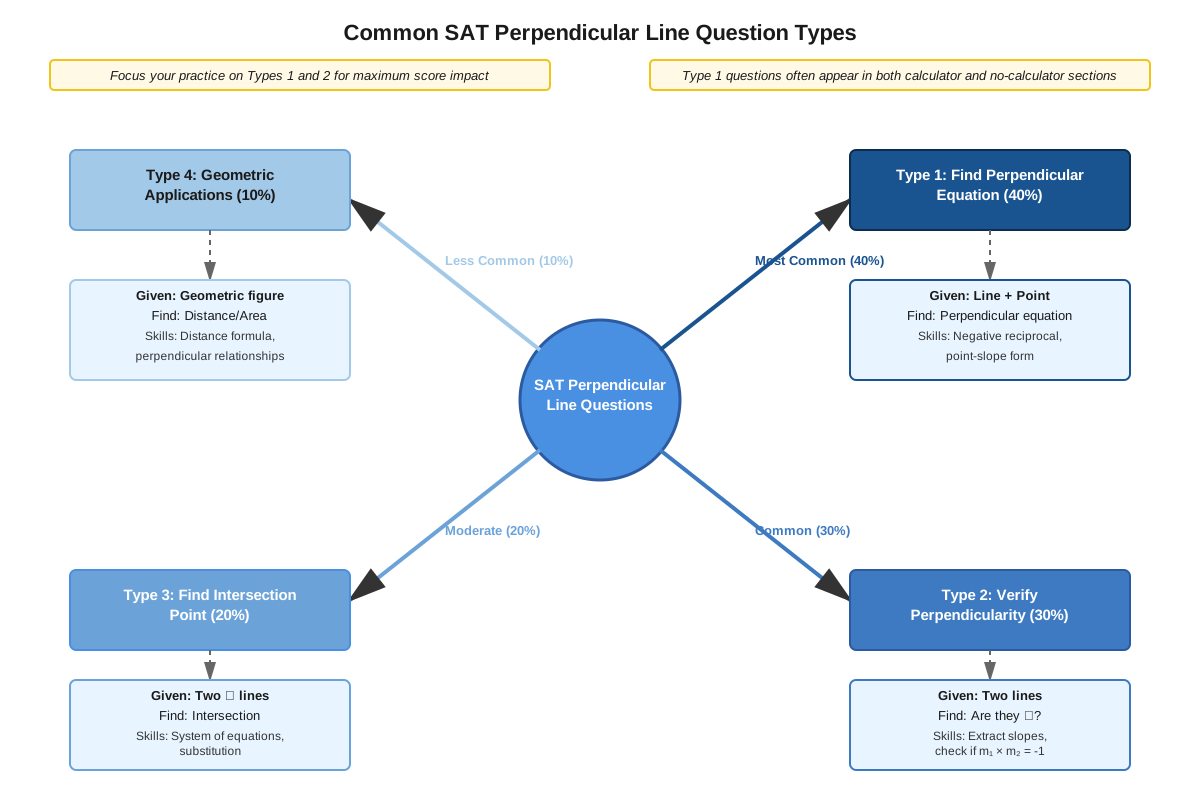
On the SAT, perpendicular lines questions appear with remarkable consistency. Statistical analysis of recent SAT administrations reveals that 2-4 questions directly test perpendicular line concepts, while an additional 1-2 questions incorporate perpendicularity as part of more complex problems. These questions typically appear in the following formats:
- Direct slope relationship questions: Given one line's equation, find the slope or equation of a perpendicular line
- Verification problems: Determine whether two given lines are perpendicular
- Construction problems: Write the equation of a line perpendicular to a given line passing through a specific point
- Geometric applications: Use perpendicular lines to find distances, areas, or solve optimization problems
- System problems: Find intersection points of perpendicular lines or solve systems involving perpendicular constraints
The topic frequently appears integrated with other concepts such as parallel lines, distance formulas, midpoint calculations, and geometric figures on the coordinate plane. Questions may present information in various forms—graphs, tables, equations, or word problems—requiring flexible thinking and strong conceptual understanding.
Core Concepts
The Fundamental Slope Relationship
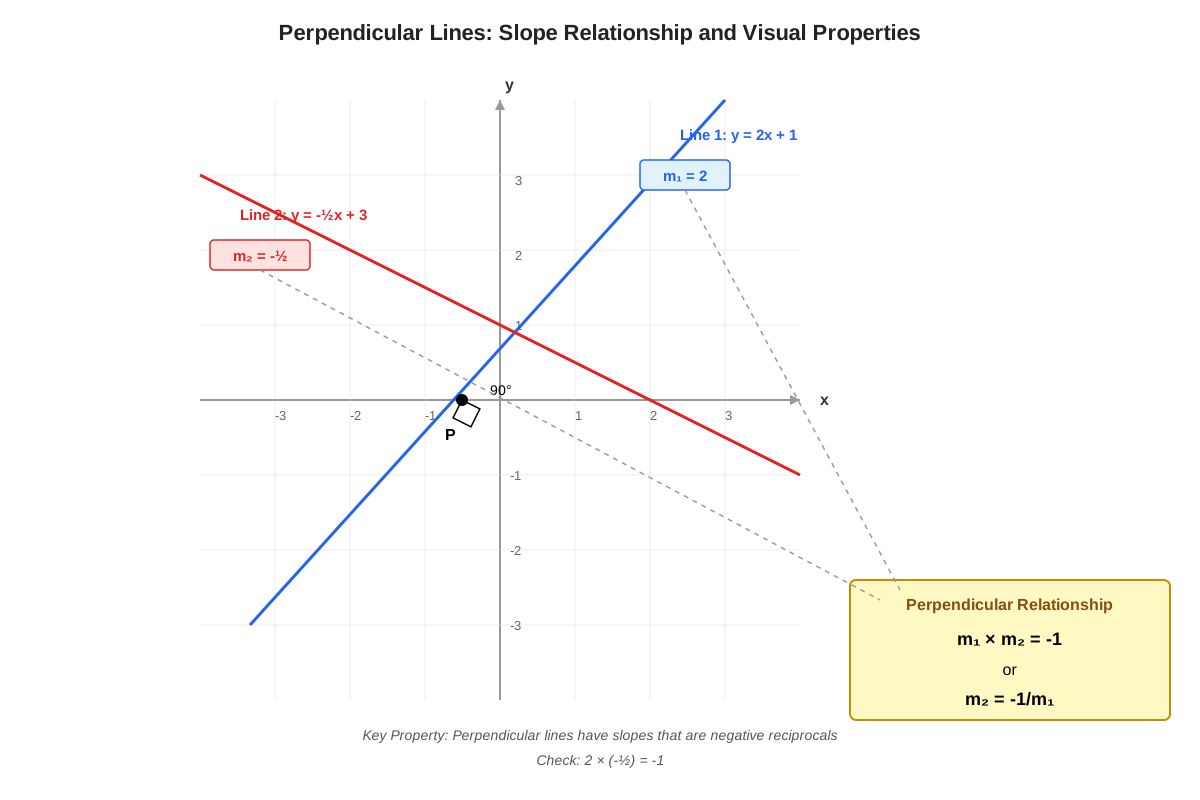
The defining characteristic of perpendicular lines is their slope relationship: two non-vertical lines are perpendicular if and only if the product of their slopes equals -1. Mathematically, if line 1 has slope m₁ and line 2 has slope m₂, the lines are perpendicular when:
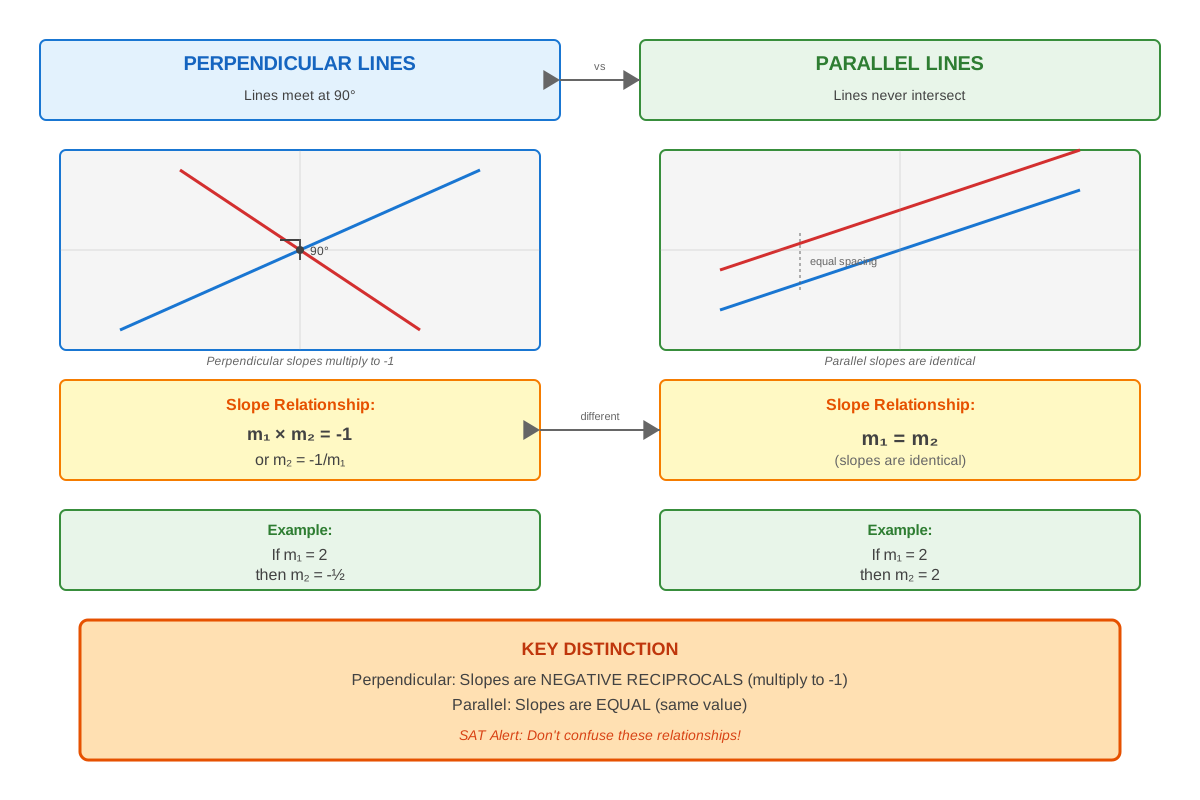
m₁ × m₂ = -1This relationship can be rearranged to show that m₂ = -1/m₁, meaning the slope of a perpendicular line is the negative reciprocal of the original slope. The negative reciprocal is found by flipping the fraction and changing the sign.
For example:
- If a line has slope 3 (or 3/1), a perpendicular line has slope -1/3
- If a line has slope -2/5, a perpendicular line has slope 5/2
- If a line has slope 0 (horizontal), a perpendicular line has undefined slope (vertical)
This relationship exists because perpendicular lines form a 90-degree angle at their intersection point. The geometric property of perpendicularity translates algebraically into this negative reciprocal relationship, creating a powerful tool for solving coordinate geometry problems.
Special Cases: Horizontal and Vertical Lines
Horizontal and vertical lines represent special cases in perpendicular line relationships. A horizontal line has slope 0 (no vertical change) and equation y = k for some constant k. A vertical line has undefined slope (no horizontal change) and equation x = h for some constant h. These lines are always perpendicular to each other.
The negative reciprocal rule cannot be directly applied to these cases because division by zero is undefined. However, the geometric relationship remains clear: horizontal and vertical lines always meet at right angles. On the SAT, questions may test whether students recognize this special case without relying solely on the slope formula.
Finding Equations of Perpendicular Lines
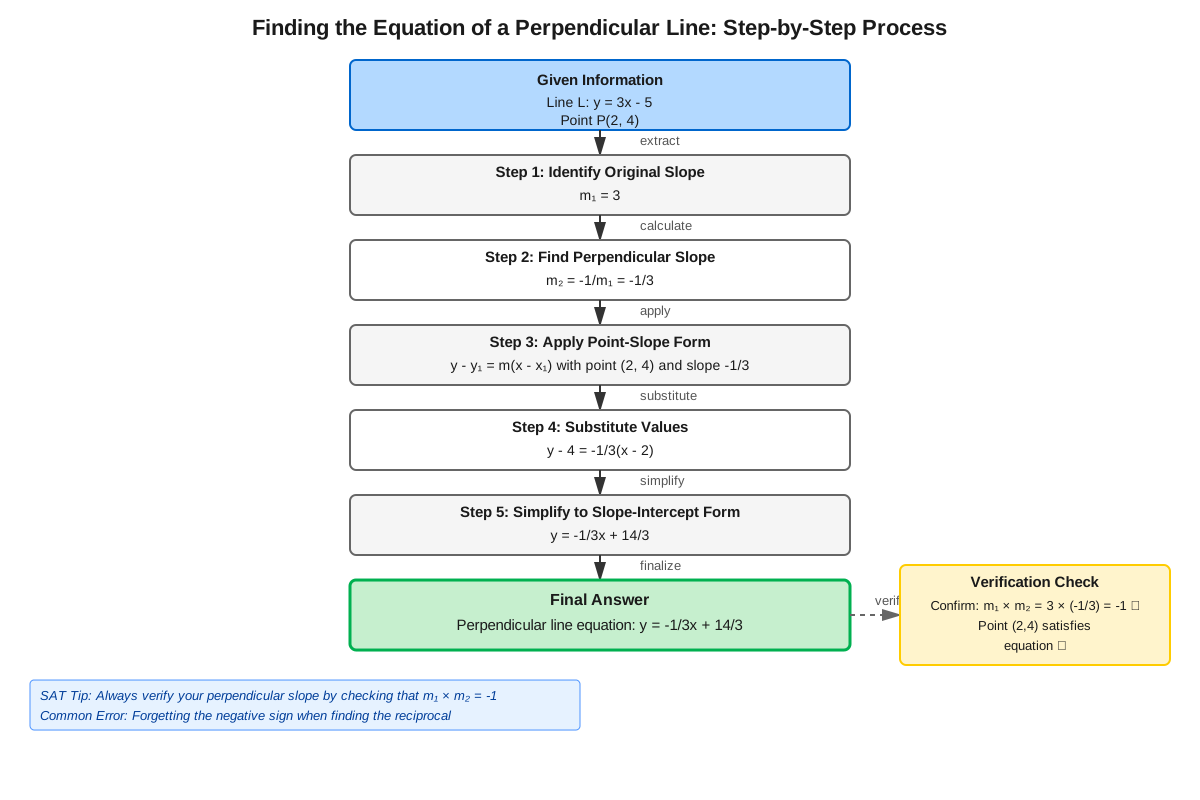
To write the equation of a line perpendicular to a given line, follow this systematic process:
- Identify the slope of the original line by converting its equation to slope-intercept form (y = mx + b) if necessary
- Calculate the negative reciprocal to find the perpendicular slope
- Use the point-slope form if a specific point is given: y - y₁ = m(x - x₁)
- Convert to the requested form (slope-intercept, standard form, etc.)
For example, to find the equation of a line perpendicular to y = 2x + 5 passing through point (4, 3):
- Original slope: m = 2
- Perpendicular slope: m_perp = -1/2
- Point-slope form: y - 3 = -1/2(x - 4)
- Slope-intercept form: y = -1/2x + 5
Verifying Perpendicularity
To determine whether two lines are perpendicular, extract their slopes and verify that their product equals -1. This process requires converting equations to slope-intercept form when they're presented in other formats.
| Equation Form | How to Extract Slope |
|---|---|
| Slope-intercept (y = mx + b) | Slope is the coefficient m |
| Point-slope (y - y₁ = m(x - x₁)) | Slope is the coefficient m |
| Standard form (Ax + By = C) | Solve for y; slope is -A/B |
| Two points given | Use slope formula: (y₂ - y₁)/(x₂ - x₁) |
After finding both slopes m₁ and m₂, check if m₁ × m₂ = -1. If this condition holds, the lines are perpendicular.
Perpendicular Lines in Standard Form
When working with equations in standard form (Ax + By = C), a useful shortcut exists for finding perpendicular lines. If the original line has equation Ax + By = C, a perpendicular line has the form Bx - Ay = D for some constant D. This works because:
- Original slope: -A/B
- Perpendicular slope: B/A (negative reciprocal)
- Equation with slope B/A: y = (B/A)x + k
- Rearranged to standard form: Bx - Ay = D
This technique saves time on SAT questions that provide equations in standard form and ask for perpendicular lines in the same format.
Geometric Applications
Perpendicular lines frequently appear in geometric contexts on the SAT. Common applications include:
- Perpendicular bisectors: Lines that pass through the midpoint of a segment and are perpendicular to it
- Altitudes of triangles: Lines from vertices perpendicular to opposite sides
- Rectangles and squares: Shapes with perpendicular adjacent sides
- Distance from point to line: The shortest distance is along a perpendicular line
These applications often require combining perpendicular line concepts with other formulas, such as the midpoint formula, distance formula, or area calculations.
Concept Relationships
The concept of perpendicular lines builds directly on fundamental slope understanding. Slope calculation → enables recognition of → negative reciprocal relationships → which define → perpendicular lines. This linear progression shows how mastering basic slope concepts is essential before tackling perpendicularity.
Perpendicular lines connect intimately with parallel lines through their contrasting slope relationships. While parallel lines have equal slopes, perpendicular lines have negative reciprocal slopes. Together, these concepts form the foundation of line relationships in coordinate geometry → which support → more complex geometric constructions → including → quadrilaterals, circles, and optimization problems.
The relationship extends to equation manipulation: various equation forms → can all represent → the same perpendicular line → requiring → conversion skills → to identify → perpendicular relationships. Students must move fluidly between slope-intercept, point-slope, and standard forms to efficiently solve SAT problems.
Perpendicular lines also connect to the distance formula through the concept that the shortest distance from a point to a line occurs along a perpendicular path. This relationship creates a bridge: perpendicular lines → enable calculation of → minimum distances → which appear in → optimization and geometry problems.
Quick check — test yourself on Perpendicular lines so far.
Try Flashcards →High-Yield Facts
⭐ Two non-vertical lines are perpendicular if and only if the product of their slopes equals -1
⭐ The slope of a line perpendicular to a line with slope m is -1/m (the negative reciprocal)
⭐ Horizontal lines (slope = 0) are always perpendicular to vertical lines (undefined slope)
⭐ To find a perpendicular line's equation, use the negative reciprocal slope with point-slope form: y - y₁ = m(x - x₁)
⭐ In standard form Ax + By = C, a perpendicular line has form Bx - Ay = D
- If a line has positive slope, its perpendicular line has negative slope, and vice versa
- The negative reciprocal of a/b is -b/a (flip the fraction and change the sign)
- Perpendicular lines always intersect at exactly one point (unless one is vertical and the other horizontal)
- The angle formed by perpendicular lines is always 90 degrees (a right angle)
- To verify perpendicularity from equations, convert both to slope-intercept form and multiply the slopes
- A line perpendicular to y = mx + b has slope -1/m regardless of the y-intercept b
- Perpendicular bisectors pass through the midpoint and have the negative reciprocal slope of the original segment
Common Misconceptions
Misconception: Perpendicular lines have slopes that are opposite in sign but equal in magnitude (e.g., 3 and -3)
Correction: Perpendicular lines have slopes that are negative reciprocals, not just opposite signs. A line with slope 3 is perpendicular to a line with slope -1/3, not -3. The relationship requires both flipping the fraction AND changing the sign.
Misconception: The y-intercept affects whether lines are perpendicular
Correction: Perpendicularity depends only on slope, not y-intercept. Lines y = 2x + 5 and y = -1/2x + 100 are perpendicular despite having very different y-intercepts, because their slopes are negative reciprocals.
Misconception: To find the negative reciprocal, simply add a negative sign to the slope
Correction: The negative reciprocal requires two operations: reciprocating (flipping) the fraction AND changing the sign. For slope 2/3, the negative reciprocal is -3/2, not -2/3.
Misconception: Perpendicular lines never intersect
Correction: Perpendicular lines always intersect at exactly one point (except in the special case where one is vertical and the other horizontal, but they still intersect). The defining feature is that they meet at a 90-degree angle, not that they don't meet.
Misconception: If two lines look perpendicular on a graph, they are perpendicular
Correction: Visual appearance can be deceiving, especially on graphs with different x and y scales. Always verify perpendicularity algebraically by checking that the product of slopes equals -1. A graph with unequal axis scaling can make perpendicular lines appear non-perpendicular.
Misconception: The perpendicular line formula changes depending on which equation form is used
Correction: The negative reciprocal relationship holds regardless of equation form. Whether working with slope-intercept, point-slope, or standard form, the fundamental slope relationship (m₁ × m₂ = -1) remains constant. Different forms simply require different extraction methods to identify the slope.
Worked Examples
Example 1: Finding a Perpendicular Line Equation
Problem: Line ℓ has equation 3x + 4y = 12. What is the equation, in slope-intercept form, of the line perpendicular to ℓ that passes through point (2, -1)?
Solution:
Step 1: Find the slope of line ℓ by converting to slope-intercept form.
3x + 4y = 12
4y = -3x + 12
y = -3/4x + 3
The slope of line ℓ is -3/4.
Step 2: Calculate the negative reciprocal to find the perpendicular slope.
m_perpendicular = -1 ÷ (-3/4) = -1 × (-4/3) = 4/3Step 3: Use point-slope form with the perpendicular slope and given point (2, -1).
y - y₁ = m(x - x₁)
y - (-1) = 4/3(x - 2)
y + 1 = 4/3x - 8/3
Step 4: Convert to slope-intercept form.
y = 4/3x - 8/3 - 1
y = 4/3x - 8/3 - 3/3
y = 4/3x - 11/3Answer: y = 4/3x - 11/3
Connection to Learning Objectives: This problem demonstrates the application of perpendicular line concepts to construct equations, requiring identification of the slope relationship, calculation of the negative reciprocal, and manipulation of equation forms—all essential SAT skills.
Example 2: Verifying Perpendicularity
Problem: Line m passes through points (-2, 5) and (4, 2). Line n has equation 2x - y = 7. Are lines m and n perpendicular?
Solution:
Step 1: Find the slope of line m using the slope formula.
m_m = (y₂ - y₁)/(x₂ - x₁) = (2 - 5)/(4 - (-2)) = -3/6 = -1/2Step 2: Find the slope of line n by converting to slope-intercept form.
2x - y = 7
-y = -2x + 7
y = 2x - 7
The slope of line n is 2.
Step 3: Check if the product of slopes equals -1.
m_m × m_n = (-1/2) × 2 = -1 ✓Since the product equals -1, the lines are perpendicular.
Answer: Yes, lines m and n are perpendicular.
Connection to Learning Objectives: This problem tests the ability to identify perpendicular relationships from different representations (points vs. equation), extract slopes from various formats, and apply the fundamental perpendicularity test—all common SAT question types.
Exam Strategy
When approaching SAT questions involving perpendicular lines, begin by identifying what information is provided and what form the answer requires. Questions typically provide either an equation, two points, or a graph, and ask for a perpendicular line's equation, slope, or verification of perpendicularity.
Trigger words and phrases that signal perpendicular line questions include:
- "perpendicular to"
- "forms a right angle with"
- "meets at 90 degrees"
- "perpendicular bisector"
- "altitude" (in triangle problems)
- "shortest distance" (implies perpendicular path)
Process-of-elimination strategies specific to perpendicular lines:
- Eliminate answer choices with incorrect slope signs: If the original line has positive slope, perpendicular lines must have negative slope (and vice versa)
- Check slope magnitude: The perpendicular slope should be the reciprocal of the original; eliminate choices that don't flip the fraction
- Verify the point: If a specific point is given, substitute it into remaining answer choices to eliminate those that don't satisfy the equation
- Use the product test: For verification questions, quickly multiply slopes; if the product isn't -1, eliminate that choice
Time allocation advice: Perpendicular line questions typically require 60-90 seconds. Spend 20 seconds identifying the given information and required answer format, 30-40 seconds calculating the perpendicular slope and constructing the equation, and 10-20 seconds verifying your answer. If a question requires multiple steps (finding a perpendicular line AND an intersection point), allocate up to 2 minutes.
Exam Tip: Always convert equations to slope-intercept form first when verifying perpendicularity. This standardizes the process and reduces errors from working with different equation formats.
For questions involving perpendicular bisectors, remember to find the midpoint first, then construct the perpendicular line through that point. For distance problems, recognize that the shortest distance always occurs along a perpendicular path.
Memory Techniques
Mnemonic for Negative Reciprocal: "Flip it and Negate" (FN)
- Flip the fraction (reciprocal)
- Negate the sign (make positive negative or negative positive)
Visualization Strategy: Picture perpendicular lines as the corner of a book or the intersection of a wall and floor—always meeting at a perfect right angle. When you see a line with positive slope rising from left to right, visualize its perpendicular partner falling from left to right (negative slope) and steeper or shallower depending on the reciprocal relationship.
Acronym for Verification Steps: SEEM Perpendicular
- Slope-intercept form (convert both equations)
- Extract the slopes
- Evaluate the product
- Multiply should equal -1
Memory Device for Special Cases: "Horizontal and Vertical are Perpendicular" (HVP)
- Horizontal (slope 0) and Vertical (undefined slope) are always perpendicular
- Think of the letters H and V themselves—they contain perpendicular segments
Rhyme for Slope Relationship: "When lines meet at ninety degrees, their slopes multiply to negative one with ease"
Summary
Perpendicular lines represent a fundamental concept in coordinate geometry that appears consistently on the SAT, requiring students to understand the negative reciprocal slope relationship where two lines are perpendicular if and only if the product of their slopes equals -1. Mastery involves three core skills: identifying perpendicular relationships from equations or graphs, calculating negative reciprocals to find perpendicular slopes, and constructing perpendicular line equations using point-slope or slope-intercept form. Special cases include horizontal and vertical lines, which are always perpendicular despite the undefined slope of vertical lines. SAT questions integrate perpendicular lines with other concepts including parallel lines, geometric figures, distance calculations, and systems of equations, requiring flexible thinking and efficient equation manipulation. Success on these questions depends on quickly converting between equation forms, accurately calculating negative reciprocals, and recognizing geometric applications such as perpendicular bisectors and altitudes. The topic's high frequency on the SAT (2-4 direct questions plus additional integrated problems) makes it essential for achieving competitive scores.
Key Takeaways
- Perpendicular lines have slopes whose product equals -1; the perpendicular slope is the negative reciprocal of the original slope
- To find the negative reciprocal, flip the fraction AND change the sign (e.g., 2/3 becomes -3/2)
- Horizontal lines (slope 0) and vertical lines (undefined slope) are always perpendicular to each other
- Convert all equations to slope-intercept form (y = mx + b) to easily identify and compare slopes
- Use point-slope form y - y₁ = m(x - x₁) to construct perpendicular line equations when given a specific point
- Perpendicularity depends only on slope, not on y-intercepts or the location of the lines
- Always verify perpendicularity algebraically by checking that m₁ × m₂ = -1, not by visual inspection of graphs
Related Topics
Parallel Lines: Lines with equal slopes that never intersect, forming the complementary concept to perpendicular lines. Mastering perpendicular lines enables quick comparison with parallel line properties and helps distinguish between these fundamental line relationships.
Distance Formula and Point-to-Line Distance: The shortest distance from a point to a line occurs along a perpendicular path, connecting perpendicular line concepts to distance calculations and optimization problems frequently tested on the SAT.
Circle Equations: Tangent lines to circles are perpendicular to radii at the point of tangency, making perpendicular line skills essential for advanced circle problems in coordinate geometry.
Systems of Linear Equations: Finding intersection points of perpendicular lines requires solving systems, extending perpendicular line concepts into algebraic problem-solving contexts.
Geometric Transformations: Reflections across lines involve perpendicular relationships, as the line connecting a point to its reflection is perpendicular to the line of reflection.
Practice CTA
Now that you've mastered the core concepts of perpendicular lines, it's time to solidify your understanding through active practice. Attempt the practice questions to test your ability to identify perpendicular relationships, calculate negative reciprocals, and construct perpendicular line equations under timed conditions. Use the flashcards to reinforce the key formulas and relationships until they become automatic. Remember, perpendicular lines appear on virtually every SAT, making this practice time a high-yield investment in your score. Each problem you solve builds the pattern recognition and computational speed necessary for test day success. You've got this!
Sign up free to keep reading
Create a free AnvayaPrep account to finish this SAT guide on Perpendicular lines — plus flashcards and practice questions.