Overview
Understanding polygon angle sum is a foundational skill in geometry that appears consistently on the SAT Math section. This topic involves calculating the sum of interior angles in any polygon, from triangles to complex multi-sided figures. The concept builds on basic angle relationships and extends to more sophisticated geometric reasoning that the SAT frequently tests. Mastering polygon angle sum formulas and their applications enables students to solve problems involving regular and irregular polygons, missing angle measures, and geometric proofs—all common question types in the Geometry Lines and Angles unit.
The SAT polygon angle sum questions typically appear 2-3 times per test administration, making this a high-yield topic that deserves focused attention. These questions range from straightforward formula application to multi-step problems that combine angle sum knowledge with other geometric principles. Students who thoroughly understand this concept gain a significant advantage, as polygon problems often serve as gateway questions that separate average scores from top-tier performance. The ability to quickly recall and apply angle sum formulas under timed conditions is essential for efficient test-taking.
Beyond isolated polygon problems, this topic connects deeply to broader math concepts tested on the SAT. Polygon angle sum knowledge supports understanding of coordinate geometry, transformations, and even trigonometry questions. The logical reasoning required to decompose polygons into triangles—a key strategy for deriving angle sums—strengthens spatial reasoning skills applicable across multiple SAT Math domains. This interconnectedness makes polygon angle sum a cornerstone concept that enhances overall geometric fluency.
Learning Objectives
- [ ] Identify key features of polygon angle sum, including the relationship between number of sides and total interior angle measure
- [ ] Explain how polygon angle sum appears on the SAT, including common question formats and difficulty levels
- [ ] Apply polygon angle sum to answer SAT-style questions involving regular and irregular polygons
- [ ] Derive the polygon angle sum formula using triangle decomposition method
- [ ] Calculate individual interior angles in regular polygons given the number of sides
- [ ] Solve for unknown variables in polygon angle problems involving algebraic expressions
- [ ] Recognize and apply exterior angle sum properties of polygons
Prerequisites
- Triangle angle sum theorem: Understanding that triangle interior angles sum to 180° forms the foundation for deriving polygon angle sums
- Basic algebraic manipulation: Solving equations and working with variables is necessary for problems involving unknown angle measures
- Properties of regular polygons: Knowing that regular polygons have equal side lengths and equal angle measures enables efficient problem-solving
- Angle vocabulary: Familiarity with terms like interior angles, exterior angles, and supplementary angles ensures proper interpretation of questions
Why This Topic Matters
Polygon angle sum concepts appear in architecture, engineering, and design fields where professionals must calculate angles in structural frameworks, tiling patterns, and geometric layouts. Urban planners use these principles when designing street intersections and property boundaries. Artists and graphic designers apply polygon angle knowledge when creating tessellations and geometric artwork. Understanding how angles relate within closed figures provides practical problem-solving tools applicable far beyond the classroom.
On the SAT, polygon angle sum questions appear with approximately 15-20% frequency within the Geometry Lines and Angles unit, which itself comprises roughly 10% of the total Math section. This translates to an expected 1-2 direct polygon angle questions per test, with additional questions incorporating polygon concepts as secondary elements. The College Board consistently includes at least one medium-difficulty polygon problem and often features a more challenging multi-step question combining angle sums with other geometric properties. These questions typically appear in both the calculator and no-calculator sections.
Common SAT question formats include: finding a missing interior angle when given other angles in the polygon; determining the number of sides when given the angle sum or individual angle measure; solving for variables in expressions representing polygon angles; and applying angle sum knowledge to real-world context problems involving geometric designs or architectural plans. Questions may present polygons in coordinate planes, require recognition of regular polygon properties, or combine angle sum concepts with parallel line relationships and transversal angles.
Core Concepts
The Fundamental Polygon Angle Sum Formula
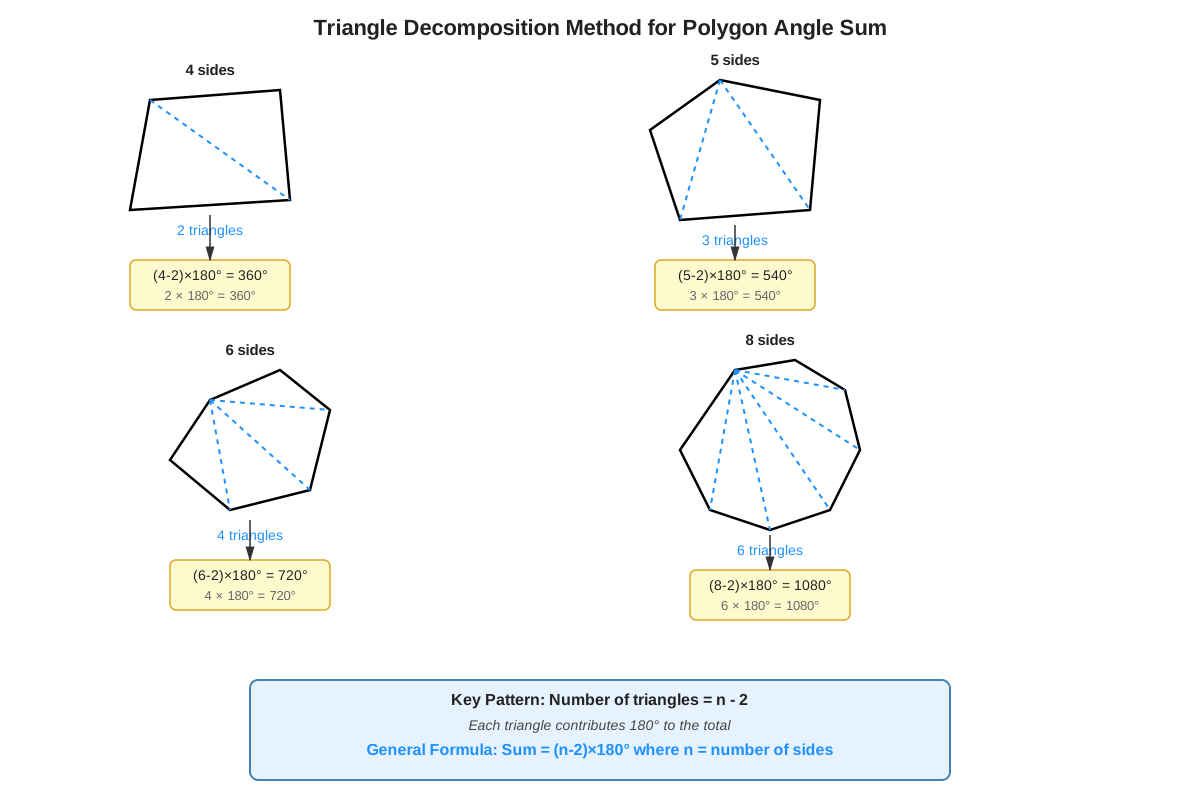
The polygon angle sum formula states that the sum of interior angles in any polygon equals (n - 2) × 180°, where n represents the number of sides. This formula derives from a powerful geometric insight: any polygon can be divided into triangles by drawing diagonals from a single vertex. Since each triangle contains 180° of angle measure, and a polygon with n sides can be divided into exactly (n - 2) triangles, the total angle sum equals the number of triangles multiplied by 180°.
For example, a quadrilateral (4 sides) divides into 2 triangles: (4 - 2) × 180° = 360°. A pentagon (5 sides) divides into 3 triangles: (5 - 2) × 180° = 540°. This pattern holds universally for all polygons, whether regular or irregular, convex or concave. The formula provides a direct calculation method without requiring actual triangle decomposition, making it efficient for timed test conditions.
Triangle Decomposition Method
Understanding why the formula works strengthens conceptual mastery and provides an alternative problem-solving approach. To decompose a polygon, select any vertex and draw diagonals to all non-adjacent vertices. A triangle requires no diagonals (already 1 triangle). A quadrilateral needs 1 diagonal, creating 2 triangles. A pentagon needs 2 diagonals, creating 3 triangles. The pattern reveals that the number of triangles always equals (n - 2).
This decomposition method proves particularly valuable when dealing with irregular polygons where individual angles vary. By mentally or physically dividing the figure into triangles, students can verify their angle sum calculations and develop stronger spatial reasoning. The SAT occasionally presents problems where recognizing triangle components within larger polygons provides the key insight for solution.
Regular Polygon Interior Angles
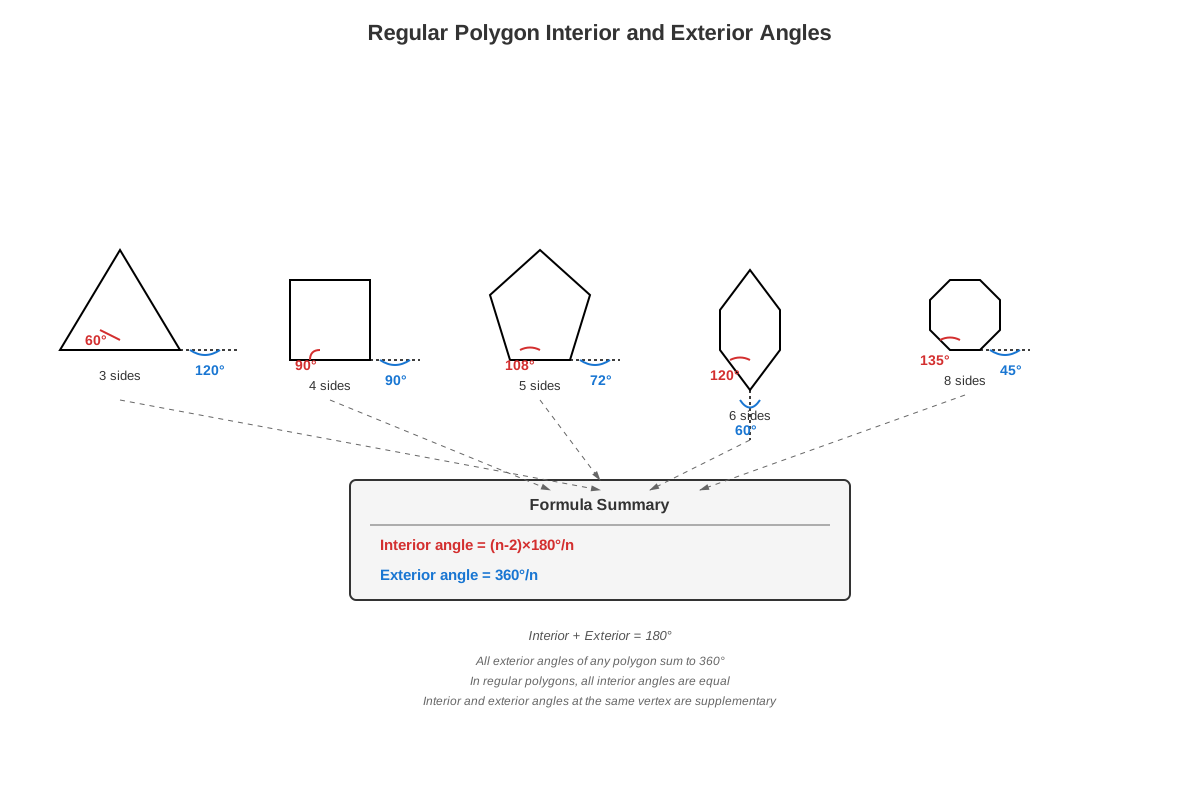
A regular polygon has all sides equal in length and all interior angles equal in measure. To find each individual interior angle in a regular polygon, divide the total angle sum by the number of angles (which equals the number of sides):
Each interior angle = [(n - 2) × 180°] / nThis formula simplifies to: Each interior angle = 180° - (360°/n)
For common regular polygons:
- Equilateral triangle (n=3): (3-2)×180°/3 = 60° per angle
- Square (n=4): (4-2)×180°/4 = 90° per angle
- Regular pentagon (n=5): (5-2)×180°/5 = 108° per angle
- Regular hexagon (n=6): (6-2)×180°/6 = 120° per angle
- Regular octagon (n=8): (8-2)×180°/8 = 135° per angle
Memorizing these common values accelerates problem-solving on the SAT, as these specific polygons appear frequently in test questions.
Exterior Angle Sum Property
The sum of exterior angles of any polygon, one at each vertex, always equals 360°, regardless of the number of sides. This remarkable property holds for all polygons and provides an alternative approach to certain problems. An exterior angle forms a linear pair with its adjacent interior angle, meaning they are supplementary (sum to 180°).
For regular polygons, each exterior angle equals 360°/n. This relationship enables quick calculation of the number of sides when given an exterior angle measure. For instance, if each exterior angle measures 40°, the polygon has 360°/40° = 9 sides (a nonagon). The SAT exploits this property in questions asking students to determine polygon characteristics from limited information.
Irregular Polygon Problem-Solving
Irregular polygons have sides and angles of varying measures. When solving for unknown angles in irregular polygons, students must:
- Apply the angle sum formula to find the total interior angle measure
- Set up an equation with the sum of all given angles and unknown variables
- Solve algebraically for the unknown values
- Verify that the solution makes geometric sense (all angles positive and less than 180° for convex polygons)
SAT questions often present irregular polygons with several angles given numerically and one or more angles expressed as algebraic expressions (e.g., "2x + 15°"). These problems test both geometric knowledge and algebraic manipulation skills simultaneously.
Polygon Classification by Sides
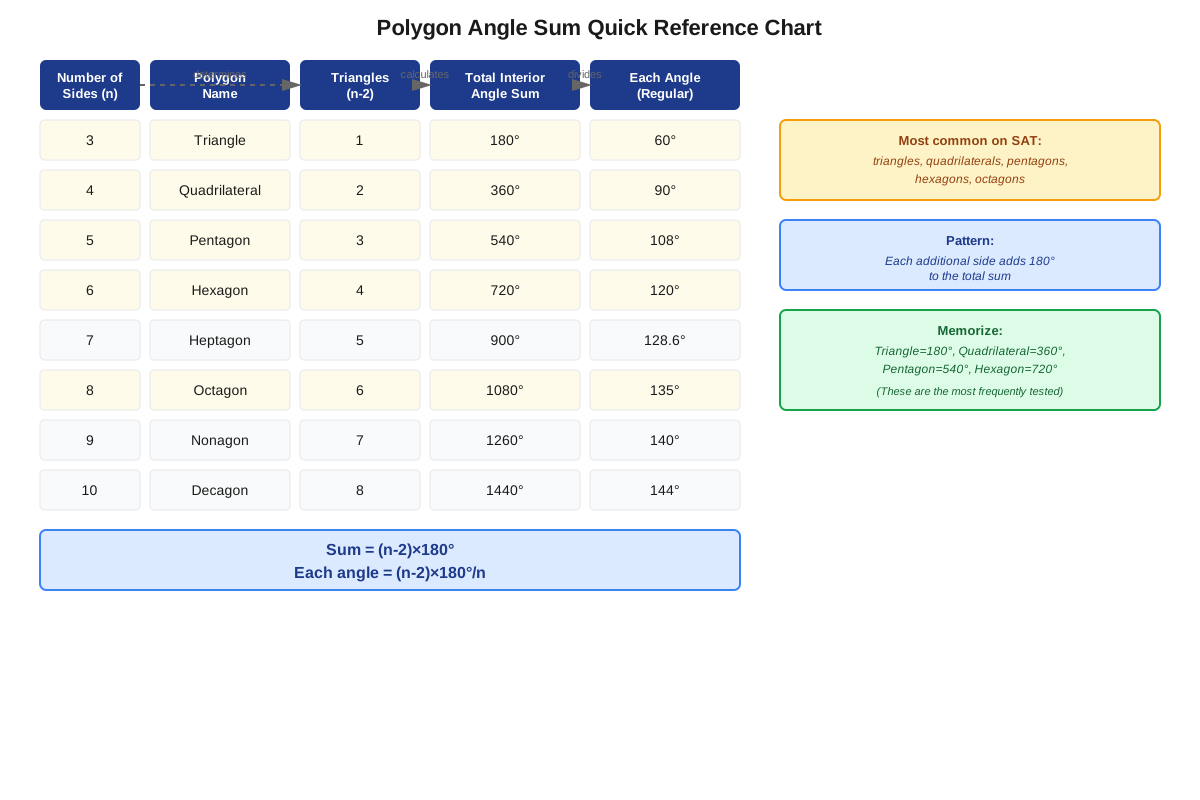
| Polygon Name | Number of Sides (n) | Angle Sum Formula | Total Interior Angle Sum |
|---|---|---|---|
| Triangle | 3 | (3-2) × 180° | 180° |
| Quadrilateral | 4 | (4-2) × 180° | 360° |
| Pentagon | 5 | (5-2) × 180° | 540° |
| Hexagon | 6 | (6-2) × 180° | 720° |
| Heptagon | 7 | (7-2) × 180° | 900° |
| Octagon | 8 | (8-2) × 180° | 1080° |
| Nonagon | 9 | (9-2) × 180° | 1260° |
| Decagon | 10 | (10-2) × 180° | 1440° |
Familiarity with polygon names and their corresponding angle sums enables quick recognition of problem parameters and efficient calculation.
Concept Relationships
The polygon angle sum concept builds directly from the triangle angle sum theorem (180°), which serves as the fundamental building block. Triangle decomposition → generates the (n-2) factor in the formula → which determines total polygon angle sum → which divides into individual angles for regular polygons → and combines with algebraic expressions for irregular polygon problems.
Polygon angle sum connects to exterior angle properties through supplementary angle relationships: interior angle + exterior angle = 180° at each vertex. This connection → enables alternative problem-solving approaches → particularly when exterior angle information is provided → leading to the constant 360° exterior angle sum property.
The concept extends to coordinate geometry when polygons are graphed on coordinate planes, requiring students to identify vertices → count sides → apply angle sum formulas. It also relates to parallel lines and transversals, as polygon sides may form parallel line systems → creating corresponding and alternate interior angles → that must satisfy both parallel line angle relationships and polygon angle sum requirements simultaneously.
Understanding regular polygon properties → connects to circle geometry and inscribed polygons → where central angles relate to interior angles → forming bridges to more advanced geometric concepts. The algebraic component of polygon problems → strengthens equation-solving skills → applicable across all SAT Math domains → demonstrating the integrated nature of mathematical reasoning.
Quick check — test yourself on Polygon angle sum so far.
Try Flashcards →High-Yield Facts
⭐ The sum of interior angles in any polygon equals (n - 2) × 180°, where n is the number of sides
⭐ The sum of exterior angles of any polygon always equals 360°, regardless of the number of sides
⭐ Each interior angle of a regular polygon equals [(n - 2) × 180°] / n
⭐ A quadrilateral's interior angles always sum to 360°
⭐ Each exterior angle of a regular polygon equals 360° / n
- A polygon with n sides can be divided into exactly (n - 2) triangles from any single vertex
- In a regular hexagon, each interior angle measures exactly 120°
- In a regular octagon, each interior angle measures exactly 135°
- Interior and exterior angles at the same vertex are supplementary (sum to 180°)
- The number of sides in a regular polygon can be found by dividing 360° by the measure of one exterior angle
- A pentagon's interior angles sum to 540°
- An equilateral triangle is the only regular polygon where each interior angle equals 60°
- The more sides a regular polygon has, the closer each interior angle approaches 180°
- Irregular polygons follow the same angle sum formula as regular polygons
- Concave polygons (with at least one interior angle greater than 180°) still follow the (n-2) × 180° formula when considering reflex angles properly
Common Misconceptions
Misconception: The angle sum formula is (n + 2) × 180° or n × 180°
Correction: The correct formula is (n - 2) × 180°. The subtraction of 2 accounts for the fact that a polygon with n sides divides into (n - 2) triangles, not n triangles. A quadrilateral forms 2 triangles, not 4.
Misconception: All polygons with the same number of sides have identical individual angle measures
Correction: Only regular polygons have equal interior angles. Irregular polygons with the same number of sides share the same total angle sum but distribute that sum differently among their angles. A square and a rectangle both have 360° total, but only the square has four 90° angles.
Misconception: The exterior angle sum varies depending on the number of sides
Correction: The exterior angle sum is always exactly 360° for any polygon, regardless of whether it has 3 sides or 100 sides. This constant property distinguishes exterior angles from interior angles, whose sum increases with additional sides.
Misconception: The formula only works for convex polygons
Correction: The (n - 2) × 180° formula applies to all simple polygons, including concave ones, as long as angles are measured correctly. For concave polygons, some interior angles may be reflex angles (greater than 180°), but the sum formula remains valid.
Misconception: Each angle in a regular polygon equals 180° / n
Correction: Each interior angle in a regular polygon equals [(n - 2) × 180°] / n, not 180° / n. The latter formula would incorrectly give 60° for a triangle, 45° for a quadrilateral, and decreasing values for larger polygons—the opposite of reality.
Misconception: You can find the number of sides by dividing the total angle sum by 180°
Correction: To find the number of sides from the total angle sum, use the equation: angle sum = (n - 2) × 180°, then solve for n. Dividing the angle sum by 180° gives (n - 2), not n, so you must add 2 to get the actual number of sides.
Worked Examples
Example 1: Finding a Missing Angle in an Irregular Pentagon
Problem: A pentagon has interior angles measuring 95°, 110°, 125°, and 108°. What is the measure of the fifth angle?
Solution:
Step 1: Identify the polygon type and apply the angle sum formula.
- Pentagon has n = 5 sides
- Total angle sum = (5 - 2) × 180° = 3 × 180° = 540°
Step 2: Set up an equation with known and unknown angles.
- Let x = the unknown fifth angle
- 95° + 110° + 125° + 108° + x = 540°
Step 3: Solve for the unknown angle.
- 438° + x = 540°
- x = 540° - 438°
- x = 102°
Step 4: Verify the answer makes sense.
- The angle is positive and less than 180°, appropriate for a convex polygon interior angle
- Sum check: 95 + 110 + 125 + 108 + 102 = 540° ✓
Answer: The fifth angle measures 102°
This problem directly addresses the learning objective of applying polygon angle sum to SAT-style questions and demonstrates the standard approach for irregular polygon problems.
Example 2: Determining the Number of Sides from Angle Information
Problem: In a regular polygon, each interior angle measures 156°. How many sides does the polygon have?
Solution:
Step 1: Recognize this is a regular polygon problem and select the appropriate formula.
- Each interior angle = [(n - 2) × 180°] / n
- Given: each angle = 156°
Step 2: Set up the equation and solve for n.
- 156° = [(n - 2) × 180°] / n
- 156n = (n - 2) × 180°
- 156n = 180n - 360
- 156n - 180n = -360
- -24n = -360
- n = 15
Step 3: Verify using the angle sum formula.
- Total angle sum = (15 - 2) × 180° = 13 × 180° = 2340°
- Each angle in regular 15-gon = 2340° / 15 = 156° ✓
Alternative approach using exterior angles:
- Exterior angle = 180° - 156° = 24°
- Number of sides = 360° / 24° = 15 sides ✓
Answer: The polygon has 15 sides (a regular pentadecagon)
This example demonstrates multiple solution pathways and reinforces the relationship between interior and exterior angles, addressing the learning objective of explaining how polygon angle sum appears in various SAT question formats.
Exam Strategy
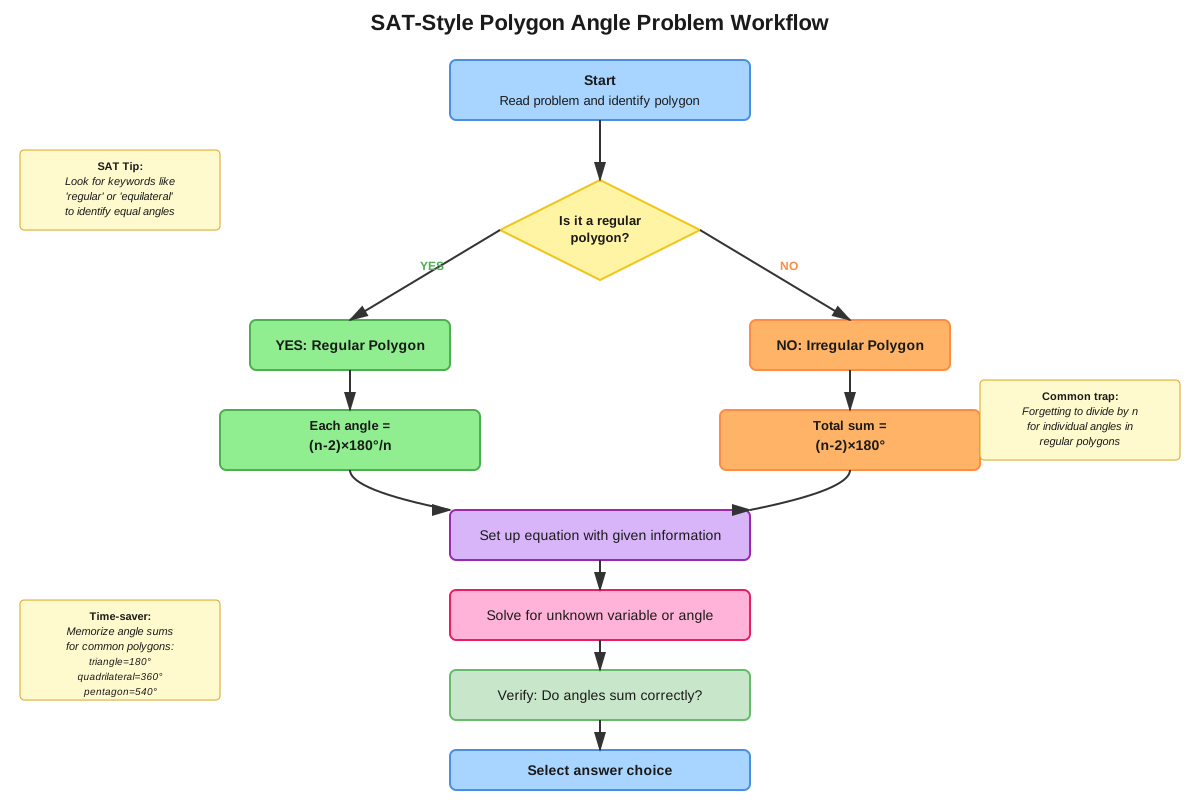
When approaching SAT polygon angle sum questions, immediately identify whether the polygon is regular or irregular, as this determines the solution strategy. For regular polygons, use the simplified formulas for individual angles. For irregular polygons, set up algebraic equations with the total angle sum. Always write down the angle sum formula first: (n - 2) × 180°—this prevents formula confusion under time pressure.
Trigger words and phrases to recognize include: "regular polygon" (signals equal angles), "interior angles," "exterior angles," "sum of angles," "each angle measures," and "how many sides." Questions asking "what is the measure of each angle" indicate regular polygons, while "what is the measure of angle X" suggests irregular polygons with specific unknown angles.
For process of elimination, eliminate answer choices that violate basic geometric principles. Interior angles in convex polygons must be less than 180°; if a choice suggests otherwise, eliminate it. When finding the number of sides, eliminate non-integer answers immediately—polygons cannot have fractional sides. If calculating an angle sum, eliminate choices that don't follow the pattern of multiples of 180° (since the formula always produces such values).
Time allocation: Straightforward polygon angle sum questions should take 30-60 seconds. Multi-step problems combining angle sums with other concepts may require 90-120 seconds. If a problem requires more than 2 minutes, mark it for review and move forward—these questions often have alternative approaches that become apparent on second viewing. Practice recognizing when to use the exterior angle sum (360°) as a faster alternative to interior angle calculations.
Sketch the polygon when possible, even roughly, and label known angles. Visual representation often reveals relationships not immediately apparent from the problem text. For problems with algebraic expressions, write out the complete equation before simplifying—this reduces arithmetic errors and provides a clear path to backtrack if needed.
Memory Techniques
PENTA-540: Remember that a PENTAgon has 540° total interior angles. From this anchor, add or subtract 180° for each additional or fewer side: hexagon = 540° + 180° = 720°; quadrilateral = 540° - 180° = 360°.
"Two Less Triangles": The phrase "(n - 2)" means "two less than the number of sides equals the number of triangles." Visualize removing two sides from the polygon count to get triangle count.
"360 Exterior": The exterior angle sum is always 360°—the same as a complete circle rotation. Imagine walking around the polygon's perimeter; you turn through exactly one full rotation (360°) regardless of the polygon's shape.
Regular Polygon Rhyme: "To find each angle in a regular shape, take the sum and divide by n—don't make a mistake!" This reinforces dividing the total sum by the number of angles.
Common Polygon Angles Mnemonic - "Six Nines Equal Twelve" (6 × 9 = 12):
- Six-sided hexagon has 120° angles (think: 6 → 12 with a zero)
- Nine-sided nonagon has 140° angles
- Twelve-sided dodecagon has 150° angles
Triangle Foundation: Always remember "triangles are the foundation"—every polygon angle sum derives from 180° triangles. When stuck, think: "How many triangles fit inside?"
Summary
Polygon angle sum represents a critical geometric concept tested consistently on the SAT Math section. The fundamental formula—(n - 2) × 180°—enables calculation of total interior angle sums for any polygon by recognizing that polygons decompose into (n - 2) triangles. Regular polygons distribute this sum equally among all angles, while irregular polygons require algebraic problem-solving to find individual unknown angles. The complementary exterior angle sum property (always 360°) provides alternative solution pathways and reinforces understanding of angle relationships. Mastery requires both formula memorization and conceptual understanding of why the formulas work, enabling flexible problem-solving under timed conditions. SAT questions range from direct formula application to multi-step problems integrating polygon concepts with algebraic expressions and other geometric principles. Success depends on quick polygon identification, appropriate formula selection, accurate calculation, and verification that answers satisfy geometric constraints.
Key Takeaways
- The sum of interior angles in any n-sided polygon equals (n - 2) × 180°, derived from triangle decomposition
- Exterior angles of any polygon always sum to exactly 360°, regardless of the number of sides
- Each interior angle in a regular n-sided polygon equals [(n - 2) × 180°] / n
- Common regular polygon angles worth memorizing: triangle (60°), square (90°), pentagon (108°), hexagon (120°), octagon (135°)
- Interior and exterior angles at the same vertex are supplementary, summing to 180°
- Irregular polygon problems require setting up equations where the sum of all angles equals the total from the formula
- The number of sides can be determined from exterior angle measures using n = 360° / (exterior angle) for regular polygons
Related Topics
Parallel Lines and Transversals: Understanding angle relationships when parallel lines are cut by transversals extends polygon knowledge, as polygon sides often form parallel line systems. Mastering polygon angles provides foundation for recognizing corresponding and alternate interior angles.
Circle Geometry and Inscribed Polygons: Regular polygons inscribed in circles create relationships between central angles, arc measures, and polygon interior angles. Polygon angle sum knowledge enables solving complex circle-polygon combination problems.
Coordinate Geometry: Polygons graphed on coordinate planes require identifying vertices and calculating angles using slope and distance formulas. Polygon angle sum principles verify whether calculated angles form valid geometric figures.
Triangle Properties and Classification: Since polygon angle sums derive from triangles, deeper triangle knowledge (isosceles, equilateral, right triangle properties) enhances polygon problem-solving and enables recognition of special cases.
Quadrilateral Properties: Specific quadrilateral types (parallelograms, trapezoids, rhombi) have unique angle relationships beyond the basic 360° sum. Understanding these special cases builds on general polygon angle sum knowledge.
Practice CTA
Now that you've mastered the core concepts of polygon angle sum, reinforce your understanding by attempting the practice questions designed specifically for this topic. These problems mirror actual SAT question formats and difficulty levels, providing essential experience with the types of challenges you'll face on test day. Work through each problem systematically, applying the formulas and strategies covered in this guide. After completing the practice questions, review the flashcards to cement key formulas and properties in your memory. Consistent practice transforms conceptual understanding into test-day confidence—you've built a strong foundation, and now it's time to prove your mastery!
Sign up free to keep reading
Create a free AnvayaPrep account to finish this SAT guide on Polygon angle sum — plus flashcards and practice questions.