Overview
Parallel lines are one of the most frequently tested geometric concepts on the SAT, appearing in both the calculator and no-calculator sections of the math portion. Understanding parallel lines goes far beyond simply recognizing that two lines never intersect—it encompasses a rich set of relationships involving angles, slopes, and algebraic representations that form the foundation for more complex geometric reasoning. On the SAT, parallel lines questions often integrate multiple mathematical concepts, requiring students to connect coordinate geometry, linear equations, angle relationships, and algebraic manipulation in a single problem.
The importance of mastering parallel lines for the SAT cannot be overstated. These questions appear in approximately 10-15% of all geometry-related problems, and they frequently serve as the basis for multi-step problems worth significant points. SAT parallel lines questions test not only recognition of parallel relationships but also the ability to work with transversals, corresponding angles, alternate interior angles, and the fundamental property that parallel lines have identical slopes. Students who thoroughly understand parallel lines gain a strategic advantage because these concepts often unlock solutions to problems that initially appear unrelated to parallelism.
Within the broader context of linear functions and coordinate geometry, parallel lines represent a critical bridge between algebraic and geometric thinking. They connect directly to slope-intercept form, systems of equations (specifically, systems with no solution), and transformations in the coordinate plane. Mastery of parallel lines enables students to tackle more advanced topics including perpendicular lines, distance formulas, and even trigonometric relationships. The conceptual framework developed through studying parallel lines—particularly the relationship between visual geometric properties and algebraic representations—serves as essential preparation for college-level mathematics.
Learning Objectives
- [ ] Identify key features of parallel lines including equal slopes and angle relationships
- [ ] Explain how parallel lines appears on the SAT in various question formats
- [ ] Apply parallel lines concepts to answer SAT-style questions efficiently
- [ ] Determine whether two lines are parallel given equations in various forms
- [ ] Calculate the slope of a line parallel to a given line from multiple representations
- [ ] Solve for unknown variables using angle relationships created by parallel lines and transversals
- [ ] Write equations of lines parallel to given lines that pass through specific points
Prerequisites
- Slope calculation: Understanding how to find slope from two points or from an equation is essential because parallel lines are defined by having equal slopes
- Linear equation forms: Familiarity with slope-intercept form (y = mx + b), point-slope form, and standard form enables quick identification of parallel relationships
- Basic angle relationships: Knowledge of supplementary, complementary, and vertical angles provides the foundation for understanding transversal angle relationships
- Coordinate plane fundamentals: Ability to plot points and visualize lines on the coordinate plane helps connect algebraic and geometric representations
- Algebraic manipulation: Skills in solving equations and isolating variables are necessary for finding slopes and writing parallel line equations
Why This Topic Matters
In real-world applications, parallel lines appear throughout architecture, engineering, computer graphics, and urban planning. Railroad tracks, building facades, circuit board designs, and road systems all rely on parallel line principles. Computer programmers use parallel line algorithms for collision detection in video games, while architects ensure structural integrity by maintaining parallel support beams. Understanding parallel lines develops spatial reasoning skills that transfer to fields ranging from graphic design to robotics.
On the SAT specifically, parallel lines questions appear with remarkable consistency. Approximately 2-4 questions per test directly involve parallel lines, and many additional questions incorporate parallel line concepts as part of multi-step solutions. These questions typically appear in three formats: pure coordinate geometry problems asking students to identify or write equations of parallel lines (30% of parallel line questions), angle relationship problems involving transversals cutting parallel lines (40%), and word problems requiring students to recognize parallel relationships from context (30%). The College Board particularly favors questions that combine parallel lines with other concepts, such as systems of equations or geometric transformations.
Common SAT question patterns include: identifying which equation represents a line parallel to a given line; finding the value of an angle when a transversal crosses parallel lines; determining the y-intercept of a line parallel to another line passing through a specific point; and solving for variables that make two lines parallel. These questions frequently appear in the middle-to-end portion of each math section, indicating their classification as medium-to-difficult problems that effectively differentiate between score ranges.
Core Concepts
Definition and Fundamental Properties
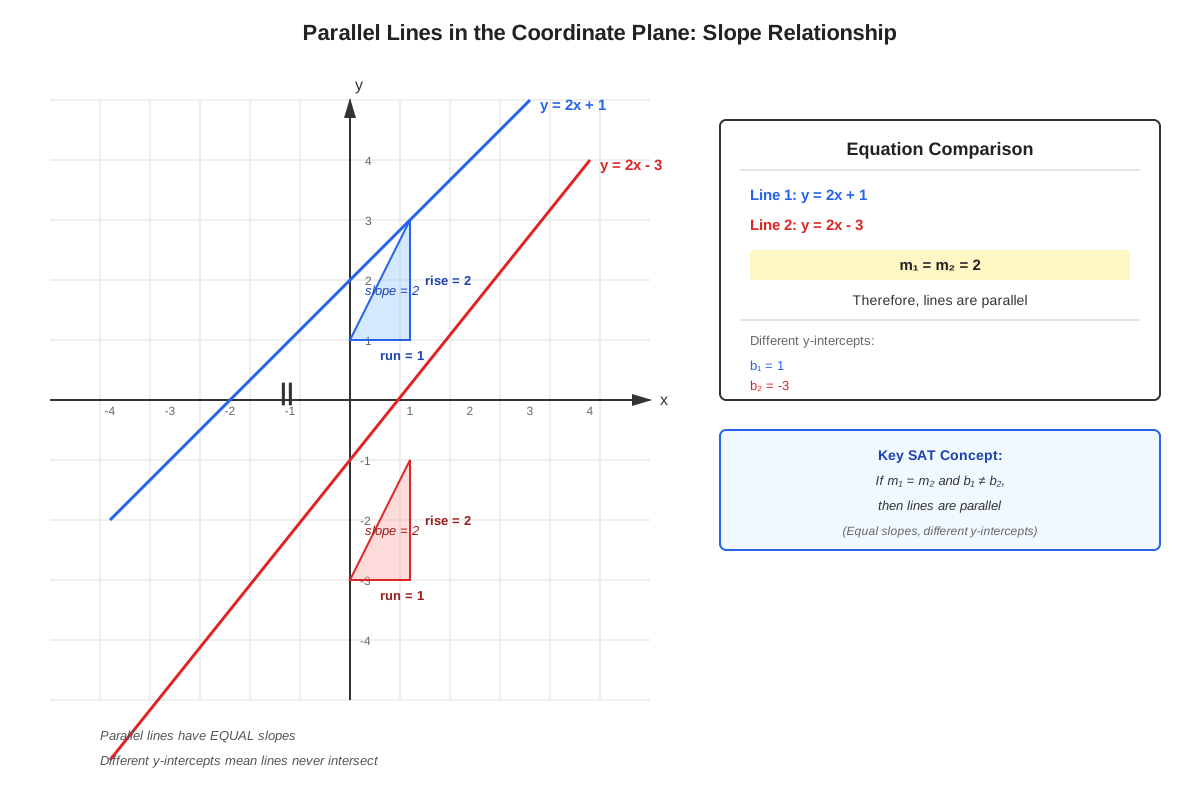
Parallel lines are two or more lines in the same plane that never intersect, regardless of how far they are extended in either direction. This geometric definition has a precise algebraic counterpart: in the coordinate plane, two non-vertical lines are parallel if and only if they have the same slope. This slope condition is the most powerful tool for identifying and working with parallel lines on the SAT.
The notation for parallel lines uses the symbol ∥, so "line l is parallel to line m" is written as l ∥ m. Three critical properties define parallel lines:
- Equal slopes: Parallel lines have identical slopes (m₁ = m₂)
- Constant separation: The perpendicular distance between parallel lines remains constant at all points
- No intersection: Parallel lines never meet, meaning a system of equations representing parallel lines has no solution
Slope as the Key Identifier
The slope of a line measures its steepness and direction, calculated as the ratio of vertical change (rise) to horizontal change (run). For a line passing through points (x₁, y₁) and (x₂, y₂), the slope formula is:
m = (y₂ - y₁)/(x₂ - x₁)When working with equations in slope-intercept form (y = mx + b), the coefficient m represents the slope, while b represents the y-intercept. For two lines to be parallel, their m values must be identical, but their b values must differ (if b values are also equal, the lines are coincident—the same line).
Consider these examples:
- Line 1: y = 3x + 5 and Line 2: y = 3x - 2 are parallel (both have slope 3)
- Line 1: y = -½x + 7 and Line 2: y = -½x + 1 are parallel (both have slope -½)
- Line 1: y = 2x + 4 and Line 2: y = 2x + 4 are NOT parallel; they're the same line
Converting Equations to Identify Parallel Lines
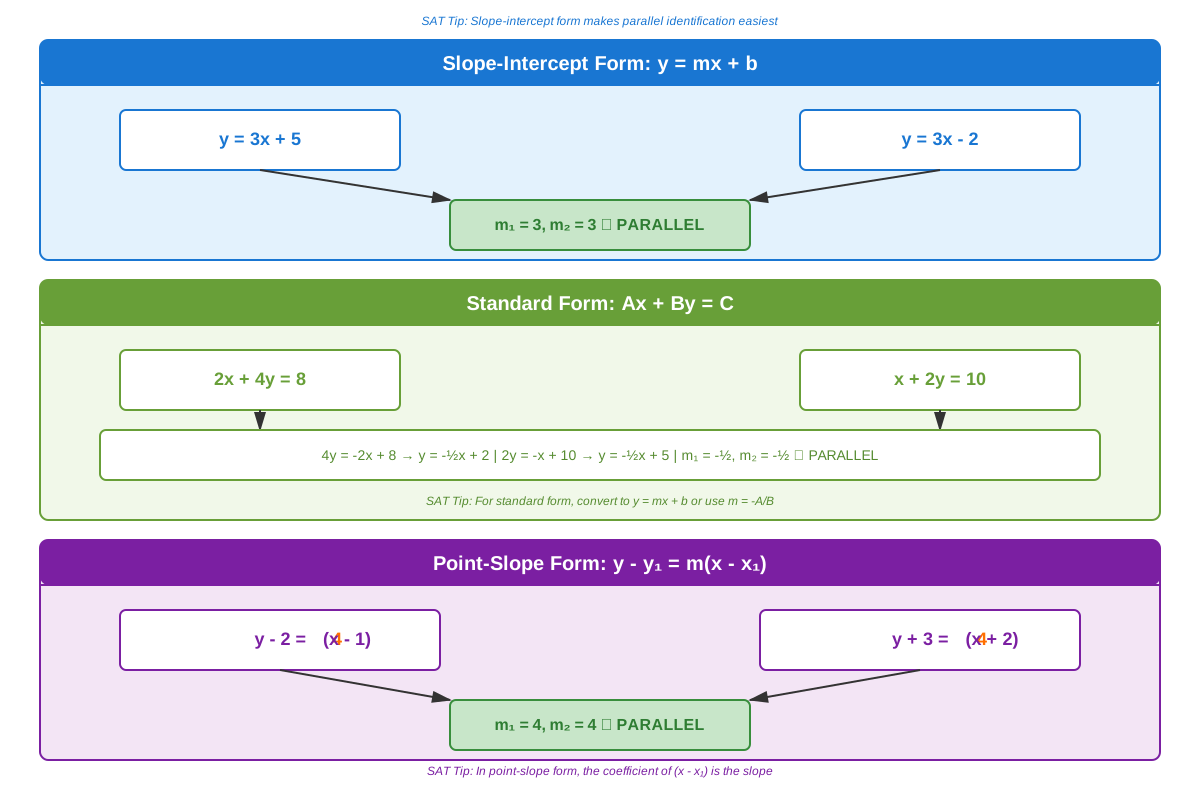
SAT questions frequently present linear equations in forms other than slope-intercept form. To determine if lines are parallel, students must convert equations to identify slopes:
Standard Form (Ax + By = C): Solve for y to find slope
- Example: 2x + 3y = 12 → 3y = -2x + 12 → y = -⅔x + 4 (slope = -⅔)
Point-Slope Form (y - y₁ = m(x - x₁)): The coefficient m is already the slope
- Example: y - 5 = 4(x - 2) has slope 4
Two-Point Form: Calculate slope using the slope formula, then compare
| Equation Form | How to Find Slope | Example | Slope |
|---|---|---|---|
| Slope-intercept: y = mx + b | m is the coefficient of x | y = 5x - 3 | 5 |
| Standard: Ax + By = C | m = -A/B | 4x + 2y = 10 | -2 |
| Point-slope: y - y₁ = m(x - x₁) | m is given directly | y - 1 = -3(x + 2) | -3 |
| Two points given | Use slope formula | (2,3) and (4,7) | 2 |
Writing Equations of Parallel Lines
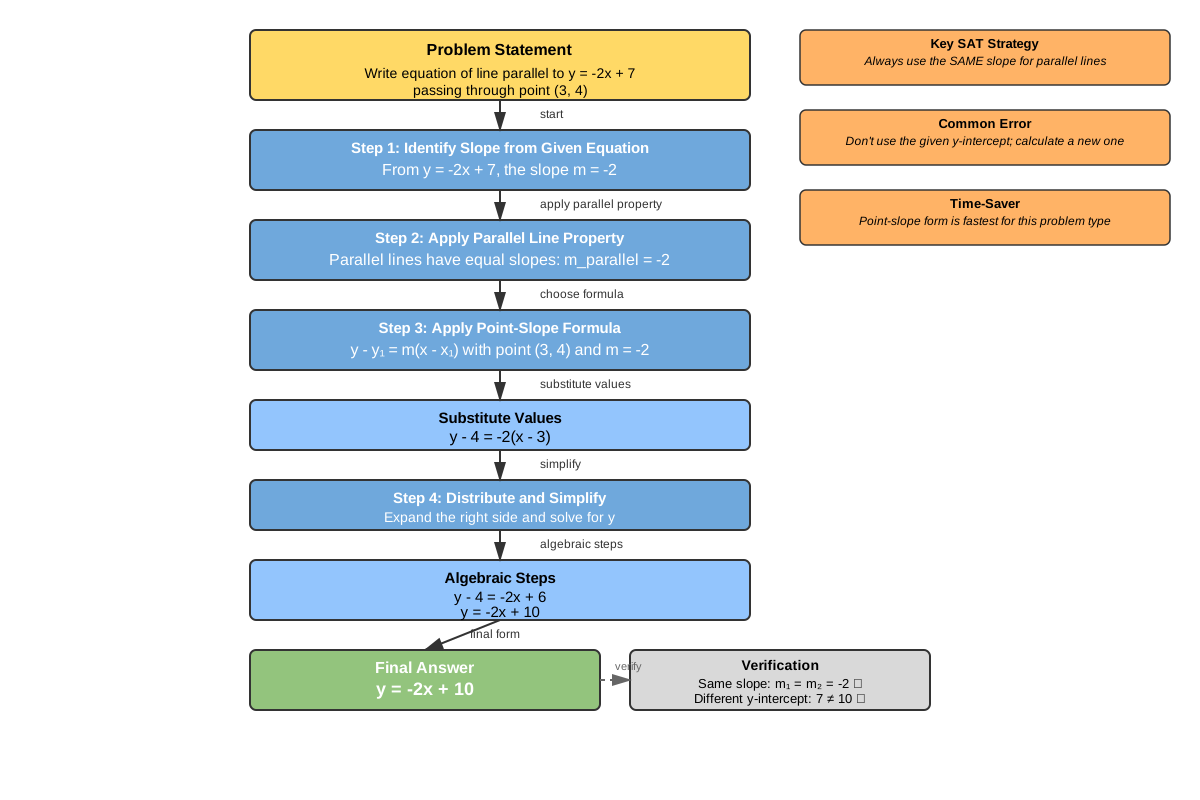
A common SAT task requires writing the equation of a line parallel to a given line that passes through a specific point. The process follows these steps:
- Identify the slope of the given line (this will be the slope of the parallel line)
- Use the point-slope form with the identified slope and the given point
- Convert to the requested form (usually slope-intercept or standard form)
Example: Write the equation of a line parallel to y = 2x - 5 that passes through (3, 4).
- Step 1: The given line has slope 2, so the parallel line also has slope 2
- Step 2: Using point-slope form: y - 4 = 2(x - 3)
- Step 3: Simplify: y - 4 = 2x - 6 → y = 2x - 2
Parallel Lines and Transversals
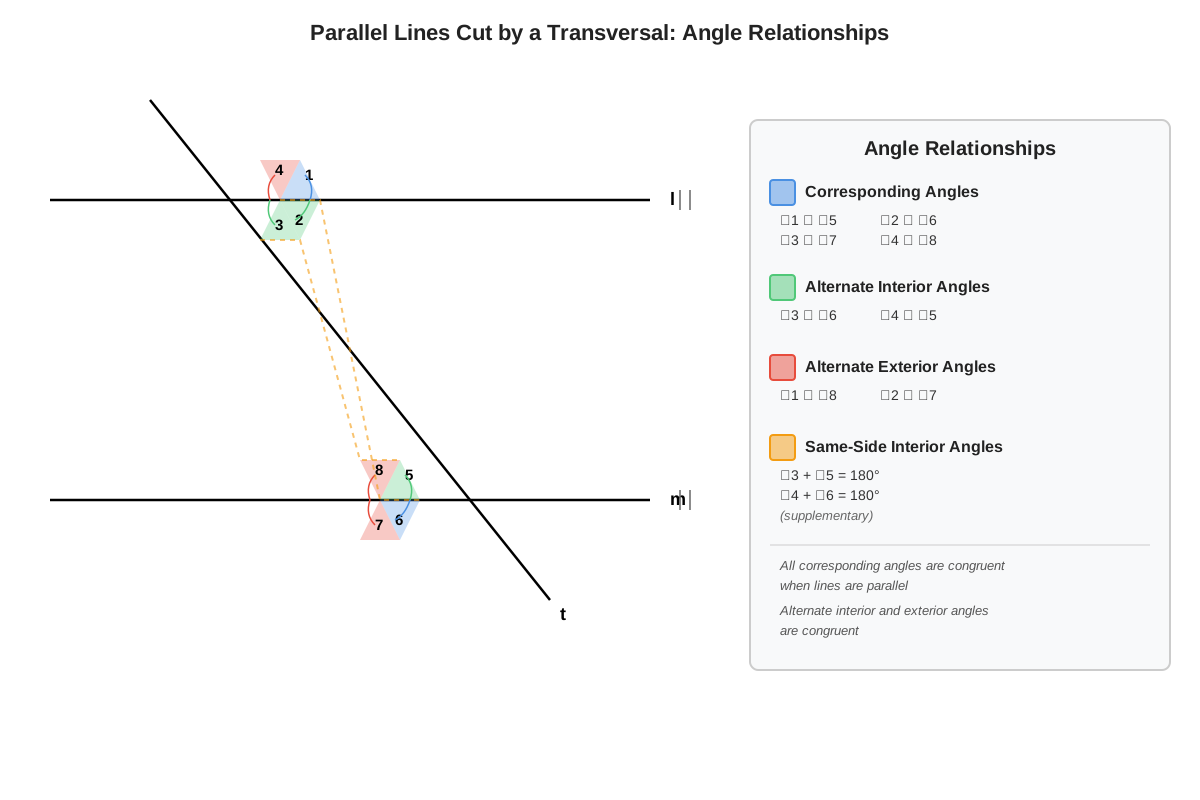
When a transversal (a line that intersects two or more other lines) crosses parallel lines, it creates eight angles with special relationships. Understanding these angle relationships is crucial for SAT geometry questions:
Corresponding Angles: Angles in the same relative position at each intersection are equal
- If angles are in matching positions (both upper-right, both lower-left, etc.), they're equal
Alternate Interior Angles: Angles on opposite sides of the transversal, between the parallel lines, are equal
- These angles form a "Z" pattern
Alternate Exterior Angles: Angles on opposite sides of the transversal, outside the parallel lines, are equal
- These angles form a reverse "Z" pattern
Consecutive Interior Angles (Same-Side Interior Angles): Angles on the same side of the transversal, between the parallel lines, are supplementary (sum to 180°)
- These angles form a "C" pattern
When the SAT presents a diagram with parallel lines cut by a transversal, students can use these relationships to find unknown angle measures. If one angle is given, all eight angles can be determined using these properties combined with vertical angles (opposite angles at an intersection are equal) and linear pairs (adjacent angles on a line sum to 180°).
Special Cases and Vertical Lines
Vertical lines (lines with undefined slope) present a special case. Two vertical lines are parallel to each other, but the slope test cannot be applied because their slopes are undefined. Vertical lines have equations of the form x = k, where k is a constant. All vertical lines are parallel to each other and perpendicular to all horizontal lines.
Similarly, all horizontal lines (lines with slope 0) are parallel to each other. Horizontal lines have equations of the form y = k.
Concept Relationships
The concept of parallel lines serves as a central hub connecting multiple mathematical ideas. At the most fundamental level, slope → determines → parallel relationships, making slope calculation the prerequisite skill that enables all parallel line work. This connection flows bidirectionally: understanding parallel lines also deepens comprehension of what slope represents geometrically.
Within coordinate geometry, parallel lines connect directly to systems of linear equations. When two equations represent parallel lines, the system has no solution because the lines never intersect. This relationship links: parallel lines → creates → inconsistent systems → results in → no solution. Conversely, when solving systems algebraically and encountering a contradiction (such as 0 = 5), students can conclude the lines are parallel.
The angle relationships created by transversals cutting parallel lines bridge pure geometry and coordinate geometry. Parallel lines + transversal → creates → predictable angle relationships → enables → solving for unknown angles. These angle relationships also connect to transformations, as translations preserve parallel relationships.
Looking forward, parallel lines form the foundation for understanding perpendicular lines (lines whose slopes are negative reciprocals). The relationship follows: master parallel lines → provides framework for → perpendicular lines → enables → advanced coordinate geometry. Additionally, parallel line concepts extend to vectors and parametric equations in higher mathematics.
The connection to linear functions is direct: linear function → graphs as → straight line → can be → parallel to other lines. Understanding when functions are parallel helps in analyzing transformations of functions, a topic that appears in SAT questions about function shifts and stretches.
High-Yield Facts
⭐ Two non-vertical lines are parallel if and only if they have equal slopes (m₁ = m₂)
⭐ When a transversal crosses parallel lines, corresponding angles are equal
⭐ Alternate interior angles formed by a transversal crossing parallel lines are equal
⭐ To write an equation of a line parallel to y = mx + b through point (x₁, y₁), use the same slope m
⭐ Consecutive interior angles (same-side interior angles) formed by parallel lines and a transversal are supplementary (sum to 180°)
- All vertical lines (x = k) are parallel to each other
- All horizontal lines (y = k) are parallel to each other
- A system of equations representing parallel lines has no solution (inconsistent system)
- Parallel lines maintain constant perpendicular distance from each other
- In standard form Ax + By = C, the slope is -A/B
- If two lines have the same slope and the same y-intercept, they are the same line (coincident), not parallel
- Alternate exterior angles formed by parallel lines and a transversal are equal
- The distance between parallel lines can be calculated using the perpendicular distance formula
- Translations (shifts) preserve parallel relationships—if two lines are parallel, their translated images are also parallel
- On the SAT, parallel line questions often combine with other topics like systems of equations or coordinate geometry
Quick check — test yourself on Parallel lines so far.
Try Flashcards →Common Misconceptions
Misconception: Lines that don't appear to intersect on a diagram are parallel.
Correction: Lines may intersect outside the visible portion of a diagram. Always use slope to verify parallel relationships algebraically rather than relying on visual appearance. The SAT frequently includes diagrams that are not drawn to scale.
Misconception: Parallel lines must have the same y-intercept.
Correction: Parallel lines must have the same slope but DIFFERENT y-intercepts. If both slope and y-intercept are identical, the lines are coincident (the same line), not parallel. For example, y = 3x + 2 and y = 3x + 7 are parallel, but y = 3x + 2 and y = 3x + 2 are the same line.
Misconception: All corresponding angles formed by any two lines and a transversal are equal.
Correction: Corresponding angles are equal ONLY when the two lines cut by the transversal are parallel. If the lines are not parallel, corresponding angles are not equal. The parallel relationship is the necessary condition for these angle equalities.
Misconception: When converting from standard form to slope-intercept form, the slope is B/A.
Correction: For the equation Ax + By = C, the slope is -A/B (negative A divided by B), not B/A. For example, in 3x + 2y = 6, the slope is -3/2, not 2/3. This sign error is one of the most common mistakes on SAT parallel line questions.
Misconception: Vertical lines have a slope of zero.
Correction: Vertical lines have undefined slope (division by zero), not zero slope. Horizontal lines have zero slope. This distinction is critical: all vertical lines are parallel to each other (all have undefined slope), and all horizontal lines are parallel to each other (all have slope 0).
Misconception: If alternate interior angles are equal, the lines might be parallel.
Correction: If alternate interior angles are equal, the lines MUST be parallel—this is both a necessary and sufficient condition. The relationship works both ways: parallel lines create equal alternate interior angles, AND equal alternate interior angles prove lines are parallel.
Misconception: The equation of a line parallel to y = 2x + 3 is y = -½x + b.
Correction: This confuses parallel lines with perpendicular lines. Parallel lines have the SAME slope, so a line parallel to y = 2x + 3 has the form y = 2x + b (where b ≠ 3). Lines with slopes that are negative reciprocals are perpendicular, not parallel.
Worked Examples
Example 1: Finding a Parallel Line Equation
Problem: Line l passes through points (2, 5) and (6, 13). Write the equation in slope-intercept form of a line parallel to line l that passes through the point (1, 4).
Solution:
Step 1: Find the slope of line l using the slope formula.
m = (y₂ - y₁)/(x₂ - x₁) = (13 - 5)/(6 - 2) = 8/4 = 2Step 2: Since parallel lines have equal slopes, the line we're looking for also has slope 2.
Step 3: Use point-slope form with the slope m = 2 and the point (1, 4):
y - y₁ = m(x - x₁)
y - 4 = 2(x - 1)
Step 4: Convert to slope-intercept form:
y - 4 = 2x - 2
y = 2x - 2 + 4
y = 2x + 2Answer: y = 2x + 2
Connection to Learning Objectives: This problem demonstrates the application of parallel line concepts to write equations, requiring identification of the key feature (equal slopes) and application to an SAT-style question format.
Example 2: Angle Relationships with Parallel Lines
Problem: In the figure below (described), lines m and n are parallel, and line t is a transversal. If angle 1 measures 65°, and angle 1 and angle 2 are consecutive interior angles, what is the measure of angle 3, which is an alternate interior angle to angle 2?
Solution:
Step 1: Identify the relationship between angles 1 and 2. Since they are consecutive interior angles (same-side interior angles) formed by parallel lines and a transversal, they are supplementary.
angle 1 + angle 2 = 180°
65° + angle 2 = 180°
angle 2 = 115°
Step 2: Identify the relationship between angles 2 and 3. Since angle 3 is an alternate interior angle to angle 2, and the lines are parallel, these angles are equal.
angle 3 = angle 2 = 115°Answer: 115°
Alternative approach: We could also recognize that angle 1 and angle 3 are consecutive interior angles on opposite sides, making them supplementary as well, giving us 180° - 65° = 115° directly.
Connection to Learning Objectives: This problem requires identifying key features of parallel lines (angle relationships with transversals) and applying multiple angle relationships in sequence, a common SAT question pattern.
Example 3: Determining Parallel Lines from Equations
Problem: Which of the following lines is parallel to the line 4x - 2y = 10?
A) y = 2x + 7
B) y = -2x + 3
C) 2x - y = 5
D) x + 2y = 8
Solution:
Step 1: Convert the given equation to slope-intercept form to find its slope.
4x - 2y = 10
-2y = -4x + 10
y = 2x - 5
The slope is 2.
Step 2: Check each answer choice for slope = 2.
Choice A: y = 2x + 7 has slope 2 ✓
Choice B: y = -2x + 3 has slope -2 ✗
Choice C: Convert to slope-intercept form:
2x - y = 5
-y = -2x + 5
y = 2x - 5
This has slope 2, but wait—this is the SAME line as the original (same slope AND same y-intercept), not a parallel line. ✗
Choice D: Convert to slope-intercept form:
x + 2y = 8
2y = -x + 8
y = -½x + 4
This has slope -½ ✗
Answer: A
Key Insight: This problem tests the common trap of confusing parallel lines with coincident lines. Choice C represents the same line as the original equation, not a parallel line. Parallel lines must have the same slope but different y-intercepts.
Connection to Learning Objectives: This demonstrates how parallel lines appear on the SAT in multiple-choice format, requiring conversion between equation forms and careful attention to the definition of parallel lines.
Exam Strategy
When approaching SAT parallel lines questions, begin by identifying what form the question takes. If equations are given, immediately convert them to slope-intercept form to expose the slopes—this single step eliminates ambiguity and enables direct comparison. If a diagram is provided, look for the parallel symbol (∥) or the statement that lines are parallel, then identify all angle relationships before attempting calculations.
Trigger words and phrases that signal parallel line questions include:
- "parallel to"
- "never intersect"
- "same slope"
- "corresponding angles"
- "alternate interior angles"
- "same-side interior angles" or "consecutive interior angles"
- "no solution" (in systems of equations context)
For equation-based questions, use this systematic approach:
- Convert all equations to slope-intercept form (y = mx + b)
- Compare slopes (m values)
- If slopes are equal but y-intercepts differ, lines are parallel
- If writing a new equation, use the same slope with the given point
For angle-based questions with transversals:
- Mark all given angle measures on the diagram
- Use vertical angles to find opposite angles (these are always equal)
- Apply parallel line angle relationships (corresponding, alternate interior, etc.)
- Use supplementary relationships (linear pairs sum to 180°)
- Work systematically until the target angle is found
Process-of-elimination tips specific to parallel lines:
- Eliminate any answer choice with a different slope than the given line
- Eliminate choices that represent the same line (same slope AND y-intercept)
- For angle problems, eliminate any answer that would violate the 180° sum of angles on a line
- If a question asks for a line parallel to a positive slope, eliminate all negative slopes immediately
Time allocation: Most parallel line questions should take 60-90 seconds. If a question requires more than 2 minutes, reassess the approach—there's likely a more direct method. For multi-step problems combining parallel lines with other concepts, allocate up to 2 minutes but prioritize finding the parallel relationship first, as this often unlocks the rest of the solution.
Common SAT tricks to watch for:
- Diagrams not drawn to scale (never assume lines are parallel based on appearance)
- Equations in standard form designed to hide the slope relationship
- Answer choices that represent perpendicular lines (negative reciprocal slopes)
- Questions that give the same line as a "parallel" option
- Angle problems that require multiple steps of reasoning
Memory Techniques
Slope Mnemonic: "Parallel = Precisely the Point" (same slope, different point/y-intercept)
Angle Relationships Mnemonic: "CAT on Zebra"
- Corresponding angles (same position)
- Alternate interior angles (make a Z pattern)
- Transversal creates these relationships
Visualization Strategy: When working with parallel lines and transversals, visualize or sketch the letter patterns:
- Z pattern: Alternate interior angles
- Reverse Z pattern: Alternate exterior angles
- C pattern: Consecutive interior angles (these are supplementary, not equal)
- F pattern: Corresponding angles
Slope Conversion Acronym: "SAND" for Standard form to slope
- Standard form: Ax + By = C
- Answer is slope
- Negative A
- Divided by B
- Result: m = -A/B
Parallel vs. Perpendicular Memory Aid:
- ParALLel = ALL the same (same slope)
- PerPENdicular = PENalty flip (negative reciprocal)
Quick Check Method: When verifying if lines are parallel, use the "Same Slope, Different Show" rule—same slope (m), different y-intercept (b) means they "show" up in different places on the y-axis.
Summary
Parallel lines represent a fundamental concept in coordinate geometry that bridges algebraic and geometric reasoning. The defining characteristic of parallel lines—equal slopes—provides the primary tool for identifying, verifying, and creating parallel relationships in the coordinate plane. On the SAT, parallel lines appear in two main contexts: equation-based questions requiring slope comparison and manipulation, and geometry questions involving angle relationships when transversals intersect parallel lines. Mastery requires fluency in converting between equation forms to expose slopes, understanding that parallel lines create predictable angle patterns (corresponding angles equal, alternate interior angles equal, consecutive interior angles supplementary), and recognizing that systems of equations representing parallel lines have no solution. The most common SAT applications involve writing equations of lines parallel to given lines through specific points, identifying parallel lines from multiple equation formats, and solving for unknown angles using transversal relationships. Success on these questions depends on systematic approaches: always convert to slope-intercept form for equation problems, always mark known angles and work systematically for geometry problems, and always verify that parallel lines have the same slope but different y-intercepts to avoid confusing them with coincident lines.
Key Takeaways
- Parallel lines have equal slopes: This is the fundamental algebraic test for parallelism in the coordinate plane (m₁ = m₂)
- Convert equations to slope-intercept form: Transform all linear equations to y = mx + b to quickly identify and compare slopes
- Corresponding angles are equal when a transversal crosses parallel lines: This relationship, along with alternate interior angles being equal, enables solving for unknown angles
- Same slope, different y-intercept: Parallel lines must differ in at least one parameter; identical equations represent the same line, not parallel lines
- Consecutive interior angles are supplementary: When parallel lines are cut by a transversal, same-side interior angles sum to 180°
- Standard form slope is -A/B: For equations in the form Ax + By = C, the slope equals negative A divided by B
- Parallel lines create systems with no solution: When two linear equations represent parallel lines, the system is inconsistent and has no point of intersection
Related Topics
Perpendicular Lines: Building directly on parallel lines, perpendicular lines have slopes that are negative reciprocals (m₁ × m₂ = -1). Mastering parallel lines provides the framework for understanding this related but distinct relationship.
Systems of Linear Equations: Parallel lines represent one of three possible relationships in systems of equations (no solution), while intersecting lines have one solution and coincident lines have infinitely many solutions.
Linear Inequalities and Shading: Understanding parallel lines helps with graphing systems of linear inequalities, where parallel boundary lines create regions that never intersect.
Transformations in the Coordinate Plane: Translations preserve parallel relationships, making parallel lines essential for understanding how figures move in the plane without changing orientation.
Distance Formula and Perpendicular Distance: Calculating the distance between parallel lines requires understanding both the parallel relationship and perpendicular distance concepts.
Vectors and Parametric Equations: In advanced mathematics, parallel lines are represented using vectors with proportional direction components, extending the slope concept to higher dimensions.
Practice CTA
Now that you've mastered the core concepts of parallel lines, it's time to solidify your understanding through active practice. The practice questions and flashcards designed for this topic will challenge you to apply these concepts in various SAT-style formats, from straightforward slope comparisons to complex multi-step problems involving transversals and angle relationships. Remember, the difference between understanding parallel lines conceptually and scoring points on test day lies in repeated, deliberate practice. Each practice problem you complete strengthens your pattern recognition and builds the automaticity needed to work efficiently under time pressure. Approach the practice materials with confidence—you now have all the tools needed to excel on any parallel lines question the SAT can present!
Sign up free to keep reading
Create a free AnvayaPrep account to finish this SAT guide on Parallel lines — plus flashcards and practice questions.