Overview
SAT angle traps represent one of the most frequently tested—and most commonly missed—question types in the geometry section of the SAT math exam. These questions are deliberately designed by test makers to exploit common assumptions students make about geometric figures, particularly regarding angles that appear to have certain measurements but actually don't. The College Board intentionally draws diagrams that are not to scale or that suggest relationships between angles that aren't necessarily true based on the given information. Students who rely on visual estimation rather than mathematical reasoning consistently fall into these traps, losing valuable points on questions they believe they've answered correctly.
Understanding sat angle traps is essential for achieving a competitive score on the SAT because these questions appear in approximately 15-20% of all geometry problems on the test. They're designed to separate students who truly understand angle relationships from those who make assumptions based on appearances. The trap works because the human brain naturally wants to trust what it sees—when an angle looks like it measures 90 degrees, students assume it's a right angle even without explicit confirmation. When two lines appear parallel, students apply parallel line theorems without verifying the parallel relationship is stated in the problem.
Mastering this topic connects directly to broader mathematical reasoning skills tested throughout the SAT. Angle trap questions reinforce the fundamental principle that mathematical conclusions must be based on given information and proven relationships, not visual appearances. This concept extends beyond geometry into algebra, data analysis, and problem-solving sections where distinguishing between what appears true and what is provably true becomes critical for success.
Learning Objectives
- [ ] Identify key features of SAT angle traps
- [ ] Explain how SAT angle traps appears on the SAT
- [ ] Apply SAT angle traps to answer SAT-style questions
- [ ] Distinguish between information that can be assumed from a diagram versus information that must be explicitly stated
- [ ] Recognize common visual deceptions in SAT geometry diagrams
- [ ] Develop systematic verification strategies to avoid angle trap mistakes
- [ ] Apply angle relationship theorems only when appropriate conditions are confirmed
Prerequisites
- Basic angle vocabulary: Understanding terms like acute, obtuse, right, straight, complementary, and supplementary angles is essential because angle traps exploit confusion about these fundamental classifications
- Angle relationship theorems: Knowledge of vertical angles, linear pairs, corresponding angles, alternate interior angles, and angles in triangles provides the foundation for recognizing when these relationships can and cannot be applied
- Triangle properties: Familiarity with triangle angle sum theorem and properties of special triangles (isosceles, equilateral) is necessary because many angle traps involve triangular figures
- Parallel line theorems: Understanding which angle relationships exist when lines are parallel versus when they're not is critical for avoiding the most common angle traps
Why This Topic Matters
In real-world applications, the skill of not making unwarranted assumptions based on visual information translates to engineering, architecture, computer graphics, and any field requiring precise spatial reasoning. Architects cannot assume walls are perpendicular just because they look square in a sketch; engineers cannot assume beams are parallel without verification. The mathematical discipline of proving relationships rather than assuming them based on appearances has practical significance across technical professions.
On the SAT specifically, angle trap questions appear with remarkable consistency. Data from released SAT exams shows that approximately 2-4 questions per test directly test students' ability to avoid angle traps, and several additional questions incorporate angle trap elements as secondary challenges. These questions typically appear in both the calculator and no-calculator sections, with difficulty ratings ranging from medium to hard. The College Board deliberately includes the warning "Note: Figure not drawn to scale" on many geometry problems, which serves as a red flag that visual estimation will lead to incorrect answers.
Common manifestations of angle traps on the SAT include: diagrams showing triangles that appear to be right triangles but aren't labeled as such; figures with lines that look parallel but aren't marked with parallel indicators; angles that appear to be equal but lack congruence marks; and shapes that seem to be special quadrilaterals (squares, rectangles) but are only labeled as general quadrilaterals. The test makers exploit the fact that students working under time pressure will default to visual processing rather than careful logical analysis.
Core Concepts
What Makes an Angle Trap
An sat angle trap is a geometry question where the visual presentation of a figure suggests certain angle measurements or relationships that cannot be logically concluded from the given information. The "trap" element comes from the natural human tendency to trust visual perception over mathematical reasoning. The SAT deliberately constructs these questions to test whether students understand the difference between what can be observed versus what can be proven.
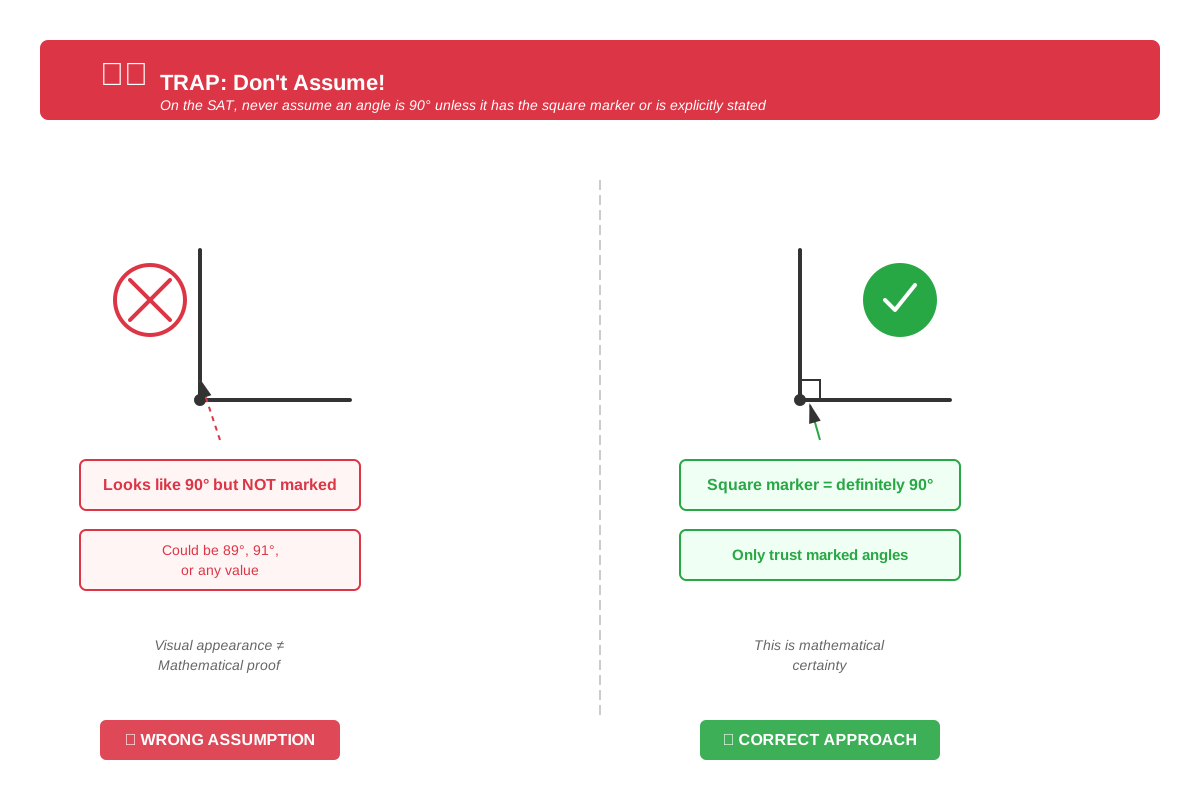
The fundamental principle underlying all angle traps is this: on the SAT, you can only rely on information that is explicitly stated in the problem or can be logically derived from stated information. Visual appearance alone never constitutes proof. This means that unless a diagram includes specific markings (like a small square indicating a right angle, tick marks showing equal segments, or arrows indicating parallel lines), you cannot assume those properties exist.
Information You CAN Trust in SAT Diagrams
Even when figures are not drawn to scale, certain aspects of SAT geometry diagrams remain reliable:
- Relative positioning: If point B appears between points A and C on a line, it actually is between them
- Intersection relationships: If two lines appear to intersect, they do intersect
- Containment: If a point appears inside a circle or polygon, it is inside
- Straightness: If something appears to be a straight line (not curved), it is straight
- Angle type (acute vs obtuse): While you cannot determine exact measurements, if an angle appears acute (less than 90°), it won't actually be obtuse (greater than 90°), and vice versa
Information You CANNOT Trust Without Confirmation
The following properties require explicit statement or marking in the problem:
- Right angles: Never assume an angle is 90° unless marked with a square symbol or stated in the problem
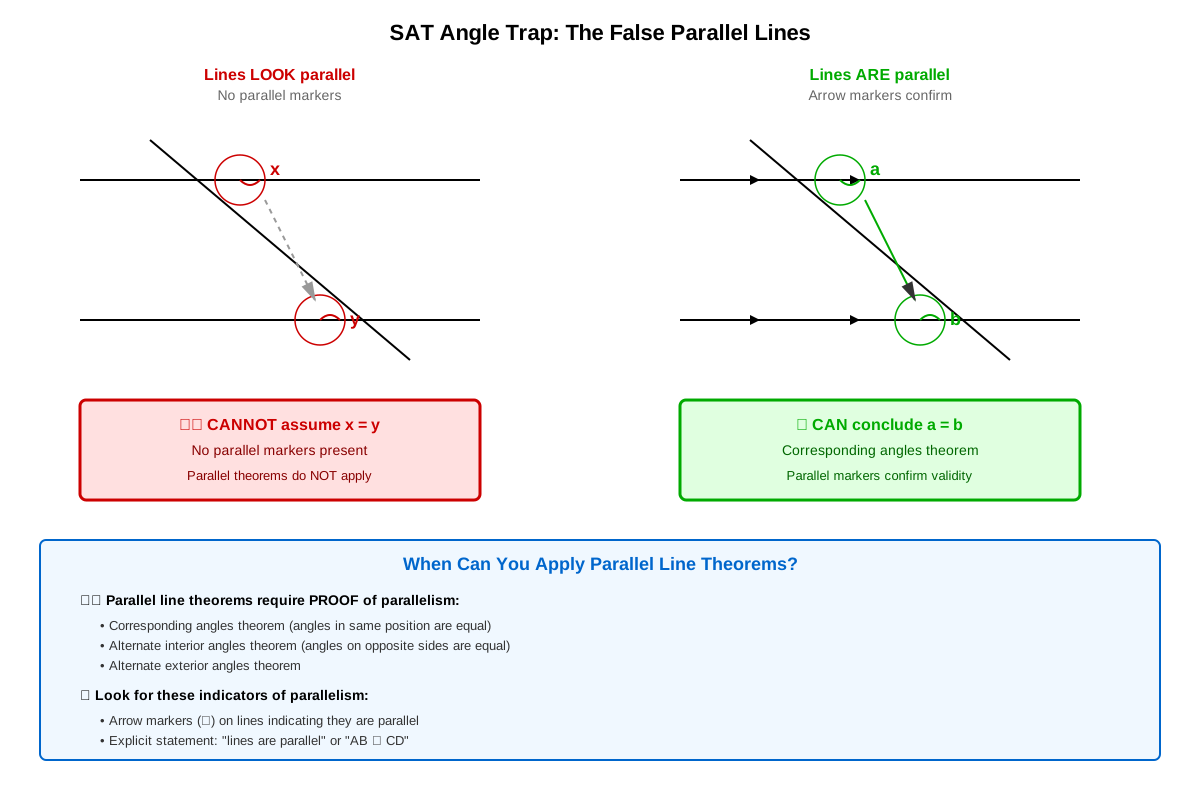
- Parallel lines: Lines must be marked with arrows or stated to be parallel; visual appearance is insufficient
- Equal angles: Angles must have congruence marks (identical arc symbols) or be provably equal through theorems
- Equal segments: Segments must have tick marks or be stated as equal
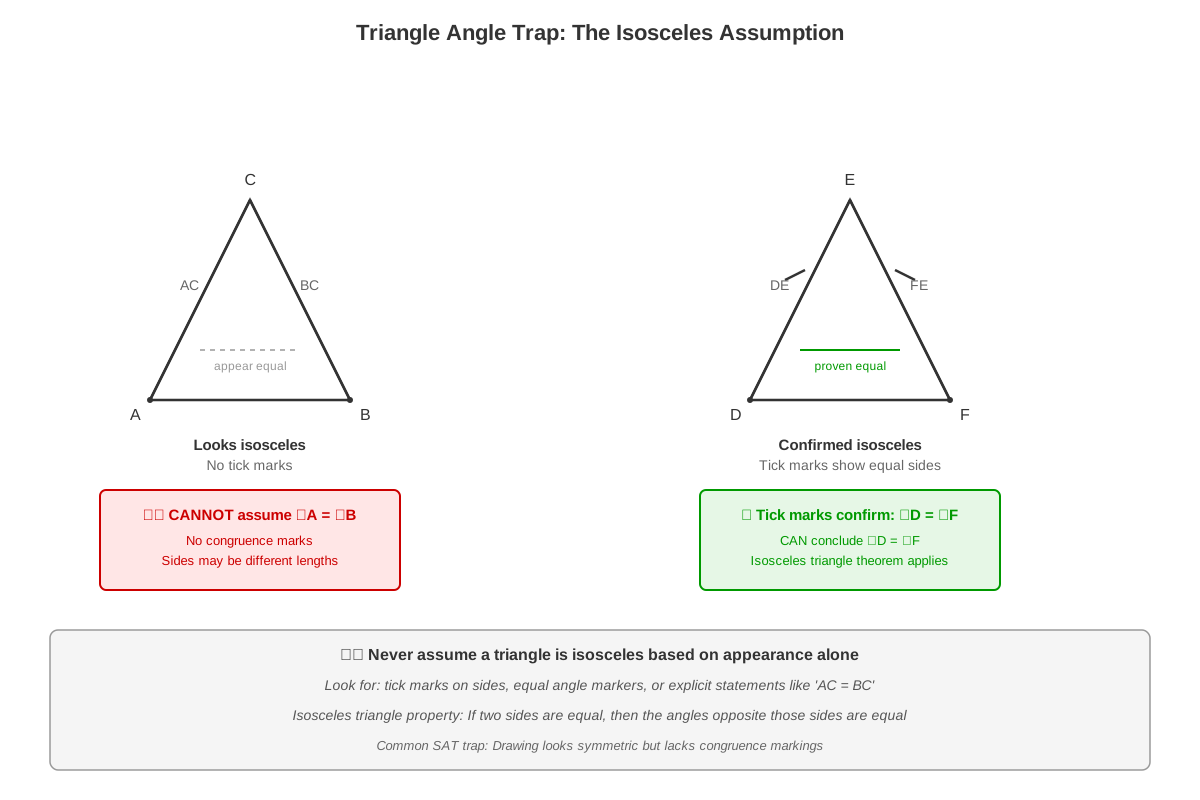
- Special triangles: Never assume a triangle is isosceles, equilateral, or right without confirmation
- Special quadrilaterals: A four-sided figure might look like a square or rectangle but could be a general quadrilateral
Common Angle Trap Scenarios
| Trap Type | Visual Appearance | What Students Assume | Reality |
|---|---|---|---|
| Fake Right Angle | Angle looks 90° | It's a right angle | Could be 89° or 91° or any measure |
| Fake Parallel Lines | Lines appear parallel | Corresponding angles are equal | Lines may not be parallel |
| Fake Isosceles Triangle | Two sides look equal | Base angles are equal | Triangle may be scalene |
| Fake Straight Line | Three points appear collinear | Angles sum to 180° | Points may not be collinear |
| Fake Perpendicular | Lines appear to meet at 90° | Can use perpendicular theorems | Lines may intersect at other angles |
The "Not Drawn to Scale" Warning
When the SAT includes the phrase "Note: Figure not drawn to scale," this is an explicit warning that visual estimation will fail. This warning appears on approximately 40% of geometry questions and signals that the test makers have intentionally distorted the figure. However, even when this warning does NOT appear, students should still avoid making assumptions beyond what's explicitly stated. The absence of the warning doesn't guarantee the figure is accurate—it simply means the test makers didn't feel the need to emphasize the point.
Systematic Verification Strategy
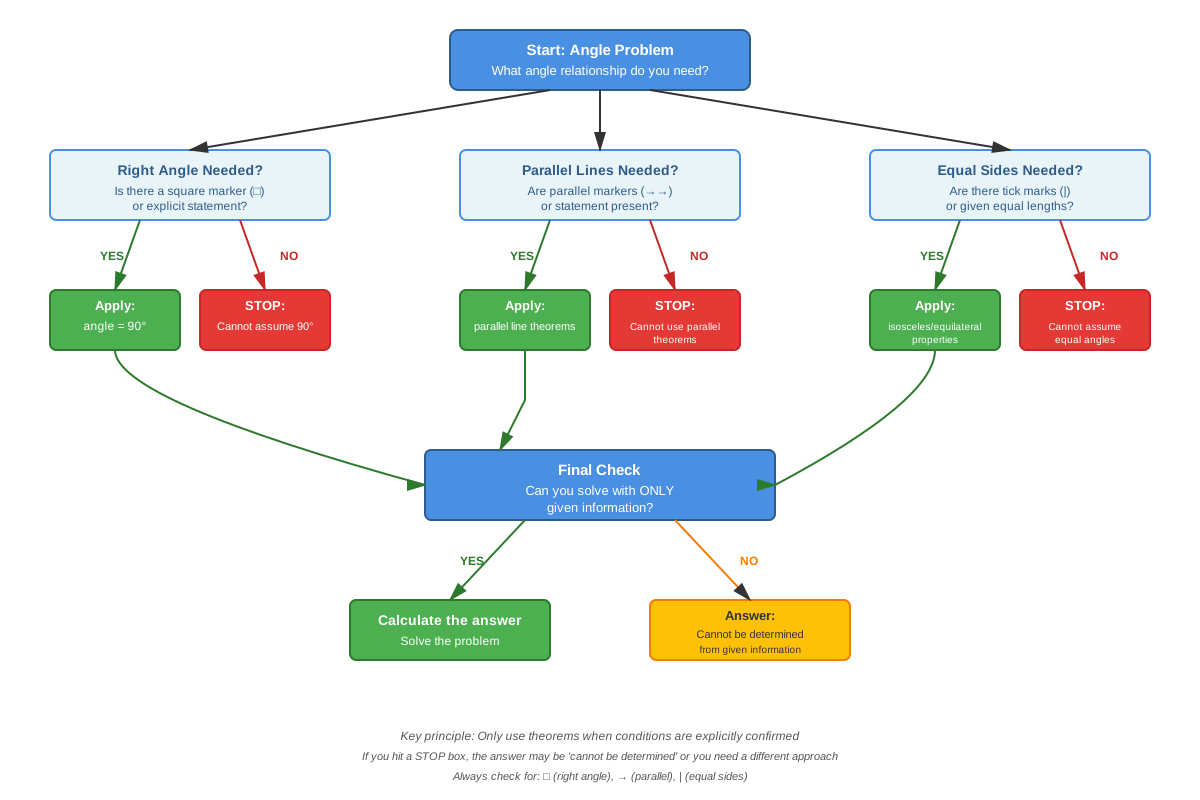
To avoid angle traps, implement this four-step verification process:
- Read the problem completely before looking at the diagram in detail
- List all given information explicitly stated in the problem text
- Mark the diagram with only the information you've verified (add right angle symbols, parallel marks, etc., based on stated facts)
- Derive additional information using only proven theorems applied to confirmed relationships
This systematic approach prevents the visual appearance of the diagram from contaminating your logical reasoning process.
Key Angle Relationships and When They Apply
Understanding when specific angle theorems can be applied is crucial for avoiding traps:
Vertical Angles Theorem (angles are equal when two lines intersect): Can be applied whenever two straight lines cross, regardless of the angle measures. This is one of the few relationships you can trust from visual inspection of intersecting lines.
Linear Pair Theorem (adjacent angles on a straight line sum to 180°): Applies when you can confirm that three points are collinear (form a straight line). The SAT may show angles that appear to form a linear pair but don't actually lie on a straight line.
Triangle Angle Sum (interior angles sum to 180°): Applies to any triangle, but you must confirm you actually have a triangle (three straight sides forming a closed figure).
Parallel Line Theorems (corresponding angles equal, alternate interior angles equal, etc.): Only apply when lines are confirmed to be parallel through explicit statement or marking. This is the most common source of angle traps.
Concept Relationships
The concepts within angle traps form a logical hierarchy: the foundation is understanding what information can be trusted in diagrams → this leads to → recognizing when specific theorems can be applied → which enables → systematic problem-solving that avoids visual deception → ultimately resulting in → correct answers on trap questions.
Angle traps connect directly to prerequisite knowledge of angle relationships. Students must first master basic theorems (vertical angles, linear pairs, parallel line relationships) before they can understand when these theorems do and don't apply. The trap element adds a meta-cognitive layer: it's not enough to know the theorems; students must also know the conditions under which each theorem is valid.
This topic also connects forward to more complex geometry problems involving circles, polygons, and coordinate geometry. The fundamental principle—prove rather than assume—applies throughout all SAT geometry. Mastering angle traps develops the careful reasoning habits necessary for success on advanced geometry questions where multiple steps of logical deduction are required.
The relationship map flows as follows: Basic Angle Vocabulary → Angle Relationship Theorems → Conditions for Theorem Application → Recognition of Unwarranted Assumptions → Systematic Verification Strategy → Successful Navigation of Angle Traps → Higher Scores on SAT Geometry.
Quick check — test yourself on SAT angle traps so far.
Try Flashcards →High-Yield Facts
⭐ Never assume an angle is 90° without a right angle symbol (small square) or explicit statement in the problem
⭐ Lines must be marked with arrows or stated to be parallel before you can apply parallel line theorems
⭐ The phrase "Note: Figure not drawn to scale" is a warning that visual estimation will lead to wrong answers
⭐ You can trust relative positioning (which points are between others) but not measurements or special angle relationships
⭐ Vertical angles are always equal when two lines intersect—this is one relationship you can trust from visual inspection
- Angles that appear equal may have different measures unless marked with congruence symbols or proven equal through theorems
- A triangle that looks isosceles may be scalene unless two sides are marked equal or two angles are proven equal
- Three points that appear to lie on a straight line may not be collinear unless explicitly stated
- Complementary angles (summing to 90°) and supplementary angles (summing to 180°) must be proven, not assumed from appearance
- The absence of the "not drawn to scale" warning does not guarantee the figure is accurate—always verify relationships
- When multiple geometric figures overlap in a diagram, the visual complexity increases trap potential
- Calculator sections and no-calculator sections both contain angle trap questions with equal frequency
Common Misconceptions
Misconception: If an angle looks like 90 degrees in the diagram, it must be a right angle. → Correction: Angles can only be confirmed as right angles when marked with a small square symbol or explicitly stated in the problem. The SAT deliberately draws angles that appear to be 90° but are actually 89° or 91° or other measures to trap students who rely on visual estimation.
Misconception: When the problem doesn't say "Note: Figure not drawn to scale," the diagram is accurate and can be trusted. → Correction: Even without this warning, students should verify all relationships using given information rather than visual appearance. The warning simply emphasizes that visual estimation will definitely fail; its absence doesn't guarantee accuracy.
Misconception: If two lines look parallel in the diagram, you can use corresponding angles and alternate interior angles theorems. → Correction: Parallel line theorems only apply when lines are confirmed to be parallel through arrow markings or explicit statement. Lines that appear parallel may actually intersect far outside the visible portion of the diagram.
Misconception: All information needed to solve the problem is contained in the diagram. → Correction: Critical information is often stated in the problem text rather than shown in the diagram. Students must read the entire problem carefully and integrate textual information with visual information.
Misconception: If a triangle has two sides that look equal, it's isosceles and the base angles are equal. → Correction: Triangles must have tick marks on sides or proven equal angles before isosceles properties can be applied. A triangle that appears isosceles may actually be scalene with sides of slightly different lengths.
Misconception: You can estimate angle measures by comparing them to right angles or straight angles in the diagram. → Correction: When figures are not drawn to scale, proportional relationships between angles are unreliable. An angle that appears to be half the size of another angle may not actually have that relationship.
Worked Examples
Example 1: The Fake Right Angle Trap
Problem: In the figure below, line segment AB intersects line segment CD at point E. Angle AEC appears to measure 90°. If angle AED measures 115°, what is the measure of angle BEC?
Note: Figure not drawn to scale
Solution Process:
Step 1: Identify what we know for certain
- AB and CD are line segments that intersect at E
- Angle AED = 115° (given explicitly)
- The figure shows an intersection but we cannot trust the visual appearance of angle AEC
Step 2: Recognize the trap
The trap here is that angle AEC appears to be 90°, which might lead students to incorrectly conclude that angle BEC is also 90° (as vertical angles). However, we're not told that angle AEC is 90°, so we cannot assume this.
Step 3: Apply verified theorems
Since AB is a straight line, angles AED and BED form a linear pair and must sum to 180°:
- Angle BED = 180° - 115° = 65°
Step 4: Use vertical angles theorem
Angles BED and AEC are vertical angles (formed by two intersecting lines), so they're equal:
- Angle AEC = 65° (not 90° as it appeared!)
Now angles AEC and BEC form a linear pair on line CD:
- Angle BEC = 180° - 65° = 115°
Step 5: Verify using vertical angles
As a check, angle BEC should equal angle AED (vertical angles), and indeed both equal 115°.
Answer: 115°
Key Lesson: This problem demonstrates why you cannot trust visual appearance. Angle AEC looked like 90° but was actually 65°. By using only stated information and proven theorems (linear pairs and vertical angles), we arrived at the correct answer.
Example 2: The Parallel Lines Assumption Trap
Problem: In the figure below, line m intersects lines p and q. Angle 1 measures 70° and angle 2 measures 70°. Line p appears to be parallel to line q. What is the measure of angle 3?
[Diagram shows line m crossing two other lines, with angle 1 on line p, angle 2 on line q, and angle 3 also on line q but on the opposite side of line m from angle 2]
Solution Process:
Step 1: Identify the trap
The trap is that lines p and q appear parallel, and angles 1 and 2 both measure 70°, which might seem to confirm they're parallel. Students might then assume angle 3 is 110° (supplementary to angle 2).
Step 2: Analyze what we actually know
- Angle 1 = 70° (given)
- Angle 2 = 70° (given)
- Lines p and q are NOT stated to be parallel
- No parallel line markings appear on the diagram
Step 3: Recognize what we cannot conclude
Even though angles 1 and 2 are equal, this doesn't prove lines p and q are parallel. Corresponding angles being equal is a consequence of parallel lines, but the converse (if corresponding angles are equal, lines must be parallel) requires those specific angles to be in corresponding positions, which we cannot verify without more information.
Step 4: Determine what can be solved
Without knowing whether lines p and q are parallel, and without additional angle measurements or relationships, we cannot determine the measure of angle 3. The problem is actually unsolvable with the given information.
Key Lesson: This example illustrates that not every geometry problem with a diagram has a solution based solely on visual information. The SAT tests whether students recognize when insufficient information is provided. The correct answer to "What is the measure of angle 3?" would be "Cannot be determined from the given information."
Exam Strategy
When approaching SAT geometry questions, implement this strategic process to avoid angle traps:
Before You Calculate:
- Read the entire problem text first, before studying the diagram in detail
- Look for the phrase "Note: Figure not drawn to scale"—this is your warning signal
- List all explicitly stated information on your scratch paper
- Identify what the question is actually asking for
Trigger Words to Watch For:
- "appears to be" or "seems to be"—these phrases often precede trap elements
- "if" statements that provide conditional information
- Absence of words like "perpendicular," "parallel," "right angle," or "equal"—what's NOT said is often as important as what is said
Visual Analysis Strategy:
- Circle or mark only the information you can verify from the problem statement
- Draw your own small diagram if the given one seems misleading
- Add symbols (right angle squares, parallel arrows, congruence marks) only for verified relationships
- Cross out or ignore visual suggestions that aren't confirmed
Process of Elimination Tips:
- Eliminate answer choices that require assuming unverified relationships
- Be suspicious of answers that seem "too easy" based on visual estimation
- If you find yourself thinking "that angle looks like 90°," that's probably the trap answer
- Correct answers often require multi-step reasoning rather than direct visual reading
Time Allocation:
Angle trap questions typically require 60-90 seconds to solve correctly. Don't rush through the verification process to save 20 seconds—the time cost of getting the question wrong (and losing points) far exceeds the time cost of careful analysis. If you're unsure, mark the question and return to it rather than guessing based on visual appearance.
Memory Techniques
The PROVE Acronym for avoiding angle traps:
- Position is reliable (relative locations of points)
- Right angles need squares (the symbol, not the shape)
- Only stated facts count (not visual impressions)
- Verify before applying theorems (check conditions are met)
- Equal marks or proof required (for angles and segments)
The "Square, Arrow, Tick" Rule: Before applying any special angle theorem, check for the three key symbols:
- Square = right angle (90°)
- Arrow = parallel lines
- Tick = equal segments or angles
If you don't see the relevant symbol, you can't use the related theorem.
Visualization Strategy: Imagine the diagram is made of rubber and could be stretched or compressed. If stretching the figure would change your answer, you're relying on visual appearance rather than proven relationships. Your answer should remain valid even if the figure were redrawn with different proportions.
The "Not Scale" Reminder: When you see "Note: Figure not drawn to scale," mentally replace it with "TRUST NOTHING YOU SEE." This extreme interpretation helps override the natural tendency to trust visual information.
Summary
SAT angle traps represent a critical testing mechanism designed to distinguish students who understand geometric reasoning from those who rely on visual estimation. The fundamental principle is that mathematical conclusions must be based on explicitly stated information and proven theorems, never on the appearance of diagrams. The College Board deliberately creates misleading figures where angles appear to be right angles, lines appear parallel, and triangles appear to have special properties—none of which can be assumed without verification. Success requires implementing a systematic approach: read the problem completely, list all given information, mark only verified relationships on the diagram, and apply theorems only when their conditions are confirmed. The most common traps involve assuming right angles without the square symbol, applying parallel line theorems without parallel markings, and treating triangles as isosceles or equilateral based on appearance. Students who master the discipline of proving rather than assuming will consistently avoid these traps and achieve higher scores on SAT geometry questions.
Key Takeaways
- Never assume an angle is 90° without a right angle symbol or explicit statement—this is the single most common angle trap on the SAT
- The phrase "Note: Figure not drawn to scale" is a warning that visual estimation will lead to incorrect answers
- Parallel line theorems only apply when lines are marked with arrows or stated to be parallel
- You can trust relative positioning of points but not measurements or special angle relationships
- Implement the PROVE acronym: Position is reliable, Right angles need squares, Only stated facts count, Verify before applying theorems, Equal marks or proof required
- Vertical angles are always equal when lines intersect—this is one of the few relationships you can trust from visual inspection
- The correct approach is to list given information, mark verified relationships, then apply appropriate theorems—never work backward from visual appearance to conclusions
Related Topics
Triangle Properties and Special Triangles: Understanding when triangles can be classified as isosceles, equilateral, or right triangles builds directly on angle trap concepts, as these classifications require proof rather than visual assumption.
Parallel Lines and Transversals: Deeper exploration of the conditions under which parallel line theorems apply, including how to prove lines are parallel and the full set of angle relationships that result.
Circle Theorems and Angles: Angles inscribed in circles, central angles, and tangent-chord angles all require careful attention to stated versus assumed relationships, extending angle trap principles to circular geometry.
Coordinate Geometry: Determining whether lines are parallel or perpendicular using slopes connects algebraic and geometric reasoning, requiring the same careful verification of relationships.
Polygon Angle Sums: Understanding interior and exterior angle relationships in polygons, where visual appearance of regular polygons may be misleading.
Mastering angle traps provides the foundational reasoning skills necessary for all advanced geometry topics on the SAT, as the principle of proving relationships rather than assuming them applies universally across geometric problem-solving.
Practice CTA
Now that you understand the key concepts behind SAT angle traps, it's time to put your knowledge into practice! Attempt the practice questions to test your ability to identify and avoid these common traps. Work through each problem systematically using the PROVE acronym and verification strategies you've learned. The flashcards will help reinforce the key distinctions between what you can and cannot assume from SAT geometry diagrams. Remember: every angle trap question you practice now is one you won't fall for on test day. Your careful attention to this topic will directly translate into points on the SAT—geometry questions are highly predictable, and students who master angle traps consistently outperform those who rely on visual intuition. You've got this!
Sign up free to keep reading
Create a free AnvayaPrep account to finish this SAT guide on SAT angle traps — plus flashcards and practice questions.