Overview
Equation constraints represent a critical concept in SAT math that tests a student's ability to understand and work with equations that have specific limitations or conditions placed on their variables or solutions. Unlike straightforward equation-solving where any solution is acceptable, constraint problems require students to identify which solutions are valid based on additional restrictions such as domain limitations, real-world contexts, or specified ranges. These problems assess deeper mathematical reasoning beyond mechanical algebraic manipulation.
This topic is essential for the SAT because it appears frequently across multiple question types, particularly in the Heart of Algebra domain and Problem Solving and Data Analysis sections. The College Board uses constraint problems to differentiate between students who merely memorize procedures and those who truly understand the logical structure of equations. Questions involving sat equation constraints often combine algebraic skills with critical thinking, requiring students to recognize when a mathematically correct solution must be rejected due to contextual or logical restrictions.
Understanding equation constraints connects to broader mathematical concepts including domain and range, function behavior, inequalities, and real-world modeling. This topic builds directly on fundamental equation-solving skills while preparing students for more advanced concepts in systems of equations, quadratic functions, and applied mathematics. Mastery of constraints enhances overall mathematical maturity and problem-solving flexibility—skills that extend far beyond the SAT into college-level mathematics and quantitative reasoning in various academic disciplines.
Learning Objectives
- [ ] Identify key features of equation constraints in algebraic expressions and word problems
- [ ] Explain how equation constraints appears on the SAT across different question formats
- [ ] Apply equation constraints to answer SAT-style questions accurately and efficiently
- [ ] Distinguish between mathematical solutions and contextually valid solutions
- [ ] Determine when domain restrictions eliminate otherwise algebraically correct answers
- [ ] Translate real-world constraints into mathematical inequalities or conditions
- [ ] Evaluate multiple solutions to identify which satisfy all given constraints
Prerequisites
- Basic equation solving: Students must solve linear equations fluently, as constraint problems build on this foundation by adding additional conditions to evaluate
- Understanding of variables: Recognizing what variables represent in context is essential for determining which constraints apply
- Inequality notation: Familiarity with inequality symbols and their meanings helps interpret constraint conditions
- Substitution skills: Testing potential solutions by substituting values requires solid computational accuracy
- Word problem translation: Converting verbal descriptions into mathematical expressions is necessary for identifying constraints from context
Why This Topic Matters
In real-world applications, mathematical solutions must satisfy practical constraints. Engineers cannot design bridges with negative dimensions, economists cannot model scenarios with negative populations, and physicists must respect physical laws that limit possible values. Equation constraints teach students to think critically about whether solutions make sense within their context—a skill applicable to finance, science, engineering, business, and everyday decision-making.
On the SAT, equation constraint questions appear in approximately 15-20% of algebra problems, making them high-yield content for score improvement. These questions typically appear as multiple-choice problems worth 1 point each or as student-produced response questions. The College Board frequently embeds constraints within word problems about real-world scenarios (age problems, measurement problems, rate problems) or presents purely mathematical constraints involving domain restrictions, such as denominators that cannot equal zero or square roots requiring non-negative radicands.
Common SAT presentations include: (1) word problems where context implies constraints (e.g., "number of tickets sold" must be a non-negative integer), (2) rational expressions where denominators create excluded values, (3) radical expressions requiring non-negative radicands, (4) systems of equations where only certain solution pairs satisfy all conditions, and (5) problems explicitly stating ranges or limitations on variables. Recognizing these patterns allows students to anticipate constraints and avoid trap answers that are algebraically correct but contextually invalid.
Core Concepts
Understanding Equation Constraints
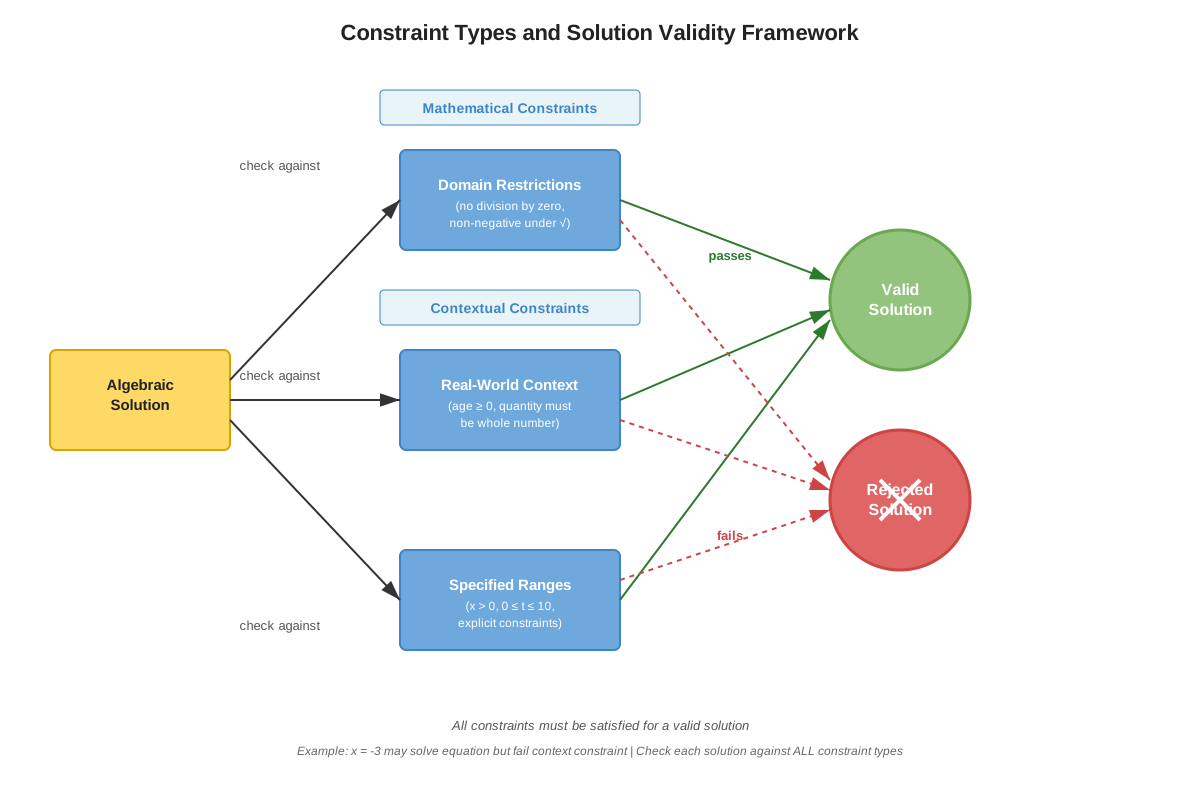
An equation constraint is any condition that limits the possible values a variable can take or restricts which solutions to an equation are valid. Constraints arise from two primary sources: mathematical necessity (such as avoiding division by zero) and contextual requirements (such as real-world limitations). When solving equations with constraints, students must complete two distinct steps: first, solve the equation algebraically to find all mathematical solutions; second, test each solution against the constraints to determine which are actually valid.
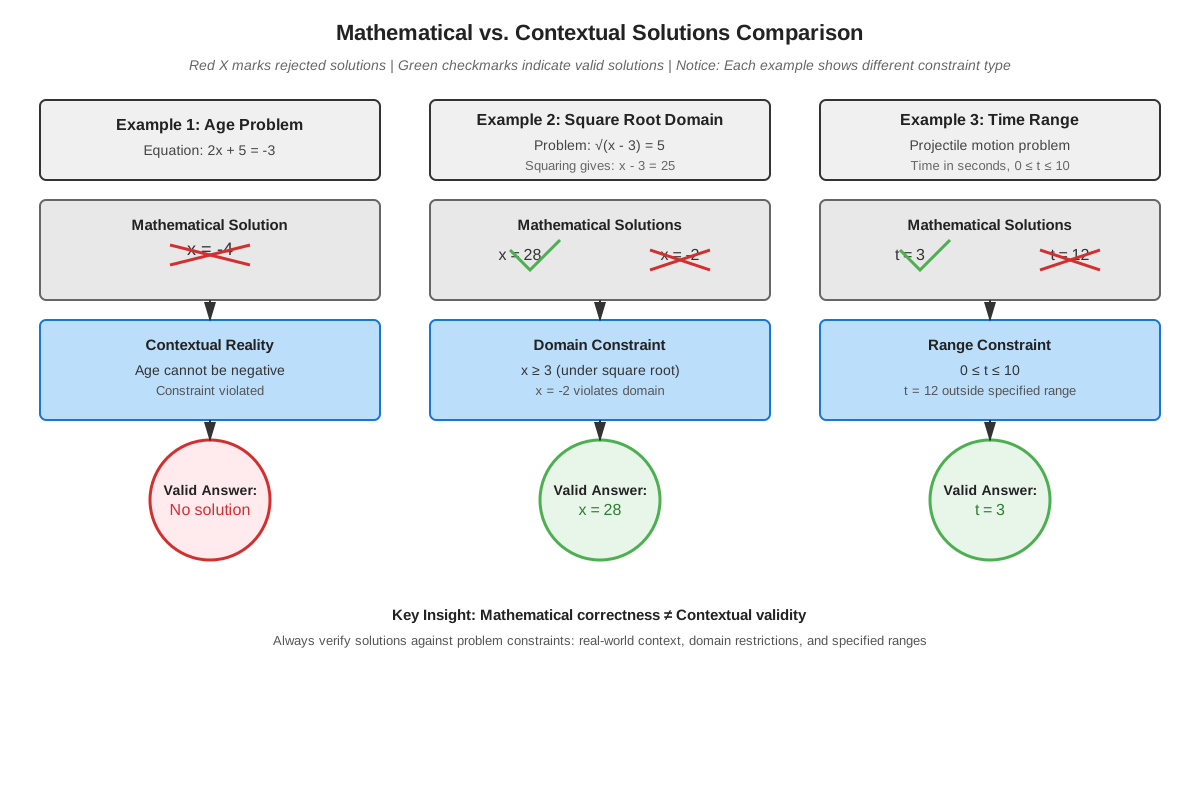
Constraints fundamentally change the solution process from purely mechanical to analytical. A student might correctly solve an equation and arrive at x = -3, but if the problem states that x represents the number of hours worked, this solution must be rejected because negative time is meaningless in context. This two-stage thinking—solve, then validate—distinguishes constraint problems from standard equation-solving.
Types of Constraints
Mathematical constraints emerge from the structure of equations themselves. The most common mathematical constraint involves rational expressions where denominators cannot equal zero. For example, in the equation 1/(x-2) = 3, the solution x = 2 would be excluded even before solving because it makes the denominator zero. Similarly, square root expressions require non-negative radicands in the real number system: √(x-5) requires x ≥ 5.
Contextual constraints arise from the real-world situation an equation models. These include:
- Non-negativity constraints (quantities like distance, time, or count cannot be negative)
- Integer constraints (you cannot have 2.7 people or 3.5 cars)
- Upper bound constraints (a container can hold at most a certain volume)
- Lower bound constraints (a minimum purchase requirement)
- Logical constraints (a person's age cannot exceed their parent's age by more than a generation)
Identifying Constraints in Problems
Recognizing constraints requires careful reading and interpretation. Explicit constraints are directly stated: "where x > 0" or "for all positive integers n." Implicit constraints require inference from context. When a problem discusses "the number of students in a class," students should automatically recognize that the answer must be a non-negative integer, even if not explicitly stated.
Key phrases that signal constraints include:
- "at least" or "at most" (inequality constraints)
- "positive," "negative," or "non-negative" (sign constraints)
- "whole number" or "integer" (discrete constraints)
- "real solution" or "real value" (excludes complex numbers)
- Contextual nouns like "age," "distance," "population," "price" (imply non-negativity)
Solving Equations with Constraints
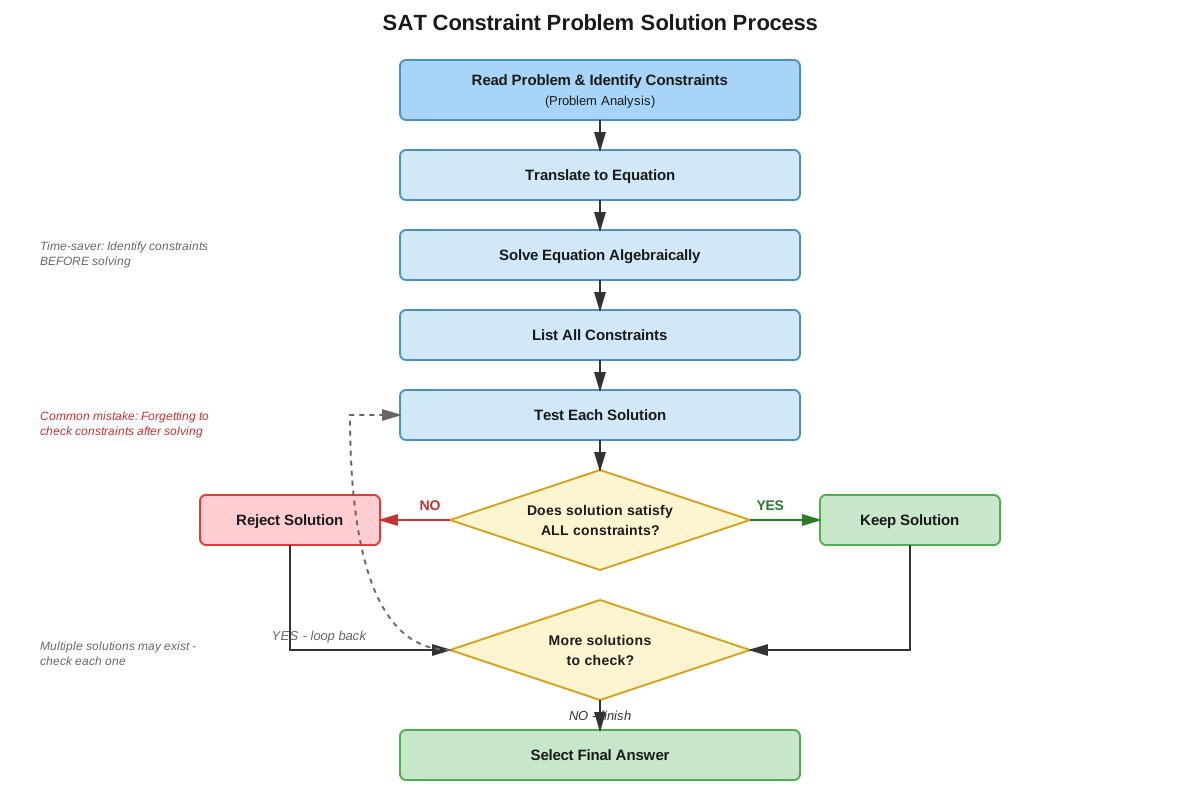
The systematic approach to constraint problems follows this sequence:
- Identify all constraints before solving (read the problem completely, note explicit restrictions, infer implicit ones from context)
- Solve the equation algebraically using standard techniques to find all mathematical solutions
- Test each solution against every constraint
- Eliminate invalid solutions that violate any constraint
- Verify remaining solutions by substituting back into the original equation
Consider the equation: 2x + 5 = 17, where x represents the number of books purchased. Solving algebraically gives x = 6. Testing against the implicit constraint (x must be a non-negative integer), we confirm x = 6 is valid. However, if the equation yielded x = 6.5, we would need to reconsider whether the problem allows fractional books or if we made an error.
Domain Restrictions
Domain restrictions are constraints on the input values (x-values) that make an expression undefined or invalid. The most critical domain restrictions on the SAT involve:
| Expression Type | Restriction | Reason |
|---|---|---|
| Rational (fraction) | Denominator ≠ 0 | Division by zero is undefined |
| Even root | Radicand ≥ 0 | Even roots of negative numbers aren't real |
| Logarithm | Argument > 0 | Logarithms of non-positive numbers are undefined |
For example, in f(x) = (x+3)/(x²-4), the domain excludes x = 2 and x = -2 because these values make the denominator zero. If solving an equation involving this function yields x = 2 as a solution, it must be rejected as extraneous.
Extraneous Solutions
An extraneous solution is a value that emerges from the algebraic solving process but does not satisfy the original equation or its constraints. These commonly arise when:
- Squaring both sides of an equation (introduces solutions to the squared equation that don't satisfy the original)
- Multiplying by a variable expression (may introduce solutions where that expression equals zero)
- Solving rational equations after clearing denominators (may introduce values that make original denominators zero)
Always verify solutions by substituting back into the original equation, not just the transformed version.
Concept Relationships
The core concepts within equation constraints form a logical hierarchy: Understanding equation constraints (the foundational concept) → leads to → Types of constraints (mathematical vs. contextual) → which requires → Identifying constraints in problems (recognition skills) → enabling → Solving equations with constraints (systematic process) → while avoiding → Extraneous solutions (validation step). Domain restrictions represent a specific, high-frequency type of mathematical constraint that deserves special attention.
This topic connects to prerequisite knowledge of basic equation solving by adding a critical validation layer. Students must first master solving equations mechanically before they can effectively evaluate whether solutions satisfy constraints. The topic also connects forward to systems of equations (where solutions must satisfy multiple constraints simultaneously), quadratic equations (which often produce two solutions requiring constraint evaluation), and function analysis (where domain and range are formalized constraint concepts).
The relationship between mathematical and contextual constraints is complementary: mathematical constraints are universal and equation-specific, while contextual constraints are problem-specific and require interpretation. Both must be checked independently, as a solution might satisfy mathematical constraints but violate contextual ones, or vice versa.
Quick check — test yourself on Equation constraints so far.
Try Flashcards →High-Yield Facts
⭐ Always check solutions against ALL constraints, both explicit and implicit, before selecting a final answer
⭐ Denominators in rational expressions can never equal zero; identify excluded values before solving
⭐ Context-based constraints (like "number of items") typically require non-negative integer solutions even when not explicitly stated
⭐ Squaring both sides of an equation can introduce extraneous solutions that must be verified
⭐ When a problem states "real solution" or "real value," exclude any complex or imaginary results
- Variables representing physical quantities (time, distance, mass, volume) cannot be negative in most contexts
- Integer constraints mean you may need to round or recognize that no exact solution exists within the constraint
- The phrase "for what value of x" often signals that only one solution will satisfy all constraints
- Domain restrictions should be identified before beginning algebraic manipulation
- Multiple-choice answers that are algebraically correct but violate constraints are common trap answers
Common Misconceptions
Misconception: All algebraic solutions to an equation are valid final answers. → Correction: Algebraic solutions must be tested against all constraints; solutions that violate constraints must be rejected even if mathematically correct.
Misconception: Constraints only matter in word problems with real-world contexts. → Correction: Mathematical constraints (like domain restrictions from denominators or radicals) apply to purely abstract equations and are equally important.
Misconception: If an equation produces x = -5 and the context requires positive values, the answer is x = 5. → Correction: Negative solutions cannot simply be made positive; if a solution violates constraints, it must be rejected entirely, and either another solution is valid or no solution exists.
Misconception: Checking the solution in the final transformed equation is sufficient verification. → Correction: Solutions must be verified in the original equation before any transformations, as algebraic operations can introduce extraneous solutions.
Misconception: Constraints are always explicitly stated in the problem. → Correction: Many constraints are implicit and must be inferred from context (e.g., "number of people" implies non-negative integers without explicit statement).
Misconception: If both solutions to a quadratic equation violate constraints, the answer should be the "closest" valid value. → Correction: If no solution satisfies all constraints, the correct answer is "no solution" or the problem may need re-examination for errors.
Worked Examples
Example 1: Rational Expression with Domain Restriction
Problem: Solve for x: (x+2)/(x-3) = 2, where x is a real number.
Solution:
Step 1: Identify constraints
The denominator (x-3) cannot equal zero, so x ≠ 3 is our constraint.
Step 2: Solve algebraically
Multiply both sides by (x-3):
x + 2 = 2(x - 3)
x + 2 = 2x - 6
2 + 6 = 2x - x
8 = x
Step 3: Test against constraints
Our solution is x = 8. Does x = 8 satisfy x ≠ 3? Yes, 8 ≠ 3.
Step 4: Verify in original equation
(8+2)/(8-3) = 10/5 = 2 ✓
Answer: x = 8
This example demonstrates the critical importance of identifying domain restrictions before solving. If the solution had been x = 3, we would need to reject it as extraneous, leaving no valid solution.
Example 2: Contextual Constraint Problem
Problem: Maria is selling tickets to a school play. Adult tickets cost $12 and student tickets cost $8. She sells tickets totaling $200. If she sold 10 adult tickets, how many student tickets did she sell?
Solution:
Step 1: Identify constraints
- Number of student tickets must be a non-negative integer (you cannot sell -5 tickets or 7.3 tickets)
- The context implies we're looking for a whole number of tickets
Step 2: Set up equation
Let s = number of student tickets
12(10) + 8s = 200
120 + 8s = 200
Step 3: Solve algebraically
8s = 80
s = 10
Step 4: Test against constraints
Is s = 10 a non-negative integer? Yes ✓
Step 5: Verify in context
10 adult tickets at $12 = $120
10 student tickets at $8 = $80
Total: $120 + $80 = $200 ✓
Answer: 10 student tickets
This example illustrates how contextual constraints (integer values, non-negativity) must be considered even when the algebraic solution naturally satisfies them. If the equation had yielded s = 10.5, we would recognize an error in the problem setup or our interpretation, as fractional tickets are impossible.
Exam Strategy
When approaching SAT questions involving equation constraints, follow this strategic process:
Before solving: Read the entire problem carefully, underlining or noting any explicit constraints ("where x > 0," "positive integer," "real solution"). Then, identify implicit constraints from context—if the variable represents something countable, physical, or bounded, note those restrictions.
Trigger words to watch for: "positive," "negative," "non-negative," "integer," "whole number," "real," "at least," "at most," "maximum," "minimum," "number of," "age," "distance," "time," "cost." Each of these signals a potential constraint that will eliminate some algebraic solutions.
Process of elimination: On multiple-choice questions, quickly eliminate answers that obviously violate constraints before doing detailed algebra. If the problem asks for a positive value, immediately eliminate negative options. If it requires an integer, eliminate decimals. This can reduce a 4-choice problem to 2 choices before calculation.
Two-pass approach: On difficult constraint problems, use a two-pass strategy. First pass: solve algebraically and identify all mathematical solutions. Second pass: systematically test each solution against every constraint, eliminating those that fail any test. This prevents the common error of stopping after finding one solution without checking if it's valid.
Time allocation: Constraint problems typically require 60-90 seconds—slightly longer than basic equation problems due to the verification step. Don't rush the constraint-checking phase; trap answers specifically target students who solve correctly but forget to validate.
Calculator usage: For problems with numerical constraints, use your calculator to verify solutions quickly, but don't rely on it to identify constraints—that requires careful reading and reasoning.
Memory Techniques
DIVE mnemonic for systematic constraint problem-solving:
- Determine all constraints (explicit and implicit)
- Isolate the variable (solve algebraically)
- Verify each solution against constraints
- Eliminate invalid solutions
"FRED" for common domain restrictions:
- Fractions: denominator ≠ 0
- Roots (even): radicand ≥ 0
- Exponents: base restrictions for certain operations
- Domain: check problem statement for explicit restrictions
Visualization strategy: Picture constraints as "gates" that solutions must pass through. Each constraint is a gate; only solutions that pass through ALL gates are valid. If a solution gets stopped at any gate, it's eliminated.
Context clue acronym "PINT" for implicit constraints:
- Physical quantities (distance, time, mass) → non-negative
- Integer contexts (people, items, tickets) → whole numbers
- Natural limits (percentages 0-100, probabilities 0-1) → bounded
- Time-based (age, duration) → non-negative, logical relationships
Summary
Equation constraints represent conditions that limit which solutions to an equation are valid, arising from either mathematical necessity (domain restrictions) or contextual requirements (real-world limitations). Mastering this topic requires a two-stage approach: first solving equations algebraically to find all mathematical solutions, then systematically testing each solution against all constraints to identify which are actually valid. The SAT frequently tests this concept by presenting algebraically correct answers that violate constraints as trap choices, making constraint recognition and verification essential skills. Students must develop the habit of identifying both explicit constraints (directly stated) and implicit constraints (inferred from context) before solving, then rigorously checking solutions before selecting final answers. Success with equation constraints demonstrates mathematical maturity beyond mechanical computation—the ability to reason about whether answers make logical and contextual sense, a skill that distinguishes high-scoring students.
Key Takeaways
- Equation constraints limit valid solutions through mathematical restrictions (domain) or contextual requirements (real-world logic)
- Always use a two-stage process: solve algebraically first, then validate against ALL constraints
- Identify both explicit constraints (stated) and implicit constraints (inferred from context like "number of items")
- Common mathematical constraints include denominators ≠ 0 and even roots requiring non-negative radicands
- Trap answers on the SAT are often algebraically correct but violate constraints—careful verification prevents these errors
- Context-based variables (time, distance, count, age) typically require non-negative values and often integers
- Extraneous solutions arise from algebraic operations like squaring; always verify in the original equation
Related Topics
Systems of Linear Equations: Building on single-equation constraints, systems require solutions that satisfy multiple equations simultaneously, with constraints applying across all equations. Mastering single-equation constraints prepares students for the more complex validation required in systems.
Quadratic Equations: Quadratics typically produce two solutions, making constraint evaluation even more critical. Students must test both solutions independently against all constraints, as one, both, or neither may be valid.
Inequalities: While equation constraints involve discrete valid/invalid determinations, inequalities represent continuous constraint conditions. Understanding equation constraints provides the logical foundation for inequality reasoning.
Functions and Domain/Range: Constraints formalize into domain (input restrictions) and range (output restrictions) in function notation. Mastering constraints in equations prepares students for formal function analysis.
Rational Expressions and Equations: These heavily feature domain restrictions from denominators, making constraint recognition essential for success with this advanced algebra topic.
Practice CTA
Now that you understand equation constraints thoroughly, it's time to cement your mastery through practice. Attempt the practice questions associated with this topic, focusing on identifying constraints before solving and verifying every solution against all restrictions. Use the flashcards to reinforce key concepts like domain restrictions and common constraint types. Remember: the difference between a good score and a great score often comes down to catching constraint violations that create trap answers. Your careful attention to this detail will pay dividends on test day. You've got this!
Sign up free to keep reading
Create a free AnvayaPrep account to finish this SAT guide on Equation constraints — plus flashcards and practice questions.