Overview
Rational expressions are algebraic fractions where both the numerator and denominator are polynomials. These expressions form a critical component of the SAT math section, appearing in multiple-choice and grid-in questions that test algebraic manipulation, simplification, and problem-solving skills. Understanding rational expressions requires fluency with factoring, polynomial operations, and the ability to recognize equivalent forms—skills that connect directly to equations, functions, and real-world modeling scenarios.
On the SAT, sat rational expressions questions typically assess whether students can simplify complex fractions, identify restrictions on variables, combine multiple rational expressions through addition or subtraction, and solve equations involving rational terms. These problems often appear in contexts requiring students to manipulate formulas, work with rates and proportions, or analyze function behavior. Mastery of rational expressions demonstrates algebraic maturity and prepares students for advanced topics in both the Heart of Algebra and Passport to Advanced Math content domains.
The importance of this topic extends beyond isolated calculation problems. Rational expressions connect to linear and quadratic equations, function analysis, and systems of equations. They provide the foundation for understanding asymptotic behavior in functions, working with inverse variation, and solving real-world problems involving rates, work, and mixture scenarios. Students who develop strong skills with rational expressions gain significant advantages across multiple SAT question types and build essential preparation for college-level mathematics.
Learning Objectives
- [ ] Identify key features of rational expressions, including restrictions on the domain
- [ ] Explain how rational expressions appears on the SAT, including common question formats and difficulty patterns
- [ ] Apply rational expressions to answer SAT-style questions involving simplification and manipulation
- [ ] Simplify complex rational expressions by factoring and canceling common factors
- [ ] Add, subtract, multiply, and divide rational expressions using appropriate algebraic techniques
- [ ] Determine excluded values and domain restrictions for rational expressions
- [ ] Recognize equivalent forms of rational expressions and select appropriate representations
Prerequisites
- Polynomial operations: Adding, subtracting, multiplying polynomials is essential for combining rational expressions and finding common denominators
- Factoring techniques: Factoring quadratics, difference of squares, and greatest common factors enables simplification of rational expressions
- Fraction arithmetic: Understanding how to add, subtract, multiply, and divide numerical fractions provides the conceptual foundation for algebraic fractions
- Solving linear and quadratic equations: These skills are necessary when rational expressions appear in equations requiring solution
- Function notation and evaluation: Rational expressions often appear as functions, requiring substitution and evaluation skills
Why This Topic Matters
Rational expressions model countless real-world phenomena where one quantity depends on another through division. Engineers use rational expressions to calculate electrical resistance in parallel circuits, economists employ them in cost-benefit analyses, and scientists apply them to concentration problems in chemistry. Understanding how to manipulate these expressions enables problem-solving across disciplines and provides essential preparation for calculus, where rational functions become central to limit analysis and integration techniques.
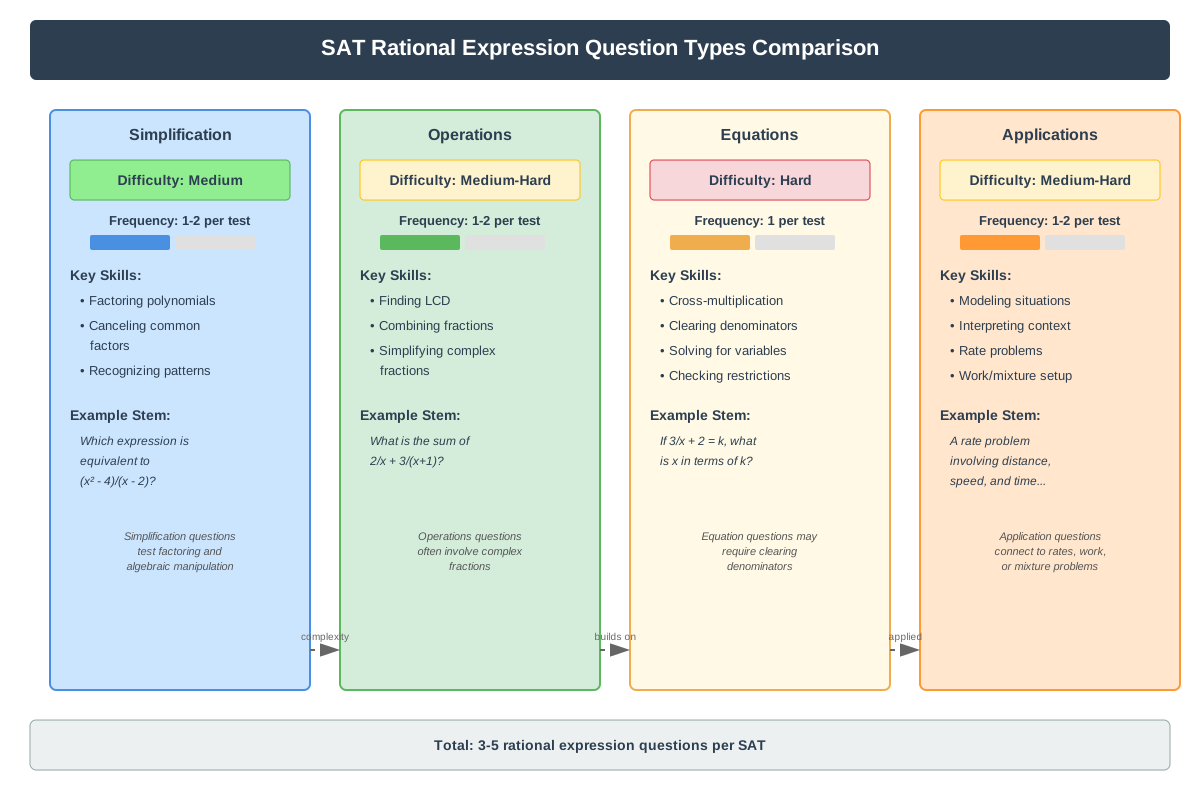
On the SAT, rational expressions appear in approximately 3-5 questions per test, representing roughly 5-8% of the math section. These questions span both calculator and no-calculator portions, with difficulty levels ranging from medium to hard. The College Board frequently tests rational expressions through:
- Simplification problems requiring factoring and cancellation
- Operations questions asking students to add, subtract, multiply, or divide rational expressions
- Equation-solving scenarios where rational expressions must be cleared or manipulated
- Word problems involving rates, work, or inverse variation that translate to rational expressions
- Function analysis questions examining behavior, domain restrictions, or equivalent forms
Questions involving rational expressions often serve as discriminators between mid-range and high-scoring students, making them particularly valuable for those targeting scores above 650 on the math section. The ability to quickly recognize factorable forms and execute algebraic manipulations efficiently can save crucial time on test day.
Core Concepts
Definition and Structure of Rational Expressions
A rational expression is a fraction where both the numerator and denominator are polynomials. The general form is:
f(x) = P(x)/Q(x)where P(x) and Q(x) are polynomials and Q(x) ≠ 0. Examples include:
- Simple:
(x + 3)/(x - 2) - Complex:
(x² - 4)/(x² + 5x + 6) - Compound:
[(2x + 1)/(x - 3)] / [(x + 4)/(x - 3)]
The key structural feature distinguishing rational expressions from other algebraic expressions is the presence of a variable in the denominator. This creates the possibility of undefined values, making domain analysis essential.
Domain Restrictions and Excluded Values
The domain of a rational expression consists of all real numbers except those that make the denominator equal to zero. To find excluded values:
- Set the denominator equal to zero
- Solve for the variable
- Exclude these values from the domain
For example, in (x + 5)/(x² - 9):
- Set denominator to zero: x² - 9 = 0
- Factor: (x + 3)(x - 3) = 0
- Excluded values: x = -3 and x = 3
- Domain: all real numbers except -3 and 3
SAT Tip: The test frequently asks about domain restrictions in multiple-choice format. Always check the denominator first, even if the question doesn't explicitly mention domain.
Simplifying Rational Expressions
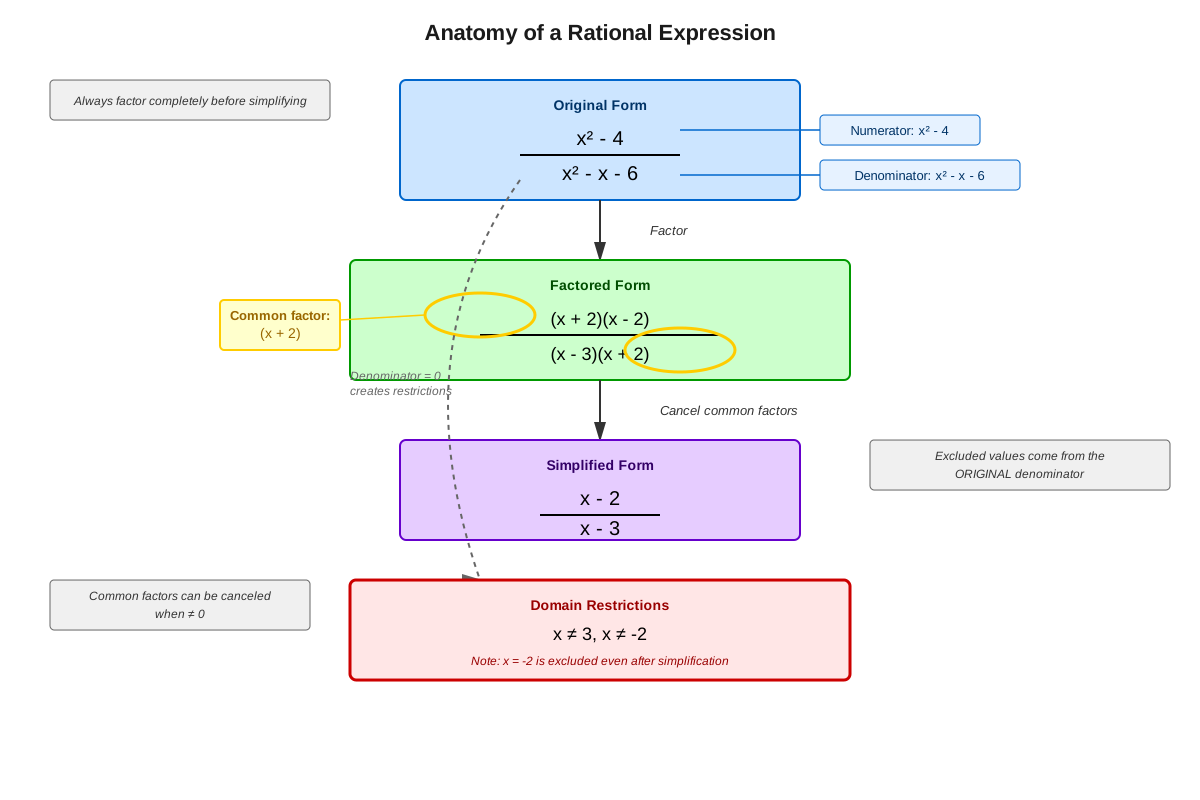
Simplification involves reducing a rational expression to its lowest terms by canceling common factors from the numerator and denominator. The process requires:
- Factor completely both numerator and denominator
- Identify common factors appearing in both
- Cancel the common factors (divide both by the common factor)
- State restrictions based on the original denominator
Example: Simplify (x² - 4)/(x² + 5x + 6)
Step 1: Factor numerator and denominator
- Numerator: x² - 4 = (x + 2)(x - 2)
- Denominator: x² + 5x + 6 = (x + 2)(x + 3)
Step 2: Expression becomes [(x + 2)(x - 2)]/[(x + 2)(x + 3)]
Step 3: Cancel (x + 2) from both: (x - 2)/(x + 3)
Step 4: Note that x ≠ -2 and x ≠ -3 (from original denominator)
Critical principle: Never cancel terms that are added or subtracted—only cancel factors that are multiplied.
Multiplying Rational Expressions
To multiply rational expressions, follow the same rules as multiplying numerical fractions:
- Factor all numerators and denominators completely
- Cancel any common factors across numerators and denominators
- Multiply remaining numerators together
- Multiply remaining denominators together
Example: [(x² - 1)/(x + 3)] × [(x + 3)/(x - 1)]
Factor: [(x + 1)(x - 1)/(x + 3)] × [(x + 3)/(x - 1)]
Cancel (x + 3) and (x - 1): Result = (x + 1)/1 = x + 1
Domain restrictions: x ≠ -3, x ≠ 1
Dividing Rational Expressions
Division of rational expressions uses the "multiply by the reciprocal" rule:
- Change division to multiplication
- Flip (take the reciprocal of) the second fraction
- Follow multiplication rules
Example: [(x + 2)/(x - 5)] ÷ [(x² - 4)/(x - 5)]
Rewrite: [(x + 2)/(x - 5)] × [(x - 5)/(x² - 4)]
Factor: [(x + 2)/(x - 5)] × [(x - 5)/((x + 2)(x - 2))]
Cancel: Result = 1/(x - 2)
Adding and Subtracting Rational Expressions
Adding or subtracting rational expressions requires a common denominator, just like numerical fractions:
When denominators are the same:
- Combine numerators directly
- Keep the common denominator
- Simplify if possible
Example: [3/(x + 1)] + [5/(x + 1)] = (3 + 5)/(x + 1) = 8/(x + 1)
When denominators are different:
- Factor all denominators
- Find the least common denominator (LCD) containing all unique factors
- Multiply each fraction by the appropriate form of 1 to create the LCD
- Combine numerators
- Simplify
Example: [2/(x - 3)] + [3/(x + 2)]
LCD = (x - 3)(x + 2)
Convert: [2(x + 2)]/[(x - 3)(x + 2)] + [3(x - 3)]/[(x - 3)(x + 2)]
Combine: [2(x + 2) + 3(x - 3)]/[(x - 3)(x + 2)]
Expand: [2x + 4 + 3x - 9]/[(x - 3)(x + 2)]
Simplify: (5x - 5)/[(x - 3)(x + 2)] or 5(x - 1)/[(x - 3)(x + 2)]
Complex Rational Expressions
A complex rational expression contains fractions within fractions. Two methods solve these:
Method 1: Multiply by the LCD of all small fractions
Example: [(1/x) + (1/y)] / [(1/x) - (1/y)]
LCD of small fractions = xy
Multiply top and bottom by xy:
- Numerator: xy(1/x) + xy(1/y) = y + x
- Denominator: xy(1/x) - xy(1/y) = y - x
- Result:
(x + y)/(y - x)
Method 2: Simplify numerator and denominator separately, then divide
This method works well when the numerator and denominator can be easily combined into single fractions.
Concept Relationships
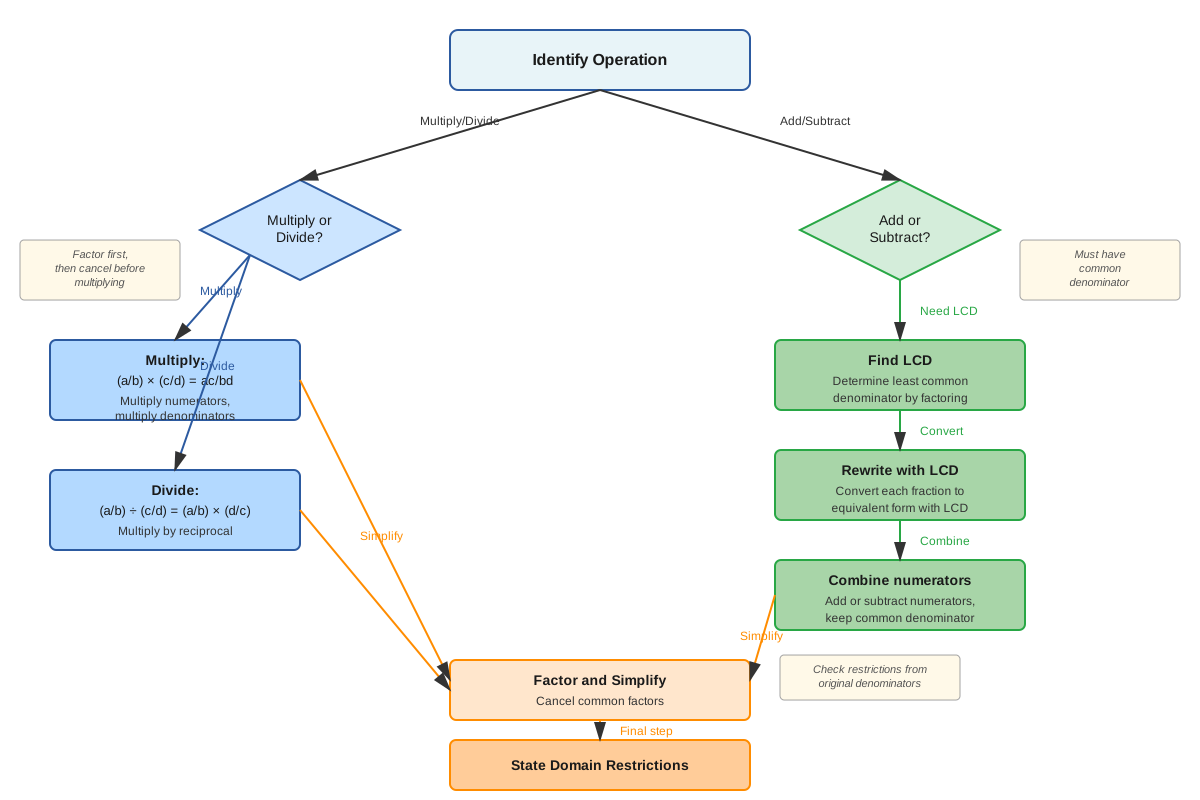
The concepts within rational expressions build hierarchically. Domain restrictions must be identified first, as they persist through all subsequent operations. Simplification depends on factoring skills and provides the foundation for all operations. Multiplication and division are simpler operations requiring only factoring and canceling, while addition and subtraction require the additional step of finding common denominators, making them more complex.
The relationship flow:
Domain Analysis → Factoring → Simplification → Operations (Multiply/Divide) → Operations (Add/Subtract) → Complex Expressions
Rational expressions connect to prerequisite topics through multiple pathways. Polynomial operations provide the mechanics for manipulating numerators and denominators. Factoring techniques enable simplification and finding common denominators. Fraction arithmetic supplies the conceptual framework that extends to algebraic fractions.
Looking forward, rational expressions connect to rational equations (where rational expressions are set equal to values), function analysis (rational functions and their graphs), and systems of equations (where rational expressions may appear in constraints). The domain restriction concept foreshadows asymptote analysis in function graphing and limit behavior in calculus.
Quick check — test yourself on Rational expressions so far.
Try Flashcards →High-Yield Facts
⭐ A rational expression is undefined when its denominator equals zero—always identify excluded values by setting the denominator to zero and solving.
⭐ Only factors can be canceled, never terms—you can cancel (x + 2) from numerator and denominator only if it's multiplied by everything else, not if it's added.
⭐ The LCD for adding/subtracting rational expressions must include all unique factors from each denominator, with each factor raised to its highest power.
⭐ When simplifying, factor completely first—partial factoring leads to missed cancellations and incorrect answers.
⭐ Domain restrictions come from the original denominator before simplification—even if a factor cancels, its restriction remains.
- To divide rational expressions, multiply by the reciprocal of the divisor (flip the second fraction and multiply).
- When multiplying rational expressions, factor everything first, then cancel before multiplying to avoid working with large polynomials.
- Complex rational expressions can be simplified by multiplying numerator and denominator by the LCD of all internal fractions.
- If a rational expression equals zero, the numerator must equal zero (while the denominator does not).
- Rational expressions with the same denominator can be combined by adding or subtracting numerators directly.
Common Misconceptions
Misconception: You can cancel terms that are added or subtracted.
Correction: Only factors (expressions that are multiplied) can be canceled. In (x + 3)/(x + 5), you cannot cancel the x's because they are terms, not factors. You can only cancel when expressions are multiplied, like canceling (x + 3) in [(x + 3)(x - 2)]/(x + 3).
Misconception: After simplifying a rational expression, the domain is determined by the simplified denominator.
Correction: Domain restrictions come from the original denominator before any simplification. If (x² - 4)/(x + 2) simplifies to (x - 2), the domain still excludes x = -2 from the original denominator, even though it doesn't appear in the simplified form.
Misconception: To add rational expressions, you add the numerators and add the denominators.
Correction: When adding rational expressions, you must find a common denominator first, then add only the numerators while keeping the common denominator. (a/b) + (c/d) = (ad + bc)/(bd), not (a + c)/(b + d).
Misconception: Any value can be substituted into a rational expression.
Correction: Values that make the denominator zero cannot be substituted and are excluded from the domain. Always check denominator restrictions before evaluating.
Misconception: Simplifying a rational expression changes its value.
Correction: Simplification creates an equivalent expression with the same value for all points in the domain. The expressions (x² - 4)/(x + 2) and (x - 2) have the same value for all x except x = -2, where the first is undefined.
Misconception: The LCD is always the product of all denominators.
Correction: The LCD is the smallest expression containing all factors from each denominator. For 1/(x - 2) and 1/((x - 2)(x + 3)), the LCD is (x - 2)(x + 3), not (x - 2)²(x + 3).
Worked Examples
Example 1: Simplification and Domain Analysis
Problem: Simplify (2x² - 8)/(x² + x - 6) and state all domain restrictions.
Solution:
Step 1: Identify domain restrictions from the original denominator.
Set denominator equal to zero: x² + x - 6 = 0
Factor: (x + 3)(x - 2) = 0
Excluded values: x = -3 and x = 2
Step 2: Factor the numerator.
2x² - 8 = 2(x² - 4) = 2(x + 2)(x - 2)
Step 3: Factor the denominator (already done).
x² + x - 6 = (x + 3)(x - 2)
Step 4: Write with factored forms.
[2(x + 2)(x - 2)]/[(x + 3)(x - 2)]
Step 5: Cancel common factors.
The factor (x - 2) appears in both numerator and denominator, so cancel it.
Step 6: Write simplified form.
[2(x + 2)]/(x + 3) or (2x + 4)/(x + 3)
Final Answer: (2x + 4)/(x + 3), where x ≠ -3 and x ≠ 2
Connection to Learning Objectives: This example demonstrates identifying key features (domain restrictions), applying simplification techniques, and recognizing that excluded values persist even after cancellation—a common SAT trap.
Example 2: Operations with Rational Expressions
Problem: Simplify [(x² - 9)/(x² + 2x)] ÷ [(x - 3)/(x)] + [2/(x + 2)]
Solution:
Step 1: Handle the division first (order of operations).
[(x² - 9)/(x² + 2x)] ÷ [(x - 3)/(x)]
Multiply by the reciprocal:
[(x² - 9)/(x² + 2x)] × [x/(x - 3)]
Step 2: Factor all expressions.
- x² - 9 = (x + 3)(x - 3)
- x² + 2x = x(x + 2)
Expression becomes:
[(x + 3)(x - 3)]/[x(x + 2)] × [x/(x - 3)]
Step 3: Cancel common factors.
Cancel x and (x - 3):
(x + 3)/(x + 2)
Step 4: Now add 2/(x + 2).
Both terms have denominator (x + 2), so add numerators:
[(x + 3) + 2]/(x + 2) = (x + 5)/(x + 2)
Final Answer: (x + 5)/(x + 2), where x ≠ 0, x ≠ -2, and x ≠ 3
Connection to Learning Objectives: This multi-step problem requires applying multiple operations with rational expressions, demonstrating the type of complex manipulation frequently tested on the SAT. It shows how division, factoring, cancellation, and addition combine in a single problem.
Exam Strategy
When approaching SAT questions involving rational expressions, use this systematic approach:
Step 1: Identify what the question asks—simplification, evaluation, domain restrictions, or operations. SAT questions often bury the actual task in word problems or complex setups.
Step 2: Check for domain restrictions immediately if the question involves evaluation or asks "for which values." Look for trigger phrases like "defined for all real numbers except" or "undefined when."
Step 3: Factor everything before attempting any operations. This single step prevents most errors and reveals cancellation opportunities that save time.
Step 4: Look for common SAT patterns:
- Difference of squares: x² - a² = (x + a)(x - a)
- Perfect square trinomials: x² + 2ax + a² = (x + a)²
- Simple trinomials: x² + bx + c factors to (x + m)(x + n) where m + n = b and mn = c
Trigger words and phrases to watch for:
- "Simplify" or "reduce" → Factor and cancel
- "Equivalent to" → Look for the same expression in different form
- "Undefined" or "not defined" → Set denominator equal to zero
- "Sum" or "difference" → Find common denominator
- "Product" or "quotient" → Factor first, then multiply or divide
Process of elimination tips:
- Eliminate answers with different domain restrictions than the original expression
- Eliminate answers that don't match when you substitute a simple test value (like x = 0 or x = 1, if allowed)
- Eliminate answers with different degrees in numerator or denominator after simplification
- Check if answer choices are already factored—this often reveals the expected form
Time allocation: Spend 30-45 seconds on simple simplification problems, up to 90 seconds on complex multi-step operations. If a problem requires more than 2 minutes, mark it and return later. Many students lose time on rational expression problems by attempting to expand everything rather than factoring strategically.
Power Strategy: When stuck, substitute a simple allowed value (like x = 1) into both the original expression and each answer choice. The correct answer must give the same numerical result.
Memory Techniques
FACTOR Acronym for Simplification:
- Find domain restrictions first
- Analyze numerator and denominator
- Completely factor both
- Take out common factors
- Observe what cancels
- Rewrite in simplest form
"Keep-Change-Flip" for Division: When dividing rational expressions, Keep the first fraction, Change division to multiplication, Flip the second fraction. This childhood mnemonic for numerical fractions works perfectly for algebraic fractions.
LCD Visualization: Picture the LCD as a "container" that must hold all the factors from each denominator. Each unique factor appears once, raised to its highest power among all denominators. Visualize stacking blocks where each denominator contributes its unique pieces.
"Zero Top, Undefined Bottom":
- If the top (numerator) equals zero and the bottom doesn't, the whole expression equals zero
- If the bottom (denominator) equals zero, the expression is undefined
- This rhyme helps remember when expressions equal zero versus when they're undefined
DADS for Operations:
- Division → multiply by reciprocal
- Addition → find common denominator
- Denominator restrictions → always check
- Simplify → factor and cancel
Summary
Rational expressions are algebraic fractions with polynomials in both numerator and denominator, forming a high-yield SAT topic that tests algebraic manipulation and conceptual understanding. Success requires mastering three core skills: identifying domain restrictions by finding values that make denominators zero, simplifying through complete factoring and strategic cancellation of common factors, and performing operations by applying fraction rules to algebraic expressions. The key principle underlying all work with rational expressions is that only factors can be canceled, never terms that are added or subtracted. Domain restrictions persist from the original denominator even after simplification, a concept the SAT frequently tests. Operations follow familiar fraction rules: multiply straight across after factoring and canceling, divide by multiplying by the reciprocal, and add or subtract by first finding a common denominator. Complex rational expressions simplify by multiplying by the LCD of all internal fractions. Students who develop systematic approaches—always factoring first, checking domains, and working methodically through operations—can efficiently handle even the most complex SAT rational expression problems.
Key Takeaways
- Rational expressions are fractions with polynomial numerators and denominators; they're undefined when the denominator equals zero
- Always identify domain restrictions first by setting the original denominator equal to zero and solving—these restrictions persist even after simplification
- Factor completely before attempting any operation; only factors (not terms) can be canceled between numerator and denominator
- Multiplication and division are simpler operations: factor, cancel, then multiply (or multiply by the reciprocal for division)
- Addition and subtraction require finding the LCD of all denominators, converting each fraction, then combining numerators
- Complex rational expressions simplify efficiently by multiplying both numerator and denominator by the LCD of all internal fractions
- SAT questions test simplification, operations, domain analysis, and recognition of equivalent forms—systematic factoring is the key to all of these
Related Topics
Rational Equations: Building on rational expressions, rational equations involve setting rational expressions equal to values or other expressions and solving for variables. Mastering rational expressions provides the manipulation skills needed to clear denominators and solve these equations efficiently.
Function Analysis and Graphing: Rational functions are functions defined by rational expressions. Understanding the algebraic properties of rational expressions enables analysis of asymptotes, discontinuities, and behavior of rational functions—topics that appear in advanced SAT problems.
Systems of Equations with Rational Expressions: More complex SAT problems may involve systems where one or more equations contain rational expressions, requiring both rational expression manipulation and system-solving techniques.
Polynomial Division: Long division and synthetic division of polynomials connect to rational expressions when dealing with improper rational expressions (where numerator degree ≥ denominator degree), enabling rewriting in mixed form.
Inverse Variation and Proportional Relationships: Many word problems involving rational expressions model inverse variation (y = k/x) or complex proportional relationships, connecting algebraic manipulation to real-world contexts.
Practice CTA
Now that you've mastered the core concepts of rational expressions, it's time to solidify your understanding through practice. Work through the practice questions to apply these techniques to SAT-style problems, and use the flashcards to reinforce key facts and procedures. Remember, rational expressions appear on every SAT, and the systematic approaches you've learned here will serve you across multiple questions. Each practice problem you complete builds the pattern recognition and algebraic fluency that separates good scores from great scores. You've got the tools—now put them to work!
Sign up free to keep reading
Create a free AnvayaPrep account to finish this SAT guide on Rational expressions — plus flashcards and practice questions.