Overview
Equation interpretation is a critical skill tested extensively on the SAT math section, requiring students to understand what equations represent in real-world contexts rather than simply solving them mechanically. This topic bridges the gap between abstract algebraic manipulation and practical problem-solving, asking students to analyze the meaning of variables, coefficients, constants, and operations within equations. On the SAT, equation interpretation questions typically present a linear equation modeling a real-world scenario and ask students to identify what specific components of the equation represent—such as initial values, rates of change, or relationships between quantities.
Mastering sat equation interpretation is essential because these questions appear frequently throughout the exam, often integrated with word problems, data analysis, and modeling scenarios. Unlike straightforward computational problems, interpretation questions assess deeper conceptual understanding: students must recognize that in an equation like y = 3x + 5, the coefficient 3 represents a rate of change, while the constant 5 represents an initial value or y-intercept. This skill is foundational for success not only on the SAT but also in higher-level mathematics and real-world applications where equations model phenomena like cost structures, population growth, or physical relationships.
Within the broader context of linear equations in one variable, equation interpretation serves as the conceptual framework that gives meaning to algebraic procedures. While solving equations focuses on finding unknown values, interpreting equations focuses on understanding what those values and the equation's structure represent. This topic connects directly to graphing linear functions, understanding slope and y-intercept, analyzing word problems, and working with formulas—all high-yield areas on the SAT. Students who excel at equation interpretation can quickly decode complex word problems and identify what the test is actually asking, giving them a significant strategic advantage.
Learning Objectives
- [ ] Identify key features of equation interpretation, including variables, coefficients, constants, and operations
- [ ] Explain how equation interpretation appears on the SAT, including common question formats and contexts
- [ ] Apply equation interpretation to answer SAT-style questions involving real-world scenarios
- [ ] Distinguish between different components of an equation and their contextual meanings
- [ ] Translate between verbal descriptions and algebraic representations
- [ ] Analyze equations to determine rates of change, initial values, and relationships between quantities
- [ ] Evaluate which equation component answers a specific interpretation question
Prerequisites
- Basic algebraic notation: Understanding variables, coefficients, and constants is essential for identifying what each component represents in context
- Linear equation structure: Familiarity with forms like y = mx + b enables recognition of slope and y-intercept meanings
- Word problem fundamentals: Ability to extract numerical information from text helps translate scenarios into equations
- Unit analysis: Understanding how units relate to quantities aids in determining what coefficients and variables represent
- Basic arithmetic operations: Knowing what addition, subtraction, multiplication, and division represent contextually is foundational
Why This Topic Matters
Equation interpretation appears in approximately 15-20% of SAT math questions, making it one of the highest-yield topics for test preparation. These questions assess whether students truly understand mathematical modeling rather than just performing rote calculations. In real-world applications, professionals in fields ranging from business to engineering must interpret equations daily—understanding that a coefficient represents a cost per unit, a constant represents a fixed fee, or a variable represents time elapsed.
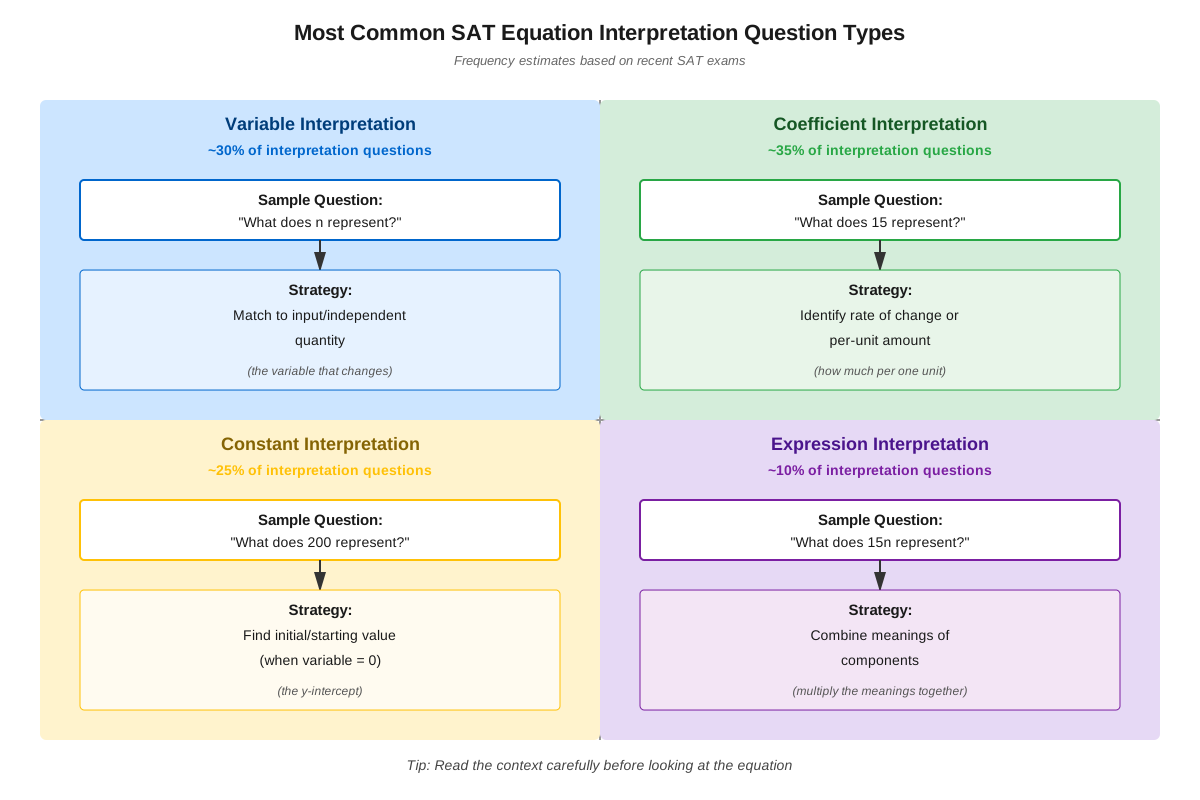
On the SAT, equation interpretation questions typically appear in several formats: multiple-choice questions asking "What does the number 5 represent in this equation?", questions requiring students to match equations to scenarios, and problems asking students to identify which equation component answers a specific question about the context. These questions often integrate with other topics like systems of equations, functions, and data analysis, making interpretation skills essential across multiple question types.
Common SAT contexts include cost scenarios (fixed costs plus variable costs), distance-rate-time problems, population or quantity changes over time, conversion between units, and scientific relationships. The College Board specifically designs these questions to test conceptual understanding rather than computational ability, meaning students cannot simply "plug and chug" their way to correct answers. Strong interpretation skills allow students to work more efficiently, eliminate incorrect answers quickly, and avoid common traps designed to catch those who don't fully understand what equations represent.
Core Concepts
Understanding Equation Components
Every equation consists of distinct components, each with potential meaning in context. Variables represent quantities that can change or that we're trying to find. In a real-world scenario, variables typically represent measurable quantities like time, distance, cost, number of items, or population. The choice of variable letter often (but not always) relates to the quantity: t for time, d for distance, C for cost, n for number.
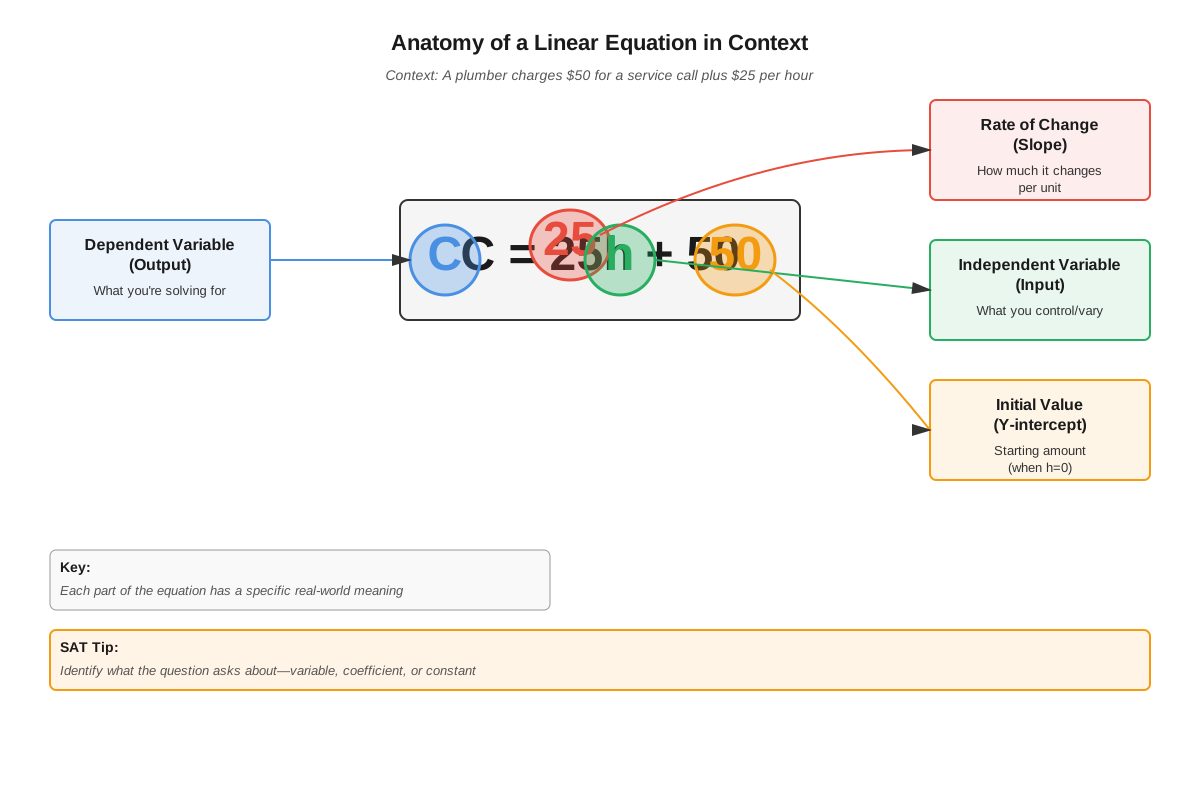
Coefficients are numbers multiplied by variables and typically represent rates of change, unit prices, or conversion factors. In the equation C = 15n + 20, the coefficient 15 represents the rate at which cost changes per unit of n. If n represents the number of hours, then 15 represents dollars per hour. Coefficients answer questions about "how much per" or "rate of change."
Constants are standalone numbers not attached to variables. They typically represent initial values, fixed amounts, starting points, or y-intercepts. In C = 15n + 20, the constant 20 represents a fixed cost that doesn't change regardless of n's value—perhaps a membership fee or initial charge. Constants answer questions about starting values or amounts that remain the same.
Operations (addition, subtraction, multiplication, division) indicate relationships between quantities. Addition often represents combining amounts or adding to an initial value. Subtraction represents decreasing amounts or finding differences. Multiplication represents repeated addition or scaling. Division represents splitting or finding unit rates.
Linear Equation Forms and Their Meanings
The most common form for interpretation questions is slope-intercept form: y = mx + b. In this form:
- m (the coefficient of x) represents the slope or rate of change
- b (the constant term) represents the y-intercept or initial value when x = 0
- x represents the independent variable (often time or quantity)
- y represents the dependent variable (the quantity that changes based on x)
Consider the equation T = 2.5h + 15, where T represents total cost in dollars and h represents hours worked. Here, 2.5 represents the rate of $2.50 per hour, and 15 represents a $15 initial fee. If asked "What does 2.5 represent?", the answer would be "the cost per hour" or "the rate of change of cost with respect to hours."
Another common form is direct variation: y = kx (no constant term). This indicates that y is directly proportional to x, with k as the constant of proportionality. When x = 0, y = 0, meaning there's no initial value—the relationship passes through the origin.
Context-Specific Interpretation Patterns
Different real-world contexts follow predictable patterns that help with interpretation:
Cost Scenarios: Equations typically take the form Total Cost = (Unit Price)(Quantity) + Fixed Cost. The coefficient represents price per item, and the constant represents fees, membership costs, or delivery charges.
Distance-Rate-Time: Equations follow Distance = Rate × Time or variations. The coefficient of time represents speed or velocity. A constant might represent initial distance from a reference point.
Population/Quantity Change: Equations model growth or decay, such as P = P₀ + rt, where P₀ is initial population, r is rate of change per time unit, and t is time elapsed.
Conversion Problems: Equations convert between units, like F = (9/5)C + 32 for Celsius to Fahrenheit. The coefficient (9/5) is the conversion factor, and the constant (32) adjusts for different zero points.
Identifying What a Question Asks
SAT interpretation questions use specific language patterns:
| Question Phrase | What to Identify |
|---|---|
| "What does [number] represent?" | The contextual meaning of that specific coefficient or constant |
| "What is the meaning of the [variable]?" | What quantity the variable measures and its units |
| "What does the [coefficient/constant] represent in terms of...?" | How that number relates to the specific context mentioned |
| "Which of the following best interprets...?" | The most accurate description of the component's meaning |
| "In the equation, what is the [quantity] per [unit]?" | The coefficient that represents that rate |
Working Backward from Context to Equation
Sometimes SAT questions provide a scenario and ask which equation correctly models it. To approach these:
- Identify the dependent variable (what's being calculated or predicted)
- Identify the independent variable (what changes or what we control)
- Determine the rate of change (how much the dependent variable changes per unit of independent variable)
- Identify any initial or fixed values (what happens when the independent variable is zero)
- Construct the equation following the pattern: Dependent = (Rate)(Independent) + Initial
For example: "A gym charges a $50 enrollment fee plus $30 per month. Which equation represents total cost C after m months?"
- Dependent variable: C (total cost)
- Independent variable: m (months)
- Rate: $30 per month (coefficient of m)
- Initial value: $50 (constant)
- Equation: C = 30m + 50
Concept Relationships
Equation interpretation serves as the conceptual foundation connecting multiple mathematical skills. The relationship flows as follows:
Word Problem Comprehension → Variable Assignment → Equation Construction → Equation Interpretation → Problem Solving
Understanding what variables represent enables proper equation setup, which then requires interpretation to verify correctness and answer questions about the model. This skill directly connects to graphing linear functions, where the coefficient becomes the slope (rise over run) and the constant becomes the y-intercept (where the line crosses the y-axis). The interpretation of slope as "rate of change" is identical whether viewing an equation algebraically or graphically.
Equation interpretation also connects to systems of equations, where students must understand what each equation represents to determine what the solution point means contextually. For example, if one equation represents cost for Company A and another for Company B, the intersection point represents when costs are equal.
The skill extends to function notation, where f(x) = mx + b requires interpreting what f(x) represents (the output or dependent variable) and what x represents (the input or independent variable). Understanding that f(5) means "the value of the function when x = 5" requires interpretation skills.
Finally, equation interpretation connects to data analysis and modeling, where students must determine whether an equation accurately represents a data set or real-world phenomenon. This requires understanding what each component should represent and whether the equation's structure matches the scenario's logic.
High-Yield Facts
⭐ In y = mx + b form, m always represents the rate of change or slope, while b represents the initial value or y-intercept
⭐ Coefficients typically represent "per unit" quantities: dollars per hour, miles per gallon, points per question
⭐ Constants typically represent fixed amounts, starting values, or fees that don't change with the variable
⭐ When a variable equals zero, the equation's value equals the constant term (this helps identify initial values)
⭐ The units of a coefficient come from dividing the dependent variable's units by the independent variable's units
- Variables represent measurable quantities that can change or that we're solving for
- Addition in equations typically represents combining quantities or adding to an initial amount
- Multiplication by a variable represents repeated addition or a rate relationship
- In cost equations, the form is typically: Total = (Unit Price)(Quantity) + Fixed Cost
- The coefficient's sign (positive or negative) indicates whether the relationship is increasing or decreasing
- When comparing two equations modeling similar scenarios, different coefficients indicate different rates
- Zero coefficients mean that variable has no effect on the outcome
- A coefficient of 1 means the quantities change at the same rate (one-to-one relationship)
- In conversion formulas, the coefficient converts between unit systems while the constant adjusts for different reference points
Quick check — test yourself on Equation interpretation so far.
Try Flashcards →Common Misconceptions
Misconception: The larger number in an equation is always more important or represents the main quantity.
Correction: The contextual meaning matters more than magnitude. A constant of 100 might be less significant than a coefficient of 5 if the variable takes large values. Always interpret based on what the component represents, not its size.
Misconception: Variables always represent the same quantities (x is always time, y is always cost).
Correction: Variables represent whatever the problem defines them to represent. Always read the problem carefully to understand what each variable means in that specific context. The same letter can represent different quantities in different problems.
Misconception: In y = mx + b, the b term is always positive.
Correction: The constant can be negative, representing scenarios like starting below zero, having a discount, or beginning below a reference point. For example, T = 3h - 10 might represent temperature starting at -10 degrees.
Misconception: Coefficients must be whole numbers.
Correction: Coefficients can be fractions, decimals, or even irrational numbers. A coefficient of 0.5 or 2/3 is perfectly valid and represents fractional rates of change.
Misconception: The equation form y = mx + b is the only way to represent linear relationships.
Correction: Linear equations can appear in many forms: ax + by = c (standard form), y - y₁ = m(x - x₁) (point-slope form), or y = k(x - h) + k (transformed form). Each form emphasizes different features, but all can be interpreted.
Misconception: If two equations have the same coefficient, they represent the same scenario.
Correction: The coefficient is only one component. Two equations like y = 3x + 5 and y = 3x + 10 have the same rate of change but different initial values, representing different scenarios entirely.
Misconception: Interpretation questions always ask about coefficients or constants.
Correction: Questions might ask about the meaning of variables, the significance of specific values of variables, what happens when a variable equals a certain number, or the meaning of the entire equation.
Worked Examples
Example 1: Cost Scenario Interpretation
Problem: A phone company charges customers according to the equation C = 0.15m + 25, where C represents the total monthly cost in dollars and m represents the number of minutes used.
a) What does 0.15 represent in this equation?
b) What does 25 represent in this equation?
c) What would be the cost for a month with 0 minutes used?
d) If the company changes its plan to C = 0.10m + 30, what changed about the pricing structure?
Solution:
a) The coefficient 0.15 is multiplied by m (minutes), so it represents the rate of change of cost with respect to minutes. Specifically, it means the company charges $0.15 per minute. The units confirm this: dollars divided by minutes gives dollars per minute.
b) The constant 25 is not multiplied by any variable, so it represents a fixed amount. When m = 0 (no minutes used), C = 0.15(0) + 25 = 25. This means $25 is the base monthly fee or fixed charge regardless of usage.
c) Substituting m = 0: C = 0.15(0) + 25 = $25. This confirms that 25 represents the minimum monthly cost even with no usage.
d) Comparing C = 0.15m + 25 to C = 0.10m + 30:
- The coefficient decreased from 0.15 to 0.10, meaning the per-minute rate decreased from $0.15 to $0.10 per minute
- The constant increased from 25 to 30, meaning the fixed monthly fee increased from $25 to $30
- The new plan has a lower per-minute rate but higher base fee
Connection to Learning Objectives: This example demonstrates identifying key features (coefficients and constants), explaining their contextual meanings, and applying interpretation to compare scenarios—all core SAT skills.
Example 2: Temperature Conversion Interpretation
Problem: The equation F = (9/5)C + 32 converts temperature from Celsius (C) to Fahrenheit (F).
a) What does the coefficient 9/5 represent?
b) What does 32 represent in this context?
c) Why is there a constant term in this conversion but not in conversions like kilometers to miles?
d) If C = 0, what does F equal, and what does this tell us?
Solution:
a) The coefficient 9/5 (or 1.8) represents the conversion factor between Celsius and Fahrenheit scales. It tells us that one degree Celsius equals 1.8 degrees Fahrenheit in terms of scale intervals. This coefficient converts the size of the degree units between systems.
b) The constant 32 represents the offset between the two temperature scales' zero points. It accounts for the fact that 0°C (water's freezing point) equals 32°F, not 0°F. This is an adjustment factor, not a rate.
c) Conversions like kilometers to miles (m = 0.621k) have no constant term because both scales start at zero—zero kilometers equals zero miles. Temperature scales have different zero points: 0°C ≠ 0°F, so we need the constant to adjust for this difference. The constant represents the "starting point difference" between scales.
d) When C = 0: F = (9/5)(0) + 32 = 32°F. This tells us that the freezing point of water (0°C) corresponds to 32°F. The constant 32 specifically represents the Fahrenheit temperature that corresponds to 0°C.
Connection to Learning Objectives: This example shows how interpretation applies to scientific formulas, demonstrates why constants appear in some conversions but not others, and illustrates how setting variables to zero helps identify constant meanings—all valuable SAT strategies.
Exam Strategy
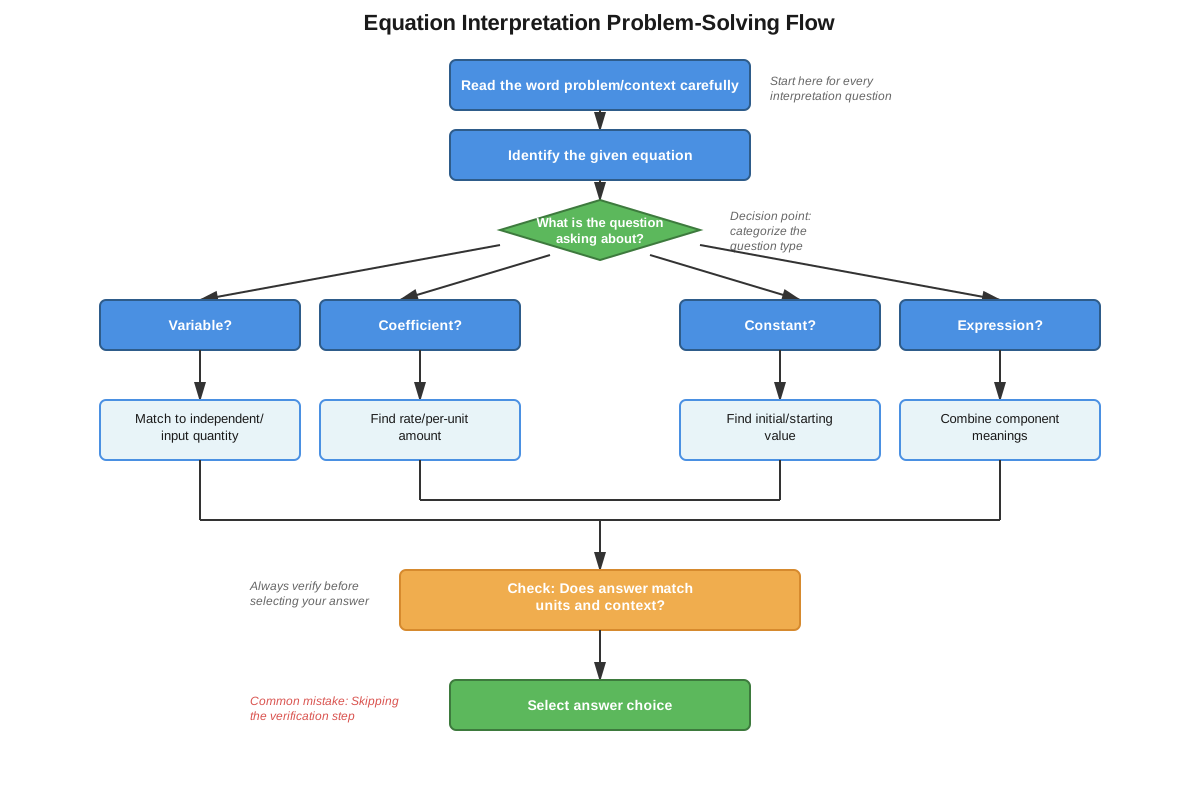
When approaching equation interpretation questions on the SAT, follow this systematic process:
Step 1: Read the context carefully before looking at the equation. Understand what real-world scenario is being modeled and what quantities are involved.
Step 2: Identify what each variable represents by reading the problem statement. The SAT always defines variables explicitly (e.g., "where t represents time in hours").
Step 3: Determine what the question asks. Are you identifying what a coefficient represents? A constant? A variable? The meaning of a specific value?
Step 4: Use the "zero test" to understand constants. Substitute zero for the independent variable to see what the equation equals—this reveals the constant's meaning as an initial or starting value.
Step 5: Check units to verify your interpretation. If the dependent variable is in dollars and the independent variable is in hours, the coefficient must be in dollars per hour.
Exam Tip: Trigger words like "initial," "starting," "base," or "fixed" indicate you should focus on the constant term. Words like "per," "each," "rate," or "every" indicate you should focus on the coefficient.
Process of Elimination Strategy:
- Eliminate answers that confuse coefficients with constants or vice versa
- Eliminate answers with incorrect units (e.g., if an answer says "dollars" when it should say "dollars per hour")
- Eliminate answers that describe the variable instead of the component asked about
- Eliminate answers that describe the wrong component (e.g., describing the coefficient when asked about the constant)
Time Allocation: Interpretation questions typically take 30-60 seconds once you understand the strategy. Don't spend time solving the equation unless specifically asked—these questions test understanding, not computation. If you find yourself calculating extensively, you're likely approaching the question incorrectly.
Common Trap Patterns: The SAT often includes wrong answers that describe related but incorrect components. For example, if asked "What does 5 represent in C = 5h + 20?", wrong answers might describe what 20 represents, what h represents, or what C represents. Always verify you're answering about the specific component mentioned.
Memory Techniques
Coefficient Mnemonic: "C-O-E-F" = "Change Over Each Factor"
Coefficients represent how much change occurs over each unit of the variable (rate of change).
Constant Mnemonic: "Constant = Consistent Start"
Constants represent values that stay consistent regardless of the variable—often starting or initial values.
Slope-Intercept Memory: "y = mx + b" → "y = (move)x + (begin)"
The coefficient m represents movement or rate of change; b represents where you begin (initial value).
Unit Analysis Visualization: Picture a fraction with the dependent variable's units on top and the independent variable's units on bottom. The coefficient must have these units.
Coefficient units = (Dependent Variable Units) / (Independent Variable Units)

Example: If C is in dollars and h is in hours
Coefficient units = dollars/hours = dollars per hour
Zero Test Acronym: "ZERO = Zero Exposes Real Origin"
Setting the independent variable to zero exposes the real origin or starting point (the constant).
Context Categories: Remember "CDPC" for common SAT contexts:
- Cost scenarios (fixed + variable costs)
- Distance problems (rate × time)
- Population/quantity change (initial + rate × time)
- Conversion formulas (factor × input + adjustment)
Summary
Equation interpretation is a fundamental SAT math skill requiring students to understand what equations represent contextually rather than merely solving them mechanically. The core principle involves recognizing that every component of an equation—variables, coefficients, constants, and operations—has specific meaning in real-world contexts. Coefficients typically represent rates of change or "per unit" quantities, answering questions about how much something changes per unit of the independent variable. Constants represent fixed amounts, initial values, or starting points that remain unchanged regardless of the variable's value. Variables represent measurable quantities that can change or that we're determining. Success on SAT interpretation questions requires reading contexts carefully, identifying what each component represents, using strategies like the "zero test" to understand constants, checking units to verify interpretations, and recognizing common patterns in cost scenarios, distance problems, population changes, and conversion formulas. These questions appear frequently on the SAT and test conceptual understanding rather than computational ability, making them high-yield for students who master the interpretation framework. Strong interpretation skills enable efficient problem-solving, quick elimination of incorrect answers, and deeper understanding of mathematical modeling.
Key Takeaways
- Coefficients represent rates of change: They tell you how much the dependent variable changes per unit of the independent variable (dollars per hour, miles per gallon, etc.)
- Constants represent initial or fixed values: They indicate starting points, base fees, or amounts that don't change with the variable
- The "zero test" reveals constant meaning: Substitute zero for the independent variable to see what the constant represents as an initial value
- Units confirm interpretations: The coefficient's units equal the dependent variable's units divided by the independent variable's units
- Context patterns are predictable: Cost scenarios follow Total = (Unit Price)(Quantity) + Fixed Cost; distance follows Distance = Rate × Time
- Read what the question asks: SAT questions specifically ask about particular components—don't confuse coefficients with constants or variables
- Interpretation requires no calculation: These questions test understanding, not computational ability; if you're doing extensive math, reconsider your approach
Related Topics
Graphing Linear Equations: Equation interpretation connects directly to graphing, where coefficients become slopes and constants become y-intercepts. Understanding interpretation enhances graph analysis skills.
Systems of Linear Equations: Interpreting what each equation in a system represents helps determine what the solution point means contextually—essential for word problems involving two scenarios.
Functions and Function Notation: Interpreting f(x) = mx + b requires the same skills as interpreting y = mx + b, extending interpretation to function contexts.
Linear Inequalities: Interpreting inequalities builds on equation interpretation, adding understanding of boundary conditions and solution regions.
Quadratic and Exponential Models: While this guide focuses on linear interpretation, the same principles extend to more complex functions where coefficients and constants have specific contextual meanings.
Practice CTA
Now that you've mastered the core concepts of equation interpretation, it's time to solidify your understanding through practice. Attempt the practice questions designed specifically for this topic—they'll challenge you to apply these interpretation strategies to realistic SAT scenarios. Use the flashcards to reinforce key definitions and patterns until identifying coefficients, constants, and their meanings becomes automatic. Remember: equation interpretation is one of the highest-yield topics on the SAT, and every minute spent practicing this skill directly translates to points on test day. You've built the foundation—now strengthen it through deliberate practice!
Sign up free to keep reading
Create a free AnvayaPrep account to finish this SAT guide on Equation interpretation — plus flashcards and practice questions.