Overview
Function notation is a fundamental mathematical language that allows us to express relationships between variables in a clear, standardized format. On the SAT, function notation appears in approximately 10-15% of all math questions, making it one of the most frequently tested concepts in the exam's algebra and problem-solving domains. Rather than writing equations in the traditional y = mx + b format, function notation uses symbols like f(x), g(t), or h(n) to represent the output of a function for any given input.
Understanding sat function notation is critical because it serves as the foundation for interpreting complex mathematical relationships, evaluating expressions, and solving multi-step problems efficiently. The SAT tests function notation not just in isolation, but integrated with other concepts including linear functions, quadratic functions, systems of equations, and real-world modeling scenarios. Students who master function notation gain a significant advantage because they can quickly decode what questions are asking and translate between different mathematical representations.
This topic connects directly to broader mathematical reasoning skills that appear throughout the SAT Math section. Function notation provides the language for describing transformations, compositions, and inverse relationships—all concepts that appear regularly on the exam. Moreover, the ability to evaluate functions, interpret function values in context, and manipulate function expressions is essential for tackling the most challenging problems in both the calculator and no-calculator portions of the test.
Learning Objectives
- [ ] Identify key features of Function notation
- [ ] Explain how Function notation appears on the SAT
- [ ] Apply Function notation to answer SAT-style questions
- [ ] Evaluate functions for specific input values, including numerical and algebraic expressions
- [ ] Interpret the meaning of function notation in real-world contexts and word problems
- [ ] Determine input values when given specific output values (inverse operations)
- [ ] Compose functions and evaluate nested function expressions
Prerequisites
- Basic algebraic manipulation: Students must be able to substitute values into expressions and simplify using order of operations, as function evaluation requires these fundamental skills
- Understanding of variables: Recognizing that variables represent unknown or changing quantities is essential for interpreting what f(x) means
- Coordinate plane familiarity: Functions can be represented graphically, so understanding ordered pairs (x, y) helps connect function notation to visual representations
- Linear equations: Since function notation often appears with linear relationships, comfort with slope, y-intercepts, and solving linear equations provides necessary context
Why This Topic Matters
Function notation is the universal language of mathematical relationships, appearing not only throughout higher mathematics but also in real-world applications across science, economics, engineering, and data analysis. When scientists model population growth, economists predict market trends, or engineers calculate stress on materials, they use function notation to express these relationships precisely and efficiently.
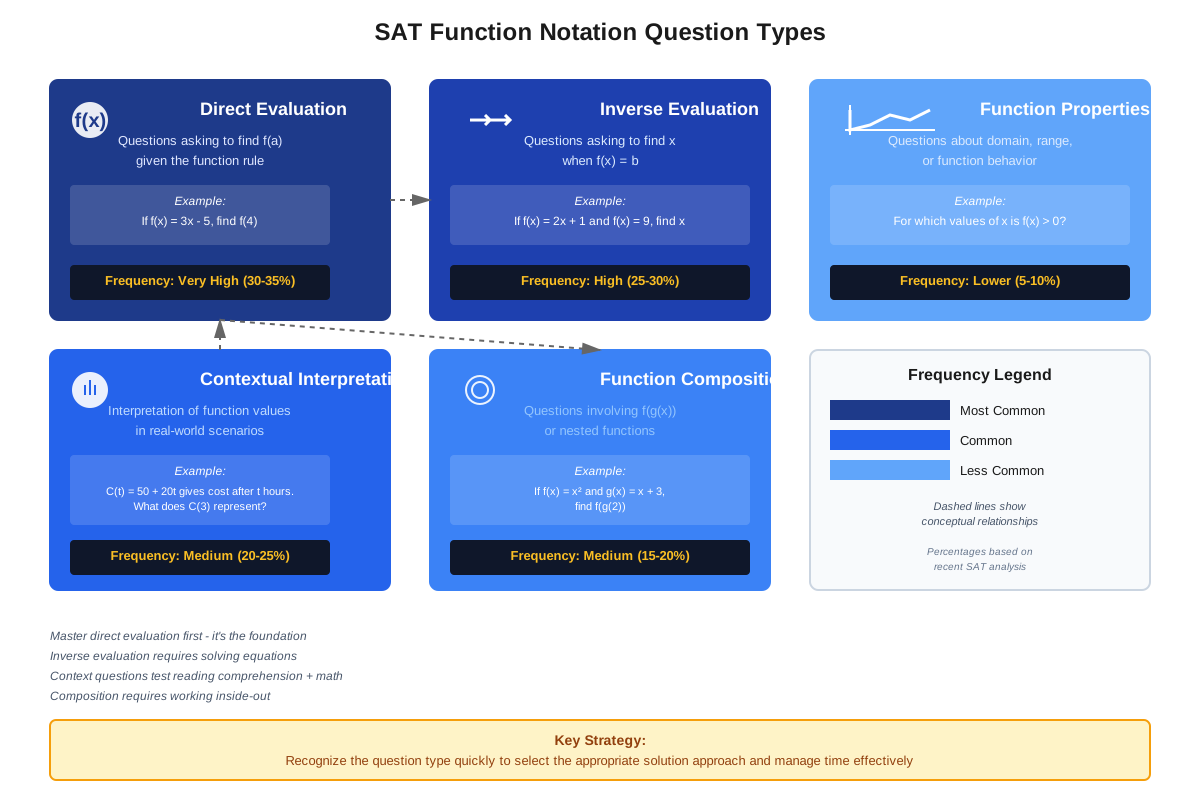
On the SAT specifically, function notation questions appear in multiple forms across both the calculator and no-calculator sections. Research on SAT question distribution shows that approximately 3-5 questions per test directly involve function notation, with many additional questions incorporating it indirectly. These questions typically fall into several categories: direct evaluation (finding f(3) when given a function rule), inverse evaluation (finding x when f(x) = 7), contextual interpretation (understanding what f(10) = 250 means in a word problem), and function composition (evaluating f(g(x))).
The College Board consistently includes function notation in medium-to-hard difficulty questions because it efficiently tests multiple skills simultaneously: reading comprehension, algebraic manipulation, logical reasoning, and attention to detail. Questions often embed function notation within real-world scenarios—such as modeling the cost of a taxi ride as a function of distance, or representing temperature as a function of time—requiring students to translate between mathematical symbols and practical meaning. Students who struggle with function notation often lose points not because they lack mathematical ability, but because they misinterpret what the notation is asking them to do.
Core Concepts
Understanding Function Notation Basics
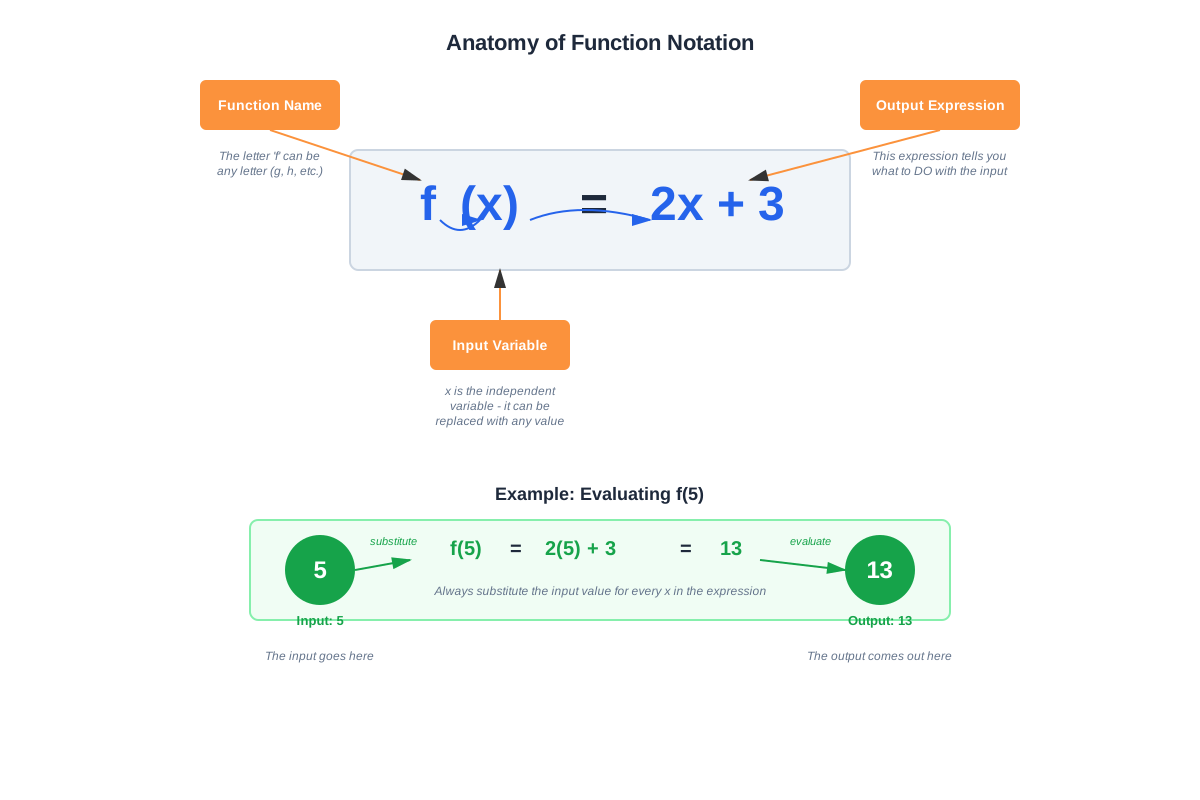
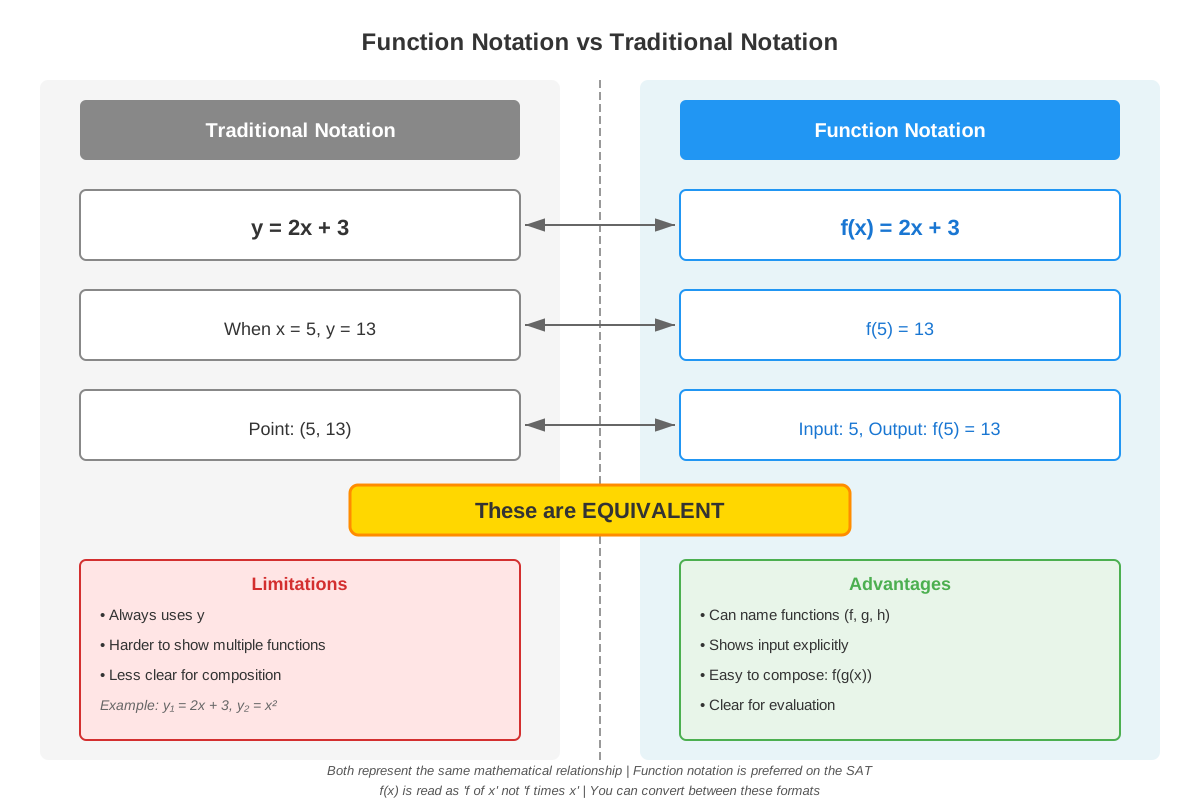
A function is a mathematical relationship where each input value corresponds to exactly one output value. Traditional equation notation writes this as y = 2x + 3, but function notation expresses the same relationship as f(x) = 2x + 3. The symbol f(x) is read as "f of x" and represents the output value when x is the input.
The letter f is simply a name for the function—like a label. Other common function names include g, h, C (for cost), P (for profit), or any letter that makes sense in context. The variable in parentheses (usually x) represents the input variable. Importantly, f(x) does NOT mean "f times x"—it's a single symbol representing the function's output.
Evaluating Functions
Function evaluation means finding the output when given a specific input. To evaluate f(x) = 2x + 3 at x = 5, substitute 5 everywhere x appears:
f(5) = 2(5) + 3 = 10 + 3 = 13The process follows these steps:
- Identify the function rule (the expression after the equals sign)
- Locate all instances of the input variable
- Replace each instance with the given input value
- Simplify using order of operations
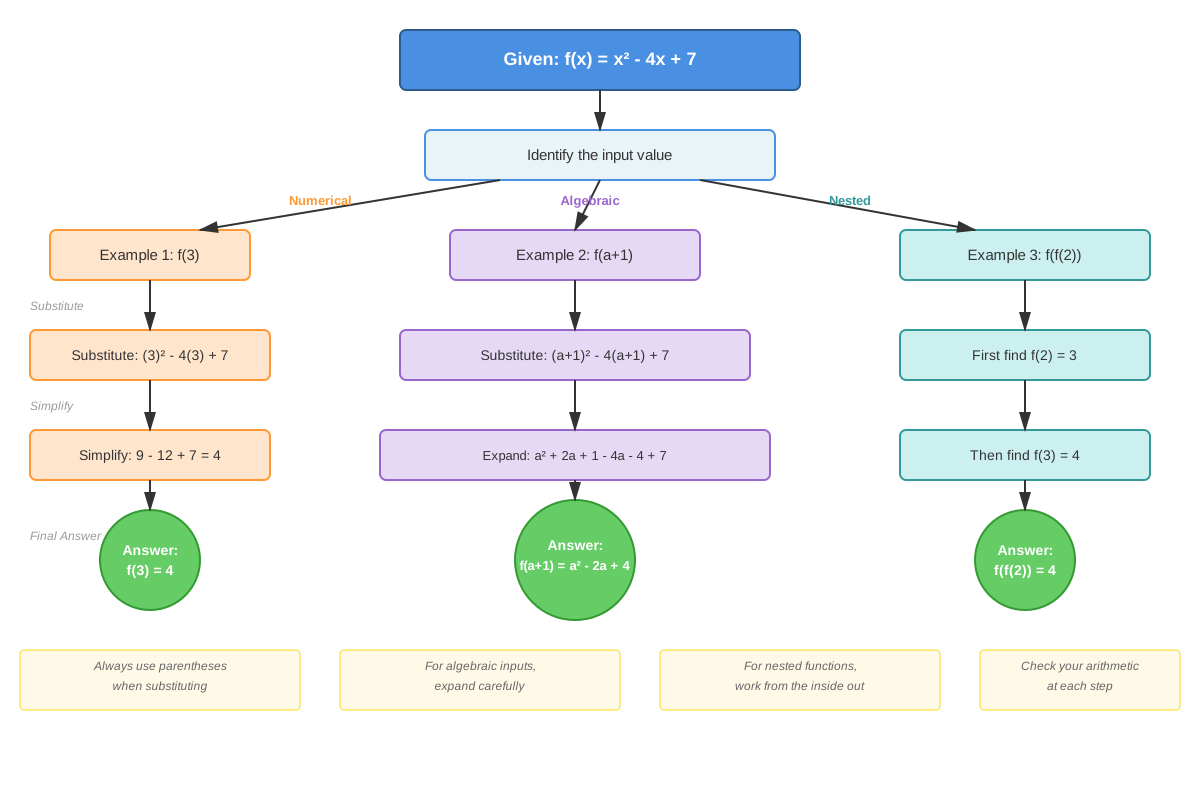
This works for any input, including negative numbers, fractions, or even algebraic expressions. For example, if f(x) = x² - 4x + 1, then:
f(-2) = (-2)² - 4(-2) + 1 = 4 + 8 + 1 = 13
f(a+1) = (a+1)² - 4(a+1) + 1 = a² + 2a + 1 - 4a - 4 + 1 = a² - 2a - 2
Multiple Functions and Function Families
SAT problems frequently present multiple functions simultaneously, such as f(x) = 3x - 2 and g(x) = x² + 5. Each function operates independently with its own rule. When asked to find f(4) and g(4), evaluate each separately:
f(4) = 3(4) - 2 = 10
g(4) = (4)² + 5 = 21
Different function names allow mathematicians to track multiple relationships in the same problem without confusion. This becomes especially important in function composition and systems involving multiple variables.
Finding Input Values (Inverse Operations)
While most function problems give an input and ask for the output, SAT questions often reverse this: given an output, find the input. If f(x) = 2x + 3 and f(x) = 11, solve for x:
2x + 3 = 11
2x = 8
x = 4
This requires treating the function notation as an equation and using algebraic solving techniques. The key insight is recognizing that f(x) represents a value (the output), so f(x) = 11 means "the output equals 11."
Function Notation in Context
The SAT frequently embeds function notation in real-world scenarios. A problem might state: "The cost C, in dollars, of renting a car for d days is given by C(d) = 45d + 25." Here, C(d) represents the total cost as a function of days rented. To find the cost for 3 days, evaluate C(3):
C(3) = 45(3) + 25 = 135 + 25 = 160The answer is $160. Understanding what the function represents—not just mechanically substituting—is crucial for interpreting results correctly.
Function Composition
Function composition occurs when one function's output becomes another function's input, written as f(g(x)) or (f ∘ g)(x). To evaluate f(g(3)) when f(x) = 2x + 1 and g(x) = x² - 4:
- Start with the innermost function: g(3) = (3)² - 4 = 9 - 4 = 5
- Use that result as input for the outer function: f(5) = 2(5) + 1 = 11
Therefore, f(g(3)) = 11. The order matters: f(g(x)) generally produces different results than g(f(x)).
Domain and Range Considerations
While the SAT rarely asks explicitly about domain and range using those terms, understanding what inputs are valid is important. For example, if h(x) = √(x - 3), only values where x ≥ 3 make sense (since you cannot take the square root of a negative number in the real number system). Questions might ask "For which value of x is h(x) undefined?" or present scenarios where certain inputs don't make practical sense.
Concept Relationships
Function notation serves as the connecting language between multiple mathematical concepts. At its foundation, function notation builds directly on algebraic expressions and variable substitution—the mechanical process of evaluating f(x) is simply substitution with a new notation system. This notation then enables more sophisticated concepts to be expressed clearly.
The relationship flow works as follows:
Variables and Expressions → Function Notation → Function Evaluation → Function Composition
Simultaneously, function notation connects horizontally to graphical representations: every point (x, y) on a function's graph can be written as (x, f(x)), where the y-coordinate is the function's output. This creates a bridge between algebraic and geometric thinking.
Function notation also enables the study of transformations. When comparing f(x) and f(x) + 3, the notation makes it clear that every output increases by 3, shifting the graph vertically. Similarly, f(x + 2) indicates a horizontal shift, concepts that appear frequently on the SAT.
Within the context of linear functions specifically, function notation provides a framework for expressing slope and intercepts: f(x) = mx + b clearly shows the rate of change (m) and initial value (b). This connects to systems of equations when multiple functions interact, and to modeling when functions represent real-world phenomena.
The inverse relationship between input and output—finding x when given f(x)—connects function notation to equation solving and prepares students for understanding inverse functions in more advanced mathematics.
Quick check — test yourself on Function notation so far.
Try Flashcards →High-Yield Facts
⭐ f(x) is read as "f of x" and represents the output value of function f when the input is x
⭐ To evaluate f(a), substitute the value a for every instance of x in the function rule
⭐ f(x) does NOT mean f multiplied by x; it is a single notation representing function output
⭐ When given f(x) = [some value], solve for x by treating it as an equation
⭐ In function composition f(g(x)), always evaluate the inner function g(x) first, then use that result as input for f
- Different function names (f, g, h, etc.) represent different relationships and have independent rules
- Function notation can represent any type of relationship: linear, quadratic, exponential, or more complex
- In context problems, the function name often relates to what it represents (C for cost, P for population, T for temperature)
- The variable in parentheses can be any letter; f(t), f(x), and f(n) all follow the same evaluation rules
- When evaluating f(expression), substitute the entire expression for the variable, using parentheses to maintain order of operations
- The domain of a function consists of all valid input values; the range consists of all possible output values
- On graphs, the x-coordinate represents the input and the y-coordinate represents f(x), the output
Common Misconceptions
Misconception: f(x) means f times x, so f(3) = 3f
Correction: Function notation is not multiplication. f(x) is a single symbol representing the output of function f for input x. If f(x) = 2x + 1, then f(3) = 2(3) + 1 = 7, not 3f.
Misconception: f(a + b) equals f(a) + f(b)
Correction: Functions do not distribute over addition. You must substitute the entire expression (a + b) into the function. If f(x) = x², then f(3 + 2) = f(5) = 25, which does not equal f(3) + f(2) = 9 + 4 = 13.
Misconception: All functions are linear, so f(x) always looks like mx + b
Correction: Functions can have any form—quadratic (f(x) = x²), exponential (f(x) = 2ˣ), rational (f(x) = 1/x), or more complex. The notation f(x) simply indicates a function relationship, not a specific type.
Misconception: In f(g(x)), you can evaluate f first or g first—the order doesn't matter
Correction: Function composition requires working from the inside out. Always evaluate the innermost function first. f(g(x)) means "apply g, then apply f to that result," which generally differs from g(f(x)).
Misconception: When solving f(x) = 5, the answer is x = 5
Correction: f(x) = 5 means the output equals 5, not the input. You must substitute the function rule and solve the resulting equation. If f(x) = 2x - 3, then 2x - 3 = 5, so 2x = 8, and x = 4.
Misconception: The letter f is special and always must be used for functions
Correction: Any letter can name a function. The SAT uses f, g, h, and context-specific letters (C for cost, d for distance, etc.). The letter is just a label; the notation and evaluation process remain the same.
Worked Examples
Example 1: Multi-Step Function Evaluation
Problem: If f(x) = 3x² - 2x + 5, find the value of f(-2) + f(1).
Solution:
Step 1: Evaluate f(-2) by substituting -2 for every x in the function rule.
f(-2) = 3(-2)² - 2(-2) + 5
f(-2) = 3(4) + 4 + 5
f(-2) = 12 + 4 + 5 = 21
Step 2: Evaluate f(1) by substituting 1 for every x.
f(1) = 3(1)² - 2(1) + 5
f(1) = 3(1) - 2 + 5
f(1) = 3 - 2 + 5 = 6
Step 3: Add the two results.
f(-2) + f(1) = 21 + 6 = 27Answer: 27
Connection to Learning Objectives: This problem demonstrates the core skill of function evaluation with multiple inputs, requiring careful substitution and order of operations—both high-yield SAT skills.
Example 2: Function Composition in Context
Problem: A company's revenue R, in thousands of dollars, depends on the number of units sold n according to R(n) = 5n - 2. The number of units sold depends on the advertising budget b, in hundreds of dollars, according to n(b) = 3b + 10. What is the company's revenue when the advertising budget is $400?
Solution:
Step 1: Identify what we're looking for. We need R when b = 4 (since b is in hundreds of dollars, $400 = 4 hundreds).
Step 2: Recognize this is function composition: R(n(b)). We need to find n(4) first.
n(4) = 3(4) + 10 = 12 + 10 = 22This means 22 units are sold when the advertising budget is $400.
Step 3: Now find R(22).
R(22) = 5(22) - 2 = 110 - 2 = 108Step 4: Interpret the result. Since R is in thousands of dollars, R(22) = 108 means $108,000.
Answer: $108,000
Connection to Learning Objectives: This problem combines function composition with contextual interpretation, demonstrating how the SAT tests function notation within real-world modeling scenarios. Students must track units, evaluate nested functions correctly, and interpret results in context.
Exam Strategy
When approaching SAT function notation questions, begin by identifying exactly what the question asks. Circle or underline key information: the function rule, the input value, and whether you're finding an output or an input. Many students lose points by solving for the wrong quantity.
Trigger words and phrases to watch for include:
- "Find f(3)" or "What is f(3)?" → Direct evaluation
- "If f(x) = 7, what is x?" → Solve for input
- "Find f(g(2))" or "What is the value of f(g(2))?" → Function composition
- "What does f(10) represent?" → Contextual interpretation
- "For what value of x is f(x) undefined?" → Domain restrictions
Use the substitution-in-parentheses strategy: When evaluating f(something), mentally or physically replace every x in the function rule with parentheses, then fill in those parentheses with "something." This prevents order-of-operations errors, especially with negative numbers or expressions.
For process of elimination on multiple-choice questions:
- Eliminate answers that ignore negative signs (common error with f(-2))
- Eliminate answers that treat f(x) as multiplication
- Check extreme cases: if asked for f(0), substitute 0 and eliminate answers that don't match
- For composition problems, eliminate answers that evaluate functions in the wrong order
Time allocation: Simple evaluation questions should take 30-45 seconds. Composition or context problems may require 60-90 seconds. If a problem takes longer, mark it and return after completing easier questions. Function notation problems often appear in the middle-to-end of sections, so don't let them consume disproportionate time early on.
Exam Tip: Always write out at least one substitution step, even if you can do it mentally. This prevents careless errors and provides a reference if you need to check your work.
Memory Techniques
FINE - Function Input Notation Evaluation
- Find the function rule
- Identify the input value
- Note all instances of the variable
- Evaluate by substituting and simplifying
"Parentheses Mean Substitute": Whenever you see f(something), think "substitute 'something' everywhere." This simple phrase reinforces the core operation.
Inside-Out for Composition: Remember function composition like getting dressed—you put on your shirt (inner function) before your jacket (outer function). Always work from the inside out: f(g(x)) means "g first, then f."
Visual Substitution Box: When evaluating f(x) = 2x² - 3x + 1 at x = -2, visualize or draw boxes:
f(☐) = 2(☐)² - 3(☐) + 1Then fill each box with -2, making it impossible to forget any instance.
Context Clue: In word problems, the function name usually hints at what it represents. C probably means cost, P means population or profit, T means temperature or time, d means distance. Use these associations to check if your answer makes practical sense.
Summary
Function notation is the mathematical language for expressing relationships between inputs and outputs, appearing in 10-15% of SAT Math questions across multiple difficulty levels. The notation f(x) represents the output of function f when x is the input, and evaluating functions requires substituting the input value for every instance of the variable in the function rule. The SAT tests function notation through direct evaluation (finding f(a) for a given value), inverse operations (finding x when f(x) equals a specific value), function composition (evaluating f(g(x)) by working inside-out), and contextual interpretation in word problems. Mastery requires understanding that f(x) is not multiplication, that functions don't distribute over addition, and that careful substitution with attention to negative signs and order of operations is essential. Success on function notation questions depends on identifying what the question asks, using systematic substitution strategies, and connecting symbolic manipulation to real-world meaning when problems involve context.
Key Takeaways
- Function notation f(x) represents output values; evaluate by substituting the input for every instance of the variable
- f(x) is NOT multiplication—it's a single symbol indicating the function's output for input x
- When solving f(x) = [value], treat it as an equation and solve for x using algebraic techniques
- Function composition f(g(x)) always evaluates inside-out: find g(x) first, then use that result as input for f
- Context problems require interpreting what the function represents and what units the answer should have
- Different function names (f, g, h, C, P) represent independent relationships with separate rules
- Careful attention to negative signs, parentheses, and order of operations prevents the most common errors
Related Topics
Quadratic Functions: Building on function notation, quadratic functions introduce f(x) = ax² + bx + c, requiring evaluation skills with squared terms and leading to concepts like vertex form and parabola properties.
Systems of Equations: When multiple functions interact (finding where f(x) = g(x)), function notation provides the framework for setting up and solving systems, a frequent SAT question type.
Function Transformations: Understanding how f(x) + k, f(x + h), and af(x) modify graphs requires solid function notation skills and appears regularly in coordinate geometry questions.
Exponential and Logarithmic Functions: These advanced function types use the same notation principles but with different rules, making function notation mastery essential for higher-level math.
Inverse Functions: The concept of "undoing" a function (finding f⁻¹(x)) builds directly on understanding the input-output relationship that function notation expresses.
Practice CTA
Now that you've mastered the fundamentals of function notation, it's time to cement your understanding through active practice. The concepts you've learned—evaluation, composition, and contextual interpretation—become automatic only through repeated application. Challenge yourself with the practice questions designed specifically to mirror SAT question types and difficulty levels. Use the flashcards to drill the high-yield facts until they become second nature. Remember: function notation appears on virtually every SAT, and the students who score highest are those who can evaluate functions quickly, accurately, and confidently under time pressure. Your investment in practice now will pay dividends on test day!
Sign up free to keep reading
Create a free AnvayaPrep account to finish this SAT guide on Function notation — plus flashcards and practice questions.