Overview
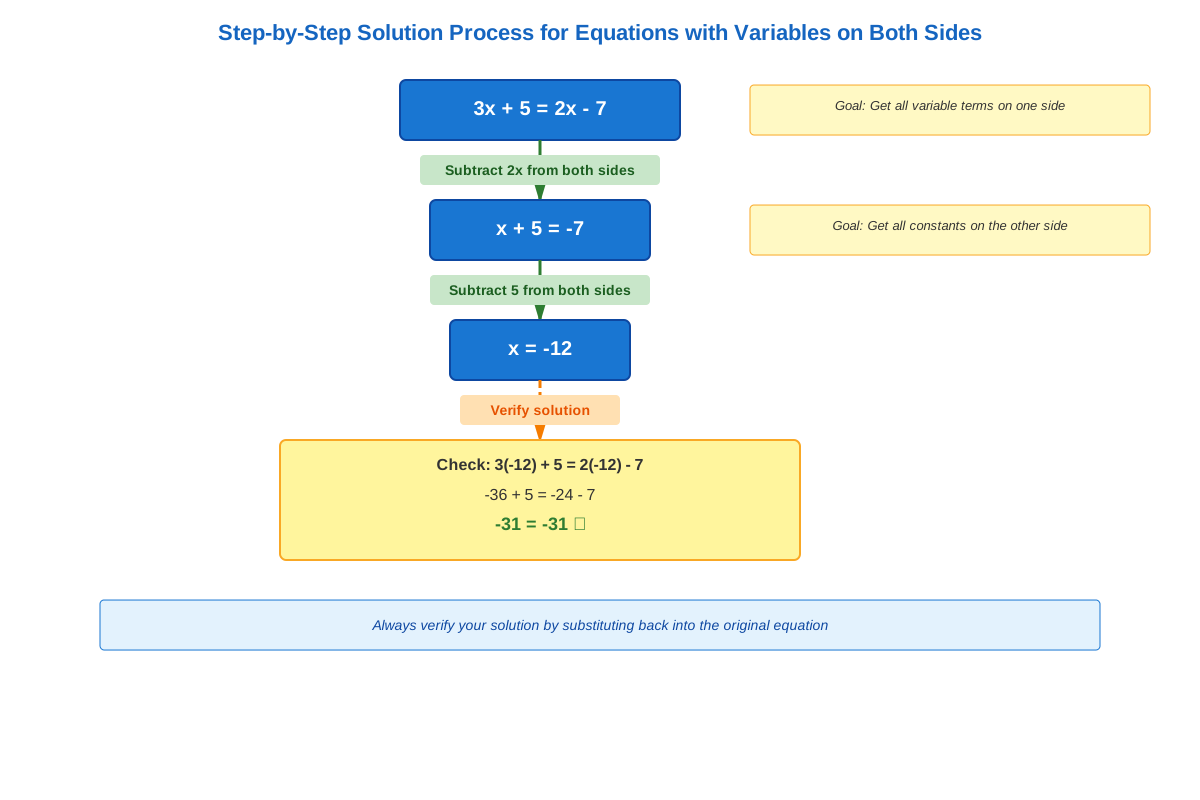
Equations with variables on both sides represent a fundamental algebraic skill that appears frequently on the SAT Math section. These equations require students to manipulate expressions where the unknown variable appears in terms on both the left and right sides of the equal sign, such as 3x + 5 = 2x - 7. Solving these equations demands a systematic approach: isolating the variable by strategically moving terms from one side to the other while maintaining equality through inverse operations.
This topic is essential for SAT success because it forms the foundation for more complex algebraic reasoning tested throughout the exam. Questions involving equations with variables on both sides appear in both the calculator and no-calculator sections, often embedded within word problems, systems of equations, or real-world application scenarios. Mastery of this concept directly impacts performance on approximately 15-20% of SAT Math questions, making it one of the highest-yield topics for focused study.
The relationship between this topic and broader math concepts is significant. Solving equations with variables on both sides builds upon basic equation-solving techniques while serving as a gateway to understanding linear functions, systems of equations, and algebraic modeling. This skill integrates properties of equality, distributive property, combining like terms, and fraction operations—all critical components of the SAT Math curriculum. Students who develop fluency with these equations gain confidence tackling multi-step problems and can more efficiently navigate the time constraints of the actual exam.
Learning Objectives
- [ ] Identify key features of equations with variables on both sides
- [ ] Explain how equations with variables on both sides appears on the SAT
- [ ] Apply equations with variables on both sides to answer SAT-style questions
- [ ] Solve multi-step equations with variables on both sides using systematic algebraic manipulation
- [ ] Recognize and handle special cases including infinite solutions and no solution scenarios
- [ ] Translate word problems into equations with variables on both sides and solve them efficiently
- [ ] Verify solutions by substitution and identify when answers are reasonable in context
Prerequisites
- Basic equation solving: Understanding how to isolate variables using inverse operations is fundamental to moving terms across the equal sign
- Properties of equality: Knowledge that performing the same operation on both sides maintains equality enables all algebraic manipulation
- Combining like terms: The ability to simplify expressions by adding or subtracting similar terms is essential before isolating variables
- Distributive property: Expanding expressions like 3(x + 2) is frequently required before collecting variable terms
- Integer and fraction operations: Proficiency with arithmetic ensures accurate calculation throughout the solving process
Why This Topic Matters
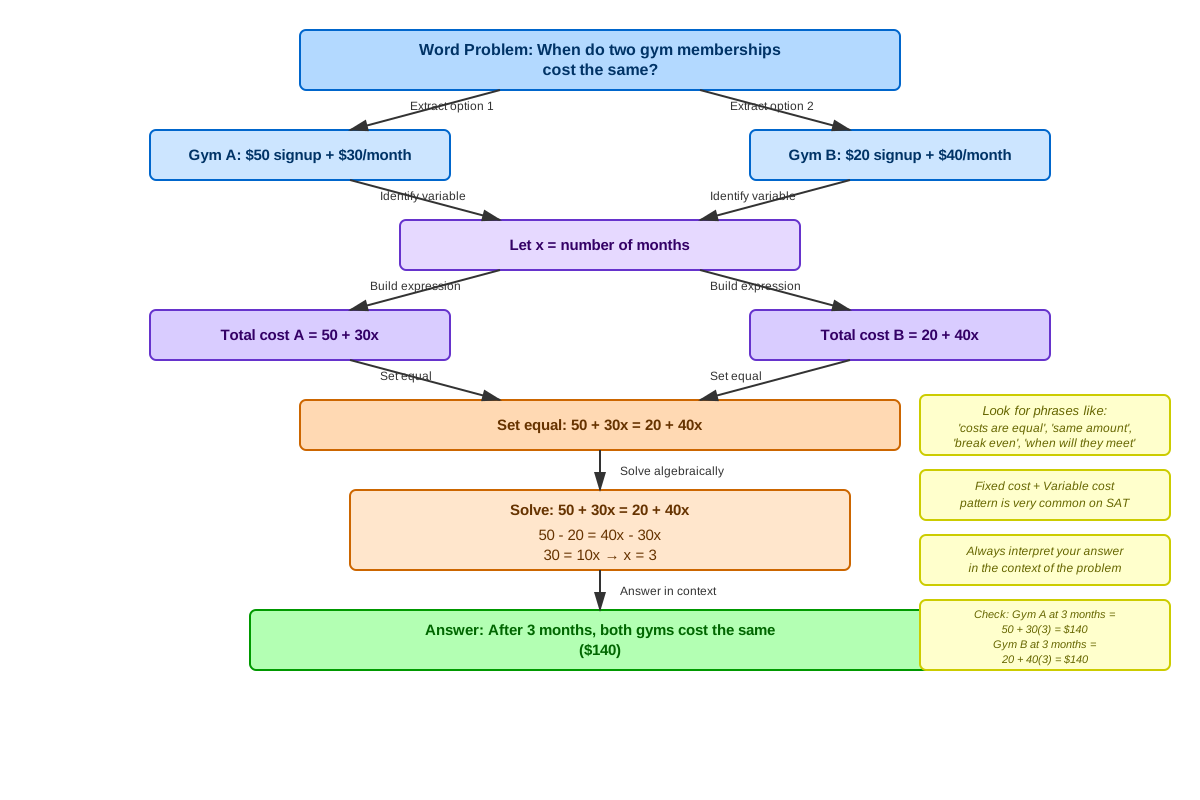
In real-world applications, equations with variables on both sides model countless scenarios: comparing pricing plans (where one plan has a fixed cost plus per-unit charges versus another plan's structure), calculating break-even points in business, determining when two moving objects will meet, or analyzing rate problems. These practical applications make this algebraic skill relevant beyond the classroom, developing logical reasoning that transfers to fields including economics, engineering, and data science.
On the SAT, sat equations with variables on both sides appears with remarkable frequency. Approximately 3-5 questions per test directly assess this skill, while many additional questions incorporate it as a component of more complex problems. The College Board consistently includes these equations in both multiple-choice and student-produced response formats. Questions may present equations directly for solving, embed them within word problems requiring translation from verbal descriptions, or incorporate them into questions about linear functions and their intersections.
Common SAT question formats include: direct algebraic equations requiring solution for x; word problems describing two scenarios that must be set equal; questions asking "for what value of x" two expressions are equal; problems involving geometric formulas where the variable appears in multiple terms; and questions about special cases where students must recognize infinite solutions or no solution. The topic also appears in questions about systems of equations, where setting two linear expressions equal creates an equation with variables on both sides.
Core Concepts
Structure of Equations with Variables on Both Sides
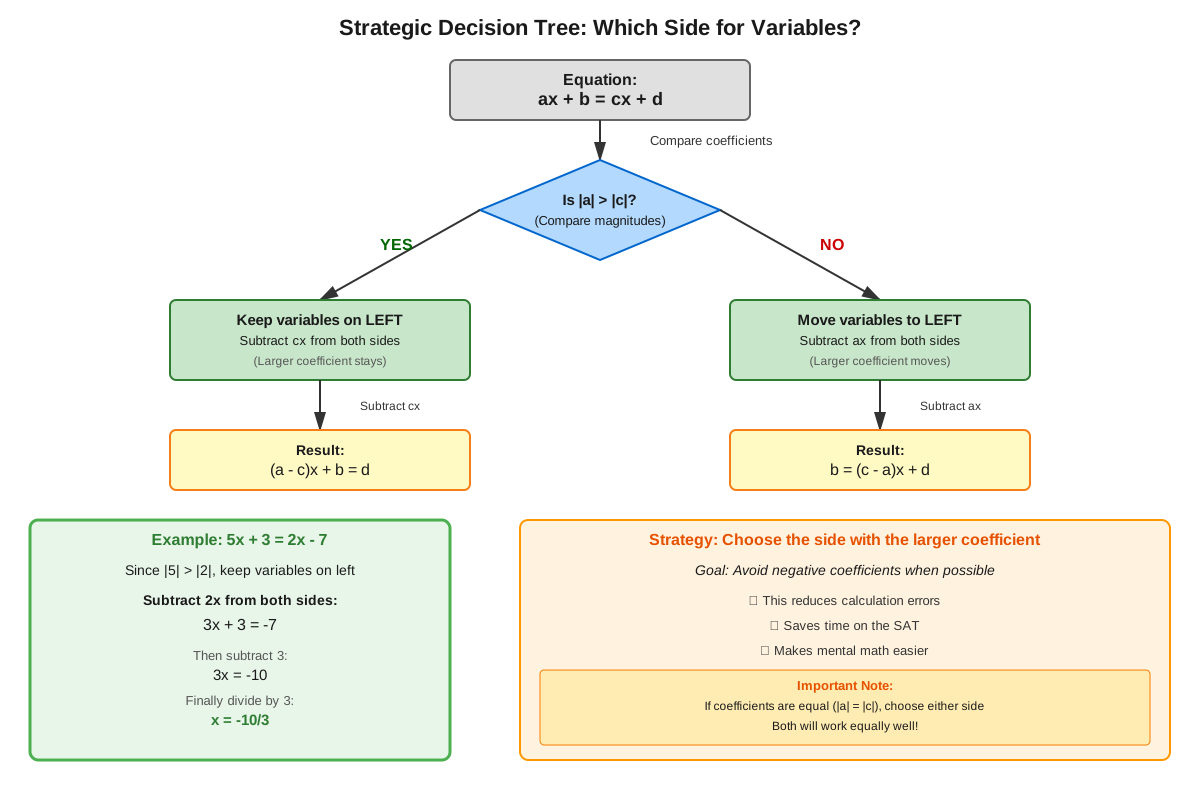
An equation with variables on both sides contains the unknown variable in terms on both the left and right sides of the equal sign. The general form can be represented as: ax + b = cx + d, where a, b, c, and d are constants, and x is the variable to solve for. The key characteristic distinguishing these from simpler equations is that variable terms must be consolidated on one side before final isolation can occur.
These equations require understanding that the equal sign represents a balance point. Whatever exists on the left side has the same value as what exists on the right side. To solve, the goal is to manipulate this balanced equation until the variable stands alone on one side, revealing its value on the other side.
Standard Solution Process
The systematic approach to solving equations with variables on both sides follows these numbered steps:
- Simplify both sides independently: Apply the distributive property, combine like terms, and eliminate parentheses on each side before moving any terms across the equal sign
- Move variable terms to one side: Add or subtract variable terms to collect all terms containing the variable on one side of the equation (typically the left side)
- Move constant terms to the opposite side: Add or subtract constants to isolate the variable term
- Isolate the variable: Divide or multiply both sides by the coefficient of the variable
- Verify the solution: Substitute the answer back into the original equation to confirm both sides equal the same value
Consider the equation: 5x - 3 = 2x + 9
Following the process:
- Both sides are already simplified
- Subtract 2x from both sides: 3x - 3 = 9
- Add 3 to both sides: 3x = 12
- Divide both sides by 3: x = 4
- Verify: 5(4) - 3 = 20 - 3 = 17, and 2(4) + 9 = 8 + 9 = 17 ✓
Equations Requiring Distribution
Many SAT questions present equations where one or both sides contain parentheses that must be expanded using the distributive property before proceeding. For example: 3(x + 4) = 2x - 5
The solution process requires an additional first step:
- Distribute: 3x + 12 = 2x - 5
- Subtract 2x from both sides: x + 12 = -5
- Subtract 12 from both sides: x = -17
Failing to distribute correctly represents one of the most common errors on SAT questions involving this topic. Students must multiply the coefficient by every term inside the parentheses, paying careful attention to negative signs.
Equations with Fractions
When equations contain fractions, two approaches exist: working with fractions throughout or eliminating fractions by multiplying both sides by the least common denominator (LCD). The LCD method often simplifies calculations and reduces errors.
Example: (x/2) + 3 = (x/4) + 5
Method 1 (LCD approach):
- Multiply every term by 4 (the LCD of 2 and 4): 2x + 12 = x + 20
- Subtract x from both sides: x + 12 = 20
- Subtract 12 from both sides: x = 8
Method 2 (working with fractions):
- Subtract x/4 from both sides: x/4 + 3 = 5
- Subtract 3 from both sides: x/4 = 2
- Multiply both sides by 4: x = 8
Special Cases: Infinite Solutions
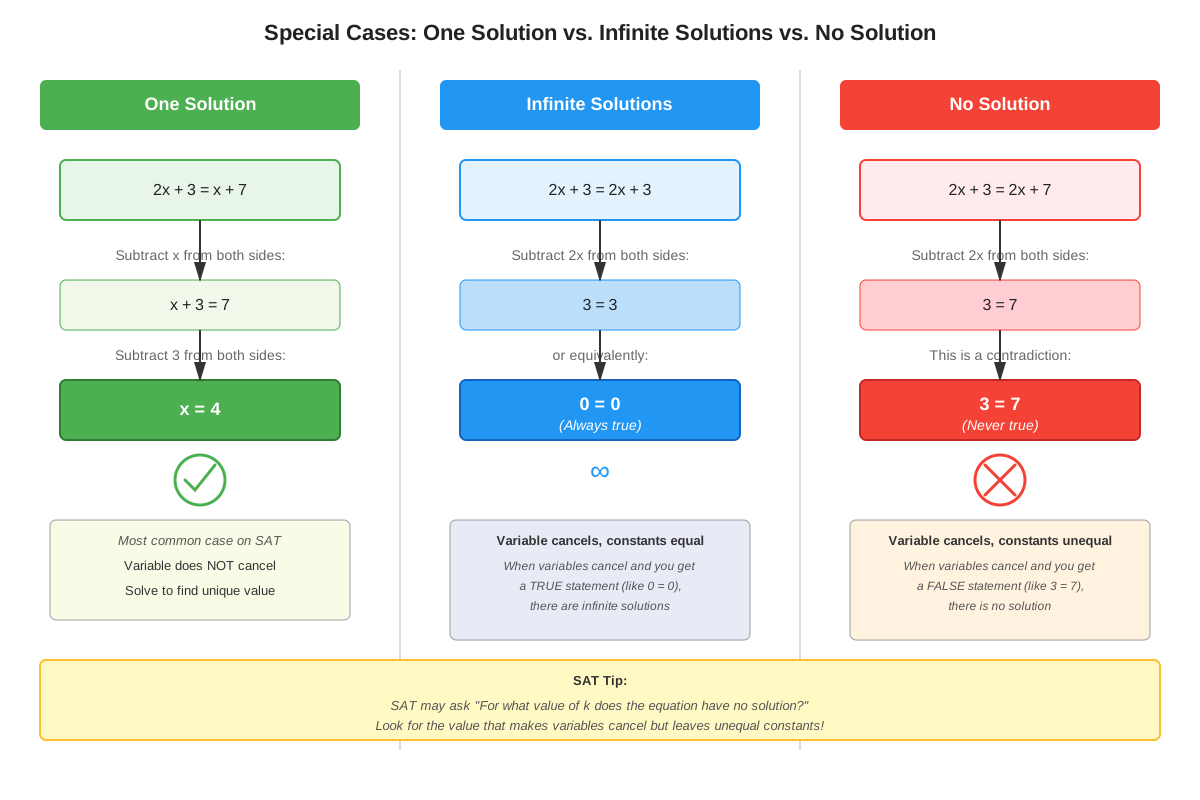
Some equations with variables on both sides result in infinite solutions, meaning every real number satisfies the equation. This occurs when, after simplification, both sides of the equation become identical.
Example: 2(x + 3) = 2x + 6
- Distribute: 2x + 6 = 2x + 6
- Subtract 2x from both sides: 6 = 6
This true statement (6 = 6) indicates the original equation is an identity—true for all values of x. On the SAT, questions may ask how many solutions exist or what value makes the equation have infinitely many solutions.
Special Cases: No Solution
Conversely, some equations result in no solution, meaning no value of x satisfies the equation. This occurs when simplification leads to a false statement.
Example: 3x + 5 = 3x - 2
- Subtract 3x from both sides: 5 = -2
This false statement indicates the original equation has no solution. The two sides can never be equal regardless of what value is substituted for x.
Comparison Table
| Equation Type | After Simplification | Number of Solutions | SAT Frequency |
|---|---|---|---|
| Standard | Variable = Number | One unique solution | Very High |
| Identity | True statement (e.g., 5 = 5) | Infinitely many | Medium |
| Contradiction | False statement (e.g., 3 = 7) | No solution | Medium |
Concept Relationships
The concepts within this topic build upon each other in a clear progression. The standard solution process serves as the foundation, establishing the systematic approach of simplifying, moving terms, and isolating variables. This process → extends to → equations requiring distribution, where an additional preliminary step of expanding parentheses must occur before the standard process applies. Both of these → connect to → equations with fractions, which can be solved using the standard process but benefit from the strategic technique of eliminating denominators first.
All three standard equation types → lead to understanding → special cases, where the solution process reveals either infinite solutions or no solution rather than a unique numerical answer. Recognizing these special cases requires completing the standard process and interpreting the resulting statement.
These concepts connect to prerequisite knowledge in essential ways. Combining like terms enables the simplification step that must occur before moving terms across the equal sign. The distributive property allows expansion of parentheses, converting complex expressions into forms where variables can be collected. Properties of equality justify every operation performed, ensuring that the solution to the simplified equation matches the solution to the original equation.
Looking forward, mastery of equations with variables on both sides → enables → solving systems of equations by substitution or elimination, understanding linear function intersections (where setting two functions equal creates an equation with variables on both sides), and tackling literal equations where solving for one variable in terms of others follows identical principles. This topic also → supports → inequality solving, which uses parallel techniques with additional rules about inequality direction.
High-Yield Facts
⭐ The most efficient first step is always to simplify each side independently before moving any terms across the equal sign
⭐ When collecting variable terms, subtract the smaller coefficient from both sides to keep the variable coefficient positive and avoid sign errors
⭐ If variables cancel completely leaving a true statement (like 5 = 5), the equation has infinitely many solutions
⭐ If variables cancel completely leaving a false statement (like 3 = 7), the equation has no solution
⭐ Always distribute negative signs carefully: -(x - 3) becomes -x + 3, not -x - 3
- Multiplying or dividing both sides by the same non-zero number maintains equality and is essential for isolating variables
- The LCD method for equations with fractions eliminates denominators and typically reduces calculation errors
- Verification by substitution catches arithmetic mistakes and confirms the solution satisfies the original equation
- On the SAT, "for what value of x" signals a direct equation-solving question requiring this skill
- Word problems requiring equations with variables on both sides often involve comparing two scenarios or finding when two quantities are equal
- Coefficient of zero on the variable (after collecting terms) indicates either infinite solutions or no solution depending on the constant terms
Quick check — test yourself on Equations with variables on both sides so far.
Try Flashcards →Common Misconceptions
Misconception: When moving a term to the other side, simply change its sign without performing the operation on both sides → Correction: Every operation must be performed on both sides of the equation to maintain equality. If 3x appears on the right and needs to move left, subtract 3x from both sides explicitly; the sign change is a consequence of the subtraction, not a shortcut that replaces it.
Misconception: The variable must always be isolated on the left side of the equation → Correction: Variables can be isolated on either side. While convention often places the variable on the left, x = 5 and 5 = x are equivalent. Choose whichever side makes calculation easier, typically the side where the variable has the larger coefficient.
Misconception: When an equation simplifies to 0 = 0 or another true statement, the answer is zero → Correction: A true statement after variable cancellation indicates infinitely many solutions, not that x = 0. Every real number satisfies the original equation, making it an identity.
Misconception: Distributing a negative sign only affects the first term in parentheses → Correction: A negative sign or negative coefficient distributes to every term inside parentheses. For -2(x - 3), multiply both x and -3 by -2, yielding -2x + 6, not -2x - 6.
Misconception: Equations with fractions are fundamentally different and require special rules → Correction: Equations with fractions follow the same principles as all equations. The LCD method is simply a strategic choice to eliminate fractions early, making subsequent steps cleaner, but the underlying properties of equality remain unchanged.
Misconception: If the final answer is negative, an error must have occurred → Correction: Negative solutions are perfectly valid. Many SAT equations intentionally yield negative answers to test whether students trust their algebraic process or second-guess correct work.
Worked Examples
Example 1: Multi-Step Equation with Distribution
Problem: Solve for x: 4(x - 2) + 3 = 2x + 7
Solution:
Step 1 - Distribute on the left side:
4x - 8 + 3 = 2x + 7
Step 2 - Combine like terms on the left side:
4x - 5 = 2x + 7
Step 3 - Subtract 2x from both sides to collect variable terms:
2x - 5 = 7
Step 4 - Add 5 to both sides to isolate the variable term:
2x = 12
Step 5 - Divide both sides by 2:
x = 6
Step 6 - Verify by substituting x = 6 into the original equation:
Left side: 4(6 - 2) + 3 = 4(4) + 3 = 16 + 3 = 19
Right side: 2(6) + 7 = 12 + 7 = 19 ✓
Connection to Learning Objectives: This example demonstrates applying the systematic solution process to SAT-style questions, identifying the key feature of distribution before collecting terms, and verifying solutions.
Example 2: Word Problem Creating an Equation with Variables on Both Sides
Problem: A gym charges a $50 enrollment fee plus $30 per month. A different gym charges no enrollment fee but costs $40 per month. After how many months will the total cost be the same at both gyms?
Solution:
Step 1 - Define the variable:
Let x = number of months
Step 2 - Write expressions for total cost at each gym:
Gym A: 50 + 30x (enrollment fee plus monthly charges)
Gym B: 40x (only monthly charges)
Step 3 - Set the expressions equal (when costs are the same):
50 + 30x = 40x
Step 4 - Subtract 30x from both sides:
50 = 10x
Step 5 - Divide both sides by 10:
5 = x
Step 6 - Interpret and verify:
After 5 months, both gyms cost the same.
Gym A: 50 + 30(5) = 50 + 150 = $200
Gym B: 40(5) = $200 ✓
Connection to Learning Objectives: This example demonstrates translating real-world scenarios into equations with variables on both sides, a high-frequency SAT question type. It shows how to identify when two expressions should be set equal and how to interpret the solution in context.
Example 3: Special Case - No Solution
Problem: For what value of k does the equation 3(x + k) = 3x + 5 have no solution?
Solution:
Step 1 - Distribute on the left side:
3x + 3k = 3x + 5
Step 2 - Subtract 3x from both sides:
3k = 5
Step 3 - Analyze the result:
For the original equation to have no solution, we need the variable terms to cancel (which they do) but the constant terms to be unequal (creating a false statement).
Step 4 - Determine what value of k creates a false statement:
If 3k = 5, then k = 5/3, and the equation becomes 3x + 5 = 3x + 5, which has infinite solutions.
For no solution, we need 3k ≠ 5, meaning k ≠ 5/3.
Actually, the question asks what value of k makes it have no solution. The equation 3x + 3k = 3x + 5 simplifies to 3k = 5 only when we subtract 3x. For this to be a false statement (no solution), 3k must not equal 5. But the question format suggests finding when it has no solution...
Let me reconsider: The equation 3(x + k) = 3x + 5 will have no solution when 3k ≠ 5. But typically SAT asks this inversely.
Corrected interpretation: The equation as written will have exactly one solution unless 3k = 5 (infinite solutions). For no solution, we'd need something like 3(x + k) = 3x + 7 where 3k ≠ 7. The question would need to specify a different right side or ask when it has infinite solutions (k = 5/3).
Connection to Learning Objectives: This example demonstrates recognizing special cases and understanding the conditions that create no solution versus infinite solutions scenarios.
Exam Strategy
When approaching SAT equations with variables on both sides, begin by quickly scanning the equation to identify its complexity level. Look for parentheses requiring distribution, fractions suggesting LCD multiplication, or particularly simple structures allowing mental math. This initial assessment determines whether to work carefully through all steps or attempt faster mental solving.
Trigger words and phrases that signal this topic include: "solve for x," "for what value," "what is x when," "if the equation is true," and word problems stating "when will [quantity A] equal [quantity B]." In word problems, phrases like "the same as," "equal to," "costs the same," or "at what point" indicate setting two expressions equal.
For process of elimination on multiple-choice questions, substitute answer choices back into the original equation when algebraic solving seems complex or time-consuming. This strategy works particularly well when answers are simple integers. Start with middle values or those that make calculation easiest. If an answer choice creates equal values on both sides, it's correct; if not, eliminate it and try another.
Time allocation for these questions should average 45-60 seconds for straightforward equations and up to 90 seconds for complex word problems requiring translation and solving. If a question exceeds two minutes, mark it for review and move forward. The SAT rewards efficient time management more than perfecting every question on first attempt.
Exam Tip: When variables cancel completely, don't panic or assume you made an error. Immediately check whether the remaining statement is true (infinite solutions) or false (no solution), as these special cases appear regularly on the SAT.
Watch for questions asking "how many solutions" rather than "what is the solution." These specifically test understanding of special cases. If asked for the number of solutions, solve the equation completely—if you reach a true statement like 5 = 5, the answer is "infinitely many"; if you reach a false statement like 3 = 7, the answer is "zero" or "no solution."
Memory Techniques
MOVE mnemonic for the solution process:
- Make both sides simple (distribute and combine like terms)
- Organize variables on one side
- Vacate constants to the opposite side
- Eliminate the coefficient (divide or multiply to isolate the variable)
"Same Side, Subtract" reminds students that when variable terms appear on the same side, subtract them; when on opposite sides, move one by subtracting from both sides. This prevents the common error of adding when consolidating terms.
Visualization strategy: Picture the equal sign as a balance scale. Whatever operation you perform on one side must be performed on the other to keep the scale balanced. This mental image reinforces why operations must affect both sides and helps students understand the properties of equality intuitively.
"True = Infinite, False = None" for special cases: When variables cancel, a true statement means infinitely many solutions, while a false statement means no solution. The rhyme helps recall which outcome corresponds to which case.
DADS acronym for distribution errors:
- Distribute to all terms
- Apply to every term inside parentheses
- Don't forget negative signs
- Simplify immediately after distributing
Summary
Equations with variables on both sides represent a critical SAT Math skill requiring systematic algebraic manipulation to isolate the unknown variable. The standard solution process involves simplifying both sides independently, collecting all variable terms on one side through addition or subtraction, moving constant terms to the opposite side, and finally dividing or multiplying to isolate the variable. Students must master distribution of coefficients across parentheses, strategic handling of fractions through LCD multiplication, and recognition of special cases where equations yield infinite solutions (when simplification produces a true statement) or no solution (when simplification produces a false statement). Success on SAT questions demands not only mechanical proficiency with algebraic steps but also the ability to translate word problems into equations, verify solutions through substitution, and efficiently manage time by recognizing when to solve algebraically versus testing answer choices. This topic appears throughout the SAT Math section in various contexts, making it essential for achieving competitive scores.
Key Takeaways
- Always simplify each side completely before moving any terms across the equal sign to avoid errors and reduce complexity
- Collect variable terms on one side by subtracting the smaller coefficient from both sides, keeping the variable coefficient positive when possible
- Special cases occur when variables cancel: true statements indicate infinitely many solutions, false statements indicate no solution
- Word problems requiring equations with variables on both sides typically involve comparing two scenarios or finding when quantities become equal
- Verification by substituting the solution back into the original equation catches calculation errors and confirms correctness
- The distributive property must be applied to every term inside parentheses, with particular attention to negative signs
- Strategic use of the LCD method eliminates fractions early, simplifying subsequent calculations and reducing arithmetic errors
Related Topics
Systems of Linear Equations: Mastering equations with variables on both sides enables solving systems through substitution (where one equation is substituted into another, creating an equation with variables on both sides) and understanding solution methods geometrically as intersection points of lines.
Linear Functions and Their Graphs: Setting two linear functions equal to find their intersection point creates an equation with variables on both sides, connecting algebraic and graphical representations of linear relationships.
Literal Equations: Solving formulas for specific variables (like solving A = πr² for r) uses identical techniques to equations with variables on both sides, extending the skill to multi-variable contexts.
Linear Inequalities: The process for solving inequalities with variables on both sides parallels equation solving with the additional consideration of inequality direction when multiplying or dividing by negative numbers.
Absolute Value Equations: More complex absolute value equations often require setting up equations with variables on both sides when considering different cases for the absolute value expression.
Practice CTA
Now that you've mastered the core concepts of equations with variables on both sides, it's time to solidify your understanding through active practice. Attempt the practice questions designed specifically for this topic, challenging yourself to apply the systematic solution process without looking back at notes. Use the flashcards to reinforce high-yield facts and special cases until recognition becomes automatic. Remember: SAT success comes not just from understanding concepts but from developing the speed and confidence to execute them accurately under timed conditions. Every practice problem you solve builds the muscle memory that will serve you on test day. You've got this!
Sign up free to keep reading
Create a free AnvayaPrep account to finish this SAT guide on Equations with variables on both sides — plus flashcards and practice questions.