Overview
Literal equations are algebraic equations that involve two or more variables, where the goal is to solve for one variable in terms of the others rather than finding a specific numerical value. Unlike traditional equations where students solve for x = 5, literal equations require rearranging formulas to isolate a particular variable while treating all other variables as constants. For example, solving the formula for the area of a rectangle (A = lw) for width (w = A/l) demonstrates this fundamental skill. This concept represents a critical bridge between basic algebraic manipulation and advanced problem-solving, requiring students to apply the same inverse operations used in single-variable equations but with greater abstraction.
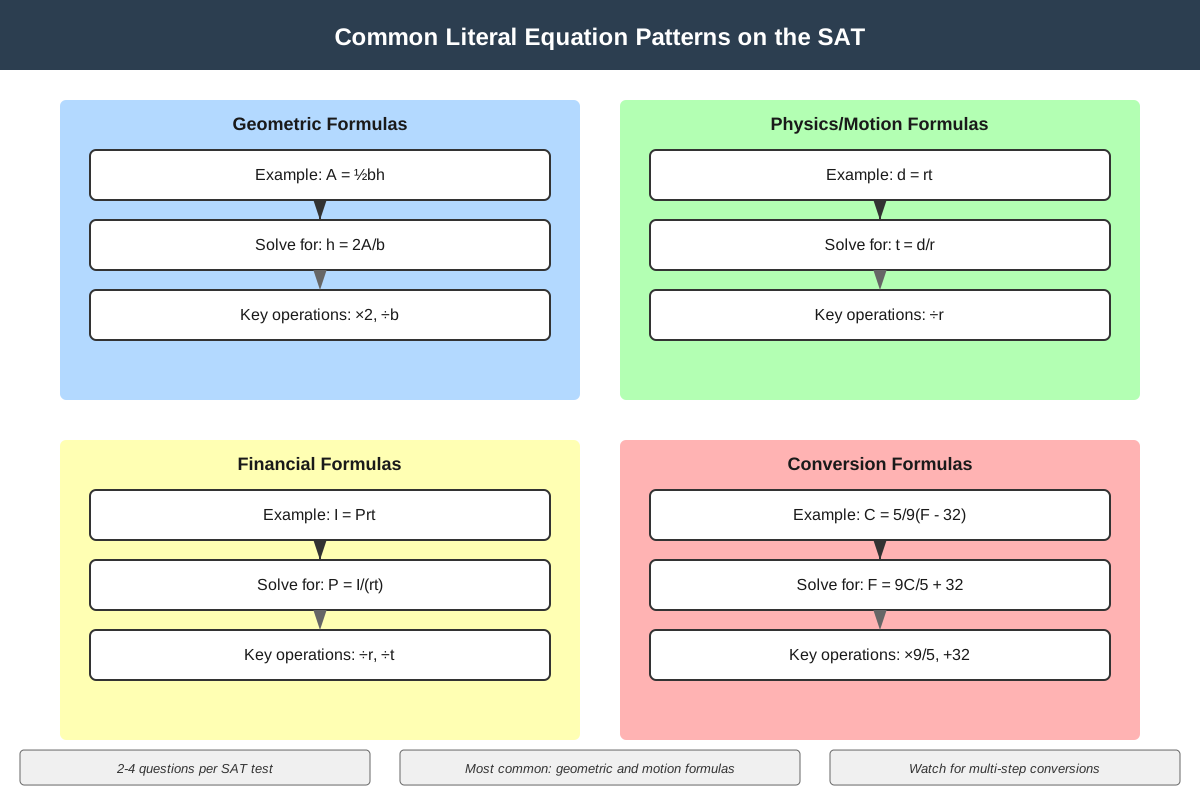
On the SAT, literal equations appear frequently in both the calculator and no-calculator sections, typically accounting for 2-4 questions per test. These problems assess a student's ability to manipulate formulas from geometry, physics, finance, and other applied contexts. The College Board uses literal equations to evaluate algebraic fluency and conceptual understanding rather than mere computational ability. Questions may present a formula and ask students to solve for a specific variable, or they may embed literal equation manipulation within word problems requiring multi-step reasoning.
Mastery of literal equations is foundational for success across multiple math domains tested on the SAT. This topic connects directly to linear equations in one variable (the prerequisite skill), systems of equations, quadratic formulas, and function notation. Students who struggle with literal equations often find advanced algebra and problem-solving questions unnecessarily difficult, as formula manipulation appears throughout the test. Understanding how to systematically isolate variables builds the algebraic dexterity needed for higher-level mathematical reasoning and real-world applications.
Learning Objectives
- [ ] Identify key features of literal equations
- [ ] Explain how literal equations appears on the SAT
- [ ] Apply literal equations to answer SAT-style questions
- [ ] Solve literal equations for a specified variable using inverse operations
- [ ] Recognize when to apply the distributive property or factoring in literal equation problems
- [ ] Translate word problems into literal equations and solve for unknown variables
- [ ] Verify solutions to literal equations by substitution and dimensional analysis
Prerequisites
- Solving one-variable linear equations: The same inverse operations (addition, subtraction, multiplication, division) used to solve x + 5 = 12 apply when solving for variables in literal equations
- Order of operations (PEMDAS): Understanding operation hierarchy is essential for correctly reversing operations when isolating variables
- Properties of equality: The ability to perform the same operation on both sides of an equation maintains equality and forms the foundation of all equation solving
- Basic algebraic manipulation: Skills like combining like terms, using the distributive property, and simplifying expressions are necessary before attempting literal equations
- Fraction operations: Many literal equations involve fractions, requiring comfort with multiplying by reciprocals and finding common denominators
Why This Topic Matters
Literal equations represent one of the most practical applications of algebra in everyday life. Scientists use them to convert between temperature scales (solving C = 5/9(F - 32) for F), engineers manipulate formulas to design structures, financial analysts rearrange interest formulas to determine investment timelines, and medical professionals adjust dosage calculations based on patient weight. The ability to manipulate formulas empowers students to use mathematical relationships flexibly rather than memorizing separate formulas for every possible scenario.
On the SAT, literal equations appear in approximately 10-15% of algebra questions, making them a high-yield topic for test preparation. The College Board typically presents 2-4 direct literal equation questions per test, plus additional questions where formula manipulation is embedded within larger problems. These questions appear in both multiple-choice and student-produced response formats, with difficulty ranging from straightforward one-step isolations to complex multi-step problems involving quadratic expressions or rational equations.
Common SAT question formats include: (1) presenting a scientific or geometric formula and asking students to solve for a specific variable, (2) providing a rearranged formula and asking which variable was isolated, (3) embedding literal equation manipulation within word problems about rates, work, or mixture, and (4) asking students to identify equivalent forms of equations. The test frequently uses real-world contexts like physics formulas (kinetic energy, density), geometric relationships (surface area, volume), and financial calculations (simple interest, compound growth) to assess this skill.
Core Concepts
Definition and Structure of Literal Equations
A literal equation is an equation that contains two or more variables, where the objective is to express one variable explicitly in terms of the others. The term "literal" refers to the use of letters (variables) rather than specific numbers. For example, the equation 2x + 3y = 12 is a literal equation, and solving it for y yields y = (12 - 2x)/3 or y = 4 - (2/3)x. The key distinction from standard equations is that the solution is an expression containing variables rather than a single numerical value.
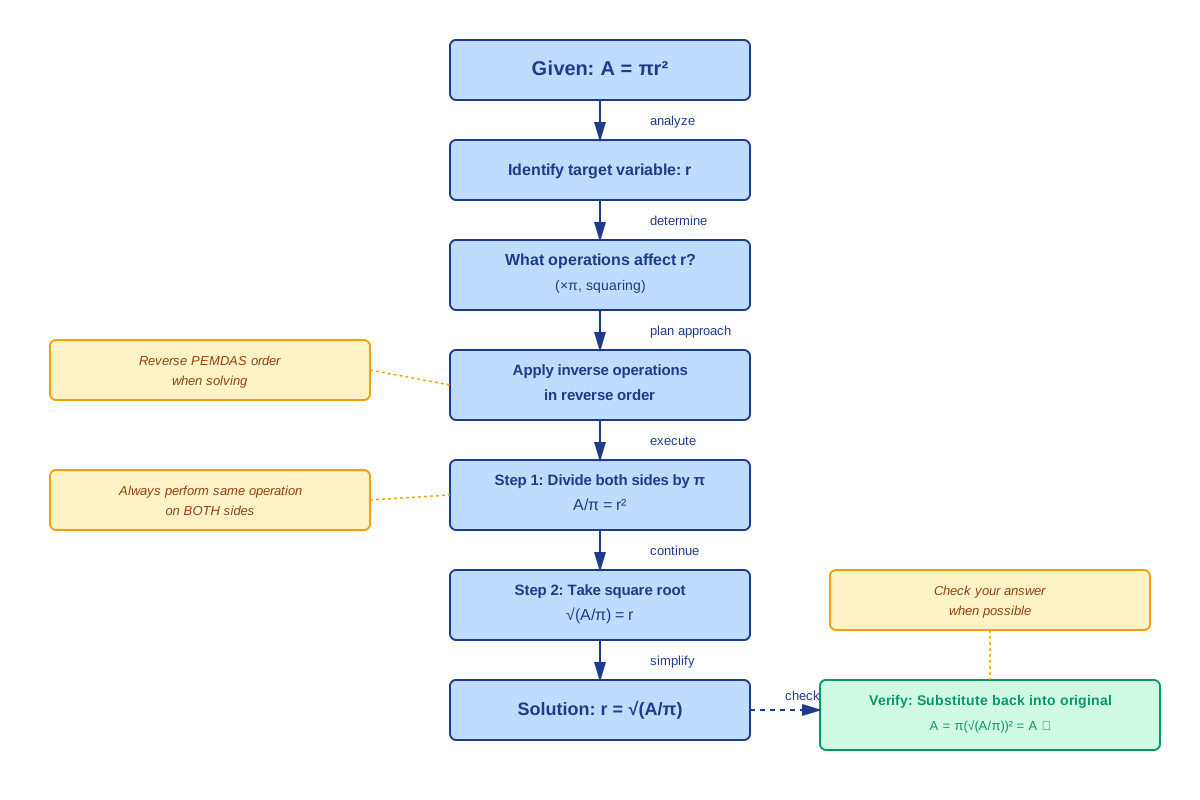
Every literal equation has a subject (the variable being solved for) and parameters (all other variables treated as constants during the solving process). When solving A = πr² for r, the subject is r, while A and π are parameters. Understanding this distinction helps students recognize that they should treat all non-subject variables exactly like numbers when applying inverse operations.
The Solving Process: Inverse Operations
Solving literal equations follows the identical logical process as solving numerical equations: identify the operations affecting the subject variable and apply inverse operations in reverse order of operations. The systematic approach involves:
- Identify the subject variable you need to isolate
- Locate where the subject appears in the equation (one location or multiple)
- List all operations affecting the subject in order of operations
- Apply inverse operations in reverse order, performing the same operation on both sides
- Simplify the resulting expression
For example, solving the formula for the perimeter of a rectangle, P = 2l + 2w, for width (w):
P = 2l + 2w
P - 2l = 2w          (subtract 2l from both sides)
(P - 2l)/2 = w       (divide both sides by 2)
w = (P - 2l)/2       (rewrite with subject on left)
Handling Fractions in Literal Equations
Many SAT literal equations involve fractional coefficients or variables in denominators, requiring strategic approaches. When the subject variable appears in a denominator, multiply both sides by that denominator as the first step. When solving for a variable that has a fractional coefficient, multiply by the reciprocal.
Consider solving the equation 1/f = 1/a + 1/b for f (a common lens equation in physics):
1/f = 1/a + 1/b
1/f = (b + a)/(ab)     (find common denominator on right)
f = ab/(a + b)         (take reciprocal of both sides)
Alternatively, when a variable appears in one denominator, cross-multiplication provides an efficient solution path. For the equation v = d/t solved for t:
v = d/t
vt = d              (multiply both sides by t)
t = d/v             (divide both sides by v)
The Distributive Property and Factoring
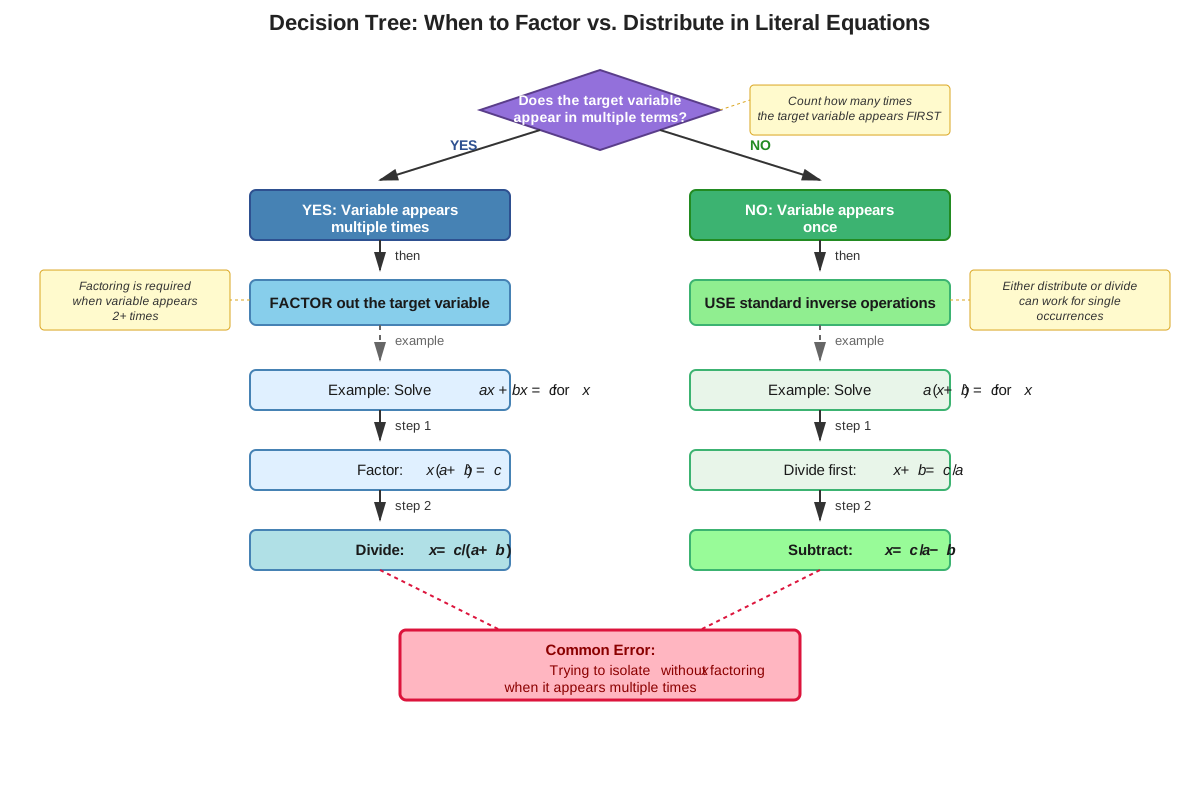
When the subject variable appears in multiple terms, factoring becomes essential. The distributive property (a(b + c) = ab + ac) works in reverse to collect all terms containing the subject variable. This technique is crucial for SAT problems where variables appear multiple times.
Solving ax + bx = c for x demonstrates this principle:
ax + bx = c
x(a + b) = c        (factor out x)
x = c/(a + b)       (divide both sides by (a + b))
A more complex example appears in the formula S = 2πr² + 2πrh (surface area of a cylinder) when solving for r. Since r appears in two terms with different exponents, this becomes a quadratic equation requiring the quadratic formula—a less common but possible SAT scenario.
Special Cases and Restrictions
Some literal equations have domain restrictions that students must recognize. When solving for a variable that appears in a denominator, the solution is undefined when that denominator equals zero. For instance, when solving y = (x + 3)/(x - 2) for x, the solution x = (2y + 3)/(y - 1) is undefined when y = 1.
Additionally, when taking square roots during the solving process, both positive and negative solutions may exist. The equation A = πr² solved for r yields r = ±√(A/π), though context often determines which solution is meaningful (radius must be positive).
Verification Strategies
After solving a literal equation, verification ensures accuracy. Substitution involves choosing simple values for all parameters and checking that both the original and solved equations yield the same result. For example, after solving P = 2l + 2w for w = (P - 2l)/2, test with P = 20 and l = 6:
- Original: 20 = 2(6) + 2w → 20 = 12 + 2w → w = 4
- Solved: w = (20 - 2(6))/2 = (20 - 12)/2 = 8/2 = 4 ✓
Dimensional analysis provides another verification method for formulas with units. The units on both sides of the equation must match after solving.
Concept Relationships
The foundation of literal equations rests entirely on solving linear equations in one variable. Every technique learned for solving 3x + 7 = 22 transfers directly to solving 3x + b = c for x. The only conceptual shift is treating letters as numbers, which requires greater abstraction but identical procedural steps. This connection means that students who master one-variable equations already possess the mechanical skills for literal equations—they simply need to develop comfort with algebraic expressions as answers.
Literal equations connect forward to systems of equations, where solving one equation for a variable enables substitution into another equation. The substitution method for systems relies entirely on literal equation manipulation. For example, solving the system {2x + y = 10, x - y = 2} begins by solving the second equation for x (x = y + 2), creating a literal equation that substitutes into the first.
Within the topic itself, concepts build progressively: Basic inverse operations → Handling fractions and denominators → Using the distributive property and factoring → Managing multiple instances of the subject variable. Each level adds complexity while maintaining the same fundamental principle: isolate the subject variable using inverse operations.
The relationship map flows as follows:
One-variable equations → provides foundation for → Basic literal equations → extends to → Literal equations with fractions → combines with → Distributive property → enables → Multi-term literal equations → connects to → Systems of equations and Quadratic formulas
Quick check — test yourself on Literal equations so far.
Try Flashcards →High-Yield Facts
⭐ Literal equations are solved using the exact same inverse operations as numerical equations—the only difference is that the answer contains variables instead of numbers
⭐ When a variable appears in a denominator, multiply both sides by that denominator as the first step to clear fractions
⭐ If the subject variable appears in multiple terms, factor it out using the distributive property before isolating
⭐ Always perform the same operation on both sides of the equation to maintain equality
⭐ The order of operations (PEMDAS) determines the sequence of inverse operations needed—apply them in reverse order
- Solving for a variable with a fractional coefficient requires multiplying by the reciprocal of that coefficient
- When both sides of an equation are fractions equal to each other, taking the reciprocal of both sides is often the fastest solution method
- Literal equations can be verified by substituting simple numerical values for all variables and checking that both forms produce identical results
- The SAT frequently uses formulas from geometry (area, volume, surface area), physics (density, velocity, kinetic energy), and finance (simple interest) in literal equation questions
- Domain restrictions occur when solving creates a denominator that could equal zero—these values must be excluded from the solution
- Rearranging formulas allows one memorized equation to solve for multiple unknowns, reducing memorization burden
- Parentheses in literal equations must be distributed before combining like terms, just as in numerical equations
Common Misconceptions
Misconception: Variables other than the subject can be combined or simplified like numbers
Correction: Variables are only like terms if they have identical variable parts. In solving ax + bx = c for x, the terms ax and bx can be combined because both contain x, but in solving ax + by = c for x, the terms cannot be combined because they contain different variables. Treat each distinct variable as a separate entity.
Misconception: When solving for a variable in a denominator, you can simply "move it to the numerator"
Correction: Variables don't "move" across fraction bars. To solve v = d/t for t, multiply both sides by t (giving vt = d), then divide both sides by v (giving t = d/v). Each step must maintain equality through valid operations on both sides.
Misconception: The subject variable must end up on the left side of the equation
Correction: While convention places the subject on the left (w = P/2 - l), the equation is equally valid with the subject on the right (P/2 - l = w). The SAT accepts either form, though answer choices typically follow standard convention.
Misconception: Literal equations always have one correct answer form
Correction: Multiple equivalent forms exist for most literal equations. Solving P = 2l + 2w for w yields w = (P - 2l)/2, which is equivalent to w = P/2 - l. The SAT may present any algebraically equivalent form in answer choices, requiring students to recognize equivalence.
Misconception: You can cancel variables that appear on both sides of an equation
Correction: Variables can only be canceled when they are factors (multiplied), never when they are terms (added or subtracted). In the equation x + a = x + b, you cannot cancel the x terms to conclude a = b (this is only true if a = b initially). Instead, subtract x from both sides: a = b, which shows the equation is only true when a equals b.
Misconception: Taking the square root of both sides always produces a single solution
Correction: When solving A = πr² for r, taking the square root yields r = ±√(A/π). Both positive and negative roots are mathematically valid, though context (like radius being positive) may eliminate one solution. The SAT occasionally tests awareness of both solutions.
Worked Examples
Example 1: Solving a Geometric Formula
Problem: The formula for the surface area of a rectangular prism is S = 2lw + 2lh + 2wh, where l is length, w is width, and h is height. Solve this formula for h.
Solution:
Step 1: Identify that h is the subject variable and appears in two terms (2lh and 2wh).
Step 2: Isolate all terms containing h on one side:
S = 2lw + 2lh + 2wh
S - 2lw = 2lh + 2wh
Step 3: Factor out h from the right side using the distributive property:
S - 2lw = h(2l + 2w)Step 4: Divide both sides by (2l + 2w):
(S - 2lw)/(2l + 2w) = hStep 5: Rewrite with subject on left (conventional form):
h = (S - 2lw)/(2l + 2w)Verification: Test with S = 52, l = 3, w = 2:
- Original: 52 = 2(3)(2) + 2(3)h + 2(2)h → 52 = 12 + 6h + 4h → 40 = 10h → h = 4
- Solved: h = (52 - 2(3)(2))/(2(3) + 2(2)) = (52 - 12)/(6 + 4) = 40/10 = 4 ✓
Connection to Learning Objectives: This problem demonstrates identifying key features (multiple instances of the subject variable), applying the distributive property for factoring, and verifying the solution—all essential SAT skills.
Example 2: Solving an Equation with Variable in Denominator
Problem: The formula for the focal length of a lens is given by 1/f = 1/d₀ + 1/dᵢ, where f is focal length, d₀ is object distance, and dᵢ is image distance. Solve for dᵢ.
Solution:
Step 1: Isolate the term containing dᵢ:
1/f = 1/d₀ + 1/dᵢ
1/f - 1/d₀ = 1/dᵢ
Step 2: Find a common denominator on the left side:
d₀/(fd₀) - f/(fd₀) = 1/dᵢ
(d₀ - f)/(fd₀) = 1/dᵢ
Step 3: Take the reciprocal of both sides (since both sides are fractions equal to each other):
dᵢ = fd₀/(d₀ - f)Alternative approach (clearing denominators first):
Step 1: Multiply all terms by the common denominator fd₀dᵢ:
1/f = 1/d₀ + 1/dᵢ
d₀dᵢ = fdᵢ + fd₀
Step 2: Collect terms with dᵢ on one side:
d₀dᵢ - fdᵢ = fd₀Step 3: Factor out dᵢ:
dᵢ(d₀ - f) = fd₀Step 4: Divide by (d₀ - f):
dᵢ = fd₀/(d₀ - f)Connection to Learning Objectives: This example shows two valid approaches to solving literal equations with fractions—finding common denominators versus clearing all denominators. Both methods appear on the SAT, and recognizing which is more efficient develops problem-solving flexibility.
Exam Strategy
When approaching sat literal equations questions, begin by carefully identifying which variable the question asks you to solve for—this is the subject variable. Circle or underline it to maintain focus throughout the problem. Many students lose points by correctly manipulating the equation but solving for the wrong variable.
Trigger words and phrases that signal literal equation questions include: "solve for," "express in terms of," "which equation shows [variable] isolated," "rearrange the formula," and "which of the following gives [variable]." Questions may also present a formula and ask "which is equivalent to" a specific variable, requiring you to recognize that you need to isolate that variable.
For process of elimination, use these strategies:
- Dimensional analysis: If the original equation has specific units, check that answer choices maintain dimensional consistency
- Substitution test: Plug in simple numbers (like 1, 2, or 10) for all variables in both the original equation and each answer choice—only the correct answer will produce matching results
- Sign checking: Verify that positive/negative signs make sense based on the original equation's structure
- Complexity matching: The correct answer typically has similar complexity to the original equation (same number of terms, similar fraction structure)
Time allocation for literal equation questions should be approximately 60-90 seconds for straightforward problems and up to 2 minutes for complex multi-step problems. If a problem requires more than three algebraic steps, double-check that you're using the most efficient approach—there may be a shortcut like factoring or cross-multiplication that simplifies the work.
Exam Tip: When the subject variable appears in multiple terms, immediately consider factoring. This is the most commonly tested advanced skill in SAT literal equations.
Always work systematically rather than trying to manipulate the equation mentally. Write each step clearly, showing one operation per line. This prevents errors and allows you to check your work if time permits. The SAT rewards careful, methodical problem-solving over speed.
Memory Techniques
ISOLATE mnemonic for the solving process:
- Identify the subject variable
- Spot where it appears in the equation
- Order the operations affecting it
- List inverse operations in reverse order
- Apply each operation to both sides
- Test your answer with substitution
- Express in conventional form (subject on left)
"Same Side, Factor Out" - When the subject variable appears in multiple terms on the same side of the equation, factor it out using the distributive property. This phrase helps students remember the key technique for multi-term literal equations.
"Denominator? Multiply!" - When the subject variable appears in any denominator, the first step is always to multiply both sides by that denominator. This simple rule prevents the common error of trying to manipulate fractions without clearing them first.
Visualization strategy: Picture literal equations as a balance scale where variables are weights. Whatever operation you perform on one side must be performed on the other to maintain balance. This mental image reinforces the fundamental principle of equality.
The "Reverse PEMDAS" approach: Remember that solving equations requires applying inverse operations in the opposite order of PEMDAS. If the subject variable is affected by operations in the order: multiply, then add, then divide—you must undo them by: multiplying (inverse of divide), then subtracting (inverse of add), then dividing (inverse of multiply).
Summary
Literal equations represent a fundamental algebraic skill where students solve equations containing multiple variables for one variable in terms of the others, producing an algebraic expression rather than a numerical answer. The solving process mirrors that of one-variable equations—identify the subject variable, determine which operations affect it, and apply inverse operations in reverse order while maintaining equality by performing identical operations on both sides. Key techniques include clearing fractions by multiplying by denominators, factoring out variables that appear in multiple terms using the distributive property, and verifying solutions through substitution. The SAT tests literal equations frequently through geometric formulas, scientific relationships, and financial calculations, making this a high-yield topic for test preparation. Success requires treating non-subject variables as constants, working systematically through each step, and recognizing equivalent forms of algebraic expressions. Mastery of literal equations builds the algebraic flexibility necessary for advanced problem-solving across all SAT math domains.
Key Takeaways
- Literal equations are solved using identical inverse operations as numerical equations—the only difference is that answers contain variables instead of numbers
- When the subject variable appears in a denominator, multiply both sides by that denominator as the first step
- If the subject variable appears in multiple terms, factor it out using the distributive property before isolating
- Always perform the same operation on both sides of the equation to maintain equality
- Verify solutions by substituting simple numerical values for all variables and confirming both forms produce identical results
- The SAT presents literal equations through real-world formulas from geometry, physics, and finance—recognize these contexts as opportunities to apply formula manipulation skills
- Multiple equivalent forms of the same solution exist—develop flexibility in recognizing algebraically equivalent expressions
Related Topics
Systems of Linear Equations: Mastering literal equations enables efficient use of the substitution method, where solving one equation for a variable creates an expression to substitute into another equation. This connection makes literal equations essential for solving systems algebraically.
Quadratic Equations and the Quadratic Formula: The quadratic formula itself (x = (-b ± √(b² - 4ac))/(2a)) is a literal equation solved for x. Understanding literal equations provides the foundation for deriving and manipulating quadratic relationships.
Function Notation and Inverse Functions: Finding inverse functions requires solving equations like y = 2x + 3 for x in terms of y, which is literal equation manipulation. This skill becomes crucial in advanced algebra and precalculus.
Rational Equations: Complex literal equations involving multiple fractions extend the techniques learned here, requiring students to find common denominators and clear complex fractions while solving for specific variables.
Physics and Chemistry Applications: Scientific formulas for density (d = m/v), velocity (v = d/t), kinetic energy (KE = ½mv²), and ideal gas law (PV = nRT) all require literal equation manipulation to solve for different variables depending on the problem context.
Practice CTA
Now that you've mastered the core concepts of literal equations, it's time to solidify your understanding through practice. Attempt the practice questions to apply these techniques to SAT-style problems, and use the flashcards to reinforce key facts and procedures. Remember that literal equations appear on every SAT, making this time investment directly translate to points on test day. Each practice problem you solve builds the algebraic fluency and confidence needed to tackle these questions quickly and accurately under timed conditions. You've built the foundation—now strengthen it through deliberate practice!
Sign up free to keep reading
Create a free AnvayaPrep account to finish this SAT guide on Literal equations — plus flashcards and practice questions.