Overview
Infinite-solution equations represent a special category of linear equations where every possible value of the variable satisfies the equation. Unlike typical linear equations that have exactly one solution, or contradictions that have no solution, infinite-solution equations are identities—they remain true regardless of what value is substituted for the variable. On the SAT, understanding this concept is crucial because these questions test algebraic reasoning, equation manipulation skills, and the ability to recognize when two expressions are equivalent in all cases.
The SAT frequently presents infinite-solution equations in the context of systems of equations or equations with parameters (unknown constants). Students must determine what value a parameter must have for an equation to possess infinitely many solutions. This requires deep understanding of algebraic equivalence and the ability to manipulate equations strategically. These questions typically appear in both the calculator and no-calculator sections, often as multiple-choice or grid-in questions worth the same points as any other question—making them high-value targets for score improvement.
Within the broader landscape of math concepts tested on the SAT, infinite-solution equations connect directly to fundamental algebraic principles including equation solving, systems of equations, and the concept of mathematical identity. Mastering this topic strengthens overall algebraic fluency and prepares students for more complex mathematical reasoning required in college-level coursework. The ability to recognize when equations are equivalent forms the foundation for understanding functions, transformations, and advanced algebraic manipulation.
Learning Objectives
- [ ] Identify key features of infinite-solution equations
- [ ] Explain how infinite-solution equations appears on the SAT
- [ ] Apply infinite-solution equations to answer SAT-style questions
- [ ] Determine the conditions under which a linear equation has infinitely many solutions
- [ ] Distinguish between equations with one solution, no solution, and infinitely many solutions
- [ ] Solve for parameter values that create infinite-solution scenarios in equations with constants
Prerequisites
- Basic equation solving: Understanding how to isolate variables and solve simple linear equations is essential because infinite-solution equations require comparing simplified forms
- Distributive property: Expanding expressions like a(bx + c) is necessary to transform equations into comparable forms
- Combining like terms: Simplifying expressions by adding or subtracting similar terms allows recognition of equivalent expressions
- Properties of equality: Knowledge that performing the same operation on both sides maintains equality is fundamental to equation manipulation
- Understanding of variables and constants: Distinguishing between variables (unknowns that can vary) and parameters (constants that may be unknown) is critical for parameter-based problems
Why This Topic Matters
In real-world applications, infinite-solution equations represent situations where multiple scenarios produce identical outcomes or where relationships are inherently equivalent. For example, in physics, different forms of the same law (like various expressions of Newton's second law) are infinite-solution equations—they're always equivalent regardless of the specific values involved. In economics, equivalent pricing formulas or cost structures demonstrate this principle when different expressions always yield the same result.
On the SAT, infinite-solution equations appear with notable frequency—typically 1-2 questions per test, representing approximately 2-4% of the math section. These questions most commonly appear as:
- Parameter determination problems: "For what value of k does the equation have infinitely many solutions?"
- System of equations questions: Identifying when two linear equations represent the same line
- Equation equivalence recognition: Determining whether two given expressions are always equal
The College Board specifically includes these questions to assess students' conceptual understanding of algebraic equivalence rather than mere computational ability. Students who can quickly recognize the conditions for infinite solutions gain a significant time advantage, as these questions can be solved in under a minute with proper technique. Missing these questions represents lost points on highly predictable, pattern-based problems—making this topic exceptionally high-yield for test preparation.
Core Concepts
What Are Infinite-Solution Equations?
An infinite-solution equation is a linear equation in one variable where every real number satisfies the equation. Mathematically, this occurs when both sides of the equation are algebraically identical—they represent the same expression in potentially different forms. When simplified completely, an infinite-solution equation reduces to a statement that is always true, such as 0 = 0 or 5 = 5.
Consider the equation: 2(x + 3) = 2x + 6
When we expand the left side using the distributive property, we get:
2x + 6 = 2x + 6
This is clearly true for any value of x. Whether x = 0, x = 100, or x = -47, both sides will always be equal. This is the defining characteristic of infinite-solution equations.
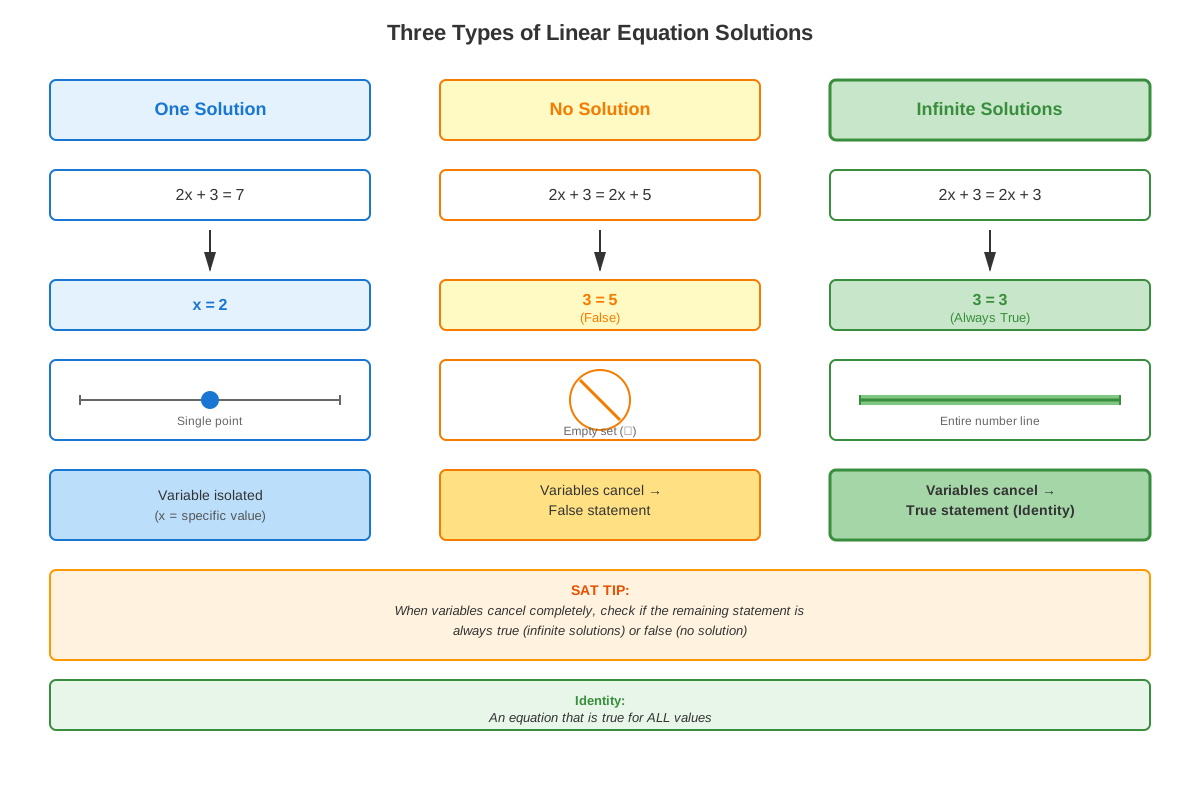
The Three Types of Linear Equation Solutions
Understanding infinite-solution equations requires recognizing how they differ from other solution types:
| Solution Type | Simplified Form | Example | Meaning |
|---|---|---|---|
| One solution | x = [number] | 2x + 3 = 7 → x = 2 | Exactly one value satisfies the equation |
| No solution | False statement | 2x + 3 = 2x + 5 → 3 = 5 | No value satisfies the equation (contradiction) |
| Infinite solutions | True statement | 2x + 3 = 2x + 3 → 3 = 3 | All values satisfy the equation (identity) |
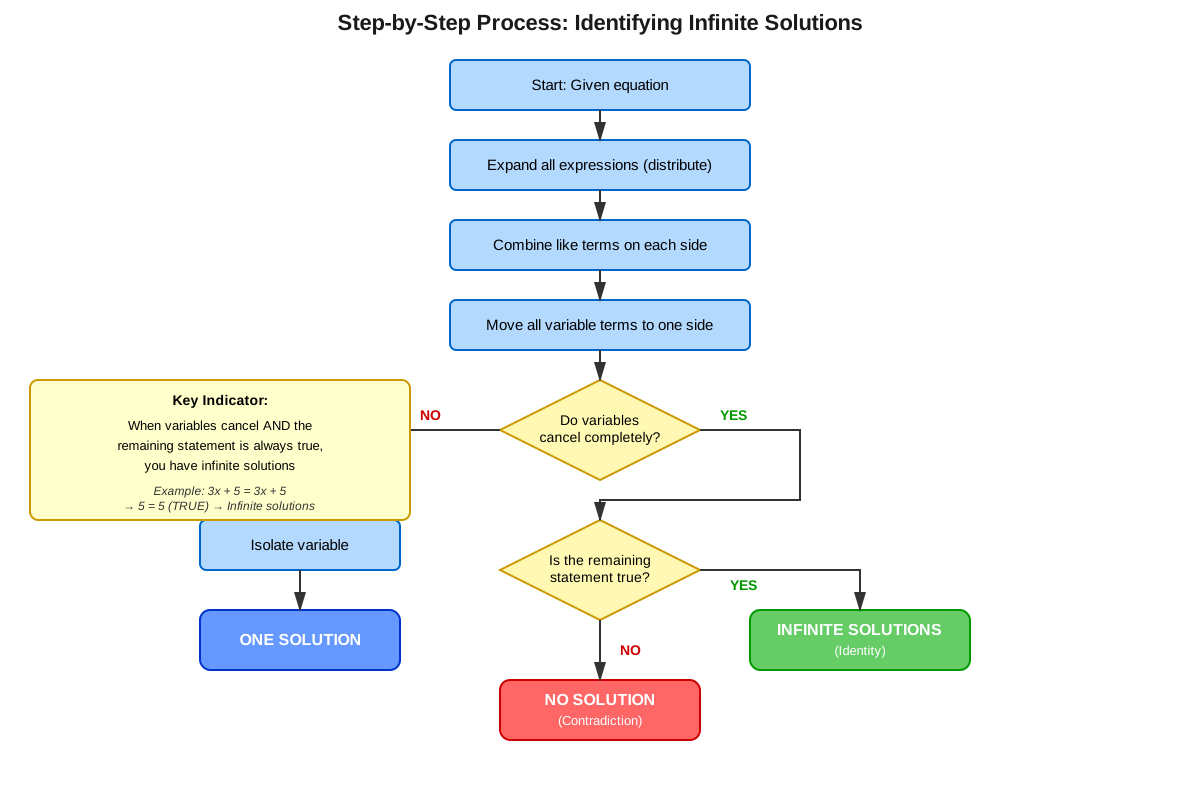
The key to identifying which type you have is to simplify the equation completely by combining like terms and isolating variable terms on one side.
Conditions for Infinite Solutions
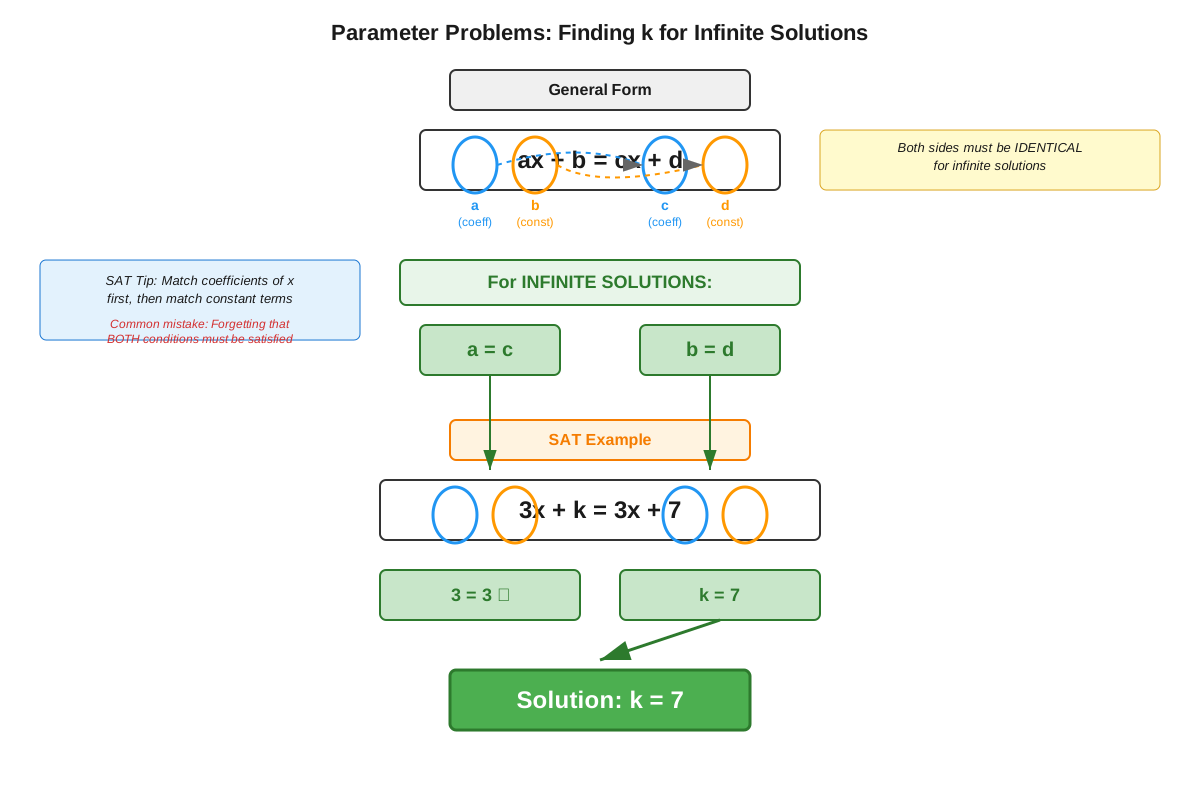
For a linear equation in the form ax + b = cx + d to have infinitely many solutions, two conditions must be met simultaneously:
- The coefficients of the variable must be equal: a = c
- The constant terms must be equal: b = d
If only the first condition is met (a = c) but b ≠ d, the equation has no solution. If the coefficients are different (a ≠ c), the equation has exactly one solution.
SAT Parameter Problems
The most common SAT application involves equations with parameters—unknown constants represented by letters like k, a, or c. A typical problem presents an equation like:
k(x - 2) = 3x - 6
The question asks: "For what value of k does this equation have infinitely many solutions?"
Solution process:
- Expand both sides completely:
- Left side: kx - 2k
- Right side: 3x - 6
- Set up the equation: kx - 2k = 3x - 6
- Apply the conditions for infinite solutions:
- Coefficient condition: k = 3
- Constant condition: -2k = -6, which gives k = 3
- Verify both conditions yield the same value: Since both conditions give k = 3, this is the answer.
If the two conditions had yielded different values for k, no value would create infinite solutions (the equation would have either one solution or no solution for any specific k value).
Systems of Equations Context
Infinite-solution equations also appear in systems of two linear equations. A system has infinitely many solutions when the two equations represent the same line—they are equivalent equations. Graphically, the lines coincide completely.
For the system:
- Equation 1: 2x + 3y = 6
- Equation 2: 4x + 6y = 12
Notice that Equation 2 is exactly twice Equation 1. These equations are equivalent, so they represent the same line, and every point on that line is a solution to both equations.
Recognition Strategies
To quickly identify infinite-solution scenarios on the SAT:
- Look for proportional relationships: If one equation is a multiple of another, they have infinite solutions
- Simplify aggressively: Distribute, combine like terms, and reduce both sides
- Watch for identical structures: If both sides have the same variable terms and constants after simplification, infinite solutions exist
- Parameter problems: Set coefficients equal AND constants equal, then solve for the parameter
Concept Relationships
The concept of infinite-solution equations builds directly on fundamental equation-solving skills. Basic linear equation solving → provides the manipulation techniques needed → to simplify and compare both sides of equations → which enables recognition of → algebraic equivalence → the core principle underlying → infinite-solution equations.
Within this topic, several interconnected ideas form a conceptual network:
- Algebraic equivalence is the foundation: two expressions are equivalent if they're equal for all variable values
- Simplification techniques (distributive property, combining like terms) serve as tools to reveal equivalence
- The three solution types (one, none, infinite) form a complete classification system for linear equations
- Parameter determination applies the equivalence conditions to find specific constant values
This topic connects forward to systems of equations, where infinite solutions indicate coincident lines, and to functions, where understanding when two function expressions are identical becomes important. The reasoning skills developed here—recognizing when mathematical expressions are fundamentally the same despite different appearances—transfer to more advanced topics including polynomial identities, trigonometric identities, and equation verification.
The relationship to no-solution equations is particularly important: both infinite-solution and no-solution equations result from having equal variable coefficients, but they differ in whether the constant terms match. This parallel structure helps students systematically analyze equations: equal coefficients → check constants → determine solution type.
High-Yield Facts
⭐ An equation has infinitely many solutions when it simplifies to an identity (a statement that's always true, like 0 = 0 or 7 = 7)
⭐ For ax + b = cx + d to have infinite solutions, both a = c AND b = d must be true
⭐ If variable coefficients are equal but constants differ, the equation has NO solution, not infinite solutions
⭐ In parameter problems, set the coefficient of x on both sides equal, then set the constant terms equal, and solve for the parameter
⭐ A system of two linear equations has infinitely many solutions when one equation is a constant multiple of the other
- When an equation simplifies so that the variable cancels completely, check what remains: if true (3 = 3), infinite solutions; if false (3 = 5), no solution
- Infinite-solution equations are also called identities because they express an identity relationship
- Every point on a line satisfies the equation of that line, which is why coincident lines in systems have infinitely many solutions
- The SAT typically presents infinite-solution questions with parameters in the range -10 to 10
- Recognizing infinite solutions quickly can save 30-60 seconds per question compared to attempting to solve for a specific x value
Quick check — test yourself on Infinite-solution equations so far.
Try Flashcards →Common Misconceptions
Misconception: If an equation has a variable on both sides, it automatically has infinitely many solutions.
Correction: Variables on both sides are common in all linear equations. Only when the coefficients AND constants are equal (making both sides identical) does the equation have infinitely many solutions. Most equations with variables on both sides have exactly one solution.
Misconception: When the variable cancels out during solving, the equation always has infinitely many solutions.
Correction: When the variable cancels, examine what remains. If you get a true statement (0 = 0, 5 = 5), there are infinite solutions. If you get a false statement (0 = 3, 2 = 7), there are NO solutions. The variable canceling indicates either infinite or no solutions, not necessarily infinite.
Misconception: In parameter problems, only the coefficient condition matters—if the coefficients match, there are infinite solutions.
Correction: BOTH conditions must be satisfied. The coefficients of the variable must be equal AND the constant terms must be equal. If only coefficients match but constants don't, the equation has no solution for that parameter value.
Misconception: An equation like 2x = 2x has infinitely many solutions, but 2x + 5 = 2x + 5 has only one solution because of the added constants.
Correction: Both equations have infinitely many solutions. Adding the same constant to both sides of an identity preserves the identity. Any equation where both sides are completely identical (after simplification) has infinitely many solutions, regardless of complexity.
Misconception: In systems of equations, if the slopes are equal, the system has infinitely many solutions.
Correction: Equal slopes mean the lines are parallel, but parallel lines can be distinct (no solution) or coincident (infinite solutions). For infinite solutions, the lines must be identical—same slope AND same y-intercept. This occurs when one equation is a multiple of the other.
Misconception: Infinite-solution equations are rare and unimportant in real mathematics.
Correction: Identities are fundamental in mathematics. Trigonometric identities, algebraic identities, and equivalent formulations of laws in science are all infinite-solution equations. They represent equivalent ways of expressing the same relationship and are central to mathematical reasoning.
Worked Examples
Example 1: Basic Parameter Determination
Problem: For what value of c does the equation 4(x - 3) = cx - 12 have infinitely many solutions?
Solution:
Step 1: Expand the left side using the distributive property.
- 4(x - 3) = 4x - 12
Step 2: Write the equation with both sides expanded.
- 4x - 12 = cx - 12
Step 3: Apply the conditions for infinite solutions.
- For infinite solutions, the coefficient of x must be equal on both sides: 4 = c
- The constant terms must also be equal: -12 = -12 ✓ (already satisfied)
Step 4: State the answer.
- c = 4
Verification: Substitute c = 4 back into the original equation:
- 4(x - 3) = 4x - 12
- 4x - 12 = 4x - 12 ✓
This is clearly an identity, confirming our answer. This problem directly addresses the learning objective of determining conditions for infinite solutions and demonstrates the systematic approach needed for SAT success.
Example 2: System of Equations with Parameters
Problem: The system of equations below has infinitely many solutions. What is the value of k?
3x + 2y = 12
kx + 8y = 48Solution:
Step 1: Recognize that for a system to have infinitely many solutions, one equation must be a multiple of the other.
Step 2: Determine what multiple relates the equations.
- Compare the y-coefficients: 8 = 4 × 2
- Compare the constants: 48 = 4 × 12
- The second equation is 4 times the first equation
Step 3: Apply this relationship to find k.
- If the second equation is 4 times the first, then: kx = 4(3x)
- Therefore: k = 4 × 3 = 12
Step 4: Verify the complete relationship.
- First equation × 4: 4(3x + 2y) = 4(12) → 12x + 8y = 48
- Second equation with k = 12: 12x + 8y = 48 ✓
Answer: k = 12
Alternative approach: We could also solve this by putting both equations in slope-intercept form and setting slopes and y-intercepts equal, but recognizing the multiple relationship is faster on the SAT.
This example demonstrates how infinite-solution concepts appear in systems of equations and shows the efficient recognition strategy that saves time on test day.
Exam Strategy
When approaching sat infinite-solution equations questions on the SAT, follow this strategic framework:
Recognition Phase (5-10 seconds):
- Identify trigger phrases: "infinitely many solutions," "all values of x satisfy," "for what value of [parameter]"
- Note whether the problem involves a single equation with a parameter or a system of equations
- Quickly scan for variables on both sides—this confirms you're dealing with an equivalence problem
Solution Phase (30-45 seconds):
- For single equations with parameters: Expand all expressions completely, then set coefficients equal AND constants equal
- For systems: Look for proportional relationships—can one equation be multiplied by a constant to produce the other?
- Write your work clearly to avoid sign errors during distribution and combination
Verification Phase (10-15 seconds):
- Substitute your parameter value back into the original equation
- Confirm that both sides become identical expressions
- If time permits, test with a simple x value (like x = 0 or x = 1) to verify both sides give the same result
Exam Tip: If you're asked for a parameter value and your coefficient condition gives one value but your constant condition gives a different value, the correct answer is "no value" or "the equation cannot have infinitely many solutions." The SAT sometimes includes this as a trap answer choice.
Time Management:
- Budget 60-90 seconds maximum for infinite-solution questions
- These problems reward systematic approach over trial-and-error
- If you find yourself spending more than 90 seconds, mark for review and move on
Process of Elimination:
- Eliminate answer choices that would create no solution (coefficients equal but constants unequal)
- Eliminate choices that would create one solution (different coefficients)
- In system problems, eliminate parameter values that don't maintain proportionality across all terms
Common Trigger Words:
- "Infinitely many solutions"
- "True for all values of x"
- "Identity"
- "For what value of [k/c/a] does..."
- "The equations are equivalent when..."
Memory Techniques
The "BOTH" Mnemonic for infinite solutions:
- Both coefficients equal
- Observe the constants
- They must match
- Have infinite solutions
The "CCI" Rule (Coefficients, Constants, Identity):
When coefficients match, check constants immediately—if they're identical, you have an identity with infinite solutions.
Visual Memory Aid:
Picture two identical twins standing side by side. Just as twins are the same person in two forms, infinite-solution equations are the same expression in two forms. If the "twins" (both sides) are truly identical, every x value works.
The Multiplication Check:
For systems, remember: "One times something equals the other? Infinite solutions together!" If you can multiply one entire equation by a constant to get the other equation, the system has infinitely many solutions.
The "Cancel and Check" Rhyme:
"When the x's cancel out, check what's left without a doubt—
If it's true (like 3 = 3), infinite solutions you'll see,
If it's false (like 2 = 7), no solution is the key!"
Summary
Infinite-solution equations represent a fundamental concept in algebra where every possible value of the variable satisfies the equation because both sides are algebraically identical. On the SAT, these questions test whether students can recognize algebraic equivalence and determine parameter values that create this condition. The key principle is that for an equation ax + b = cx + d to have infinitely many solutions, both the coefficients (a = c) and the constants (b = d) must be equal. When simplified, infinite-solution equations reduce to identities—statements that are always true, such as 0 = 0. In systems of equations, infinite solutions occur when one equation is a constant multiple of the other, representing coincident lines. SAT questions typically present these concepts through parameter determination problems or system analysis. Success requires systematic expansion of expressions, careful comparison of coefficients and constants, and verification of results. Understanding the distinction between infinite solutions (identity), no solution (contradiction), and one solution (typical linear equation) is essential for accurate classification and efficient problem-solving on test day.
Key Takeaways
- An equation has infinitely many solutions when both sides are algebraically identical, simplifying to a true statement like 0 = 0
- For infinite solutions in ax + b = cx + d, BOTH conditions must hold: a = c (coefficients equal) AND b = d (constants equal)
- When the variable cancels during solving, check the remaining statement: true = infinite solutions, false = no solution
- In parameter problems, set coefficients equal and constants equal separately, then solve for the parameter—both must yield the same value
- Systems have infinitely many solutions when one equation is a constant multiple of the other (coincident lines)
- Infinite-solution questions appear 1-2 times per SAT and are highly predictable with proper technique
- Quick recognition of infinite-solution scenarios saves valuable time and prevents unnecessary calculation attempts
Related Topics
No-Solution Equations: Understanding equations that have no solution (contradictions) complements infinite-solution knowledge, as both involve equal coefficients but differ in constant terms. Mastering infinite solutions makes no-solution recognition immediate.
Systems of Linear Equations: Infinite-solution concepts extend naturally to systems, where understanding when lines coincide (infinite solutions), are parallel (no solution), or intersect (one solution) becomes crucial for SAT success.
Linear Functions and Graphs: Recognizing when two function expressions are equivalent (infinite solutions to f(x) = g(x)) connects algebraic and graphical reasoning, a key SAT skill.
Algebraic Identities: More advanced identities (like (a + b)² = a² + 2ab + b²) are infinite-solution equations that remain true for all variable values, building on the foundational concepts learned here.
Parametric Equations: In advanced mathematics, determining parameter values that create specific solution types extends the reasoning developed in this topic to more complex scenarios.
Practice CTA
Now that you've mastered the core concepts of infinite-solution equations, it's time to cement your understanding through active practice. The practice questions and flashcards designed for this topic will challenge you to apply these principles in varied SAT-style contexts, building the speed and confidence you need for test day. Remember: infinite-solution questions are among the most predictable on the SAT—with focused practice, these become reliable points in your score. Each practice problem you complete strengthens your pattern recognition and reduces your solution time. Start practicing now to transform this high-yield topic into one of your strongest areas!
Sign up free to keep reading
Create a free AnvayaPrep account to finish this SAT guide on Infinite-solution equations — plus flashcards and practice questions.