Overview
No-solution equations represent a critical category of linear equations that students encounter on the SAT Math section. These equations appear when algebraic manipulation leads to a false statement, such as 5 = 3 or 0 = 7, indicating that no value of the variable can satisfy the equation. Understanding this concept is essential because the SAT frequently tests whether students can recognize when an equation has no solution, one solution, or infinitely many solutions. Questions involving no-solution equations often require students to determine what value of a parameter (like k or a) would make an equation unsolvable, making this a high-yield topic that combines algebraic manipulation with conceptual understanding.
The ability to identify and work with no-solution equations demonstrates mathematical maturity beyond simple equation-solving. This topic bridges basic algebraic manipulation with more sophisticated reasoning about the structure of equations. Students must understand not just how to solve equations mechanically, but also why certain equations cannot be solved at all. This conceptual depth is precisely what the SAT aims to assess in its Heart of Algebra domain.
Mastering no-solution equations connects directly to broader mathematical concepts including systems of equations, parallel lines, and the fundamental properties of equality. When students understand why an equation like 2x + 3 = 2x + 5 has no solution, they develop insight into the logical structure of mathematics itself. This understanding proves invaluable not only for the SAT but also for future coursework in algebra, precalculus, and beyond.
Learning Objectives
- [ ] Identify key features of no-solution equations
- [ ] Explain how no-solution equations appears on the SAT
- [ ] Apply no-solution equations to answer SAT-style questions
- [ ] Determine parameter values that create no-solution conditions in linear equations
- [ ] Distinguish between no-solution equations, one-solution equations, and infinite-solution equations
- [ ] Recognize the algebraic signature of no-solution equations during simplification
- [ ] Solve multi-step problems involving conditions for no solutions
Prerequisites
- Basic algebraic manipulation: Students must be able to combine like terms, distribute, and isolate variables—these skills are essential for simplifying equations to determine their solution status
- Understanding of linear equations: Familiarity with the standard form and slope-intercept form of linear equations provides the foundation for recognizing when equations cannot intersect
- Properties of equality: Knowledge that the same operation can be performed on both sides of an equation is necessary for the algebraic steps that reveal no-solution conditions
- Concept of variables and constants: Distinguishing between variables (which can change) and constants (which cannot) is crucial for understanding why certain equations produce contradictions
Why This Topic Matters
In real-world applications, no-solution equations model impossible conditions or incompatible constraints. Engineers might encounter no-solution scenarios when design specifications conflict, economists might find them when supply and demand curves never intersect under certain conditions, and computer scientists use similar logic in constraint satisfaction problems. Understanding when a system has no solution prevents wasted effort trying to find answers that don't exist.
On the SAT, no-solution equations appear with remarkable frequency, typically showing up in 2-4 questions per test. These questions most commonly appear in two formats: (1) determining what value of a parameter makes an equation have no solution, and (2) identifying whether a given equation has no solution, one solution, or infinitely many solutions. The College Board particularly favors questions where students must set up an equation with specific solution properties, making this a high-value topic for score improvement.
The SAT presents no-solution equations in various contexts: pure algebraic expressions, word problems requiring equation setup, and questions about systems of equations. The test often embeds these questions in the calculator-permitted section but designs them to reward conceptual understanding rather than computational skill. Students who recognize the patterns of no-solution equations can answer these questions quickly and confidently, gaining a significant time advantage.
Core Concepts
Definition and Fundamental Characteristics
A no-solution equation is a linear equation in one variable that, when simplified using valid algebraic operations, reduces to a false statement where a constant equals a different constant. The defining characteristic is that the variable completely cancels out during simplification, leaving an impossible equality such as 0 = 5, 3 = 7, or -2 = 4.
The algebraic signature of a no-solution equation follows this pattern:
- Both sides of the equation contain the same variable term with identical coefficients
- The constant terms on each side differ
- When like terms are combined and the equation is simplified, the variable disappears
- What remains is a false numerical statement
For example, in the equation 3x + 7 = 3x + 2, both sides contain the term 3x. Subtracting 3x from both sides yields 7 = 2, which is false. Since no value of x can make 7 equal 2, the equation has no solution.
The Three Types of Linear Equation Solutions
Understanding no-solution equations requires distinguishing them from the other two solution types:
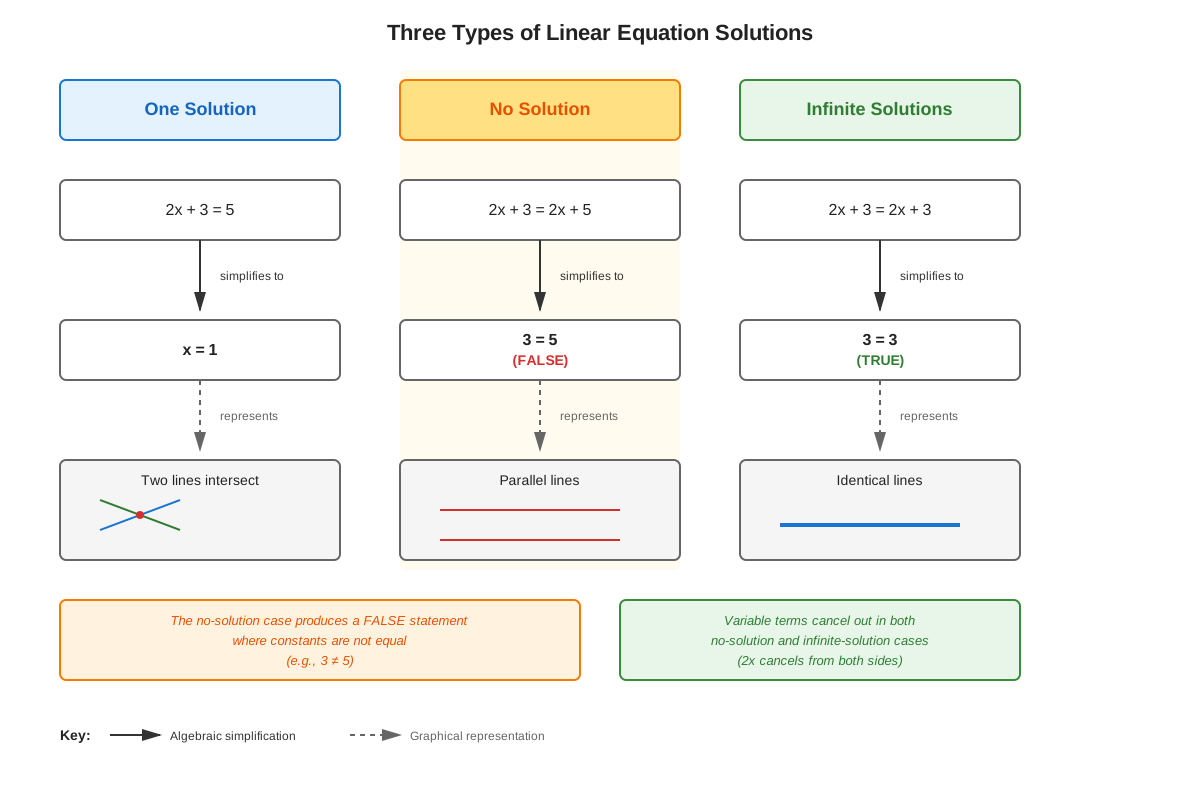
| Solution Type | Algebraic Result | Example | Meaning |
|---|---|---|---|
| One Solution | Variable equals a specific number | x = 5 | Exactly one value satisfies the equation |
| No Solution | False statement (constant ≠ different constant) | 3 = 7 | No value satisfies the equation |
| Infinite Solutions | True statement (constant = same constant) | 5 = 5 | Every value satisfies the equation |
The key distinction lies in what remains after simplification. One-solution equations retain the variable with a coefficient that can be divided out. No-solution equations eliminate the variable and produce a false statement. Infinite-solution equations also eliminate the variable but produce a true statement, indicating the two sides of the equation are identical.
Creating No-Solution Conditions with Parameters
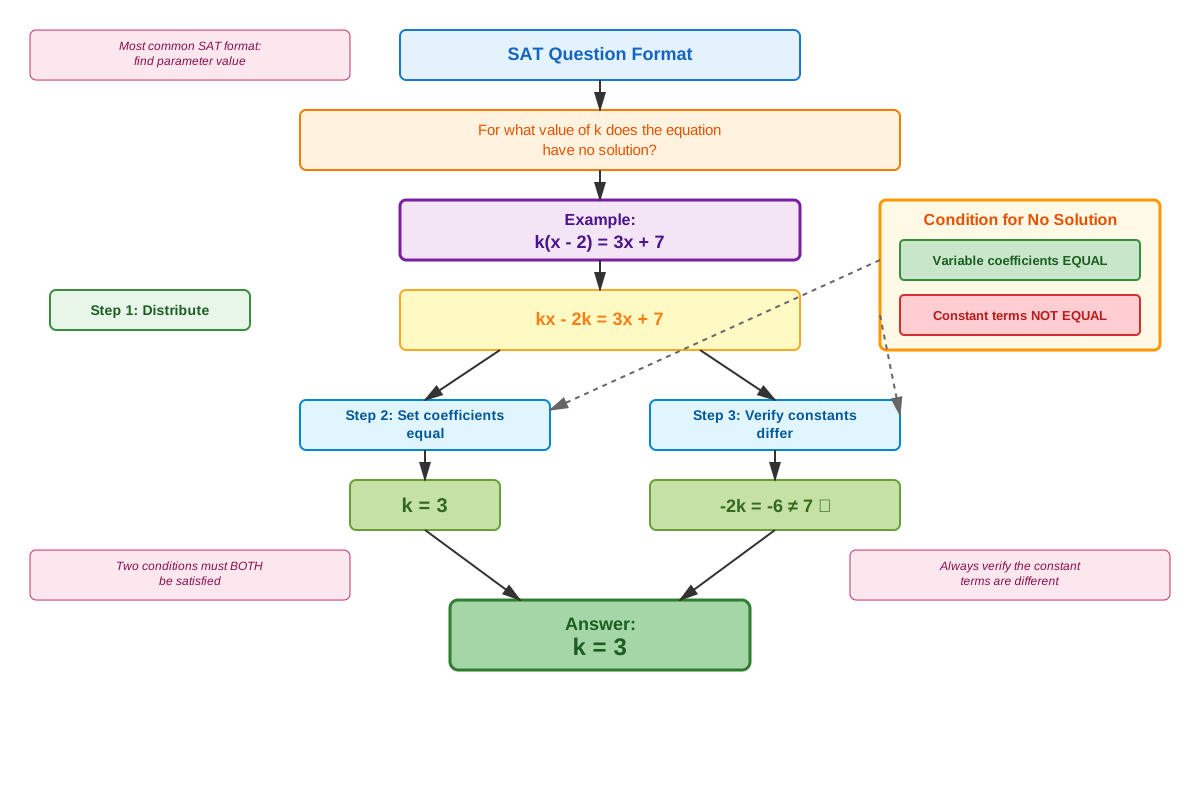
The SAT frequently asks students to determine what value of a parameter (often represented by letters like k, a, b, or c) will make an equation have no solution. This requires understanding the structural requirements for no-solution equations.
Consider the general form: ax + b = cx + d
For this equation to have no solution:
- The coefficients of x must be equal: a = c
- The constant terms must be different: b ≠ d
When both conditions are met, simplifying the equation eliminates the variable and produces a false statement. If only the first condition is met (a = c) but b = d as well, the equation has infinitely many solutions instead. If a ≠ c, the equation has exactly one solution.
Step-by-Step Process for Identifying No-Solution Equations
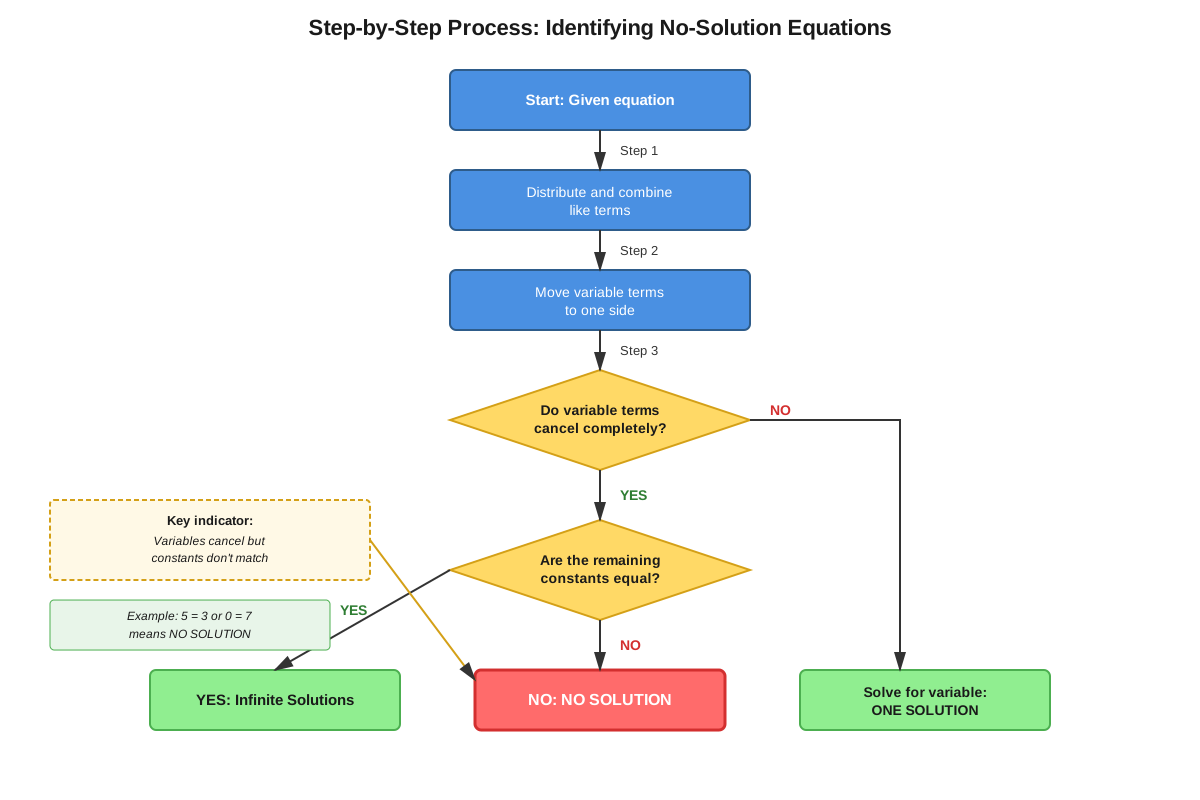
To determine whether an equation has no solution, follow this systematic approach:
- Distribute and expand all parentheses and products
- Collect like terms on each side of the equation separately
- Move all variable terms to one side (typically the left) by adding or subtracting
- Move all constant terms to the other side (typically the right)
- Examine the result:
- If you have a variable with a non-zero coefficient equal to a number (like 2x = 10), there is one solution
- If you have a false statement (like 0 = 5), there is no solution
- If you have a true statement (like 0 = 0 or 3 = 3), there are infinitely many solutions
Geometric Interpretation
From a geometric perspective, linear equations in one variable can be thought of as the x-coordinate where two linear functions intersect. A no-solution equation represents two parallel lines with the same slope but different y-intercepts—they never intersect, so there is no x-value that satisfies both equations simultaneously.
For example, the equation 2x + 3 = 2x + 5 can be rewritten as two functions: y = 2x + 3 and y = 2x + 5. Both have slope 2 (parallel) but different y-intercepts (3 and 5), so they never meet. This geometric insight reinforces why no solution exists.
Common Algebraic Forms
No-solution equations appear in several standard forms on the SAT:
Form 1: Direct comparison
ax + b = ax + c (where b ≠ c)Form 2: With distribution
k(x + m) = kx + n (where km ≠ n)Form 3: With multiple terms
ax + bx + c = (a + b)x + d (where c ≠ d)Recognizing these patterns allows for quick identification during the exam.
Concept Relationships
The concept of no-solution equations builds directly on fundamental algebraic manipulation skills. Basic equation solving → understanding of like terms → recognition of solution types → no-solution equations. Each step in this progression adds a layer of sophistication to equation analysis.
No-solution equations connect intimately with infinite-solution equations because both involve the complete cancellation of the variable term. The only difference is whether the remaining constant statement is false (no solution) or true (infinite solutions). This relationship means students must be careful and precise in their simplification to distinguish between these cases.
The concept extends naturally to systems of linear equations, where no-solution systems represent parallel lines. Understanding no-solution equations in one variable provides the foundation for recognizing inconsistent systems in two variables. Similarly, the topic connects to linear inequalities, where the concept of no solution also exists but manifests differently.
Parameter-based no-solution problems link to algebraic reasoning and conditional logic. Students must think: "Under what conditions will this equation have no solution?" This type of reasoning appears throughout higher mathematics and represents a crucial thinking skill beyond mechanical computation.
High-Yield Facts
⭐ A no-solution equation always simplifies to a false statement where one constant equals a different constant
⭐ For the equation ax + b = cx + d to have no solution, the coefficients must be equal (a = c) AND the constants must be different (b ≠ d)
⭐ When solving an equation, if the variable completely cancels out and you're left with a false statement, the equation has no solution
⭐ No-solution equations represent parallel lines that never intersect when graphed
⭐ The SAT most commonly asks for the parameter value that creates a no-solution condition, not just whether an equation has no solution
- If an equation simplifies to 0 = 0 or any true statement, it has infinitely many solutions, not no solution
- The phrase "no solution" means there is no value of the variable that makes the equation true
- Multiplying or dividing both sides of an equation by the same non-zero number never changes whether it has no solution
- An equation like 0·x = 5 has no solution because zero times any number cannot equal 5
- When checking your work, substitute your parameter value back into the original equation and verify it produces a false statement after simplification
Quick check — test yourself on No-solution equations so far.
Try Flashcards →Common Misconceptions
Misconception: An equation has no solution if you cannot solve for the variable.
Correction: An equation has no solution only if it simplifies to a false statement. If you can isolate the variable to get something like x = 3, that IS a solution—specifically, one solution. The inability to isolate the variable doesn't automatically mean no solution; it might mean infinitely many solutions if the equation simplifies to a true statement.
Misconception: If both sides of an equation look different, it must have a solution.
Correction: The appearance of the equation before simplification doesn't determine the solution type. Equations like 2(x + 3) = 2x + 7 look different on each side but simplify to 2x + 6 = 2x + 7, which becomes 6 = 7 (no solution). Always simplify completely before determining solution type.
Misconception: For ax + b = cx + d to have no solution, you need a = c = 0.
Correction: The coefficients a and c must be equal to each other, but they don't need to be zero. For example, 5x + 2 = 5x + 9 has no solution because the coefficients are both 5 (equal) and the constants 2 and 9 are different. If a = c = 0, you'd have b = d, which is either true (infinite solutions) or false (no solution) depending on whether b and d are equal.
Misconception: No solution and undefined are the same thing.
Correction: These are distinct concepts. "No solution" means no value satisfies the equation. "Undefined" typically refers to operations that cannot be performed, like division by zero. An equation can have no solution without involving any undefined operations.
Misconception: When the SAT asks "for what value of k does the equation have no solution," you should solve for k by setting the equation equal to zero.
Correction: To find the parameter value that creates no solution, you must ensure the variable coefficients are equal AND the constants are different. This typically means setting the coefficient of the variable on one side equal to the coefficient on the other side, then verifying the constants differ. Don't solve the equation for the variable; instead, analyze the structure.
Worked Examples
Example 1: Identifying a No-Solution Equation
Problem: Determine whether the equation 4(x - 2) + 3 = 4x - 5 has no solution, one solution, or infinitely many solutions.
Solution:
Step 1: Distribute on the left side
4(x - 2) + 3 = 4x - 5
4x - 8 + 3 = 4x - 5
Step 2: Combine like terms on the left side
4x - 5 = 4x - 5Step 3: Subtract 4x from both sides
4x - 5 - 4x = 4x - 5 - 4x
-5 = -5
Step 4: Analyze the result
We have -5 = -5, which is a TRUE statement. This means the equation has infinitely many solutions, not no solution.
Key Insight: This example demonstrates why careful simplification is crucial. The equation looked like it might have no solution because both sides contained 4x, but the constants were also equal, creating an identity. This connects to Learning Objective 5 (distinguishing between solution types).
Example 2: Finding a Parameter Value for No Solution
Problem: For what value of k does the equation 3(x + 2) = kx + 8 have no solution?
Solution:
Step 1: Distribute on the left side
3(x + 2) = kx + 8
3x + 6 = kx + 8
Step 2: Identify the conditions for no solution
For no solution, we need:
- The coefficients of x to be equal: 3 = k
- The constants to be different: 6 ≠ 8 ✓ (already satisfied)
Step 3: Determine k
Since we need the coefficient of x on the left (which is 3) to equal the coefficient of x on the right (which is k), we have:
k = 3Step 4: Verify
Substitute k = 3 back into the original equation:
3(x + 2) = 3x + 8
3x + 6 = 3x + 8
3x - 3x = 8 - 6
0 = 2 (FALSE)
Since we get a false statement, k = 3 creates a no-solution equation.
Answer: k = 3
Key Insight: This problem type appears frequently on the SAT. The strategy is to match coefficients of the variable while ensuring constants differ. This directly addresses Learning Objectives 1, 3, and 4.
Exam Strategy
When approaching SAT no-solution equations questions, begin by identifying the question type. If asked whether an equation has no solution, plan to simplify completely and look for a false statement. If asked for a parameter value that creates no solution, plan to match variable coefficients while keeping constants different.
Trigger words and phrases to watch for include:
- "For what value of [parameter] does the equation have no solution?"
- "How many solutions does the equation have?"
- "The equation has no solution when..."
- "For which value of k is there no value of x that satisfies..."
These phrases signal that you need to analyze solution type rather than solve for a specific variable value.
Exam Tip: When you see a parameter in an equation and are asked about solution types, immediately identify the coefficient of the variable on each side. Set these coefficients equal to find the parameter value, then verify the constants are different.
For process of elimination on multiple-choice questions, test each answer choice by substituting it into the equation and simplifying. The correct answer for a no-solution question will produce a false statement like 3 = 7. If you get a true statement like 5 = 5, that answer creates infinite solutions. If you can solve for the variable, that answer creates one solution.
Time allocation: These questions typically take 60-90 seconds if you recognize the pattern immediately. If you find yourself doing extensive algebraic manipulation for more than 2 minutes, you may be overcomplicating the problem. Step back and look for the structural pattern (matching coefficients, different constants).
A powerful shortcut: When comparing ax + b = cx + d, you can immediately see that if a = c and b ≠ d, there's no solution. You don't always need to fully simplify—pattern recognition saves time.
Memory Techniques
Mnemonic for No Solution: "Same Slope, Different Height = Never Meet"
- Same Slope = same coefficient on the variable
- Different Height = different constant terms
- Never Meet = no solution (parallel lines)
Visualization Strategy: Picture two parallel train tracks. They have the same direction (slope/coefficient) but are separated by a constant distance (different constants). No matter how far you extend them, they never intersect—just like a no-solution equation.
The "False Statement" Rule: Remember "F.S. = N.S." (False Statement = No Solution). When your simplification ends with a false statement, you have no solution.
Acronym for Solution Types: "ONE-IF"
- One solution: Number Equals variable (like x = 5)
- Infinite solutions: Fact equals same fact (like 3 = 3)
- (No solution is what's left: false statement)
The Coefficient-Constant Check: Use your fingers as a memory aid. Hold up two fingers on one hand (for the two coefficients that must match) and cross your fingers on the other hand (for the constants that must be different/crossed). This physical reminder reinforces the two conditions for no solution.
Summary
No-solution equations represent a fundamental concept in algebra where no value of the variable can satisfy the equation. These equations are characterized by their simplification to a false statement, occurring when both sides have identical variable terms but different constants. On the SAT, understanding no-solution equations is essential for success in the Heart of Algebra domain, appearing in multiple question formats that test both recognition and parameter manipulation. The key to mastering this topic lies in recognizing the structural pattern: equal coefficients on the variable combined with unequal constant terms. Students must distinguish no-solution equations from one-solution equations (which isolate the variable to a specific value) and infinite-solution equations (which simplify to true statements). The most common SAT question type asks students to determine what parameter value creates a no-solution condition, requiring them to set variable coefficients equal while ensuring constants differ. Geometric interpretation as parallel lines reinforces the concept, and systematic algebraic simplification provides the method for identification.
Key Takeaways
- No-solution equations simplify to false statements where one constant equals a different constant, indicating no value of the variable satisfies the equation
- The structural requirement for no solution in ax + b = cx + d is that a = c (equal coefficients) AND b ≠ d (different constants)
- Complete simplification is essential to distinguish between no solution (false statement), one solution (variable equals a number), and infinite solutions (true statement)
- SAT questions typically ask for parameter values that create no-solution conditions rather than simply asking whether an equation has no solution
- Geometric interpretation as parallel lines provides conceptual understanding: same slope (coefficient) but different y-intercepts (constants) means lines never intersect
- Pattern recognition saves time: immediately identify matching variable coefficients and differing constants without extensive algebraic manipulation
- Verification is crucial: always substitute your answer back into the original equation to confirm it produces a false statement after simplification
Related Topics
Infinite-Solution Equations: The complementary concept where equations simplify to true statements, indicating every value satisfies the equation. Mastering no-solution equations makes infinite-solution equations immediately accessible since they differ only in whether the final statement is true or false.
Systems of Linear Equations: No-solution concepts extend to systems where two lines are parallel. Understanding no solution in one variable provides the foundation for recognizing inconsistent systems in two variables.
Linear Inequalities: While inequalities have different solution properties, the concept of impossible conditions (no solution) appears here as well, particularly in compound inequalities with contradictory constraints.
Absolute Value Equations: Some absolute value equations have no solution when the absolute value is set equal to a negative number. The logical reasoning developed with linear no-solution equations transfers to this more advanced topic.
Functions and Domain Restrictions: Understanding when equations have no solution connects to recognizing when functions are undefined or when domain restrictions eliminate all possible inputs.
Practice CTA
Now that you've mastered the core concepts of no-solution equations, it's time to solidify your understanding through practice. Work through the practice questions to test your ability to identify no-solution conditions, determine parameter values, and distinguish between solution types. The flashcards will help you memorize the key patterns and structural requirements that appear repeatedly on the SAT. Remember, recognizing these patterns quickly is what separates good scores from great scores—and you're well on your way to mastery. Each practice problem you complete builds the confidence and speed you need for test day success!
Sign up free to keep reading
Create a free AnvayaPrep account to finish this SAT guide on No-solution equations — plus flashcards and practice questions.