Overview
Mixture equation problems are a critical category of linear equation questions that appear regularly on the SAT math section. These problems involve combining two or more substances, solutions, or groups with different characteristics (such as concentration, price, or percentage) to create a new mixture with specific properties. Students must set up and solve equations that account for the quantities and properties of each component in the mixture.
Understanding sat mixture equation problems is essential because they test multiple mathematical skills simultaneously: translating word problems into algebraic expressions, organizing information systematically, and solving linear equations. These problems frequently appear in both the calculator and no-calculator sections of the SAT, typically presenting scenarios involving solutions with different concentrations, items with different prices, or groups with different characteristics. Mastery of this topic directly impacts a student's ability to score well on the exam, as mixture problems often serve as medium-to-hard difficulty questions that separate high scorers from average performers.
Mixture problems connect to broader mathematical concepts including systems of equations, percentages, ratios, and proportional reasoning. They require students to think algebraically about real-world situations and demonstrate proficiency with linear equations in one variable—a foundational skill that appears throughout the SAT math curriculum. The problem-solving framework developed through mixture problems also transfers to other question types involving weighted averages, rate problems, and multi-step algebraic reasoning.
Learning Objectives
- [ ] Identify key features of mixture equation problems
- [ ] Explain how mixture equation problems appears on the SAT
- [ ] Apply mixture equation problems to answer SAT-style questions
- [ ] Construct algebraic equations from verbal descriptions of mixture scenarios
- [ ] Distinguish between different types of mixture problems (concentration, price, percentage)
- [ ] Evaluate the reasonableness of solutions in the context of mixture problems
- [ ] Synthesize information from tables or graphs to solve mixture equations
Prerequisites
- Basic algebraic manipulation: Students must solve linear equations with one variable, including distributing, combining like terms, and isolating variables—the fundamental operations needed to solve mixture equations
- Percentage calculations: Converting between decimals, fractions, and percentages is essential since mixture problems frequently involve concentration percentages or percentage compositions
- Unit analysis: Understanding how to track and convert units ensures students correctly interpret what each term in their equation represents
- Word problem translation: The ability to convert verbal descriptions into mathematical expressions forms the foundation for setting up mixture equations correctly
Why This Topic Matters
Mixture problems have significant real-world applications across multiple fields. Chemists use mixture calculations to prepare solutions with specific concentrations, pharmacists compound medications with precise ingredient ratios, and business professionals analyze product blends to optimize pricing and quality. Financial analysts apply mixture concepts when calculating weighted portfolio returns, and environmental scientists use them to model pollution concentrations in water systems.
On the SAT, mixture equation problems appear with notable frequency—typically 1-2 questions per test administration. These questions usually fall in the medium-to-hard difficulty range (questions 10-20 in a section) and are worth the same points as easier questions, making them high-value targets for prepared students. The College Board includes mixture problems because they assess multiple mathematical competencies: reading comprehension, algebraic reasoning, and quantitative problem-solving.
Common SAT presentations of mixture problems include: solution concentration scenarios (mixing different percentage solutions to achieve a target concentration), pricing problems (combining items at different costs to achieve an average price), and population or group problems (combining groups with different characteristics to find overall percentages). These problems may appear as straightforward word problems, questions accompanied by tables showing mixture components, or multi-step problems requiring students to first calculate intermediate values before solving for the final answer.
Core Concepts
The Fundamental Mixture Equation
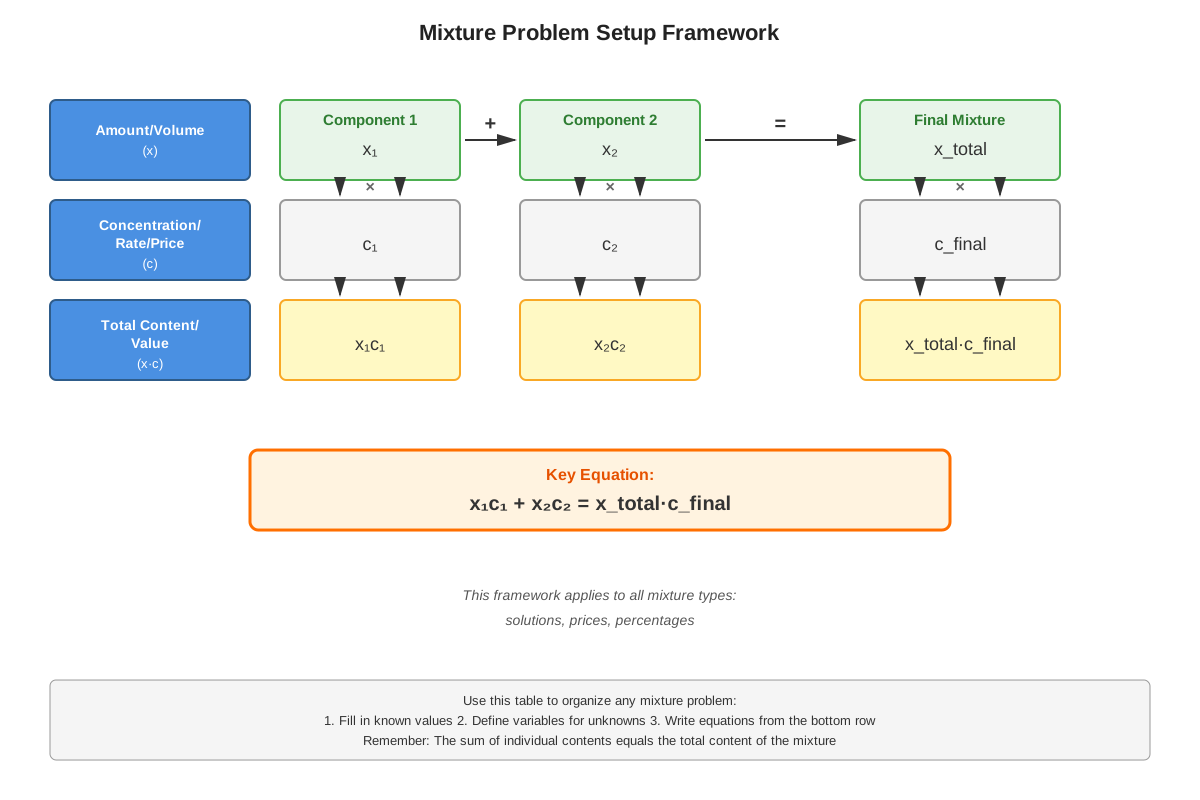
The core principle underlying all mixture equation problems is the conservation of the quantity being mixed. Whether dealing with pure substance in a solution, total cost in a price mixture, or specific characteristics in a population, the fundamental equation follows this pattern:
(Amount₁ × Property₁) + (Amount₂ × Property₂) = (Total Amount × Final Property)This equation states that the sum of each component's contribution equals the total contribution in the final mixture. Each term represents the "active ingredient" or characteristic being tracked. For example, in a salt solution problem, Amount represents volume and Property represents concentration, so each term calculates the actual amount of salt.
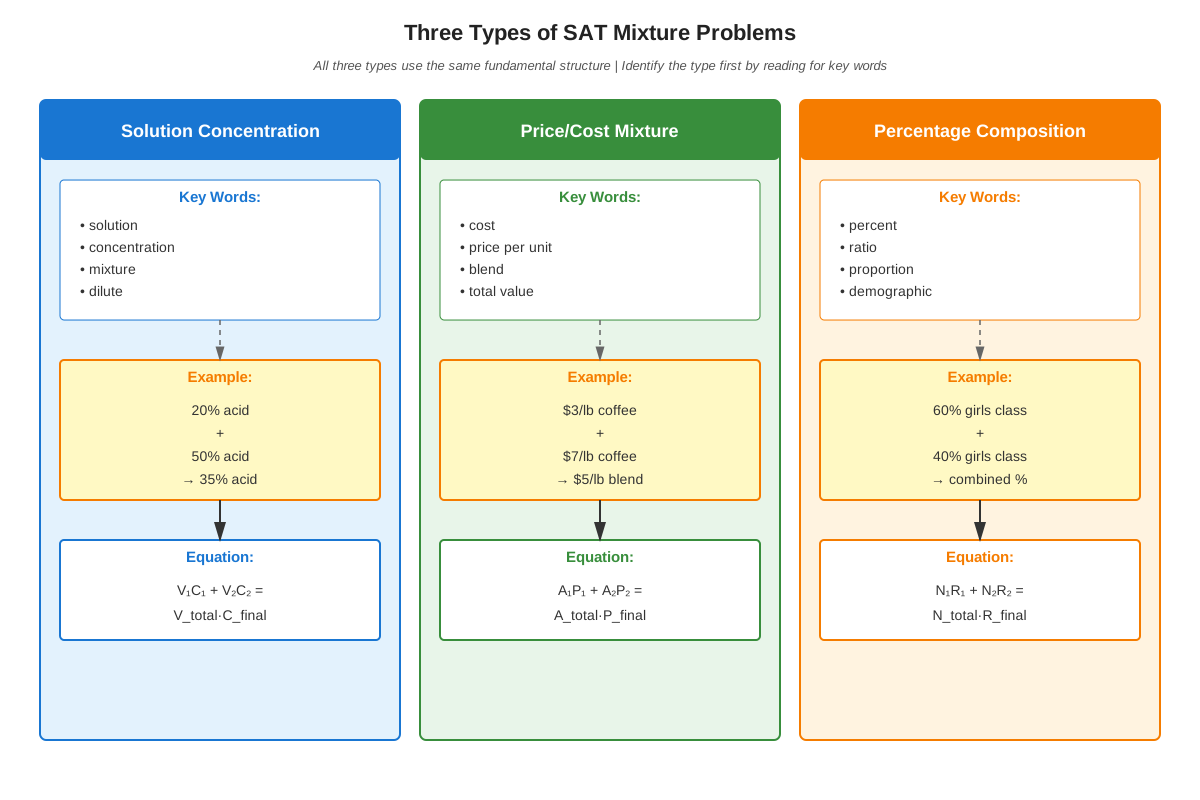
Types of Mixture Problems
Concentration/Solution Problems involve mixing liquids or solutions with different percentage compositions. A typical scenario asks students to determine how much of a 20% acid solution must be mixed with a 50% acid solution to create a specific amount of 35% acid solution. The key insight is tracking the pure substance (acid) rather than the total solution volume.
Price/Value Problems combine items with different unit costs to achieve a target average price or total value. For instance, mixing coffee beans costing $8 per pound with beans costing $12 per pound to create a blend worth $10 per pound. Here, the equation tracks total dollar value rather than concentration.
Population/Group Problems merge groups with different characteristics (such as percentage of members with a specific trait) to find overall statistics. An example might involve combining two classes with different percentages of students who passed an exam to find the overall pass rate.
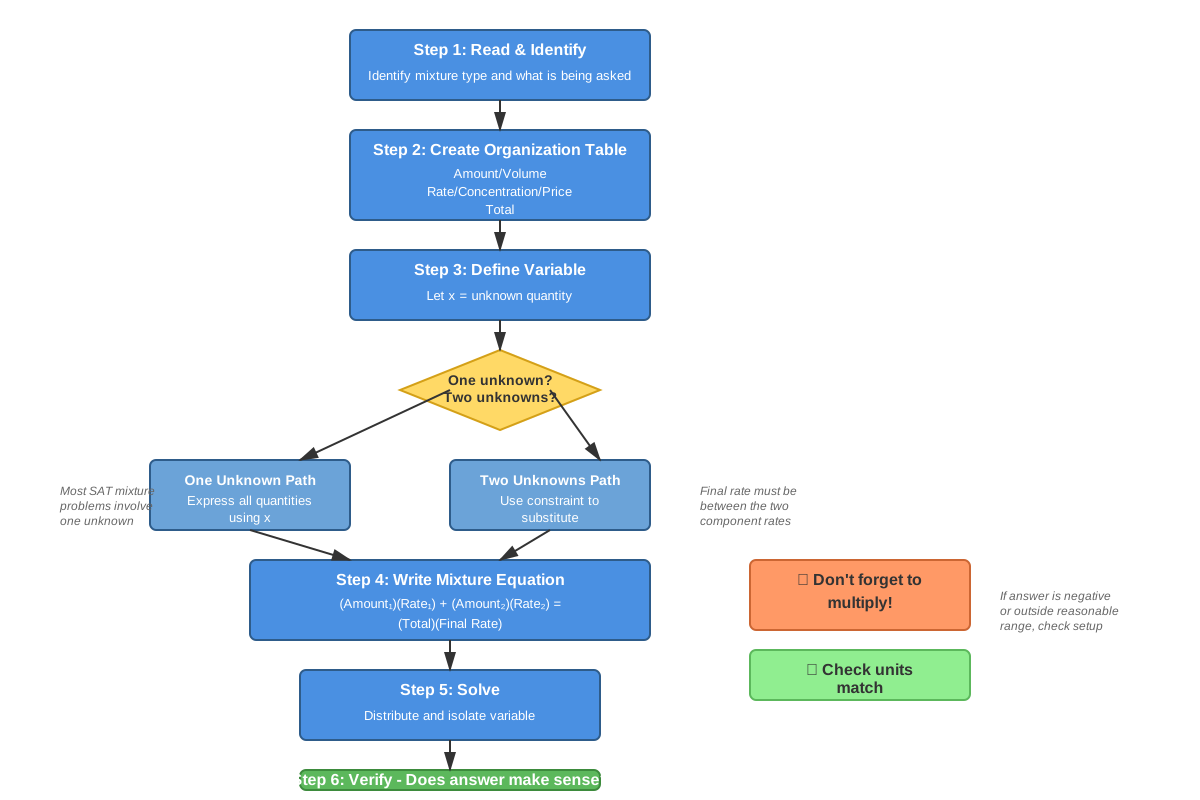
Setting Up Mixture Equations: The Systematic Approach
- Identify what is being mixed: Determine the substances, items, or groups being combined
- Define the variable: Choose what unknown quantity the variable will represent (usually the amount of one component)
- Express all amounts algebraically: Write expressions for each component's amount in terms of the variable
- Identify the property being tracked: Determine what characteristic (concentration, price, percentage) matters
- Write the mixture equation: Apply the fundamental equation structure
- Solve and verify: Solve the equation and check that the answer makes sense in context
The Table Method for Organization
Many students find success organizing mixture problems using a table structure:
| Component | Amount | Property (%) | Total Property |
|---|---|---|---|
| Component 1 | x | p₁ | x × p₁ |
| Component 2 | y | p₂ | y × p₂ |
| Mixture | x + y | p_final | (x + y) × p_final |
The bottom row equation becomes: (x × p₁) + (y × p₂) = (x + y) × p_final
This visual organization prevents common errors and ensures all necessary information is accounted for in the equation.
Converting Percentages in Mixture Equations
A critical skill in solving sat mixture equation problems is correctly converting percentages to decimals within equations. A 25% solution means 0.25 of the total is the active substance. When setting up equations, always convert percentages to decimal form: 25% becomes 0.25, 8% becomes 0.08, and 100% (pure substance) becomes 1.00.
Special Case: Adding Pure Substance or Diluting
Some mixture problems involve adding pure substance (100% concentration) or pure dilutent (0% concentration) to an existing mixture. For example, adding pure water (0% salt) to a salt solution, or adding pure alcohol (100% alcohol) to a weaker alcohol solution. These problems simplify because one term in the equation becomes zero (for dilutent) or simplifies to just the amount (for pure substance).
Working Backward from Final Conditions
SAT mixture problems sometimes provide the final mixture characteristics and ask students to determine the ratio or amounts of original components. These problems require the same fundamental equation but may need algebraic manipulation to express one variable in terms of another or to find a ratio rather than absolute quantities.
Concept Relationships
The concepts within mixture equation problems build upon each other hierarchically. The fundamental mixture equation serves as the foundation, from which all specific problem types derive. Understanding this core principle → enables recognition of concentration problems, price problems, and population problems as variations of the same mathematical structure → which leads to the ability to apply the systematic setup approach regardless of context.
The table method for organization connects directly to the fundamental equation by providing a visual framework that makes the equation structure explicit. This organizational tool → facilitates percentage conversion by creating designated spaces where students must consciously convert percentages to decimals → which reduces algebraic errors during equation solving.
Special cases (pure substance addition or dilution) represent simplified applications of the general mixture equation where recognizing the simplification → allows faster problem-solving and provides opportunities to check work against intuition.
Mixture problems connect to prerequisite knowledge through multiple pathways: basic algebraic manipulation provides the tools to solve the equations once set up; percentage calculations enable proper conversion of concentration or composition data; word problem translation skills allow students to extract the relevant information and identify which mixture type they're facing.
Looking forward, mastery of mixture equations → prepares students for systems of equations (where two mixture conditions might be given simultaneously) → and connects to weighted average problems (which use identical mathematical reasoning) → ultimately building toward more complex rate and work problems that employ similar multi-component equation structures.
High-Yield Facts
⭐ The fundamental mixture equation structure is: (Amount₁ × Property₁) + (Amount₂ × Property₂) = (Total Amount × Final Property)
⭐ Always convert percentages to decimals before substituting into mixture equations (25% = 0.25)
⭐ The sum of the amounts of individual components must equal the total amount of the final mixture
⭐ In concentration problems, track the amount of pure substance (solute), not the total solution volume
⭐ When adding pure substance (100% concentration), the property value is 1.00 in the equation
- When adding pure dilutent (0% concentration), that term contributes zero to the pure substance total
- The property being tracked must be consistent across all terms (all concentrations, all prices, or all percentages)
- If a problem asks for a ratio rather than absolute amounts, express one variable in terms of the other
- The final mixture's property value must fall between the properties of the components being mixed (you cannot mix 20% and 40% solutions to get 50%)
- Drawing a table with columns for Amount, Property, and Total helps organize information and prevent setup errors
- The units in a mixture equation must be consistent (all liters, all pounds, all gallons, etc.)
- Mixture problems often require checking that the solution makes physical sense (negative amounts or percentages over 100% indicate errors)
Quick check — test yourself on Mixture equation problems so far.
Try Flashcards →Common Misconceptions
Misconception: Students can add the percentages directly to find the final mixture percentage.
Correction: Percentages must be weighted by the amounts of each component. A 50-50 mixture of 20% and 40% solutions yields 30%, but a 1-liter-to-3-liter mixture of the same solutions yields 35%, not 30%. The mixture equation accounts for these different amounts.
Misconception: The variable can represent any quantity in the problem without affecting the equation.
Correction: The variable choice determines how all other quantities must be expressed. If x represents the amount of the first component, the second component's amount must be expressed in terms of x (or as a separate variable if using a system of equations). Inconsistent variable definitions lead to incorrect equations.
Misconception: In a problem asking "how much of solution A must be added to solution B," students can ignore the initial amount of solution B.
Correction: The final mixture amount includes both the added solution A and the original solution B. The equation must account for all components present in the final mixture, including what was already there before adding more.
Misconception: When mixing a 30% solution with pure water, students should use 0% for water in the equation, but this means water contributes 0 × (amount), which students sometimes incorrectly interpret as meaning water doesn't appear in the equation at all.
Correction: Water does appear in the total amount on the right side of the equation. The 0% concentration means water contributes no solute, but it does contribute to the total volume, which dilutes the concentration.
Misconception: The final mixture percentage should be the average of the two component percentages.
Correction: The final percentage is a weighted average based on the amounts of each component, not a simple arithmetic mean. Equal amounts produce an arithmetic average, but unequal amounts require the mixture equation to calculate the weighted result.
Misconception: Students can use percentages directly in the equation without converting to decimals.
Correction: While mathematically this could work if done consistently, it creates opportunities for errors. Standard practice converts all percentages to decimals (25% → 0.25) to ensure proper calculation when multiplying by amounts.
Worked Examples
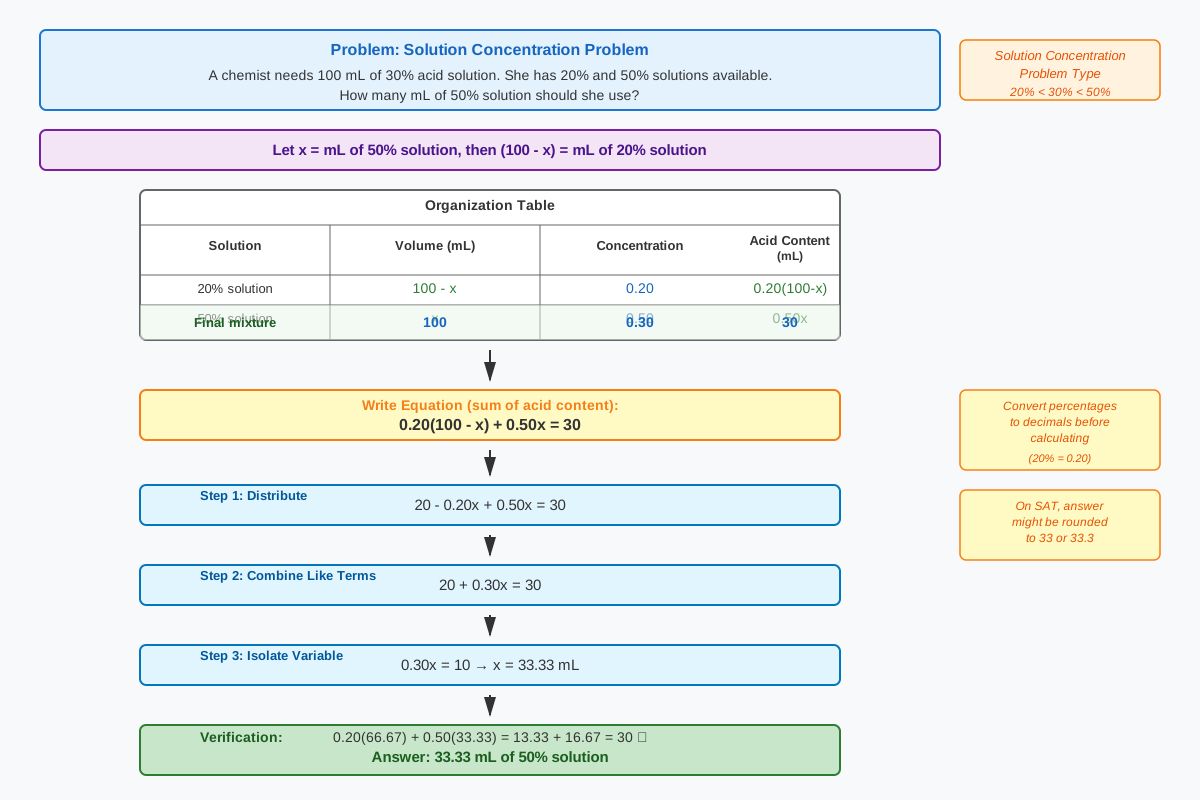
Example 1: Concentration Mixture Problem
Problem: A chemist needs to create 500 mL of a 15% acid solution by mixing a 10% acid solution with a 25% acid solution. How many milliliters of the 25% solution are needed?
Solution:
Step 1: Identify the problem type and what's being mixed
This is a concentration mixture problem. We're mixing two acid solutions with different concentrations to achieve a target concentration.
Step 2: Define the variable
Let x = the amount (in mL) of the 25% acid solution needed
Step 3: Express all amounts
- Amount of 25% solution: x mL
- Amount of 10% solution: (500 - x) mL (since the total must be 500 mL)
- Total mixture: 500 mL
Step 4: Set up the table
| Component | Amount (mL) | Concentration | Pure Acid (mL) |
|---|---|---|---|
| 25% solution | x | 0.25 | 0.25x |
| 10% solution | 500 - x | 0.10 | 0.10(500 - x) |
| Final mixture | 500 | 0.15 | 0.15(500) |
Step 5: Write and solve the equation
The pure acid from both components equals the pure acid in the final mixture:
0.25x + 0.10(500 - x) = 0.15(500)
0.25x + 50 - 0.10x = 75
0.15x + 50 = 75
0.15x = 25
x = 166.67 mL
Step 6: Verify the answer
The chemist needs approximately 167 mL of the 25% solution (and therefore 333 mL of the 10% solution). Check: Does this make sense? Since 15% is closer to 10% than to 25%, we should need more of the 10% solution, which we do (333 mL vs. 167 mL). ✓
Answer: 167 mL of the 25% acid solution (or 166.67 mL for an exact answer)
Example 2: Price Mixture Problem
Problem: A coffee shop owner wants to create a 20-pound blend of coffee worth $9 per pound by mixing coffee that costs $7 per pound with coffee that costs $12 per pound. How many pounds of the $12 coffee should be used?
Solution:
Step 1: Identify the problem type
This is a price/value mixture problem. We're combining coffees with different prices to achieve a target average price.
Step 2: Define the variable
Let x = the number of pounds of $12 coffee
Step 3: Express all amounts
- Amount of $12 coffee: x pounds
- Amount of $7 coffee: (20 - x) pounds
- Total blend: 20 pounds
Step 4: Set up the table
| Component | Amount (lb) | Price ($/lb) | Total Value ($) |
|---|---|---|---|
| $12 coffee | x | 12 | 12x |
| $7 coffee | 20 - x | 7 | 7(20 - x) |
| Blend | 20 | 9 | 9(20) |
Step 5: Write and solve the equation
The total value from both components equals the total value of the blend:
12x + 7(20 - x) = 9(20)
12x + 140 - 7x = 180
5x + 140 = 180
5x = 40
x = 8
Step 6: Verify the answer
The owner should use 8 pounds of the $12 coffee and 12 pounds of the $7 coffee.
Check: (8 × $12) + (12 × $7) = $96 + $84 = $180, and $180 ÷ 20 pounds = $9 per pound ✓
Answer: 8 pounds of the $12 coffee
This problem demonstrates how the same mixture equation structure applies to price problems as to concentration problems—only the property being tracked changes from concentration to price per unit.
Exam Strategy
When approaching sat mixture equation problems, begin by quickly identifying the problem type (concentration, price, or population) by noting what property is being mixed. Look for trigger phrases such as "percent solution," "concentration," "price per unit," "average cost," or "percentage of the group." These phrases signal which variation of the mixture equation to apply.
Exam Tip: Always read the question twice—once to understand the scenario and once to identify exactly what the question asks for. Mixture problems may ask for the amount of one component, the ratio of components, or the final property of the mixture.
Create a quick organizational table on your scratch paper before writing any equations. This 30-second investment prevents costly setup errors and makes the equation structure obvious. Label columns clearly: Amount, Property (with units), and Total Property. This visual organization also helps catch unit inconsistencies before they become calculation errors.
Watch for these specific trigger words and phrases:
- "Solution," "mixture," "concentration," "percent" → concentration problem
- "Price per," "cost," "worth," "value" → price problem
- "Combined," "merged," "together" → general mixture requiring identification of what's being tracked
- "Pure," "100%" → one component has property value of 1.00
- "Water," "dilute" → one component has property value of 0.00
For process of elimination on multiple-choice questions, immediately eliminate answers that fall outside the possible range. The final mixture property must be between the properties of the components being mixed (unless adding pure substance or dilutent). If mixing 20% and 60% solutions, any answer suggesting a final concentration below 20% or above 60% is impossible.
Time allocation for mixture problems should be approximately 2-3 minutes. If you find yourself spending more than 3 minutes, mark the question and return to it after completing easier problems. These problems reward systematic setup more than computational speed—rushing the setup phase leads to unsolvable or incorrect equations.
Before selecting your final answer, perform a quick reasonableness check: Does the amount make sense? Are the units correct? If mixing to get a property closer to one component's property, did you use more of that component? This 10-second verification catches many errors.
Memory Techniques
The "MAPS" Mnemonic for Mixture Problem Setup:
- Mixture type (identify concentration, price, or population)
- Amounts (define variable and express all amounts)
- Property (identify what's being tracked and convert percentages)
- Set equation (apply the fundamental mixture equation)
Visualization Strategy: Picture mixture problems as combining colored liquids in transparent containers. The darkness of the color represents concentration or property value. When you mix a dark liquid (high concentration) with a light liquid (low concentration), the result is medium-colored (middle concentration). The more dark liquid you add, the darker the result. This mental image helps verify that your answer makes intuitive sense.
The "Pure is One, Water is None" Rhyme: When dealing with concentration problems, remember that pure substance (100%) converts to 1.00 in equations, and pure water or dilutent (0%) converts to 0.00. This rhyme helps recall these special cases quickly.
Acronym for Verification - CHECK:
- Convert percentages to decimals
- Have all amounts been expressed?
- Equation follows the fundamental structure
- Consistent units throughout
- Known values make sense in context
Summary
Mixture equation problems represent a high-yield SAT math topic that tests algebraic reasoning through real-world scenarios involving combining substances, items, or groups with different properties. The fundamental principle underlying all mixture problems is that the sum of each component's contribution equals the total contribution in the final mixture, expressed mathematically as (Amount₁ × Property₁) + (Amount₂ × Property₂) = (Total Amount × Final Property). Success requires systematic problem-solving: identifying the mixture type, defining variables clearly, organizing information (ideally in a table), converting percentages to decimals, setting up the equation correctly, and verifying that solutions make contextual sense. Whether dealing with concentration problems, price problems, or population problems, the same mathematical structure applies—only the property being tracked changes. Students who master the setup process and avoid common pitfalls (such as adding percentages directly or forgetting to account for all components in the total) can reliably solve these medium-difficulty problems and gain valuable points on the SAT.
Key Takeaways
- The fundamental mixture equation structure applies to all mixture problem types: (Amount₁ × Property₁) + (Amount₂ × Property₂) = (Total Amount × Final Property)
- Always convert percentages to decimals before substituting into equations (25% becomes 0.25)
- Creating an organizational table with columns for Amount, Property, and Total prevents setup errors and clarifies equation structure
- The final mixture property must fall between the properties of the components being mixed (unless adding pure substance or dilutent)
- Define your variable clearly and express all other amounts in terms of that variable or as known quantities
- Verify answers by checking that they make physical sense: amounts should be positive, percentages between 0 and 100, and the weighted average should reflect the relative amounts of each component
- Mixture problems appear 1-2 times per SAT administration and typically fall in the medium-to-hard difficulty range, making them high-value targets for prepared students
Related Topics
Systems of Linear Equations: Mixture problems can extend to systems when two conditions are given simultaneously (for example, two different mixtures with specified properties). Mastering single-variable mixture equations provides the foundation for setting up and solving these more complex scenarios.
Weighted Averages: The mathematical reasoning in mixture problems directly parallels weighted average calculations. Understanding mixture equations enables students to solve weighted average problems involving test scores, grade point averages, or any scenario where different components contribute unequally to a final result.
Rate and Work Problems: These problems use similar equation structures where (Rate₁ × Time₁) + (Rate₂ × Time₂) = Total Work, mirroring the mixture equation format. The problem-solving framework developed through mixture problems transfers directly to this related topic.
Ratio and Proportion: Many mixture problems can be reframed as ratio problems, and understanding the relationship between mixture equations and proportional reasoning deepens mathematical flexibility and provides alternative solution methods.
Practice CTA
Now that you've mastered the concepts, strategies, and techniques for solving mixture equation problems, it's time to put your knowledge into action! Attempt the practice questions to reinforce your understanding and build the speed and confidence you need for test day. Each practice problem you solve strengthens your pattern recognition and problem-solving instincts. Remember, mixture problems reward systematic thinking—apply the MAPS approach, organize your information clearly, and verify your answers. The flashcards will help you internalize key formulas and concepts for instant recall. You've got this!
Sign up free to keep reading
Create a free AnvayaPrep account to finish this SAT guide on Mixture equation problems — plus flashcards and practice questions.