Overview
Work problems are a fundamental category of SAT work problems that test a student's ability to analyze rates, time, and combined efforts to complete tasks. These problems typically involve scenarios where one or more workers, machines, or processes complete a job at different rates, and students must determine how long it takes to finish the work when these entities work alone or together. On the SAT math section, work problems appear regularly as rational expression and equation challenges that require translating real-world scenarios into algebraic relationships.
Understanding work problems is essential for SAT success because they combine multiple mathematical skills: setting up equations from word problems, manipulating rational expressions, solving for unknown variables, and interpreting results in context. These problems test not just computational ability but also logical reasoning and the capacity to model complex situations mathematically. Work problems frequently appear in both the calculator and no-calculator sections, making them high-yield content that can significantly impact overall scores.
Work problems connect to broader mathematical concepts including rates, proportional reasoning, systems of equations, and rational expressions. Mastery of this topic strengthens problem-solving skills applicable to distance-rate-time problems, mixture problems, and other multi-step word problems. The algebraic techniques used in work problems—particularly working with reciprocals and combining rates—form a foundation for more advanced mathematical thinking required in college-level courses.
Learning Objectives
- [ ] Identify key features of work problems including individual rates, combined rates, and time relationships
- [ ] Explain how work problems appears on the SAT in various question formats and difficulty levels
- [ ] Apply work problems concepts to answer SAT-style questions efficiently and accurately
- [ ] Convert work scenarios into algebraic equations using rate formulas
- [ ] Calculate combined work rates when multiple entities work together or in sequence
- [ ] Solve rational equations that arise from work problem scenarios
- [ ] Interpret solutions in the context of the original problem and verify reasonableness
Prerequisites
- Basic algebraic manipulation: Essential for setting up and solving equations that model work scenarios
- Understanding of fractions and rational expressions: Required to work with rates expressed as fractions of jobs per unit time
- Solving linear and rational equations: Necessary to find unknown variables representing time or rate
- Rate concepts (distance = rate × time): The fundamental relationship that extends to work = rate × time
- Finding common denominators: Critical for combining rates and solving rational equations
Why This Topic Matters
Work problems have significant real-world applications in project management, resource allocation, manufacturing efficiency, and collaborative task completion. Understanding how to calculate combined productivity helps in workforce planning, estimating project timelines, and optimizing team composition. These skills translate directly to professional environments where multiple people or machines contribute to completing tasks.
On the SAT, work problems appear with moderate to high frequency, typically showing up 1-2 times per test administration. They most commonly appear as medium to hard difficulty questions in the calculator-permitted section, though they can also appear in the no-calculator section when the numbers are designed to work out cleanly. Work problems account for approximately 3-5% of all SAT math questions, making them a reliable topic to master for score improvement.
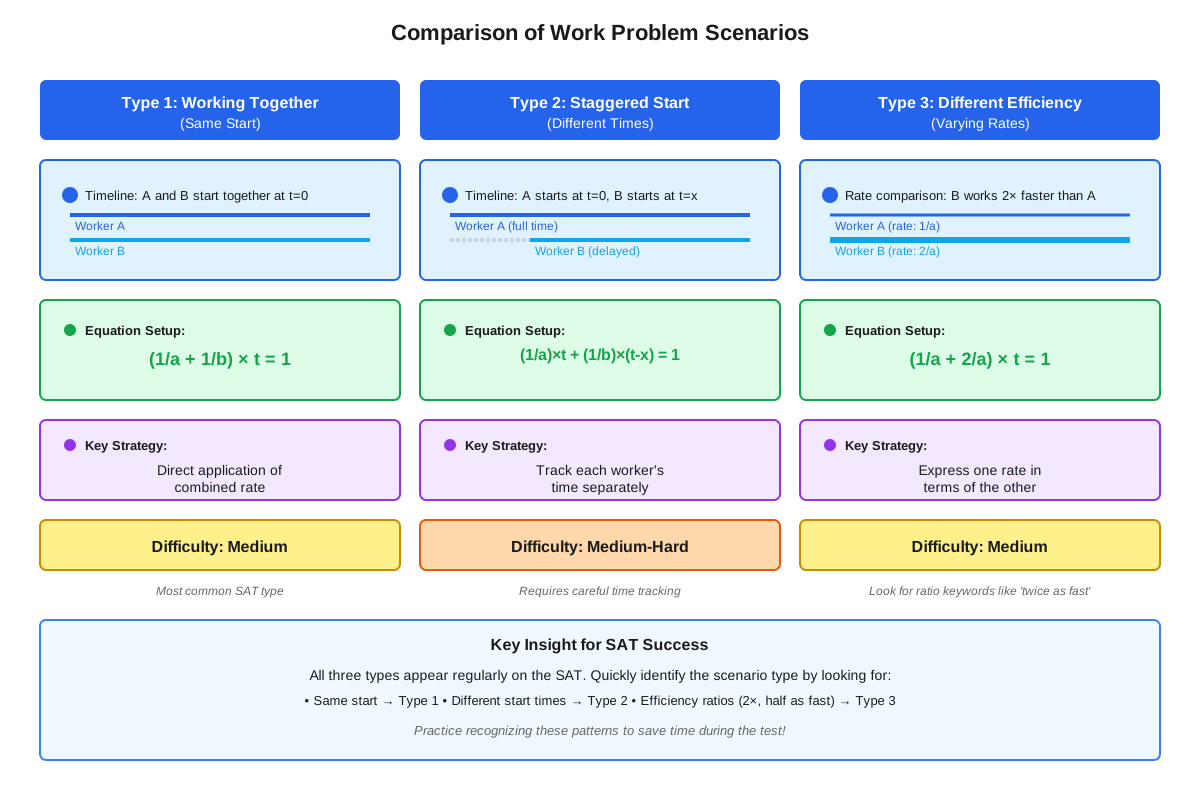
These problems typically appear in several formats: straightforward two-worker scenarios, problems involving workers with different efficiency levels, situations where workers start at different times, and complex scenarios involving workers leaving or joining a project mid-completion. The SAT often embeds work problems within real-world contexts such as filling pools, painting houses, completing assignments, or manufacturing products, requiring students to extract mathematical relationships from narrative descriptions.
Core Concepts
The Fundamental Work Formula
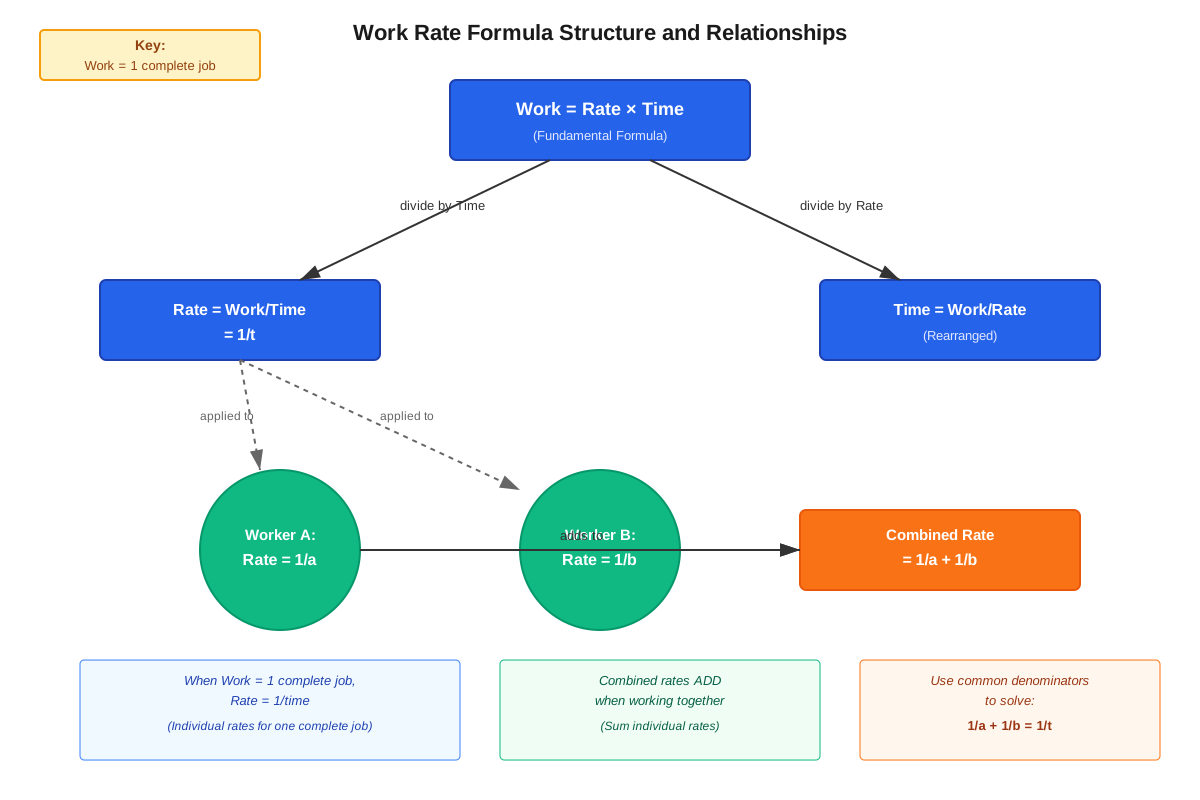
The foundation of all work problems is the relationship between work completed, rate of work, and time spent working. This relationship mirrors the distance-rate-time formula but applies to any measurable task completion:
Work = Rate × TimeIn most work problems, the total work is defined as one complete job (represented as 1 or 100%). The rate represents the fraction of the job completed per unit of time. If a worker completes a job in t hours, their rate is 1/t jobs per hour. This reciprocal relationship is crucial: time to complete one job and rate of work are multiplicative inverses.
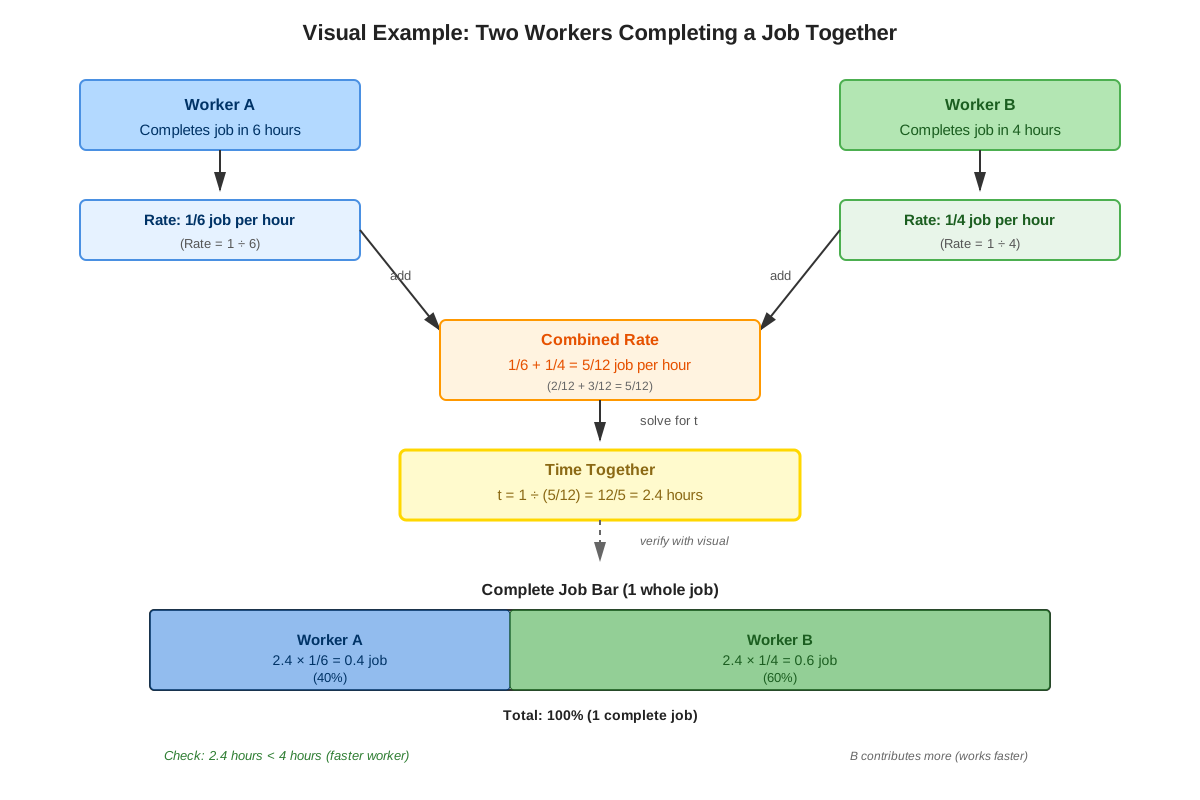
For example, if Sarah can paint a room in 4 hours, her rate is 1/4 of the room per hour. If Tom can paint the same room in 6 hours, his rate is 1/6 of the room per hour. Understanding this conversion between time and rate is the first critical skill in solving work problems.
Combined Work Rates
When multiple workers collaborate on the same task simultaneously, their individual rates add together to create a combined rate. This additive property is the key insight that unlocks most work problems:
Combined Rate = Rate₁ + Rate₂ + Rate₃ + ...Using the previous example, if Sarah (rate = 1/4 room/hour) and Tom (rate = 1/6 room/hour) work together, their combined rate is:
Combined Rate = 1/4 + 1/6 = 3/12 + 2/12 = 5/12 room per hourTo find the time required to complete one job at this combined rate, use the formula:
Time = Work ÷ Rate = 1 ÷ (5/12) = 12/5 = 2.4 hoursThis demonstrates the complete solution process: convert individual times to rates, add rates, then convert the combined rate back to time.
Setting Up Work Equations
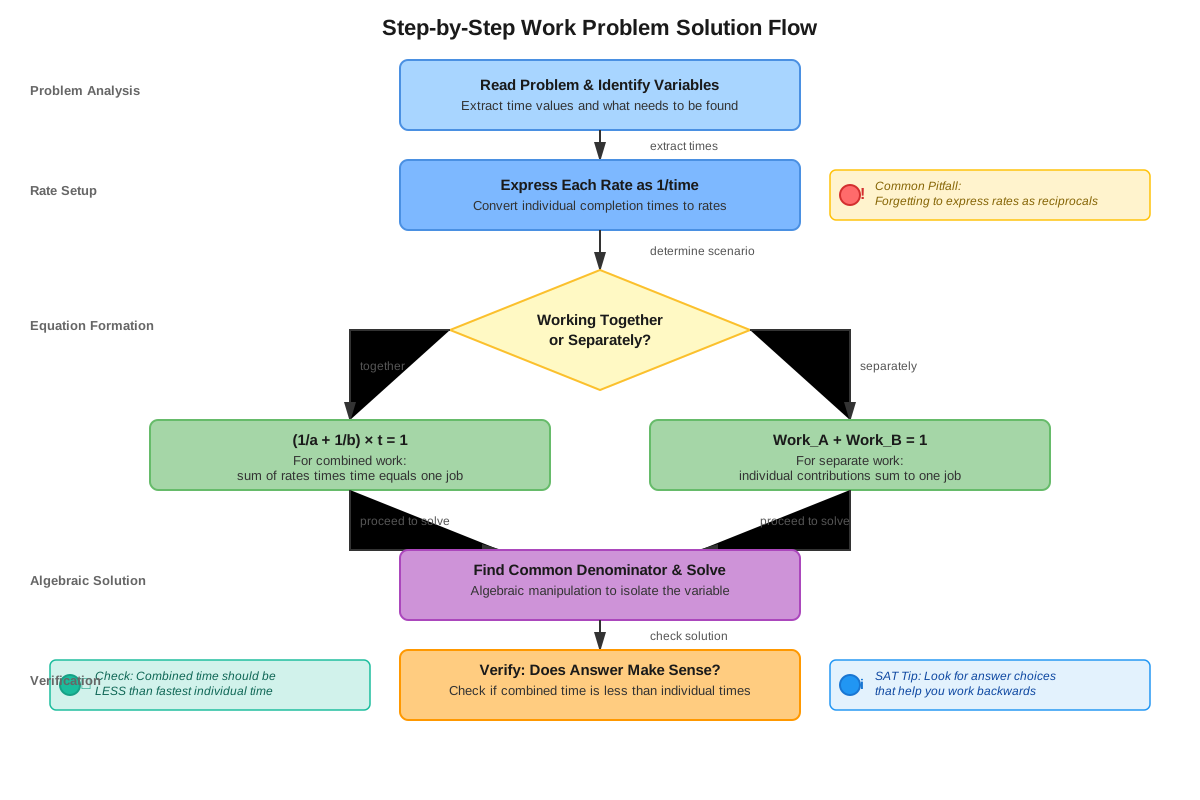
The most challenging aspect of work problems is translating word problems into algebraic equations. The standard approach involves:
- Define variables: Let t represent the unknown time or rate
- Express rates: Write each worker's rate as a fraction (often involving the variable)
- Set up the equation: Use the principle that total work completed equals 1
- Solve: Manipulate the rational equation to find the variable
- Interpret: Ensure the answer makes sense in context
Consider this problem structure: "Worker A can complete a job in x hours. Worker B can complete the same job in (x + 3) hours. Working together, they complete the job in 2 hours. Find x."
The equation becomes:
(1/x + 1/(x+3)) × 2 = 1This equation states that the combined rate multiplied by 2 hours equals one complete job.
Types of Work Problem Scenarios
| Scenario Type | Key Characteristic | Solution Approach |
|---|---|---|
| Basic Combined Work | Two or more workers with known individual times | Add rates, find combined time |
| Unknown Individual Time | One or more times expressed as variables | Set up equation, solve for variable |
| Sequential Work | Workers work in shifts, not simultaneously | Calculate work done in each period separately |
| Partial Work Completion | Workers complete only part of the job | Use Work = Rate × Time for each segment |
| Variable Efficiency | Workers have rates that change over time | Break into time periods with constant rates |
Solving Rational Equations from Work Problems
Work problems frequently generate rational equations that require algebraic manipulation. The standard solving process involves:
- Find the least common denominator (LCD) of all fractions in the equation
- Multiply every term by the LCD to eliminate denominators
- Simplify to create a polynomial equation (often quadratic)
- Solve using factoring, quadratic formula, or other appropriate methods
- Check solutions for extraneous roots and contextual validity
For example, solving:
1/x + 1/(x+3) = 1/2Multiply by LCD of 2x(x+3):
2(x+3) + 2x = x(x+3)
2x + 6 + 2x = x² + 3x
4x + 6 = x² + 3x
0 = x² - x - 6
0 = (x-3)(x+2)
Solutions are x = 3 or x = -2. Since time cannot be negative, x = 3 hours.
Negative Work and Opposing Rates
Some work problems involve processes that work against each other, such as filling a pool while a drain is open. In these scenarios, rates can be subtracted rather than added:
Net Rate = Filling Rate - Draining RateIf a pipe fills a pool at 1/5 pool per hour and a drain empties it at 1/8 pool per hour, the net filling rate is:
Net Rate = 1/5 - 1/8 = 8/40 - 5/40 = 3/40 pool per hourThe pool would fill in 40/3 ≈ 13.33 hours with both operating.
Concept Relationships
The core concepts in work problems build upon each other in a logical progression. The fundamental work formula (Work = Rate × Time) serves as the foundation, from which the concept of rate as reciprocal of time emerges. This reciprocal relationship enables the conversion between "time to complete one job" and "fraction of job completed per unit time."
The combined work rates concept extends directly from understanding individual rates, applying the principle that simultaneous efforts are additive. This leads naturally to setting up work equations, which requires synthesizing the rate addition principle with the constraint that total work equals one complete job. The equation-setting process connects to solving rational equations, which applies prerequisite algebraic skills to the specific context of work problems.
Sequential work scenarios and partial work completion represent applications of the fundamental formula to more complex situations, requiring students to break problems into segments and sum the work completed in each period. Negative work extends the rate addition concept to situations involving opposing processes.
The relationship map flows as:
Fundamental Formula → Rate-Time Reciprocal → Individual Rates → Combined Rates → Work Equations → Rational Equation Solving → Complex Scenarios (Sequential, Partial, Opposing)
These concepts connect to prerequisite knowledge of rational expressions (manipulating fractions), equation solving (isolating variables), and proportional reasoning (understanding rates). They also relate to other SAT topics including distance-rate-time problems (identical mathematical structure), mixture problems (combining quantities with different properties), and systems of equations (multiple constraints on variables).
Quick check — test yourself on Work problems so far.
Try Flashcards →High-Yield Facts
⭐ The rate of work is the reciprocal of time: If a job takes t hours, the rate is 1/t jobs per hour
⭐ Combined rates add when working together: Rate₁ + Rate₂ = Combined Rate
⭐ Time for combined work: Time = 1 ÷ (Rate₁ + Rate₂)
⭐ The fundamental equation: (1/t₁ + 1/t₂) × Time_together = 1 complete job
⭐ Always check if solutions are contextually valid: Negative times or rates are typically not meaningful
- Work completed equals rate multiplied by time for any time interval
- When workers start at different times, calculate work done in each time period separately
- If one worker is twice as fast as another, their rate is double (not their time)
- The combined time is always less than either individual time when working together
- Opposing processes (like filling and draining) require subtracting rates
- Partial work problems use the equation: Rate₁ × Time₁ + Rate₂ × Time₂ = Total Work
- Converting between "jobs per hour" and "hours per job" requires taking the reciprocal
- The LCD method is the most reliable approach for solving rational work equations
- Work problems often generate quadratic equations that require factoring or the quadratic formula
- Units must be consistent throughout the problem (all hours, or all minutes, etc.)
Common Misconceptions
Misconception: When two workers collaborate, the time is cut in half.
Correction: The combined time is only half of one individual time if both workers have identical rates. Generally, 1/Time_combined = 1/Time₁ + 1/Time₂, which does not simplify to Time_combined = (Time₁ + Time₂)/2.
Misconception: If Worker A is twice as fast as Worker B, then Worker A takes twice as long.
Correction: "Twice as fast" means twice the rate, which corresponds to half the time. If Worker B takes 6 hours, Worker A (twice as fast) takes 3 hours, not 12 hours.
Misconception: Rates should be multiplied when workers collaborate.
Correction: Rates add when workers work simultaneously on the same task. Multiplication would apply if you're calculating total work over time (Work = Rate × Time), not combined rates.
Misconception: The answer to a work problem must always be a whole number.
Correction: Work problems frequently yield fractional or decimal answers for time. For example, 2.5 hours (2 hours 30 minutes) is a perfectly valid answer.
Misconception: In sequential work problems, you can simply add the times each worker spends.
Correction: You must calculate the fraction of work completed in each time period (Rate × Time) and ensure these fractions sum to 1. Simply adding times ignores the different rates of work.
Misconception: All solutions to the algebraic equation are valid answers.
Correction: Always check solutions for contextual validity. Negative times, negative rates, or values that contradict the problem setup (like a slower worker having less time) must be rejected as extraneous solutions.
Worked Examples
Example 1: Basic Combined Work Problem
Problem: Machine A can produce 200 widgets in 5 hours. Machine B can produce 200 widgets in 8 hours. How long will it take both machines working together to produce 200 widgets?
Solution:
Step 1: Identify individual rates
- Machine A completes the job in 5 hours, so its rate is 1/5 job per hour
- Machine B completes the job in 8 hours, so its rate is 1/8 job per hour
Step 2: Calculate combined rate
Combined Rate = 1/5 + 1/8Finding common denominator (LCD = 40):
Combined Rate = 8/40 + 5/40 = 13/40 job per hourStep 3: Calculate time for one complete job
Time = Work ÷ Rate = 1 ÷ (13/40) = 40/13 ≈ 3.08 hoursStep 4: Interpret the answer
Working together, the machines complete the job in approximately 3.08 hours, or about 3 hours and 5 minutes.
Connection to Learning Objectives: This example demonstrates identifying key features (individual rates, combined rate), applying the fundamental work formula, and interpreting the solution contextually.
Example 2: Unknown Individual Time with Variable
Problem: Pump A can fill a swimming pool in x hours. Pump B can fill the same pool in (x + 4) hours. When both pumps work together, they fill the pool in 3 hours. Find the value of x.
Solution:
Step 1: Set up the equation
- Pump A's rate: 1/x pools per hour
- Pump B's rate: 1/(x + 4) pools per hour
- Combined rate working for 3 hours completes 1 pool:
(1/x + 1/(x+4)) × 3 = 1Step 2: Simplify the equation
3/x + 3/(x+4) = 1Step 3: Eliminate denominators
Multiply every term by x(x + 4):
3(x+4) + 3x = x(x+4)
3x + 12 + 3x = x² + 4x
6x + 12 = x² + 4x
Step 4: Rearrange to standard form
0 = x² + 4x - 6x - 12
0 = x² - 2x - 12
Step 5: Solve the quadratic
Using the quadratic formula where a = 1, b = -2, c = -12:
x = (2 ± √(4 + 48))/2 = (2 ± √52)/2 = (2 ± 7.21)/2This gives x ≈ 4.6 or x ≈ -2.6
Step 6: Check validity
Since time cannot be negative, x ≈ 4.6 hours.
Step 7: Verify the answer
- Pump A fills the pool in 4.6 hours (rate = 1/4.6 ≈ 0.217 pools/hour)
- Pump B fills the pool in 8.6 hours (rate = 1/8.6 ≈ 0.116 pools/hour)
- Combined rate ≈ 0.333 pools/hour
- Time together = 1/0.333 ≈ 3 hours ✓
Connection to Learning Objectives: This example demonstrates setting up equations from word problems, solving rational equations that become quadratic, and verifying solutions for contextual validity—all critical SAT skills.
Exam Strategy
When approaching sat work problems on the test, follow this systematic process:
Step 1: Identify the problem type
Look for trigger phrases like "working together," "complete a job," "fill a tank," "paint a room," or "produce items." These signal a work problem requiring rate analysis.
Step 2: Extract and organize information
Create a simple table or list:
- What is the complete job (usually defined as 1 or 100%)?
- What are the individual times or rates?
- What is being asked (combined time, individual time, rate)?
Step 3: Convert times to rates immediately
Write down the rate formula (1/time) for each worker or machine as soon as you identify their individual completion time. This prevents confusion later.
Step 4: Set up the equation before calculating
Don't rush to compute. Write the complete equation representing the situation, then solve systematically. This reduces errors and makes checking work easier.
Step 5: Watch for these trigger words
- "Together" or "simultaneously" → add rates
- "Alone" → use individual rate
- "Starts 2 hours later" → sequential work problem
- "Twice as fast" → rate is doubled (time is halved)
- "Completes 3/4 of the job" → partial work scenario
Process of elimination tips:
- Eliminate answers greater than the smallest individual time (combined work is always faster)
- Eliminate negative values unless the problem involves debt or removal
- Check if the answer is reasonable by rough estimation (e.g., if two workers take 4 and 6 hours individually, together should take between 2 and 3 hours)
- When solving for a rate, eliminate answers with wrong units
Time allocation:
Spend 30-45 seconds reading and organizing information, 60-90 seconds setting up and solving the equation, and 15-30 seconds checking your answer. Work problems typically warrant 2-3 minutes total—they're worth the investment as medium-to-hard point opportunities.
Memory Techniques
R-A-T-E Mnemonic for the solution process:
- Reciprocal: Convert time to rate (1/time)
- Add: Combine rates when working together
- Time: Calculate time from combined rate (1/combined rate)
- Evaluate: Check if the answer makes contextual sense
"Rates Add, Times Don't": Remember this phrase to avoid the common error of averaging times instead of adding rates.
The Reciprocal Flip: Visualize flipping a fraction. Time on bottom (1/time) gives rate; rate on bottom (1/rate) gives time. This physical visualization helps remember the reciprocal relationship.
T-R-T Pattern: Time → Rate → Time. You often start with time, convert to rate to solve, then convert back to time for the answer. Recognizing this pattern helps structure solutions.
"Faster means smaller time, bigger rate": When comparing workers, the faster one has a larger rate (bigger fraction) but smaller time. This prevents confusion with "twice as fast" language.
Summary
Work problems on the SAT test the ability to model collaborative task completion using rates, time, and rational expressions. The fundamental principle is that work equals rate multiplied by time, with rates expressed as reciprocals of completion times. When multiple entities work simultaneously, their rates add to create a combined rate, which can then be converted back to time for the complete job. Solving work problems requires translating word problems into algebraic equations, manipulating rational expressions, solving the resulting equations (often quadratic), and verifying solutions for contextual validity. Success depends on recognizing problem types, systematically converting between time and rate representations, correctly applying the rate addition principle, and checking answers for reasonableness. Mastery of work problems provides a significant advantage on the SAT, as these questions appear regularly and test multiple mathematical skills simultaneously.
Key Takeaways
- Work rate is always the reciprocal of time: if a job takes t hours, the rate is 1/t jobs per hour
- Combined rates add when workers collaborate: Rate_total = Rate₁ + Rate₂ + Rate₃...
- The standard equation for combined work is (1/t₁ + 1/t₂) × Time_together = 1
- Always convert times to rates before combining, then convert the combined rate back to time
- Check all solutions for contextual validity—negative times and rates are usually meaningless
- Sequential work problems require calculating work completed in each time period separately
- "Twice as fast" means double the rate, which corresponds to half the time, not double the time
Related Topics
Distance-Rate-Time Problems: These use an identical mathematical structure (Distance = Rate × Time) and the same problem-solving strategies, making work problems excellent preparation for motion problems.
Mixture Problems: Combining substances with different concentrations uses similar rate-addition principles, extending the collaborative work concept to chemical or solution contexts.
Systems of Equations: Complex work problems with multiple unknowns often require setting up and solving systems, building on the single-equation work problem foundation.
Rational Expressions and Equations: Work problems provide practical applications for simplifying complex fractions, finding common denominators, and solving rational equations—skills tested independently on the SAT.
Quadratic Equations: Many work problems generate quadratic equations, reinforcing factoring, the quadratic formula, and solution verification skills.
Practice CTA
Now that you've mastered the concepts, strategies, and common pitfalls of work problems, it's time to solidify your understanding through practice. Attempt the practice questions to apply these techniques to SAT-style problems, and use the flashcards to reinforce key formulas and relationships. Remember: work problems are high-yield content that appear consistently on the SAT—investing time in practice now will pay dividends on test day. Each problem you solve strengthens your pattern recognition and builds the confidence needed to tackle these questions quickly and accurately under timed conditions. You've got this!
Sign up free to keep reading
Create a free AnvayaPrep account to finish this SAT guide on Work problems — plus flashcards and practice questions.