Overview
Percent equation problems are among the most frequently tested question types in SAT math, appearing in multiple forms across both the calculator and no-calculator sections. These problems require students to translate real-world scenarios involving percentages into algebraic equations and solve for unknown values. Mastery of this topic is essential because percent problems appear not only as standalone questions but also embedded within word problems involving discounts, tax calculations, population changes, financial scenarios, and scientific data interpretation.
The SAT tests percent equation problems to assess both mathematical reasoning and practical problem-solving skills. Students must demonstrate the ability to identify what quantity represents the "whole," what represents the "part," and what percentage relationship connects them. Unlike simple percentage calculations that might appear on basic math assessments, sat percent equation problems require multi-step reasoning, often involving the setup and solution of linear equations where the unknown variable could represent any component of the percent relationship—the part, the whole, or the percentage itself.
Understanding percent equation problems connects directly to broader mathematical concepts including proportional reasoning, linear equations in one variable, and algebraic manipulation. These problems serve as a bridge between arithmetic percentage calculations and more complex algebraic thinking. Students who master this topic develop stronger skills in translating verbal descriptions into mathematical expressions, a competency that extends to virtually every other quantitative reasoning task on the SAT. The ability to work fluently with percent equations also supports success in data interpretation questions, where percentage changes and comparisons frequently appear in charts, graphs, and tables.
Learning Objectives
- [ ] Identify key features of percent equation problems
- [ ] Explain how percent equation problems appears on the SAT
- [ ] Apply percent equation problems to answer SAT-style questions
- [ ] Convert between different forms of the percent equation (part = percent × whole)
- [ ] Solve for any unknown variable in a percent relationship (part, whole, or percentage)
- [ ] Translate complex word problems involving percentages into algebraic equations
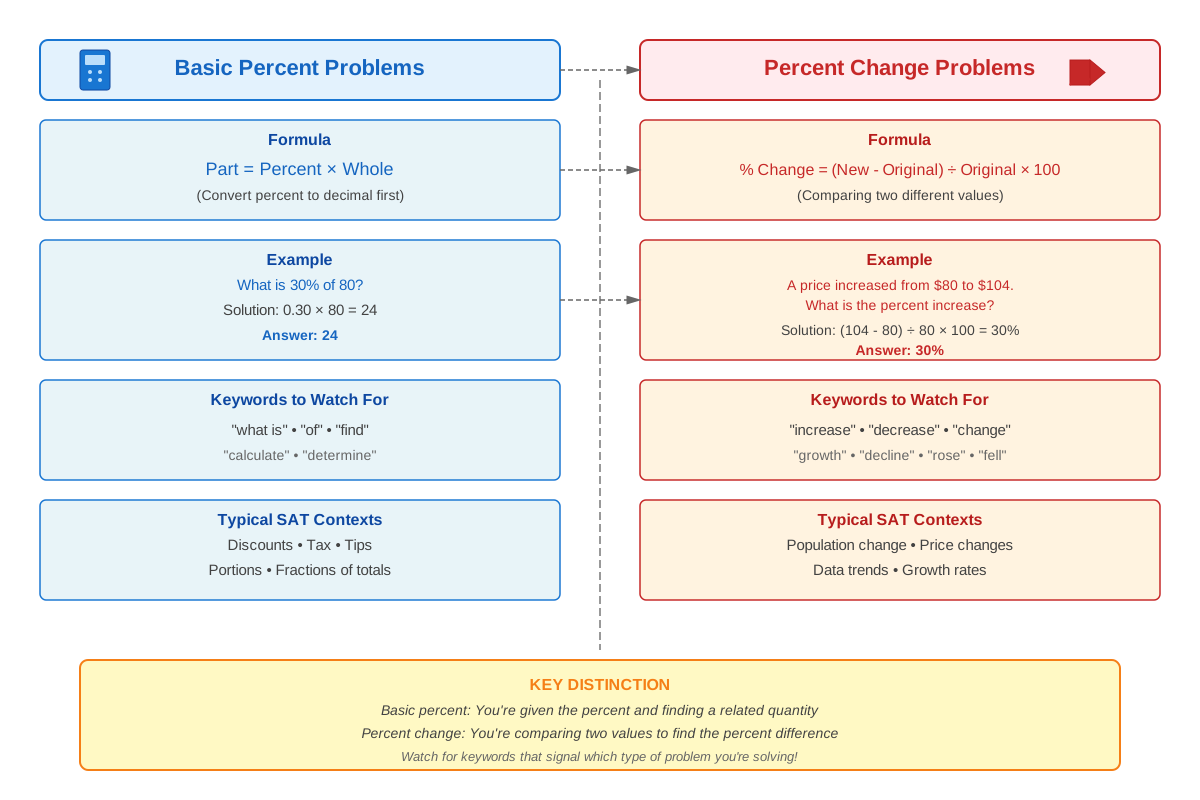
- [ ] Distinguish between percent increase/decrease problems and basic percent problems
Prerequisites
- Basic percentage concepts: Understanding that percentages represent parts per hundred is fundamental to setting up percent equations correctly
- Decimal and fraction conversion: Converting percentages to decimals (dividing by 100) is necessary for algebraic manipulation in percent equations
- One-variable linear equations: Solving equations like 0.15x = 30 requires isolation of variables through inverse operations
- Order of operations: Correctly evaluating expressions ensures accurate calculation when working through multi-step percent problems
- Word problem translation: The ability to identify given information and unknown quantities is essential for setting up percent equations from verbal descriptions
Why This Topic Matters
Percent equation problems represent one of the highest-yield topics for SAT preparation because they appear with remarkable consistency across all test administrations. Research on SAT question distribution indicates that 3-5 questions per test directly involve percent calculations or percent-based reasoning, accounting for approximately 5-9% of the total math score. These questions span difficulty levels from straightforward calculations to complex multi-step problems that combine percentages with other algebraic concepts.
In real-world contexts, percentage calculations are ubiquitous in financial literacy (calculating tips, interest, discounts, and tax), scientific analysis (expressing experimental results and changes in measurements), business operations (profit margins, growth rates, and market share), and data interpretation (demographic statistics and survey results). The SAT deliberately includes percent problems that mirror these practical applications, recognizing that quantitative literacy in modern society requires fluency with percentage-based reasoning.
On the SAT, percent equation problems commonly appear in several distinct formats: straightforward "what is X% of Y" calculations, reverse problems asking "N is what percent of M," problems requiring students to find the original value before a percentage increase or decrease, and complex scenarios involving successive percentage changes. These questions may be presented as pure computational problems, embedded within word problems describing real-world scenarios, or integrated into data interpretation questions where students must calculate percentages from tables or graphs. The College Board specifically designs these problems to test whether students can move beyond memorized procedures to demonstrate genuine understanding of proportional relationships.
Core Concepts
The Fundamental Percent Equation
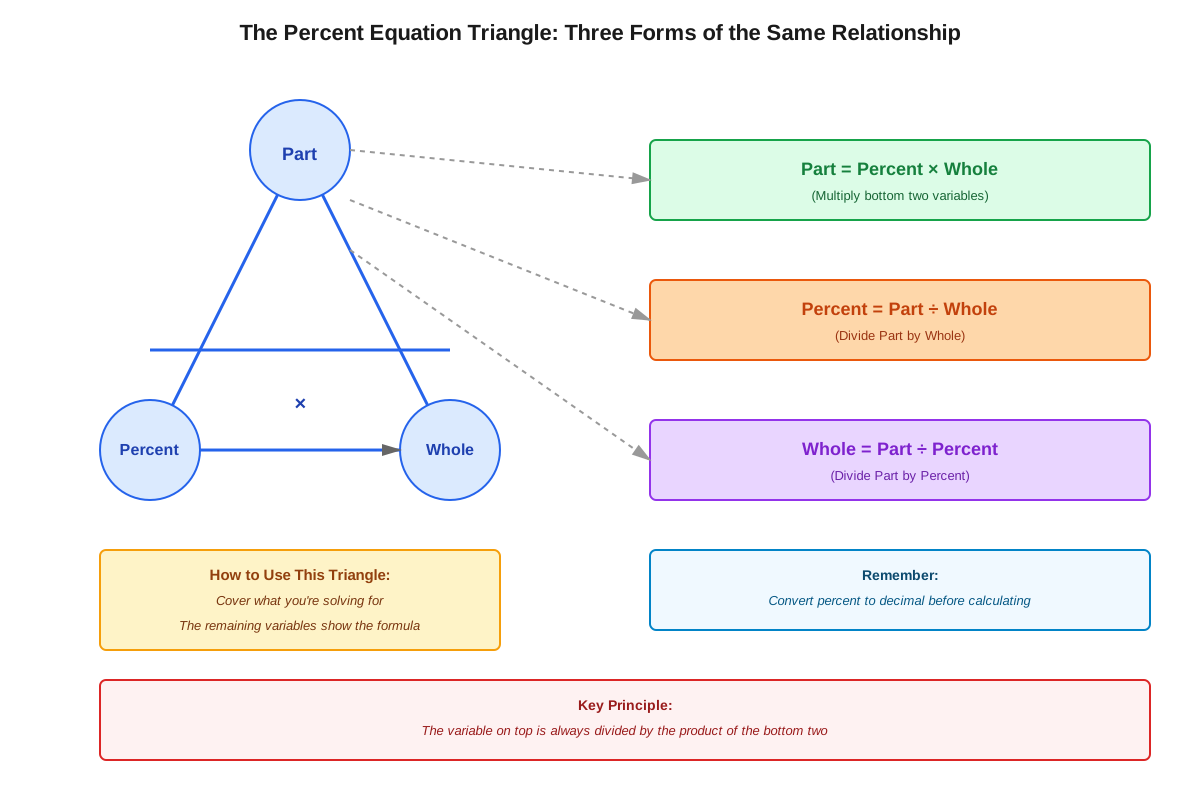
The foundation of all percent equation problems is the relationship expressed by the formula:
Part = Percent × WholeThis equation can also be written as:
Part = (Percent/100) × WholeWhen working algebraically, the percentage is converted to decimal form by dividing by 100. For example, 25% becomes 0.25, and 8% becomes 0.08. This conversion is crucial because it allows the percent equation to be manipulated using standard algebraic techniques.
The three components of this equation are:
- Part: The portion or subset of the whole quantity
- Percent: The rate or proportion expressed per hundred
- Whole: The total quantity or base amount
Any of these three values can be the unknown variable in an SAT problem, requiring students to set up and solve the appropriate equation.
Identifying the Whole vs. the Part
A critical skill in solving percent equation problems is correctly identifying which quantity represents the whole (base) and which represents the part. The whole is typically the reference amount—the quantity that represents 100%. The part is a portion of that reference amount.
Key linguistic indicators help identify these components:
| Phrase Pattern | Indicates | Example |
|---|---|---|
| "X is Y% of Z" | Z is the whole, X is the part | "15 is 30% of 50" |
| "Y% of Z" | Z is the whole | "20% of 80" |
| "What percent of X is Y" | X is the whole, Y is the part | "What percent of 200 is 50?" |
| "X is what percent of Y" | Y is the whole, X is the part | "12 is what percent of 60?" |
The word "of" in percentage problems almost always precedes the whole. This linguistic pattern provides a reliable method for setting up equations correctly.
Three Types of Percent Equation Problems
Type 1: Finding the Part
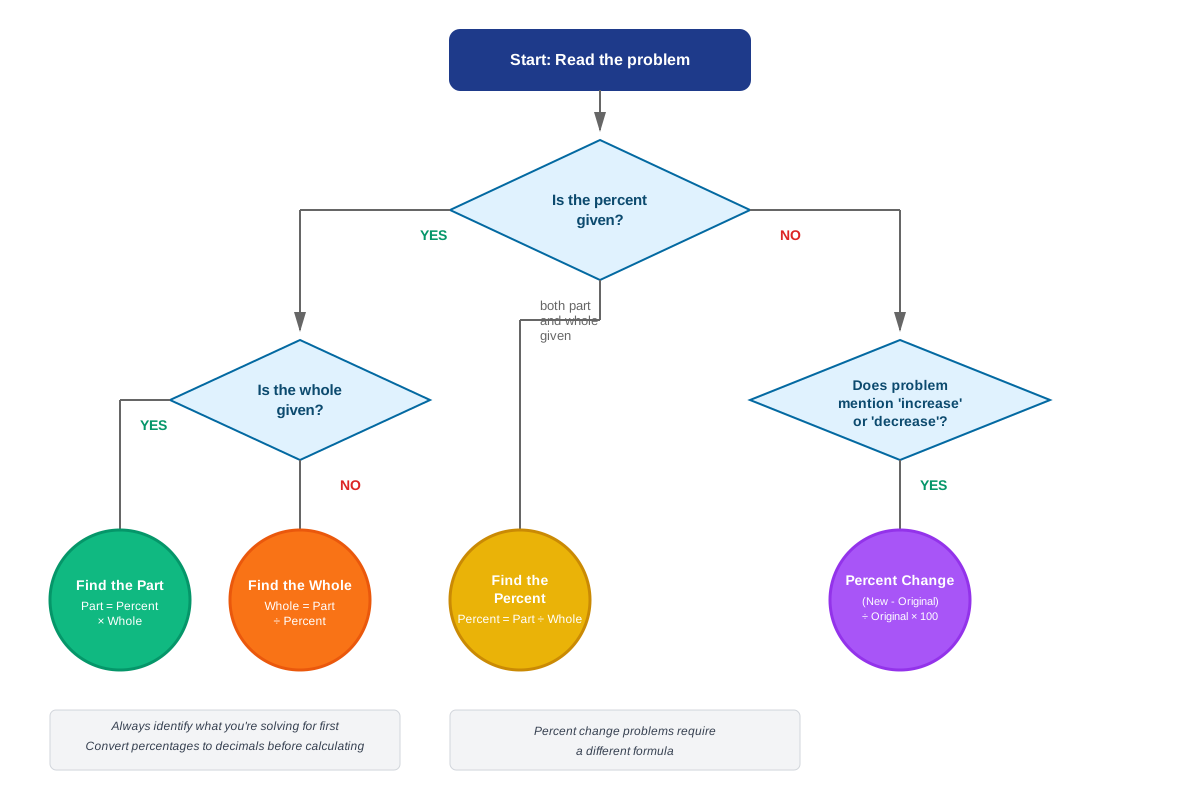
These problems provide the percentage and the whole, asking students to find the part. The setup follows directly from the fundamental equation:
Example: What is 35% of 80?
- Equation: Part = 0.35 × 80
- Solution: Part = 28
Type 2: Finding the Percentage
These problems provide the part and the whole, asking students to find what percentage the part represents. The equation must be rearranged:
Example: 24 is what percent of 60?
- Equation: 24 = (Percent/100) × 60
- Rearranged: Percent = (24/60) × 100
- Solution: Percent = 40%
Alternatively, using decimal form:
- Equation: 24 = x × 60 (where x is the decimal form of the percent)
- Solution: x = 24/60 = 0.4 = 40%
Type 3: Finding the Whole
These problems provide the part and the percentage, asking students to find the whole. This type often appears in reverse percentage problems:
Example: 18 is 30% of what number?
- Equation: 18 = 0.30 × Whole
- Solution: Whole = 18/0.30 = 60
Percent Increase and Decrease Problems
A specialized category of percent equation problems involves calculating or working with percentage changes. These problems require understanding that:
New Value = Original Value ± (Percent Change × Original Value)This can be simplified to:
New Value = Original Value × (1 ± Percent Change as decimal)For percent increase: New Value = Original Value × (1 + rate)
For percent decrease: New Value = Original Value × (1 - rate)
Example: A shirt originally priced at $40 is discounted by 25%. What is the sale price?
- Calculation: Sale Price = 40 × (1 - 0.25) = 40 × 0.75 = $30
Finding the original value before a percentage change requires working backward:
Example: After a 20% increase, a population is now 360. What was the original population?
- Equation: 360 = Original × (1 + 0.20)
- Solution: Original = 360/1.20 = 300
Successive Percentage Changes
Some SAT problems involve multiple percentage changes applied sequentially. A crucial concept is that successive percentage changes are multiplicative, not additive.
Example: A price increases by 10%, then decreases by 10%. The final price is NOT the same as the original.
- If original = 100
- After 10% increase: 100 × 1.10 = 110
- After 10% decrease: 110 × 0.90 = 99
- Net result: 1% decrease overall
The combined effect is calculated by multiplying the change factors:
Final Value = Original × (1 + change₁) × (1 + change₂)Percent Greater/Less Than Comparisons
SAT problems frequently ask students to determine by what percentage one quantity exceeds or falls short of another. The formula structure is:
Percent Difference = (Difference/Reference Value) × 100The reference value (denominator) depends on the question wording:
- "A is what percent greater than B?" → Reference is B
- "A is what percent less than B?" → Reference is B
- "What percent of A is B?" → Reference is A
Example: 75 is what percent greater than 50?
- Difference: 75 - 50 = 25
- Percent: (25/50) × 100 = 50%
- Answer: 75 is 50% greater than 50
Concept Relationships
The fundamental percent equation serves as the central organizing principle, with all other concepts branching from this core relationship. Understanding that Part = Percent × Whole enables students to solve for any unknown component through algebraic manipulation.
Relationship Map:
- Fundamental Percent Equation → enables → Three Types of Problems (finding part, percentage, or whole)
- Fundamental Percent Equation → extends to → Percent Change Problems (by recognizing new value as a part of modified whole)
- Percent Change Problems → combines with → Successive Changes (through multiplicative application)
- Identifying Whole vs. Part → supports → Correct Equation Setup → leads to → Accurate Solutions
- Percent Greater/Less Comparisons → builds on → Fundamental Equation (by treating difference as the part)
These concepts connect to prerequisite knowledge of linear equations because solving for unknowns in percent problems requires the same algebraic manipulation skills: isolating variables, applying inverse operations, and maintaining equation balance. The proportional reasoning underlying percentages also connects to ratio and proportion concepts, as percentages are simply ratios with a denominator of 100.
Mastery of percent equation problems enables progression to more advanced topics including exponential growth and decay (which extends successive percentage changes), compound interest calculations (repeated percentage applications), and statistical analysis (where percentage-based comparisons are fundamental to data interpretation).
Quick check — test yourself on Percent equation problems so far.
Try Flashcards →High-Yield Facts
⭐ The fundamental percent equation is Part = Percent × Whole, where Percent is expressed as a decimal
⭐ The word "of" in a percentage problem typically precedes the whole (base amount)
⭐ To find what percent one number is of another, divide the part by the whole and multiply by 100
⭐ When a value increases by x% then decreases by x%, the final value is LESS than the original (not equal)
⭐ To find the original value before a percent increase, divide the new value by (1 + rate as decimal)
- Converting a percentage to decimal form requires dividing by 100 (35% = 0.35)
- A 100% increase means doubling the original value (multiplying by 2)
- Percent decrease problems use the formula: New = Original × (1 - rate)
- Successive percentage changes multiply: apply each change factor sequentially
- "What percent greater" problems require calculating (Difference/Original) × 100
- A discount of 30% means paying 70% of the original price
- Finding 10% of a number is equivalent to dividing by 10
- Percent problems can always be checked by verifying that the part is reasonable relative to the whole
- When the part equals the whole, the percentage is 100%
- Zero percent of any number equals zero
Common Misconceptions
Misconception: Adding successive percentage changes gives the total percentage change.
Correction: Successive percentage changes must be multiplied, not added. A 20% increase followed by a 30% increase results in a 1.20 × 1.30 = 1.56 multiplier, which is a 56% increase, not 50%.
Misconception: A 50% increase followed by a 50% decrease returns to the original value.
Correction: These changes are applied to different base amounts. If starting with 100: after 50% increase = 150, then 50% decrease of 150 = 75, which is 25% less than the original.
Misconception: The whole is always the larger number in a percent problem.
Correction: The whole is the reference amount (what represents 100%), which may be smaller than the part. For example, "150 is what percent of 100?" has 100 as the whole, and the answer is 150%.
Misconception: To find the original price before a 25% discount, subtract 25% from the sale price.
Correction: The sale price represents 75% of the original. To find the original, divide the sale price by 0.75, not subtract 25% of the sale price.
Misconception: "What percent of A is B" and "B is what percent of A" mean the same thing.
Correction: These questions have different reference values (wholes). The first has A as the whole; the second also has A as the whole. However, "What percent of B is A" would have B as the whole, giving a different answer.
Misconception: Percent increase and percent of increase are the same.
Correction: "Percent increase" refers to the rate of change, while "percent of increase" could refer to the actual amount of increase expressed as a percentage of the original. Context determines meaning, but SAT questions are typically clear about which is requested.
Misconception: When finding what percent one number is of another, the order doesn't matter.
Correction: The order is critical. "What percent of 50 is 25?" (answer: 50%) is different from "What percent of 25 is 50?" (answer: 200%). The number after "of" is always the whole.
Worked Examples
Example 1: Multi-Step Percent Problem with Unknown Whole
Problem: At a school fundraiser, 40% of the money raised came from ticket sales, and the remaining $720 came from donations. What was the total amount of money raised?
Solution:
Step 1: Identify the components
- If 40% came from ticket sales, then 60% came from donations
- The part (donations) = $720
- The percent (donations) = 60% = 0.60
- The whole (total raised) = unknown (x)
Step 2: Set up the equation
Using Part = Percent × Whole:
720 = 0.60 × xStep 3: Solve for x
x = 720 ÷ 0.60
x = 1200
Step 4: Verify the answer
- Donations (60%): 0.60 × 1200 = 720 ✓
- Ticket sales (40%): 0.40 × 1200 = 480
- Total: 720 + 480 = 1200 ✓
Answer: The total amount raised was $1,200.
Connection to Learning Objectives: This problem demonstrates identifying key features (recognizing that the given amount represents the remaining percentage after subtracting from 100%) and applying the percent equation to find an unknown whole, a common SAT question type.
Example 2: Successive Percentage Changes
Problem: A store marks up the wholesale price of an item by 60%, then offers a 25% discount during a sale. If the wholesale price was $50, what is the final sale price?
Solution:
Step 1: Calculate the price after markup
- Markup of 60% means multiplying by (1 + 0.60) = 1.60
- Price after markup = 50 × 1.60 = $80
Step 2: Calculate the price after discount
- Discount of 25% means multiplying by (1 - 0.25) = 0.75
- Final price = 80 × 0.75 = $60
Alternative approach (combined calculation):
Final Price = Original × (1 + markup) × (1 - discount)
Final Price = 50 × 1.60 × 0.75
Final Price = 50 × 1.20
Final Price = 60
Step 3: Analyze the net effect
- The final price ($60) is 20% more than the wholesale price ($50)
- Net multiplier: 1.60 × 0.75 = 1.20
- This represents a 20% net increase, NOT a 35% increase (60% - 25%)
Answer: The final sale price is $60.
Connection to Learning Objectives: This problem illustrates how percent equation problems appear on the SAT in multi-step scenarios, requiring students to apply successive percentage changes correctly and avoid the common misconception of adding percentage changes.
Exam Strategy
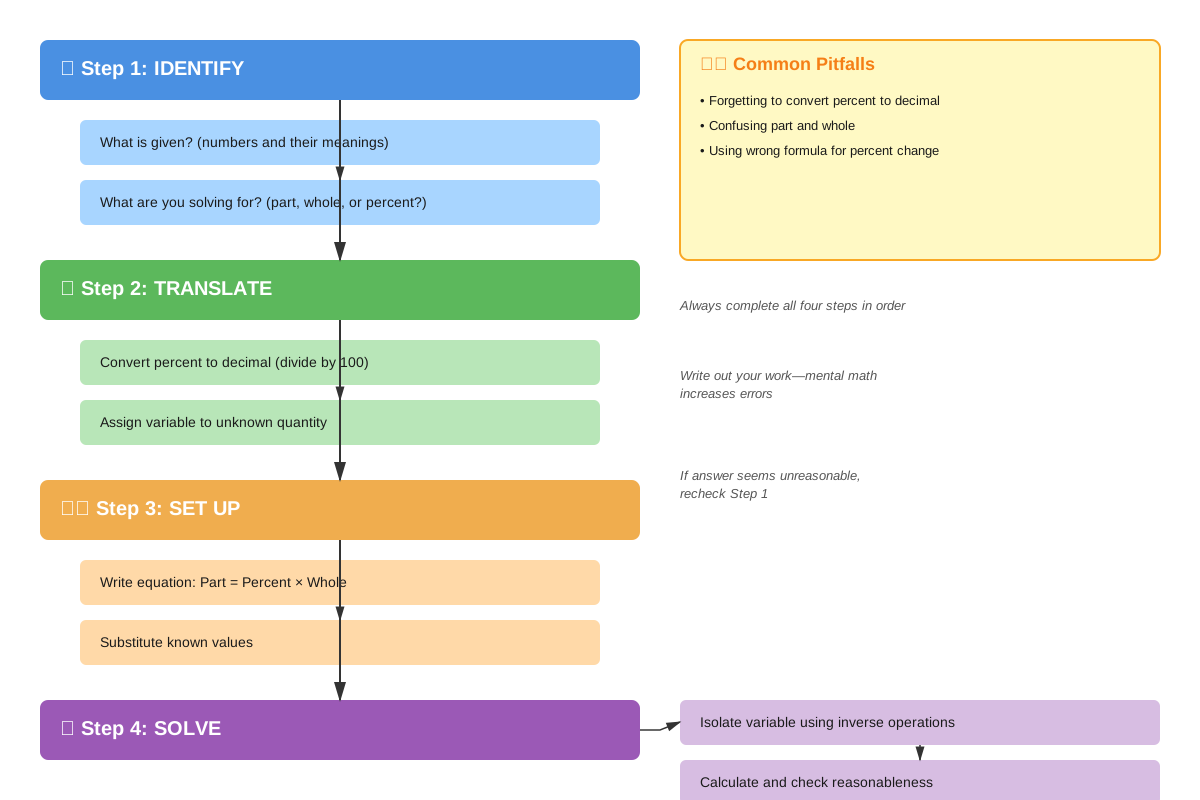
When approaching sat percent equation problems, follow this systematic process:
1. Identify the Question Type
Quickly determine whether the problem asks for the part, the whole, or the percentage. Underline or circle the question being asked to maintain focus.
2. Locate and Label Components
Mark the given information:
- Circle the whole (often follows "of")
- Underline the part
- Box the percentage
- Use a variable (x, n, etc.) for the unknown
3. Convert Percentages to Decimals
Before setting up equations, convert all percentages to decimal form. This prevents calculation errors and simplifies algebraic manipulation.
4. Set Up the Equation Carefully
Write out Part = Percent × Whole explicitly, substituting known values. Double-check that the whole is correctly identified before solving.
Exam Tip: If a problem asks "A is what percent of B," B is always the whole. If it asks "What is X% of Y," Y is the whole. The word "of" is your most reliable indicator.
Trigger Words and Phrases to Watch For:
- "What percent" → You're solving for the percentage
- "Is what percent of" → The number after "of" is the whole
- "Increased by" → Add the percentage change
- "Decreased by" → Subtract the percentage change
- "Percent greater than" → Calculate (difference/original) × 100
- "After a discount of" → Multiply by (1 - discount rate)
- "Marked up by" → Multiply by (1 + markup rate)
Process of Elimination Tips:
- Eliminate answers that are larger than the whole when the problem asks for a part less than 100%
- Eliminate answers that would make the percentage greater than 100% unless the context supports it
- For percent increase/decrease problems, eliminate answers that don't reflect the direction of change
- Check extreme cases: if the percentage is very small, the part should be much smaller than the whole
Time Allocation:
- Simple percent calculations: 30-45 seconds
- Multi-step percent problems: 60-90 seconds
- Complex word problems with percentages: 90-120 seconds
If a problem requires more than 2 minutes, mark it for review and move on. Often, returning with fresh perspective reveals a simpler approach.
Memory Techniques
The "POW" Mnemonic:
Part = Percent × Whole
Remember: "POW" packs a punch—it's the power formula for all percent problems.
The "OF" Rule:
Of Follows the Whole
Whenever you see "of" in a percent problem, the number immediately after it is the whole (base amount).
The "1-Plus/1-Minus" Visualization:
For percent change problems, visualize a number line:
- Increases move right: multiply by (1 + rate)
- Decreases move left: multiply by (1 - rate)
- The "1" represents the original 100%
The "Successive Multiplication" Reminder:
Think of successive percentage changes as a chain: each link multiplies the previous result. You can't skip links or add them together—you must multiply through the chain.
The "Flip and Divide" Technique:
When finding the original value before a percentage change:
- Increase: divide by (1 + rate)
- Decrease: divide by (1 - rate)
Remember: "To undo a multiplication, flip and divide"
The "Reference Check" Method:
Before solving "percent greater/less than" problems, ask: "Greater/less than WHAT?" That "what" is your denominator (reference value).
Summary
Percent equation problems form a cornerstone of SAT math assessment, testing students' ability to translate proportional relationships into algebraic equations and solve for unknown quantities. The fundamental relationship—Part = Percent × Whole—serves as the foundation for all percent calculations, with the critical skill being correct identification of which quantity represents the whole (base) and which represents the part. SAT problems require students to solve for any of these three components, work with percent increases and decreases, handle successive percentage changes through multiplication rather than addition, and interpret complex word problems involving real-world percentage scenarios. Success requires converting percentages to decimal form, setting up equations carefully based on linguistic cues (especially the word "of"), and applying systematic algebraic manipulation. Students must also recognize that percentage changes are multiplicative, meaning a 20% increase followed by a 20% decrease does not return to the original value. Mastery of these concepts enables confident, efficient problem-solving across the wide range of percentage-based questions that consistently appear on every SAT administration.
Key Takeaways
- The fundamental percent equation Part = Percent × Whole (with percent as a decimal) solves all basic percentage problems through algebraic manipulation
- The word "of" in percentage problems reliably indicates the whole (base amount), making it the most important linguistic cue for correct equation setup
- Successive percentage changes must be multiplied, not added: a 30% increase followed by a 20% decrease results in a 1.30 × 0.80 = 1.04 multiplier (4% net increase)
- To find the original value before a percent increase, divide the new value by (1 + rate); before a decrease, divide by (1 - rate)
- "What percent greater/less than" problems require calculating (Difference/Reference Value) × 100, where the reference value is the quantity being compared to
- Percent increase/decrease problems use the formulas New = Original × (1 + rate) for increases and New = Original × (1 - rate) for decreases
- Converting percentages to decimals before setting up equations prevents calculation errors and simplifies algebraic manipulation
Related Topics
Ratio and Proportion: Percentages are special ratios with a denominator of 100; mastering percent equations strengthens proportional reasoning skills applicable to direct and inverse variation problems.
Linear Equations and Inequalities: The algebraic manipulation required for percent problems extends to more complex linear equations, including those with variables on both sides and multi-step solutions.
Exponential Growth and Decay: Successive percentage changes form the foundation for understanding exponential functions, where repeated multiplication by a constant factor creates exponential patterns.
Data Interpretation and Statistics: Percentage calculations are essential for analyzing data in tables, charts, and graphs, including calculating percentage distributions, changes over time, and comparative statistics.
Financial Mathematics: Percent equations underlie more advanced financial concepts including simple and compound interest, investment returns, loan calculations, and cost-benefit analysis.
Practice CTA
Now that you've mastered the core concepts of percent equation problems, it's time to solidify your understanding through active practice. The practice questions and flashcards designed for this topic will challenge you to apply these concepts in varied contexts, building the speed and accuracy essential for SAT success. Remember: understanding the theory is just the first step—consistent practice with SAT-style questions transforms knowledge into test-day performance. Each practice problem you solve strengthens your pattern recognition and problem-solving efficiency, bringing you closer to your target score. Approach the practice materials with confidence, knowing you now have the conceptual foundation to tackle any percent equation problem the SAT presents!
Sign up free to keep reading
Create a free AnvayaPrep account to finish this SAT guide on Percent equation problems — plus flashcards and practice questions.