Overview
Solving one-step equations forms the foundational bedrock of algebraic manipulation that students encounter throughout the SAT math section. These equations require exactly one mathematical operation to isolate the variable and determine its value. While the concept appears deceptively simple, mastering this skill is absolutely critical because it serves as the building block for more complex algebraic problems, including multi-step equations, systems of equations, and even quadratic equations that frequently appear on the SAT.
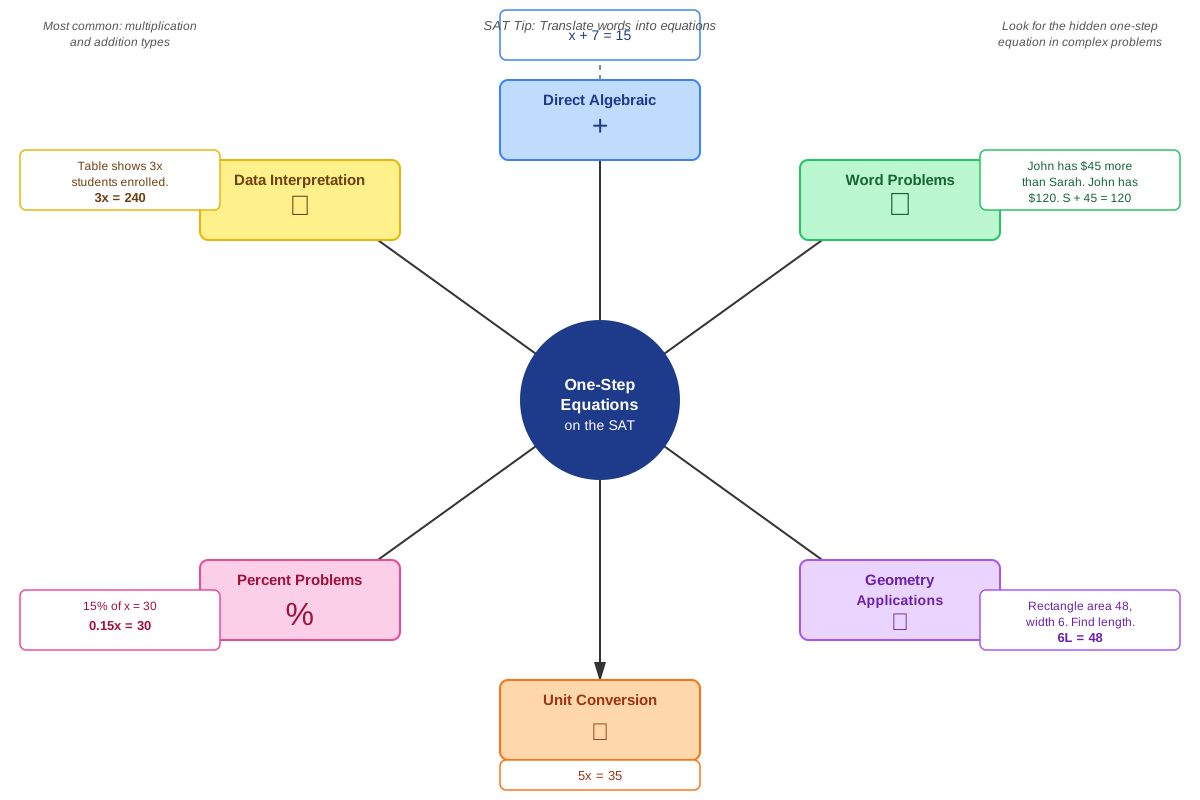
The SAT tests one-step equations both directly and indirectly. Direct questions present straightforward equations requiring a single operation to solve, while indirect applications embed these principles within word problems, geometry contexts, or data interpretation scenarios. Students who can rapidly and accurately solve one-step equations gain a significant time advantage on the exam, as these problems should take no more than 30 seconds each when approached correctly. The ability to recognize when an equation requires only one step versus multiple steps is itself a valuable skill that prevents overthinking and wasted time.
Understanding one-step equations creates the conceptual framework for all algebraic thinking on the SAT. This topic connects directly to the properties of equality, inverse operations, and the fundamental principle that whatever operation is performed on one side of an equation must be performed on the other. These principles extend beyond simple linear equations into rational equations, radical equations, and even exponential relationships. Students who develop fluency with one-step equations build the automaticity needed to tackle the more complex algebraic challenges that constitute approximately 35% of SAT math questions.
Learning Objectives
- [ ] Identify key features of solving one-step equations, including the variable, coefficient, constant, and required operation
- [ ] Explain how solving one-step equations appears on the SAT in both direct and contextual formats
- [ ] Apply solving one-step equations to answer SAT-style questions within the allocated time constraints
- [ ] Determine which inverse operation is required to isolate the variable in any one-step equation
- [ ] Verify solutions by substituting values back into the original equation
- [ ] Recognize when a problem that initially appears complex actually reduces to a one-step equation
Prerequisites
- Basic arithmetic operations (addition, subtraction, multiplication, division): These operations form the inverse operations needed to solve equations
- Understanding of variables: Variables represent unknown quantities that equations help us determine
- Properties of equality: The principle that performing the same operation on both sides maintains equality is essential
- Order of operations: Recognizing which operation is being performed on the variable helps identify the inverse operation needed
- Fraction and decimal operations: Many SAT one-step equations involve rational numbers rather than just integers
Why This Topic Matters
One-step equations appear in everyday situations far beyond the classroom. Calculating sales tax, determining unit prices, converting units of measurement, and solving for unknown quantities in recipes or construction projects all involve one-step equation logic. Financial literacy—understanding interest calculations, discount percentages, and budget allocations—relies heavily on the ability to isolate variables quickly and accurately.
On the SAT specifically, one-step equations appear in approximately 3-5 questions per test, either as standalone problems or embedded within more complex scenarios. These questions typically appear in both the calculator and no-calculator sections, with the no-calculator section particularly favoring straightforward one-step problems that test conceptual understanding rather than computational complexity. The College Board frequently embeds one-step equations within word problems about rates, percentages, proportions, and geometric formulas. Students who can quickly identify the underlying one-step equation within a word problem gain significant time advantages.
Common SAT question formats include: direct algebraic equations presented symbolically (e.g., "If 3x = 27, what is x?"), word problems requiring equation setup (e.g., "A number increased by 7 equals 15. What is the number?"), and contextual problems involving formulas (e.g., "The area of a rectangle is 48 square units. If the width is 6 units, what is the length?"). The ability to recognize these various presentations as fundamentally one-step equations is a high-yield skill that separates efficient test-takers from those who struggle with time management.
Core Concepts
The Structure of One-Step Equations
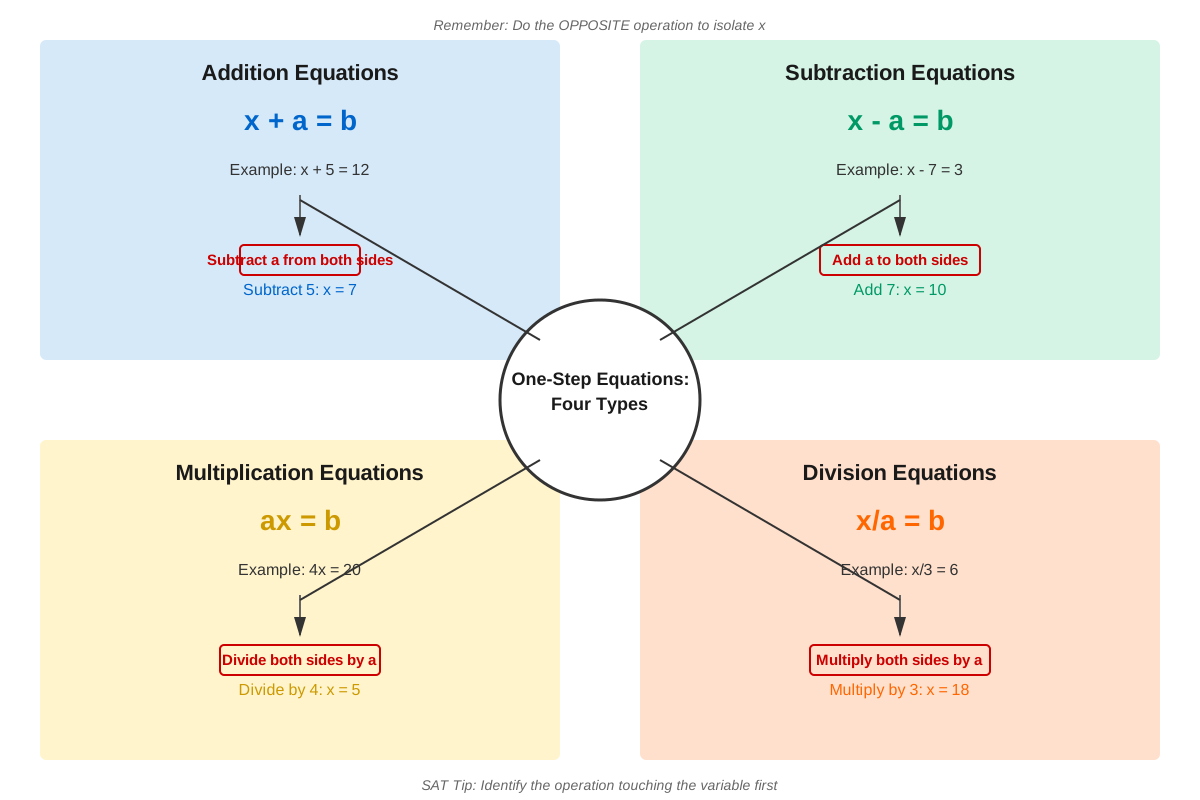
A one-step equation is an algebraic equation that requires exactly one mathematical operation to isolate the variable and solve for its value. These equations follow the general forms:
- Addition form: x + a = b
- Subtraction form: x - a = b
- Multiplication form: ax = b (where a ≠ 0)
- Division form: x/a = b (where a ≠ 0)
Each form involves a variable (typically represented by letters like x, y, or n), a coefficient (the number multiplied by the variable), and constants (numbers without variables). The goal is always to isolate the variable on one side of the equation, leaving only its value on that side.
Inverse Operations: The Key to Solving
The fundamental principle behind solving one-step equations is the use of inverse operations. Inverse operations are mathematical operations that undo each other. Understanding these pairs is essential:
| Operation | Inverse Operation | Example |
|---|---|---|
| Addition (+) | Subtraction (-) | If x + 5 = 12, subtract 5 from both sides |
| Subtraction (-) | Addition (+) | If x - 3 = 10, add 3 to both sides |
| Multiplication (×) | Division (÷) | If 4x = 20, divide both sides by 4 |
| Division (÷) | Multiplication (×) | If x/6 = 3, multiply both sides by 6 |
The critical insight is that applying the inverse operation to both sides of the equation maintains the equality while isolating the variable. This principle stems from the properties of equality, which state that performing the same operation on both sides of an equation preserves the truth of that equation.
Solving Addition and Subtraction Equations
When a constant is added to or subtracted from a variable, use the inverse operation to isolate the variable:
For addition equations (x + a = b):
- Identify the constant being added to the variable
- Subtract that constant from both sides
- Simplify to find the variable's value
Example: x + 8 = 15
- Subtract 8 from both sides: x + 8 - 8 = 15 - 8
- Simplify: x = 7
For subtraction equations (x - a = b):
- Identify the constant being subtracted from the variable
- Add that constant to both sides
- Simplify to find the variable's value
Example: y - 12 = 5
- Add 12 to both sides: y - 12 + 12 = 5 + 12
- Simplify: y = 17
Solving Multiplication and Division Equations
When a variable is multiplied or divided by a constant, use the inverse operation:
For multiplication equations (ax = b):
- Identify the coefficient (the number multiplied by the variable)
- Divide both sides by that coefficient
- Simplify to find the variable's value
Example: 6x = 42
- Divide both sides by 6: 6x/6 = 42/6
- Simplify: x = 7
For division equations (x/a = b):
- Identify the divisor (the number dividing the variable)
- Multiply both sides by that divisor
- Simplify to find the variable's value
Example: n/5 = 9
- Multiply both sides by 5: (n/5) × 5 = 9 × 5
- Simplify: n = 45
Working with Fractions and Decimals
SAT solving one-step equations frequently involves fractions and decimals, which follow the same principles but require careful arithmetic:
Fractional coefficients: When the coefficient is a fraction, multiply both sides by its reciprocal.
Example: (2/3)x = 10
- Multiply both sides by 3/2: (3/2) × (2/3)x = 10 × (3/2)
- Simplify: x = 15
Decimal coefficients: Either work with decimals directly or convert to fractions.
Example: 0.5x = 7
- Divide both sides by 0.5: x = 7/0.5 = 14
- Or recognize 0.5 = 1/2, so multiply by 2: x = 14
Verification: Checking Your Solution
After solving any equation, verification ensures accuracy. Substitute the solution back into the original equation:
- Take your solution value
- Replace the variable in the original equation with this value
- Perform the arithmetic
- Confirm both sides equal the same number
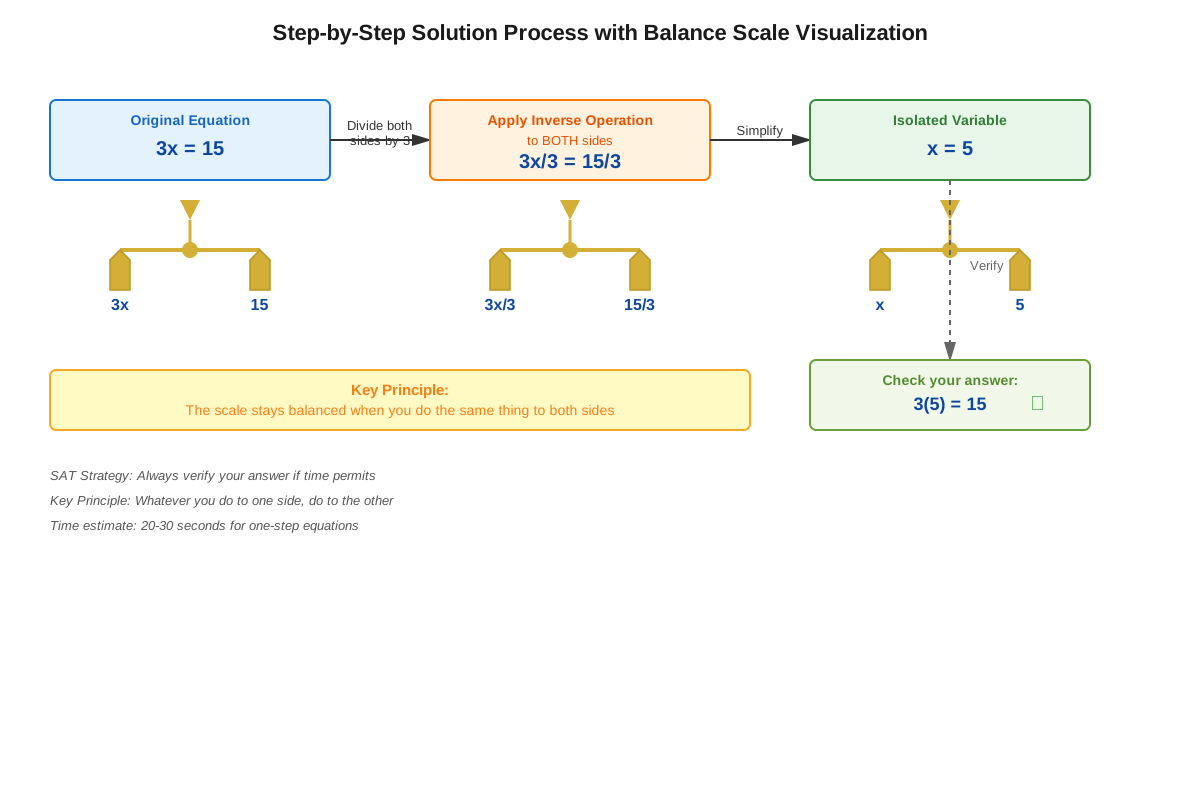
Example: If you solved 3x = 21 and got x = 7:
- Check: 3(7) = 21
- 21 = 21 ✓ (Solution verified)
This verification step is particularly valuable on the SAT when you're unsure between two answer choices or want to confirm your work quickly.
Concept Relationships
The concepts within one-step equations build upon each other in a logical progression. Understanding inverse operations is the prerequisite for recognizing which operation to apply in any given equation. The four equation types (addition, subtraction, multiplication, division) all rely on this inverse operation principle, making it the central concept from which all solution methods derive.
The relationship flows as follows: Properties of Equality → enables → Inverse Operations → applied to → Four Equation Types → verified through → Solution Checking. Each step depends on the previous one, creating a coherent problem-solving framework.
One-step equations connect backward to prerequisite topics like basic arithmetic and the concept of variables. They connect forward to multi-step equations (which are simply combinations of multiple one-step operations), literal equations (solving for one variable in terms of others), and systems of equations (where one-step thinking helps isolate variables). The skill of identifying what operation is being performed on a variable—essential for one-step equations—becomes critical when simplifying complex algebraic expressions and solving inequalities.
Additionally, one-step equations form the foundation for understanding functions, as solving f(x) = k for x often reduces to one-step equation logic. They also underpin geometric problem-solving, where formulas like A = lw or C = 2πr require isolating specific variables using one-step techniques.
Quick check — test yourself on Solving one-step equations so far.
Try Flashcards →High-Yield Facts
⭐ The inverse operation of addition is subtraction, and vice versa; the inverse operation of multiplication is division, and vice versa
⭐ Whatever operation you perform on one side of an equation must be performed on the other side to maintain equality
⭐ To solve ax = b, divide both sides by a; to solve x/a = b, multiply both sides by a
⭐ When a coefficient is a fraction, multiply both sides by its reciprocal to isolate the variable
⭐ Always verify your solution by substituting it back into the original equation
- One-step equations require exactly one mathematical operation to isolate the variable
- The coefficient is the number directly multiplied by the variable
- Division by zero is undefined, so equations like x/0 = 5 have no solution
- Negative coefficients require dividing or multiplying by a negative number, which doesn't change the solution process
- Equations like 0x = 0 have infinitely many solutions, while 0x = 5 has no solution
- The SAT may present one-step equations in word problem format, requiring translation from English to algebra
- Decimal coefficients can be eliminated by multiplying both sides by an appropriate power of 10
- The variable can appear on either side of the equation; if it's on the right, the solution process is identical
- Parentheses around a single term don't change the one-step nature: (x) + 5 = 12 is still one-step
- Time efficiency on the SAT demands recognizing one-step equations within 5 seconds of reading the problem
Common Misconceptions
Misconception: When solving x + 5 = 12, students subtract 5 from only the left side, getting x = 12.
Correction: The properties of equality require performing the same operation on both sides. Subtract 5 from both sides: x + 5 - 5 = 12 - 5, so x = 7.
Misconception: To solve 3x = 15, students divide only the left side by 3, writing x = 15.
Correction: Division must be applied to both sides of the equation. Divide both sides by 3: 3x/3 = 15/3, yielding x = 5.
Misconception: When solving x/4 = 7, students think they should divide both sides by 4, getting x/16 = 7/4.
Correction: Division and multiplication are inverse operations. To undo division by 4, multiply both sides by 4: (x/4) × 4 = 7 × 4, so x = 28.
Misconception: Students believe that x - 8 = 10 means x = 2 because 10 - 8 = 2.
Correction: The equation states that x minus 8 equals 10, not that 10 minus 8 equals x. Add 8 to both sides: x - 8 + 8 = 10 + 8, giving x = 18.
Misconception: When the coefficient is negative, such as -5x = 20, students forget to account for the negative sign and write x = 4.
Correction: Divide both sides by -5 (not positive 5): -5x/-5 = 20/-5, which gives x = -4. The negative coefficient requires dividing by a negative number.
Misconception: Students think that equations with fractions are automatically multi-step equations.
Correction: An equation like (1/2)x = 6 is still one-step; multiply both sides by 2 (the reciprocal of 1/2) to get x = 12. The presence of fractions doesn't determine the number of steps.
Misconception: When checking solutions, students substitute the answer into their work rather than the original equation.
Correction: Always verify by substituting into the original equation as written in the problem. If you made an error in your work, checking your work will confirm the error rather than catch it.
Worked Examples
Example 1: Direct Algebraic Equation
Problem: Solve for x: 7x = 91
Solution Process:
Step 1: Identify the equation type. The variable x is multiplied by 7, making this a multiplication equation.
Step 2: Determine the inverse operation. Since multiplication is being performed, use division to isolate x.
Step 3: Apply the inverse operation to both sides. Divide both sides by 7:
7x/7 = 91/7Step 4: Simplify both sides:
x = 13Step 5: Verify the solution by substituting x = 13 into the original equation:
7(13) = 91
91 = 91 ✓
Connection to Learning Objectives: This example demonstrates identifying the key features (coefficient of 7, variable x, constant 91), applying the inverse operation (division), and verifying the solution—all essential skills for SAT success.
Example 2: Word Problem Application
Problem: Maria's age decreased by 15 years equals 28 years. How old is Maria?
Solution Process:
Step 1: Translate the word problem into an algebraic equation. Let m represent Maria's age.
- "Maria's age" → m
- "decreased by 15" → - 15
- "equals 28" → = 28
- Equation: m - 15 = 28
Step 2: Identify the equation type. This is a subtraction equation (a constant is subtracted from the variable).
Step 3: Determine the inverse operation. The inverse of subtraction is addition.
Step 4: Apply the inverse operation to both sides. Add 15 to both sides:
m - 15 + 15 = 28 + 15Step 5: Simplify:
m = 43Step 6: Verify by checking if the answer makes sense in context. If Maria is 43, then 43 - 15 = 28 ✓
Step 7: Check that this matches the original word problem: "Maria's age (43) decreased by 15 years equals 28 years." This is true.
Connection to Learning Objectives: This example shows how one-step equations appear on the SAT in contextual formats, requiring translation from words to algebra before applying solution techniques. This is a high-yield skill that appears frequently on the exam.
Example 3: Fractional Coefficient
Problem: If (3/4)n = 27, what is the value of n?
Solution Process:
Step 1: Identify the equation type. The variable n is multiplied by the fraction 3/4.
Step 2: Determine the inverse operation. To undo multiplication by 3/4, multiply by its reciprocal, 4/3.
Step 3: Apply the inverse operation to both sides:
(4/3) × (3/4)n = 27 × (4/3)Step 4: Simplify the left side. The fractions 4/3 and 3/4 are reciprocals, so they multiply to 1:
n = 27 × (4/3)Step 5: Simplify the right side:
n = 108/3 = 36Step 6: Verify by substituting n = 36 into the original equation:
(3/4)(36) = 27
108/4 = 27
27 = 27 ✓
Connection to Learning Objectives: This example demonstrates handling fractional coefficients, a common SAT challenge that tests deeper understanding of inverse operations and fraction arithmetic.
Exam Strategy
When approaching one-step equation problems on the SAT, develop a systematic recognition process. First, scan the problem for the variable and identify what operation is being performed on it. Look for trigger words in word problems: "increased by" or "more than" signal addition; "decreased by" or "less than" signal subtraction; "times" or "product" signal multiplication; "divided by" or "quotient" signal division.
Time management is critical. One-step equations should take no more than 30-45 seconds to solve, including verification. If you find yourself spending more time, you may be overcomplicating the problem. Step back and ask: "What single operation will isolate the variable?" This refocusing often reveals the simple solution path.
For multiple-choice questions, use the answer choices strategically. If you're uncertain about your algebraic solution, substitute each answer choice back into the original equation. The correct answer will make the equation true. This backsolving technique is particularly efficient when the arithmetic is simple or when you've narrowed down to two possible answers.
Watch for distractor answers that result from common errors. If you solve 3x = 21 and get x = 7, but see both 7 and 24 (which would result from adding instead of dividing) as answer choices, the test is specifically checking whether you applied the correct inverse operation. Recognizing these patterns helps you avoid traps.
In the no-calculator section, the SAT often presents one-step equations with numbers chosen to make mental math efficient. Numbers like 12, 15, 18, 24, 30, and 36 appear frequently because they have many factors. Practice mental division and multiplication with these numbers to increase your speed.
For word problems, underline or circle the key information: the unknown quantity (your variable), the operation being performed, and the result. This physical marking helps translate English to algebra accurately. Many students rush through reading and misidentify the operation, leading to incorrect equations.
Memory Techniques
DAIM - Remember the inverse operation pairs:
- Division undoes Multiplication
- Addition undoes Subtraction (DAIM-S)
"Keep the Balance" - Visualize an equation as a balanced scale. Whatever you do to one side, you must do to the other to keep it balanced. This mental image reinforces the properties of equality.
"Opposite Operations" - When you see an operation in the equation, think "opposite" to determine what to do. The opposite of adding 5 is subtracting 5; the opposite of multiplying by 3 is dividing by 3.
Reciprocal Flip - For fractional coefficients, remember "flip and multiply." If the coefficient is 2/3, flip it to 3/2 and multiply both sides. The visual of flipping the fraction helps recall the reciprocal concept.
SOLVE - A process acronym:
- See the operation on the variable
- Opposite operation is what you need
- Left and right sides both get it
- Verify by substituting back
- Evaluate your answer's reasonableness
For word problem translation, remember "IS means equals" - whenever you see "is" in a word problem, it typically translates to the equals sign in your equation. "Maria's age decreased by 15 is 28" directly becomes m - 15 = 28.
Summary
Solving one-step equations represents the fundamental algebraic skill of isolating a variable through a single mathematical operation. These equations take four primary forms—addition, subtraction, multiplication, and division—each requiring the application of its inverse operation to both sides of the equation. The core principle underlying all one-step equations is the properties of equality: performing the same operation on both sides maintains the truth of the equation while transforming it into a simpler form. On the SAT, one-step equations appear both as direct algebraic problems and embedded within word problems, geometric contexts, and data interpretation scenarios. Mastery requires recognizing the equation type within seconds, applying the correct inverse operation efficiently, and verifying solutions through substitution. Students must develop fluency with fractional and decimal coefficients, as these frequently appear on the exam. The ability to translate word problems into one-step equations is particularly high-yield, as the SAT emphasizes contextual problem-solving over pure computation. Success with one-step equations builds the foundation for all subsequent algebraic topics and provides a significant time advantage on test day.
Key Takeaways
- One-step equations require exactly one inverse operation to isolate the variable and determine its value
- The four inverse operation pairs are: addition/subtraction and multiplication/division
- Always perform the same operation on both sides of the equation to maintain equality
- Fractional coefficients are eliminated by multiplying both sides by the reciprocal
- Verification through substitution catches errors and confirms solutions quickly
- Word problems require translating English phrases into algebraic operations before solving
- One-step equations should take 30-45 seconds maximum on the SAT, including verification
Related Topics
Multi-Step Equations: Building on one-step equations, these problems require combining multiple inverse operations in the correct sequence. Mastering one-step equations makes multi-step problems simply a matter of applying the same principles repeatedly.
Literal Equations: These equations involve solving for one variable in terms of other variables (like solving A = lw for l). The same one-step principles apply, but the "constants" are now other variables.
Linear Inequalities: Solving inequalities uses identical techniques to one-step equations, with one additional rule about reversing the inequality sign when multiplying or dividing by negative numbers.
Systems of Equations: More complex problems involving multiple equations and variables often require using one-step equation techniques to isolate variables during the solution process.
Proportions and Ratios: Many proportion problems reduce to one-step equations after cross-multiplication, making this foundational skill essential for that topic.
Practice CTA
Now that you've mastered the core concepts of solving one-step equations, it's time to solidify your understanding through practice. Attempt the practice questions designed specifically for this topic, focusing on speed and accuracy. Use the flashcards to drill the inverse operation pairs until they become automatic. Remember, the difference between knowing how to solve these equations and being able to solve them quickly under test conditions comes down to deliberate practice. Every practice problem you complete builds the automaticity that will save you valuable time on test day and boost your confidence. You've built a strong foundation—now strengthen it through application!
Sign up free to keep reading
Create a free AnvayaPrep account to finish this SAT guide on Solving one-step equations — plus flashcards and practice questions.