Overview
Unknown constant equations represent a sophisticated category of linear equation problems that frequently appear on the SAT Math section. These problems present equations containing one or more letter constants (typically represented by letters like a, b, c, k, or m) whose values are initially unknown but can be determined through given conditions or constraints. Unlike standard linear equations where the goal is to solve for a single variable like x or y, these problems require students to work backward from given information—such as a known solution to the equation or a specific relationship between variables—to determine the value of the constant itself.
The SAT tests this concept because it assesses multiple mathematical competencies simultaneously: algebraic manipulation, logical reasoning, substitution skills, and the ability to understand the relationship between variables and constants. Students must recognize that constants, while represented by letters, are fixed values that remain the same throughout a problem, distinguishing them from variables that can take on different values. This distinction is fundamental to algebraic thinking and appears across approximately 10-15% of SAT Math questions, making it a high-yield topic for test preparation.
Mastery of sat unknown constant equations connects directly to broader algebraic concepts including systems of equations, function notation, and parametric relationships. These problems serve as a bridge between basic equation-solving and more advanced mathematical reasoning, requiring students to think flexibly about the roles different symbols play in mathematical expressions. Success with this topic demonstrates mathematical maturity and prepares students for the analytical thinking required in college-level math courses.
Learning Objectives
- [ ] Identify key features of unknown constant equations
- [ ] Explain how unknown constant equations appears on the SAT
- [ ] Apply unknown constant equations to answer SAT-style questions
- [ ] Distinguish between variables and constants in algebraic expressions
- [ ] Use substitution to determine the value of unknown constants given specific conditions
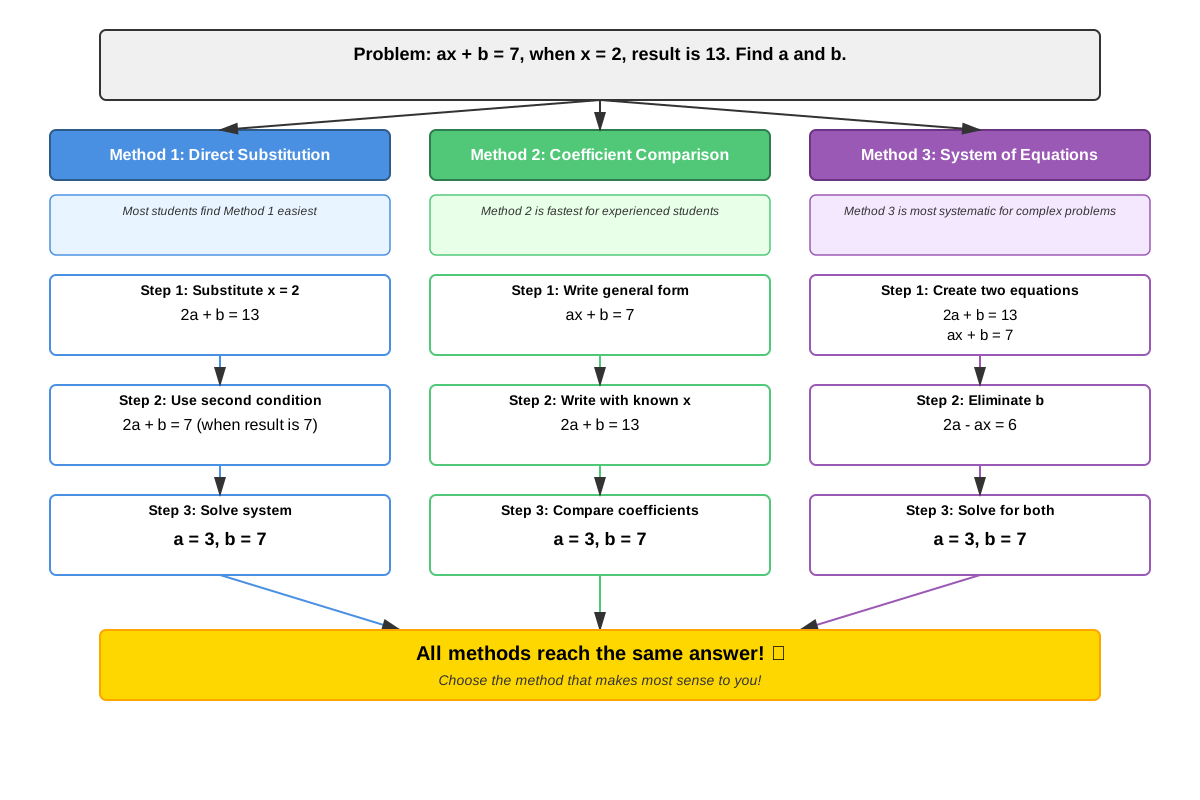
- [ ] Recognize multiple approaches to solving for unknown constants (substitution, comparison, elimination)
- [ ] Verify solutions by checking that determined constant values satisfy all given conditions
Prerequisites
- Basic linear equation solving: Students must be able to isolate variables and perform algebraic operations, as these skills form the foundation for manipulating equations to find unknown constants
- Understanding of variables and constants: Recognizing that letters can represent both changing quantities (variables) and fixed values (constants) is essential for interpreting these problems correctly
- Substitution method: The ability to replace variables with known values is the primary technique used to determine unknown constants
- Order of operations: Correctly applying PEMDAS ensures accurate simplification when working with expressions containing multiple constants and variables
- Combining like terms: Simplifying expressions by grouping similar terms is necessary before comparing coefficients or solving for constants
Why This Topic Matters
Unknown constant equations appear in numerous real-world contexts where relationships between quantities must be determined from observed data. Engineers use these concepts when calibrating instruments, economists apply them when determining parameters in economic models, and scientists employ them when deriving formulas from experimental results. The ability to work backward from known outcomes to determine underlying parameters represents a crucial problem-solving skill across STEM disciplines.
On the SAT, unknown constant equations appear in approximately 3-5 questions per test, representing roughly 5-9% of the total Math section. These questions typically appear in both the calculator and no-calculator portions, with difficulty levels ranging from medium to hard. The College Board considers this topic essential because it tests deeper conceptual understanding rather than mere procedural fluency. Questions may appear as standalone algebra problems, within word problems requiring equation setup, or as part of more complex multi-step problems involving systems of equations or functions.
Common SAT presentations include: (1) providing a solution to an equation and asking for the value of a constant that makes that solution valid; (2) stating that two expressions are equivalent and requiring students to find the constant that ensures this equivalence; (3) giving information about the relationship between coefficients in an equation; and (4) presenting scenarios where an equation must satisfy multiple conditions simultaneously. The SAT particularly favors questions where students must recognize that if a value is a solution to an equation, substituting it must make the equation true—a fundamental principle that many students overlook under test pressure.
Core Concepts
Understanding Constants vs. Variables
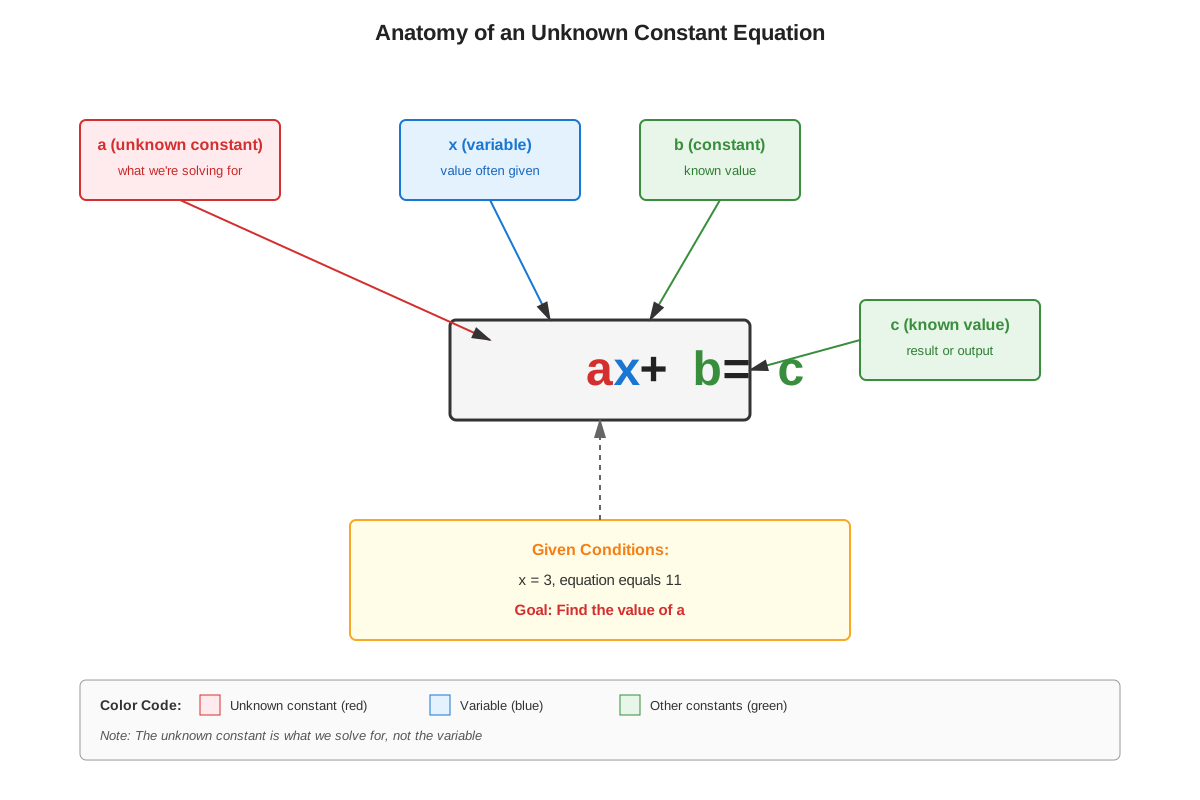
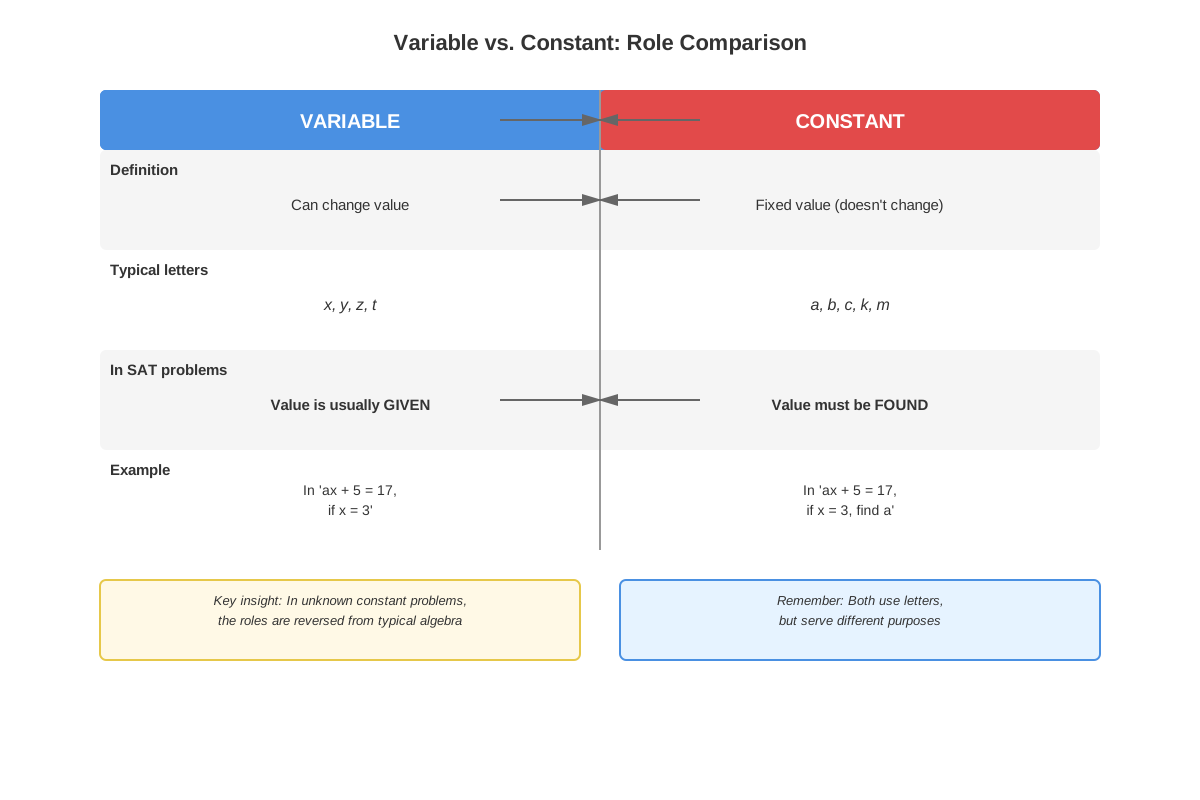
In algebraic expressions, variables represent quantities that can change or take on different values, while constants are fixed values that remain the same throughout a problem. In the equation ax + b = 0, the letter x is typically the variable we solve for, while a and b are constants—fixed numbers whose specific values we might need to determine. The key insight for unknown constant equations is that even though constants are represented by letters (making them look like variables), they behave as fixed numbers once their values are established.
When the SAT presents an unknown constant equation, it provides enough information to determine the constant's value uniquely. This information might come in several forms: a known solution to the equation, a relationship between the constant and other quantities, or conditions that the equation must satisfy. Recognizing what information has been provided and how to use it strategically is the first step toward solving these problems efficiently.
The Substitution Principle
The most fundamental technique for solving unknown constant equations relies on the substitution principle: if a specific value is a solution to an equation, then substituting that value for the variable must make the equation true (both sides equal). For example, if we're told that x = 3 is a solution to the equation 2x + k = 11, we can substitute 3 for x:
2(3) + k = 11
6 + k = 11
k = 5
This principle extends to more complex scenarios. If an equation has a specific solution, every occurrence of the variable can be replaced with that solution value, creating a new equation containing only the unknown constant. This transformed equation can then be solved using standard algebraic techniques.
Equivalent Expressions and Coefficient Matching
Another common SAT approach involves stating that two expressions are equivalent or equal for all values of the variable. When two polynomial expressions are equal for all values of a variable, their corresponding coefficients must be equal. This coefficient matching technique is powerful for finding unknown constants.
For example, if 3x + 2a = 6x - 4 for all values of x, we can rearrange to get:
3x + 2a = 6x - 4
2a + 4 = 6x - 3x
2a + 4 = 3x
For this equation to be true for all values of x, the coefficient of x on the left side must equal the coefficient on the right side, and the constant terms must also be equal. This means the left side cannot actually contain x, so we must have made an error in our reasoning. Let's reconsider: if the equation is true for all x, we should rearrange to:
3x + 2a = 6x - 4
2a + 4 = 3x
This cannot be true for all x unless we reconsider the original problem. Actually, for two linear expressions to be equal for all values of x, we need:
- Coefficients of x to be equal: 3 = 6 (which is false)
This example illustrates that not all problems are solvable—sometimes the SAT tests whether students recognize impossible conditions.
A better example: If ax + 3 = 4x + 3 for all values of x, then a = 4 because the coefficients of x must match.
Systems with Unknown Constants
Some SAT problems present systems of equations where one or more equations contain unknown constants. These problems require students to use information from one equation to determine the constant, then apply that constant in another equation. The strategy involves:
- Identifying which equation(s) contain the unknown constant
- Determining what information allows you to find the constant
- Solving for the constant using substitution or other methods
- Using the determined constant value in subsequent calculations
For example: "If x = 2 is a solution to 3x + k = 10, and y satisfies ky = 12, what is y?"
First, find k: 3(2) + k = 10, so k = 4
Then solve for y: 4y = 12, so y = 3
Equations with Multiple Constants
Advanced SAT problems may include equations with two or more unknown constants. These problems require multiple pieces of information—typically two conditions for two unknowns, three conditions for three unknowns, etc. Students must recognize that each independent piece of information provides one equation, and solving for multiple unknowns requires a system of equations approach.
For instance: "If x = 1 and x = -2 are both solutions to x² + bx + c = 0, find b + c."
Using x = 1: 1 + b + c = 0, so b + c = -1
We can verify with x = -2: 4 - 2b + c = 0
From the first equation: b + c = -1
From the second equation: -2b + c = -4
Subtracting: 3b = 3, so b = 1 and c = -2
Therefore, b + c = -1
Concept Relationships
The core concepts within unknown constant equations build upon each other in a logical progression. The foundation begins with understanding the distinction between constants and variables, which enables students to correctly interpret what they're solving for. This understanding leads directly to the substitution principle, the most frequently used technique, which states that known solutions can be substituted to create solvable equations for constants.
From substitution, students can progress to coefficient matching for equivalent expressions, which represents a more sophisticated application where the equality must hold for all variable values rather than just one specific value. This concept connects to polynomial identity and the uniqueness of polynomial representation. Both substitution and coefficient matching serve as tools for handling systems with unknown constants, where multiple equations must be considered together.
The relationship map flows as follows:
Constants vs. Variables → enables → Substitution Principle → applies to → Single Equation Problems
Substitution Principle + Coefficient Matching → combine in → Systems with Unknown Constants
All Core Concepts → extend to → Multiple Unknown Constants → requires → Systems of Equations
These concepts connect to prerequisite knowledge of basic equation solving (providing the algebraic manipulation skills needed) and to future topics including systems of equations (where constants in one equation affect solutions in another), functions (where constants determine function behavior), and parametric equations (where constants serve as parameters defining families of curves).
Quick check — test yourself on Unknown constant equations so far.
Try Flashcards →High-Yield Facts
⭐ If x = a is a solution to an equation, substituting a for x must make the equation true—this is the most common method for finding unknown constants on the SAT
⭐ When two expressions are equal for all values of a variable, their corresponding coefficients must be equal
⭐ Constants are fixed values represented by letters; they don't change within a problem even though they're represented by symbols
⭐ The number of unknown constants you can solve for equals the number of independent conditions or equations provided
⭐ Always verify your answer by substituting the constant back into the original equation to ensure it satisfies all given conditions
- Unknown constant problems typically appear 3-5 times per SAT, making them high-yield for test preparation
- The SAT often disguises unknown constant problems within word problems or function notation
- If an equation has infinitely many solutions, it means the equation is an identity, and coefficients on both sides must match
- When working with quadratic equations, if you know two solutions, you can determine both constants in the standard form
- Constants can appear in any position within an equation: as coefficients, as constant terms, or even as exponents in exponential expressions
- The phrase "for all values of x" signals that coefficient matching should be used rather than substitution of a specific value
- Multiple-choice answers can often be tested by substitution, making these problems amenable to working backward from answer choices
Common Misconceptions
Misconception: Constants and variables are the same thing because both are represented by letters
Correction: While both use letter symbols, constants represent fixed, unchanging values within a problem, whereas variables represent quantities that can take on different values. In ax + b = 0, if we're solving for x, then a and b are constants (fixed numbers) even though we might not know their specific values yet.
Misconception: If you're given one equation with two unknown letters, you can solve for both
Correction: Generally, you need as many independent equations as you have unknowns. One equation with two unknowns typically has infinitely many solution pairs. However, if additional information is provided (like "for all values of x"), this can provide the additional constraint needed.
Misconception: When substituting a solution into an equation to find a constant, you should substitute for all letters
Correction: Only substitute for the variable (the quantity that changes), not for the constants you're trying to find. If x = 3 is a solution to 2x + k = 11, substitute only the 3 for x, leaving k as is: 2(3) + k = 11.
Misconception: The constant must always be a positive integer
Correction: Constants can be any real number—positive, negative, zero, fractions, or irrational numbers. Don't eliminate answer choices simply because they're negative or non-integer values.
Misconception: If two expressions are equal, you can just set the constant terms equal and the variable terms equal separately
Correction: This only works when the expressions are equal for all values of the variable (an identity). If they're equal for just one specific value, you must substitute that value first, then solve. The equation 3x + 2 = 5x - 4 being true for x = 3 doesn't mean 2 = -4.
Misconception: Once you find the value of an unknown constant, you're done with the problem
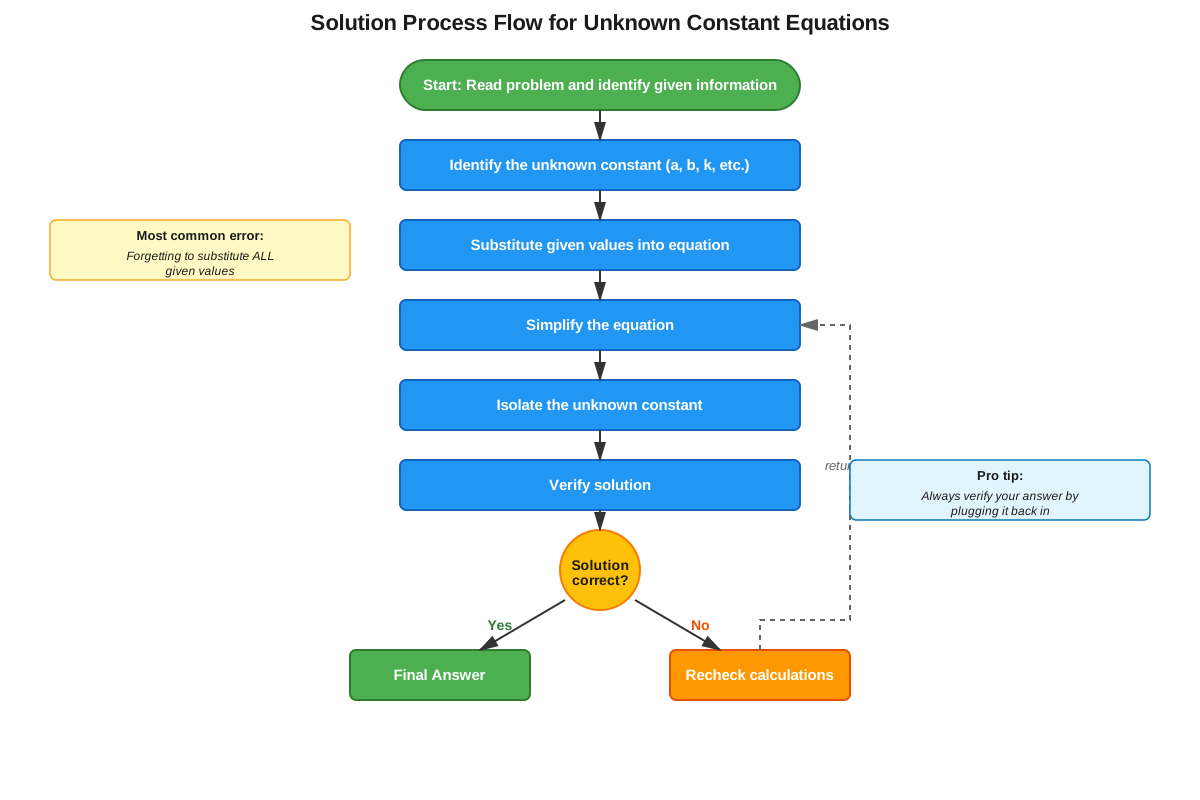
Correction: Always read the question carefully—the SAT often asks for a related quantity rather than the constant itself. You might need to find 2k, k + 3, or use k to solve for another variable. Additionally, verify your answer satisfies all given conditions.
Worked Examples
Example 1: Basic Substitution
Problem: If x = 4 is a solution to the equation 3x - 2k = 6, what is the value of k?
Solution:
Step 1: Identify what we know and what we're looking for.
- We know: x = 4 is a solution to 3x - 2k = 6
- We want: the value of k
Step 2: Apply the substitution principle. Since x = 4 is a solution, substituting 4 for x must make the equation true.
3(4) - 2k = 6
12 - 2k = 6
Step 3: Solve for k using standard algebraic techniques.
12 - 2k = 6
-2k = 6 - 12
-2k = -6
k = 3
Step 4: Verify the answer. Substitute k = 3 and x = 4 back into the original equation:
3(4) - 2(3) = 12 - 6 = 6 ✓
Answer: k = 3
Connection to Learning Objectives: This example demonstrates the fundamental technique of using substitution to find unknown constants, directly applying the core principle that solutions must satisfy equations.
Example 2: Coefficient Matching with Equivalent Expressions
Problem: If 2(x + 3) + a = bx + 10 for all values of x, what is a + b?
Solution:
Step 1: Recognize the key phrase "for all values of x" which signals that these expressions are identically equal, meaning we should use coefficient matching.
Step 2: Expand and simplify the left side to standard form.
2(x + 3) + a = bx + 10
2x + 6 + a = bx + 10
Step 3: Rearrange to group like terms clearly.
2x + (6 + a) = bx + 10Step 4: For this equation to be true for all values of x, the coefficients of x must be equal, and the constant terms must be equal.
Coefficients of x: 2 = b, so b = 2
Constant terms: 6 + a = 10, so a = 4
Step 5: Answer the question asked.
a + b = 4 + 2 = 6Step 6: Verify by testing with a specific value. Let's try x = 0:
Left side: 2(0 + 3) + 4 = 10
Right side: 2(0) + 10 = 10 ✓
Let's try x = 1:
Left side: 2(1 + 3) + 4 = 8 + 4 = 12
Right side: 2(1) + 10 = 12 ✓
Answer: a + b = 6
Connection to Learning Objectives: This example illustrates coefficient matching for equivalent expressions and demonstrates the importance of recognizing trigger phrases like "for all values" that indicate which technique to use.
Exam Strategy
When approaching unknown constant equations on the SAT, begin by carefully reading the problem to identify what information is given and what is being asked. Look for key phrases that indicate the solution method: "is a solution to" suggests direct substitution, while "for all values of" indicates coefficient matching. Circle or underline these trigger phrases to ensure you use the appropriate technique.
Trigger words and phrases to watch for:
- "is a solution to" or "satisfies the equation" → use substitution
- "for all values of x" or "for every value" → use coefficient matching
- "are equivalent" or "are equal" → may require coefficient matching
- "both x = a and x = b are solutions" → provides two conditions for finding constants
Process-of-elimination strategies:
- If answer choices are given, consider working backward by testing each choice—substitute the constant value and verify whether it satisfies all given conditions
- Eliminate answers that would make denominators zero or create undefined expressions
- For problems involving "for all values," eliminate any answer that works for one test value but not another
- Check extreme cases: if the constant must work for all x, try x = 0 (simplifies calculations) and x = 1 (easy to verify)
Time allocation advice:
Unknown constant problems typically require 1-2 minutes to solve. If you find yourself spending more than 2.5 minutes, consider:
- Marking the question and returning to it later
- Trying the answer choices by substitution rather than solving algebraically
- Re-reading the problem to ensure you understand what's being asked
Set up your work clearly by writing down what you know, what you're finding, and each step of your solution. This organization prevents errors and makes it easier to check your work if time permits. Always perform a quick verification by substituting your answer back into the original equation—this takes only 10-15 seconds and catches most calculation errors.
Memory Techniques
SOLVE - A mnemonic for approaching unknown constant problems:
- Substitute the given solution into the equation
- Organize by isolating the unknown constant
- Linearize by simplifying both sides
- Verify your answer works in the original equation
- Evaluate what the question actually asks for
The "Freeze and Flow" Visualization: Think of constants as "frozen" values (ice cubes) and variables as "flowing" values (water). When you see an equation, mentally color-code: constants are blue (frozen), variables are clear (flowing). This helps distinguish what you're solving for versus what you're solving with.
C-V-C Pattern: When reading a problem, identify the pattern:
- Condition given (what you know)
- Variable or unknown (what changes)
- Constant to find (what's fixed but unknown)
"All Values Alert": Create a mental alarm for the phrase "for all values"—whenever you see it, immediately think "coefficient matching" rather than substitution. Visualize this phrase in bright red letters to trigger the correct approach.
The Substitution Chant: "If it's a solution, make it true; substitute the value through and through." This simple rhyme reinforces the fundamental principle that solutions must satisfy equations.
Summary
Unknown constant equations represent a critical SAT Math topic that tests students' ability to work backward from given conditions to determine fixed values represented by letter symbols. The fundamental principle underlying all these problems is that constants, while represented by letters, are fixed values that can be determined when sufficient information is provided. The two primary solution techniques—substitution (when a specific solution is given) and coefficient matching (when expressions are equivalent for all variable values)—cover the vast majority of SAT questions on this topic. Success requires distinguishing between constants and variables, recognizing which technique to apply based on problem wording, executing algebraic manipulations accurately, and verifying that determined constant values satisfy all given conditions. These problems appear frequently on the SAT because they assess multiple competencies simultaneously: algebraic fluency, logical reasoning, and the ability to translate between different representations of mathematical relationships. Mastery of unknown constant equations not only improves SAT scores but also builds foundational skills for advanced mathematics, where parameters and constants play central roles in modeling real-world phenomena.
Key Takeaways
- Unknown constant equations require finding fixed values (constants) represented by letters, using given conditions such as known solutions or equivalence relationships
- The substitution principle—if x = a is a solution, then substituting a for x must make the equation true—is the most common solution method on the SAT
- Coefficient matching applies when expressions are equal "for all values" of a variable, requiring corresponding coefficients to be equal
- Always distinguish between what you're solving for (the unknown constant) and what you're given (the variable value or condition)
- Verify your answer by substituting back into the original equation to ensure it satisfies all given conditions
- The number of unknown constants you can determine equals the number of independent conditions provided
- Read questions carefully to identify what's actually being asked—the SAT often asks for expressions involving the constant rather than the constant itself
Related Topics
Systems of Linear Equations: Unknown constant equations serve as building blocks for systems where constants in one equation affect solutions in another. Mastering single-equation constant problems prepares students for multi-equation scenarios where constants must be determined before solving for variables.
Function Notation and Transformations: Constants in functions (like f(x) = ax + b) determine key features such as slope and y-intercept. Understanding how to find these constants from given conditions extends directly to analyzing and graphing functions.
Quadratic Equations and Factoring: When quadratics contain unknown constants, students must use given roots or conditions to determine coefficient values. This connects to Vieta's formulas and the relationship between roots and coefficients.
Parametric Equations: In advanced mathematics, constants serve as parameters that define families of curves or surfaces. The skills developed with unknown constant equations provide the foundation for parametric thinking.
Linear Inequalities with Constants: The techniques for finding constants in equations extend naturally to inequalities, where constants determine boundary conditions and solution regions.
Practice CTA
Now that you've mastered the core concepts of unknown constant equations, it's time to solidify your understanding through active practice. Attempt the practice questions designed specifically for this topic, focusing on applying the substitution principle and coefficient matching techniques you've learned. Use the flashcards to reinforce key facts and trigger phrases that signal which approach to use. Remember, the SAT rewards not just knowledge but also strategic thinking—practice identifying problem types quickly and executing solutions efficiently. Each practice problem you solve builds the pattern recognition and confidence needed to excel on test day. You've built a strong foundation; now strengthen it through deliberate practice!
Sign up free to keep reading
Create a free AnvayaPrep account to finish this SAT guide on Unknown constant equations — plus flashcards and practice questions.