Overview
Linear function transformations represent one of the most fundamental and frequently tested concepts in SAT Math. These transformations describe how the graph of a linear function changes when its equation is modified through shifts, reflections, stretches, and compressions. Understanding these transformations allows students to quickly visualize and predict how changes to a function's equation affect its graphical representation, and vice versa. On the SAT, questions involving sat linear function transformations typically appear in both the calculator and no-calculator sections, often requiring students to identify how a given transformation affects key features like slope, y-intercept, and the overall position of the line.
Mastery of linear function transformations is essential because these concepts form the foundation for understanding more complex function families tested on the SAT, including quadratic, exponential, and absolute value functions. The ability to recognize transformation patterns enables students to solve problems more efficiently, often allowing them to eliminate incorrect answer choices without extensive calculation. Additionally, transformation questions frequently integrate multiple math concepts, such as coordinate geometry, function notation, and algebraic manipulation, making them high-value targets for comprehensive SAT preparation.
The SAT tests linear function transformations through various question formats: identifying transformed graphs, writing equations after transformations, determining the effects of parameter changes, and solving real-world problems involving linear models. These questions assess both conceptual understanding and procedural fluency, requiring students to move fluidly between algebraic and graphical representations. Given that linear functions appear in approximately 15-20% of SAT Math questions, and transformations represent a significant subset of these problems, investing time in mastering this topic yields substantial score improvements.
Learning Objectives
- [ ] Identify key features of Linear function transformations
- [ ] Explain how Linear function transformations appears on the SAT
- [ ] Apply Linear function transformations to answer SAT-style questions
- [ ] Determine the equation of a transformed linear function given the original function and transformation description
- [ ] Predict the graphical effect of algebraic changes to linear function parameters
- [ ] Distinguish between horizontal and vertical transformations and their corresponding algebraic representations
- [ ] Solve multi-step problems involving combinations of transformations
Prerequisites
- Basic linear function concepts: Understanding slope-intercept form (y = mx + b) and point-slope form is essential for recognizing how transformations modify function equations
- Coordinate plane familiarity: Ability to plot points and interpret graphs enables visualization of transformation effects
- Function notation: Comfort with f(x) notation is necessary for understanding transformation syntax like f(x + 2) or f(x) - 3
- Algebraic manipulation: Skills in simplifying expressions and solving equations support the process of determining transformed function equations
Why This Topic Matters
Linear function transformations have extensive real-world applications across multiple disciplines. In economics, transformations model changes in cost structures (vertical shifts represent fixed cost changes, while slope changes reflect variable cost modifications). In physics, transformations describe motion scenarios where initial position or velocity changes. In data analysis, transformations help adjust datasets for comparison by accounting for baseline differences or scaling factors.
On the SAT, linear function transformations appear in approximately 3-5 questions per test, representing roughly 5-8% of the total Math section. These questions typically fall into several categories: identifying transformed graphs from equations (multiple-choice), writing equations after described transformations (grid-in), determining transformation types from before-and-after graphs, and solving contextual problems where transformations represent real-world changes. The College Board frequently combines transformation concepts with other topics like systems of equations, inequalities, and data interpretation, making this a high-integration topic.
Common SAT question formats include: presenting a linear function and asking which graph represents a specific transformation; providing two parallel or perpendicular lines and asking about their relationship; describing a real-world scenario where a linear model undergoes a change and asking for the new equation; and showing a graph with a transformed line and asking students to identify the transformation applied. Questions may also present transformations in context, such as "If the cost function increases by $50, how does the equation change?" These applications make transformation knowledge both conceptually important and practically valuable for test performance.
Core Concepts
The Standard Form of Linear Functions
A linear function is typically expressed in slope-intercept form: f(x) = mx + b, where m represents the slope and b represents the y-intercept. This form provides the foundation for understanding transformations because each parameter (m and b) controls specific graphical features. The slope m determines the steepness and direction of the line, while the y-intercept b determines where the line crosses the vertical axis. All linear function transformations can be understood as modifications to these parameters or to the input variable x.
Vertical Translations (Shifts)
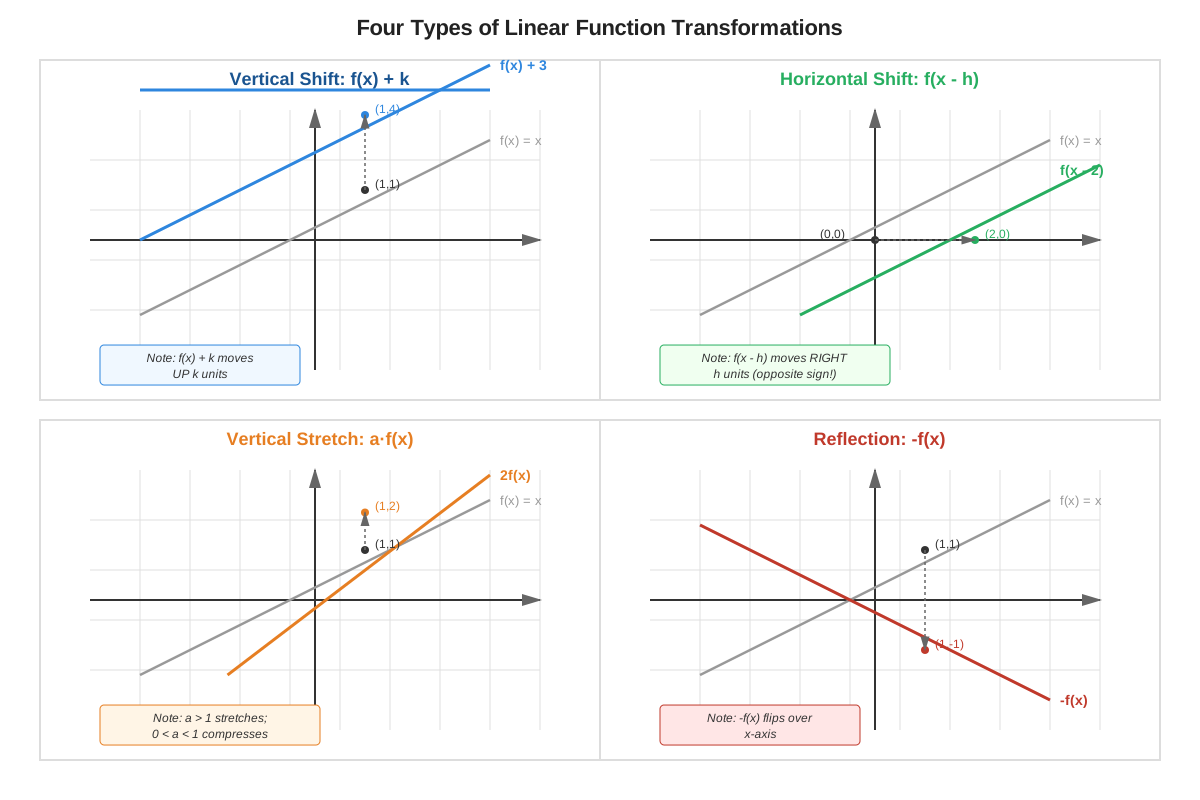
A vertical translation moves the entire graph of a linear function up or down without changing its slope. Algebraically, this transformation adds or subtracts a constant to the entire function:
- Upward shift by k units: g(x) = f(x) + k = mx + b + k
- Downward shift by k units: g(x) = f(x) - k = mx + b - k
The key insight is that vertical translations affect only the y-intercept, not the slope. If the original function is f(x) = 2x + 3, then f(x) + 4 = 2x + 7 represents a vertical shift upward by 4 units. The slope remains 2, but the y-intercept changes from 3 to 7. On the SAT, students must recognize that adding a constant outside the function notation creates a vertical shift.
Horizontal Translations (Shifts)
A horizontal translation moves the graph left or right, which is algebraically represented by modifying the input variable:
- Right shift by h units: g(x) = f(x - h) = m(x - h) + b
- Left shift by h units: g(x) = f(x + h) = m(x + h) + b
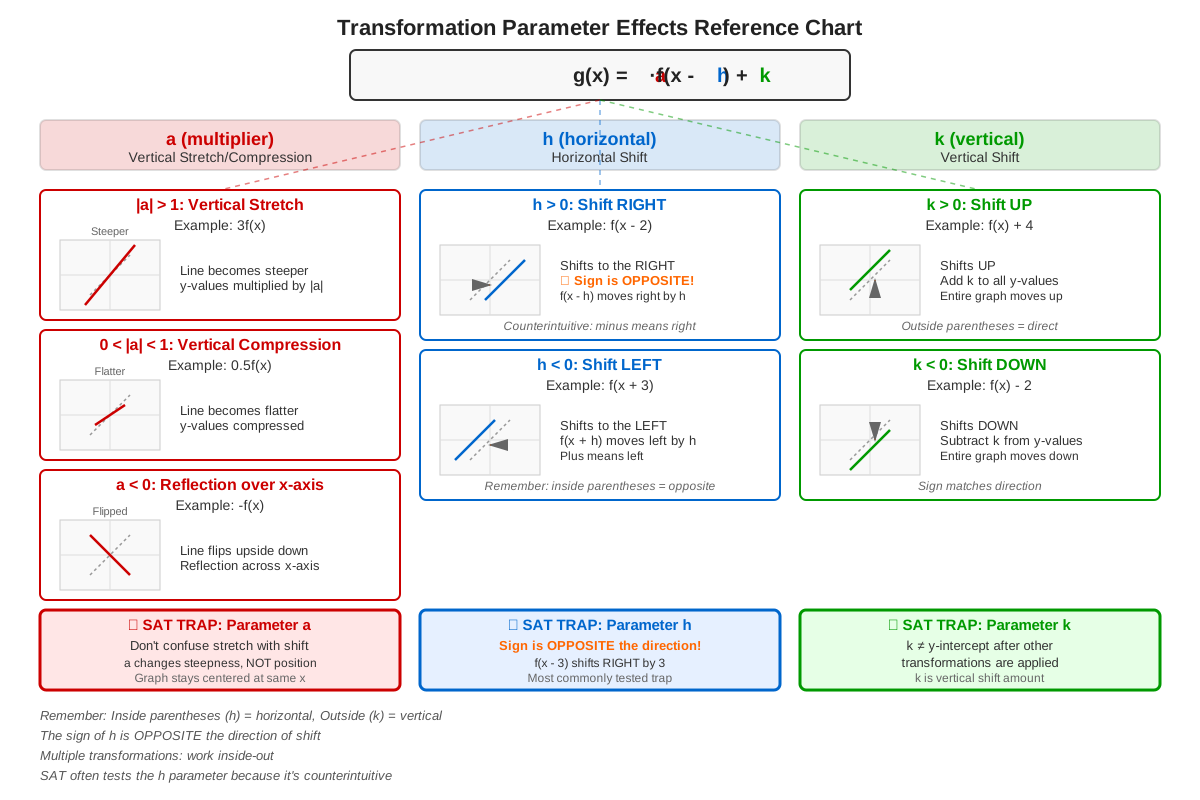
This transformation is counterintuitive because the algebraic sign appears opposite to the direction of movement. Subtracting inside the function (x - h) shifts the graph right, while adding (x + h) shifts it left. For example, if f(x) = 2x + 3, then f(x - 5) = 2(x - 5) + 3 = 2x - 10 + 3 = 2x - 7 represents a horizontal shift right by 5 units. Both the slope and the effective y-intercept change, though the fundamental relationship between variables remains linear.
Vertical Stretches and Compressions
Vertical stretches and compressions change the steepness of the line by multiplying the entire function by a constant factor:
- Vertical stretch by factor a (where a > 1): g(x) = a · f(x) = a(mx + b) = amx + ab
- Vertical compression by factor a (where 0 < a < 1): g(x) = a · f(x) = a(mx + b) = amx + ab
These transformations multiply both the slope and y-intercept by the same factor. If f(x) = 2x + 4, then 3f(x) = 6x + 12 represents a vertical stretch by factor 3. The slope increases from 2 to 6, and the y-intercept increases from 4 to 12. On the SAT, recognizing that multiplying the entire function affects both parameters is crucial for eliminating incorrect answer choices.
Reflections
Reflections flip the graph across an axis:
- Reflection across the x-axis: g(x) = -f(x) = -(mx + b) = -mx - b
- Reflection across the y-axis: g(x) = f(-x) = m(-x) + b = -mx + b
Reflection across the x-axis negates the entire function, changing the signs of both slope and y-intercept. Reflection across the y-axis negates only the input variable, changing only the slope's sign. For f(x) = 3x + 2, reflection across the x-axis yields -f(x) = -3x - 2, while reflection across the y-axis yields f(-x) = -3x + 2. The SAT frequently tests whether students can distinguish between these two types of reflections.
Transformation Combinations
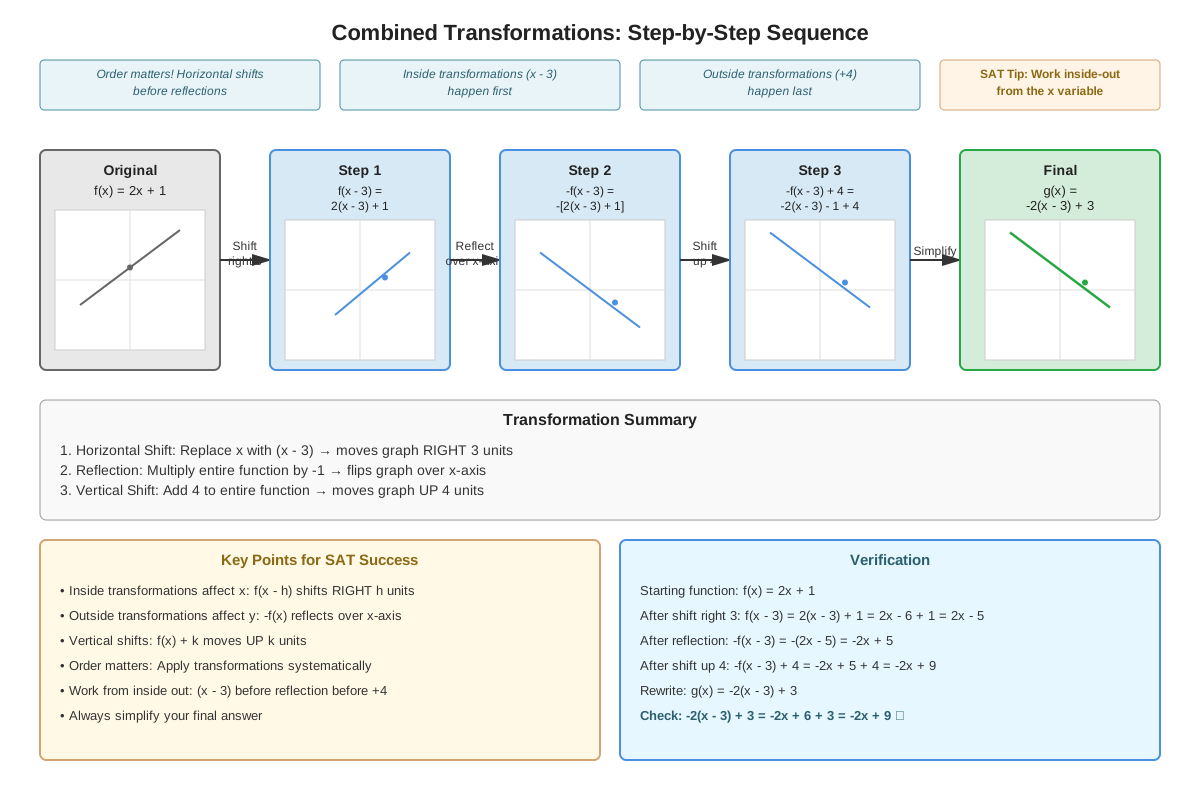
The SAT often presents combined transformations where multiple operations are applied sequentially. The order of operations matters, particularly when combining horizontal and vertical shifts with stretches or reflections. For example, if f(x) = 2x + 1, the transformation g(x) = 3f(x - 2) + 4 involves:
- Horizontal shift right by 2: f(x - 2) = 2(x - 2) + 1 = 2x - 3
- Vertical stretch by 3: 3f(x - 2) = 3(2x - 3) = 6x - 9
- Vertical shift up by 4: 3f(x - 2) + 4 = 6x - 5
Understanding the sequence and effect of each transformation enables students to work systematically through complex problems.
Transformation Summary Table
| Transformation Type | Algebraic Form | Effect on Graph | Effect on Slope | Effect on Y-intercept |
|---|---|---|---|---|
| Vertical shift up | f(x) + k | Moves up k units | No change | Increases by k |
| Vertical shift down | f(x) - k | Moves down k units | No change | Decreases by k |
| Horizontal shift right | f(x - h) | Moves right h units | No change | Changes (calculate) |
| Horizontal shift left | f(x + h) | Moves left h units | No change | Changes (calculate) |
| Vertical stretch | a·f(x), a > 1 | Steeper line | Multiplied by a | Multiplied by a |
| Vertical compression | a·f(x), 0 < a < 1 | Less steep line | Multiplied by a | Multiplied by a |
| Reflection over x-axis | -f(x) | Flips vertically | Negated | Negated |
| Reflection over y-axis | f(-x) | Flips horizontally | Negated | Unchanged |
Concept Relationships
Linear function transformations build directly upon fundamental linear function concepts. The slope-intercept form (y = mx + b) serves as the starting point, with transformations representing systematic modifications to this base structure. Understanding how m and b control the graph's appearance enables prediction of transformation effects.
Within the topic itself, transformations follow a logical hierarchy: vertical translations → horizontal translations → stretches/compressions → reflections → combined transformations. Vertical translations are typically easiest to grasp because they directly modify the visible y-intercept. Horizontal translations require deeper understanding because the algebraic representation appears counterintuitive. Stretches and compressions extend the concept of slope modification, while reflections introduce sign changes. Combined transformations synthesize all previous concepts, requiring systematic application of multiple operations.
The relationship map flows as follows: Basic linear function → Parameter identification (m, b) → Single transformations (vertical/horizontal shifts) → Scaling transformations (stretches/compressions) → Symmetry transformations (reflections) → Complex combinations → Real-world applications. Each level builds upon previous understanding, with combined transformations representing the highest cognitive demand.
Connections to other SAT Math topics include: systems of equations (transformed parallel lines have equal slopes), inequalities (transformations affect solution regions), function composition (sequential transformations), and coordinate geometry (distance and midpoint calculations with transformed points). Mastery of transformations also prepares students for quadratic and exponential function transformations, which follow analogous patterns with additional complexity.
Quick check — test yourself on Linear function transformations so far.
Try Flashcards →High-Yield Facts
⭐ Vertical shifts add or subtract a constant outside the function: f(x) + k shifts up, f(x) - k shifts down
⭐ Horizontal shifts modify the input variable with opposite signs: f(x - h) shifts right, f(x + h) shifts left
⭐ Multiplying the entire function by a constant greater than 1 creates a vertical stretch; between 0 and 1 creates a compression
⭐ Reflection across the x-axis negates the entire function: -f(x); reflection across the y-axis negates the input: f(-x)
⭐ Vertical translations change only the y-intercept, not the slope
- Horizontal translations affect both the slope coefficient and the constant term when expanded
- Parallel lines have identical slopes, so transformations that preserve slope create parallel lines
- Vertical stretches multiply both the slope and y-intercept by the same factor
- Combined transformations must be applied in the correct order: inside the function first (horizontal), then outside (vertical)
- The graph of f(x) = mx + b and f(x) + c are parallel lines separated by vertical distance c
- Transformations preserve the linear nature of functions—a transformed linear function remains linear
- The x-intercept changes with most transformations except pure vertical translations of functions with non-zero slope
- Two lines are perpendicular if their slopes are negative reciprocals; reflections can create perpendicular relationships
- The domain and range of linear functions remain all real numbers regardless of transformations (unlike other function types)
Common Misconceptions
Misconception: Adding a constant inside the parentheses, like f(x + 3), shifts the graph to the right.
Correction: Adding inside the function notation creates a leftward shift. The transformation f(x + 3) moves the graph 3 units left, while f(x - 3) moves it 3 units right. The algebraic sign is opposite to the direction of movement.
Misconception: Multiplying a linear function by a constant only changes the slope.
Correction: Multiplying the entire function by a constant affects both the slope and the y-intercept. If f(x) = 2x + 3, then 2f(x) = 4x + 6, changing both parameters proportionally.
Misconception: Horizontal shifts don't affect the y-intercept.
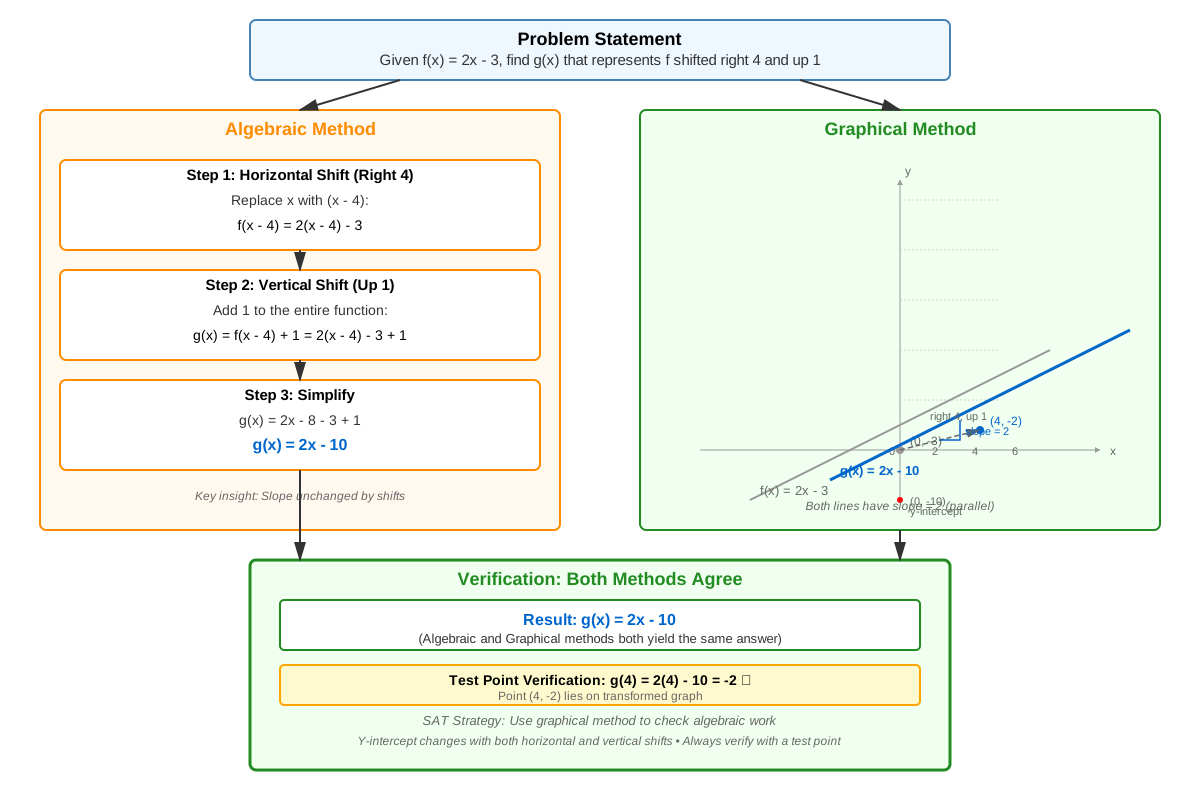
Correction: While horizontal shifts don't change the slope, they do affect the y-intercept when the equation is written in slope-intercept form. The function f(x) = 2x + 3 shifted right by 4 units becomes f(x - 4) = 2(x - 4) + 3 = 2x - 5, changing the y-intercept from 3 to -5.
Misconception: Reflecting across the y-axis changes both the slope and y-intercept.
Correction: Reflection across the y-axis (f(-x)) negates only the slope, leaving the y-intercept unchanged. For f(x) = 3x + 2, the reflection f(-x) = -3x + 2 keeps the y-intercept at 2.
Misconception: All transformations can be applied in any order with the same result.
Correction: The order of transformations matters, especially when combining horizontal shifts with stretches or reflections. The transformation 2f(x - 3) produces a different result than f(2x - 3) or f(2(x - 3)).
Misconception: Vertical compression makes the line less steep, so the slope gets closer to zero.
Correction: While vertical compression does reduce the absolute value of the slope, the term "compression" specifically refers to multiplying by a factor between 0 and 1. A compression by factor 0.5 changes f(x) = 4x + 2 to 0.5f(x) = 2x + 1, reducing steepness but maintaining the same direction.
Misconception: Transformations change whether a function is linear.
Correction: All transformations of linear functions produce linear functions. The linearity is preserved through shifts, stretches, compressions, and reflections—the result always remains a straight line.
Worked Examples
Example 1: Multiple Transformation Application
Problem: The function f(x) = 3x - 2 is transformed to create g(x). The transformation involves shifting f(x) right by 4 units, then reflecting across the x-axis, and finally shifting up by 5 units. What is the equation of g(x)?
Solution:
Step 1: Apply the horizontal shift right by 4 units.
This means replacing x with (x - 4):
f(x - 4) = 3(x - 4) - 2 = 3x - 12 - 2 = 3x - 14
Step 2: Apply the reflection across the x-axis.
This means negating the entire function:
-f(x - 4) = -(3x - 14) = -3x + 14
Step 3: Apply the vertical shift up by 5 units.
This means adding 5 to the entire function:
-f(x - 4) + 5 = -3x + 14 + 5 = -3x + 19
Answer: g(x) = -3x + 19
Connection to Learning Objectives: This problem demonstrates the application of multiple transformations in sequence, requiring identification of each transformation type and systematic execution. The solution shows how horizontal shifts affect the constant term, reflections change signs, and vertical shifts modify the y-intercept.
Example 2: Identifying Transformations from Equations
Problem: The graph of y = 2x + 7 is transformed to produce y = 6x + 21. Which of the following describes this transformation?
A) Vertical shift up by 14 units
B) Vertical stretch by a factor of 3
C) Horizontal shift left by 7 units
D) Vertical stretch by a factor of 3 and vertical shift up by 14 units
Solution:
Step 1: Compare the two equations to identify changes.
Original: y = 2x + 7
Transformed: y = 6x + 21
Step 2: Analyze the slope change.
The slope changed from 2 to 6, which is a multiplication by 3.
This suggests a vertical stretch by factor 3.
Step 3: Check if vertical stretch alone explains the transformation.
If we apply only a vertical stretch by 3: 3(2x + 7) = 6x + 21 ✓
Step 4: Verify the y-intercept change.
Original y-intercept: 7
Transformed y-intercept: 21 = 3 × 7 ✓
This confirms that both the slope and y-intercept were multiplied by 3, which is exactly what a vertical stretch does.
Step 5: Eliminate incorrect answers.
- Choice A would only change the y-intercept, not the slope
- Choice C would change the y-intercept but not multiply the slope by 3
- Choice D is redundant because the vertical stretch already accounts for all changes
Answer: B) Vertical stretch by a factor of 3
Connection to Learning Objectives: This problem requires identifying transformation features by comparing equations and understanding that vertical stretches multiply all coefficients. It demonstrates the SAT's tendency to include answer choices that represent common misconceptions (like thinking the y-intercept change requires a separate shift).
Exam Strategy
When approaching SAT questions on linear function transformations, begin by identifying what information is given and what is being asked. Questions typically provide either two equations, two graphs, or one of each, and ask about the transformation connecting them. Trigger words to watch for include: "shifted," "translated," "reflected," "stretched," "compressed," "parallel," and "perpendicular."
Process-of-elimination strategy: When given multiple-choice options, quickly eliminate answers that violate basic transformation rules. If the question involves a vertical shift, eliminate any answer that changes the slope. If it involves a horizontal shift, calculate the expected y-intercept change and eliminate answers with incorrect values. For reflection questions, check the signs of slope and y-intercept—incorrect sign changes indicate wrong answers.
Graphical approach: When graphs are provided, identify key features before writing equations. Note the y-intercept and calculate slope using two clear points. Compare these features between the original and transformed graphs to determine what changed. If the y-intercept changed but the slope didn't, it's a vertical translation. If both changed proportionally, it's a vertical stretch or compression.
Algebraic approach: When working with equations, write both in slope-intercept form for easy comparison. Calculate the ratio of slopes and the difference in y-intercepts. These values directly indicate the transformation type and magnitude.
Time allocation: Transformation questions typically require 45-90 seconds. Spend 15-20 seconds identifying the transformation type, 20-40 seconds performing calculations, and 10-30 seconds verifying your answer. If a problem involves multiple transformations, allocate an additional 30 seconds for systematic application of each step.
Common trap answers: The SAT frequently includes answer choices that result from applying transformations in the wrong order, using incorrect signs for horizontal shifts, or forgetting that vertical stretches affect both slope and y-intercept. Always verify your answer by checking whether it produces the correct final equation or graph.
Memory Techniques
Mnemonic for transformation order: "Inside-Out, Left-Right, Up-Down" (IOLRUD)
- Inside the function first (horizontal shifts and reflections)
- Outside the function second (vertical stretches/compressions)
- Left-Right before Up-Down when combining shifts
Horizontal shift sign rule: "Opposite Day"
Remember that horizontal shifts work opposite to intuition: minus means right, plus means left. Visualize the function "chasing" the subtracted value—if you subtract 3, the function moves right to catch up to where x = 3 used to be.
Vertical stretch vs. compression: "Greater than 1 = Greater steepness"
If the multiplier is greater than 1, the line gets steeper (stretch). If it's between 0 and 1, the line gets less steep (compression). The number's relationship to 1 matches the line's relationship to its original steepness.
Reflection memory aid: "Negative X = X-axis flip, Negative function = function flip"
When you negate the input (x), you flip across the y-axis (vertical line). When you negate the output (entire function), you flip across the x-axis (horizontal line). The axis you flip across is perpendicular to what you negated.
Parallel lines reminder: "Same Slope = Same Direction = Parallel"
Transformations that preserve slope (vertical shifts) create parallel lines. This connects to the geometric principle that parallel lines never meet because they travel in the same direction.
Summary
Linear function transformations represent systematic modifications to the equation f(x) = mx + b that produce predictable changes in the graph. Vertical translations add or subtract constants outside the function, changing only the y-intercept. Horizontal translations modify the input variable with counterintuitive signs—subtracting shifts right, adding shifts left—and affect both slope coefficient and constant term when expanded. Vertical stretches and compressions multiply the entire function by a constant, proportionally changing both slope and y-intercept. Reflections negate either the input (y-axis reflection) or the entire function (x-axis reflection), changing signs of specific parameters. Combined transformations require systematic application in the correct order: inside modifications first, then outside operations. The SAT tests these concepts through equation-to-graph matching, transformation identification from equation pairs, and real-world modeling scenarios. Success requires recognizing transformation types from algebraic forms, predicting graphical effects, and understanding how each transformation affects slope and y-intercept independently or together.
Key Takeaways
- Vertical shifts (f(x) ± k) change only the y-intercept, preserving slope and creating parallel lines
- Horizontal shifts (f(x ± h)) work opposite to algebraic signs: minus shifts right, plus shifts left
- Vertical stretches/compressions (a·f(x)) multiply both slope and y-intercept by the same factor
- Reflections across the x-axis negate the entire function; reflections across the y-axis negate only the input
- Combined transformations must be applied systematically: horizontal operations first, then vertical operations
- All transformations preserve linearity—transformed linear functions remain linear
- Comparing slope and y-intercept changes between equations reveals the transformation type and magnitude
Related Topics
Quadratic Function Transformations: Extends transformation concepts to parabolas, where horizontal and vertical shifts affect the vertex position, and stretches/compressions change the width of the parabola. Mastering linear transformations provides the foundation for understanding these more complex patterns.
Exponential Function Transformations: Applies similar transformation rules to exponential functions, with horizontal shifts affecting the asymptote position and vertical stretches changing the growth rate. The principles learned with linear functions transfer directly to this function family.
Absolute Value Function Transformations: Combines linear transformation concepts with piecewise behavior, creating V-shaped graphs that shift, stretch, and reflect according to the same rules. Understanding linear transformations makes absolute value transformations more intuitive.
Systems of Linear Equations: Transformations create relationships between lines (parallel, perpendicular, intersecting), which directly connects to solving systems. Recognizing that vertical shifts create parallel lines helps predict whether systems have solutions.
Function Composition: Sequential transformations represent a form of function composition, where the output of one transformation becomes the input for the next. This topic extends transformation concepts into more abstract function operations.
Practice CTA
Now that you've mastered the core concepts of linear function transformations, it's time to solidify your understanding through active practice. Attempt the practice questions to test your ability to identify, explain, and apply transformations in various SAT-style contexts. Use the flashcards to reinforce high-yield facts and transformation rules until they become automatic. Remember, transformation questions appear frequently on the SAT and often integrate multiple math concepts, making them high-value targets for score improvement. Consistent practice with these problems will build the pattern recognition and procedural fluency needed to answer transformation questions quickly and accurately on test day. You've got this!
Sign up free to keep reading
Create a free AnvayaPrep account to finish this SAT guide on Linear function transformations — plus flashcards and practice questions.