Overview
Linear models are mathematical representations that describe relationships between two variables using straight-line equations. On the SAT math section, linear models form the foundation for understanding how real-world quantities change in relation to one another at a constant rate. These models appear in word problems, data interpretation questions, and graphical analysis scenarios, making them one of the most frequently tested concepts on the exam.
Understanding linear models is essential for SAT success because they bridge abstract algebraic concepts with practical applications. Students encounter sat linear models in contexts ranging from business scenarios (cost and revenue relationships) to scientific applications (temperature conversions, speed calculations) to everyday situations (cell phone plans, rental fees). The ability to translate verbal descriptions into mathematical equations, interpret slopes and intercepts meaningfully, and make predictions based on linear relationships is tested repeatedly throughout the SAT Math section.
Linear models connect to broader mathematical concepts including functions, coordinate geometry, systems of equations, and data analysis. Mastery of this topic enables students to tackle more complex problems involving quadratic and exponential models, as linear relationships serve as the baseline comparison for all other function types. The skills developed through studying linear models—pattern recognition, algebraic manipulation, and contextual interpretation—transfer directly to higher-level mathematics and real-world problem-solving.
Learning Objectives
- [ ] Identify key features of linear models including slope, y-intercept, and rate of change
- [ ] Explain how linear models appears on the SAT in various question formats and contexts
- [ ] Apply linear models to answer SAT-style questions involving real-world scenarios
- [ ] Construct linear equations from verbal descriptions and data tables
- [ ] Interpret the meaning of slope and intercept within specific contexts
- [ ] Determine whether a linear model is appropriate for a given situation
- [ ] Make predictions and extrapolations using established linear relationships
Prerequisites
- Basic algebraic manipulation: Solving for variables and rearranging equations is necessary for working with linear model formulas
- Coordinate plane understanding: Plotting points and understanding x and y axes enables visualization of linear relationships
- Slope-intercept form (y = mx + b): This fundamental equation form is the primary representation of linear models
- Rate and ratio concepts: Understanding how quantities change relative to one another underlies the concept of slope
- Function notation: Recognizing f(x) notation and understanding input-output relationships helps interpret linear models
Why This Topic Matters
Linear models represent one of the most practical applications of mathematics in everyday life. From calculating taxi fares that charge a base fee plus a per-mile rate to understanding how temperature scales relate to each other, linear relationships govern countless real-world phenomena. Businesses use linear models for break-even analysis, scientists employ them to describe constant-rate processes, and economists apply them to supply and demand relationships.
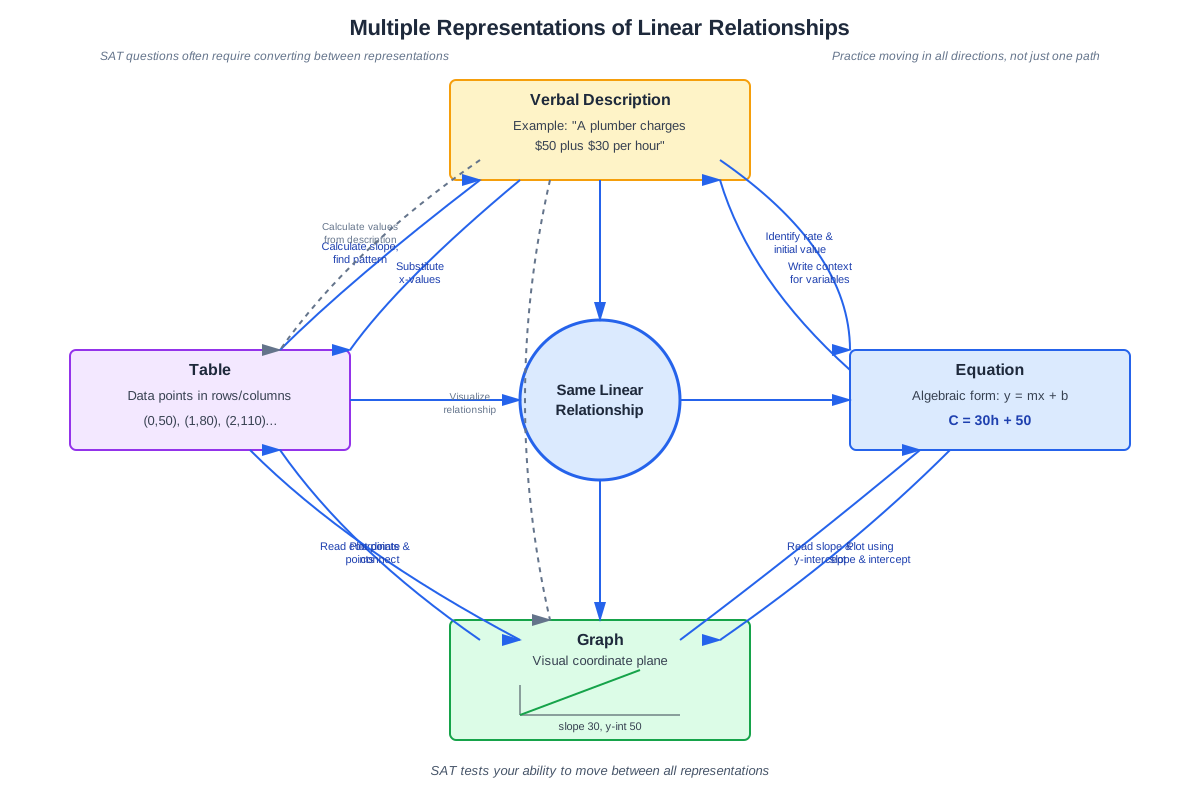
On the SAT, linear models appear in approximately 15-20% of all Math section questions, making them a high-yield topic for focused study. Questions involving linear models typically appear in multiple formats: pure algebraic manipulation, word problems requiring equation construction, graph interpretation, and data analysis scenarios. The College Board specifically tests whether students can move fluidly between different representations of linear relationships (equations, graphs, tables, and verbal descriptions).
Common SAT question types include: identifying the meaning of slope or y-intercept in context, determining which equation best models a described situation, predicting values using a linear model, comparing two linear models, and recognizing when a linear model is or isn't appropriate. These questions often appear in both the calculator and no-calculator sections, emphasizing the importance of understanding concepts rather than just computational procedures.
Core Concepts
Definition and Structure of Linear Models
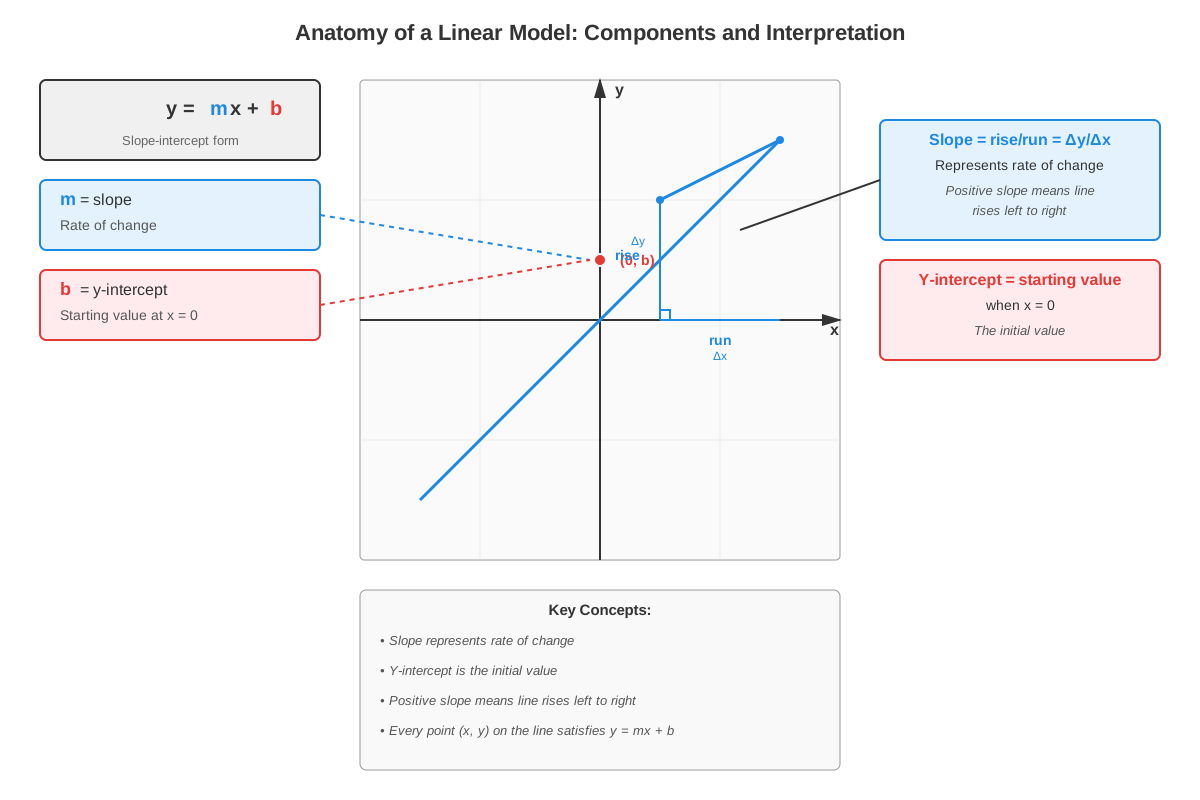
A linear model is a mathematical equation that describes a relationship between two variables where one variable changes at a constant rate with respect to the other. The standard form of a linear model is y = mx + b, where:
- y represents the dependent variable (output)
- x represents the independent variable (input)
- m represents the slope (rate of change)
- b represents the y-intercept (initial value when x = 0)
Linear models produce straight lines when graphed on a coordinate plane, hence the term "linear." The defining characteristic is that the rate of change remains constant throughout the entire relationship—for every unit increase in x, y changes by exactly m units.
Slope: The Rate of Change
The slope (m) is the most critical component of a linear model as it quantifies how rapidly the dependent variable changes relative to the independent variable. Mathematically, slope is calculated as:
m = (y₂ - y₁)/(x₂ - x₁) = rise/run = change in y/change in xIn SAT contexts, slope always has a real-world meaning. For example:
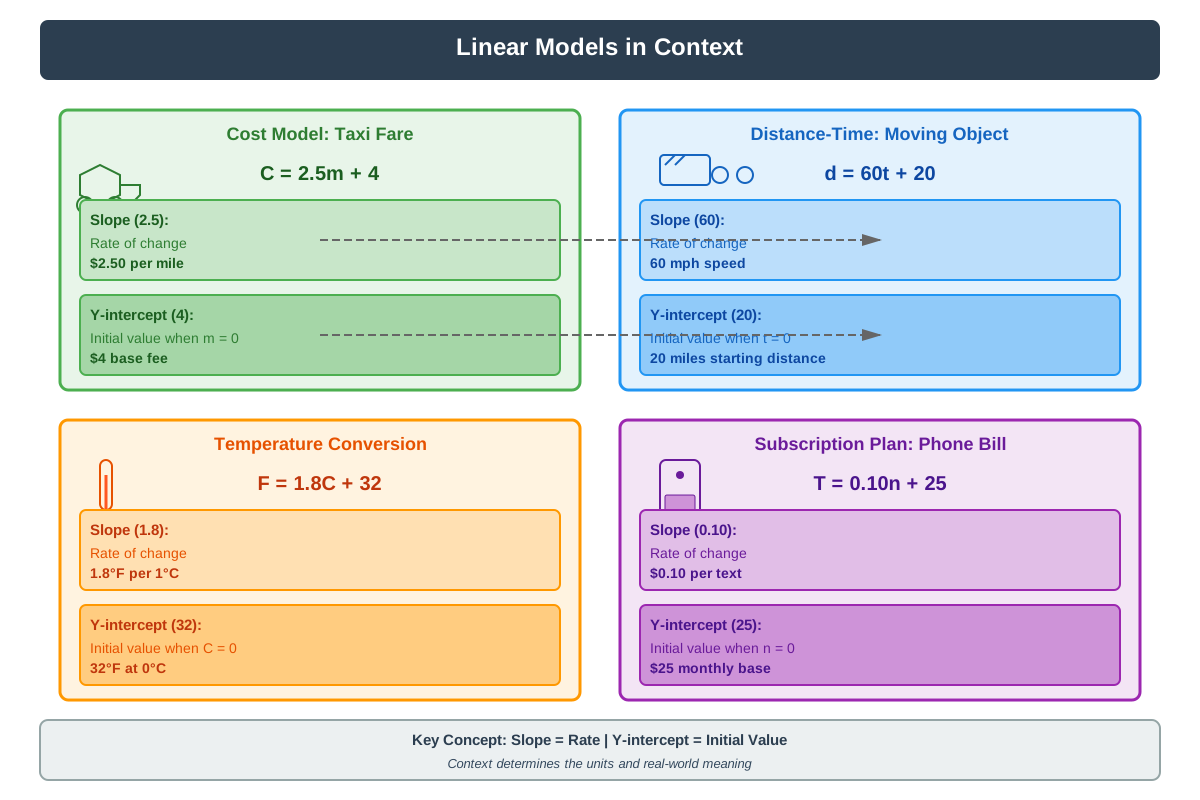
- In a cost model: slope represents cost per unit (dollars per item)
- In a distance model: slope represents speed (miles per hour)
- In a temperature conversion: slope represents the conversion factor
- In a population model: slope represents growth rate (people per year)
Positive slopes indicate that as x increases, y increases. Negative slopes indicate that as x increases, y decreases. A slope of zero indicates a horizontal line (no change in y), while an undefined slope indicates a vertical line (not a function).
Y-Intercept: The Starting Value
The y-intercept (b) represents the value of y when x equals zero. In practical applications, this often represents an initial condition, starting value, or fixed cost. Understanding the contextual meaning of the y-intercept is crucial for SAT success.
Common interpretations include:
- Initial population at time zero
- Fixed fee or base charge before variable costs
- Starting temperature or measurement
- Value of one variable when the other is absent
Not all linear models have meaningful y-intercepts in their contexts. For instance, if x represents years since 2000, the y-intercept represents the value in the year 2000, which may or may not be relevant to the problem.
Constructing Linear Models from Context
SAT questions frequently require students to translate verbal descriptions into mathematical equations. The key is identifying:
- What changes at a constant rate (this becomes the slope)
- What the starting or fixed value is (this becomes the y-intercept)
- Which variable depends on the other (dependent vs. independent)
For example: "A water tank contains 500 gallons and drains at a rate of 25 gallons per hour."
- Starting value: 500 gallons (y-intercept, b = 500)
- Rate of change: -25 gallons per hour (slope, m = -25, negative because draining)
- Independent variable: time in hours (x)
- Dependent variable: gallons remaining (y)
- Model: y = -25x + 500
Interpreting Linear Models from Graphs
When linear models are presented graphically, students must extract information from visual representations:
| Graph Feature | Mathematical Meaning | How to Identify |
|---|---|---|
| Steepness | Magnitude of slope | Steeper lines have larger absolute slope values |
| Direction | Sign of slope | Upward = positive, downward = negative |
| Y-axis crossing | Y-intercept value | Point where line crosses vertical axis |
| X-axis crossing | X-intercept (zero) | Point where line crosses horizontal axis |
The x-intercept has contextual meaning as the value of x when y equals zero—often representing when something runs out, reaches zero, or breaks even.
Comparing Two Linear Models
SAT questions often present two competing scenarios modeled by different linear equations and ask students to compare them. Key comparison points include:
- Which has a greater rate of change (comparing slopes)
- Which starts higher (comparing y-intercepts)
- At what point they're equal (finding intersection)
- Which is better under certain conditions (contextual analysis)
For example, comparing two cell phone plans:
- Plan A: $30 per month + $0.10 per minute → C = 0.10m + 30
- Plan B: $20 per month + $0.15 per minute → C = 0.15m + 20
Plan A has a higher fixed cost but lower per-minute rate. The plans cost the same when 0.10m + 30 = 0.15m + 20, solving gives m = 200 minutes.
Domain and Range Restrictions
While mathematical linear models extend infinitely in both directions, real-world applications often have domain restrictions (limitations on x-values) and range restrictions (limitations on y-values). SAT questions test whether students recognize these practical boundaries.
For instance, in the draining tank example (y = -25x + 500), the mathematical model allows negative time and negative gallons, but the practical domain is 0 ≤ x ≤ 20 (tank is empty after 20 hours) and the practical range is 0 ≤ y ≤ 500 (can't have negative gallons or more than started with).
Determining Model Appropriateness
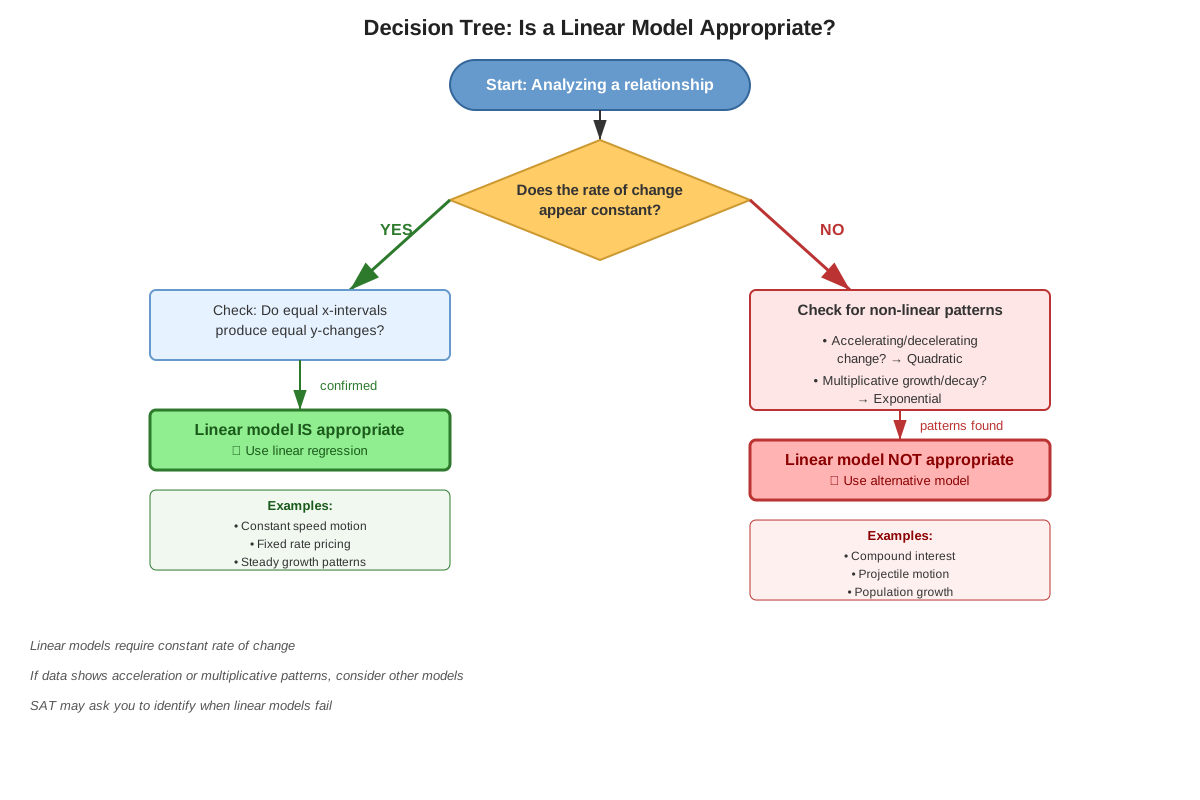
Not every relationship is linear. SAT questions may present data and ask whether a linear model is appropriate. A linear model is suitable when:
- The rate of change is constant
- Data points roughly form a straight line
- The relationship shows consistent increase or decrease
- There's no acceleration, deceleration, or exponential growth
Students should recognize that curved patterns, exponential growth, or varying rates of change indicate non-linear relationships.
Concept Relationships
The concepts within linear models are hierarchically connected. The fundamental equation structure (y = mx + b) serves as the foundation, with slope and y-intercept as the two essential parameters that define any specific linear model. Understanding slope requires grasping rate of change, which connects to prerequisite knowledge of ratios and rates. The y-intercept connects to understanding initial conditions and the coordinate plane.
The relationship flow can be mapped as:
Basic equation form → Parameter identification (m and b) → Contextual interpretation → Model construction from descriptions → Predictions and applications → Model comparison and evaluation
Linear models connect backward to prerequisite topics including coordinate geometry (graphing lines), algebraic manipulation (solving equations), and function concepts (input-output relationships). They connect forward to systems of linear equations (where two models intersect), linear inequalities (regions rather than lines), and serve as the comparison baseline for quadratic and exponential models.
Within the broader SAT Math curriculum, linear models integrate with statistics (linear regression and correlation), data analysis (interpreting trends), and problem-solving (translating real-world scenarios into mathematical representations). The skills developed—particularly contextual interpretation and moving between representations—transfer to virtually every other math topic tested.
Quick check — test yourself on Linear models so far.
Try Flashcards →High-Yield Facts
⭐ The slope of a linear model always represents a rate of change with specific units in context problems
⭐ The y-intercept represents the value of y when x = 0, often an initial value or fixed cost
⭐ A linear model has the form y = mx + b where m is slope and b is y-intercept
⭐ Positive slope means both variables increase together; negative slope means one increases as the other decreases
⭐ To find where two linear models are equal, set their equations equal and solve for x
- The x-intercept of a linear model is found by setting y = 0 and solving for x
- Parallel lines have identical slopes but different y-intercepts
- A slope of zero indicates a horizontal line (constant y-value)
- The steeper the line, the greater the absolute value of the slope
- Linear models assume constant rate of change throughout the entire domain
- When constructing a model from a word problem, identify what changes (slope) and what's fixed (intercept)
- The domain of a real-world linear model may be restricted even though the mathematical function extends infinitely
- Slope can be calculated from any two points on the line using (y₂ - y₁)/(x₂ - x₁)
Common Misconceptions
Misconception: The y-intercept is always the starting value in time-based problems.
Correction: The y-intercept represents the value when x = 0, which only corresponds to a "starting value" if x = 0 represents the beginning of the scenario. If x represents "years since 2000," the y-intercept is the value in 2000, not necessarily when the situation began.
Misconception: A larger slope always means a better or more desirable outcome.
Correction: The desirability of a larger slope depends entirely on context. A larger positive slope in a cost model means costs increase faster (undesirable), while a larger positive slope in a revenue model means income increases faster (desirable).
Misconception: Linear models can be used for any relationship between two variables.
Correction: Linear models are only appropriate when the rate of change is constant. Relationships with acceleration, exponential growth, or diminishing returns require non-linear models.
Misconception: The slope is always calculated as y/x.
Correction: Slope is the change in y divided by the change in x (Δy/Δx), not simply y divided by x. Using a single point's coordinates to calculate slope is incorrect; two points are needed.
Misconception: In the equation y = mx + b, the variables m and b can represent anything.
Correction: The letters m and b are parameters (constants) that define the specific linear relationship, while x and y are the variables. Confusing parameters with variables leads to incorrect equation setup.
Misconception: The point where two linear models intersect is always the "better" choice.
Correction: The intersection point shows where two models are equal, not which is better. The better choice depends on the context and which side of the intersection point is relevant to the question.
Worked Examples
Example 1: Constructing and Interpreting a Linear Model
Problem: A gym charges a one-time enrollment fee of $50 and a monthly membership fee of $35. Write a linear model for the total cost C after m months of membership. What does the slope represent? After how many months will the total cost reach $400?
Solution:
Step 1: Identify the components
- Fixed cost (y-intercept): $50 enrollment fee
- Rate of change (slope): $35 per month
- Independent variable: m (months)
- Dependent variable: C (total cost)
Step 2: Construct the model
C = 35m + 50
Step 3: Interpret the slope
The slope of 35 means that for each additional month of membership, the total cost increases by $35. The units are dollars per month.
Step 4: Find when total cost reaches $400
Set C = 400 and solve:
400 = 35m + 50
350 = 35m
m = 10
After 10 months, the total cost will reach $400.
Connection to learning objectives: This example demonstrates constructing a linear model from a verbal description, interpreting the slope in context, and applying the model to make predictions—all key SAT skills.
Example 2: Comparing Two Linear Models
Problem: Company A charges $200 plus $15 per hour for home repairs. Company B charges $120 plus $25 per hour. For what number of hours do both companies charge the same amount? For a 6-hour job, which company is less expensive?
Solution:
Step 1: Write both models
- Company A: C_A = 15h + 200
- Company B: C_B = 25h + 120
Step 2: Find when costs are equal
Set the equations equal:
15h + 200 = 25h + 120
200 - 120 = 25h - 15h
80 = 10h
h = 8 hours
Both companies charge the same amount for an 8-hour job.
Step 3: Evaluate for 6 hours
Company A: C_A = 15(6) + 200 = 90 + 200 = $290
Company B: C_B = 25(6) + 120 = 150 + 120 = $270
Company B is less expensive for a 6-hour job.
Step 4: Interpret the comparison
Company A has a higher initial fee ($200 vs. $120) but a lower hourly rate ($15 vs. $25). For jobs shorter than 8 hours, Company B is cheaper despite the higher hourly rate because the lower initial fee dominates. For jobs longer than 8 hours, Company A becomes cheaper because the lower hourly rate eventually overcomes the higher initial fee.
Connection to learning objectives: This example shows how to compare linear models, find intersection points, and make contextual decisions based on model analysis—all high-frequency SAT question types.
Exam Strategy
When approaching SAT questions on linear models, follow this systematic process:
Step 1: Identify the question type
- Are you constructing a model from a description?
- Are you interpreting an existing model?
- Are you comparing two models?
- Are you making a prediction using a model?
Step 2: Extract the key information
Look for trigger words and phrases:
- "Per," "each," "every" → indicates slope (rate)
- "Initial," "starting," "base fee," "fixed cost" → indicates y-intercept
- "After x units," "when x equals" → indicates a specific point to evaluate
- "At what point," "when do they equal" → indicates finding intersection
Step 3: Set up the relationship carefully
- Clearly identify which variable is independent (x) and which is dependent (y)
- Ensure the slope has the correct sign (positive for increase, negative for decrease)
- Verify units match the context
Step 4: Use process of elimination strategically
- Eliminate answer choices with incorrect y-intercepts (check what happens when x = 0)
- Eliminate choices with incorrect slope signs
- Test answer choices with given data points if construction seems difficult
- Check units in answer choices against the problem context
Time allocation advice: Linear model questions typically require 1-2 minutes. If a question involves complex comparison or multiple steps, allocate up to 2.5 minutes. Don't spend excessive time on algebraic manipulation—if you're stuck after 30 seconds of algebra, try substituting answer choices or using the graphing calculator.
Exam Tip: When a question asks "what does the slope/intercept represent," the answer must include both the numerical value AND the contextual units. "The slope is 25" is incomplete; "The slope is 25 dollars per hour" is complete.
Memory Techniques
Slope Meaning Mnemonic: "S.R.U." - Slope is the Rate with Units
Remember that slope always represents a rate of change and must have units in context problems (dollars per hour, miles per gallon, etc.).
Y-Intercept Mnemonic: "Y-Zero" - The Y-intercept is where X equals Zero
This reminds you both how to find it mathematically and that it represents the initial or fixed value.
Model Construction Visualization: Picture a staircase for positive slope (going up as you move right) and a slide for negative slope (going down as you move right). The height where the staircase/slide starts is the y-intercept.
Comparison Strategy Acronym: "S.I.I." - Compare Slopes, Intercepts, then find Intersection
When comparing two linear models, systematically check slopes first, then intercepts, then calculate where they're equal.
Context Interpretation Reminder: "Every slope tells a story"
Never leave slope or intercept as just numbers—always attach meaning from the problem context.
Summary
Linear models are mathematical representations of constant-rate relationships between two variables, expressed in the form y = mx + b. On the SAT, success with linear models requires three interconnected skills: constructing models from verbal descriptions by identifying rates of change (slopes) and initial values (y-intercepts), interpreting the contextual meaning of these parameters, and applying models to make predictions or comparisons. The slope always represents how much the dependent variable changes per unit change in the independent variable, while the y-intercept represents the dependent variable's value when the independent variable equals zero. SAT questions test whether students can move fluidly between equations, graphs, tables, and verbal descriptions of linear relationships, recognize when linear models are appropriate, and extract meaningful information from model parameters. Mastery requires understanding that every number in a linear model has both mathematical significance and real-world meaning within the problem context.
Key Takeaways
- Linear models follow the form y = mx + b where m (slope) is the constant rate of change and b (y-intercept) is the initial value
- Slope always has contextual meaning and units in real-world problems (dollars per hour, miles per gallon, etc.)
- Constructing a model from a word problem requires identifying what changes at a constant rate (slope) and what's fixed (intercept)
- The intersection point of two linear models shows where they're equal, not necessarily which is "better"
- Positive slopes indicate both variables increase together; negative slopes indicate inverse relationships
- Real-world linear models often have domain and range restrictions even though mathematical functions extend infinitely
- Moving between representations (equations, graphs, tables, descriptions) is a core SAT skill for linear models
Related Topics
Systems of Linear Equations: Building on single linear models, systems involve finding where two or more linear models intersect, representing situations where multiple constraints must be satisfied simultaneously.
Linear Inequalities: Extending linear models to represent regions rather than lines, useful for optimization problems and constraint scenarios where ranges of solutions exist.
Linear Regression and Correlation: Statistical applications of linear models involving fitting lines to data sets and measuring the strength of linear relationships.
Quadratic and Exponential Models: Non-linear models that describe accelerating or decelerating relationships, often compared to linear models to determine which best fits a situation.
Absolute Value Functions: Piecewise linear models that create V-shaped graphs, representing situations where rate of change shifts at a critical point.
Practice CTA
Now that you've mastered the core concepts of linear models, it's time to solidify your understanding through practice. Work through the practice questions to apply these concepts to SAT-style problems, and use the flashcards to reinforce key definitions and relationships. Remember, linear models appear on approximately 15-20% of SAT Math questions—your investment in mastering this topic will pay significant dividends on test day. Focus especially on translating between different representations and interpreting slope and intercept in context, as these skills transfer across multiple question types. You've got this!
Sign up free to keep reading
Create a free AnvayaPrep account to finish this SAT guide on Linear models — plus flashcards and practice questions.