Overview
Absolute value functions represent one of the most frequently tested function types on the SAT and serve as a critical bridge between linear functions and more complex piecewise functions. At their core, absolute value functions measure distance from zero on the number line, creating distinctive V-shaped graphs that appear regularly in both the calculator and no-calculator sections of the SAT math test. Understanding these functions requires mastery of both algebraic manipulation and graphical interpretation—two skills that the College Board consistently evaluates across multiple question formats.
The importance of absolute value functions extends beyond isolated problems. These functions frequently appear in questions involving transformations, systems of equations, inequalities, and real-world modeling scenarios. A solid grasp of absolute value behavior enables students to quickly identify solution sets, determine the number of intersection points between functions, and analyze how parameter changes affect graph characteristics. The SAT particularly favors questions that test whether students can translate between algebraic and graphical representations, making visual literacy with absolute value graphs essential.
Within the broader landscape of SAT math concepts, absolute value functions connect foundational linear function knowledge with advanced topics like piecewise functions and function composition. They reinforce critical thinking about domain and range, introduce students to non-differentiable points (the vertex), and provide concrete examples of how algebraic expressions can encode geometric properties. Mastering this topic strengthens overall function literacy and prepares students for the approximately 3-5 questions per test that directly or indirectly involve absolute value concepts.
Learning Objectives
- [ ] Identify key features of absolute value functions including vertex, axis of symmetry, domain, and range
- [ ] Explain how absolute value functions appears on the SAT in graphical, algebraic, and applied contexts
- [ ] Apply absolute value functions to answer SAT-style questions involving transformations and intersections
- [ ] Translate between algebraic and graphical representations of absolute value functions
- [ ] Solve absolute value equations and inequalities using both algebraic and graphical methods
- [ ] Determine the number of solutions to systems involving absolute value functions
- [ ] Analyze the effects of parameters on absolute value function graphs
Prerequisites
- Linear functions and their graphs: Absolute value functions are built from linear expressions, and understanding slope and y-intercept is essential for analyzing the two "arms" of the V-shape
- Coordinate plane and graphing: Students must be comfortable plotting points and interpreting graphs to visualize absolute value transformations
- Function notation: Expressions like f(x) = |x - 3| + 2 require fluency with function notation and evaluation
- Basic algebraic manipulation: Solving absolute value equations requires isolating expressions and considering multiple cases
- Transformations of functions: Horizontal and vertical shifts, reflections, and stretches apply to absolute value functions just as they do to other function families
Why This Topic Matters
Absolute value functions model numerous real-world phenomena where only magnitude matters, not direction. Distance problems, error measurements, tolerance specifications in manufacturing, and deviation from target values all naturally involve absolute value. For instance, if a machine part must be 5 cm ± 0.2 cm, the acceptable range can be expressed as |x - 5| ≤ 0.2. Temperature variations from average, stock price volatility, and GPS accuracy all utilize absolute value concepts in their mathematical formulations.
On the SAT, absolute value functions appear in approximately 8-12% of function-related questions, translating to roughly 3-5 questions per test administration. These questions span multiple formats: multiple-choice problems asking students to identify graphs from equations, grid-in questions requiring calculation of specific function values, and word problems embedding absolute value in real-world contexts. The College Board particularly favors questions that combine absolute value with other concepts—such as finding intersection points with linear or quadratic functions, determining the number of solutions to equations, or analyzing transformations.
Common SAT question types include: identifying the vertex of a transformed absolute value function, determining how many solutions exist when an absolute value function equals a constant, finding the range of an absolute value function over a restricted domain, and interpreting absolute value inequalities in context. Questions often present graphs and ask students to match them with equations, or conversely, provide equations and ask about graphical features. The test also includes problems where students must recognize that an absolute value equation may have zero, one, or two solutions depending on the constant value.
Core Concepts
Definition and Basic Form
An absolute value function is a function that contains an algebraic expression within absolute value symbols. The most basic form is f(x) = |x|, which outputs the distance of x from zero on the number line. By definition, |x| equals x when x ≥ 0 and equals -x when x < 0. This creates a piecewise definition:
f(x) = |x| = {
  x,   if x ≥ 0
  -x,  if x < 0
}
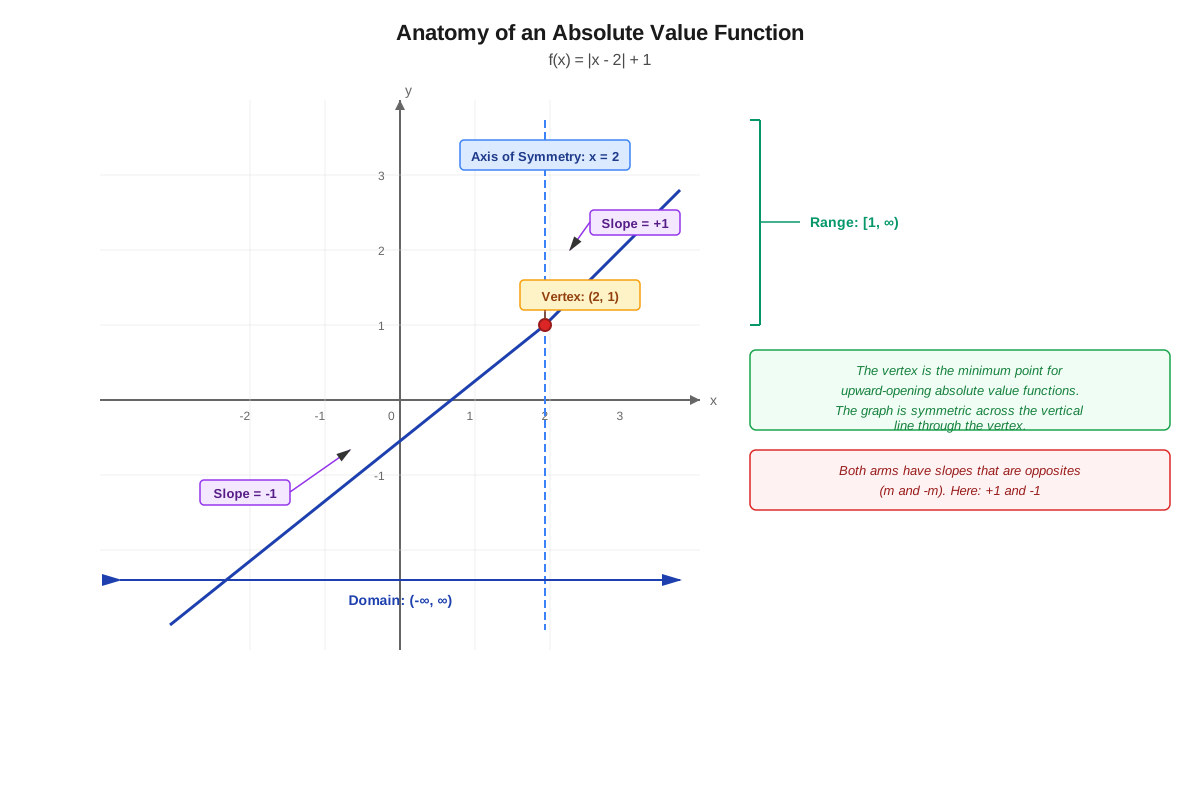
The graph of f(x) = |x| forms a V-shape with its vertex at the origin (0, 0). The left arm has a slope of -1, and the right arm has a slope of +1. This symmetry about the y-axis makes f(x) = |x| an even function, meaning f(-x) = f(x) for all x in the domain.
Standard Form and Transformations
The standard form of an absolute value function is:
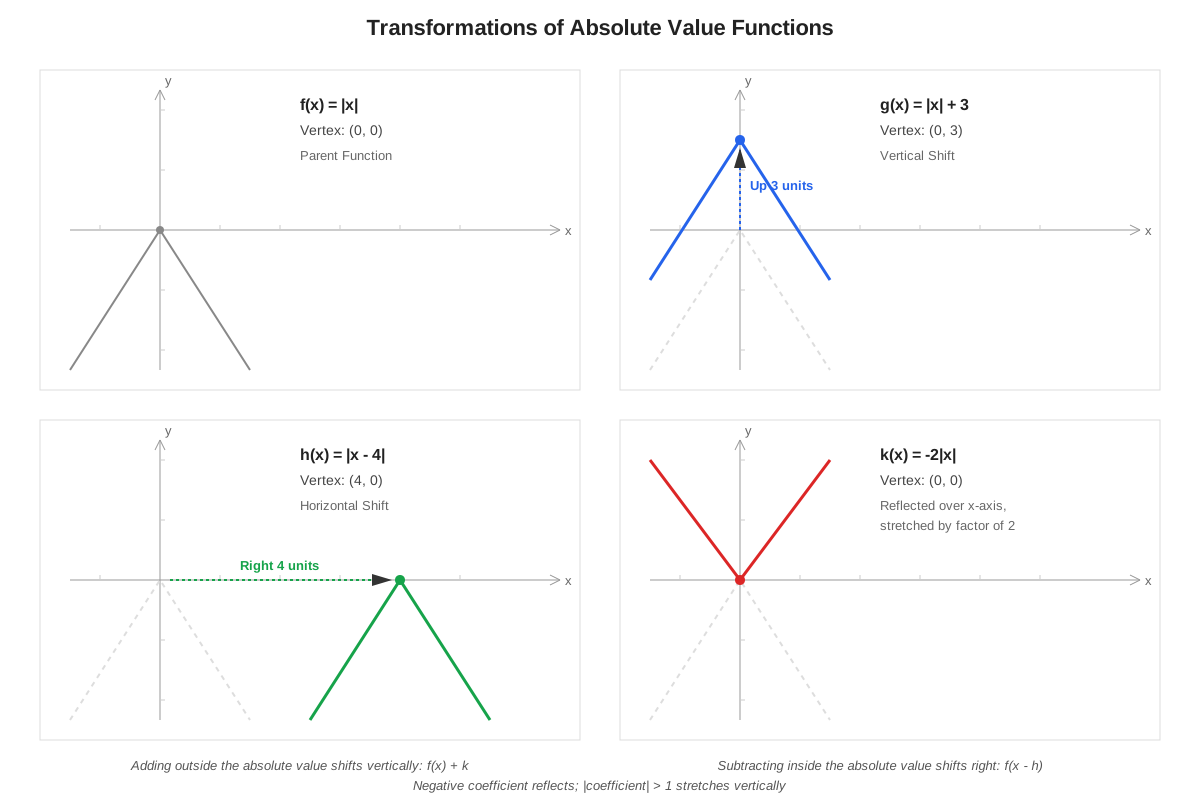
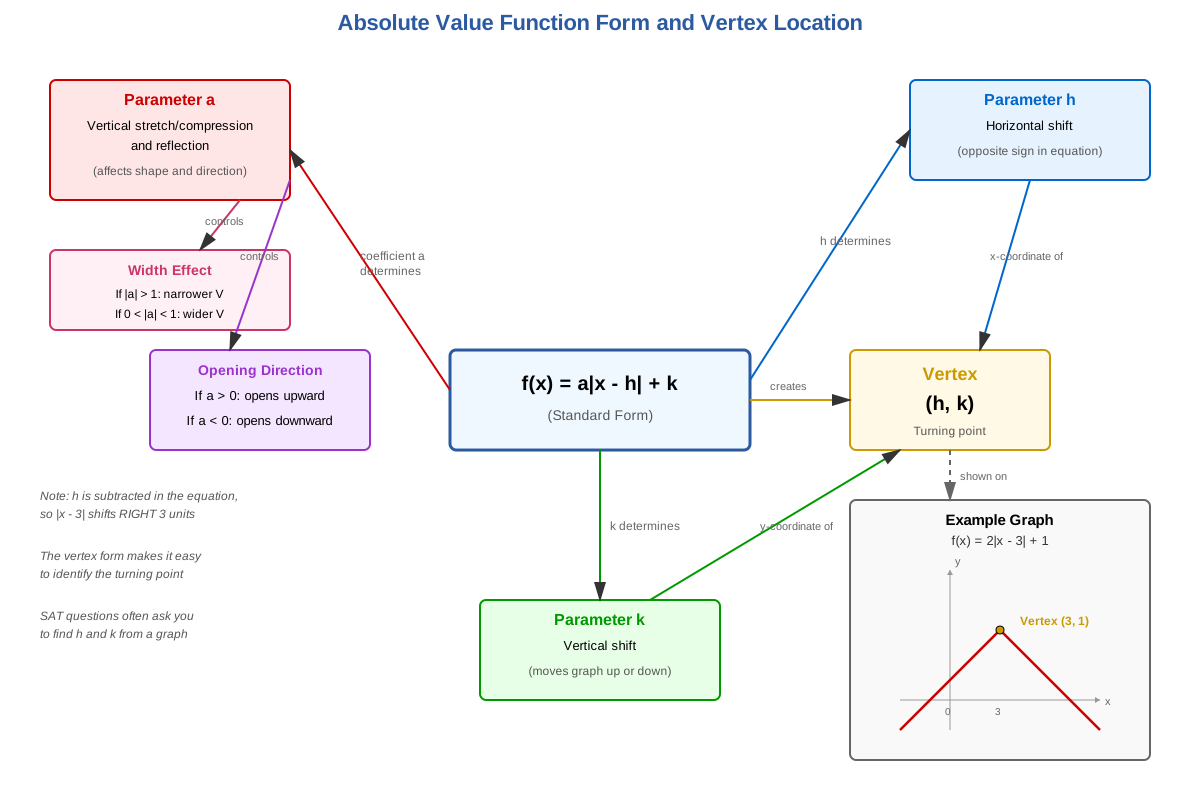
f(x) = a|x - h| + kEach parameter controls a specific transformation:
| Parameter | Effect | Example |
|---|---|---|
| a | Vertical stretch/compression and reflection | a = 2 stretches vertically; a = -1 reflects over x-axis |
| h | Horizontal shift | h = 3 shifts right 3 units; h = -2 shifts left 2 units |
| k | Vertical shift | k = 5 shifts up 5 units; k = -4 shifts down 4 units |
The vertex of the function occurs at the point (h, k). This is the minimum point when a > 0 and the maximum point when a < 0. The vertex represents the point where the function changes direction and is the only point where the function is not differentiable (though this concept is beyond SAT scope, recognizing the "corner" is important).
The axis of symmetry is the vertical line x = h, which divides the graph into two mirror-image halves. Understanding this symmetry helps quickly sketch graphs and verify solutions.
Domain and Range
For any absolute value function f(x) = a|x - h| + k:
- Domain: All real numbers (-∞, ∞), since absolute value is defined for every real number
- Range: Depends on the vertex and the sign of a
- If a > 0: Range is [k, ∞) because the vertex is the minimum point
- If a < 0: Range is (-∞, k] because the vertex is the maximum point
The range determination is crucial for SAT questions that ask about possible output values or the minimum/maximum of a function.
Solving Absolute Value Equations
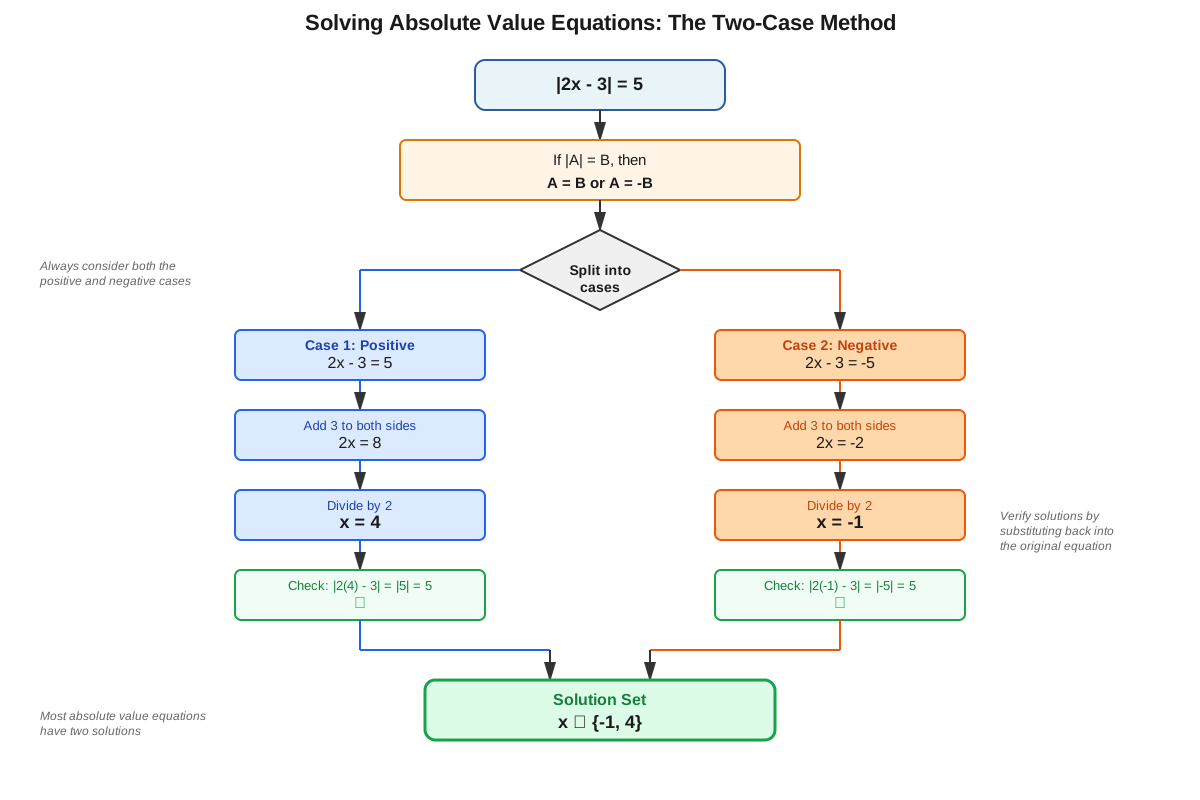
When solving equations like |x - 3| = 5, students must recognize that the expression inside the absolute value can equal either +5 or -5:
Case 1: x - 3 = 5 → x = 8
Case 2: x - 3 = -5 → x = -2
This two-case approach stems from the definition of absolute value. Graphically, these solutions represent the x-coordinates where the absolute value function intersects the horizontal line y = 5.
For equations like |2x + 1| = |x - 4|, the expressions inside can be equal or opposite:
Case 1: 2x + 1 = x - 4 → x = -5
Case 2: 2x + 1 = -(x - 4) → 2x + 1 = -x + 4 → x = 1
Number of Solutions
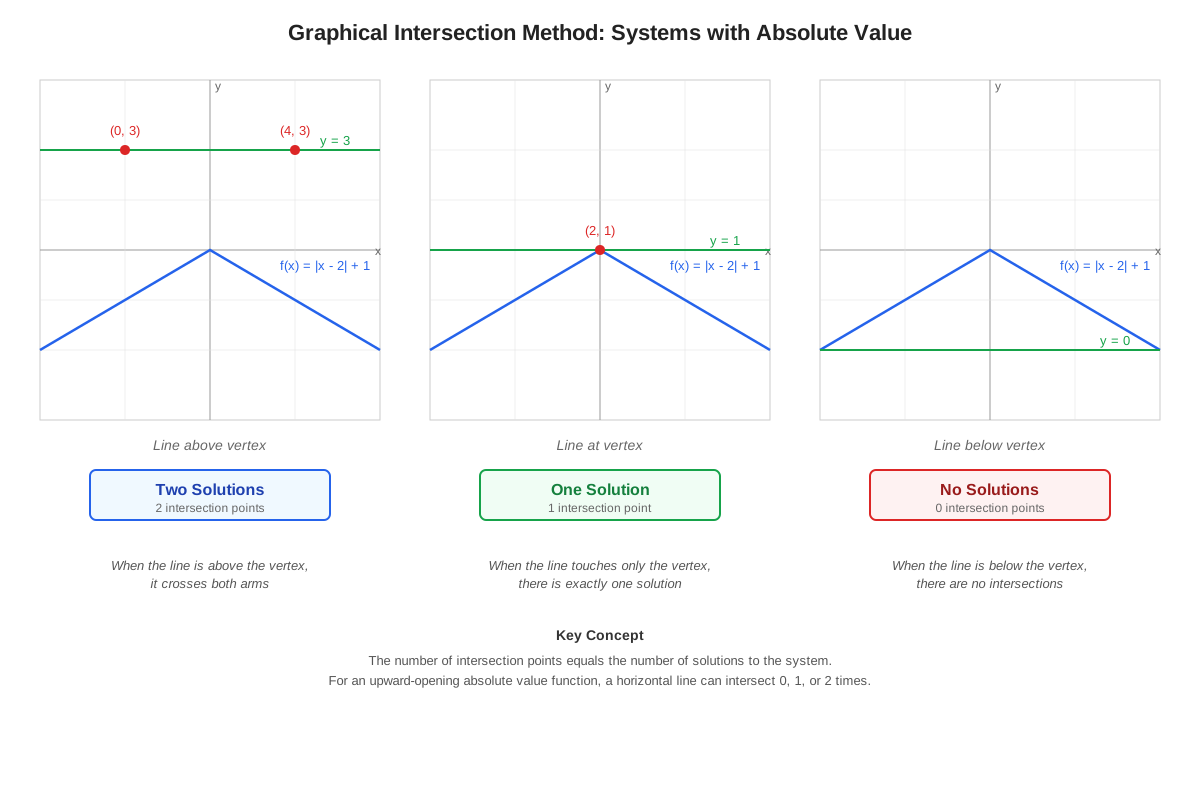
A critical SAT concept involves determining how many solutions exist for equations of the form |x - h| + k = c:
- No solutions: When c < k (for a > 0), the horizontal line y = c lies below the vertex, never intersecting the V-shape
- One solution: When c = k, the line passes through the vertex exactly
- Two solutions: When c > k, the line intersects both arms of the V-shape
This concept frequently appears in questions asking "For how many values of x does f(x) = 7?"
Absolute Value Inequalities
Inequalities involving absolute value require careful consideration of direction:
For |x - h| < c (where c > 0):
- The solution is h - c < x < h + c (a bounded interval)
- Graphically, this represents x-values where the function is below the line y = c
For |x - h| > c (where c > 0):
- The solution is x < h - c or x > h + c (two separate intervals)
- Graphically, this represents x-values where the function is above the line y = c
Graphical Analysis
When presented with a graph of an absolute value function, students should identify:
- Vertex location (h, k): The point where the graph changes direction
- Slope of each arm: The left arm has slope -a, the right arm has slope +a
- Y-intercept: Found by evaluating f(0) = a|0 - h| + k = a|h| + k
- X-intercepts: Found by solving a|x - h| + k = 0, which gives |x - h| = -k/a (only exists if -k/a > 0)
Concept Relationships
The foundation of absolute value functions rests on understanding linear functions, as each arm of the V-shape is essentially a linear piece. The transformation concepts (shifts, stretches, reflections) learned with linear and quadratic functions apply identically to absolute value functions, creating a unified framework for function manipulation. Specifically: linear functions → provide the building blocks → absolute value functions → which are special cases of → piecewise functions.
Within absolute value functions themselves, the algebraic form f(x) = a|x - h| + k directly determines graphical features: the parameters (a, h, k) → control transformations → which determine the vertex location → which establishes the axis of symmetry → which defines the range. This chain of relationships means that identifying any two features often allows determination of the entire function.
Absolute value equations connect to systems of equations, as solving |f(x)| = g(x) is equivalent to finding intersection points between the absolute value function and another function. The number of solutions to such systems depends on the relative positions of the graphs, linking algebraic solution methods to geometric visualization.
The concept of domain and range for absolute value functions reinforces these ideas for all function types, while the special case of restricted domains (common in SAT word problems) requires combining interval notation with function evaluation. Finally, absolute value inequalities bridge to number line reasoning and interval notation, skills that appear throughout SAT math.
High-Yield Facts
⭐ The vertex of f(x) = a|x - h| + k is located at the point (h, k), which is the minimum when a > 0 and maximum when a < 0
⭐ The domain of any absolute value function is all real numbers, but the range depends on the vertex and the sign of a
⭐ An equation |x - h| + k = c has two solutions when c > k, one solution when c = k, and no solutions when c < k (assuming a > 0)
⭐ The graph of f(x) = |x| is V-shaped with vertex at (0, 0) and slopes of -1 and +1 on the left and right arms respectively
⭐ To solve |expression| = c, set up two cases: expression = c and expression = -c, then solve both
- The axis of symmetry for f(x) = a|x - h| + k is the vertical line x = h
- Reflecting an absolute value function over the x-axis changes the sign of a (multiplies the entire function by -1)
- The y-intercept of f(x) = a|x - h| + k is found by evaluating f(0) = a|h| + k
- Absolute value functions are continuous everywhere but not differentiable at the vertex
- When |a| > 1, the graph is vertically stretched (narrower V); when 0 < |a| < 1, the graph is vertically compressed (wider V)
- The solution to |x - h| < c is the interval (h - c, h + c), while |x - h| > c gives x < h - c or x > h + c
- Two absolute value functions intersect at points where their expressions are equal or opposite in value
Quick check — test yourself on Absolute value functions so far.
Try Flashcards →Common Misconceptions
Misconception: The vertex of f(x) = |x - 3| + 2 is at (-3, 2) because of the minus sign
Correction: The vertex is at (3, 2). The standard form is f(x) = |x - h| + k, so h = 3 (not -3). The expression inside the absolute value is set equal to zero to find the x-coordinate: x - 3 = 0 gives x = 3.
Misconception: Absolute value equations always have two solutions
Correction: The number of solutions depends on the constant value. For |x - 2| + 1 = 1, there is exactly one solution (x = 2) because the equation simplifies to |x - 2| = 0. For |x - 2| + 1 = 0, there are no solutions because |x - 2| = -1 is impossible (absolute values are never negative).
Misconception: The range of f(x) = -2|x - 1| + 5 is [5, ∞)
Correction: Because a = -2 is negative, the graph opens downward, making the vertex a maximum point. The range is (-∞, 5], not [5, ∞). The negative coefficient flips the V-shape upside down.
Misconception: To solve |2x + 4| = 6, divide both sides by 2 first to get |x + 2| = 3
Correction: While this approach works in this specific case, it's safer to set up cases with the original equation: 2x + 4 = 6 or 2x + 4 = -6. Dividing can lead to errors when the coefficient is not a factor of the constant, and it's not a generalizable method for all absolute value equations.
Misconception: The graph of f(x) = |x + 2| shifts right 2 units from f(x) = |x|
Correction: The graph shifts left 2 units. In the form f(x) = |x - h|, a positive h shifts right, but |x + 2| = |x - (-2)|, so h = -2, indicating a leftward shift. This is consistent with all function transformations: f(x - h) shifts right when h > 0.
Misconception: If |x| = |y|, then x = y
Correction: If |x| = |y|, then x = y OR x = -y. For example, |3| = |-3| = 3, but 3 ≠ -3. This misconception leads to missing solutions when solving equations like |2x - 1| = |x + 3|.
Worked Examples
Example 1: Identifying Function from Graph
Problem: A graph shows a V-shaped function with vertex at (2, -3). The right arm passes through the point (4, 1). What is the equation of this function in the form f(x) = a|x - h| + k?
Solution:
Step 1: Identify the vertex parameters
From the vertex (2, -3), we know h = 2 and k = -3.
Current form: f(x) = a|x - 2| - 3
Step 2: Use the given point to find a
The point (4, 1) must satisfy the equation:
1 = a|4 - 2| - 3
1 = a|2| - 3
1 = 2a - 3
4 = 2a
a = 2
Step 3: Write the complete equation
f(x) = 2|x - 2| - 3
Verification: Check that the point (4, 1) works:
f(4) = 2|4 - 2| - 3 = 2(2) - 3 = 4 - 3 = 1 ✓
Connection to Learning Objectives: This problem requires identifying key features (vertex) from a graph and translating them into algebraic form, demonstrating the bidirectional relationship between graphical and algebraic representations that the SAT frequently tests.
Example 2: Determining Number of Solutions
Problem: For the function f(x) = |x - 4| + 2, for how many values of x does f(x) = k?
(A) Zero, for all values of k
(B) One, for all values of k
(C) Two, for all values of k
(D) It depends on the value of k
Solution:
Step 1: Identify the vertex and opening direction
The function f(x) = |x - 4| + 2 has vertex at (4, 2) and opens upward (a = 1 > 0).
The minimum value of f(x) is 2 (at the vertex).
Step 2: Analyze different cases for k
Case 1: If k < 2
The horizontal line y = k lies below the vertex, never intersecting the graph.
Number of solutions: 0
Case 2: If k = 2
The horizontal line y = k passes exactly through the vertex.
Number of solutions: 1 (at x = 4)
Case 3: If k > 2
The horizontal line y = k intersects both arms of the V-shape.
Number of solutions: 2
Step 3: Select the answer
The number of solutions depends on the value of k.
Answer: (D)
Alternative approach (algebraic):
Solve |x - 4| + 2 = k
|x - 4| = k - 2
For this equation to have solutions, we need k - 2 ≥ 0, so k ≥ 2.
- If k > 2: Two solutions (x - 4 = k - 2 and x - 4 = -(k - 2))
- If k = 2: One solution (x - 4 = 0)
- If k < 2: No solutions (absolute value cannot equal a negative number)
Connection to Learning Objectives: This problem applies absolute value function knowledge to determine solution counts, a high-yield SAT question type that tests both graphical reasoning and algebraic understanding.
Exam Strategy
When approaching SAT questions involving absolute value functions, first determine whether the question presents information graphically or algebraically, then translate to the other form if needed. The SAT rewards students who can move fluidly between representations. If given an equation, quickly sketch a rough graph to visualize the situation; if given a graph, immediately identify the vertex to write the equation.
Trigger words and phrases to watch for include: "minimum value" or "maximum value" (directing attention to the vertex and range), "how many solutions" (requiring analysis of intersection points), "for all values of x such that" (indicating domain restrictions or inequalities), and "the graph of f is shown" (requiring translation from visual to algebraic form). Questions using phrases like "shifts right 3 units" or "reflected over the x-axis" test transformation knowledge directly.
For process of elimination, use these strategies:
- If answer choices are equations, test the vertex point—incorrect equations will fail this test immediately
- If answer choices are graphs, check the vertex location and opening direction first, eliminating mismatches
- For "how many solutions" questions, eliminate answers that don't account for the vertex position relative to the constant
- When inequalities are involved, test a simple value (like x = 0 or the vertex x-coordinate) to eliminate impossible answer ranges
Time allocation: Most absolute value questions should take 45-90 seconds. If a problem requires more than 2 minutes, consider whether there's a simpler approach—perhaps graphical reasoning instead of algebraic manipulation, or vice versa. Questions asking only for the vertex or range should take 30-45 seconds with practice. Complex systems involving absolute value and another function type may warrant up to 2 minutes.
Common SAT setups include:
- Matching four graphs to four equations (test vertex and opening direction)
- Finding the value of a parameter given a point on the graph (substitute and solve)
- Determining solution counts for f(x) = c (compare c to the vertex y-coordinate)
- Word problems where absolute value represents distance or deviation (translate to |x - target| ≤ tolerance)
Memory Techniques
Vertex Location Mnemonic: "Horizontal Has H" — The h in f(x) = a|x - h| + k controls the horizontal shift, and you find it where the expression inside equals zero. The k is the kick up or down (vertical shift).
Solution Count Visualization: Picture a V for the absolute value graph and a horizontal line for the constant. Count intersections:
- Line below the point of the V: 0 solutions
- Line at the point of the V: 1 solution
- Line above the point of the V: 2 solutions
Transformation Memory Device: "Amplitude, Horizontal, Kick" (AHK)
- A controls how steep/wide and which direction the V opens
- H moves the vertex left or right (opposite of the sign!)
- K kicks the vertex up or down (same as the sign)
Inequality Direction: For |x - h| < c, think "less than means between" (solution is between h - c and h + c). For |x - h| > c, think "greater than means outside" (solution is outside that interval).
Two-Case Setup: When solving |expression| = c, remember "Plus or Minus Twins"—the expression inside can equal +c or -c, giving you twin cases to solve.
Summary
Absolute value functions, characterized by their distinctive V-shaped graphs, represent a fundamental function family that appears consistently throughout the SAT math sections. These functions measure distance from zero and are defined by the standard form f(x) = a|x - h| + k, where the vertex occurs at (h, k), the parameter a controls vertical stretch and opening direction, and the domain is always all real numbers while the range depends on the vertex and sign of a. Success with absolute value functions requires facility in translating between algebraic and graphical representations, understanding how transformations affect the graph, and determining the number of solutions to equations by comparing constant values to the vertex y-coordinate. The most critical skills include identifying the vertex from either form, solving absolute value equations using the two-case method, analyzing inequalities to determine solution intervals, and recognizing that equations can have zero, one, or two solutions depending on the relationship between the constant and the vertex. Students must also understand that the expression |x - h| represents horizontal shift (with the sign opposite to what appears), that negative values of a flip the V-shape upside down, and that absolute value functions connect to broader concepts including piecewise functions, systems of equations, and real-world modeling of distance and deviation scenarios.
Key Takeaways
- The standard form f(x) = a|x - h| + k has vertex at (h, k), with h controlling horizontal shift (opposite sign) and k controlling vertical shift (same sign)
- Absolute value functions always have domain (-∞, ∞), but range is [k, ∞) when a > 0 and (-∞, k] when a < 0
- Equations of the form |x - h| + k = c have two solutions when c > k, one solution when c = k, and no solutions when c < k (for a > 0)
- To solve |expression| = c, create two cases: expression = c and expression = -c, then solve both equations
- The graph is V-shaped with the vertex as the point of symmetry; the axis of symmetry is the vertical line x = h
- SAT questions frequently test translation between graphs and equations, solution counting, and transformation effects
- Graphical reasoning often provides faster solutions than pure algebra, especially for determining number of solutions or analyzing intersections
Related Topics
Piecewise Functions: Absolute value functions are special cases of piecewise functions, where f(x) = |x - h| + k can be written as two linear pieces. Mastering absolute value functions provides the foundation for understanding more complex piecewise definitions that appear in advanced SAT questions.
Systems of Equations: Finding where absolute value functions intersect with linear or quadratic functions requires solving systems, combining absolute value techniques with substitution or graphical analysis. This topic extends absolute value mastery to multi-function scenarios.
Function Transformations: The parameters in f(x) = a|x - h| + k follow the same transformation rules as other function families (quadratic, exponential, etc.). Understanding these transformations systematically across all function types strengthens overall function fluency.
Inequalities and Interval Notation: Absolute value inequalities connect to broader inequality-solving skills and require expressing solutions using interval notation, a critical skill for domain and range questions across all function types.
Distance and Midpoint: The geometric interpretation of absolute value as distance on the number line connects to coordinate geometry concepts, particularly in problems involving distance between points or finding points equidistant from two locations.
Practice CTA
Now that you've mastered the core concepts of absolute value functions, it's time to cement your understanding through active practice. Work through the practice questions to apply these concepts in SAT-style scenarios, testing your ability to move between algebraic and graphical representations, determine solution counts, and analyze transformations. Use the flashcards to reinforce key definitions and high-yield facts, ensuring you can quickly recall vertex formulas, transformation rules, and solution strategies under test conditions. Remember: understanding the concepts is the first step, but fluency comes from repeated application. Each practice problem you solve strengthens your pattern recognition and builds the confidence you need to tackle any absolute value question the SAT presents. You've got this!
Sign up free to keep reading
Create a free AnvayaPrep account to finish this SAT guide on Absolute value functions — plus flashcards and practice questions.