Overview
Slope is one of the most fundamental and frequently tested concepts in SAT math, appearing in approximately 10-15% of all math questions on the exam. Understanding slope is essential not only for answering direct questions about linear relationships but also for interpreting graphs, analyzing data trends, and solving real-world problems involving rates of change. The concept of slope bridges algebraic thinking with geometric visualization, making it a cornerstone of the Linear Functions unit.
On the SAT, slope questions range from straightforward calculations using two points to more complex applications involving parallel and perpendicular lines, interpreting slope in context, and analyzing linear models. Students who master slope gain a significant advantage because this concept appears across multiple question formats: multiple-choice, grid-in, and even within word problems that initially seem unrelated to linear functions. The ability to quickly identify, calculate, and interpret slope is a high-yield skill that directly translates to points on test day.
Beyond its immediate application to linear equations, slope connects to broader mathematical concepts including systems of equations, inequalities, and function analysis. A solid understanding of slope provides the foundation for tackling more advanced topics in coordinate geometry and prepares students for the analytical reasoning required throughout the SAT math section. This topic exemplifies how the SAT tests not just computational ability but also conceptual understanding and the capacity to apply mathematical principles to varied contexts.
Learning Objectives
- [ ] Identify key features of slope including its definition, calculation methods, and graphical representation
- [ ] Explain how slope appears on the SAT in various question formats and contexts
- [ ] Apply slope to answer SAT-style questions involving linear functions and real-world scenarios
- [ ] Calculate slope using multiple methods: two points, from an equation, and from a graph
- [ ] Determine relationships between slopes of parallel and perpendicular lines
- [ ] Interpret the meaning of slope in context-based problems and data analysis questions
- [ ] Recognize and avoid common errors in slope calculations and applications
Prerequisites
- Coordinate plane basics: Understanding x and y coordinates is essential for plotting points and visualizing slope geometrically
- Basic algebra: Manipulating equations and solving for variables enables working with slope-intercept and point-slope forms
- Fraction operations: Slope calculations frequently result in fractions requiring simplification and comparison
- Negative number operations: Correctly handling negative values is critical since slope can be positive, negative, or zero
- Graphing fundamentals: Reading and interpreting graphs allows students to extract slope information visually
Why This Topic Matters
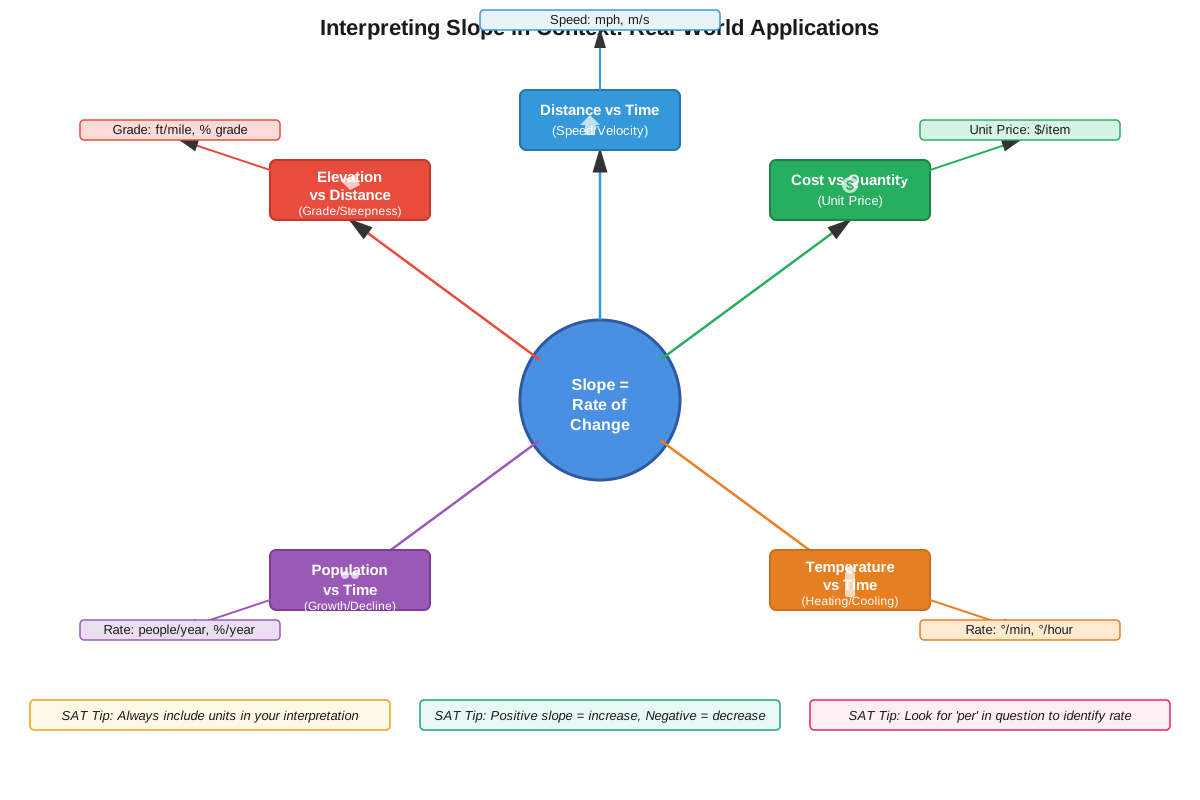
Slope represents the rate of change between two variables, making it applicable to countless real-world scenarios. In physics, slope describes velocity and acceleration. In economics, it represents marginal cost or revenue growth. In everyday life, slope appears in calculating speed (miles per hour), pricing structures (cost per unit), and even in understanding the steepness of roads or ramps. This practical relevance makes slope questions on the SAT particularly valuable for testing mathematical reasoning in authentic contexts.
On the SAT, slope-related questions appear with remarkable consistency. Approximately 3-5 questions per test directly involve slope calculations or interpretations, while many additional questions incorporate slope as part of larger problems involving linear equations, systems, or data analysis. The College Board frequently tests slope through multiple formats: identifying slope from graphs, calculating slope from tables or coordinate pairs, interpreting slope in word problems, and applying properties of parallel and perpendicular lines. Questions may appear in both the calculator and no-calculator sections, emphasizing the importance of both computational fluency and conceptual understanding.
Common SAT question types include: determining the slope of a line passing through two given points, identifying which graph represents a specific slope value, interpreting what a slope means in a real-world context (such as "the line's slope represents the cost per item"), finding equations of lines parallel or perpendicular to a given line, and analyzing how changes in slope affect a linear model. The versatility of slope questions means students must be prepared to recognize this concept in various disguises, from purely algebraic expressions to data-driven scenarios requiring interpretation and analysis.
Core Concepts
Definition of Slope
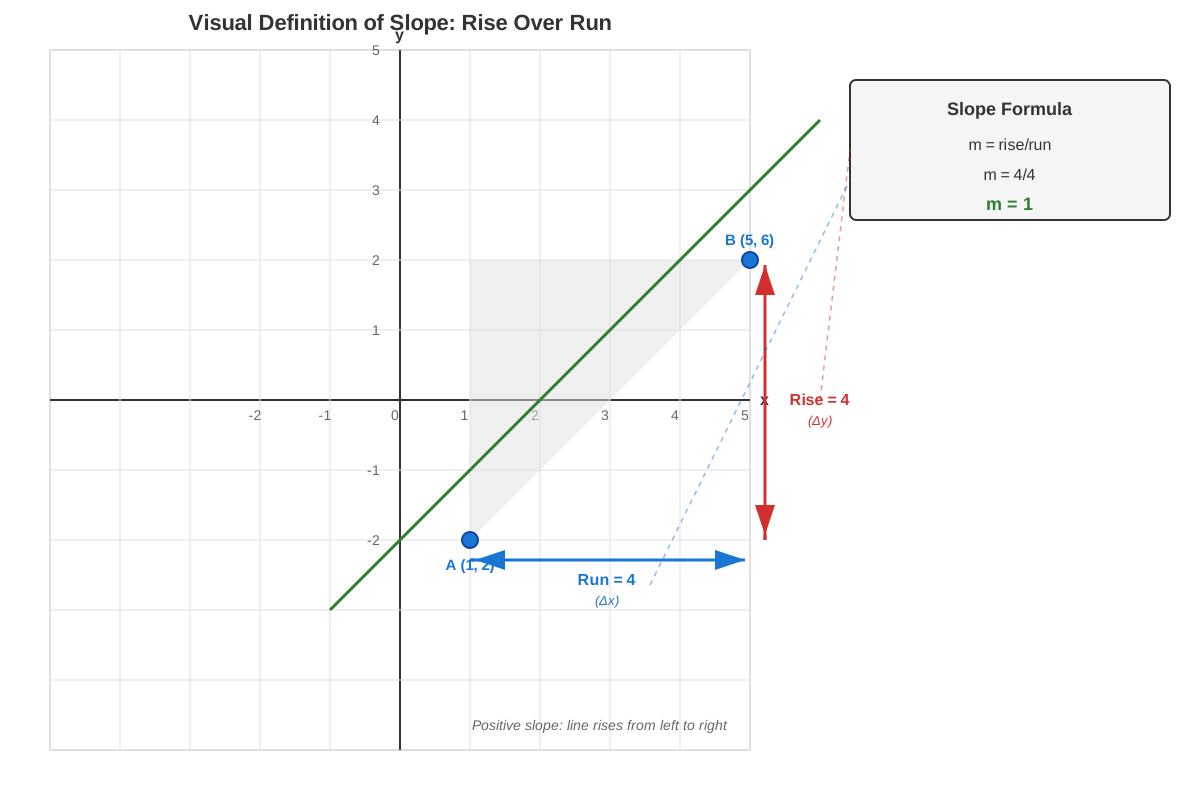
Slope is the measure of the steepness and direction of a line, representing the ratio of vertical change to horizontal change between any two points on that line. Mathematically, slope quantifies how much the y-value changes for each unit change in the x-value. This ratio remains constant for any straight line, which is why linear functions have a consistent rate of change. The concept of slope as "rise over run" provides an intuitive way to understand this relationship: rise refers to the vertical change (change in y), while run refers to the horizontal change (change in x).
Calculating Slope from Two Points
The most fundamental slope calculation uses the slope formula:
m = (y₂ - y₁)/(x₂ - x₁)Where m represents slope, and (x₁, y₁) and (x₂, y₂) are two distinct points on the line. The order of subtraction must be consistent: if you subtract y₁ from y₂ in the numerator, you must subtract x₁ from x₂ in the denominator. Reversing both subtractions yields the same result, but mixing the order produces an incorrect answer.
Example: To find the slope between points (2, 5) and (6, 13):
m = (13 - 5)/(6 - 2) = 8/4 = 2This slope of 2 means that for every 1 unit moved to the right, the line rises 2 units upward.
Types of Slope
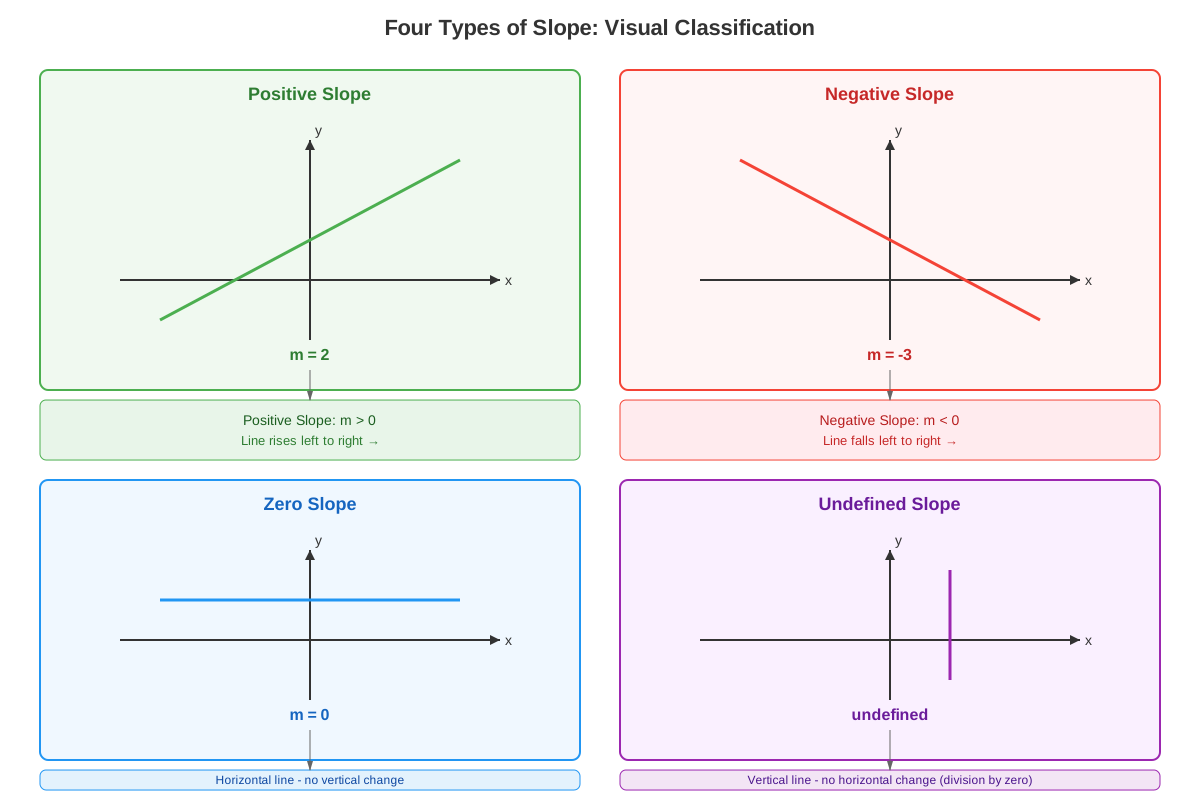
Understanding the four categories of slope is essential for quickly analyzing lines on the SAT:
| Slope Type | Value | Visual Appearance | Direction |
|---|---|---|---|
| Positive | m > 0 | Line rises from left to right | Upward |
| Negative | m < 0 | Line falls from left to right | Downward |
| Zero | m = 0 | Horizontal line | No vertical change |
| Undefined | Division by zero | Vertical line | No horizontal change |
Positive slope indicates a direct relationship: as x increases, y increases. Negative slope indicates an inverse relationship: as x increases, y decreases. A zero slope occurs when all points have the same y-coordinate, creating a horizontal line with equation y = k (where k is a constant). An undefined slope occurs when all points have the same x-coordinate, creating a vertical line with equation x = k; this happens because the denominator in the slope formula becomes zero.
Slope from Equations
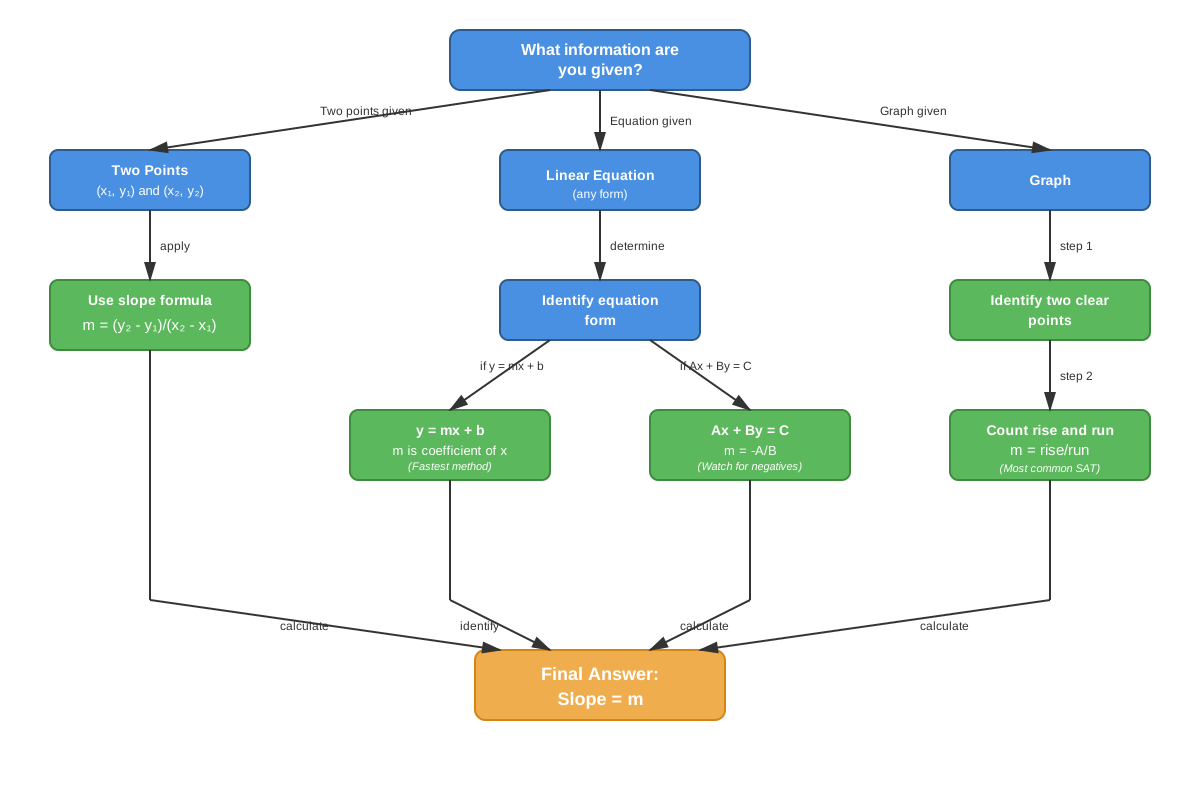
When a linear equation is written in slope-intercept form (y = mx + b), the coefficient m directly represents the slope, while b represents the y-intercept. This form is particularly valuable on the SAT because it allows immediate identification of slope without calculation.
For equations not in slope-intercept form, convert them by solving for y:
- Given: 3x + 4y = 12
- Solve for y: 4y = -3x + 12
- Divide by 4: y = (-3/4)x + 3
- The slope is -3/4
Standard form equations (Ax + By = C) can also reveal slope information. The slope equals -A/B, though converting to slope-intercept form is often more reliable for avoiding sign errors.
Slope from Graphs
Extracting slope from a graph requires identifying two clear points where the line crosses grid intersections. Count the vertical change (rise) and horizontal change (run) between these points, maintaining awareness of direction. Moving upward represents positive rise; moving downward represents negative rise. Moving right represents positive run; moving left represents negative run (though it's conventional to always move left-to-right and adjust the rise accordingly).
Exam Tip: On the SAT, always verify that points you select from a graph have integer coordinates or coordinates you can determine precisely. Estimating coordinates leads to calculation errors.
Parallel and Perpendicular Lines
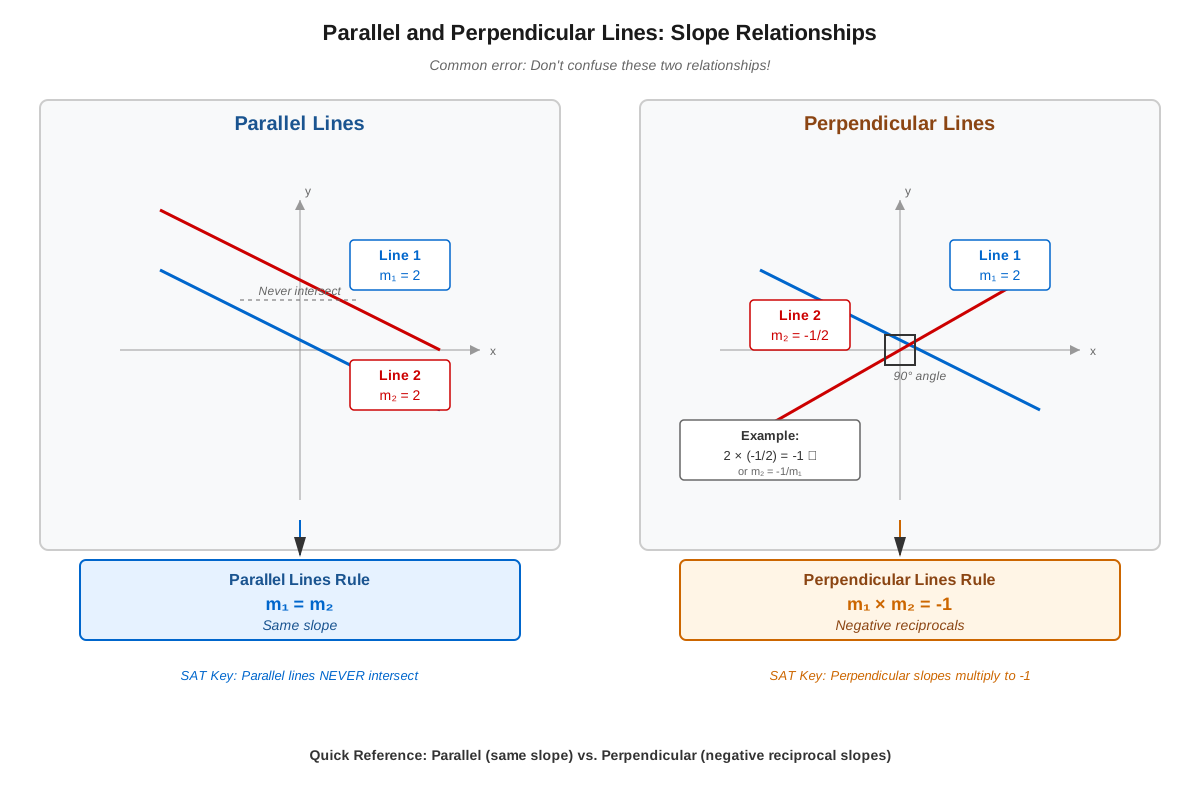
Parallel lines have identical slopes but different y-intercepts. If two lines have the same slope value, they will never intersect (unless they are the same line). This property is frequently tested on the SAT through questions asking for equations of lines parallel to a given line.
Perpendicular lines have slopes that are negative reciprocals of each other. If one line has slope m, a perpendicular line has slope -1/m. To find the negative reciprocal: flip the fraction and change the sign. For example, if m = 2/3, the perpendicular slope is -3/2. If m = -4, the perpendicular slope is 1/4.
Special cases:
- Horizontal lines (slope = 0) are perpendicular to vertical lines (undefined slope)
- A line with slope 1 is perpendicular to a line with slope -1
Interpreting Slope in Context
SAT slope questions frequently require interpreting what slope represents in real-world scenarios. The slope's units derive from the units of the y-variable divided by the units of the x-variable. For instance:
- If y represents dollars and x represents hours, slope represents dollars per hour (wage rate)
- If y represents miles and x represents gallons, slope represents miles per gallon (fuel efficiency)
- If y represents temperature and x represents time, slope represents degrees per unit time (rate of temperature change)
Understanding these contextual meanings allows students to eliminate unreasonable answer choices and verify their calculations make practical sense.
Concept Relationships
The concept of slope serves as the foundation for understanding all linear functions. Slope calculation → connects directly to → linear equations, as slope is the defining characteristic that determines a line's steepness and direction. Once slope is known, combined with a single point, the entire line can be determined using point-slope form: y - y₁ = m(x - x₁).
Slope-intercept form (y = mx + b) → builds upon → slope understanding by providing a standardized way to express linear relationships where slope and y-intercept are immediately visible. This form → facilitates → graphing linear functions and comparing multiple lines quickly.
The relationship between parallel and perpendicular slopes → extends → basic slope concepts into geometric relationships, which → connects to → systems of equations (parallel lines have no solution, intersecting lines have one solution). These geometric properties → appear in → coordinate geometry problems involving distances, areas, and shapes on the coordinate plane.
Contextual interpretation of slope → bridges → abstract mathematical concepts with real-world applications, which is precisely how the SAT tests mathematical reasoning. This interpretation skill → transfers to → data analysis questions where students must extract meaning from graphs and tables, and → applies to → modeling problems where linear functions represent real situations.
Understanding that slope represents rate of change → provides the conceptual foundation for → calculus concepts (derivatives) in advanced mathematics, though the SAT focuses on the linear case. This rate-of-change perspective → helps students → analyze trends in data and make predictions based on linear models.
Quick check — test yourself on Slope so far.
Try Flashcards →High-Yield Facts
⭐ The slope formula is m = (y₂ - y₁)/(x₂ - x₁), and the order of subtraction must be consistent in numerator and denominator
⭐ In slope-intercept form y = mx + b, the coefficient m is always the slope
⭐ Parallel lines have equal slopes; perpendicular lines have slopes that are negative reciprocals
⭐ Positive slope means the line rises from left to right; negative slope means the line falls from left to right
⭐ Horizontal lines have slope = 0; vertical lines have undefined slope
- A slope of 1 means the line rises at a 45-degree angle (equal rise and run)
- The slope between any two points on a line is the same as the slope between any other two points on that line
- To find the negative reciprocal, flip the fraction and change the sign: the negative reciprocal of 3/4 is -4/3
- When interpreting slope in context, the units are (y-axis units) per (x-axis units)
- A steeper line has a greater absolute value of slope than a less steep line
- If a line passes through the origin (0, 0) and point (a, b), its slope is simply b/a
- Converting from standard form Ax + By = C to slope-intercept form reveals that slope = -A/B
- Two lines with slopes m₁ and m₂ are perpendicular if and only if m₁ × m₂ = -1
- A line with undefined slope cannot be written in slope-intercept form because it's vertical
- The sign of the slope tells you the direction of the relationship between variables in context problems
Common Misconceptions
Misconception: Slope is calculated as (x₂ - x₁)/(y₂ - y₁), with x-values in the numerator.
Correction: Slope is always "rise over run," meaning vertical change over horizontal change: (y₂ - y₁)/(x₂ - x₁). The y-values must be in the numerator.
Misconception: When finding slope from two points, you can subtract in any order without consequence.
Correction: While you can choose which point is "first," you must be consistent. If you calculate y₂ - y₁ in the numerator, you must calculate x₂ - x₁ in the denominator using the same point designations. Mixing the order produces the wrong sign.
Misconception: A vertical line has a slope of zero.
Correction: A vertical line has undefined slope (not zero) because the denominator in the slope formula is zero (no horizontal change). A horizontal line has slope of zero because the numerator is zero (no vertical change).
Misconception: Perpendicular lines have slopes that are opposite in sign but otherwise equal.
Correction: Perpendicular lines have slopes that are negative reciprocals, not just opposite signs. If one slope is 2, the perpendicular slope is -1/2 (not -2). You must flip the fraction AND change the sign.
Misconception: A larger slope number always means a steeper line.
Correction: The absolute value of the slope determines steepness. A line with slope -5 is steeper than a line with slope 2, even though -5 < 2. The negative sign indicates direction (downward), not steepness.
Misconception: In the equation 2x + 3y = 6, the slope is 2.
Correction: The slope is not immediately visible in standard form. You must solve for y first: 3y = -2x + 6, so y = (-2/3)x + 2. The slope is -2/3, not 2.
Misconception: If two lines have different y-intercepts, they cannot be parallel.
Correction: Parallel lines must have different y-intercepts (otherwise they'd be the same line). The defining characteristic of parallel lines is equal slopes, not equal y-intercepts.
Worked Examples
Example 1: Multi-Step Slope Calculation and Application
Problem: Line ℓ passes through points A(-3, 7) and B(5, -1). Line m is perpendicular to line ℓ and passes through point C(2, 4). What is the slope of line m?
Solution:
Step 1: Calculate the slope of line ℓ using the two given points.
m_ℓ = (y₂ - y₁)/(x₂ - x₁) = (-1 - 7)/(5 - (-3)) = -8/8 = -1Step 2: Identify the relationship between the lines. Since line m is perpendicular to line ℓ, its slope must be the negative reciprocal of line ℓ's slope.
Step 3: Find the negative reciprocal of -1.
The reciprocal of -1 is -1/1 = -1 (flipping doesn't change it).
The negative reciprocal is -(-1) = 1.
Step 4: Verify the perpendicular relationship.
If m_ℓ = -1 and m_m = 1, then m_ℓ × m_m = (-1)(1) = -1 ✓
Answer: The slope of line m is 1.
Connection to Learning Objectives: This problem requires identifying slope from two points, calculating slope accurately, and applying the perpendicular line relationship—demonstrating mastery of multiple core concepts in a single question typical of SAT difficulty.
Example 2: Contextual Interpretation
Problem: A water tank contains 500 gallons of water. Water is being drained at a constant rate. After 4 hours, the tank contains 380 gallons. After 10 hours, the tank contains 200 gallons. What does the slope of the line representing this situation indicate?
Solution:
Step 1: Identify the two points in context. Let x = hours and y = gallons.
Point 1: (4, 380)
Point 2: (10, 200)
Step 2: Calculate the slope.
m = (200 - 380)/(10 - 4) = -180/6 = -30Step 3: Interpret the slope in context.
The slope is -30 gallons per hour. The negative sign indicates the amount of water is decreasing. The magnitude (30) tells us the rate of decrease.
Step 4: Express the meaning clearly.
The slope indicates that water is being drained from the tank at a rate of 30 gallons per hour.
Answer: The slope of -30 means the tank is losing 30 gallons of water per hour.
Connection to Learning Objectives: This problem demonstrates how slope appears in real-world SAT contexts, requiring students to calculate slope from data points and interpret the meaning of both the numerical value and the sign in a practical scenario.
Exam Strategy
When approaching SAT slope questions, begin by identifying what form the information is presented in: two points, an equation, a graph, or a word problem. This initial categorization determines your solution path. For two-point problems, immediately write down the slope formula to avoid order-of-subtraction errors. For equation problems, check if the equation is in slope-intercept form; if not, solve for y before attempting to identify the slope.
Trigger words and phrases that signal slope questions include: "rate of change," "per unit," "steepness," "for every increase of," "constant rate," "linear relationship," "parallel to," "perpendicular to," and "rise over run." In word problems, phrases like "dollars per hour," "miles per gallon," or "degrees per minute" indicate that slope represents the rate described. Questions asking "what does the slope represent" or "what is the meaning of m in the equation" require contextual interpretation rather than calculation.
For process-of-elimination strategies, use these approaches:
- Eliminate answer choices with incorrect signs first (positive vs. negative)
- Check if the slope's magnitude makes sense (a very steep line shouldn't have a slope close to zero)
- For parallel/perpendicular questions, immediately eliminate choices that don't match the required relationship
- In context problems, eliminate interpretations that don't match the units or real-world logic
- When graphs are provided, estimate the slope visually before calculating to catch arithmetic errors
Time allocation for slope questions should average 45-60 seconds for straightforward calculations and 90-120 seconds for multi-step problems involving parallel/perpendicular lines or contextual interpretation. If a slope question is taking longer than two minutes, mark it for review and move on—these questions rarely require complex reasoning, so extended time usually indicates a conceptual misunderstanding that won't resolve through continued effort.
Exam Tip: Always simplify slope fractions to lowest terms, as SAT answer choices are presented in simplified form. However, don't spend excessive time simplifying complex fractions; if your answer doesn't match any choice, check your calculation rather than continuing to simplify.
Memory Techniques
"Rise over Run, Y before X": This mnemonic helps remember that slope is vertical change over horizontal change, and in the formula, y-values come before x-values in the subtraction: (y₂ - y₁)/(x₂ - x₁).
"Parallel = Partner slopes": Both words start with P, and parallel lines are "partners" that have the same slope. This helps distinguish from perpendicular lines.
"Perpendicular = Product of -1": Both start with P, and perpendicular slopes multiply to give -1. This helps remember that m₁ × m₂ = -1 for perpendicular lines, which is equivalent to saying they're negative reciprocals.
Visualization strategy for slope types: Picture a person walking along the line from left to right. If they're walking uphill, the slope is positive. If they're walking downhill, the slope is negative. If they're walking on flat ground, the slope is zero. If they're climbing a wall (vertical), the slope is undefined.
"Flip and Negate" for perpendicular slopes: To find a perpendicular slope, flip the fraction (reciprocal) and negate (change the sign). This two-step process is easier to remember than "negative reciprocal."
Acronym for slope-intercept form: "Y = MX + B" can be remembered as "Your Math eXam Begins" to recall the order and variables in slope-intercept form, where M is the slope.
Hand gesture for slope sign: Point your right hand in the direction the line goes (from left to right). If your hand points upward, positive slope; downward, negative slope; straight right, zero slope; straight up, undefined slope.
Summary
Slope is the mathematical measure of a line's steepness and direction, calculated as the ratio of vertical change to horizontal change between any two points. On the SAT, slope appears in multiple contexts: direct calculations using the formula m = (y₂ - y₁)/(x₂ - x₁), identification from equations in slope-intercept form (y = mx + b), extraction from graphs, and interpretation in real-world scenarios. Understanding the four types of slope—positive (rising), negative (falling), zero (horizontal), and undefined (vertical)—enables quick visual analysis of linear relationships. The relationships between parallel lines (equal slopes) and perpendicular lines (negative reciprocal slopes) extend slope concepts into geometric applications. Mastery of slope requires both computational accuracy and conceptual understanding, particularly the ability to interpret slope as a rate of change in context problems. Success on SAT slope questions depends on recognizing the various forms in which slope information is presented, applying the appropriate calculation method, and avoiding common errors related to sign, order of operations, and perpendicular relationships.
Key Takeaways
- Slope measures steepness and direction using the formula m = (y₂ - y₁)/(x₂ - x₁), with consistent order of subtraction being critical
- In y = mx + b form, m is always the slope and can be identified immediately without calculation
- Parallel lines share identical slopes; perpendicular lines have slopes that are negative reciprocals (multiply to -1)
- Positive slope rises left-to-right, negative slope falls left-to-right, zero slope is horizontal, undefined slope is vertical
- Context problems require interpreting slope as a rate with units derived from (y-axis units) per (x-axis units)
- The absolute value of slope determines steepness; the sign determines direction
- Converting equations to slope-intercept form by solving for y reveals the slope coefficient directly
Related Topics
Linear Equations and Functions: Building on slope mastery, this topic explores how to write complete equations of lines using point-slope form and slope-intercept form, combining slope with y-intercepts to fully define linear relationships.
Systems of Linear Equations: Understanding slope relationships enables analysis of whether systems have one solution (intersecting lines with different slopes), no solution (parallel lines with equal slopes), or infinitely many solutions (identical lines).
Graphing Linear Inequalities: Slope knowledge transfers directly to graphing inequalities, where the boundary line's slope determines the region of solutions and whether the line itself is included.
Functions and Function Notation: Slope represents the rate of change of a function, connecting to the broader concept of how functions transform inputs to outputs and preparing for more advanced rate-of-change concepts.
Practice CTA
Now that you've mastered the core concepts of slope, it's time to solidify your understanding through practice! Attempt the practice questions to apply these concepts to SAT-style problems, and use the flashcards to reinforce key formulas and relationships. Remember, slope appears on virtually every SAT, making this one of the highest-yield topics you can master. Each practice problem you complete builds the pattern recognition and computational fluency that translates directly to points on test day. You've got this—let's put your slope knowledge to work!
Sign up free to keep reading
Create a free AnvayaPrep account to finish this SAT guide on Slope — plus flashcards and practice questions.