Overview
Writing equations from tables is a fundamental skill in algebra that appears frequently on the SAT math section. This topic requires students to analyze numerical patterns presented in tabular form and translate them into algebraic equations, typically linear functions. The ability to extract mathematical relationships from organized data is not only crucial for standardized test success but also forms the foundation for understanding how mathematical models represent real-world phenomena.
On the SAT, questions involving sat writing equations from tables test multiple competencies simultaneously: pattern recognition, understanding of function notation, knowledge of slope and y-intercept, and the ability to verify equations against given data points. These questions often appear in both the calculator and no-calculator sections, making them unavoidable for test-takers. Students who master this skill gain a significant advantage because these problems typically appear 2-4 times per test and can be solved quickly once the underlying patterns are recognized.
This topic serves as a bridge between basic algebraic manipulation and more complex function analysis. It connects directly to graphing linear equations, understanding rate of change, and interpreting real-world scenarios mathematically. Mastery of writing equations from tables strengthens overall algebraic reasoning and prepares students for more advanced topics like systems of equations, exponential functions, and data analysis—all of which are heavily weighted on the SAT.
Learning Objectives
- [ ] Identify key features of writing equations from tables, including patterns in x and y values
- [ ] Explain how writing equations from tables appears on the SAT in various question formats
- [ ] Apply writing equations from tables to answer SAT-style questions accurately and efficiently
- [ ] Calculate slope (rate of change) from any two points in a table
- [ ] Determine the y-intercept or initial value from table data
- [ ] Verify that a derived equation matches all data points in the table
- [ ] Distinguish between linear and non-linear relationships in tabular data
Prerequisites
- Basic algebraic manipulation: Essential for rearranging equations and solving for variables when deriving formulas from tables
- Understanding of slope-intercept form (y = mx + b): The primary equation format used when writing linear equations from tables
- Coordinate plane fundamentals: Necessary for visualizing table values as ordered pairs (x, y)
- Arithmetic operations with integers and fractions: Required for calculating slope and performing verification calculations
- Function notation: Important for understanding how input values (x) relate to output values (y or f(x))
Why This Topic Matters
In real-world applications, tables organize data from scientific experiments, financial projections, population studies, and countless other scenarios. The ability to write equations from tables allows professionals to make predictions, identify trends, and create mathematical models that inform decision-making. Engineers use this skill to analyze test data, economists employ it to model market trends, and scientists apply it to understand experimental results.
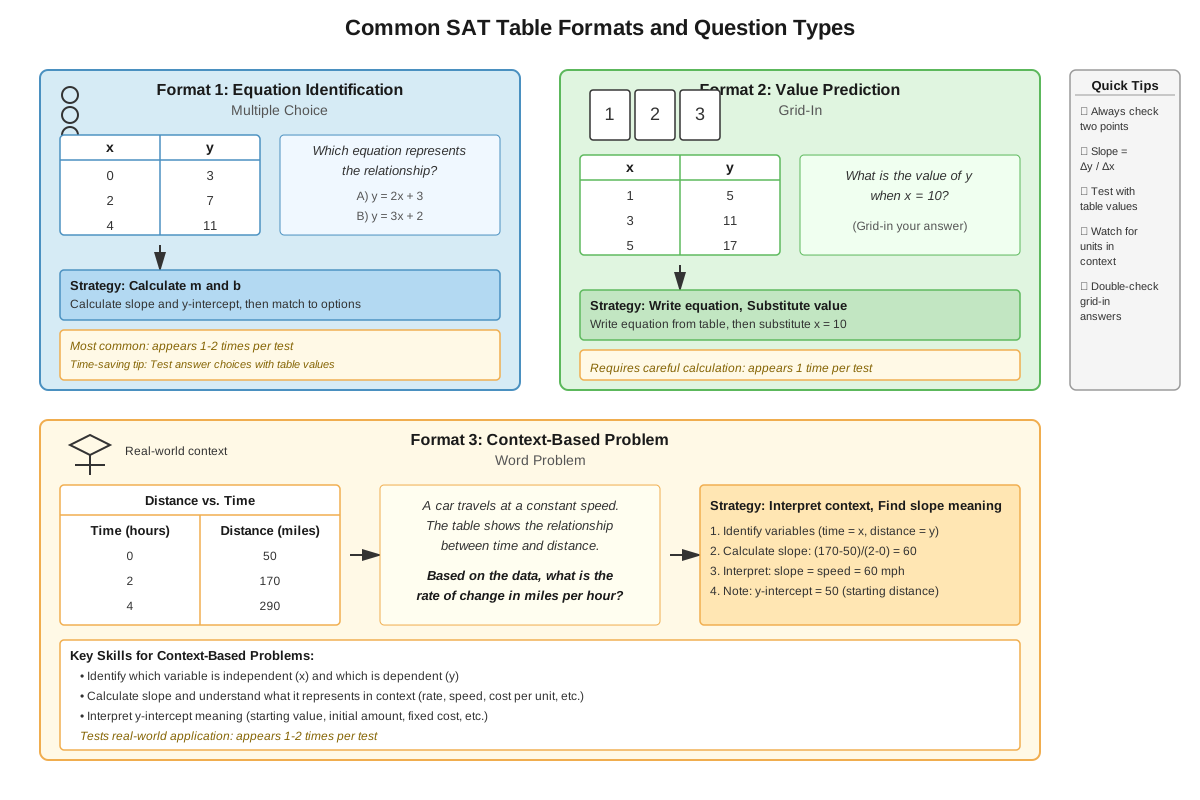
On the SAT, writing equations from tables appears with remarkable consistency. Approximately 2-4 questions per test directly assess this skill, accounting for roughly 3-7% of the total math score. These questions appear in multiple formats: multiple-choice problems asking students to identify the correct equation, grid-in questions requiring calculation of specific values, and word problems where tables represent real-world scenarios. The College Board considers this a "Passport to Advanced Math" skill, indicating its importance for college readiness.
Common SAT presentations include: tables showing linear relationships with constant rates of change, tables embedded within word problems about real-world scenarios (cost analysis, distance-time relationships, population growth), tables with missing values that must be determined using the equation, and questions asking students to identify which equation best models the data. The versatility of this question type makes it a high-yield study focus.
Core Concepts
Understanding Table Structure and Function Relationships
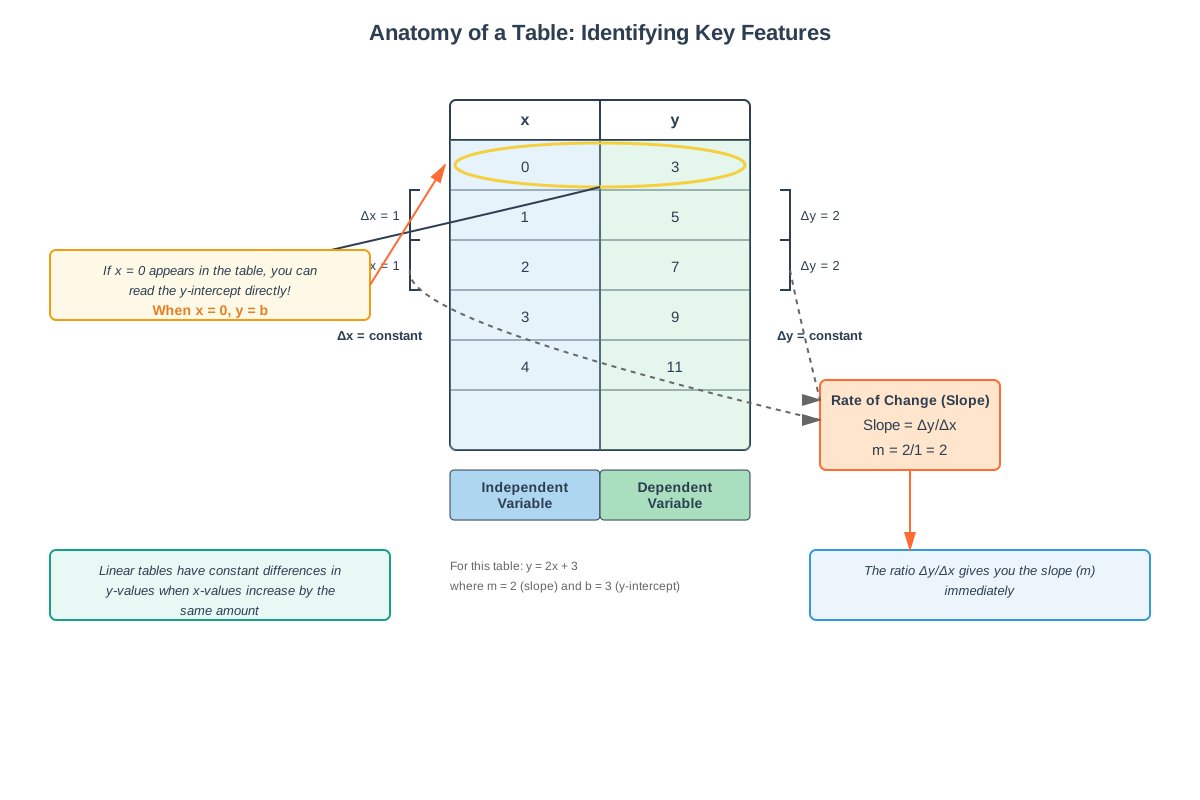
A table organizing mathematical data typically presents input values (independent variable, usually x) in one column and corresponding output values (dependent variable, usually y) in another column. Each row represents an ordered pair (x, y) that satisfies the underlying relationship. When writing equations from tables, the goal is to identify the mathematical rule that transforms each input into its corresponding output.
For linear relationships, this rule takes the form y = mx + b, where m represents the slope (rate of change) and b represents the y-intercept (initial value when x = 0). The consistency of the pattern—specifically, whether the change in y divided by the change in x remains constant—determines whether the relationship is linear.
Calculating Slope from Table Values
The slope (m) represents the rate of change between variables and is calculated using any two points from the table. The slope formula is:
m = (y₂ - y₁) / (x₂ - x₁)To find slope from a table:
- Select any two complete ordered pairs from the table
- Identify which values are x₁, y₁, x₂, and y₂
- Subtract the y-values (numerator) and x-values (denominator)
- Simplify the fraction to find the constant rate of change
Critical insight: For linear relationships, the slope will be identical regardless of which two points you choose. If calculating slope with different point pairs yields different results, the relationship is not linear.
Determining the Y-Intercept
The y-intercept (b) represents the output value when the input is zero. There are three methods to find the y-intercept:
Method 1: Direct observation - If the table includes a row where x = 0, the corresponding y-value is the y-intercept.
Method 2: Using point-slope substitution - After calculating slope, select any point from the table (x, y) and substitute into y = mx + b, then solve for b.
Method 3: Working backward - If the table doesn't include x = 0, use the slope to work backward. For each decrease of 1 in the x-value, subtract the slope from the corresponding y-value.
Writing the Complete Equation
Once slope (m) and y-intercept (b) are determined, write the equation in slope-intercept form: y = mx + b. For SAT questions, this may need to be expressed using function notation as f(x) = mx + b, or rearranged into standard form (Ax + By = C) depending on the question requirements.
Verification Process
After deriving an equation, verification is essential. Test the equation by substituting x-values from the table and confirming that the calculated y-values match those in the table. This step catches calculation errors and confirms the equation's validity. On the SAT, verification can also eliminate incorrect answer choices efficiently.
Identifying Non-Linear Patterns
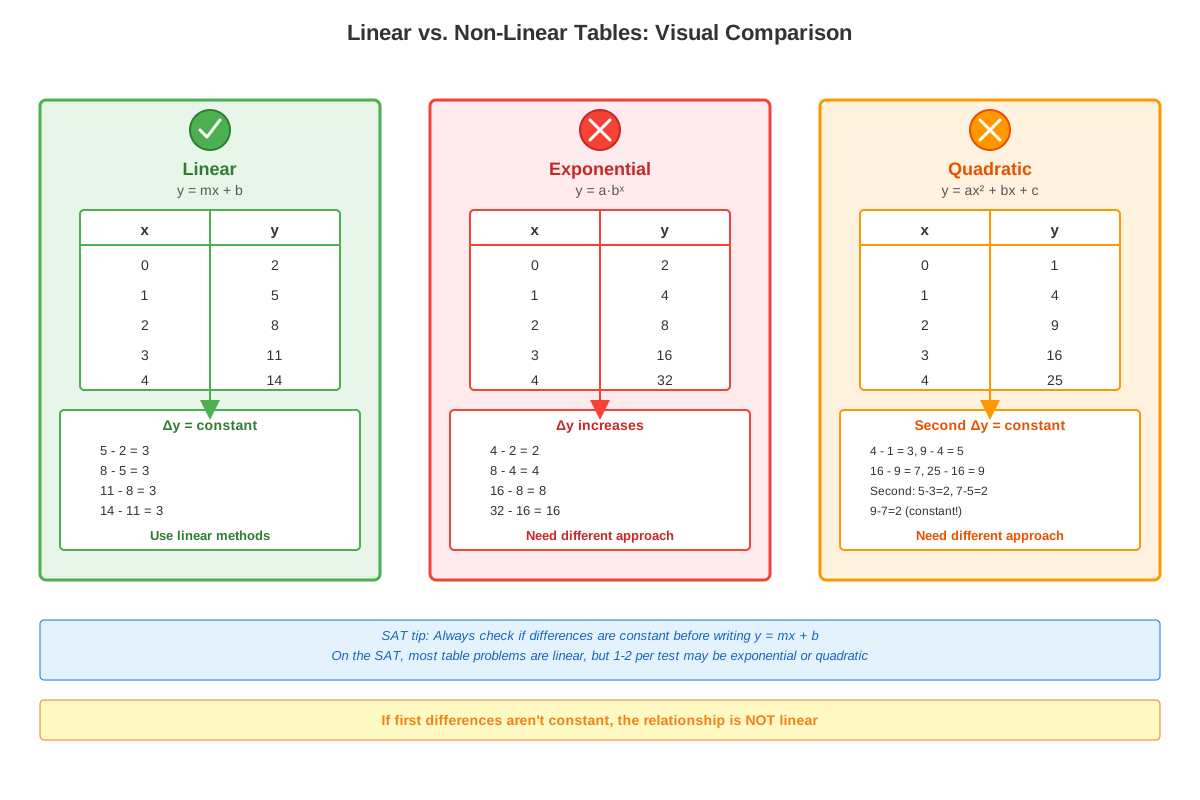
Not all tables represent linear relationships. Key indicators of non-linear patterns include:
- Non-constant differences in y-values when x-values increase by constant amounts
- Ratios between consecutive y-values that remain constant (exponential relationships)
- Patterns where y-values are perfect squares or cubes of x-values (polynomial relationships)
For SAT purposes, recognizing when a relationship is NOT linear prevents wasted time attempting to force-fit a linear equation to non-linear data.
Special Cases and Variations
Horizontal lines (y = c): When all y-values in the table are identical regardless of x-values, the slope is zero and the equation is simply y = constant.
Vertical lines (x = c): When all x-values are identical (rare in function tables since this violates the definition of a function), the relationship cannot be expressed as y = mx + b.
Tables with fractional or decimal slopes: SAT questions frequently use non-integer slopes to increase difficulty. Careful arithmetic with fractions is essential.
Concept Relationships
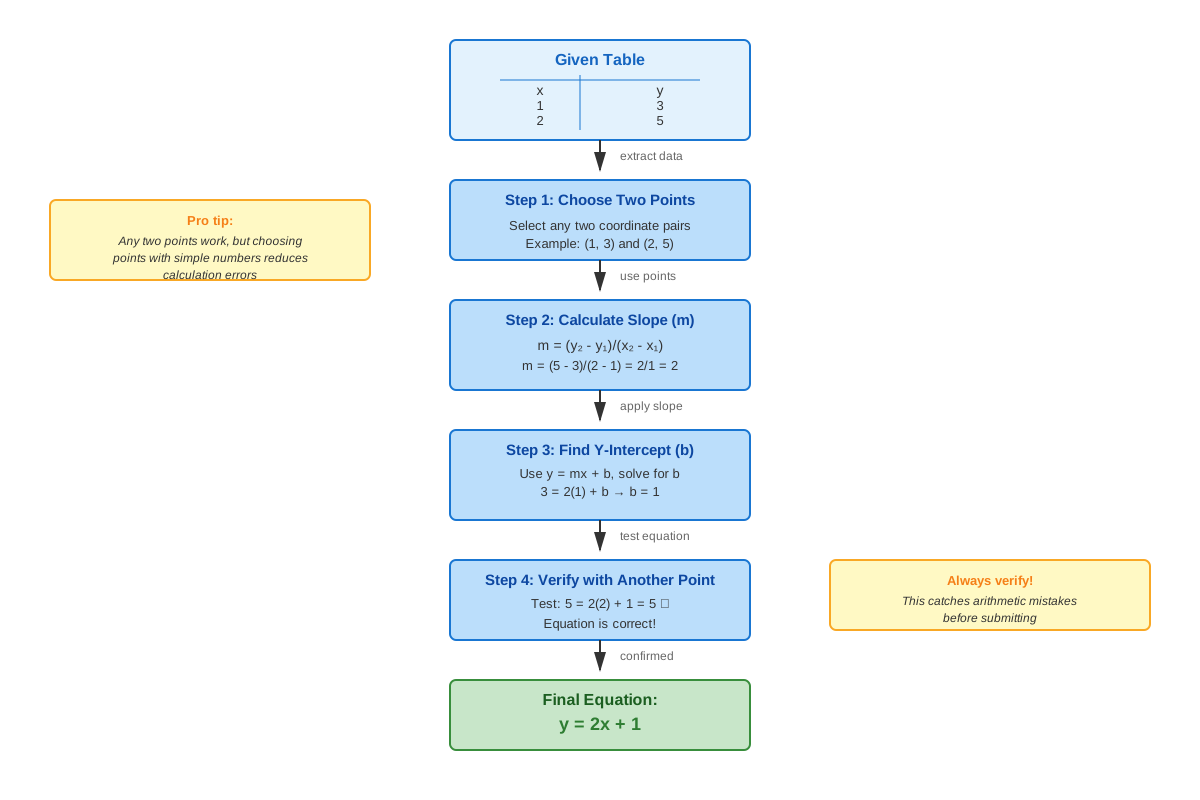
The process of writing equations from tables follows a logical sequence: Table analysis → Pattern recognition → Slope calculation → Y-intercept determination → Equation formation → Verification. Each step depends on the previous one, making this a hierarchical skill set.
This topic directly builds upon prerequisite knowledge of slope-intercept form, which provides the template for the final equation. It also connects to graphing linear equations, as each table row represents a point that would appear on the function's graph. Understanding rate of change from real-world contexts helps interpret what the slope means in word problems involving tables.
Writing equations from tables serves as preparation for more advanced topics including systems of equations (where multiple tables might represent different linear relationships that intersect), linear modeling (using equations to make predictions beyond the table's data), and function transformation (understanding how changes to m and b affect the relationship). The verification process reinforces function evaluation, a critical skill throughout algebra.
High-Yield Facts
⭐ The slope formula (y₂ - y₁)/(x₂ - x₁) works with ANY two points from a linear table and will always yield the same result
⭐ For linear relationships, the difference between consecutive y-values divided by the difference between consecutive x-values equals the slope
⭐ The y-intercept can be found by substituting any point from the table into y = mx + b after calculating slope
⭐ If a table includes the point (0, b), then b is the y-intercept directly
⭐ Always verify your equation by testing at least two points from the original table
- A negative slope indicates that y decreases as x increases
- When x-values increase by 1, the corresponding y-values increase by exactly the slope amount
- Tables representing linear functions will show constant first differences in y-values when x-values have constant differences
- Function notation f(x) and y are interchangeable when writing equations from tables
- The equation y = mx + b can be rearranged to standard form Ax + By = C if required by the question
- If the slope calculation yields a fraction, keep it in fraction form for accuracy rather than converting to decimals
- Zero slope (m = 0) produces horizontal lines with equations y = b
Quick check — test yourself on Writing equations from tables so far.
Try Flashcards →Common Misconceptions
Misconception: The y-intercept is always visible in the table as one of the given y-values.
Correction: The y-intercept only appears directly in the table if there is a row where x = 0. Otherwise, it must be calculated using the slope and any point from the table.
Misconception: Slope can be calculated as (x₂ - x₁)/(y₂ - y₁), reversing the numerator and denominator.
Correction: Slope is always "rise over run" or change in y over change in x: (y₂ - y₁)/(x₂ - x₁). Reversing this formula gives the reciprocal of the slope, which is incorrect.
Misconception: Any equation that works for one or two points from the table is correct.
Correction: The correct equation must work for ALL points in the table. Always verify with multiple points, especially the first and last rows.
Misconception: If the table shows x-values that don't start at zero or increase by one, the standard approach doesn't work.
Correction: The slope formula and equation-writing process work regardless of which x-values appear in the table or how they're spaced. The method remains the same.
Misconception: When calculating slope, it doesn't matter which point is labeled (x₁, y₁) and which is (x₂, y₂).
Correction: While the slope magnitude will be correct either way, consistency is crucial—if you subtract x₁ from x₂ in the denominator, you must subtract y₁ from y₂ in the numerator. Mixing the order produces incorrect signs.
Misconception: Tables always represent linear relationships.
Correction: SAT questions may present non-linear data to test whether students can recognize that a linear equation is inappropriate. Check for constant differences before assuming linearity.
Worked Examples
Example 1: Standard Linear Table
Problem: Write an equation in slope-intercept form for the relationship shown in the table:
| x | y |
|---|---|
| 2 | 7 |
| 4 | 13 |
| 6 | 19 |
| 8 | 25 |
Solution:
Step 1: Calculate the slope using any two points. Using (2, 7) and (4, 13):
m = (13 - 7)/(4 - 2) = 6/2 = 3Step 2: Verify the slope is constant by checking another pair. Using (6, 19) and (8, 25):
m = (25 - 19)/(8 - 6) = 6/2 = 3 ✓Step 3: Find the y-intercept. The table doesn't include x = 0, so substitute any point and the slope into y = mx + b. Using (2, 7):
7 = 3(2) + b
7 = 6 + b
b = 1
Step 4: Write the complete equation:
y = 3x + 1Step 5: Verify with a different point. Using (6, 19):
y = 3(6) + 1 = 18 + 1 = 19 ✓Answer: y = 3x + 1
This example demonstrates the standard process and addresses Learning Objective 3 (applying the method to answer questions) and Objective 4 (calculating slope).
Example 2: Table with Fractional Slope and No Zero
Problem: A table shows the cost C(n) in dollars for renting n hours of equipment. Write an equation for C(n).
| n | C(n) |
|---|---|
| 3 | 47.50 |
| 5 | 62.50 |
| 7 | 77.50 |
| 9 | 92.50 |
Solution:
Step 1: Calculate slope using (3, 47.50) and (5, 62.50):
m = (62.50 - 47.50)/(5 - 3) = 15/2 = 7.5This means the cost increases by $7.50 per hour.
Step 2: Find the initial cost (y-intercept) using the point (3, 47.50):
47.50 = 7.5(3) + b
47.50 = 22.50 + b
b = 25
Step 3: Write the equation:
C(n) = 7.5n + 25or equivalently:
C(n) = (15/2)n + 25Step 4: Verify with (7, 77.50):
C(7) = 7.5(7) + 25 = 52.50 + 25 = 77.50 ✓Interpretation: The equipment rental costs $25 as a base fee plus $7.50 per hour.
Answer: C(n) = 7.5n + 25
This example addresses real-world application (Learning Objective 2) and demonstrates working with decimal slopes and function notation.
Exam Strategy
When approaching SAT questions on writing equations from tables, follow this systematic approach:
Step 1: Scan the table structure - Identify how many data points are provided and whether x = 0 appears. Note whether the question uses function notation or standard y-variable notation.
Step 2: Check for linearity - Before attempting to write a linear equation, verify that the relationship is actually linear by checking if differences in y-values are constant when x-values increase by constant amounts. This prevents wasting time on non-linear data.
Step 3: Calculate slope efficiently - Use the first and last points in the table for slope calculation, as this often involves simpler arithmetic and provides a good verification check. Write your calculation clearly to avoid sign errors.
Step 4: Determine the y-intercept strategically - If x = 0 appears in the table, use that y-value directly. Otherwise, use the point with the smallest x-value to minimize calculation complexity.
Trigger words and phrases to watch for:
- "Write an equation" or "which equation represents" signals direct equation-writing
- "Initial value" or "starting amount" refers to the y-intercept
- "Rate of change" or "per unit increase" refers to the slope
- "When x = 0" directly asks for the y-intercept
- "For every increase of..." describes the slope
Process of elimination tips:
- Immediately eliminate any answer choice where the slope sign (positive/negative) doesn't match the table's trend
- Substitute x = 0 into remaining choices; eliminate those that don't yield the correct y-intercept
- Test one point from the table in remaining choices to identify the correct equation
Time allocation: These questions should take 60-90 seconds once the method is mastered. Spend 20 seconds analyzing the table, 30 seconds calculating slope and y-intercept, and 20 seconds verifying your answer.
Exam Tip: If you're running short on time, calculate the slope and immediately check which answer choice has that slope. Often only one choice will match, eliminating the need to find the y-intercept.
Memory Techniques
Mnemonic for the equation-writing process: "SPIV"
- Slope first (calculate using any two points)
- Point selection (choose one point from the table)
- Intercept calculation (substitute into y = mx + b and solve for b)
- Verify (test the equation with another point)
Visualization strategy: Picture the table as a ladder where each rung represents a point. The slope tells you how steeply the ladder leans (rise over run), and the y-intercept tells you where the bottom of the ladder touches the ground (y-axis).
Acronym for slope formula: "RISE over RUN"
- Right minus left (y₂ - y₁)
- In the numerator
- Subtract x-values (x₂ - x₁)
- Enter as denominator
Memory hook for y-intercept: "When x is ZERO, y is the HERO" - the y-intercept is the y-value when x equals zero, and it's the "starting point" of the relationship.
Pattern recognition tip: "Constant change means linear range" - if the y-values change by the same amount each time x increases by a constant amount, the relationship is linear.
Summary
Writing equations from tables is a high-yield SAT math skill that requires students to identify mathematical patterns in organized data and express them as algebraic equations. The process involves calculating slope using any two points from the table with the formula (y₂ - y₁)/(x₂ - x₁), determining the y-intercept either directly (when x = 0 appears in the table) or through substitution, and combining these values into the slope-intercept form y = mx + b. Verification is essential—the derived equation must work for all points in the table, not just one or two. Students must recognize whether relationships are linear by checking for constant differences in y-values, as non-linear data cannot be modeled with y = mx + b. This topic appears 2-4 times per SAT, often embedded in real-world contexts, making it crucial for achieving competitive scores. Mastery requires understanding the conceptual meaning of slope (rate of change) and y-intercept (initial value), executing calculations accurately with integers and fractions, and applying systematic verification strategies.
Key Takeaways
- The slope of a linear relationship can be calculated from any two points in a table using (y₂ - y₁)/(x₂ - x₁) and will always be constant
- The y-intercept is the y-value when x = 0, found either directly from the table or by substituting a known point into y = mx + b
- Always verify your equation by testing multiple points from the original table to ensure accuracy
- Linear relationships show constant differences in y-values when x-values increase by constant amounts
- SAT questions frequently embed tables in real-world contexts where slope represents a rate and y-intercept represents an initial value
- Function notation f(x) and y are interchangeable when writing equations from tables
- Systematic approaches (calculate slope → find y-intercept → write equation → verify) prevent errors and save time on test day
Related Topics
Graphing Linear Equations: After writing equations from tables, students learn to visualize these relationships on coordinate planes, connecting algebraic and geometric representations of functions.
Systems of Linear Equations: Mastery of writing single equations from tables prepares students for scenarios involving multiple tables representing different relationships that must be solved simultaneously.
Linear Modeling and Regression: Advanced applications involve writing equations from real-world data sets, making predictions, and understanding correlation—skills that build directly on table-to-equation conversion.
Exponential Functions from Tables: The same analytical approach applies to non-linear relationships, where students identify constant ratios instead of constant differences.
Function Transformation: Understanding how changes to m and b in y = mx + b affect the table values prepares students for more abstract function manipulation.
Practice CTA
Now that you've mastered the concepts and strategies for writing equations from tables, it's time to solidify your understanding through practice. Attempt the practice questions designed specifically for this topic, focusing on applying the SPIV method (Slope, Point, Intercept, Verify) to each problem. Use the flashcards to reinforce key formulas and concepts until they become automatic. Remember, the SAT rewards both accuracy and speed—consistent practice with these high-yield problems will build the confidence and efficiency you need to excel on test day. Every table you convert to an equation strengthens your algebraic reasoning and brings you closer to your target score!
Sign up free to keep reading
Create a free AnvayaPrep account to finish this SAT guide on Writing equations from tables — plus flashcards and practice questions.