Overview
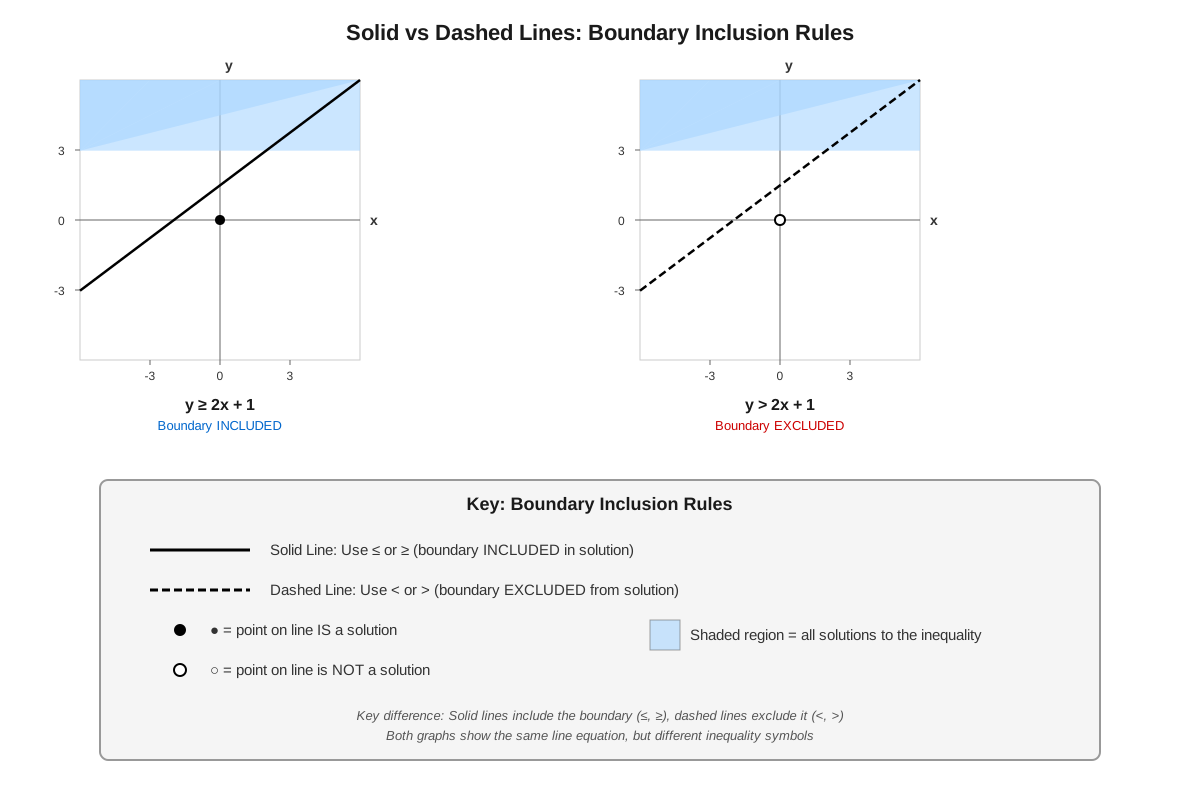
When graphing linear inequalities on a coordinate plane, one of the most fundamental decisions involves choosing between dashed vs solid lines. This distinction is not merely aesthetic—it carries precise mathematical meaning that directly affects whether solutions are correct or incorrect. A solid line indicates that points on the boundary line itself are included in the solution set (corresponding to ≤ or ≥ inequalities), while a dashed line signals that boundary points are excluded (corresponding to < or > inequalities). This visual representation transforms abstract algebraic relationships into concrete geometric regions that students can analyze and interpret.
Understanding sat dashed vs solid lines is essential for success on the SAT math section because inequality questions appear regularly throughout the exam, particularly in the calculator and no-calculator portions. These questions test not only computational skills but also conceptual understanding of how algebraic expressions translate into graphical representations. The College Board frequently presents scenarios where students must either identify the correct graph for a given inequality or write an inequality based on a provided graph. Misinterpreting the line type leads to selecting incorrect answer choices, even when all other aspects of the problem are handled correctly.
This topic connects directly to broader mathematical concepts including linear equations, coordinate geometry, solution sets, and systems of inequalities. Mastery of dashed versus solid lines provides the foundation for understanding more complex topics such as linear programming, feasibility regions, and optimization problems. The skill of translating between symbolic and graphical representations is a core competency that the SAT assesses repeatedly, making this seemingly simple distinction a high-yield area for focused study.
Learning Objectives
- [ ] Identify key features of dashed vs solid lines in graphical representations of inequalities
- [ ] Explain how dashed vs solid lines appears on the SAT in various question formats
- [ ] Apply dashed vs solid lines to answer SAT-style questions accurately and efficiently
- [ ] Determine the correct inequality symbol (≤, ≥, <, >) based on line type in a graph
- [ ] Construct accurate graphs of linear inequalities using appropriate line types
- [ ] Analyze systems of inequalities by interpreting multiple boundary lines simultaneously
- [ ] Recognize and correct common errors related to boundary inclusion/exclusion
Prerequisites
- Linear equations in two variables: Understanding how to graph lines using slope-intercept form (y = mx + b) or standard form (Ax + By = C) is essential because inequality boundaries are linear equations
- Inequality symbols and their meanings: Familiarity with <, >, ≤, and ≥ symbols and their verbal interpretations ("less than," "greater than or equal to," etc.) provides the foundation for understanding when boundaries are included
- Coordinate plane navigation: Ability to plot points and identify regions on the xy-plane enables visualization of solution sets
- Substitution and testing points: Knowing how to substitute coordinate pairs into inequalities helps verify which side of the boundary contains solutions
Why This Topic Matters
In real-world applications, dashed versus solid lines represent the difference between inclusive and exclusive boundaries in practical scenarios. Engineers use these concepts when defining acceptable ranges for measurements (a part must be "at least 5 cm" versus "more than 5 cm"). Economists model feasibility regions for production constraints where resources might be used completely (solid boundary) or must remain strictly below a threshold (dashed boundary). Urban planners use inequality systems to define zoning restrictions, and data scientists employ them in machine learning algorithms for classification boundaries.
On the SAT, questions involving linear inequalities and their graphical representations appear in approximately 3-5% of all math questions, translating to roughly 2-3 questions per exam. These questions typically appear in multiple formats: selecting the correct graph for a given inequality, writing an inequality from a graph, identifying solution points, or working with systems of inequalities. The College Board particularly favors questions that combine multiple skills—for example, presenting a word problem that requires translating a real-world constraint into an inequality, then identifying the correct graphical representation.
Common SAT question types include: (1) matching an inequality to its graph among four choices where line type is the distinguishing feature; (2) word problems describing constraints where students must determine whether boundary values are permissible; (3) systems of inequalities where students identify the feasible region; and (4) questions asking whether specific coordinate pairs satisfy given inequalities. The visual nature of these questions makes them particularly susceptible to careless errors, but also makes them highly coachable with proper understanding.
Core Concepts
The Fundamental Distinction
The choice between dashed vs solid lines directly corresponds to whether the inequality includes or excludes the boundary values. This relationship is absolute and invariant:
| Inequality Symbol | Line Type | Boundary Points | Verbal Meaning |
|---|---|---|---|
| ≤ (less than or equal to) | Solid | Included | "At most" or "no more than" |
| ≥ (greater than or equal to) | Solid | Included | "At least" or "no less than" |
| < (less than) | Dashed | Excluded | "Fewer than" or "strictly less than" |
| > (greater than) | Dashed | Excluded | "More than" or "strictly greater than" |
The mathematical reasoning behind this convention stems from set theory. When an inequality includes the equals component (≤ or ≥), the solution set contains all points in the region AND all points on the boundary line itself. A solid line visually communicates that these boundary points are part of the solution. Conversely, strict inequalities (< or >) define solution sets that approach but never reach the boundary, making a dashed line the appropriate visual representation of this exclusion.
Graphing Process for Linear Inequalities
To correctly graph a linear inequality with the appropriate line type, follow this systematic process:
- Rewrite the inequality in slope-intercept form (y = mx + b) if possible, isolating y on one side
- Identify the boundary equation by temporarily replacing the inequality symbol with an equals sign
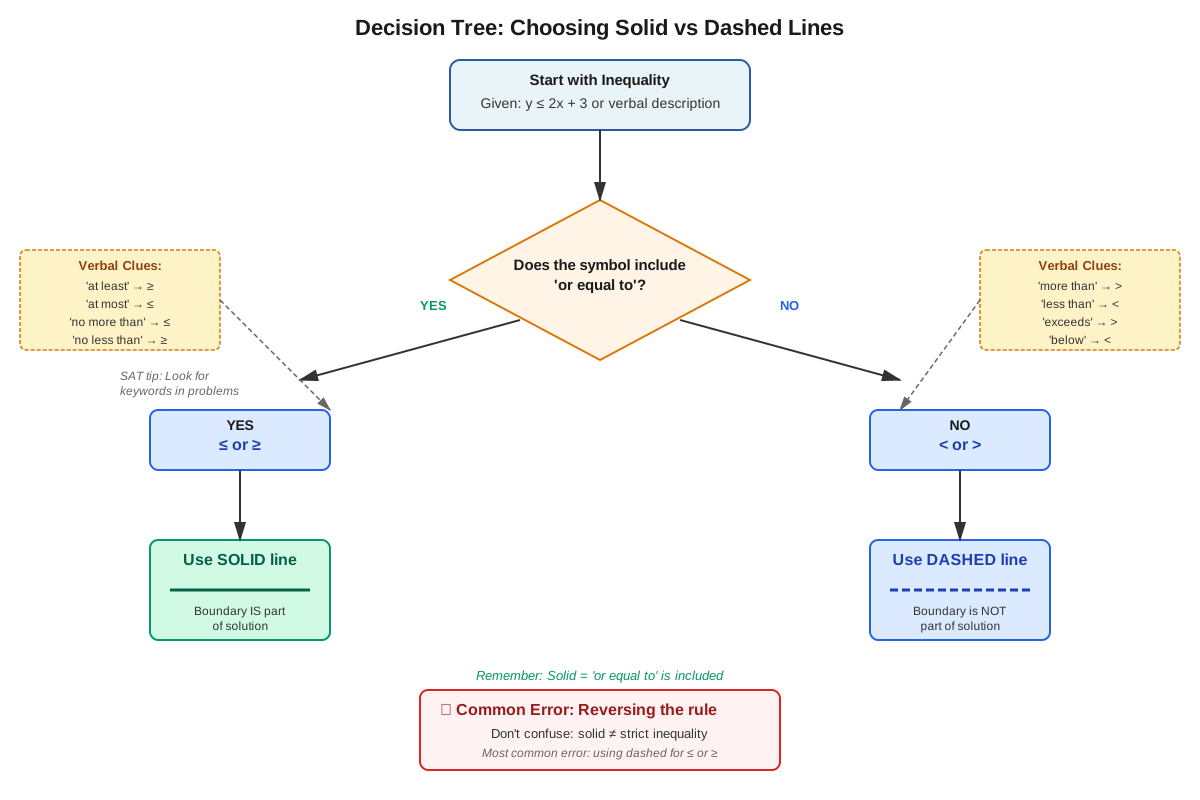
- Determine line type by examining the inequality symbol:
- If ≤ or ≥: use a solid line
- If < or >: use a dashed line
- Graph the boundary line using standard techniques (plotting y-intercept and using slope, or finding two points)
- Select a test point not on the line (origin (0,0) is convenient if the line doesn't pass through it)
- Shade the appropriate region based on whether the test point satisfies the inequality
Critical Detail: Reversing Inequality Signs
When solving for y, students must remember that multiplying or dividing both sides by a negative number reverses the inequality symbol. This affects line type determination:
- Original: -2y < 6 (dashed line for <)
- After dividing by -2: y > -3 (still dashed, but now for >)
This reversal is a frequent source of errors on the SAT, particularly in questions where the inequality is presented in standard form (Ax + By < C) and requires manipulation.
Reading Graphs to Write Inequalities
The reverse process—interpreting a graph to write the corresponding inequality—requires careful observation:
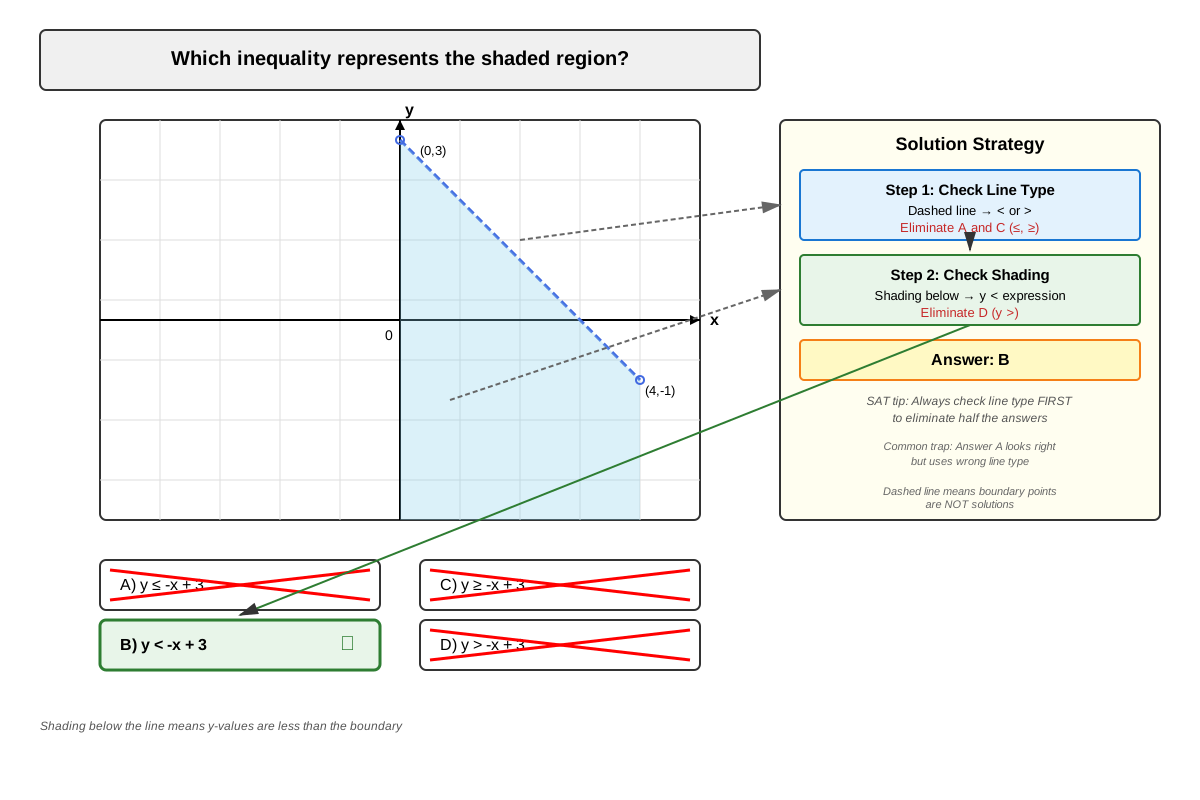
- Examine the line type first: Solid indicates ≤ or ≥; dashed indicates < or >
- Determine the boundary equation by identifying slope and y-intercept or using two points on the line
- Identify the shaded region (above or below the line for non-vertical boundaries)
- Select the correct inequality symbol:
- Shaded above + solid line → y ≥ mx + b
- Shaded above + dashed line → y > mx + b
- Shaded below + solid line → y ≤ mx + b
- Shaded below + dashed line → y < mx + b
Systems of Inequalities
When multiple inequalities appear on the same coordinate plane, each boundary line follows the same rules independently. The solution region is the intersection (overlap) of all individual solution regions. In these problems:
- Each boundary line has its own type (solid or dashed) based on its inequality symbol
- A point is a solution to the system only if it satisfies ALL inequalities simultaneously
- Boundary points require special attention: a point on a solid boundary of one inequality might still be excluded from the system if it lies on a dashed boundary of another inequality
Special Cases: Vertical and Horizontal Lines
Vertical boundaries (x = k) and horizontal boundaries (y = k) follow identical rules:
- x ≤ 3 or x ≥ 3: solid vertical line at x = 3
- x < 3 or x > 3: dashed vertical line at x = 3
- y ≤ -2 or y ≥ -2: solid horizontal line at y = -2
- y < -2 or y > -2: dashed horizontal line at y = -2
The shading extends left/right for vertical boundaries and up/down for horizontal boundaries, but the line type determination remains unchanged.
Concept Relationships
The core concept of dashed versus solid lines emerges directly from the mathematical definition of inequality symbols. The distinction between "less than" (<) and "less than or equal to" (≤) creates the necessity for different visual representations. This fundamental relationship can be mapped as:
Inequality Symbol Definition → Boundary Inclusion/Exclusion → Line Type Selection → Graphical Representation
Within the topic itself, the concepts connect hierarchically. Understanding the basic correspondence between symbols and line types enables the graphing process, which in turn supports the reverse skill of reading graphs to write inequalities. Both of these skills combine when working with systems of inequalities, where multiple boundaries must be interpreted simultaneously.
The topic connects backward to prerequisite knowledge of linear equations—every inequality boundary is fundamentally a linear equation with an added constraint about which side contains solutions. The graphing techniques for lines (using slope-intercept form, finding intercepts, plotting points) transfer directly to graphing inequality boundaries.
Looking forward, mastery of dashed versus solid lines enables progression to more advanced topics including linear programming (where feasible regions are defined by systems of inequalities with various boundary types), absolute value inequalities (which create two boundary lines), and even quadratic inequalities (where boundaries are parabolas rather than lines, but the solid/dashed distinction remains relevant).
The connection to SAT problem-solving strategies is also crucial: Visual Analysis → Symbol Identification → Algebraic Verification forms a complete approach where line type serves as a visual trigger for the underlying mathematical relationship.
Quick check — test yourself on Dashed vs solid lines so far.
Try Flashcards →High-Yield Facts
⭐ Solid lines correspond exclusively to ≤ and ≥ inequalities; dashed lines correspond exclusively to < and > inequalities
⭐ Points on a solid boundary line ARE solutions to the inequality; points on a dashed boundary line are NOT solutions
⭐ When dividing or multiplying both sides of an inequality by a negative number, the inequality symbol reverses, which changes the line type if the symbol changes from strict to non-strict or vice versa
⭐ In systems of inequalities, a point must satisfy ALL inequalities to be a solution; if it lies on a dashed boundary of any inequality, it cannot be a solution to the system
⭐ The test point method (substituting coordinates into the inequality) definitively determines which region to shade, but line type depends only on the inequality symbol
- Vertical lines (x = k) and horizontal lines (y = k) follow the same solid/dashed rules as slanted lines
- When an inequality is written in standard form (Ax + By ≤ C), the line type is determined before solving for y
- Graphing calculators and digital tools may represent dashed lines with dots or lighter shading, but the mathematical meaning remains identical
- The boundary line itself represents the related equation (where the inequality symbol is replaced with =)
- In word problems, phrases like "at least," "at most," "no more than," and "no less than" indicate ≤ or ≥ (solid lines), while "more than," "less than," "exceeds," and "below" indicate < or > (dashed lines)
Common Misconceptions
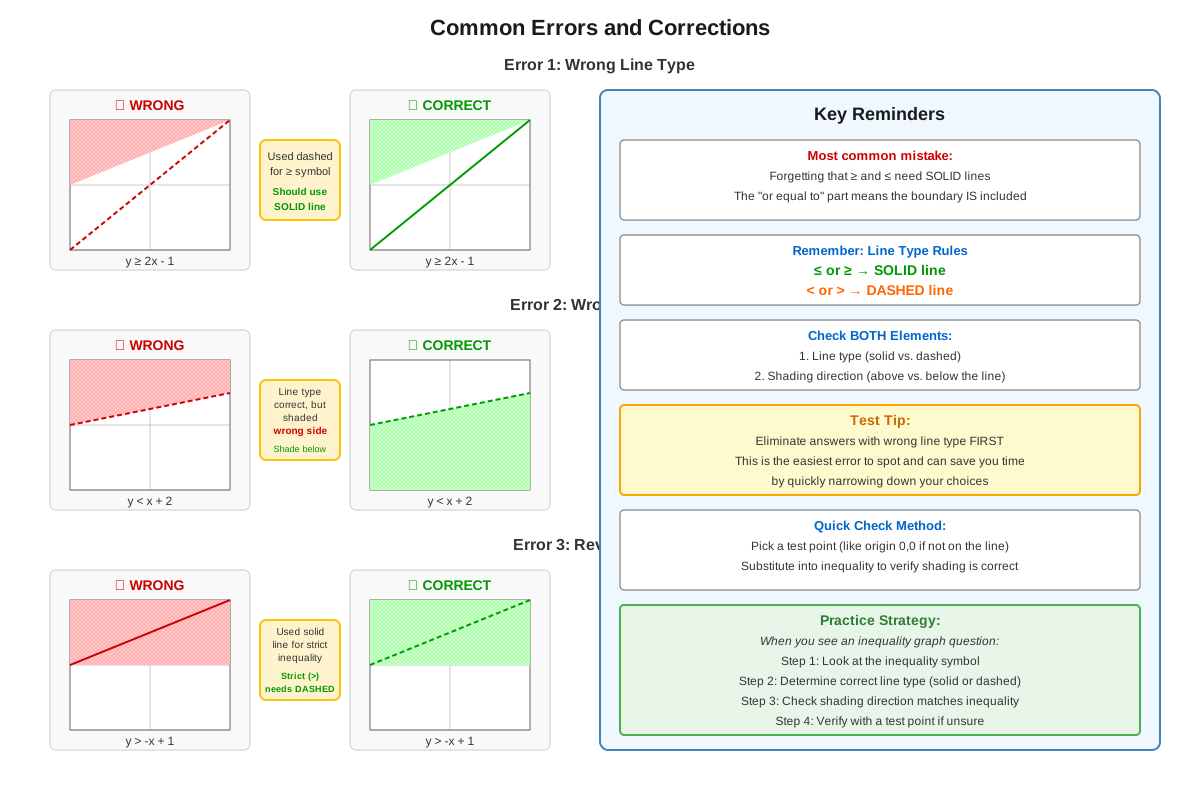
Misconception: A dashed line means the inequality is "less than" (<) and a solid line means "greater than" (>).
Correction: Line type depends on whether the boundary is included (solid for ≤ or ≥) or excluded (dashed for < or >), not on the direction of the inequality. Both y > 2 and y < 2 could have dashed lines; both y ≥ 2 and y ≤ 2 would have solid lines.
Misconception: When shading is above the line, the line must be solid.
Correction: Shading direction (above or below) is independent of line type. The inequality y > 3 has shading above a dashed line, while y ≥ 3 has shading above a solid line. Line type depends only on inclusion/exclusion of the boundary.
Misconception: In a system of inequalities, if one boundary is solid and another is dashed, the entire solution region boundary is dashed.
Correction: Each boundary segment retains its own type. The solution region may have some solid boundary segments and some dashed boundary segments, depending on which inequalities define each edge of the region.
Misconception: The point (0, 0) can always be used as a test point to determine shading direction.
Correction: While (0, 0) is convenient when the boundary line doesn't pass through the origin, it cannot be used if the line passes through (0, 0). In such cases, select any other point not on the line, such as (1, 0) or (0, 1).
Misconception: When solving for y and the inequality symbol reverses, the line type must also change.
Correction: The line type is determined by the final inequality symbol after all algebraic manipulation. If -y < 4 becomes y > -4, the line is dashed because the final symbol is >. The reversal itself doesn't change the line type; the final symbol determines it.
Misconception: A solid line means "solid shading" (completely filled region).
Correction: The terms "solid" and "dashed" refer only to the boundary line itself, not to the shading pattern of the solution region. All inequality graphs show shaded regions; the line type indicates whether the boundary is included in that region.
Worked Examples
Example 1: Graphing an Inequality with Correct Line Type
Problem: Graph the inequality 3x - 2y > 6 and explain why the boundary line is dashed or solid.
Solution:
Step 1: Solve for y to get slope-intercept form.
3x - 2y > 6
-2y > -3x + 6
y < (3/2)x - 3  [Note: inequality reversed when dividing by -2]
Step 2: Identify the boundary equation by replacing < with =.
y = (3/2)x - 3Step 3: Determine line type. The inequality symbol is < (strict inequality), so the boundary line must be dashed. Points on the line y = (3/2)x - 3 are NOT solutions to y < (3/2)x - 3.
Step 4: Graph the boundary line. The y-intercept is -3, and the slope is 3/2 (rise 3, run 2). Plot (0, -3), then move up 3 and right 2 to reach (2, 0). Draw a dashed line through these points.
Step 5: Determine shading. Test point (0, 0):
0 < (3/2)(0) - 3
0 < -3  [FALSE]
Since (0, 0) does not satisfy the inequality, shade the region that does NOT contain (0, 0)—the region below the line.
Connection to Learning Objectives: This example demonstrates identifying the key feature (dashed line for strict inequality), applying the concept to create an accurate graph, and explaining the mathematical reasoning behind the line type choice.
Example 2: Writing an Inequality from a Graph
Problem: A graph shows a solid line passing through points (0, 4) and (2, 0), with shading below the line. Write the inequality represented by this graph.
Solution:
Step 1: Determine the boundary equation using the two points.
Slope m = (0 - 4)/(2 - 0) = -4/2 = -2
Using point-slope form with (0, 4):
y - 4 = -2(x - 0)
y = -2x + 4
Step 2: Identify the line type. The problem states the line is solid, which means the inequality must be ≤ or ≥ (boundary included).
Step 3: Determine the inequality direction. The shading is below the line, meaning y-values in the solution are less than the boundary values. Combined with the solid line, the inequality is:
y ≤ -2x + 4Step 4: Verify with a test point. Choose (0, 0), which is in the shaded region:
0 ≤ -2(0) + 4
0 ≤ 4  [TRUE]
Also verify a boundary point like (2, 0):
0 ≤ -2(2) + 4
0 ≤ 0  [TRUE]
The boundary point satisfies the inequality, confirming the solid line is correct.
Connection to Learning Objectives: This example shows how to identify line type from a graph, explain how this feature appears in SAT questions (reverse-engineering inequalities from graphs), and apply the concept to write the correct inequality symbol.
Exam Strategy
When approaching SAT questions involving dashed versus solid lines, implement this systematic strategy:
1. Identify the Question Type First
- Is the question asking you to select a graph for a given inequality?
- Is it asking you to write an inequality from a graph?
- Does it involve determining whether specific points are solutions?
2. Focus on the Inequality Symbol Immediately
- Before doing any algebraic manipulation, identify whether the symbol is strict (<, >) or non-strict (≤, ≥)
- Circle or underline the symbol to maintain awareness throughout your work
3. Watch for Trigger Words in Word Problems
Exam Tip: These phrases are high-yield indicators of inequality type: - "At least," "at most," "no more than," "no less than," "minimum," "maximum" → ≤ or ≥ (solid line) - "More than," "less than," "exceeds," "below," "above," "fewer than" → < or > (dashed line)
4. Use Process of Elimination on Graph Selection Questions
- If the inequality has ≤ or ≥, immediately eliminate all answer choices with dashed lines
- If the inequality has < or >, immediately eliminate all answer choices with solid lines
- This often eliminates 2 of 4 answer choices before considering shading direction
5. Verify Boundary Points When Uncertain
- If you're unsure whether a line should be solid or dashed, test a point that lies exactly on the boundary line
- If the point satisfies the inequality, the line must be solid
- If the point does not satisfy the inequality, the line must be dashed
6. Time Allocation
- These questions should take 45-60 seconds once you understand the concept
- Spend 10-15 seconds identifying line type, 20-30 seconds on algebraic manipulation if needed, and 15-20 seconds verifying your answer
7. Double-Check After Algebraic Manipulation
- If you divided or multiplied by a negative number, verify that you reversed the inequality symbol
- Re-check the line type after any symbol reversal
Memory Techniques
Mnemonic for Solid Lines: "Solid = Equals Included" — The word "solid" has 5 letters, and both ≤ and ≥ have the equals sign (=) as part of the symbol. Solid lines mean the equals part is included.
Mnemonic for Dashed Lines: "Dashed = Definitely Apart" — The dashed line is broken apart (not continuous), just as the boundary points are separated from the solution set. The boundary is definitely apart from solutions.
Visual Memory Aid: Picture a fence (solid line) that you can stand on versus a cliff edge (dashed line) that you cannot stand on. If you can be "on" the boundary, it's solid; if you must stay away from the boundary, it's dashed.
Symbol Association:
- ≤ and ≥ have two parts (< or > plus =) → two-part symbol = solid line (more substantial)
- < and > have one part → single-part symbol = dashed line (less substantial)
Acronym for Checking Work: SLIDE
- Symbol: Identify the inequality symbol
- Line: Determine if solid or dashed
- Intercepts: Find where the boundary crosses axes
- Direction: Determine which region to shade
- Evaluate: Test a point to verify
Summary
The distinction between dashed and solid lines in graphing linear inequalities represents a fundamental concept that translates algebraic inequality symbols into visual geometric representations. Solid lines correspond exclusively to inequalities with ≤ or ≥ symbols, indicating that points on the boundary line itself are included in the solution set. Dashed lines correspond to strict inequalities with < or > symbols, indicating that boundary points are excluded from solutions. This visual convention enables students to quickly interpret graphs, write corresponding inequalities, and identify solution regions. On the SAT, questions involving this concept appear regularly in multiple formats: selecting graphs for given inequalities, writing inequalities from graphs, and determining whether specific points satisfy inequality systems. Success requires careful attention to inequality symbols, systematic graphing procedures, and awareness of common pitfalls such as inequality reversal when multiplying or dividing by negative numbers. The ability to move fluently between algebraic and graphical representations of inequalities is essential for SAT math success and forms the foundation for more advanced topics in coordinate geometry and optimization.
Key Takeaways
- Solid lines (≤, ≥) include boundary points in the solution set; dashed lines (<, >) exclude boundary points
- Line type is determined solely by the inequality symbol, independent of shading direction or line orientation
- When dividing or multiplying by negative numbers, inequality symbols reverse, which may change line type
- In systems of inequalities, each boundary maintains its own line type; solution points must satisfy all inequalities simultaneously
- Word problem trigger phrases like "at least" and "at most" indicate solid lines, while "more than" and "less than" indicate dashed lines
- Testing a point on the boundary line definitively determines whether the line should be solid (point satisfies inequality) or dashed (point does not satisfy inequality)
- Process of elimination on SAT questions can immediately eliminate half the answer choices by checking line type alone
Related Topics
Systems of Linear Inequalities: Building on single inequality graphing, systems require interpreting multiple boundaries simultaneously, each with its own line type, to identify feasible regions. Mastery of dashed versus solid lines is essential for correctly determining whether boundary intersection points are included in solution sets.
Linear Programming: This optimization technique uses systems of inequalities to define constraint regions, then finds maximum or minimum values of objective functions. Understanding boundary inclusion/exclusion is critical for identifying corner points that may or may not be feasible solutions.
Absolute Value Inequalities: These create two boundary lines on the coordinate plane, each requiring correct line type determination. The concepts of dashed versus solid lines extend directly to these more complex inequality forms.
Quadratic and Polynomial Inequalities: While boundaries become curves rather than lines, the fundamental principle of solid versus dashed boundaries (included versus excluded) remains identical, making this topic foundational for advanced inequality work.
Practice CTA
Now that you understand the critical distinction between dashed and solid lines in linear inequalities, it's time to reinforce your mastery through active practice. Complete the practice questions to test your ability to identify line types, graph inequalities accurately, and interpret graphs to write correct inequalities. Use the flashcards to drill the key correspondences between inequality symbols and line types until they become automatic. Remember: this concept appears on virtually every SAT, and the questions are highly predictable once you've mastered the fundamentals. Your investment in practice now will translate directly into points on test day. You've got this!
Sign up free to keep reading
Create a free AnvayaPrep account to finish this SAT guide on Dashed vs solid lines — plus flashcards and practice questions.