Overview
Absolute value inequalities represent a critical intersection of algebraic reasoning and number line visualization that appears consistently on the SAT math section. These inequalities extend the concept of absolute value—the distance a number is from zero on the number line—into the realm of inequality relationships, requiring students to think about ranges of values rather than single solutions. Unlike simple linear inequalities, absolute value inequalities demand that students consider two distinct cases simultaneously, making them a powerful tool for testing mathematical maturity and logical reasoning.
Understanding sat absolute value inequalities is essential because they appear in multiple question formats throughout the exam, from straightforward algebraic manipulation problems to complex word problems involving tolerances, margins of error, and distance relationships. The College Board frequently uses these problems to assess whether students can translate between algebraic notation, graphical representations, and real-world contexts. Mastery of this topic typically accounts for 2-4 questions per test administration, making it a high-yield area for score improvement.
This topic builds directly on foundational concepts in linear inequalities, equation solving, and absolute value equations, while serving as a gateway to more advanced topics like systems of inequalities and piecewise functions. The logical structure required to solve absolute value inequalities—breaking a single inequality into two separate cases and then combining the results—develops critical thinking skills that transfer to many other mathematical domains. Students who master this topic gain confidence in handling complex algebraic situations and improve their ability to visualize solution sets on number lines.
Learning Objectives
- [ ] Identify key features of absolute value inequalities
- [ ] Explain how absolute value inequalities appears on the SAT
- [ ] Apply absolute value inequalities to answer SAT-style questions
- [ ] Translate absolute value inequalities into compound inequalities without absolute value notation
- [ ] Represent solution sets of absolute value inequalities graphically on number lines
- [ ] Distinguish between "less than" and "greater than" absolute value inequality structures and their corresponding solution patterns
- [ ] Solve multi-step absolute value inequalities involving algebraic manipulation before case analysis
Prerequisites
- Linear inequalities: Understanding how to solve and graph basic inequalities like 2x + 3 < 7 is essential because absolute value inequalities decompose into linear inequality cases
- Absolute value equations: Familiarity with solving equations like |x - 3| = 5 provides the foundation for understanding the two-case structure of absolute value problems
- Number line representation: The ability to visualize and graph solution sets on number lines is crucial for understanding the geometric meaning of absolute value inequalities
- Compound inequalities: Knowledge of "and" versus "or" compound statements is necessary because absolute value inequalities always resolve into one of these two forms
- Order of operations and algebraic manipulation: Proficiency in isolating absolute value expressions and performing algebraic operations ensures accurate problem-solving
Why This Topic Matters
Absolute value inequalities have profound real-world applications that extend far beyond the SAT. Engineers use them to specify manufacturing tolerances (a part must be 5 cm ± 0.02 cm), scientists employ them to express measurement uncertainty, and quality control specialists rely on them to establish acceptable ranges for products. In everyday life, these concepts appear in contexts like acceptable temperature ranges, speed limits with tolerance zones, and financial budgeting with allowable variances.
On the SAT, absolute value inequalities appear with remarkable consistency, typically showing up in 2-4 questions per test across both the calculator and no-calculator sections. According to College Board data, approximately 8-12% of algebra questions involve absolute value concepts, with inequalities representing roughly half of those. These questions appear in multiple formats: direct algebraic solving (worth 1 point each), word problems requiring translation from context to inequality notation, and occasionally as part of multi-step problems worth 2 points in the Student-Produced Response section.
The exam commonly presents these problems in three distinct ways: (1) straightforward "solve and identify the solution set" questions, (2) word problems involving distance, tolerance, or acceptable ranges that must be translated into absolute value inequality notation, and (3) questions asking students to identify which inequality corresponds to a given number line graph. The College Board particularly favors problems that test whether students understand the fundamental difference between |x| < a (which produces a bounded interval) and |x| > a (which produces two unbounded rays). Questions may also involve absolute value inequalities embedded within more complex scenarios, such as systems of inequalities or function analysis problems.
Core Concepts
Definition and Geometric Interpretation
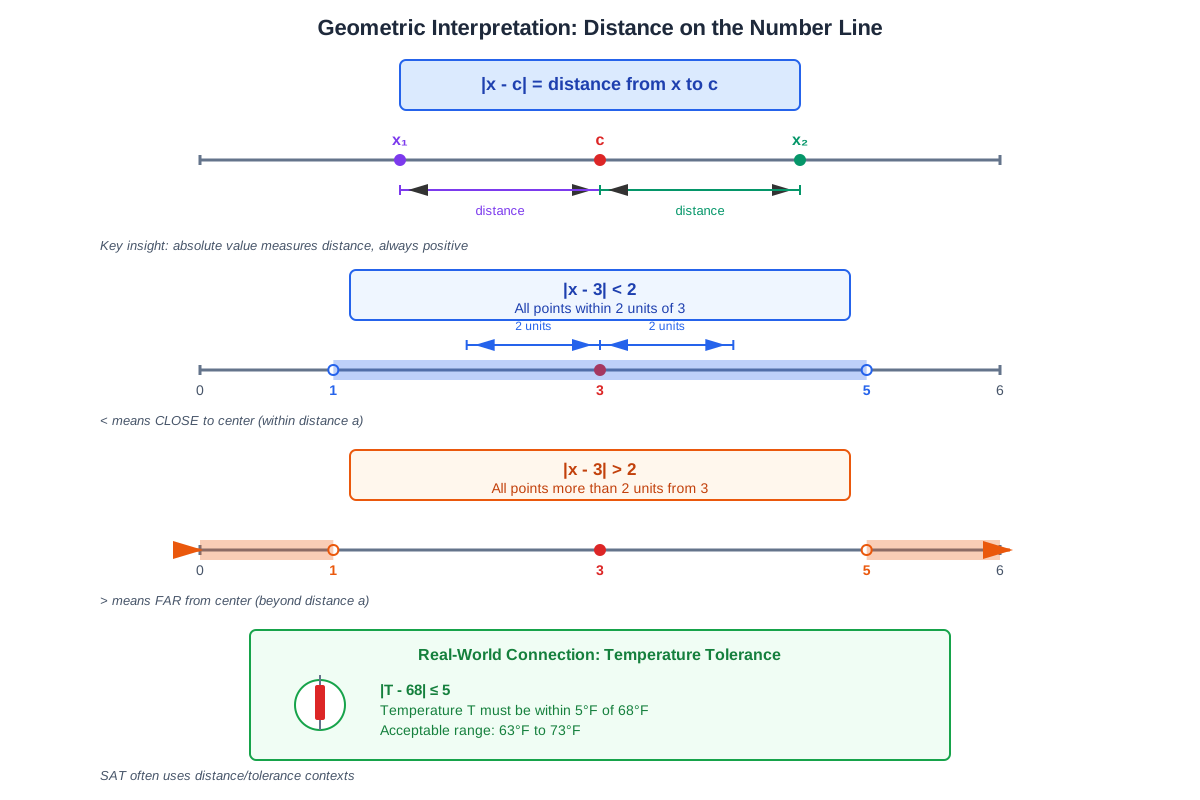
An absolute value inequality is an inequality that contains an absolute value expression. The absolute value |x| represents the distance from x to zero on the number line, always yielding a non-negative result. When we write |x| < 3, we're asking: "What values of x are less than 3 units away from zero?" This geometric interpretation is fundamental to understanding why absolute value inequalities split into two cases.
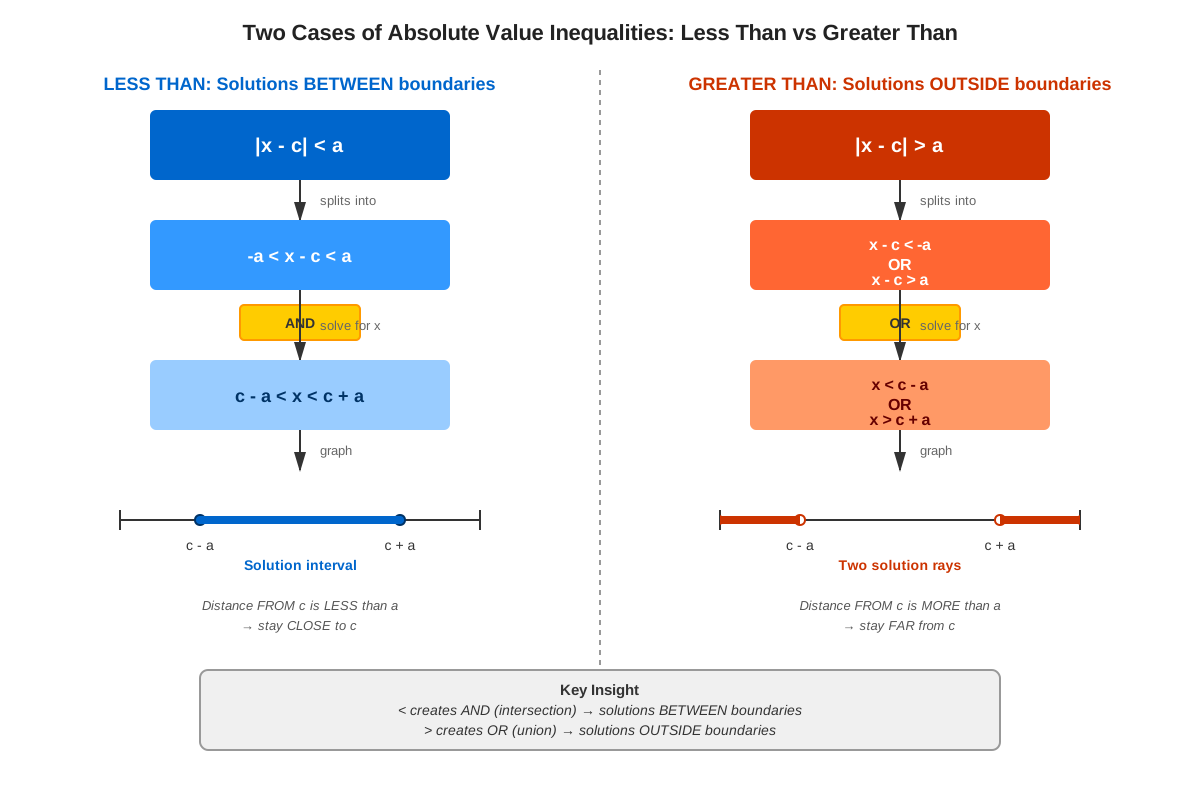
The inequality |x| < a (where a > 0) describes all numbers whose distance from zero is less than a. This creates a bounded interval: -a < x < a. Conversely, |x| > a describes all numbers whose distance from zero is greater than a, creating two unbounded regions: x < -a or x > a. This fundamental distinction—bounded versus unbounded solution sets—is the most important conceptual understanding for the SAT.
The Two Types of Absolute Value Inequalities
| Inequality Type | Standard Form | Equivalent Compound Inequality | Solution Set Description | Number Line Appearance | ||
|---|---|---|---|---|---|---|
| "Less than" | \ | x\ | < a | -a < x < a | Single bounded interval | Segment between two points |
| "Less than or equal" | \ | x\ | ≤ a | -a ≤ x ≤ a | Single bounded interval (inclusive) | Segment with closed endpoints |
| "Greater than" | \ | x\ | > a | x < -a OR x > a | Two unbounded rays | Two rays extending outward |
| "Greater than or equal" | \ | x\ | ≥ a | x ≤ -a OR x ≥ a | Two unbounded rays (inclusive) | Two rays with closed endpoints |
The critical distinction lies in the connecting word: "less than" inequalities use AND (the solution must satisfy both conditions simultaneously), while "greater than" inequalities use OR (the solution satisfies at least one condition). This logical difference determines whether the solution set is a single interval or two separate regions.
Solving Basic Absolute Value Inequalities
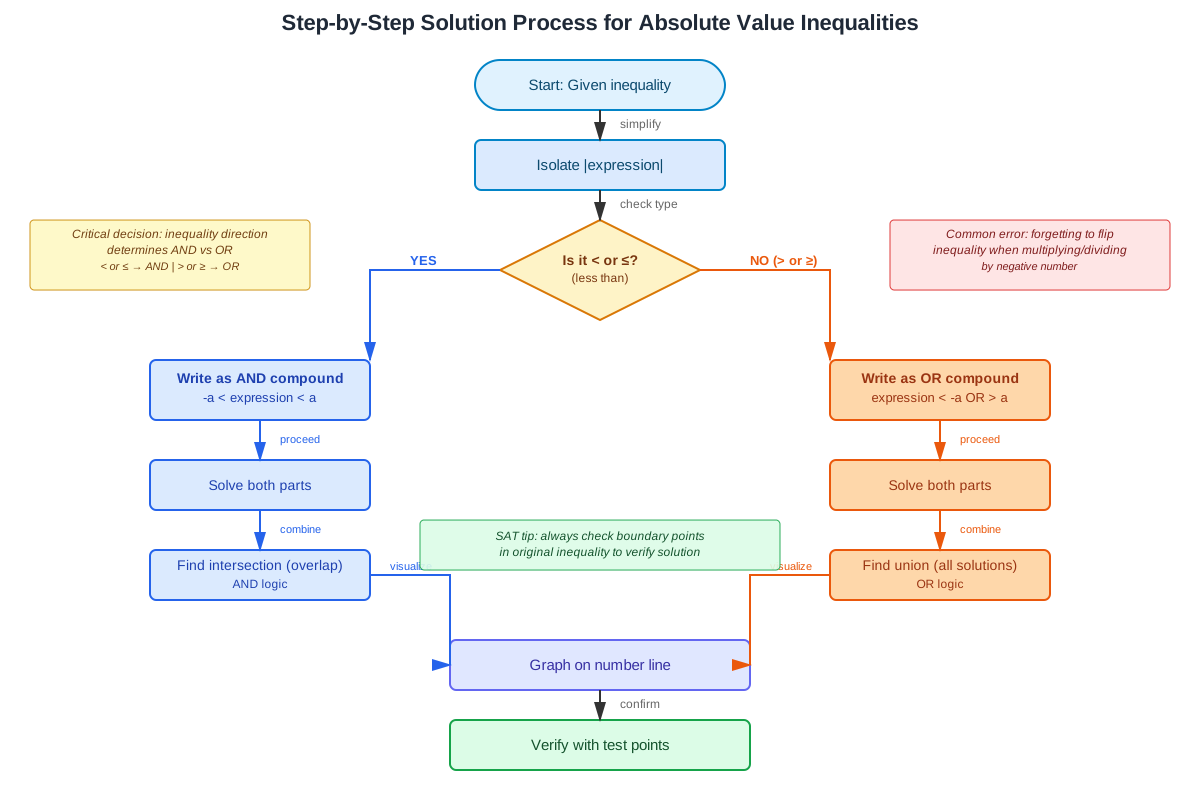
The standard procedure for solving absolute value inequalities follows these steps:
- Isolate the absolute value expression on one side of the inequality
- Identify the inequality type (less than or greater than)
- Split into two cases according to the type
- Solve each resulting linear inequality
- Combine the solutions appropriately (AND for "less than," OR for "greater than")
- Express the solution in interval notation or graph on a number line
For example, to solve |x - 2| < 5:
- The absolute value is already isolated
- This is a "less than" type
- Split into: -5 < x - 2 < 5
- Add 2 to all parts: -3 < x < 7
- Solution: all x between -3 and 7 (exclusive)
Solving Complex Absolute Value Inequalities
When the absolute value expression contains more complex algebraic terms, additional steps are required before applying the standard procedure. Consider |2x + 3| ≥ 7:
- Recognize this is a "greater than or equal" type
- Split into two cases:
- Case 1: 2x + 3 ≥ 7
- Case 2: 2x + 3 ≤ -7
- Solve Case 1: 2x ≥ 4, so x ≥ 2
- Solve Case 2: 2x ≤ -10, so x ≤ -5
- Combine with OR: x ≤ -5 or x ≥ 2
The solution set consists of two separate rays on the number line, extending left from -5 and right from 2.
Multi-Step Absolute Value Inequalities
Some SAT problems require algebraic manipulation before the absolute value can be isolated. For |3x - 1| + 4 < 10:
- Isolate the absolute value: |3x - 1| < 6
- Apply the "less than" rule: -6 < 3x - 1 < 6
- Add 1 to all parts: -5 < 3x < 7
- Divide by 3: -5/3 < x < 7/3
This type of problem tests whether students can perform algebraic operations correctly before applying absolute value inequality rules. A common error is attempting to split into cases before isolating the absolute value expression.
Absolute Value Inequalities with Variables on Both Sides
Occasionally, the SAT presents inequalities where absolute value expressions appear on both sides or where the comparison value is itself a variable. These require careful case analysis. For |x| < |x - 2|, students must consider multiple scenarios based on the signs of the expressions inside the absolute values. While less common, these problems test deeper conceptual understanding and typically appear as higher-difficulty questions.
Graphical Representation and Interpretation
Every absolute value inequality corresponds to a specific pattern on the number line. For "less than" inequalities, the solution is a single segment (open or closed circles at the endpoints). For "greater than" inequalities, the solution consists of two rays extending in opposite directions. The SAT frequently presents a number line graph and asks students to identify the corresponding inequality, or vice versa. Understanding this visual-algebraic connection is essential for quick problem-solving.
Concept Relationships
The concepts within absolute value inequalities form a hierarchical structure. The geometric interpretation (distance from zero) serves as the foundation, leading directly to the two-type classification (less than vs. greater than). This classification determines the solution structure (bounded interval vs. two rays), which in turn dictates the solving procedure (compound inequality with AND vs. OR). Each level builds logically on the previous one.
Absolute value inequalities connect backward to several prerequisite topics. They extend absolute value equations by replacing equality with inequality, requiring solution sets rather than discrete solutions. They build on linear inequalities by incorporating the two-case structure inherent in absolute value. They rely on compound inequalities to express solutions, using the AND/OR logic that distinguishes the two types.
Looking forward, absolute value inequalities connect to more advanced topics. They provide the foundation for piecewise functions, where different rules apply in different domains. They appear in systems of inequalities, where absolute value constraints combine with other conditions. They relate to function transformations, particularly when graphing absolute value functions and identifying their domains and ranges.
The relationship map flows as follows: Absolute Value Definition → Distance Interpretation → Two-Type Classification → Case Splitting → Linear Inequality Solving → Solution Set Combination → Graphical Representation. Each arrow represents a logical dependency, and mastery requires understanding each connection.
Quick check — test yourself on Absolute value inequalities so far.
Try Flashcards →High-Yield Facts
⭐ |x| < a always produces a bounded interval: -a < x < a (using AND logic)
⭐ |x| > a always produces two unbounded rays: x < -a OR x > a (using OR logic)
⭐ The absolute value expression must be isolated before splitting into cases
⭐ "Less than" absolute value inequalities use AND; "greater than" use OR
⭐ The solution to |x - c| < a is the interval (c - a, c + a), centered at c
- When solving |ax + b| < c, first ensure c > 0; if c ≤ 0, special analysis is required
- The inequality |x| ≥ 0 is true for all real numbers (always true)
- The inequality |x| < 0 has no solution (never true)
- Multiplying or dividing an inequality by a negative number reverses the inequality sign, even within absolute value problems
- On a number line, open circles indicate strict inequalities (<, >), while closed circles indicate inclusive inequalities (≤, ≥)
- The solution to |x - c| > a consists of two rays: x < c - a or x > c + a
- Absolute value inequalities can be verified by testing values from each region of the solution set
- When an absolute value inequality includes a variable in the comparison value, multiple cases based on the sign of that variable may be necessary
Common Misconceptions
Misconception: |x| < -3 has solutions between -3 and 3 → Correction: Absolute value is always non-negative, so |x| can never be less than a negative number. This inequality has no solution (empty set).
Misconception: |x| > 5 means -5 < x < 5 → Correction: This reverses the logic. |x| > 5 means x < -5 OR x > 5 (two separate rays), not a bounded interval. The "greater than" structure always produces unbounded regions.
Misconception: |x - 3| < 2 splits into x - 3 < 2 OR x - 3 > -2 → Correction: "Less than" inequalities use AND, not OR. The correct split is -2 < x - 3 < 2, which simplifies to 1 < x < 5. The OR connector is only for "greater than" inequalities.
Misconception: When solving |2x + 1| > 5, you can divide both sides by 2 first → Correction: You cannot distribute division across an absolute value. The absolute value must be isolated first, then split into cases. The correct approach is: 2x + 1 > 5 OR 2x + 1 < -5.
Misconception: The solution to |x| ≤ 3 is x ≤ 3 → Correction: This ignores the negative case. The complete solution is -3 ≤ x ≤ 3. Absolute value inequalities always involve considering both positive and negative scenarios.
Misconception: |x + 2| < 5 and |x| < 3 have the same solution → Correction: The first inequality centers at -2 (solution: -7 < x < 3), while the second centers at 0 (solution: -3 < x < 3). The expression inside the absolute value determines the center of the solution interval.
Misconception: You can square both sides of an absolute value inequality to eliminate the absolute value → Correction: While squaring can work for equations, it's unreliable for inequalities because squaring doesn't preserve inequality direction for negative numbers. Always use the case-splitting method for inequalities.
Worked Examples
Example 1: Standard "Less Than" Inequality
Problem: Solve |3x - 7| ≤ 5 and graph the solution on a number line.
Solution:
Step 1: Identify the type. This is a "less than or equal" inequality, so the solution will be a single bounded interval.
Step 2: Split into a compound inequality using AND logic:
-5 ≤ 3x - 7 ≤ 5
Step 3: Solve by adding 7 to all three parts:
-5 + 7 ≤ 3x - 7 + 7 ≤ 5 + 7
2 ≤ 3x ≤ 12
Step 4: Divide all parts by 3:
2/3 ≤ x ≤ 4
Step 5: Express the solution. In interval notation: [2/3, 4]. On a number line, this is a segment from 2/3 to 4 with closed circles at both endpoints (because the inequality includes "equal to").
Connection to Learning Objectives: This example demonstrates the core procedure for solving "less than" absolute value inequalities and shows how to represent the solution graphically, addressing the objectives of identifying key features and applying solution techniques.
Example 2: Multi-Step "Greater Than" Inequality
Problem: A manufacturing process requires that the actual length L of a component differs from the target length of 50 mm by no more than 0.3 mm. Which inequality represents the acceptable lengths?
Solution:
Step 1: Translate the word problem. "Differs from 50 by no more than 0.3" means the distance from 50 is at most 0.3. This translates to:
|L - 50| ≤ 0.3
Step 2: Solve the inequality. This is a "less than or equal" type:
-0.3 ≤ L - 50 ≤ 0.3
Step 3: Add 50 to all parts:
49.7 ≤ L ≤ 50.3
Step 4: Interpret the result. The acceptable lengths are between 49.7 mm and 50.3 mm, inclusive.
Alternative presentation: Now suppose the problem asked which lengths are unacceptable. This would require |L - 50| > 0.3, which splits into:
L - 50 > 0.3 OR L - 50 < -0.3
L > 50.3 OR L < 49.7
The unacceptable lengths are those less than 49.7 mm or greater than 50.3 mm.
Connection to Learning Objectives: This example shows how absolute value inequalities appear in real-world SAT contexts (explaining how they appear on the exam) and demonstrates the translation from word problem to mathematical notation (applying the concept to SAT-style questions).
Example 3: Complex Algebraic Manipulation
Problem: Solve |2 - 4x| + 3 > 11
Solution:
Step 1: Isolate the absolute value expression by subtracting 3 from both sides:
|2 - 4x| > 8
Step 2: Identify the type. This is a "greater than" inequality, so the solution will be two unbounded rays connected by OR.
Step 3: Split into two cases:
Case 1: 2 - 4x > 8
Case 2: 2 - 4x < -8
Step 4: Solve Case 1:
2 - 4x > 8
-4x > 6
x < -3/2 (inequality reverses when dividing by negative)
Step 5: Solve Case 2:
2 - 4x < -8
-4x < -10
x > 5/2 (inequality reverses when dividing by negative)
Step 6: Combine with OR:
x < -3/2 OR x > 5/2
In interval notation: (-∞, -3/2) ∪ (5/2, ∞)
Connection to Learning Objectives: This example demonstrates multi-step algebraic manipulation before applying absolute value inequality rules, addressing the advanced objective of solving complex problems and showing attention to sign changes when dividing by negatives.
Exam Strategy
When approaching absolute value inequality questions on the SAT, begin by quickly identifying whether the problem involves "less than" or "greater than" structure, as this immediately tells you whether to expect a bounded interval or two rays. This initial classification prevents the most common error—using the wrong logical connector (AND vs. OR).
Trigger words and phrases to watch for include: "differs by no more than" (translates to ≤), "differs by at least" (translates to ≥), "within X units of" (translates to |expression| ≤ X), "more than X units away from" (translates to |expression| > X), "tolerance," "margin of error," and "acceptable range." These phrases signal that the problem requires translation into absolute value inequality notation.
For multiple-choice questions, process of elimination is particularly effective. If the question asks for the solution to |x| < 5, immediately eliminate any answer choice that shows two separate rays or includes values like x = 6 or x = -6. If solving |x| > 3, eliminate any answer showing a single bounded interval. Check the endpoints: strict inequalities should have open circles or parentheses, while inclusive inequalities should have closed circles or brackets.
Time allocation: Straightforward absolute value inequality problems should take 45-60 seconds. If you find yourself spending more than 90 seconds, consider whether you've correctly isolated the absolute value expression or whether you're making the problem more complicated than necessary. Word problems requiring translation may take 90-120 seconds, which is reasonable for their complexity.
Quick verification strategy: After solving, test one value from each region of your solution. For |x - 2| < 3 with solution -1 < x < 5, test x = 0 (should work: |0 - 2| = 2 < 3 ✓) and x = 6 (should not work: |6 - 2| = 4 < 3 ✗). This 10-second check catches most errors.
Calculator usage: For calculator-permitted sections, you can verify solutions by graphing. Graph y = |expression| and y = comparison value, then identify where the absolute value function is above or below the comparison line. However, algebraic solving is typically faster for straightforward problems.
Memory Techniques
The "LASSO" mnemonic for "Less than" inequalities:
- Less than
- And (not or)
- Single interval
- Sandwiched between two values
- One continuous segment
The "GATOR" mnemonic for "Greater than" inequalities:
- Greater than
- Always OR (not and)
- Two separate rays
- Outside the boundary values
- Rays extending to infinity
Visual anchor: Picture absolute value as a "distance detector." When you want things CLOSE (less than), you get one piece in the middle. When you want things FAR (greater than), you get two pieces on the outside. This mental image reinforces the bounded vs. unbounded distinction.
The "Isolation First" rule: Before splitting into cases, always Isolate the Absolute value First. The acronym IAF sounds like "if," reminding you: "IF you want to solve it correctly, isolate first."
Sign flip reminder: When dividing or multiplying by a negative number, remember "FLIP" (Flip the Inequality when Processing negatives). This applies to all inequalities, not just absolute value problems, but it's crucial to remember during case analysis.
Summary
Absolute value inequalities represent a fundamental SAT math topic that combines algebraic manipulation with geometric reasoning about distance on the number line. The essential principle is that absolute value measures distance from zero, and inequalities involving absolute value split into two distinct types based on whether the comparison uses "less than" or "greater than." Less than inequalities (|x| < a) produce bounded intervals using AND logic (-a < x < a), while greater than inequalities (|x| > a) produce two unbounded rays using OR logic (x < -a or x > a). Solving requires isolating the absolute value expression first, then splitting into appropriate cases based on the inequality type. The SAT tests this concept through direct algebraic problems, word problems involving tolerances and acceptable ranges, and graphical interpretation questions. Success requires recognizing the inequality type immediately, applying the correct logical structure (AND vs. OR), and accurately performing algebraic manipulations while attending to sign changes. Mastery of this topic provides a strong foundation for more advanced inequality concepts and demonstrates the mathematical maturity that the SAT seeks to assess.
Key Takeaways
- Absolute value inequalities split into two types: "less than" creates one bounded interval (AND), while "greater than" creates two unbounded rays (OR)
- Always isolate the absolute value expression before splitting into cases; attempting to split too early leads to errors
- The geometric interpretation is fundamental: |x - c| < a means "within a units of c," while |x - c| > a means "more than a units from c"
- Verify solutions by testing values from each region; this quick check catches most common mistakes
- Watch for trigger phrases in word problems like "differs by no more than," "within," and "tolerance" that signal absolute value inequality translation
- The inequality sign direction matters critically: < and ≤ use AND logic with bounded solutions, while > and ≥ use OR logic with unbounded solutions
- Sign changes when dividing by negatives must be carefully tracked throughout the solving process, especially during case analysis
Related Topics
Systems of Inequalities: After mastering absolute value inequalities, students can tackle systems that include absolute value constraints combined with linear inequalities, requiring graphical analysis of overlapping solution regions.
Piecewise Functions: Absolute value functions are naturally piecewise, and understanding absolute value inequalities provides the foundation for analyzing functions defined by different rules in different domains.
Function Transformations: The graph of y = |x - h| + k involves transformations that relate directly to the solution sets of absolute value inequalities, connecting algebraic and graphical reasoning.
Quadratic Inequalities: The case-splitting logic developed for absolute value inequalities transfers to solving quadratic inequalities, where sign analysis of factors determines solution intervals.
Distance and Midpoint Problems: The geometric interpretation of absolute value as distance extends to coordinate geometry problems involving distances between points and midpoint calculations.
Practice CTA
Now that you've mastered the core concepts of absolute value inequalities, it's time to solidify your understanding through practice. Attempt the practice questions to test your ability to identify inequality types, split into cases correctly, and solve multi-step problems under timed conditions. Use the flashcards to reinforce the key distinctions between "less than" and "greater than" structures, and to memorize the trigger phrases that appear in word problems. Remember: absolute value inequalities appear on virtually every SAT, and mastering this topic can directly translate to 2-4 additional correct answers on test day. Your investment in practice now will pay dividends in confidence and speed when you encounter these problems under exam conditions!
Sign up free to keep reading
Create a free AnvayaPrep account to finish this SAT guide on Absolute value inequalities — plus flashcards and practice questions.