Overview
SAT inequality traps represent one of the most deceptive categories of math problems on the SAT, designed specifically to catch students who rush through algebraic manipulations without careful attention to mathematical rules. These traps exploit common algebraic mistakes, particularly those involving multiplication or division by negative numbers, squaring both sides of inequalities, and misapplying properties that work for equations but fail for inequalities. Understanding these traps is not merely about avoiding errors—it's about developing the mathematical maturity to recognize when standard procedures require modification.
The College Board deliberately includes inequality trap questions because they efficiently test whether students truly understand the underlying principles of algebraic manipulation or simply memorize procedures. These questions typically appear 2-3 times per SAT exam, often in the calculator and no-calculator sections, and frequently serve as medium-to-hard difficulty questions that separate high scorers from average performers. Students who master inequality traps gain a significant competitive advantage, as these questions often have answer choices specifically designed to capture common errors.
Within the broader landscape of SAT Math, inequality traps connect directly to linear inequalities, absolute value inequalities, systems of inequalities, and even quadratic relationships. They also reinforce critical thinking skills applicable to functions, coordinate geometry, and word problems. Mastering this topic strengthens overall algebraic reasoning and builds the careful, methodical approach necessary for consistent high performance across all SAT Math domains.
Learning Objectives
- [ ] Identify key features of SAT inequality traps
- [ ] Explain how SAT inequality traps appears on the SAT
- [ ] Apply SAT inequality traps to answer SAT-style questions
- [ ] Recognize when multiplying or dividing by negative values requires reversing inequality signs
- [ ] Distinguish between valid and invalid operations when manipulating inequalities
- [ ] Evaluate compound inequalities and identify trap answer choices
- [ ] Analyze word problems to determine when inequality relationships create potential traps
Prerequisites
- Basic algebraic manipulation: Understanding how to isolate variables and perform operations on both sides of equations is essential because inequality manipulation follows similar but not identical rules
- Number line representation: Visualizing inequalities on number lines helps identify solution sets and catch errors in inequality direction
- Properties of negative numbers: Knowing how negative numbers behave under multiplication and division is fundamental to avoiding the most common inequality traps
- Solving linear equations: Fluency with equation-solving provides the foundation for inequality work, though students must learn where the procedures diverge
Why This Topic Matters
In real-world applications, inequalities model constraints and boundaries in countless scenarios: budget limitations, speed limits, acceptable temperature ranges, minimum safety requirements, and optimization problems in business and engineering. Understanding inequality traps ensures accurate modeling of these real situations where the direction of the inequality carries critical meaning—the difference between "at least" and "at most" can determine whether a bridge is safe or a business is profitable.
On the SAT, inequality trap questions appear with remarkable consistency. Statistical analysis of released SAT exams shows that approximately 2-4 questions per test directly involve inequality manipulation, with an additional 1-2 questions embedding inequality concepts within word problems or systems. These questions typically appear in positions 10-20 in each math section, placing them in the medium-to-hard difficulty range. The College Board reports that inequality questions have among the highest discrimination indices, meaning they effectively separate students at different skill levels.
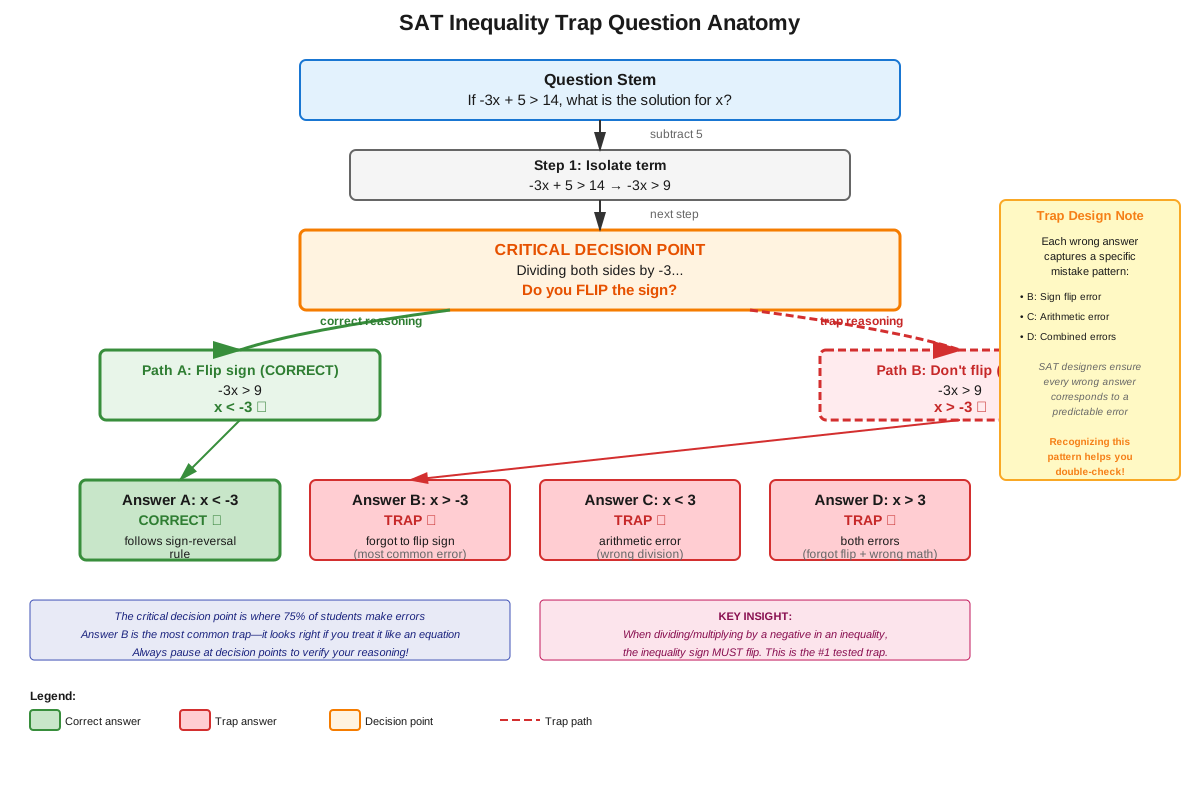
Common SAT manifestations include: direct algebraic manipulation problems where students must solve for a variable within an inequality; word problems requiring translation of verbal constraints into inequality notation; compound inequalities testing understanding of "and" versus "or" logic; and absolute value inequalities that combine multiple trap opportunities. The test makers consistently design wrong answer choices that capture specific errors—particularly answers that would be correct if the inequality sign weren't reversed when required.
Core Concepts
The Fundamental Trap: Multiplying or Dividing by Negative Numbers
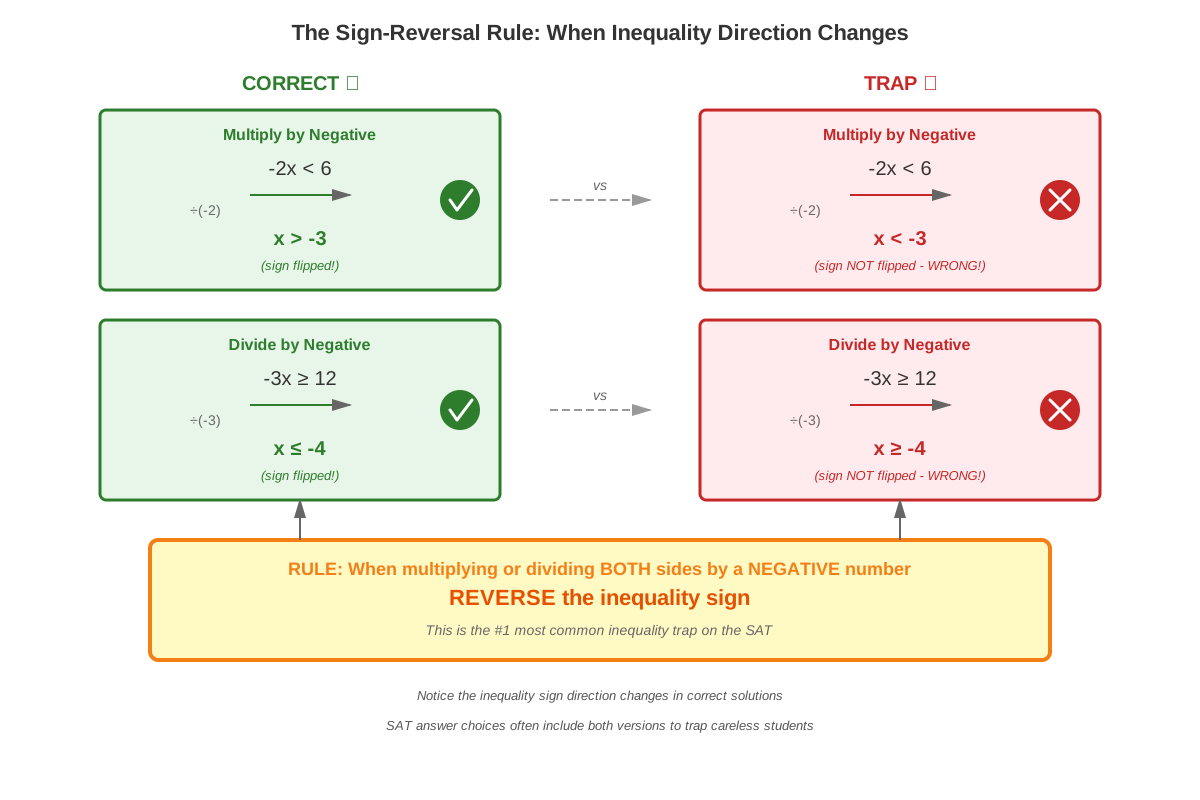
The single most important SAT inequality trap involves the rule that multiplying or dividing both sides of an inequality by a negative number requires reversing the inequality sign. This rule exists because negative multiplication reverses order on the number line. For example, 3 > 2, but when multiplied by -1, we get -3 < -2. The inequality direction flips.
Consider the inequality: -2x > 6
Many students incorrectly solve this as:
- Divide both sides by -2: x > -3 ❌ (WRONG)
The correct solution requires reversing the sign:
- Divide both sides by -2 AND flip the sign: x < -3 ✓ (CORRECT)
This trap becomes particularly insidious when the negative coefficient is embedded in a multi-step problem or when students are working quickly under time pressure.
The Variable Sign Trap
When an inequality contains a variable in the denominator or as a multiplier, and that variable's sign is unknown, students cannot simply multiply or divide without considering cases. This creates a sophisticated trap that appears on harder SAT questions.
For example, given x ≠ 0, solving 1/x > 2 requires case analysis:
Case 1: If x > 0, multiply both sides by x (positive): 1 > 2x, so x < 1/2. Combined with x > 0, we get 0 < x < 1/2.
Case 2: If x < 0, multiply both sides by x (negative, so flip sign): 1 < 2x, so x > 1/2. But this contradicts x < 0, so no solutions exist in this case.
The SAT exploits this by offering answer choices that ignore case analysis entirely.
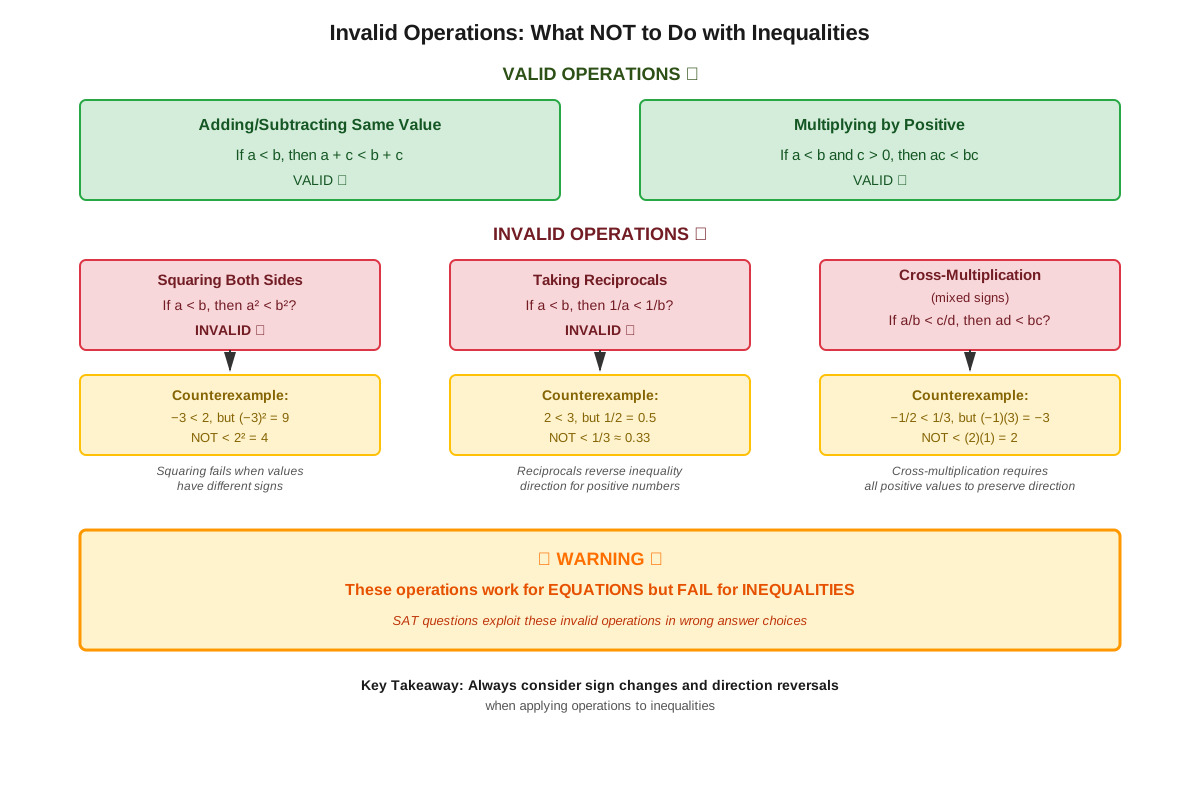
Squaring Both Sides: The Direction Destroyer
Unlike equations, where squaring both sides is generally safe (though it may introduce extraneous solutions), squaring both sides of an inequality can completely destroy the inequality relationship. This occurs because squaring is not a monotonic operation across all real numbers—it reverses order for negative numbers.
Consider: -3 < 2 (true)
Squaring both sides: 9 < 4 (FALSE!)
The SAT uses this trap in problems involving absolute values or when students try to eliminate square roots. The safe approach requires ensuring both sides are positive before squaring, or splitting into cases.
Compound Inequality Traps
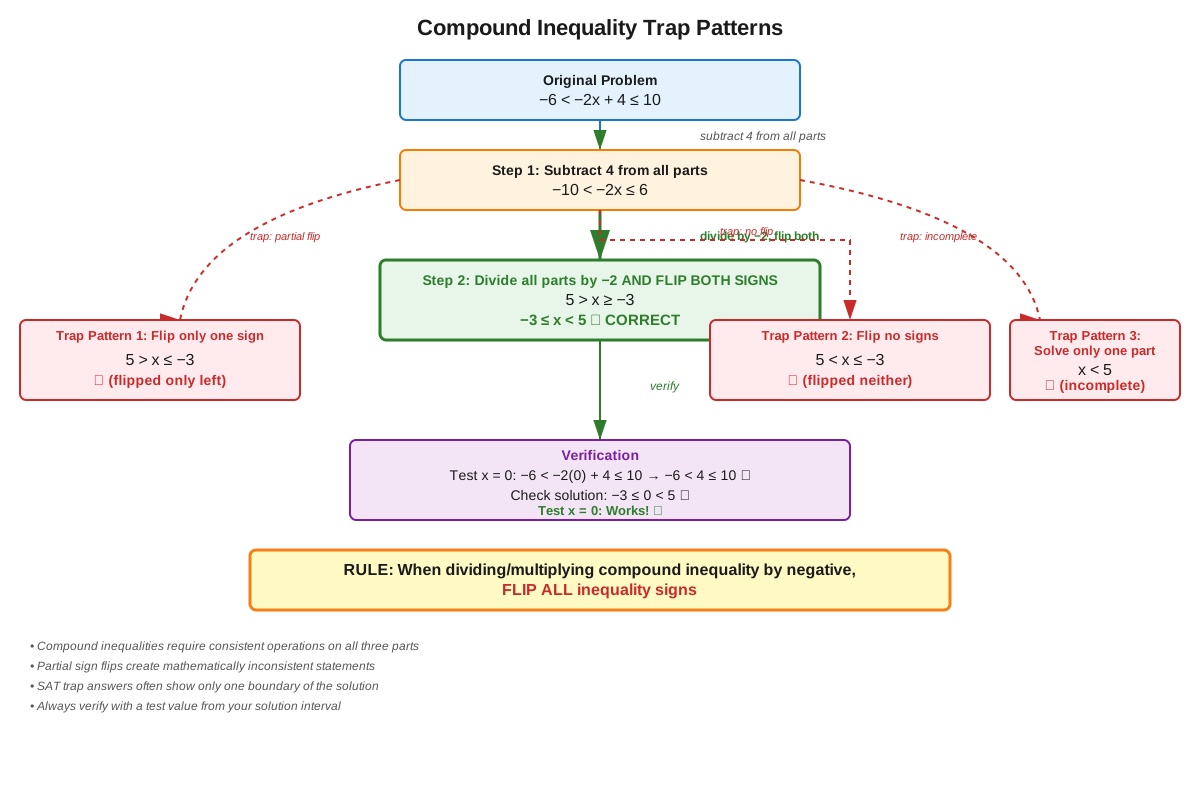
Compound inequalities like -3 < 2x + 1 < 7 require simultaneous operations on all three parts. The trap emerges when students:
- Forget to perform the same operation on all three parts
- Reverse the sign on only one or two parts when dividing by a negative
- Misinterpret the logical relationship (AND vs. OR)
Correct solution:
- Subtract 1 from all parts: -4 < 2x < 6
- Divide all parts by 2: -2 < x < 3
A trap answer might show -2 > x > 3 (reversing both signs incorrectly) or -2 < x > 3 (mixing inequality directions).
Absolute Value Inequality Traps
Absolute value inequalities combine multiple trap opportunities. The inequality |x| < a (where a > 0) translates to -a < x < a, while |x| > a translates to x < -a OR x > a. Students frequently confuse these translations or fail to recognize that |x| < -5 has no solutions (absolute values are never negative).
The SAT exploits this with problems like |2x - 3| < 5, where students must:
- Recognize this means -5 < 2x - 3 < 5
- Add 3 to all parts: -2 < 2x < 8
- Divide by 2: -1 < x < 4
Trap answers include solutions that treat this as |2x - 3| > 5 or that make sign errors during manipulation.
Inequality Graphing and Solution Set Traps
When graphing inequalities on a number line or coordinate plane, the SAT tests whether students understand:
- Open circles (○) for < and >, closed circles (●) for ≤ and ≥
- Shading direction corresponds to inequality direction
- Intersection (AND) versus union (OR) for compound inequalities
A common trap presents a correctly solved inequality but asks for the graph, with wrong answers showing reversed shading or incorrect circle types.
Word Problem Translation Traps
The SAT frequently embeds inequality traps in word problems where students must translate verbal constraints into mathematical notation. Key phrases and their trap potential:
| Phrase | Correct Translation | Common Trap |
|---|---|---|
| "at least" | ≥ | Using > instead |
| "at most" | ≤ | Using < instead |
| "more than" | > | Using ≥ |
| "no more than" | ≤ | Using < |
| "between A and B" | A < x < B | Using ≤ when endpoints excluded |
The trap intensifies when the problem requires solving the inequality after translation, combining translation errors with manipulation errors.
Concept Relationships
The core concepts within SAT inequality traps form an interconnected web of potential pitfalls. The fundamental sign-reversal rule serves as the foundation, connecting to every other trap type. When this rule combines with compound inequalities, students must apply it consistently across all parts. The variable sign trap represents an advanced application of the fundamental rule, requiring conditional reasoning about when to apply it.
Absolute value inequalities build upon compound inequalities, as solving them requires splitting into compound inequality form. Both connect back to the fundamental rule when manipulation involves negative coefficients. The squaring trap stands somewhat apart but intersects with absolute value problems, where students might attempt to square to eliminate absolute value symbols.
Graphing and solution sets represent the visual manifestation of all other concepts—every algebraic trap has a corresponding graphical interpretation. Word problem translation serves as the entry point, determining which type of inequality trap will emerge in the algebraic work.
The relationship map flows as:
Word Problem Translation → Inequality Setup → Algebraic Manipulation (Fundamental Rule + Variable Sign Considerations) → Compound/Absolute Value Complications → Solution Set → Graphical Representation
Each arrow represents a point where traps can emerge, and mastery requires vigilance at every transition.
High-Yield Facts
⭐ Multiplying or dividing both sides of an inequality by a negative number requires reversing the inequality sign
⭐ The inequality |x| < a (where a > 0) translates to -a < x < a, while |x| > a translates to x < -a OR x > a
⭐ When solving compound inequalities, every operation must be performed on all three parts simultaneously
⭐ "At least" translates to ≥, while "at most" translates to ≤—these are among the most commonly tested translations
⭐ Squaring both sides of an inequality can reverse the inequality relationship and should be avoided unless both sides are known to be positive
- When a variable appears in the denominator or as a multiplier with unknown sign, case analysis is required before multiplying or dividing
- Open circles (○) represent < and >, while closed circles (●) represent ≤ and ≥ on number line graphs
- The inequality |x| < -5 has no solutions because absolute values are never negative
- Adding or subtracting the same value to both sides of an inequality never requires reversing the sign
- The solution to x² > 9 is x < -3 OR x > 3, not -3 < x < 3 (a common trap)
Quick check — test yourself on SAT inequality traps so far.
Try Flashcards →Common Misconceptions
Misconception: When dividing both sides of an inequality by a negative number, the inequality sign stays the same as it does for equations.
Correction: Unlike equations, inequalities require reversing the sign when multiplying or dividing by negative numbers because this operation reverses the order relationship on the number line.
Misconception: The compound inequality -3 < x < 5 means x is less than -3 or greater than 5.
Correction: This notation means x is simultaneously greater than -3 AND less than 5, representing values between -3 and 5. The "or" interpretation would be written as x < -3 OR x > 5.
Misconception: Squaring both sides of an inequality is always safe, just like with equations.
Correction: Squaring can reverse inequality relationships, particularly when negative numbers are involved. For example, -3 < 2 is true, but 9 < 4 is false. Only square when both sides are known to be positive.
Misconception: "At least 5" means x > 5.
Correction: "At least 5" means x ≥ 5, including the value 5 itself. The phrase indicates a minimum value that is included in the solution set.
Misconception: When solving |x + 2| > 5, the solution is -5 < x + 2 < 5.
Correction: The inequality |x + 2| > 5 means the expression x + 2 is more than 5 units from zero, giving x + 2 < -5 OR x + 2 > 5, which simplifies to x < -7 OR x > 3. The compound inequality form applies to |x + 2| < 5, not the "greater than" version.
Misconception: If x/y > 2, then x > 2y.
Correction: This is only true if y is positive. If y is negative, multiplying both sides by y requires reversing the sign, giving x < 2y. Without knowing y's sign, case analysis is required.
Misconception: The solution to -x > 4 is x > -4.
Correction: To solve -x > 4, multiply both sides by -1 (reversing the sign): x < -4. Alternatively, recognize that -x > 4 means x is negative and more than 4 units from zero, placing it to the left of -4.
Worked Examples
Example 1: Multi-Step Inequality with Negative Coefficient
Problem: Solve for x: -3(2x - 4) ≥ 18
Solution:
Step 1: Distribute the -3 on the left side.
-3(2x - 4) ≥ 18
-6x + 12 ≥ 18
Step 2: Subtract 12 from both sides.
-6x + 12 - 12 ≥ 18 - 12
-6x ≥ 6
Step 3: Divide both sides by -6. CRITICAL TRAP POINT: Since we're dividing by a negative number, we must reverse the inequality sign.
-6x ≥ 6
x ≤ -1 (sign reversed!)
Step 4: Verify with a test value. Let's try x = -2 (which should work since -2 ≤ -1):
-3(2(-2) - 4) = -3(-4 - 4) = -3(-8) = 24
Is 24 ≥ 18? Yes! ✓
Let's also try x = 0 (which should NOT work since 0 > -1):
-3(2(0) - 4) = -3(-4) = 12
Is 12 ≥ 18? No! ✓
Answer: x ≤ -1
Trap answer that would appear on the SAT: x ≥ -1 (failing to reverse the sign)
Connection to learning objectives: This example demonstrates identifying the key feature of sign reversal (Objective 1), shows how this trap appears in multi-step problems (Objective 2), and applies the concept to reach the correct answer (Objective 3).
Example 2: Absolute Value Inequality with Compound Translation
Problem: Solve for x: |3x + 6| < 12
Solution:
Step 1: Recognize that |expression| < positive number translates to a compound inequality.
|3x + 6| < 12 means -12 < 3x + 6 < 12
Step 2: Solve the compound inequality by performing operations on all three parts.
Subtract 6 from all parts:
-12 - 6 < 3x + 6 - 6 < 12 - 6
-18 < 3x < 6
Step 3: Divide all parts by 3 (positive number, so no sign reversal needed).
-18/3 < 3x/3 < 6/3
-6 < x < 2
Step 4: Verify with test values.
Try x = 0 (should work since -6 < 0 < 2):
|3(0) + 6| = |6| = 6
Is 6 < 12? Yes! ✓
Try x = -7 (should NOT work since -7 < -6):
|3(-7) + 6| = |-21 + 6| = |-15| = 15
Is 15 < 12? No! ✓
Answer: -6 < x < 2
Common trap answers on the SAT:
- x < -6 OR x > 2 (confusing with |3x + 6| > 12)
- -6 > x > 2 (reversing signs incorrectly)
- -4 < x < 4 (solving |3x| < 12 instead)
Connection to learning objectives: This example shows how absolute value creates compound inequality traps (Objective 1), demonstrates the SAT's testing approach through trap answers (Objective 2), and applies systematic problem-solving (Objective 3).
Exam Strategy
When approaching SAT inequality questions, implement a systematic three-phase strategy: identify, execute, verify.
Phase 1: Identify the Trap Type
Before solving, scan the problem for trap indicators:
- Negative coefficients (especially in front of the variable term)
- Absolute value symbols
- Compound inequalities with three parts
- Variables in denominators
- Word problems with "at least," "at most," "between," or "no more than"
Exam Tip: Circle or underline negative signs immediately. This physical action creates a mental checkpoint that prevents rushing past the sign-reversal requirement.
Phase 2: Execute with Checkpoints
As you solve, pause at critical moments:
- Before multiplying or dividing, ask: "Is this number negative?"
- When translating words to symbols, double-check the inequality direction
- For absolute values, write out the full compound inequality before solving
- For compound inequalities, verify you're operating on all parts
Phase 3: Verify with Strategic Testing
Time permitting, test your solution:
- Pick a value that should work (inside your solution set)
- Pick a value that should NOT work (outside your solution set)
- Substitute both into the original inequality
Trigger Words and Phrases:
- "At least" → ≥ (includes the boundary)
- "At most" → ≤ (includes the boundary)
- "More than" → > (excludes the boundary)
- "Less than" → < (excludes the boundary)
- "Between" → usually < on both sides (excludes endpoints unless stated)
- "No more than" → ≤
- "No less than" → ≥
Process of Elimination Tips:
- Eliminate answers with the wrong inequality direction first
- Check boundary values—if the original uses ≤, the answer should too
- For absolute value problems, eliminate answers that don't account for both directions
- If you made a sign-reversal error, your wrong answer is likely among the choices—look for its opposite
Time Allocation:
- Simple inequality manipulation: 30-45 seconds
- Compound or absolute value inequalities: 60-90 seconds
- Word problems with inequalities: 90-120 seconds
- Always reserve 10-15 seconds for verification if time allows
Memory Techniques
Mnemonic for Sign Reversal: "Negative Flip"
When you multiply or divide by a Negative, you must Flip the inequality sign. Visualize physically flipping the < or > symbol.
Absolute Value Translation Mnemonic: "Less is Between, Greater is Outside"
- |x| Less than a → x is Between -a and a
- |x| Greater than a → x is Outside (less than -a OR greater than a)
Compound Inequality Visualization: Picture a number line segment. The compound inequality -3 < x < 5 represents a segment from -3 to 5. If you perform an operation, the entire segment moves or stretches together—all three parts must change the same way.
Word Problem Translation Acronym: "LAMB"
- Least → ≥ (at Least includes the boundary)
- At most → ≤ (At most includes the boundary)
- More than → > (More excludes the boundary)
- Between → < both sides (Between excludes endpoints)
The "Negative Number Line Flip": Visualize the number line. When you multiply by -1, imagine the entire number line rotating 180° around zero. What was on the right (greater) is now on the left (less), so the inequality flips.
Summary
SAT inequality traps represent a high-yield category of math problems that test whether students truly understand algebraic manipulation or merely follow memorized procedures. The fundamental trap—failing to reverse the inequality sign when multiplying or dividing by negative numbers—appears consistently across multiple question types. This core concept extends to compound inequalities, absolute value problems, and word problem translations, each adding layers of complexity. Success requires recognizing trap indicators before solving, executing operations with deliberate attention to sign changes, and verifying solutions through strategic testing. The SAT deliberately designs wrong answer choices to capture common errors, making these questions effective discriminators between score levels. Students who master inequality traps through systematic identification, careful execution, and verification develop not only the skills to answer these specific questions but also the mathematical maturity and attention to detail that elevates performance across all SAT Math domains.
Key Takeaways
- Multiplying or dividing both sides of an inequality by a negative number requires reversing the inequality sign—this is the single most important rule for avoiding SAT inequality traps
- Absolute value inequalities split into two cases: |x| < a becomes -a < x < a (compound), while |x| > a becomes x < -a OR x > a (union)
- Compound inequalities require performing identical operations on all three parts simultaneously, with sign reversals applied consistently
- Word problem translations are trap-heavy: "at least" means ≥, "at most" means ≤, and confusing these creates immediate errors
- Verification through test values catches errors and builds confidence—always test one value inside and one outside your solution set when time permits
- The SAT includes wrong answers specifically designed to capture common errors, so recognizing your potential mistakes helps eliminate trap choices
- Systematic problem-solving (identify trap type → execute with checkpoints → verify) prevents rushing into errors under time pressure
Related Topics
Systems of Linear Inequalities: Building on single inequality manipulation, systems require graphing multiple inequalities and finding intersection regions, combining inequality trap awareness with coordinate geometry skills.
Quadratic Inequalities: Extends inequality concepts to parabolic relationships, requiring factoring, sign analysis, and understanding how quadratic expressions change sign across their roots.
Rational Inequalities: Involves inequalities with variables in denominators, intensifying the variable sign trap and requiring sophisticated case analysis and sign charts.
Optimization Problems: Real-world applications where inequalities represent constraints in maximization or minimization scenarios, connecting to linear programming concepts.
Absolute Value Equations and Inequalities: Deepens understanding of absolute value by combining equation-solving with inequality manipulation, a frequent SAT topic.
Practice CTA
Now that you've mastered the core concepts of SAT inequality traps, it's time to cement your understanding through active practice. The practice questions and flashcards designed for this topic will challenge you with authentic SAT-style problems that target each trap type discussed in this guide. Remember: recognizing these traps in practice builds the automatic awareness you'll need on test day. Each practice problem you solve strengthens your pattern recognition and reinforces the systematic approach that separates high scorers from average performers. Approach each question deliberately, identify the trap type before solving, and verify your answers—these habits will become second nature with consistent practice. You've built the knowledge foundation; now build the execution skills that translate knowledge into points!
Sign up free to keep reading
Create a free AnvayaPrep account to finish this SAT guide on SAT inequality traps — plus flashcards and practice questions.