Overview
Quadratic inequalities represent one of the most frequently tested algebraic concepts on the SAT and form a critical bridge between basic equation-solving and more advanced math reasoning. Unlike quadratic equations that ask for specific values where a parabola crosses the x-axis, quadratic inequalities require students to identify entire intervals where a quadratic expression remains above or below a certain threshold. This distinction transforms the problem from finding discrete points to analyzing continuous regions, demanding both algebraic manipulation skills and conceptual understanding of parabolic behavior.
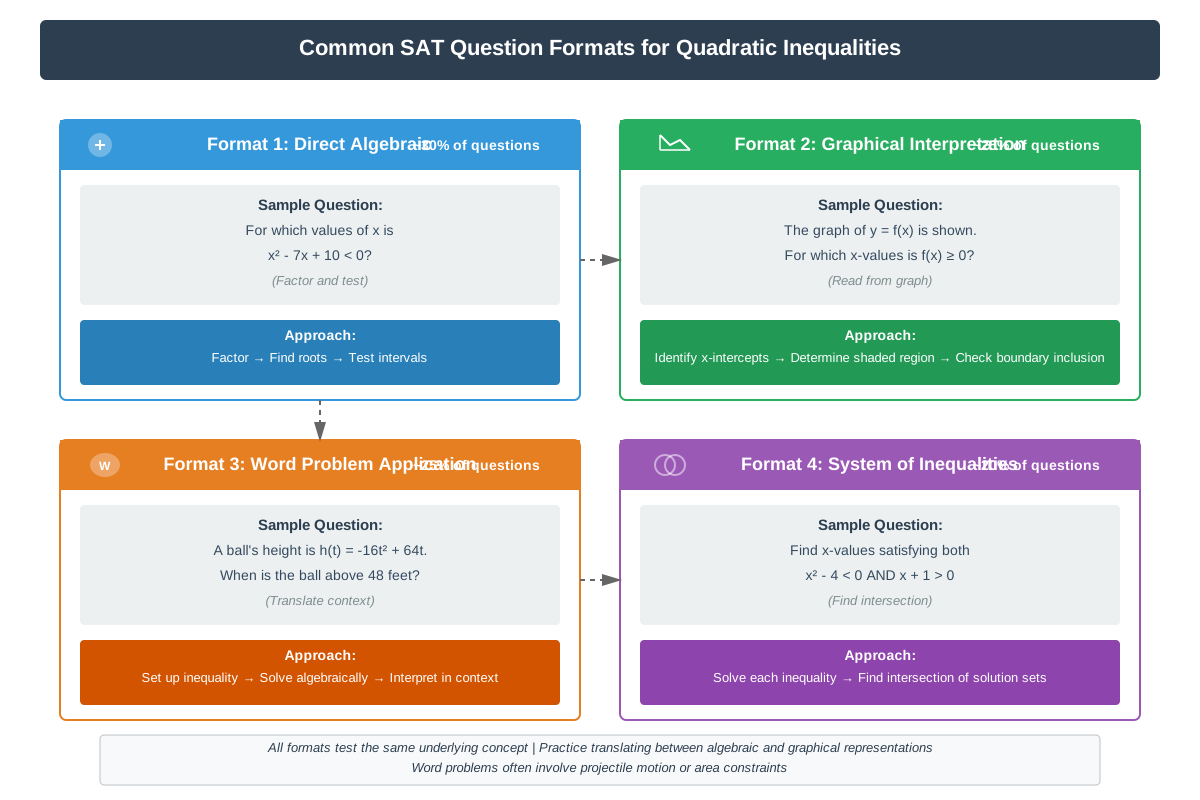
Mastering sat quadratic inequalities is essential because these problems appear in multiple formats throughout the exam: as standalone algebra questions, within word problems modeling real-world constraints, and as components of more complex multi-step problems. The College Board consistently includes 2-4 questions per test that directly or indirectly assess quadratic inequality concepts, making this a high-yield topic that can significantly impact overall scores. Students who develop fluency with these problems gain valuable time on test day and build confidence in their algebraic reasoning abilities.
The conceptual foundation of quadratic inequalities connects deeply to other SAT math topics including quadratic equations, graphing parabolas, systems of inequalities, and function analysis. Understanding how to solve these inequalities algebraically while simultaneously visualizing the solution on a coordinate plane creates a powerful dual approach that enhances problem-solving flexibility. This topic also reinforces critical thinking about domain and range restrictions, which appears throughout functions and modeling questions on the exam.
Learning Objectives
- [ ] Identify key features of quadratic inequalities including critical points, test intervals, and solution regions
- [ ] Explain how quadratic inequalities appears on the SAT in various question formats and contexts
- [ ] Apply quadratic inequalities to answer SAT-style questions using both algebraic and graphical methods
- [ ] Determine solution sets for quadratic inequalities using sign analysis and interval testing
- [ ] Translate word problems involving constraints into quadratic inequality representations
- [ ] Interpret graphical representations of quadratic inequalities and connect them to algebraic solutions
- [ ] Distinguish between inclusive and exclusive inequality boundaries and represent them correctly
Prerequisites
- Solving quadratic equations: Factoring, quadratic formula, and completing the square are essential for finding critical boundary points in inequalities
- Understanding parabola graphs: Recognizing vertex, axis of symmetry, and whether parabolas open upward or downward determines solution regions
- Linear inequalities: The fundamental logic of inequality manipulation and solution representation extends to quadratic cases
- Number line representation: Visualizing solution sets on number lines provides the foundation for interval notation
- Basic function notation: Understanding f(x) notation helps interpret when expressions are positive, negative, or zero
Why This Topic Matters
Quadratic inequalities model countless real-world scenarios where constraints involve squared relationships. Engineers use them to determine safe operating ranges for systems with quadratic power relationships, economists apply them to profit optimization problems with quadratic cost functions, and physicists employ them when analyzing projectile motion to find time intervals when objects exceed certain heights. The ability to work with these inequalities translates directly to practical problem-solving in STEM fields and quantitative business applications.
On the SAT, quadratic inequalities appear with remarkable consistency. Approximately 15-20% of algebra questions involve inequality reasoning, with quadratic inequalities representing roughly 2-4 questions per test administration. These questions typically appear in both the calculator and no-calculator sections, with difficulty ratings ranging from medium to hard. The College Board particularly favors questions that combine multiple skills: solving the inequality algebraically, interpreting a graph, or applying the solution to a word problem context.
Common SAT question formats include: asking for the solution set in interval notation, identifying which graph represents the solution, determining integer values that satisfy the inequality, finding the range of a parameter that makes an inequality true, and applying quadratic inequalities to real-world modeling scenarios involving area, revenue, or motion. Questions may present the inequality directly or require students to construct it from a verbal description or graphical representation.
Core Concepts
Understanding Quadratic Inequalities
A quadratic inequality is an inequality that can be written in one of the following standard forms:
- ax² + bx + c > 0
- ax² + bx + c ≥ 0
- ax² + bx + c < 0
- ax² + bx + c ≤ 0
where a, b, and c are constants and a ≠ 0. The fundamental question these inequalities ask is: "For which values of x is the quadratic expression positive (or negative)?" This differs from quadratic equations, which ask "For which values of x does the expression equal zero?"
The solution to a quadratic inequality is typically an interval or union of intervals rather than discrete points. Understanding this distinction is crucial for SAT success, as many students incorrectly treat inequalities like equations and provide only the boundary points rather than the complete solution regions.
The Critical Points Method
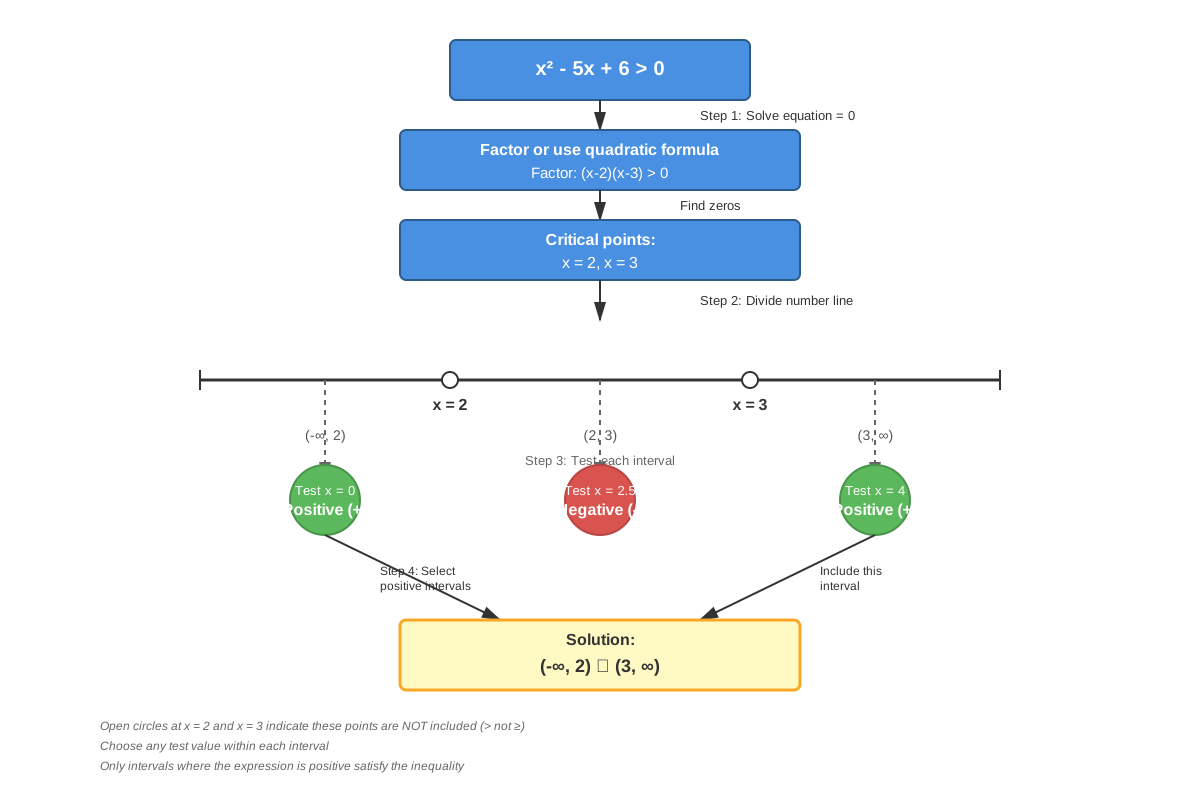
The most reliable approach for solving quadratic inequalities involves finding critical points (also called boundary points or zeros) where the quadratic expression equals zero. These points divide the number line into distinct intervals where the expression maintains a consistent sign (always positive or always negative).
Step-by-step process:
- Rewrite the inequality in standard form with zero on one side
- Solve the related equation ax² + bx + c = 0 to find critical points
- Plot critical points on a number line, creating test intervals
- Test each interval by selecting any value within it and evaluating the expression's sign
- Identify solution intervals based on the original inequality direction
- Write the solution in interval notation, using brackets [ ] for inclusive boundaries (≥ or ≤) and parentheses ( ) for exclusive boundaries (> or <)
Sign Analysis and Parabola Behavior
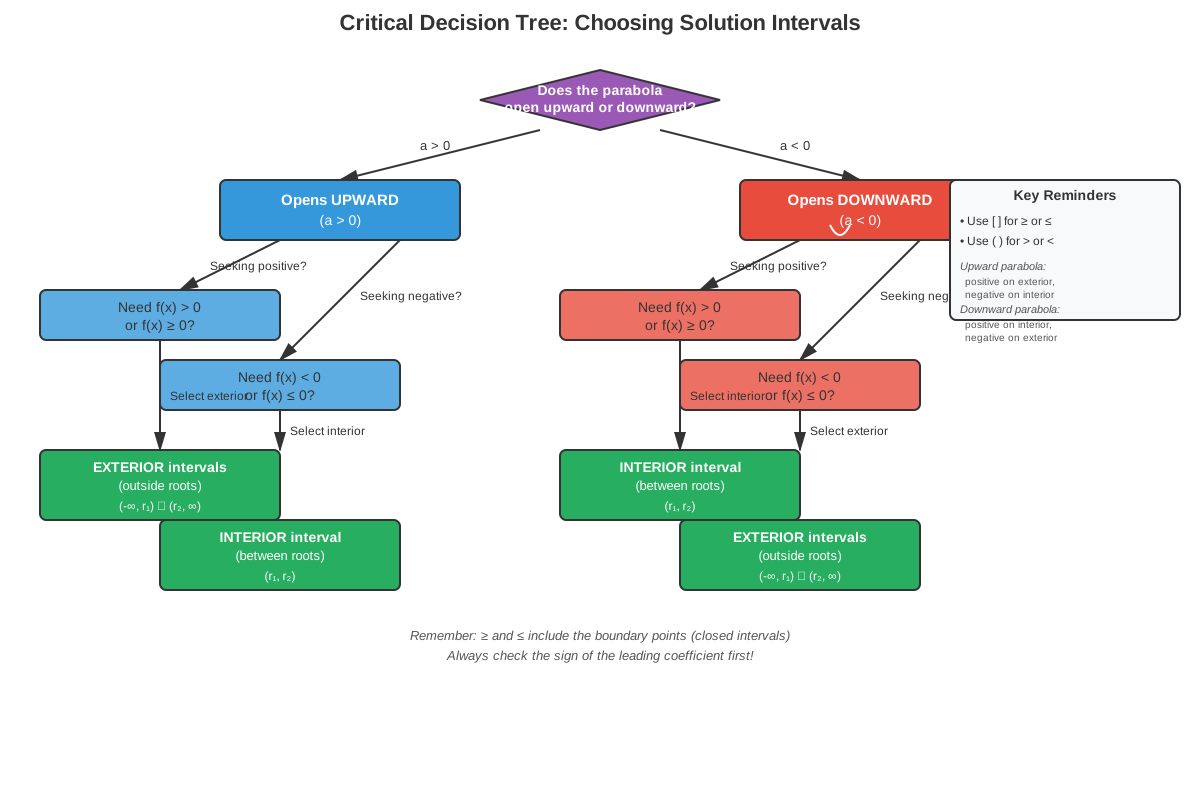
Understanding parabola orientation is essential for efficient solving. When a > 0, the parabola opens upward, creating a U-shape. When a < 0, the parabola opens downward, creating an inverted U-shape. This orientation determines where the quadratic expression is positive versus negative.
| Parabola Opens | Between Roots | Outside Roots |
|---|---|---|
| Upward (a > 0) | Negative | Positive |
| Downward (a < 0) | Positive | Negative |
For an upward-opening parabola with roots r₁ and r₂ (where r₁ < r₂):
- The expression is positive when x < r₁ or x > r₂
- The expression is negative when r₁ < x < r₂
- The expression equals zero when x = r₁ or x = r₂
This pattern reverses for downward-opening parabolas, making the coefficient of x² a critical piece of information.
Special Cases in Quadratic Inequalities
Case 1: No Real Roots
When the discriminant (b² - 4ac) is negative, the quadratic has no real roots and never crosses the x-axis. The expression maintains the same sign for all real numbers. If a > 0, the expression is always positive; if a < 0, the expression is always negative.
Example: x² + 4x + 5 > 0 has discriminant 16 - 20 = -4 < 0. Since a = 1 > 0, the parabola opens upward and never touches the x-axis, so the expression is always positive. Solution: all real numbers, written as (-∞, ∞).
Case 2: One Root (Perfect Square)
When the discriminant equals zero, the parabola touches the x-axis at exactly one point (the vertex). The expression is zero at this point and maintains the same sign everywhere else.
Example: x² - 6x + 9 ≤ 0 factors as (x - 3)² ≤ 0. Since squares are never negative, the only solution is where the expression equals zero: x = 3.
Case 3: Two Distinct Roots
This is the most common SAT scenario, where the parabola crosses the x-axis at two points, creating three distinct intervals to analyze.
Graphical Interpretation
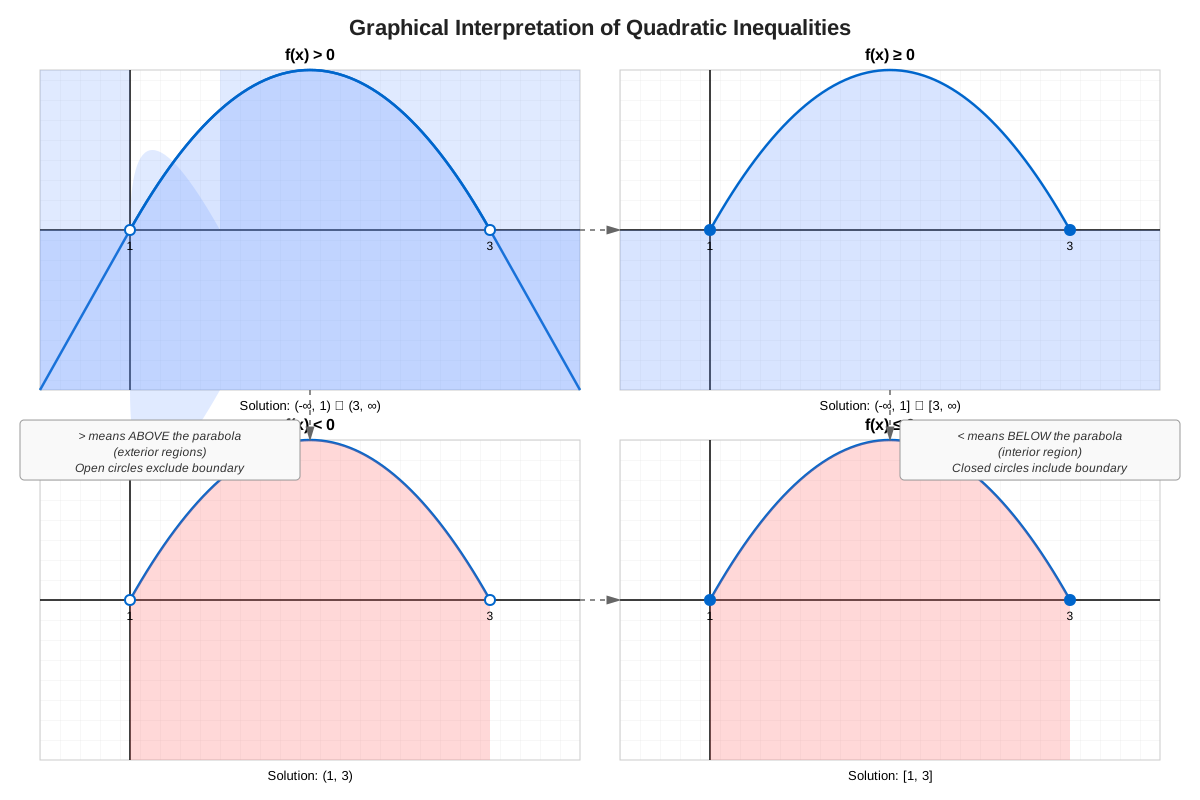
The graphical approach provides powerful visual confirmation of algebraic solutions. When solving f(x) > 0, identify where the parabola lies above the x-axis. When solving f(x) < 0, identify where the parabola lies below the x-axis. The x-intercepts represent the critical points, and the solution consists of the x-values in the appropriate regions.
For inequalities with ≥ or ≤, the critical points themselves are included in the solution (shown with closed dots on graphs or brackets in interval notation). For strict inequalities with > or <, the critical points are excluded (shown with open dots or parentheses).
Interval Notation and Solution Sets
Proper notation is essential for SAT questions that ask for solution sets:
- (a, b): All numbers between a and b, excluding endpoints
- [a, b]: All numbers between a and b, including endpoints
- [a, b): Includes a but excludes b
- (a, ∞): All numbers greater than a
- (-∞, a]: All numbers less than or equal to a
- (-∞, a) ∪ (b, ∞): All numbers less than a OR greater than b
The union symbol ∪ combines disjoint intervals when the solution consists of multiple separate regions.
Concept Relationships
The solution process for quadratic inequalities builds directly on quadratic equation solving techniques → which provide the critical boundary points → that divide the number line into test intervals → where sign analysis determines which regions satisfy the inequality → leading to solutions expressed in interval notation.
Understanding parabola graphs connects to quadratic inequalities through visual interpretation: the vertex indicates the maximum or minimum value, the axis of symmetry helps identify the parabola's center, and the x-intercepts correspond exactly to the critical points found algebraically. The leading coefficient (a) determines whether the parabola opens upward or downward, which directly predicts the sign pattern across intervals.
Quadratic inequalities extend naturally to systems of inequalities where multiple constraints must be satisfied simultaneously, and to absolute value inequalities which can often be rewritten as quadratic inequalities. They also connect forward to rational inequalities where similar sign analysis techniques apply but with additional considerations for undefined points.
The relationship map: Quadratic Equations → Critical Points → Number Line Intervals → Sign Testing → Solution Regions → Interval Notation ← Graph Interpretation ← Parabola Properties
High-Yield Facts
⭐ The solution to a quadratic inequality is an interval or union of intervals, not just the critical points themselves
⭐ For upward-opening parabolas (a > 0), the expression is negative between the roots and positive outside the roots
⭐ For downward-opening parabolas (a < 0), the expression is positive between the roots and negative outside the roots
⭐ Use brackets [ ] for ≥ or ≤ (inclusive) and parentheses ( ) for > or < (exclusive) in interval notation
⭐ When the discriminant is negative, the quadratic expression never changes sign and has no real critical points
- Critical points are found by solving the related equation where the quadratic expression equals zero
- Testing one value from each interval is sufficient to determine the sign throughout that entire interval
- The union symbol (∪) connects disjoint solution intervals when the solution has multiple separate regions
- Graphically, solutions to f(x) > 0 correspond to where the parabola is above the x-axis
- Always rewrite the inequality with zero on one side before solving to avoid sign errors
- The vertex of the parabola represents the maximum or minimum value of the quadratic expression
- Factored form (a(x - r₁)(x - r₂)) makes critical points immediately visible as r₁ and r₂
- When multiplying or dividing an inequality by a negative number, the inequality sign must reverse
- SAT questions often ask for integer solutions within a specific range rather than the complete solution set
- Quadratic inequalities with no solution occur when asking for regions where the expression has the opposite sign from its constant behavior
Quick check — test yourself on Quadratic inequalities so far.
Try Flashcards →Common Misconceptions
Misconception: The solution to a quadratic inequality is just the two roots found by solving the equation.
Correction: The roots are critical boundary points that divide the number line into intervals. The solution consists of the entire interval(s) where the inequality is satisfied, not just the boundary points themselves. For example, if x² - 4 > 0, the solution is (-∞, -2) ∪ (2, ∞), not just x = -2 and x = 2.
Misconception: When a quadratic inequality has no real roots, it has no solution.
Correction: When the discriminant is negative, the quadratic never crosses the x-axis and maintains a constant sign. If that sign matches the inequality direction, the solution is all real numbers. For instance, x² + 1 > 0 is true for all real x because the expression is always positive.
Misconception: The inequality sign determines which interval to choose, regardless of the parabola's orientation.
Correction: Both the inequality direction AND the parabola's orientation (determined by the sign of a) must be considered together. An upward-opening parabola with > 0 gives the outer regions, but a downward-opening parabola with > 0 gives the inner region between roots.
Misconception: Brackets and parentheses in interval notation are interchangeable.
Correction: Brackets [ ] indicate the endpoint is included (for ≥ or ≤), while parentheses ( ) indicate the endpoint is excluded (for > or <). Using the wrong notation changes the solution set. Also, infinity symbols always use parentheses because infinity is a concept, not a reachable number.
Misconception: You can test any value to determine the sign of the entire quadratic expression.
Correction: You can only test values within a specific interval to determine the sign in that interval. The sign changes at each critical point, so you must test at least one value in each interval created by the critical points.
Misconception: Squaring both sides of an inequality preserves the inequality direction.
Correction: Squaring both sides can introduce extraneous solutions or reverse the inequality depending on whether the expressions are positive or negative. This operation should be avoided when solving quadratic inequalities; instead, move all terms to one side and analyze the resulting quadratic expression.
Worked Examples
Example 1: Standard Algebraic Solution
Problem: Solve x² - 5x + 6 < 0 and express the solution in interval notation.
Solution:
Step 1: The inequality is already in standard form with zero on the right side.
Step 2: Solve the related equation x² - 5x + 6 = 0 to find critical points.
Factor: (x - 2)(x - 3) = 0
Critical points: x = 2 and x = 3
Step 3: Plot critical points on a number line, creating three intervals:
- Interval 1: (-∞, 2)
- Interval 2: (2, 3)
- Interval 3: (3, ∞)
Step 4: Test one value from each interval:
- Test x = 0 in Interval 1: (0)² - 5(0) + 6 = 6 > 0 (positive)
- Test x = 2.5 in Interval 2: (2.5)² - 5(2.5) + 6 = 6.25 - 12.5 + 6 = -0.25 < 0 (negative)
- Test x = 4 in Interval 3: (4)² - 5(4) + 6 = 16 - 20 + 6 = 2 > 0 (positive)
Step 5: We need where the expression is less than zero (negative), which occurs in Interval 2.
Step 6: Since the inequality is strict (<), we use parentheses to exclude the endpoints.
Answer: (2, 3)
Connection to learning objectives: This example demonstrates the complete algebraic process for solving quadratic inequalities, identifying critical points, testing intervals, and expressing the solution properly—directly addressing the application objective.
Example 2: Graphical Interpretation with Word Problem
Problem: A company's profit P (in thousands of dollars) from producing x hundred units of a product is modeled by P(x) = -2x² + 12x - 10. For what production levels does the company make a profit (P > 0)?
Solution:
Step 1: Set up the inequality: -2x² + 12x - 10 > 0
Step 2: Solve -2x² + 12x - 10 = 0 for critical points.
Divide by -2: x² - 6x + 5 = 0
Factor: (x - 1)(x - 5) = 0
Critical points: x = 1 and x = 5
Step 3: Analyze the parabola: Since a = -2 < 0, the parabola opens downward.
Step 4: For a downward-opening parabola, the expression is positive between the roots and negative outside the roots.
Step 5: Therefore, -2x² + 12x - 10 > 0 when 1 < x < 5.
Step 6: Interpret in context: Since x represents hundreds of units, the company makes a profit when producing between 100 and 500 units.
Answer: The company makes a profit when producing between 100 and 500 units (1 < x < 5 in the model).
Graphical verification: The parabola opens downward with vertex at x = 3 (midpoint of roots), crosses the x-axis at x = 1 and x = 5, and is above the x-axis (positive) between these points.
Connection to learning objectives: This example shows how quadratic inequalities appear in SAT word problems, requires translating between mathematical and contextual language, and demonstrates using parabola properties to solve efficiently without extensive testing.
Exam Strategy
When approaching SAT quadratic inequality questions, first identify whether the problem presents the inequality algebraically, graphically, or verbally. Trigger phrases include "for what values," "which interval," "when is the expression positive/negative," "solution set," and "satisfies the inequality." These phrases signal that you need to find a range of values rather than specific points.
Algebraic approach strategy: If given an inequality in standard form, immediately solve the related equation to find critical points. Before testing intervals, check the sign of the leading coefficient to predict the sign pattern—this can save valuable time. For upward-opening parabolas, remember the mnemonic "U-shape: negative in the middle" (between roots). For downward-opening parabolas, "inverted U: positive in the middle."
Graphical approach strategy: When a graph is provided, identify x-intercepts first, then determine which regions satisfy the inequality by checking whether you need the parabola above or below the x-axis. Pay careful attention to whether dots at intercepts are open or closed, as this indicates whether endpoints are included. If the question asks which inequality matches a shaded region, check both the inequality direction and whether boundaries should be inclusive.
Process of elimination tips: For multiple-choice questions asking for solution sets, eliminate options that include only the critical points (common distractor). Eliminate intervals that extend in the wrong direction from the critical points. If you know the parabola opens upward and the inequality is > 0, eliminate any answer showing only the middle region. Check endpoint notation carefully—if the original inequality is strict (< or >), eliminate answers with brackets.
Time allocation: Standard quadratic inequality problems should take 60-90 seconds. If you're spending more than 2 minutes, switch to testing answer choices by plugging in values. For word problems involving quadratic inequalities, allocate 2-3 minutes to translate the context, set up the inequality, and solve.
Calculator usage: On calculator-permitted sections, graph the quadratic function and use the calculator's table or trace feature to verify where the expression is positive or negative. This provides quick confirmation of algebraic work or can serve as a primary solution method when time is limited.
Memory Techniques
Mnemonic for solution regions: "Upward U-shape: Under is negative" — For upward-opening parabolas (a > 0), the region under the curve (between the roots) is where the expression is negative.
Mnemonic for interval notation: "Brackets Belong to Boundaries that Belong" — Use brackets when the boundary points belong to (are included in) the solution set (≥ or ≤).
Visualization strategy: Picture a parabola as a smile (opens up) or frown (opens down). A smile is happy (positive) on the outside, sad (negative) in the middle. A frown is sad (negative) on the outside, happy (positive) in the middle.
Acronym for solving steps: SCRIPT
- Standardize (get zero on one side)
- Critical points (solve the equation)
- Regions (divide number line)
- Interval testing (check signs)
- Pick solution regions (match inequality)
- Transcribe (write in interval notation)
Sign pattern memory: Create a visual number line in your mind with the critical points marked. For upward parabolas, draw a U-shape connecting the points with the bottom between them—this shows the negative region. For downward parabolas, draw an inverted U with the top between the points—this shows the positive region.
Summary
Quadratic inequalities extend equation-solving to finding intervals where quadratic expressions satisfy inequality conditions. The fundamental solution method involves finding critical points by solving the related equation, dividing the number line into test intervals, determining the sign of the expression in each interval, and selecting regions that satisfy the original inequality. The parabola's orientation—determined by whether the leading coefficient is positive or negative—predicts the sign pattern: upward-opening parabolas are negative between roots and positive outside, while downward-opening parabolas show the opposite pattern. Solutions must be expressed in proper interval notation, using brackets for inclusive boundaries (≥, ≤) and parentheses for exclusive boundaries (>, <). Special cases include quadratics with no real roots (constant sign for all x) and perfect squares (single point solutions). SAT questions test this concept through direct algebraic problems, graphical interpretations, and real-world modeling scenarios, making it essential to develop both computational fluency and conceptual understanding of how quadratic expressions behave across different regions of the number line.
Key Takeaways
- Quadratic inequalities ask for intervals where expressions are positive or negative, not just where they equal zero
- Critical points found by solving the related equation divide the number line into regions with consistent signs
- Upward-opening parabolas (a > 0) are negative between roots and positive outside; downward-opening parabolas (a < 0) show the opposite pattern
- Proper interval notation uses brackets [ ] for inclusive boundaries (≥, ≤) and parentheses ( ) for exclusive boundaries (>, <)
- Testing one value per interval is sufficient to determine the sign throughout that entire region
- Graphical solutions identify where parabolas lie above (for > 0) or below (for < 0) the x-axis
- When discriminant is negative, the quadratic maintains constant sign for all real numbers—either all solutions or no solutions depending on inequality direction
Related Topics
Systems of Inequalities: After mastering single quadratic inequalities, students progress to solving systems involving multiple inequalities simultaneously, including combinations of linear and quadratic constraints. This builds on interval analysis skills and introduces graphical solution regions in the coordinate plane.
Rational Inequalities: These extend quadratic inequality techniques to expressions involving fractions with polynomial numerators and denominators. The sign analysis method applies similarly, but with additional considerations for values that make denominators zero.
Absolute Value Inequalities: Many absolute value inequalities can be rewritten as quadratic inequalities, particularly those involving expressions like |x - a| < b. Understanding quadratic inequalities provides tools for solving these more complex problems.
Optimization Problems: Real-world applications often require finding maximum or minimum values subject to quadratic constraints, combining inequality reasoning with vertex analysis and domain restrictions.
Polynomial Inequalities: The interval testing method learned for quadratic inequalities extends naturally to higher-degree polynomial inequalities, making this topic foundational for advanced algebra.
Practice CTA
Now that you've mastered the core concepts of quadratic inequalities, it's time to solidify your understanding through active practice. Work through the practice questions to apply these techniques to SAT-style problems, and use the flashcards to reinforce key facts and procedures. Remember, the difference between understanding a concept and scoring points on test day comes from repeated, deliberate practice. Each problem you solve strengthens your pattern recognition and builds the confidence you need to tackle any quadratic inequality the SAT presents. You've got this—start practicing now!
Sign up free to keep reading
Create a free AnvayaPrep account to finish this SAT guide on Quadratic inequalities — plus flashcards and practice questions.