Overview
Two-variable inequalities represent one of the most visually intuitive yet conceptually challenging topics in SAT math. Unlike single-variable inequalities that produce solutions on a number line, two-variable inequalities define entire regions on the coordinate plane. These mathematical statements express relationships between two quantities where one side is greater than, less than, greater than or equal to, or less than or equal to the other side. For example, the inequality y > 2x + 3 describes all points above a particular line on the coordinate plane.
Understanding sat two-variable inequalities is essential because they appear regularly on both the calculator and no-calculator sections of the SAT Math test. These questions test multiple skills simultaneously: graphing linear relationships, understanding inequality symbols, identifying solution regions, and interpreting real-world constraints. The College Board frequently embeds two-variable inequalities within word problems about budgets, time constraints, or physical limitations, making them practical applications of abstract mathematical concepts.
This topic builds directly on foundational algebra skills including graphing linear equations, understanding slope-intercept form, and working with inequality symbols. Mastery of two-variable inequalities also prepares students for more advanced topics like systems of inequalities and linear programming, which occasionally appear on the SAT. The visual nature of these problems makes them excellent candidates for process-of-elimination strategies, but only when students understand the underlying principles of how inequalities translate to graphical representations.
Learning Objectives
- [ ] Identify key features of two-variable inequalities including boundary lines, solution regions, and inequality symbols
- [ ] Explain how two-variable inequalities appears on the SAT in both graphical and algebraic contexts
- [ ] Apply two-variable inequalities to answer SAT-style questions involving real-world scenarios
- [ ] Determine whether a boundary line should be solid or dashed based on the inequality symbol
- [ ] Test points to verify which region of the coordinate plane satisfies a given inequality
- [ ] Convert word problems into two-variable inequality expressions
- [ ] Interpret the meaning of solution regions in context-based problems
Prerequisites
- Linear equations in two variables: Understanding y = mx + b form is essential because inequalities use the same linear relationships as their foundation
- Graphing lines on the coordinate plane: Students must be able to plot points and draw lines accurately to represent inequality boundaries
- Inequality symbols and their meanings: Familiarity with <, >, ≤, and ≥ symbols and how they differ from equality is fundamental
- Substitution and evaluation: The ability to substitute coordinate pairs into expressions to test whether they satisfy conditions
- Slope-intercept form: Recognizing how to identify slope and y-intercept quickly enables faster graphing of boundary lines
Why This Topic Matters
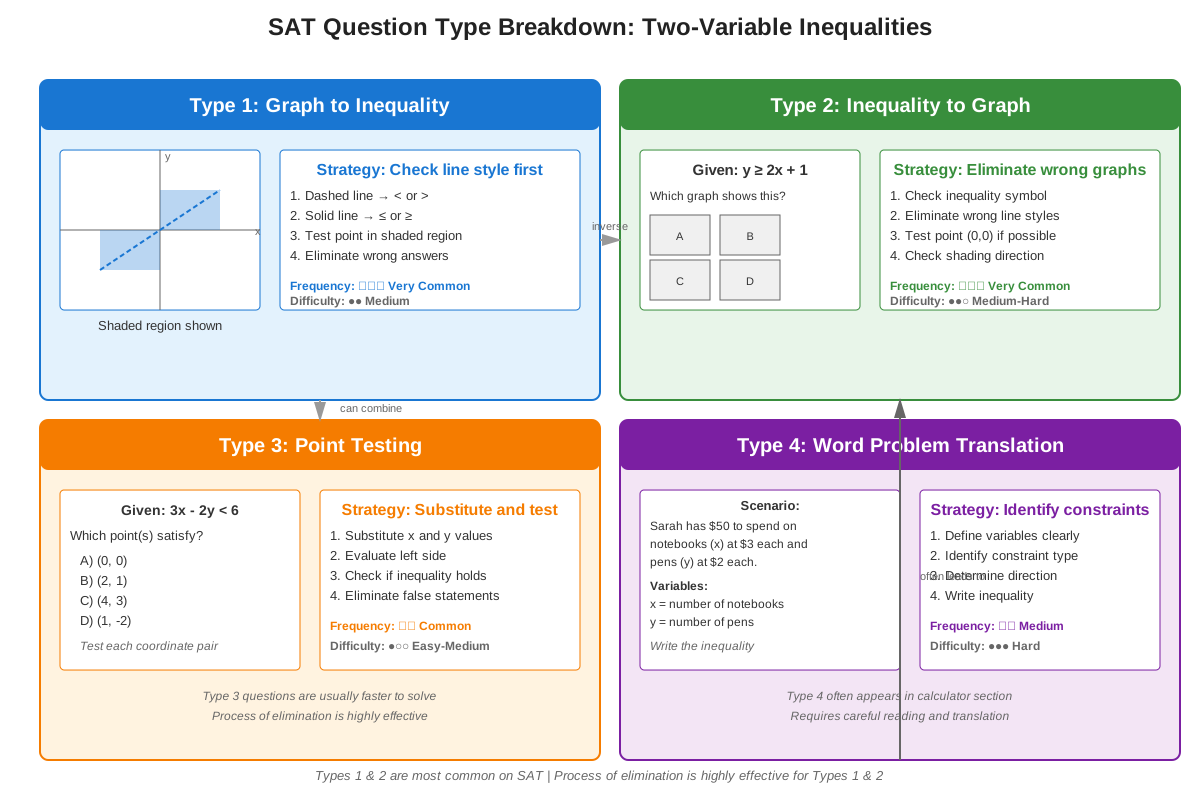
Two-variable inequalities appear in approximately 2-4 questions per SAT Math section, making them a high-yield topic that can significantly impact overall scores. These questions typically appear as medium-to-hard difficulty problems worth the same points as easier questions, making them excellent targets for focused study. The College Board tests this concept through multiple question formats: identifying graphs that match given inequalities, selecting inequalities that match given graphs, determining which points satisfy inequalities, and translating word problems into inequality notation.
Beyond the exam, two-variable inequalities model countless real-world situations. Businesses use them to represent budget constraints (cost of materials plus labor must be less than revenue), manufacturers apply them to production limitations (machine hours plus worker hours cannot exceed available time), and scientists employ them to describe feasible regions in experiments (temperature and pressure must remain within safe ranges). This practical applicability makes the topic particularly valuable for developing quantitative reasoning skills.
On the SAT, two-variable inequalities commonly appear in questions about: purchasing scenarios with budget limits, time management problems with multiple activities, mixture problems with quantity constraints, and geometric situations involving area or perimeter restrictions. Recognizing these common contexts helps students quickly identify when to apply inequality concepts and set up problems correctly.
Core Concepts
Understanding Two-Variable Inequalities
A two-variable inequality is a mathematical statement that relates two variables using an inequality symbol rather than an equals sign. The general form is similar to linear equations but uses <, >, ≤, or ≥ instead of =. For example, y < 3x - 2 or 2x + 5y ≥ 10 are both two-variable inequalities. The solution to a two-variable inequality is not a single point or line, but rather an entire region of the coordinate plane containing infinitely many points that make the inequality true.
The key distinction between equations and inequalities lies in their solutions: while y = 2x + 1 has solutions forming a line, y > 2x + 1 has solutions forming a half-plane (an entire region on one side of that line). This fundamental difference makes visualization crucial for understanding and solving problems involving two-variable inequalities.
Boundary Lines: Solid vs. Dashed
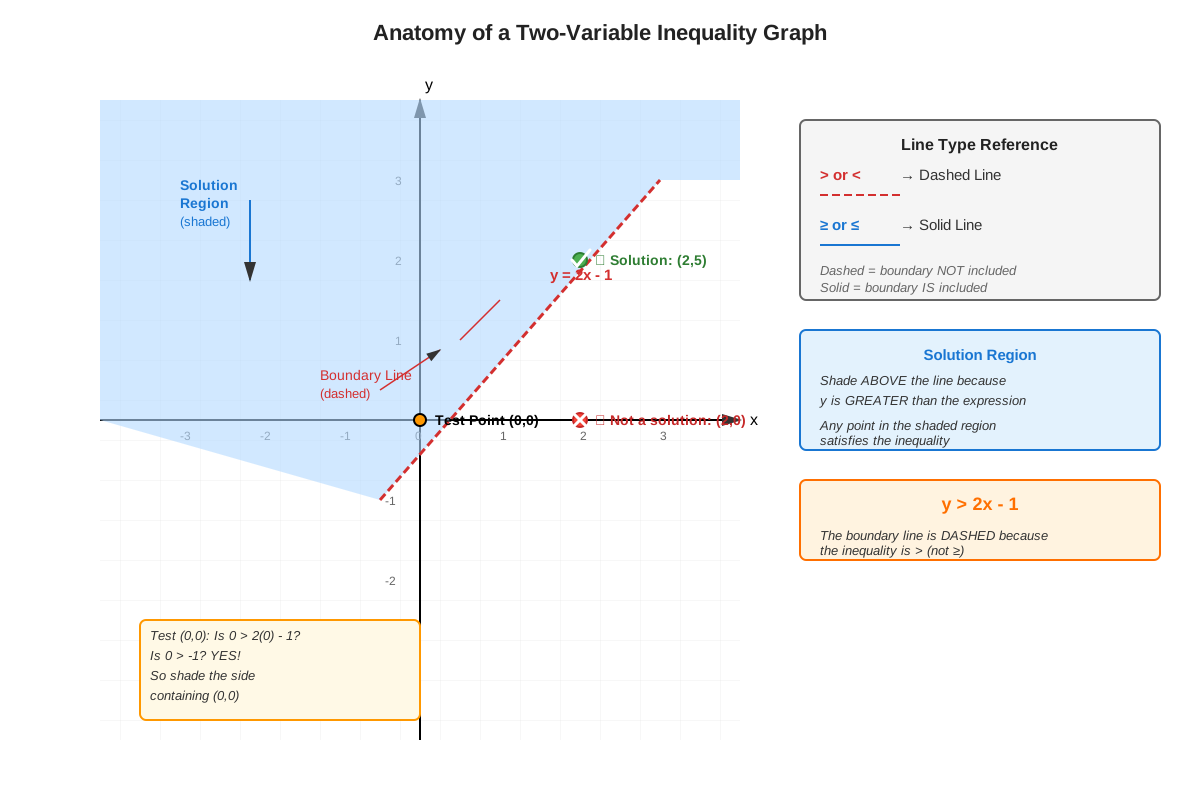
Every two-variable inequality has a boundary line that separates the coordinate plane into two regions. This boundary line is the graph of the related equation formed by replacing the inequality symbol with an equals sign. For y < 2x + 3, the boundary line is y = 2x + 3.
The type of line drawn depends on the inequality symbol:
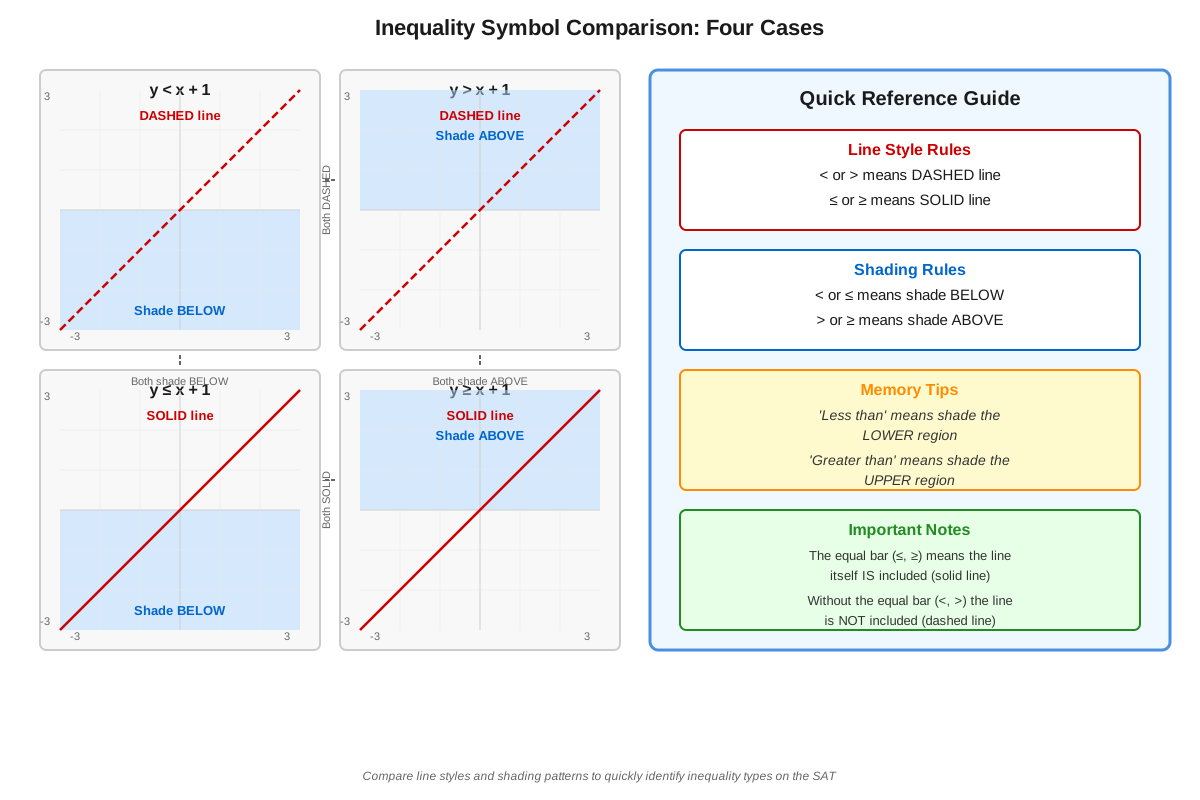
| Inequality Symbol | Line Type | Points on Line | Example |
|---|---|---|---|
| < or > | Dashed line | NOT included in solution | y > 2x + 1 |
| ≤ or ≥ | Solid line | Included in solution | y ≤ 2x + 1 |
This distinction is critical for SAT questions. A dashed line indicates that points exactly on the line do NOT satisfy the inequality (strict inequality), while a solid line indicates that points on the line DO satisfy the inequality (inclusive inequality). Many SAT questions specifically test whether students recognize this difference by asking about points that lie exactly on the boundary.
Identifying the Solution Region
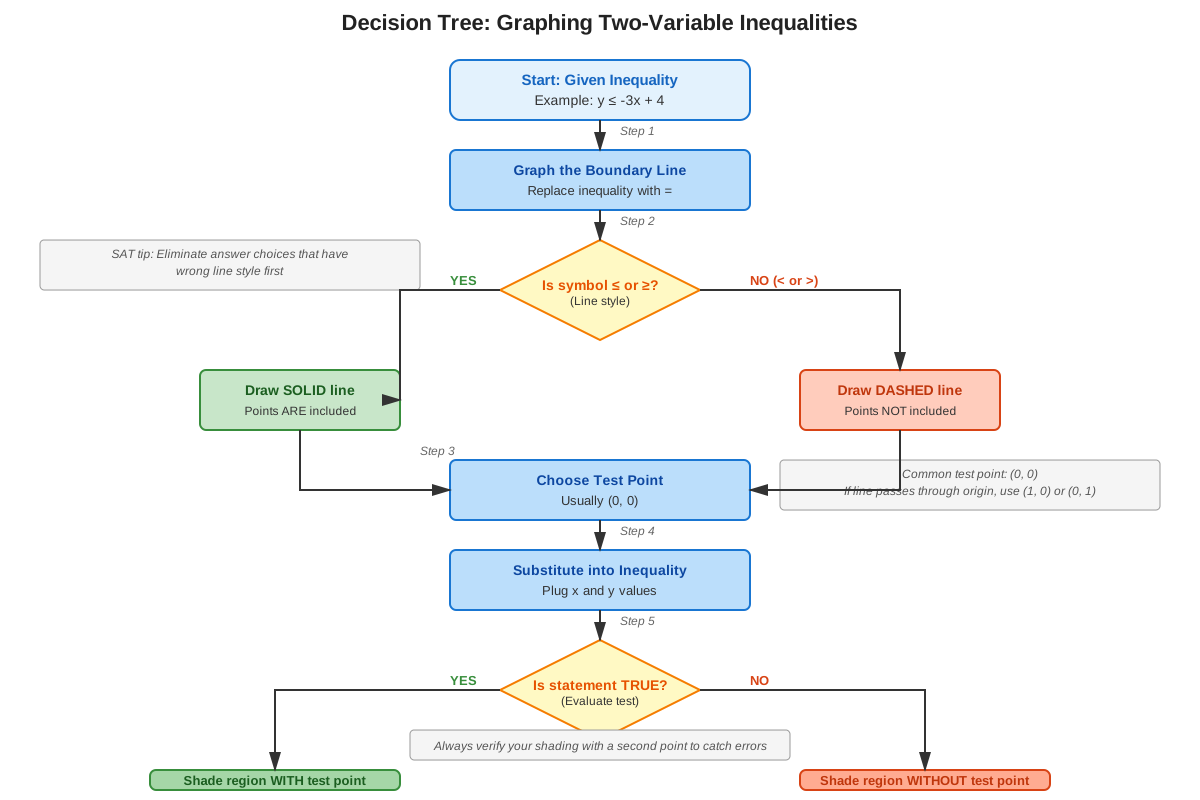
Once the boundary line is drawn, determining which side represents the solution region requires testing. The most reliable method is the test point method:
- Draw the boundary line (solid or dashed as appropriate)
- Choose a test point NOT on the boundary line (the origin (0,0) is usually easiest if the line doesn't pass through it)
- Substitute the test point coordinates into the original inequality
- If the inequality is TRUE, shade the region containing the test point
- If the inequality is FALSE, shade the region on the opposite side
For example, with y > 2x + 1:
- Boundary line: y = 2x + 1 (dashed)
- Test point: (0, 0)
- Substitute: 0 > 2(0) + 1 → 0 > 1 (FALSE)
- Therefore, shade the region NOT containing (0, 0), which is above the line
Standard Forms and Transformations
Two-variable inequalities can appear in multiple forms on the SAT:
Slope-intercept form: y < mx + b or y > mx + b
- Easiest to graph quickly
- When y is isolated with > or ≥, shade ABOVE the line
- When y is isolated with < or ≤, shade BELOW the line
Standard form: Ax + By < C or Ax + By > C
- May require rearrangement to identify the solution region
- Test point method is most reliable here
Horizontal and vertical boundaries: x < a, x > a, y < b, y > b
- Create vertical or horizontal boundary lines
- x < a means shade LEFT of the vertical line x = a
- x > a means shade RIGHT of the vertical line x = a
- y < b means shade BELOW the horizontal line y = b
- y > b means shade ABOVE the horizontal line y = b
Interpreting Inequalities in Context
SAT questions frequently present two-variable inequalities within real-world scenarios. The key is translating verbal constraints into mathematical notation:
- "At most" or "no more than" → ≤
- "At least" or "no less than" → ≥
- "Less than" or "fewer than" → <
- "Greater than" or "more than" → >
- "Maximum" → ≤
- "Minimum" → ≥
For example: "A student works at most 20 hours per week between two jobs, where x represents hours at Job A and y represents hours at Job B" translates to x + y ≤ 20.
Concept Relationships
The foundation of two-variable inequalities rests on understanding linear equations in two variables. The relationship flows: Linear equations → Boundary lines → Inequality symbols → Solution regions. Each two-variable inequality contains a linear equation (the boundary) plus a directional component (the inequality symbol) that determines which side of the boundary contains solutions.
Two-variable inequalities connect to single-variable inequalities through the concept of solution sets. While single-variable inequalities produce solution intervals on a number line, two-variable inequalities produce solution regions on a coordinate plane. Both require understanding inequality symbols and testing values, but two-variable inequalities add the complexity of graphical representation.
The concept also bridges to systems of inequalities, where multiple two-variable inequalities overlap to create a feasible region. Understanding individual inequalities is prerequisite knowledge for systems. Additionally, two-variable inequalities relate to functions because they often involve determining whether points satisfy functional relationships with inequality constraints rather than equality.
Within the topic itself: Boundary line identification → Line type determination (solid/dashed) → Solution region identification → Point testing for verification. This sequence represents the standard problem-solving approach for graphing and interpreting two-variable inequalities.
Quick check — test yourself on Two-variable inequalities so far.
Try Flashcards →High-Yield Facts
⭐ The inequality symbol determines whether the boundary line is solid (≤ or ≥) or dashed (< or >)
⭐ When y is isolated, y > or y ≥ means shade ABOVE the line; y < or y ≤ means shade BELOW the line
⭐ Any point in the shaded region is a solution to the inequality; any point outside the shaded region is not
⭐ The test point (0,0) is the easiest to use unless the boundary line passes through the origin
⭐ Points exactly on a dashed boundary line are NOT solutions; points on a solid boundary line ARE solutions
- Switching the sides of an inequality requires reversing the inequality symbol (if y < 2x + 1, then 2x + 1 > y)
- Multiplying or dividing both sides of an inequality by a negative number reverses the inequality symbol
- Vertical boundary lines have the form x = a and divide the plane into left and right regions
- Horizontal boundary lines have the form y = b and divide the plane into upper and lower regions
- The solution region of a two-variable inequality always extends infinitely in at least one direction
- Two-variable inequalities can model constraints in optimization problems where multiple conditions must be satisfied simultaneously
Common Misconceptions
Misconception: All boundary lines should be drawn as solid lines. → Correction: Boundary lines are dashed for strict inequalities (< or >) and solid for inclusive inequalities (≤ or ≥). The symbol determines the line type, and this distinction affects whether points on the boundary are solutions.
Misconception: If the inequality is y > 2x + 1, shade below the line because "greater than" means the larger numbers at the bottom of the graph. → Correction: When y is isolated with > or ≥, always shade ABOVE the line because y-values increase as you move up on the coordinate plane. The shaded region contains points where y-coordinates are greater than the boundary line's y-coordinates.
Misconception: The test point method only works with (0,0). → Correction: Any point NOT on the boundary line can serve as a test point. While (0,0) is convenient, if the boundary passes through the origin, choose any other simple point like (1,0), (0,1), or (1,1).
Misconception: In the inequality 2x + 3y < 12, you can immediately tell which region to shade without testing. → Correction: When the inequality is not solved for y, the safest approach is to either solve for y first or use the test point method. Guessing the direction leads to errors approximately 50% of the time.
Misconception: If a point satisfies the equation of the boundary line, it automatically satisfies the inequality. → Correction: Points on the boundary line only satisfy the inequality if the symbol is ≤ or ≥ (inclusive). For strict inequalities (< or >), points on the boundary do NOT satisfy the inequality, which is why the line is dashed.
Worked Examples
Example 1: Graphing and Identifying Solutions
Problem: Graph the inequality y ≤ -½x + 3 and determine whether the points (2, 2), (0, 4), and (4, 1) are solutions.
Solution:
Step 1: Identify the boundary line equation: y = -½x + 3
Step 2: Determine line type. Since the symbol is ≤ (inclusive), draw a solid line.
Step 3: Graph the boundary line using slope-intercept form:
- y-intercept: (0, 3)
- slope: -½ (down 1, right 2)
- Plot (0, 3), then move down 1 and right 2 to get (2, 2), then to (4, 1)
- Draw a solid line through these points
Step 4: Determine shading direction. Since y is isolated with ≤, shade BELOW the line.
Step 5: Test each point:
For (2, 2): Substitute into y ≤ -½x + 3
- 2 ≤ -½(2) + 3
- 2 ≤ -1 + 3
- 2 ≤ 2 ✓ TRUE
- (2, 2) IS a solution (it's on the boundary line, which is included)
For (0, 4): Substitute into y ≤ -½x + 3
- 4 ≤ -½(0) + 3
- 4 ≤ 3 ✗ FALSE
- (0, 4) is NOT a solution (it's above the line, in the unshaded region)
For (4, 1): Substitute into y ≤ -½x + 3
- 1 ≤ -½(4) + 3
- 1 ≤ -2 + 3
- 1 ≤ 1 ✓ TRUE
- (4, 1) IS a solution (it's on the boundary line, which is included)
Connection to Learning Objectives: This example demonstrates identifying key features (boundary line, line type, solution region) and applying the concept to test specific points.
Example 2: Real-World Application
Problem: A bakery makes cookies and brownies. Each batch of cookies requires 2 hours of baking time, and each batch of brownies requires 3 hours. The bakery has at most 24 hours of baking time available per day. Write an inequality representing this constraint where x = batches of cookies and y = batches of brownies. Then determine if making 6 batches of cookies and 4 batches of brownies is feasible.
Solution:
Step 1: Translate the constraint into mathematical notation.
- Cookies: 2 hours per batch × x batches = 2x hours
- Brownies: 3 hours per batch × y batches = 3y hours
- Total time: 2x + 3y
- Constraint: "at most 24 hours" means ≤ 24
- Inequality: 2x + 3y ≤ 24
Step 2: Test whether (6, 4) satisfies the inequality.
- Substitute x = 6 and y = 4:
- 2(6) + 3(4) ≤ 24
- 12 + 12 ≤ 24
- 24 ≤ 24 ✓ TRUE
Step 3: Interpret the result.
Making 6 batches of cookies and 4 batches of brownies uses exactly 24 hours, which satisfies the constraint. This point lies on the boundary line of the feasible region, meaning it's the maximum production possible with this combination.
Connection to Learning Objectives: This example shows how two-variable inequalities appear in SAT word problems and demonstrates the application of inequality concepts to real-world scenarios.
Exam Strategy
When approaching SAT questions on two-variable inequalities, follow this systematic process:
For graphing questions: First, identify whether the boundary should be solid or dashed by examining the inequality symbol. Next, determine the boundary line equation by temporarily replacing the inequality with an equals sign. Then, use either the test point method or the "y isolated" rule to determine which region to shade. Finally, eliminate answer choices that have the wrong line type or wrong shading direction.
For "which point is a solution" questions: Substitute each answer choice into the inequality and evaluate. This direct approach is faster than graphing. Remember that you're looking for which point makes the inequality TRUE, not which makes it equal.
Trigger words and phrases to watch for:
- "At most," "maximum," "no more than" → ≤
- "At least," "minimum," "no less than" → ≥
- "Shaded region," "solution region" → indicates a graphing question
- "Which point satisfies" → indicates a substitution question
- "Boundary line" → focus on the related equation
Process of elimination tips:
- Immediately eliminate graphs with the wrong line type (solid vs. dashed)
- If you can identify one point that should be in the solution region, eliminate any graph that doesn't shade that point
- For word problems, eliminate inequalities with the wrong inequality symbol based on constraint language
- If the inequality has y isolated with >, eliminate any graph shaded below the line
Time allocation: Most two-variable inequality questions should take 45-90 seconds. If graphing from scratch would take too long, use the test point method on answer choices instead. Don't spend more than 2 minutes on any single inequality question—if stuck, make an educated guess and move on.
Exam Tip: When the SAT shows you a graph and asks which inequality it represents, test the point (0,0) if it's in the shaded region. Substitute (0,0) into each answer choice and eliminate those that give FALSE results.
Memory Techniques
Mnemonic for line types: "Solid means Same or Satisfied" — the ≤ and ≥ symbols include the line underneath (solid line), and points on the line satisfy the inequality.
Visualization for shading direction: Picture the inequality symbol as an arrow pointing toward the solution region. For y > 2x + 1, the > symbol points upward (shade above). For y < 2x + 1, the < symbol points downward (shade below).
Acronym for test point method: DBTS
- Draw the boundary line
- Boundary type (solid or dashed)
- Test a point
- Shade the correct region
Memory aid for word problem translation: Create a mental chart:
Maximum/At most → ≤ (less than or equal)
Minimum/At least → ≥ (greater than or equal)
Spatial memory technique: When practicing, physically point to the region you're shading while saying "above" or "below" out loud. This kinesthetic reinforcement helps cement the connection between isolated y-inequalities and shading direction.
Summary
Two-variable inequalities extend the concept of linear equations by defining entire regions of the coordinate plane rather than single lines. The solution to a two-variable inequality consists of all ordered pairs that make the inequality true, represented graphically as a shaded half-plane. The boundary line, derived from the related equation, is drawn solid when the inequality includes equality (≤ or ≥) and dashed for strict inequalities (< or >). Determining the solution region requires either using the test point method or applying the rule that y > or y ≥ means shade above while y < or y ≤ means shade below. On the SAT, these concepts appear in both pure graphing questions and real-world application problems involving constraints like budgets, time limits, or quantity restrictions. Success requires recognizing inequality symbols, accurately graphing boundary lines, correctly identifying solution regions, and translating verbal constraints into mathematical notation. Mastery of two-variable inequalities provides essential skills for systems of inequalities and optimization problems while developing spatial reasoning and algebraic manipulation abilities crucial for SAT Math success.
Key Takeaways
- Two-variable inequalities define regions on the coordinate plane, not just lines or points
- The inequality symbol determines both the line type (solid for ≤/≥, dashed for ) and the solution region direction
- When y is isolated, shade above the line for y > or y ≥, and below the line for y < or y ≤
- The test point method (usually using (0,0)) reliably identifies which region satisfies the inequality
- Points on a solid boundary line are solutions; points on a dashed boundary line are not solutions
- SAT questions test both graphical interpretation and real-world application through word problems
- Translating constraint language ("at most," "at least," "maximum," "minimum") into correct inequality symbols is essential for word problems
Related Topics
Systems of Linear Inequalities: Building on single two-variable inequalities, systems involve multiple inequalities whose solution regions overlap to create a feasible region. Mastering individual inequalities is prerequisite for understanding how multiple constraints interact.
Linear Programming: An advanced application where two-variable inequalities define constraints, and students find maximum or minimum values of objective functions within feasible regions. This topic occasionally appears on SAT Math as challenging problems.
Absolute Value Inequalities: While typically involving one variable, absolute value inequalities can extend to two variables, creating V-shaped or angular boundary regions rather than straight lines.
Functions and Their Graphs: Understanding how inequalities relate to functions helps with questions about function domains, ranges, and regions where one function exceeds another.
Coordinate Geometry: Two-variable inequalities reinforce understanding of the coordinate plane, distance, midpoint, and spatial relationships between points and lines.
Practice CTA
Now that you've mastered the core concepts of two-variable inequalities, it's time to solidify your understanding through active practice. Work through the practice questions to apply these strategies under test-like conditions, and use the flashcards to reinforce key facts and procedures. Remember, the SAT rewards both conceptual understanding and efficient execution—practice will build both. Each problem you solve strengthens your pattern recognition and increases your speed for test day. You've got this!
Sign up free to keep reading
Create a free AnvayaPrep account to finish this SAT guide on Two-variable inequalities — plus flashcards and practice questions.