Overview
Decimal percent conversion is a fundamental mathematical skill that appears frequently throughout the SAT Math section. This topic involves the ability to seamlessly translate between decimal representations and percentage representations of numbers—a skill that underpins numerous question types ranging from straightforward computation problems to complex word problems involving statistics, ratios, and data interpretation. Understanding how to convert between these two forms allows students to work flexibly with numerical information and choose the most efficient representation for solving problems.
On the SAT, sat decimal percent conversion questions rarely appear in isolation. Instead, this skill integrates into multi-step problems involving proportions, probability, data analysis, and real-world scenarios. Students who master this conversion process gain a significant advantage because they can quickly interpret information presented in various formats and select the most strategic approach for each problem. The ability to recognize that 0.35, 35%, and 35/100 all represent the same value—and to move fluidly between these representations—is essential for success on test day.
This topic connects directly to broader math concepts including fractions, ratios, proportions, and algebraic reasoning. Decimal and percent conversions serve as a bridge between arithmetic and algebra, appearing in questions about growth and decay, financial calculations, statistical analysis, and geometric scaling. Mastery of this foundational skill enables students to tackle more complex problems with confidence and efficiency, making it one of the highest-yield topics for SAT preparation.
Learning Objectives
- [ ] Identify key features of Decimal percent conversion
- [ ] Explain how Decimal percent conversion appears on the SAT
- [ ] Apply Decimal percent conversion to answer SAT-style questions
- [ ] Convert any decimal to its equivalent percentage form with accuracy
- [ ] Convert any percentage to its equivalent decimal form with accuracy
- [ ] Recognize equivalent representations of the same value across decimal, percent, and fraction forms
- [ ] Apply conversion skills to solve multi-step word problems involving percentages and decimals
Prerequisites
- Basic decimal operations: Understanding place value and decimal notation is essential because conversions rely on moving the decimal point systematically
- Understanding of percentages: Recognizing that "percent" means "per hundred" provides the conceptual foundation for all conversion procedures
- Multiplication and division by powers of 10: These operations form the mechanical basis of the conversion process
- Fraction fundamentals: Since percentages can be expressed as fractions with denominator 100, basic fraction literacy supports deeper understanding
Why This Topic Matters
Real-World Applications
Decimal and percent conversions appear constantly in everyday life. Financial literacy requires converting between decimals and percentages when calculating interest rates, tax amounts, discounts, and investment returns. Scientific data often presents information in decimal form that must be converted to percentages for clear communication. Sports statistics, polling data, and business metrics all require fluency in moving between these representations. Understanding these conversions empowers students to make informed decisions about money, interpret news and research accurately, and communicate quantitative information effectively.
SAT Exam Statistics
Decimal percent conversion appears in approximately 10-15% of SAT Math questions, either directly or as a necessary step within larger problems. This topic appears across both the calculator and no-calculator sections, with varying levels of complexity. Direct conversion questions typically appear as straightforward computational problems worth one point each, while integrated applications appear in word problems, data interpretation questions, and multi-step algebraic scenarios. The College Board consistently includes at least 2-3 questions per test that require conversion skills as a critical component of the solution process.
Common Exam Appearances
On the SAT, this topic manifests in several characteristic ways: percentage increase/decrease problems that require converting the result back to decimal form; data interpretation questions where graphs display decimals but answer choices use percentages; probability problems where decimal probabilities must be expressed as percentages; financial scenarios involving interest rates, discounts, or markups; and scientific contexts where experimental results appear in decimal form but questions ask for percentage interpretations.
Core Concepts
Understanding the Relationship Between Decimals and Percentages
The fundamental principle underlying all decimal percent conversion is that percentages represent parts per hundred. The word "percent" derives from the Latin "per centum," meaning "by the hundred." When expressing a value as a percentage, we indicate how many parts out of 100 that value represents. A decimal, conversely, represents a value in our base-10 number system where each position to the right of the decimal point represents a decreasing power of 10.
The key insight is that moving between these representations involves a consistent scaling factor of 100. Since 1 equals 100%, any decimal value can be converted to a percentage by determining what that decimal represents out of 100 parts. Similarly, any percentage can be converted to a decimal by determining what fraction of 1 (the whole) that percentage represents.
Converting Decimals to Percentages
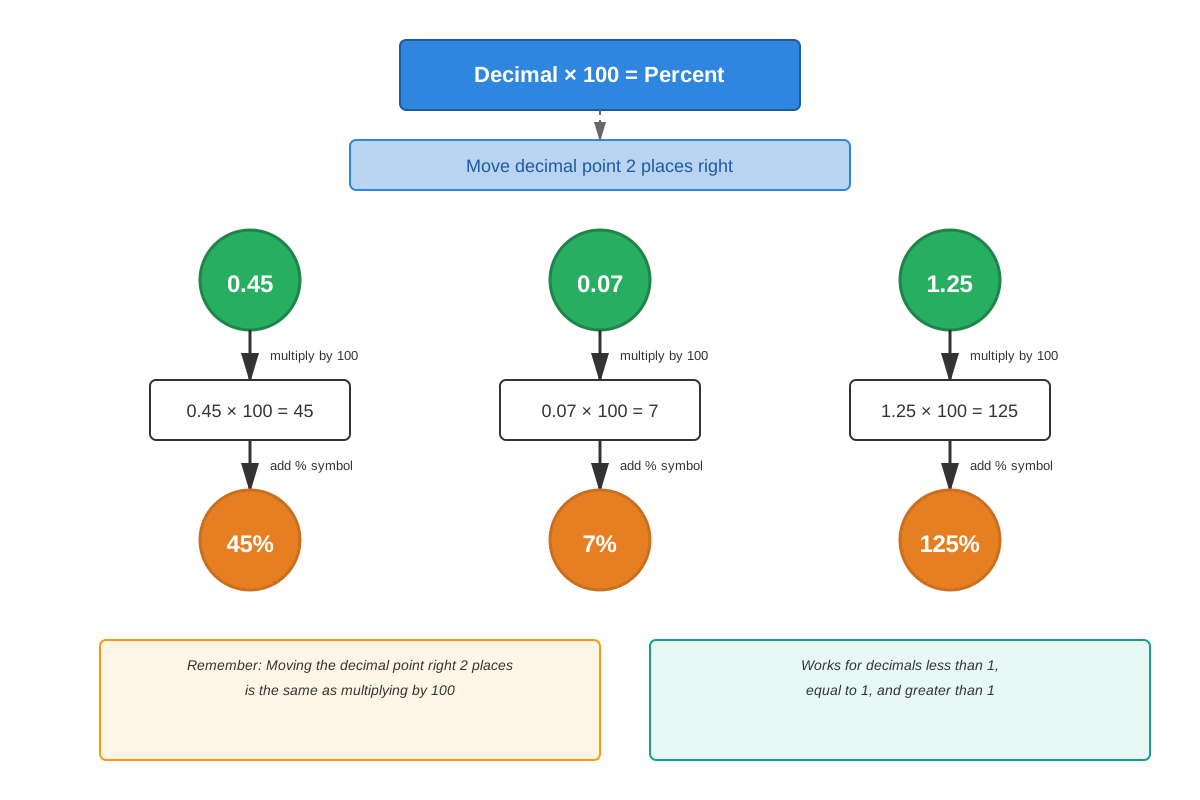
To convert a decimal to a percentage, multiply the decimal by 100 and add the percent symbol (%). This multiplication by 100 effectively moves the decimal point two places to the right.
Step-by-step process:
- Identify the decimal value to be converted
- Multiply the decimal by 100 (or move the decimal point two places to the right)
- Add the percent symbol (%)
Examples:
- 0.45 → 0.45 × 100 = 45%
- 0.8 → 0.8 × 100 = 80% (note: 0.80 = 80%)
- 0.075 → 0.075 × 100 = 7.5%
- 1.25 → 1.25 × 100 = 125%
- 0.003 → 0.003 × 100 = 0.3%
Notice that decimals greater than 1 convert to percentages greater than 100%, which is perfectly valid and commonly appears in growth scenarios. Decimals less than 0.01 convert to percentages less than 1%, which appear in contexts involving small probabilities or concentrations.
Converting Percentages to Decimals
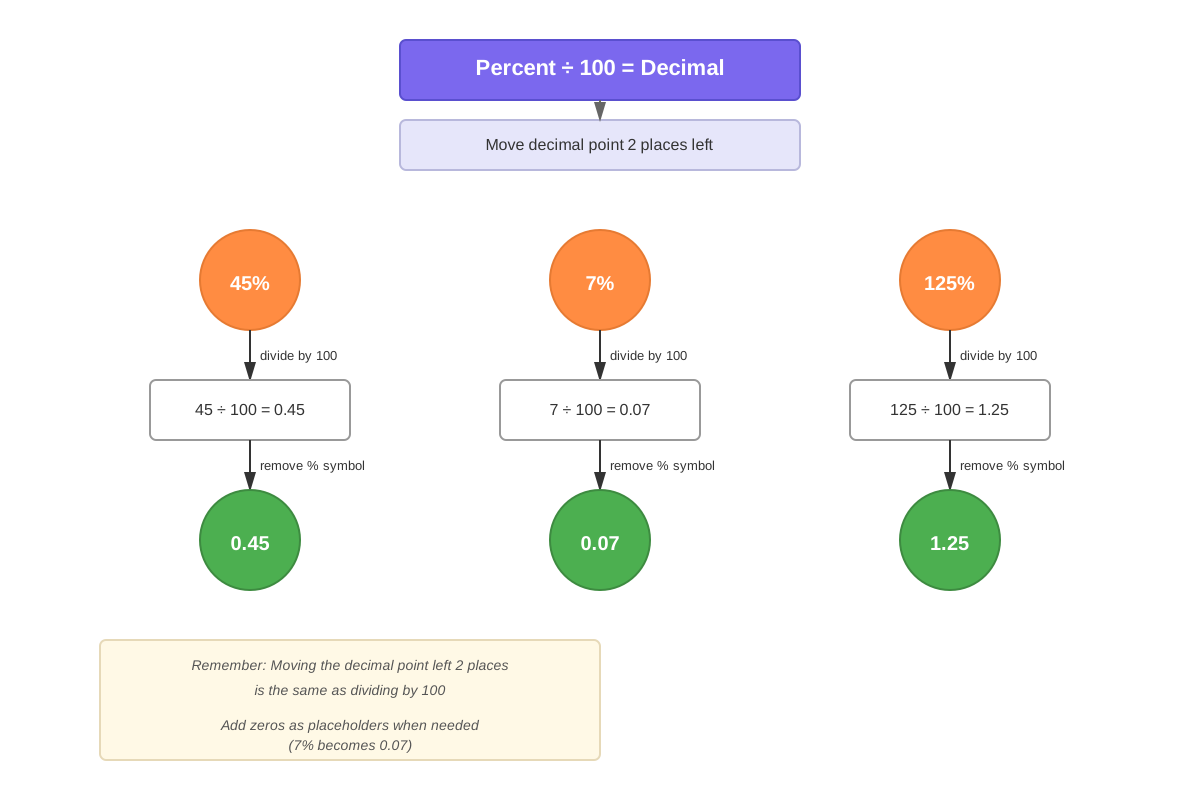
To convert a percentage to a decimal, divide the percentage by 100 and remove the percent symbol. This division by 100 effectively moves the decimal point two places to the left.
Step-by-step process:
- Identify the percentage value to be converted
- Remove the percent symbol (%)
- Divide the number by 100 (or move the decimal point two places to the left)
Examples:
- 65% → 65 ÷ 100 = 0.65
- 8% → 8 ÷ 100 = 0.08 (note: must add a leading zero)
- 150% → 150 ÷ 100 = 1.5
- 0.5% → 0.5 ÷ 100 = 0.005
- 33.3% → 33.3 ÷ 100 = 0.333
When converting percentages less than 10% to decimals, students must remember to include the leading zero before the decimal point (0.08, not .08) for clarity and to avoid calculation errors.
Special Cases and Edge Cases
Several special cases deserve particular attention:
| Percentage | Decimal | Notes |
|---|---|---|
| 100% | 1.0 | Represents the whole or complete amount |
| 50% | 0.5 | One-half; frequently appears in SAT problems |
| 25% | 0.25 | One-quarter; common in discount problems |
| 10% | 0.1 | Useful for mental math estimation |
| 1% | 0.01 | Baseline for small percentages |
| 200% | 2.0 | Doubling; appears in growth problems |
| 0.1% | 0.001 | Very small percentages in scientific contexts |
Working with Percentage Points vs. Percentages
An important distinction that appears on the SAT involves the difference between "percentage points" and "percentages." If a value increases from 20% to 25%, it has increased by 5 percentage points, but the percentage increase is 25% (since 5 is 25% of 20). This distinction requires careful reading and proper conversion between decimals and percentages to calculate correctly.
Mental Math Shortcuts
For efficient SAT performance, students should memorize common conversions:
- Halving and doubling: 50% = 0.5, so 25% = 0.25 and 75% = 0.75
- Tenths: 10% = 0.1, 20% = 0.2, 30% = 0.3, etc.
- Common fractions: 33⅓% = 0.333..., 66⅔% = 0.666..., 12.5% = 0.125
- Quick estimation: To find 1% of any number, move the decimal two places left
Concept Relationships
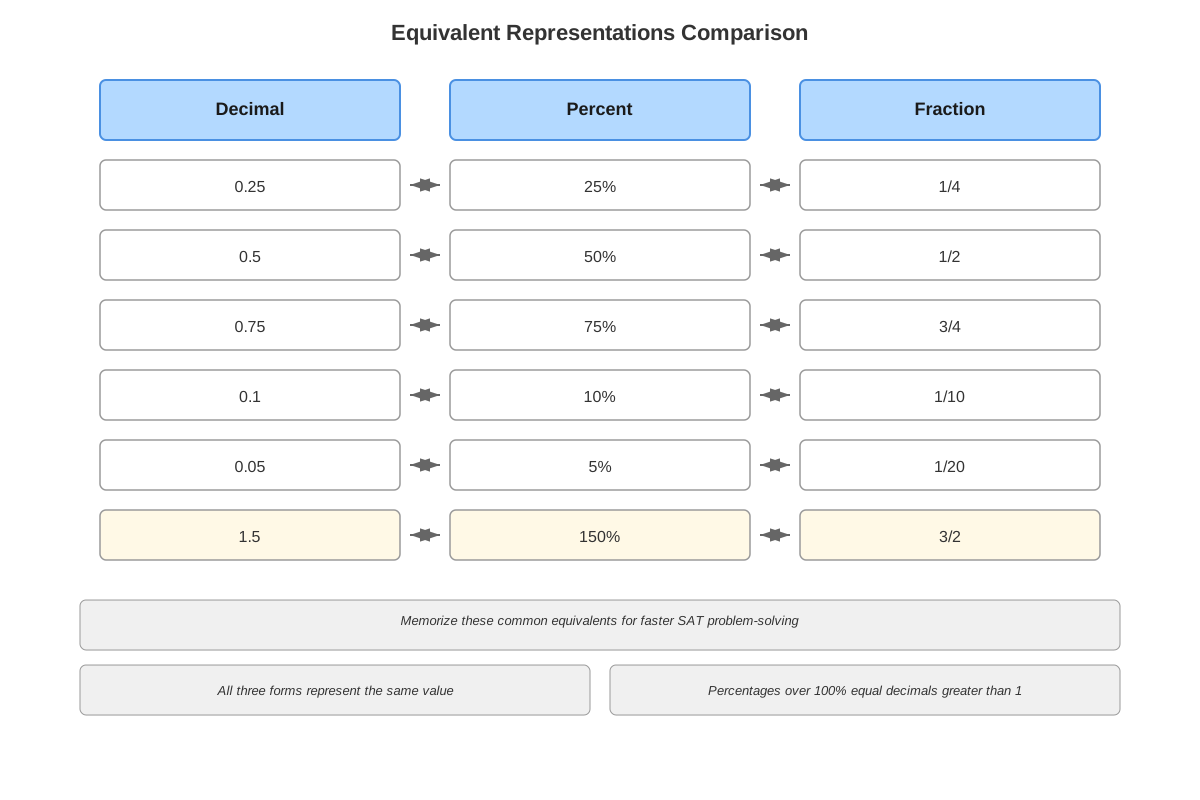
The conversion between decimals and percentages forms a bidirectional relationship where each representation can be transformed into the other through inverse operations (multiplication and division by 100). This conversion skill connects directly to fraction operations because percentages can also be expressed as fractions with denominator 100, creating a three-way relationship: decimal ↔ percentage ↔ fraction.
Within the broader context of SAT Math, decimal percent conversion serves as a foundational skill that enables more complex operations. The relationship map flows as follows:
Basic Conversion → Percentage Calculations → Percentage Change Problems → Growth and Decay Models
Similarly: Decimal Operations → Decimal Percent Conversion → Probability Calculations → Statistical Analysis
The topic also connects to ratio and proportion concepts, as percentages represent a specific type of ratio (parts per hundred). This connection extends to scale factors in geometry and unit rates in algebra. Understanding these relationships allows students to recognize that many seemingly different SAT problems actually rely on the same fundamental conversion skills.
Quick check — test yourself on Decimal percent conversion so far.
Try Flashcards →High-Yield Facts
⭐ To convert a decimal to a percentage, multiply by 100 (move decimal point two places right) and add the % symbol
⭐ To convert a percentage to a decimal, divide by 100 (move decimal point two places left) and remove the % symbol
⭐ 100% equals 1.0 in decimal form; this is the baseline for all conversions
⭐ Percentages greater than 100% convert to decimals greater than 1.0 and represent values exceeding the original whole
⭐ When converting percentages less than 10% to decimals, always include a zero in the tenths place (e.g., 5% = 0.05, not 0.5)
- The operations for converting between decimals and percentages are inverse operations (multiplication and division by 100)
- A decimal value of 0.01 represents exactly 1%, making this a useful reference point for mental calculations
- Percentages can exceed 100% or be less than 1%, depending on the context of the problem
- Moving the decimal point two places is equivalent to multiplying or dividing by 100
- The percent symbol (%) is not a unit that can be canceled algebraically; it represents a specific mathematical operation (division by 100)
- Common benchmark percentages (10%, 25%, 50%, 75%) should be memorized in decimal form for rapid calculation
- Percentage points and percentages are different concepts; a change from 30% to 40% is a 10 percentage point increase but a 33.3% increase
Common Misconceptions
Misconception: Moving the decimal point one place converts between decimals and percentages → Correction: The decimal point must move exactly two places because the conversion factor is 100 (which has two zeros), not 10. Moving it only one place would multiply or divide by 10, giving an incorrect result that is off by a factor of 10.
Misconception: Percentages cannot exceed 100% → Correction: Percentages can be any positive value, including values greater than 100%. A 150% increase or a value that is 200% of the original are both valid and commonly appear in SAT problems involving growth, comparison, or scaling.
Misconception: 0.5% equals 0.5 in decimal form → Correction: 0.5% equals 0.005 in decimal form. Students often forget to divide by 100 when the percentage itself contains a decimal point, leading to answers that are 100 times too large.
Misconception: The percent symbol can be treated like a variable and canceled algebraically → Correction: The percent symbol represents a mathematical operation (division by 100), not a variable. It cannot be canceled or manipulated using algebraic rules. It must be converted to decimal or fraction form before performing algebraic operations.
Misconception: When converting 8% to a decimal, the answer is 0.8 → Correction: 8% converts to 0.08, not 0.8. This error occurs when students move the decimal point only one place instead of two, or when they confuse 8% with 80%. Always move the decimal point two full places to the left when converting percentages to decimals.
Misconception: A percentage increase from 20% to 25% is a 5% increase → Correction: This is a 5 percentage point increase, but the percentage increase is 25% (since 5 is 25% of the original 20). The SAT frequently tests the distinction between percentage points and percentages, requiring careful attention to the specific wording of the question.
Worked Examples
Example 1: Direct Conversion in a Word Problem
Problem: A student answered 34 questions correctly on a 40-question test. The teacher records grades as decimals in the gradebook but reports them as percentages to students. What percentage did the student earn, and what decimal should the teacher record?
Solution:
Step 1: Calculate the decimal grade by dividing correct answers by total questions.
34 ÷ 40 = 0.85Step 2: Convert the decimal to a percentage for reporting to the student.
0.85 × 100 = 85%Step 3: Verify the conversion by checking that the decimal and percentage represent the same value.
85% = 85/100 = 0.85 ✓Answer: The student earned 85%, and the teacher should record 0.85 in the gradebook.
Connection to Learning Objectives: This problem demonstrates the practical application of decimal percent conversion in a real-world academic context, requiring conversion in both directions and showing how the same value can be represented in multiple forms depending on the purpose.
Example 2: Multi-Step Problem with Percentage Change
Problem: A stock was valued at $50 per share. After one year, its value increased to $65 per share. Express the increase as both a decimal and a percentage of the original value. If an investor owned 200 shares, what was the dollar amount of the increase?
Solution:
Step 1: Calculate the dollar amount of increase per share.
$65 - $50 = $15 increase per shareStep 2: Express the increase as a decimal of the original value.
$15 ÷ $50 = 0.3Step 3: Convert the decimal to a percentage.
0.3 × 100 = 30%Step 4: Calculate the total dollar increase for 200 shares.
$15 × 200 = $3,000Step 5: Verify using the percentage method.
$50 × 200 = $10,000 (original investment)
$10,000 × 0.3 = $3,000 (increase) ✓Answer: The increase was 0.3 (or 30%) of the original value, representing a $3,000 gain for the investor.
Connection to Learning Objectives: This problem integrates decimal percent conversion with percentage change calculations, demonstrating how conversion skills enable solving complex, multi-step problems. It also shows the importance of working flexibly between decimal and percentage forms to verify answers and choose efficient solution paths.
Exam Strategy
Approaching SAT Questions on This Topic
When encountering problems involving decimals and percentages on the SAT, follow this systematic approach:
- Identify the given format: Determine whether the problem provides information in decimal or percentage form
- Identify the required format: Note whether the answer choices are in decimal or percentage form
- Convert strategically: Only convert when necessary; sometimes working in the given format is more efficient
- Double-check decimal placement: The most common errors involve misplacing the decimal point by one position
Trigger Words and Phrases
Watch for these key phrases that signal the need for decimal percent conversion:
- "Express as a percentage" or "What percent..." → Convert decimal result to percentage
- "Express as a decimal" → Convert percentage to decimal
- "Increased by X%" → Convert percentage to decimal before multiplying
- "X% of Y" → Convert percentage to decimal, then multiply
- "What is the decimal equivalent..." → Direct conversion required
- "Probability" problems → Often require converting decimal answers to percentages or vice versa
Process-of-Elimination Tips
When answer choices mix decimals and percentages:
- Eliminate answers in the wrong format if the question specifically asks for a decimal or percentage
- Check magnitude: If you calculate approximately 0.3, eliminate answers like 3% (too small) or 300% (too large)
- Verify decimal placement: If your calculation gives 0.45, eliminate 4.5%, 450%, 0.045, and 4.5 as likely decimal placement errors
- Use benchmark values: If you know the answer should be around half, eliminate options far from 50% or 0.5
Time Allocation Advice
Direct conversion problems should take 15-30 seconds once the skill is mastered. For multi-step problems incorporating conversion:
- Spend 10-15 seconds reading and identifying what conversion is needed
- Spend 20-30 seconds performing the conversion and primary calculation
- Reserve 10-15 seconds for verification, especially checking decimal point placement
If a problem seems to require complex conversion calculations, look for alternative approaches—the SAT often rewards strategic thinking over lengthy computation.
Memory Techniques
The "Two-Place Rule" Mnemonic
"Percent has two syllables, move two places"
This simple phrase reminds students that converting to or from percentages involves moving the decimal point exactly two places. The two syllables in "per-cent" correspond to the two places the decimal moves.
Directional Memory Aid
"Percent is bigger, decimal is smaller"
When converting from decimal to percent, the number gets bigger (0.45 becomes 45), so multiply (or move right). When converting from percent to decimal, the number gets smaller (45 becomes 0.45), so divide (or move left).
Visualization Strategy: The Hundred-Square Grid
Visualize a 10×10 grid containing 100 squares. When you see 0.35, imagine 35 of those 100 squares shaded—that's 35%. This mental image reinforces that percentages represent parts per hundred and helps prevent decimal placement errors.
Benchmark Anchors
Memorize these anchor points and use them as reference:
- 0.5 = 50% (half)
- 0.25 = 25% (quarter)
- 0.1 = 10% (tenth)
- 1.0 = 100% (whole)
When converting unfamiliar values, compare them to these anchors. Is 0.35 closer to 0.25 or 0.5? It's between them, so it should be between 25% and 50%—and indeed, 35% fits perfectly.
Summary
Decimal percent conversion is an essential mathematical skill that enables students to translate flexibly between two common numerical representations. The conversion process relies on the fundamental relationship that percentages represent parts per hundred, making the conversion factor consistently 100. Converting from decimal to percentage requires multiplying by 100 (moving the decimal point two places right) and adding the percent symbol, while converting from percentage to decimal requires dividing by 100 (moving the decimal point two places left) and removing the percent symbol. On the SAT, this skill rarely appears in isolation but instead integrates into multi-step problems involving percentage change, probability, data interpretation, and real-world applications. Mastery requires not only mechanical proficiency with the conversion process but also strategic awareness of when conversion is necessary, careful attention to decimal point placement, and understanding of special cases like percentages exceeding 100% or less than 1%. Students who develop fluency with these conversions gain significant advantages in speed and accuracy across numerous SAT Math question types.
Key Takeaways
- Decimal to percentage conversion: multiply by 100 and add %; percentage to decimal: divide by 100 and remove %
- The decimal point always moves exactly two places during conversion because the conversion factor is 100
- Percentages can be any positive value, including those greater than 100% or less than 1%
- Common conversion errors involve misplacing the decimal point by one position—always double-check placement
- Memorize benchmark conversions (0.5 = 50%, 0.25 = 25%, 0.1 = 10%, 1.0 = 100%) for rapid mental calculation
- Distinguish between "percentage points" and "percentages" when interpreting change problems
- Strategic conversion—only convert when necessary for the specific problem or answer format required
Related Topics
Percentage Calculations: Building on conversion skills, this topic covers finding percentages of quantities, calculating percentage increase and decrease, and solving problems involving successive percentage changes. Mastering decimal percent conversion is essential groundwork for these more complex operations.
Ratios and Proportions: Percentages represent a specific type of ratio (parts per 100), so understanding conversions enables deeper work with proportional relationships, scale factors, and comparative analysis across different contexts.
Probability and Statistics: Many probability problems require converting between decimal probabilities (like 0.35) and percentage probabilities (like 35%). Statistical data interpretation often involves converting between formats depending on how information is presented in tables and graphs.
Financial Mathematics: Interest calculations, discount problems, tax computations, and investment returns all require fluent conversion between decimals and percentages. This topic provides the foundation for all SAT financial literacy questions.
Practice CTA
Now that you've mastered the core concepts of decimal percent conversion, it's time to solidify your understanding through active practice. Complete the practice questions to test your ability to convert quickly and accurately under timed conditions. Use the flashcards to drill the benchmark conversions until they become automatic. Remember: the difference between knowing the process and achieving mastery lies in deliberate practice. Every conversion you practice now is one you'll execute flawlessly and efficiently on test day. You've got this!
Sign up free to keep reading
Create a free AnvayaPrep account to finish this SAT guide on Decimal percent conversion — plus flashcards and practice questions.