Overview
Finding original value is a critical percentage skill that appears frequently on the SAT math section. This concept involves working backward from a final amount to determine what the starting value was before a percentage increase or decrease occurred. For example, if a shirt is on sale for $60 after a 25% discount, finding the original value means calculating what the shirt cost before the discount was applied.
This topic represents a fundamental application of algebraic thinking combined with percentage operations. Unlike straightforward percentage problems where students calculate a percentage of a known value, sat finding original value questions require reverse reasoning and equation setup. Students must recognize that the final value represents a certain percentage of the unknown original, then construct and solve an equation to find that original amount. This skill appears in various contexts on the SAT, including word problems about sales discounts, population changes, price increases, tax calculations, and investment scenarios.
Mastering finding original value strengthens overall mathematical reasoning and connects directly to other essential SAT topics including linear equations, ratios, proportions, and real-world problem solving. The ability to work backward from given information is a higher-order thinking skill that the SAT tests extensively. Students who can confidently tackle these problems gain a significant advantage, as these questions often appear in the medium-to-hard difficulty range where correct answers substantially impact scores. Understanding this concept also builds the foundation for more complex percentage problems involving compound changes and multi-step calculations.
Learning Objectives
- [ ] Identify key features of finding original value problems
- [ ] Explain how finding original value appears on the SAT
- [ ] Apply finding original value to answer SAT-style questions
- [ ] Set up and solve equations to determine original values from final amounts
- [ ] Distinguish between percentage increase and decrease scenarios when finding original values
- [ ] Convert word problems into mathematical expressions involving original values
- [ ] Verify solutions by checking whether the calculated original value produces the given final value
Prerequisites
- Basic percentage calculations: Understanding how to find a percentage of a number is essential because finding original value reverses this operation
- Solving linear equations: Students must manipulate equations with variables to isolate the unknown original value
- Decimal and fraction conversions: Converting percentages to decimals (e.g., 30% = 0.30) is necessary for setting up equations correctly
- Order of operations: Properly evaluating expressions ensures accurate calculations when working with percentages and original values
Why This Topic Matters
Finding original value has immediate real-world applications that students encounter regularly. When shopping, consumers often see sale prices and want to know the original cost to evaluate the actual savings. Financial planning requires understanding how to work backward from investment goals to determine required initial deposits. Business owners must calculate original prices before markup to set competitive pricing. Tax calculations frequently involve determining pre-tax amounts from final totals.
On the SAT, finding original value questions appear with notable frequency—typically 2-4 questions per test across both the calculator and no-calculator sections. These problems consistently appear in the Problem Solving and Data Analysis domain, which comprises approximately 29% of SAT math questions. The College Board specifically tests this skill because it demonstrates mathematical maturity and the ability to think flexibly about quantitative relationships.
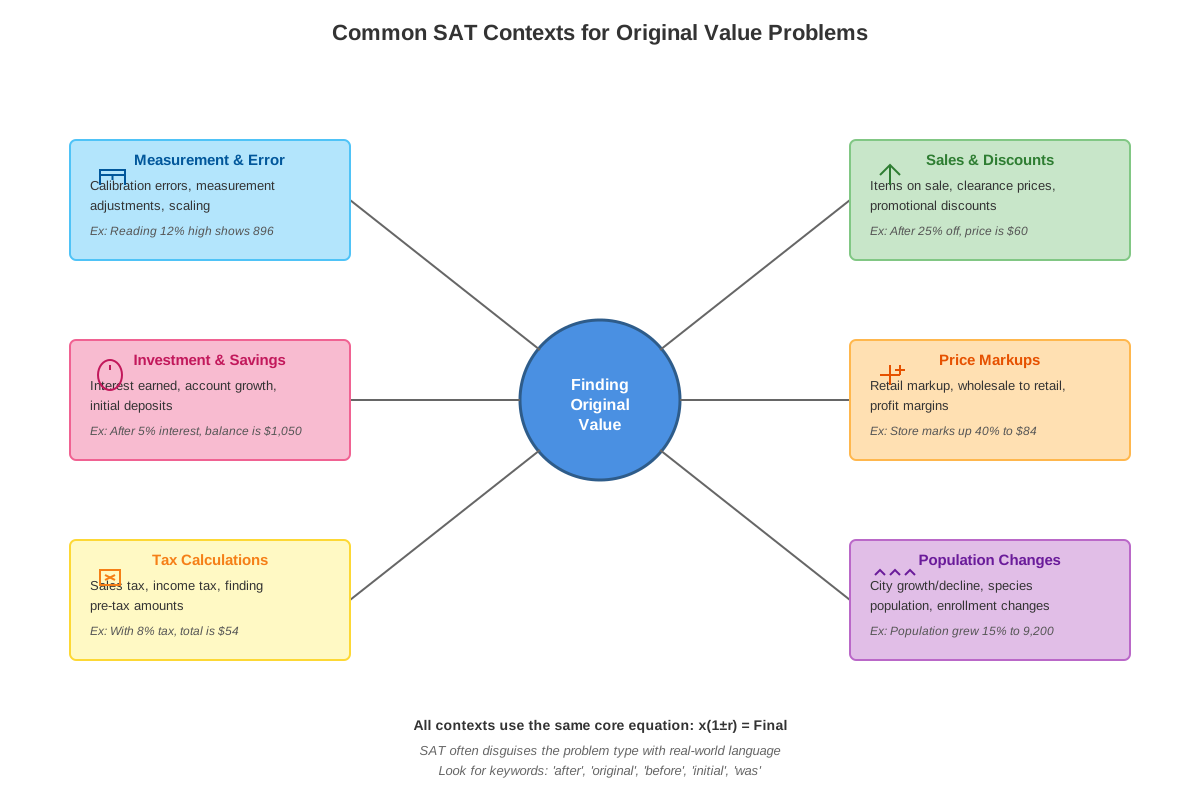
Common SAT presentations include: word problems describing discounts or markups where the final price is given; scenarios involving population or quantity changes over time; tax and tip calculations presented in reverse; and multi-step problems where finding the original value is one component of a larger solution. Questions may appear as multiple-choice, grid-in responses, or as part of extended thinking problems worth multiple points. The SAT particularly favors contexts involving retail pricing, percentage growth/decline in populations or measurements, and financial scenarios that test real-world mathematical literacy.
Core Concepts
The Fundamental Relationship
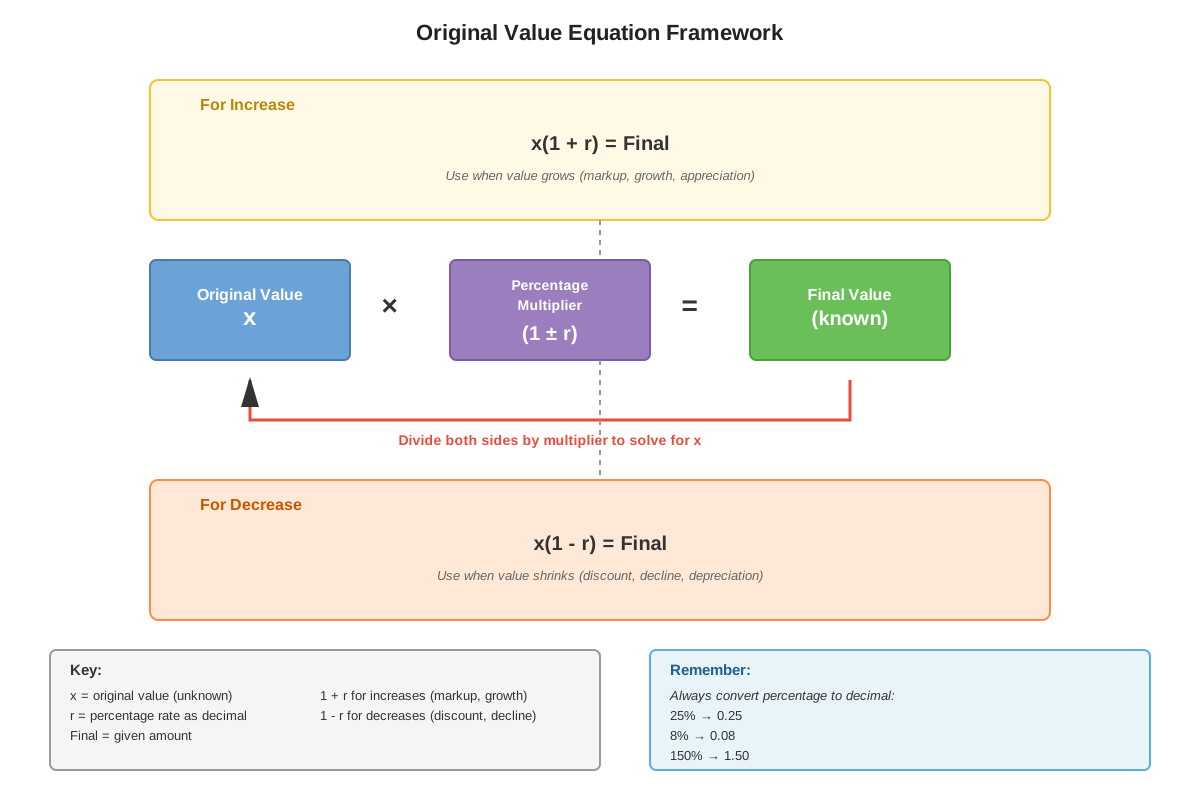
The core principle of finding original value rests on understanding the relationship between an original amount, a percentage change, and a final amount. When a value increases or decreases by a certain percentage, the final value represents a specific percentage of the original. This relationship can be expressed algebraically:
Final Value = Original Value × (1 ± Percentage Change)
For increases, use addition: Final = Original × (1 + rate)
For decreases, use subtraction: Final = Original × (1 - rate)
To find the original value, this equation must be rearranged:
Original Value = Final Value ÷ (1 ± Percentage Change)
Percentage Decrease Scenarios
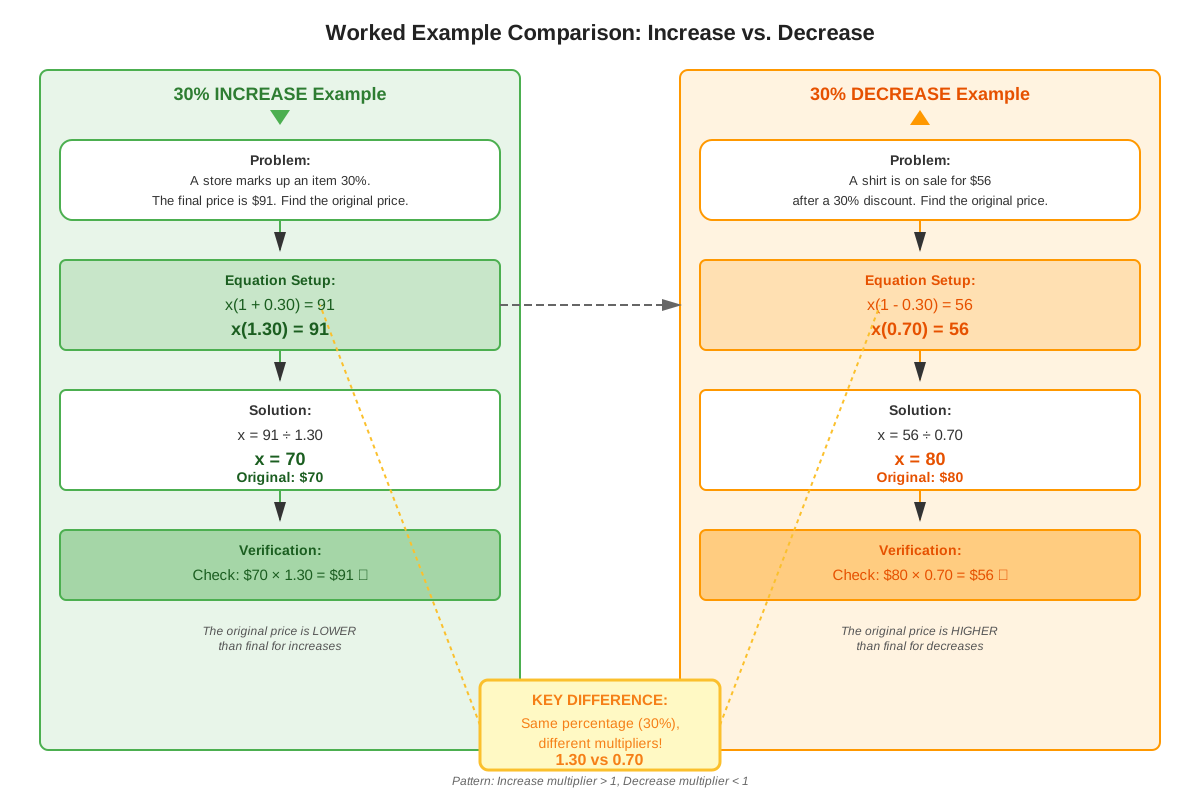
When an item decreases in value—through discounts, depreciation, or reduction—the final amount represents less than 100% of the original. If a $120 jacket is discounted by 20%, the sale price is 80% of the original price (100% - 20% = 80%).
To find the original value when given a final value after a decrease:
- Determine what percentage the final value represents (100% - decrease percentage)
- Convert this percentage to a decimal
- Divide the final value by this decimal
Example: A discounted item costs $45 after a 25% discount. What was the original price?
- After 25% off, the price is 75% of the original (100% - 25% = 75%)
- Convert to decimal: 75% = 0.75
- Original = $45 ÷ 0.75 = $60
Percentage Increase Scenarios
When values increase—through markups, growth, or appreciation—the final amount represents more than 100% of the original. If a store marks up an item by 30%, the selling price is 130% of the original cost (100% + 30% = 130%).
To find the original value when given a final value after an increase:
- Determine what percentage the final value represents (100% + increase percentage)
- Convert this percentage to a decimal
- Divide the final value by this decimal
Example: After a 15% price increase, an item costs $92. What was the original price?
- After 15% increase, the price is 115% of the original (100% + 15% = 115%)
- Convert to decimal: 115% = 1.15
- Original = $92 ÷ 1.15 = $80
Setting Up Equations
The algebraic approach provides a systematic method for solving finding original value problems. Let x represent the original value. The equation structure depends on whether the change is an increase or decrease:
For decreases: x(1 - r) = final value
For increases: x(1 + r) = final value
Where r is the rate expressed as a decimal.
Example equation setup: "After a 12% decrease, the population is 22,000"
- Let x = original population
- Equation: x(1 - 0.12) = 22,000
- Simplify: x(0.88) = 22,000
- Solve: x = 22,000 ÷ 0.88 = 25,000
Multiple Percentage Changes
Some SAT problems involve finding the original value after multiple percentage changes have occurred. These require careful sequential thinking or can be solved by combining the multipliers.
Sequential approach: Work backward through each change in reverse order.
Combined approach: Multiply the change factors together, then divide the final value by the product.
Example: A price increased by 20%, then decreased by 10%, resulting in $108. Find the original price.
- Combined multiplier: (1.20)(0.90) = 1.08
- Original = $108 ÷ 1.08 = $100
Common Formula Variations
| Scenario | Formula | Example |
|---|---|---|
| After discount | Original = Final ÷ (1 - discount rate) | Final = $80, 20% off: $80 ÷ 0.80 = $100 |
| After markup | Original = Final ÷ (1 + markup rate) | Final = $150, 25% markup: $150 ÷ 1.25 = $120 |
| After tax added | Original = Final ÷ (1 + tax rate) | Final = $53, 6% tax: $53 ÷ 1.06 = $50 |
| After depreciation | Original = Final ÷ (1 - depreciation rate) | Final = $12,000, 40% loss: $12,000 ÷ 0.60 = $20,000 |
Verification Strategy
After calculating an original value, always verify the answer by working forward. Apply the percentage change to the calculated original value and confirm it produces the given final value. This catches calculation errors and confirms the problem was interpreted correctly.
Verification steps:
- Take the calculated original value
- Apply the stated percentage change
- Check if the result matches the given final value
- If not, review the equation setup and calculations
Concept Relationships
Finding original value builds directly on basic percentage calculations but reverses the typical computational direction. While standard percentage problems move from known original values to final values (Original → Percentage Change → Final), finding original value problems require working backward (Final → Reverse Calculation → Original). This reverse thinking connects to the broader mathematical concept of inverse operations.
The relationship map for this topic flows as follows:
Basic Percentages → enables → Percentage Change Calculations → reverses to → Finding Original Value → extends to → Multi-step Percentage Problems
Within the topic itself, concepts connect hierarchically:
Understanding the 100% baseline → leads to → Recognizing what percentage the final represents → enables → Setting up the division equation → results in → Calculating the original value → requires → Verification through forward calculation
Finding original value also connects laterally to other SAT math topics. It shares equation-solving techniques with linear equations, uses proportional reasoning similar to ratio problems, and applies the same logical structure as working backward in function problems. The skill of identifying what percentage a value represents connects to fraction and decimal operations. Additionally, word problem interpretation skills developed here transfer directly to other applied mathematics contexts on the SAT.
High-Yield Facts
⭐ The final value after a percentage decrease equals the original value multiplied by (1 - rate as a decimal)
⭐ To find original value after a decrease, divide the final value by (1 - rate)
⭐ The final value after a percentage increase equals the original value multiplied by (1 + rate as a decimal)
⭐ To find original value after an increase, divide the final value by (1 + rate)
⭐ A 25% discount means the sale price is 75% of the original, not that you divide by 0.25
- After a 100% increase, the final value is 200% (or 2 times) the original value
- Multiple percentage changes cannot be simply added; each must be applied sequentially or multiplied as factors
- The original value is always larger than the final value after a decrease and smaller than the final value after an increase
- Converting percentages to decimals is essential: divide by 100 or move the decimal point two places left
- Verification by working forward should always produce the given final value if the original was calculated correctly
- Grid-in questions about original values require careful attention to rounding instructions
- Context clues in word problems indicate whether the change is an increase (markup, growth, appreciation, tax added) or decrease (discount, depreciation, reduction, loss)
Quick check — test yourself on Finding original value so far.
Try Flashcards →Common Misconceptions
Misconception: Dividing the final value by the percentage change rate gives the original value.
Correction: You must divide by (1 ± rate), not by the rate alone. For a 30% discount resulting in $70, the original is $70 ÷ 0.70 = $100, not $70 ÷ 0.30 = $233.33.
Misconception: A 20% discount means multiplying the final price by 0.20 to find the original.
Correction: After a 20% discount, the final price is 80% of the original. To find the original, divide the final price by 0.80, not multiply by 0.20.
Misconception: To reverse a percentage increase, simply subtract that percentage from the final value.
Correction: Percentage changes are multiplicative, not additive. If a value increased by 10% to reach $110, the original isn't $110 - $10 = $100 by coincidence, but because $110 ÷ 1.10 = $100. For other amounts, simple subtraction fails.
Misconception: Multiple percentage changes can be combined by adding them (e.g., +20% then -10% equals +10% total).
Correction: Percentage changes multiply, not add. A 20% increase followed by 10% decrease means multiplying by 1.20 then 0.90, giving a combined factor of 1.08 (an 8% increase), not 1.10.
Misconception: The original value after a 50% decrease is found by doubling the final value.
Correction: While this happens to work for 50% (since 1 - 0.50 = 0.50, and dividing by 0.50 equals multiplying by 2), it's a special case. Understanding the general formula prevents errors with other percentages.
Misconception: If an item increased by 25% to reach $100, it originally cost $75.
Correction: After a 25% increase, the price is 125% of the original. Original = $100 ÷ 1.25 = $80, not $75. The error comes from subtracting 25% of the final value instead of dividing by 1.25.
Misconception: Tax problems always involve finding the original value before tax.
Correction: Read carefully—some problems give the pre-tax amount and ask for the total, while others give the total and ask for the pre-tax amount. Identify which value is given and which is requested.
Worked Examples
Example 1: Discount Scenario
Problem: A laptop is on sale for $680 after a 15% discount. What was the original price of the laptop?
Solution:
Step 1: Identify the type of change
This is a discount (decrease), so the sale price represents less than 100% of the original.
Step 2: Determine what percentage the final value represents
100% - 15% = 85%
The sale price is 85% of the original price.
Step 3: Convert to decimal
85% = 0.85
Step 4: Set up the equation
Let x = original price
0.85x = 680
Step 5: Solve for x
x = 680 ÷ 0.85
x = 800
Step 6: Verify
Check: $800 × 0.85 = $680 ✓
Answer: The original price was $800.
Connection to learning objectives: This example demonstrates identifying key features (discount scenario), applying the concept to solve an SAT-style problem, and verifying the solution.
Example 2: Multiple Changes with Population
Problem: A town's population decreased by 20% from 2010 to 2015, then increased by 30% from 2015 to 2020. If the population in 2020 was 20,800, what was the population in 2010?
Solution:
Step 1: Identify the changes
- First change: 20% decrease (multiply by 0.80)
- Second change: 30% increase (multiply by 1.30)
Step 2: Determine the combined multiplier
Combined factor = 0.80 × 1.30 = 1.04
Step 3: Set up the equation
Let x = original population in 2010
x × 1.04 = 20,800
Step 4: Solve for x
x = 20,800 ÷ 1.04
x = 20,000
Step 5: Verify by working forward
- 2010: 20,000
- After 20% decrease: 20,000 × 0.80 = 16,000 (population in 2015)
- After 30% increase: 16,000 × 1.30 = 20,800 (population in 2020) ✓
Answer: The population in 2010 was 20,000.
Connection to learning objectives: This example shows how to handle multi-step percentage problems, set up complex equations, and distinguish between different types of percentage changes when finding original values.
Example 3: Markup Scenario
Problem: A retailer sells a jacket for $156 after applying a 30% markup to the wholesale cost. What was the wholesale cost?
Solution:
Step 1: Identify the type of change
This is a markup (increase), so the retail price is more than 100% of the wholesale cost.
Step 2: Determine what percentage the final value represents
100% + 30% = 130%
The retail price is 130% of the wholesale cost.
Step 3: Convert to decimal
130% = 1.30
Step 4: Set up and solve
Let x = wholesale cost
1.30x = 156
x = 156 ÷ 1.30
x = 120
Step 5: Verify
Check: $120 × 1.30 = $156 ✓
Answer: The wholesale cost was $120.
Exam Strategy
When approaching SAT questions on finding original value, begin by carefully reading the problem to identify whether the given value is the original or the final amount. Look for keywords that signal the direction of change: "after," "following," "resulting in," and "now" typically indicate a final value is given, requiring you to find the original.
Trigger words for decreases: discount, sale, off, reduced, decreased, depreciation, loss, decline, markdown, savings
Trigger words for increases: markup, increased, growth, appreciation, more than, tax added, tip included, surcharge
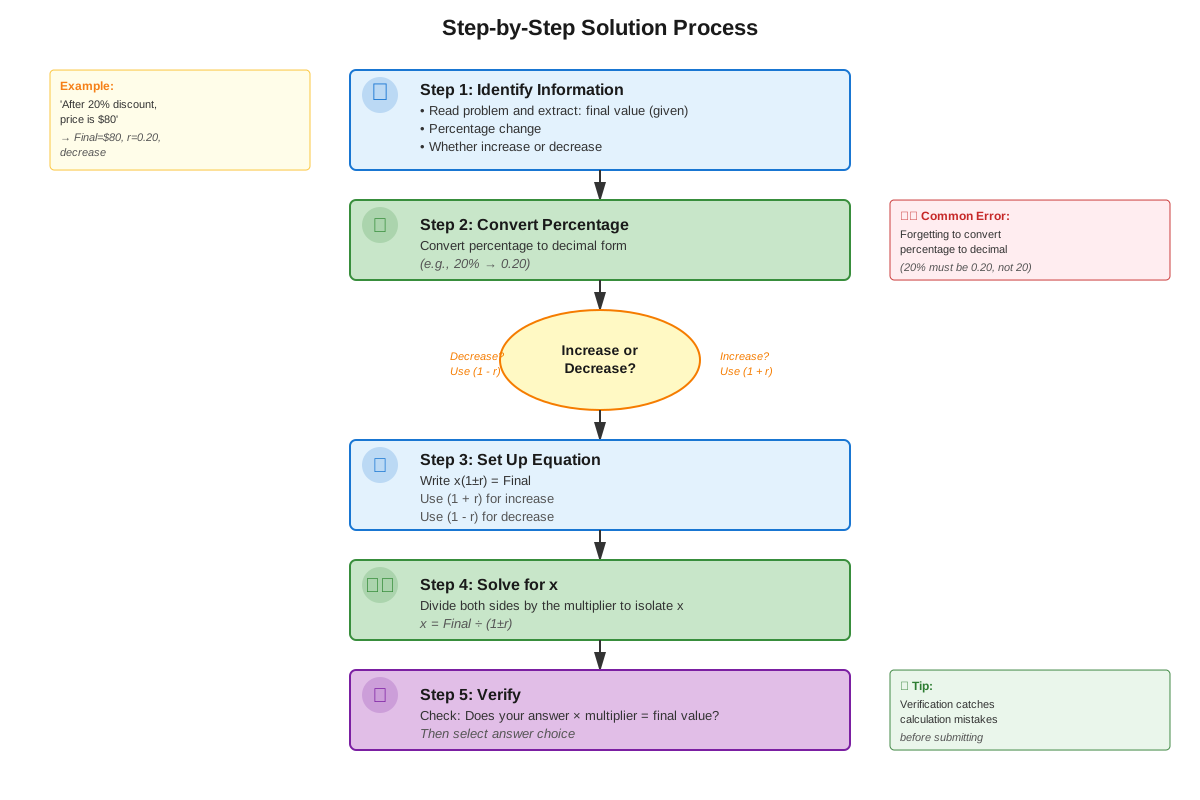
Create a systematic approach for every problem:
- Identify what's given and what's requested (circle the final value, underline what you're solving for)
- Determine if the change is an increase or decrease (this affects whether you use 1 + r or 1 - r)
- Calculate what percentage the given value represents (100% ± change percentage)
- Set up the division (final value ÷ decimal form of the percentage)
- Verify your answer (multiply back to check)
For process-of-elimination on multiple-choice questions, use estimation and logic. If an item costs $80 after a 20% discount, the original must be greater than $80 (eliminate any choices ≤ $80). Quick mental math: 20% off means paying 80%, so the original is roughly $80 ÷ 0.8 = $100. Eliminate choices far from this estimate.
Time allocation: These problems typically require 60-90 seconds. If you're spending more than 2 minutes, move on and return later. The calculation itself is quick once the equation is properly set up, so most time should go to careful reading and setup.
Watch for trap answers that result from common errors: dividing by the rate instead of (1 ± rate), or subtracting the percentage from the final value. The SAT deliberately includes these as wrong answer choices.
For grid-in questions, pay attention to whether the answer should be in dollars, whole numbers, or can include decimals. If your calculated original value is $83.33..., check whether the problem asks for the nearest dollar or exact value.
Memory Techniques
The "Reverse Percentage" Mnemonic: F.O.D. - Final Over Decimal
- Final value goes in the numerator
- Over (division symbol)
- Decimal form of (1 ± rate) goes in the denominator
The "100% Baseline" Visualization: Picture a number line with 100% in the middle. Discounts move left (below 100%), markups move right (above 100%). The final value sits at the new percentage mark, and you're finding what value sits at the 100% mark.
The "Opposite Operations" Reminder:
- Problem gives you: Original × Factor = Final
- You need to do: Final ÷ Factor = Original
- Remember: Multiplication Divides (when reversed)
Acronym for verification - CHECK:
- Calculate the original value
- Have the percentage change ready
- Execute the forward calculation
- Compare to the given final value
- Keep or revise your answer
The "Sale Price Rhyme":
"When the sale price you see, divide by what's left of one-hundred-and-three" (adjust the number to match the percentage remaining)
For remembering increase vs. decrease formulas, visualize:
- Decrease = Diminish = Subtract → (1 - r)
- Increase = Add = Plus → (1 + r)
Summary
Finding original value is an essential SAT math skill that requires working backward from a final amount to determine the starting value before a percentage change occurred. The fundamental principle involves recognizing that after a percentage increase or decrease, the final value represents a specific percentage of the original—either more than 100% (for increases) or less than 100% (for decreases). The core formula divides the final value by (1 ± rate), where the rate is expressed as a decimal and the sign depends on whether the change was an increase or decrease. Success with these problems requires careful reading to identify which value is given and which is requested, proper equation setup using the relationship Final = Original × (1 ± rate), and verification by working forward to confirm the calculated original produces the given final value. This topic appears frequently on the SAT in contexts involving discounts, markups, population changes, and financial calculations, making it a high-yield area for focused study and practice.
Key Takeaways
- To find the original value after a percentage change, divide the final value by (1 ± rate as a decimal)
- Use (1 - rate) for decreases like discounts and depreciation; use (1 + rate) for increases like markups and growth
- The final value after a 30% discount is 70% of the original, not 30% of the original
- Always verify your answer by multiplying the calculated original by the change factor to confirm it produces the given final value
- Multiple percentage changes require sequential application or multiplying the factors together—never simply add the percentages
- Careful reading is crucial: identify whether the problem gives the original or final value, and note whether the change is an increase or decrease
- Common SAT contexts include retail pricing, population changes, tax calculations, and investment scenarios
Related Topics
Compound Percentage Changes: Building on finding original value, this topic explores situations where percentage changes occur repeatedly over time, such as compound interest or multi-year population growth. Mastering original value calculations provides the foundation for understanding how to work backward through multiple compounding periods.
Percent Change and Percent Difference: These related concepts involve calculating what percentage one value is of another or how much a value changed. Understanding finding original value strengthens the ability to work flexibly with all percentage relationship problems.
Ratio and Proportion Applications: Many finding original value problems can alternatively be solved using proportional reasoning (setting up ratios). Exploring this connection deepens understanding of multiple solution pathways.
Linear Equations in Context: Finding original value problems are essentially linear equations disguised as word problems. Strengthening skills in this area improves overall equation-solving abilities across all SAT math domains.
Practice CTA
Now that you've mastered the concepts and strategies for finding original value, it's time to solidify your understanding through practice. Work through the practice questions to apply these techniques to SAT-style problems, and use the flashcards to reinforce key formulas and concepts. Remember, the difference between understanding a concept and mastering it lies in repeated, deliberate practice. Each problem you solve strengthens your pattern recognition and builds the confidence you need to tackle these questions quickly and accurately on test day. You've got this!
Sign up free to keep reading
Create a free AnvayaPrep account to finish this SAT guide on Finding original value — plus flashcards and practice questions.