Overview
Percent change is one of the most frequently tested concepts in SAT math, appearing in multiple questions across both the calculator and no-calculator sections. This fundamental topic measures a student's ability to calculate and interpret how quantities increase or decrease relative to their original values. Understanding percent change is essential not only for direct calculation problems but also for interpreting data in tables, graphs, and word problems that describe real-world scenarios involving growth, decline, discounts, markups, and population changes.
The SAT tests percent change in various contexts: retail pricing scenarios with successive discounts, population growth over time periods, financial calculations involving interest and investments, and scientific data analysis showing experimental changes. Questions may ask students to calculate the percent change directly, work backward from a final value to find an original amount, or determine which of several scenarios represents the greatest or least percent change. The College Board consistently includes 3-5 questions per test that directly or indirectly require percent change calculations, making this a high-yield topic for score improvement.
Percent change serves as a bridge between basic percentage operations and more complex mathematical modeling. It connects foundational arithmetic skills with algebraic reasoning, proportional relationships, and data interpretation. Mastering this topic enables students to tackle advanced problems involving exponential growth and decay, compound interest, and multi-step percentage problems that frequently appear in the higher-difficulty questions on the SAT.
Learning Objectives
- [ ] Identify key features of percent change including the original value, new value, and direction of change
- [ ] Explain how percent change appears on the SAT in various question formats and contexts
- [ ] Apply percent change formulas to answer SAT-style questions accurately and efficiently
- [ ] Calculate percent increase and percent decrease using the standard formula
- [ ] Determine original values when given final values and percent changes
- [ ] Distinguish between percent change and percentage point change in data interpretation questions
- [ ] Solve multi-step problems involving successive percent changes
Prerequisites
- Basic percentage calculations: Converting between decimals, fractions, and percentages is essential for all percent change computations
- Algebraic manipulation: Solving for unknown variables appears in reverse percent change problems where the original value must be determined
- Order of operations: Multi-step percent change problems require proper sequencing of calculations
- Proportional reasoning: Understanding ratios and proportions underlies the conceptual foundation of percent change
Why This Topic Matters
Percent change is ubiquitous in real-world applications, making it one of the most practical mathematical concepts students will use throughout their lives. Financial literacy depends heavily on understanding percent change: calculating investment returns, comparing salary increases, evaluating loan interest, analyzing stock market performance, and making informed purchasing decisions during sales all require this skill. Scientific fields use percent change to measure experimental results, population dynamics, chemical concentrations, and statistical significance. Business professionals rely on percent change to track revenue growth, market share fluctuations, and performance metrics.
On the SAT, percent change appears with remarkable consistency. Statistical analysis of recent SAT administrations shows that approximately 8-12% of all math questions involve percent change either as the primary concept or as a necessary step in solving more complex problems. The topic appears across all difficulty levels, from straightforward single-step calculations worth one point to challenging multi-step problems that combine percent change with functions, systems of equations, or data analysis. Questions typically appear in both multiple-choice and student-produced response formats.
Common SAT question formats include: word problems describing price changes with discounts and markups; data interpretation questions requiring students to calculate percent change from tables or graphs; comparison questions asking which scenario shows the greatest percent change; reverse problems providing the final amount and percent change while asking for the original value; and multi-step problems involving successive percent changes where students must recognize that changes don't simply add together. The College Board particularly favors questions that test whether students understand the difference between absolute change and relative (percent) change, and whether they can identify the correct reference value for their calculations.
Core Concepts
The Percent Change Formula
The fundamental percent change formula is the cornerstone of all calculations in this topic:
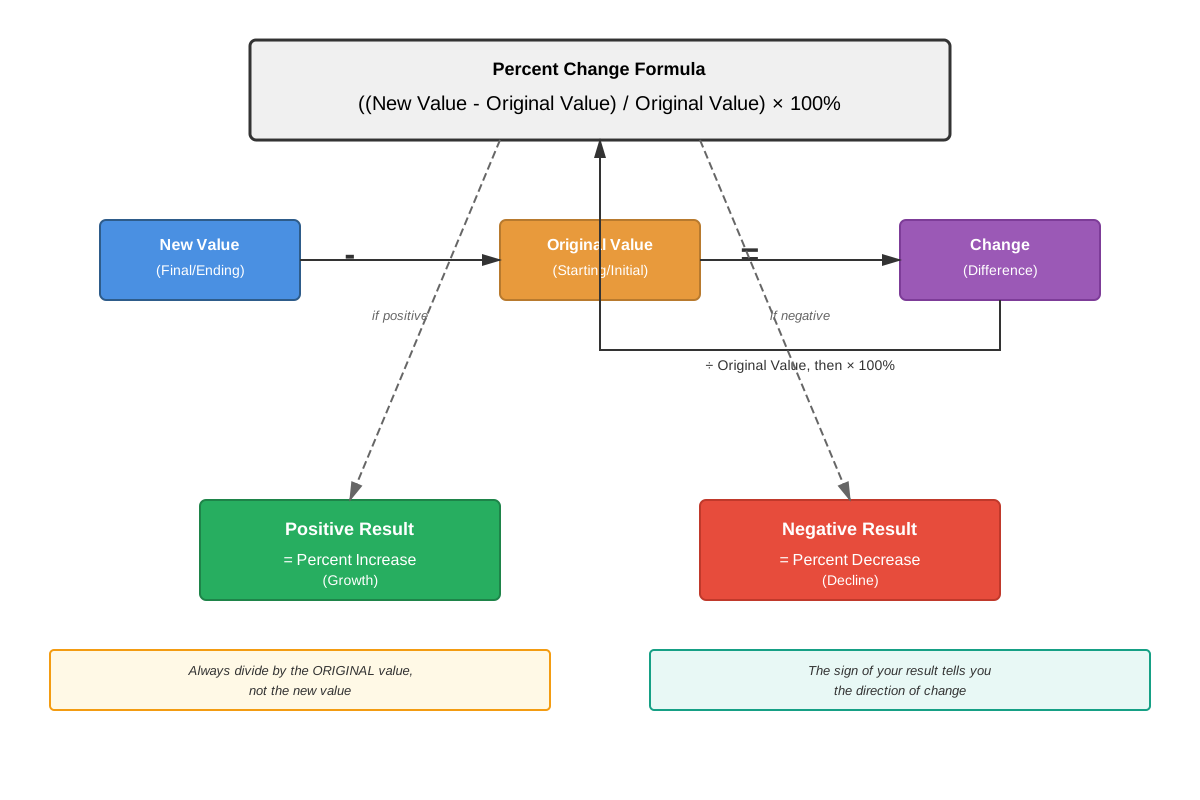
Percent Change = (New Value - Original Value) / Original Value × 100%This formula calculates the relative change as a percentage of the starting amount. The numerator represents the absolute change (the actual difference between values), while the denominator provides the reference point—always the original value. Multiplying by 100 converts the decimal result to a percentage. The sign of the result indicates direction: positive values represent increases, while negative values represent decreases.
Understanding each component is crucial. The original value (also called the initial value, starting value, or base value) is the quantity before any change occurs. The new value (also called the final value or ending value) is the quantity after the change. The difference between these values, when divided by the original value, gives the proportional change, which becomes a percentage when multiplied by 100.
Percent Increase vs. Percent Decrease
While the same formula applies to both increases and decreases, the SAT often uses specific terminology that students must recognize:
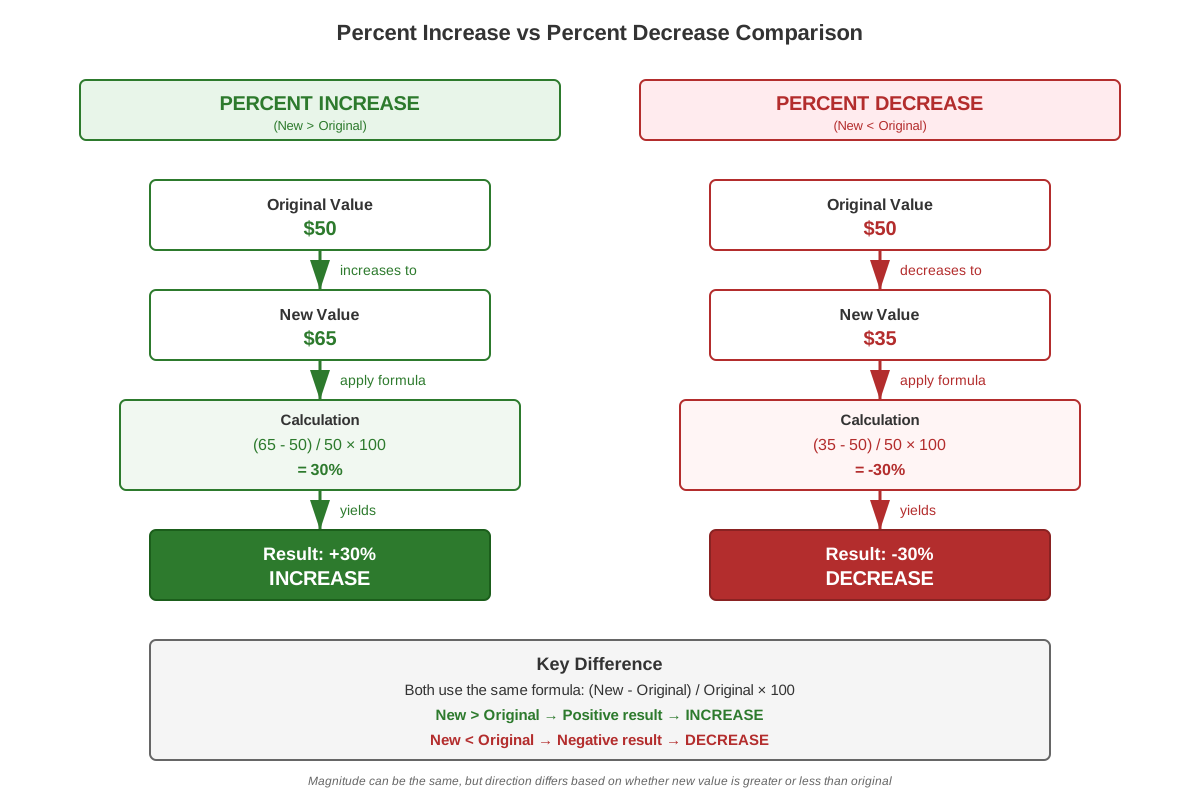
Percent Increase occurs when the new value exceeds the original value. The calculation yields a positive result. Common SAT contexts include: price markups, population growth, salary raises, investment gains, and temperature increases. The formula can be written specifically as:
Percent Increase = (New Value - Original Value) / Original Value × 100%where New Value > Original Value.
Percent Decrease occurs when the new value is less than the original value. The calculation yields a negative result, though the SAT typically asks for "percent decrease" as a positive number (the magnitude of the change). Common contexts include: discounts, depreciation, population decline, weight loss, and price reductions. The formula can be written as:
Percent Decrease = (Original Value - New Value) / Original Value × 100%where Original Value > New Value, ensuring a positive result.
| Aspect | Percent Increase | Percent Decrease |
|---|---|---|
| Direction | New > Original | New < Original |
| Sign | Positive | Negative (or positive magnitude) |
| Common contexts | Growth, markup, gain | Discount, loss, decline |
| Formula variation | (New - Original)/Original | (Original - New)/Original |
Reverse Percent Change Problems
A particularly challenging SAT question type provides the final value and the percent change, requiring students to calculate the original value. These problems require algebraic manipulation of the percent change relationship.
If a value increases by p%, the new value equals the original value times (1 + p/100). Conversely, if a value decreases by p%, the new value equals the original value times (1 - p/100). This relationship can be expressed as:
New Value = Original Value × (1 ± p/100)To find the original value when given the new value and percent change:
Original Value = New Value / (1 ± p/100)For example, if a shirt costs $45 after a 25% discount, the original price was $45 ÷ (1 - 0.25) = $45 ÷ 0.75 = $60.
Successive Percent Changes
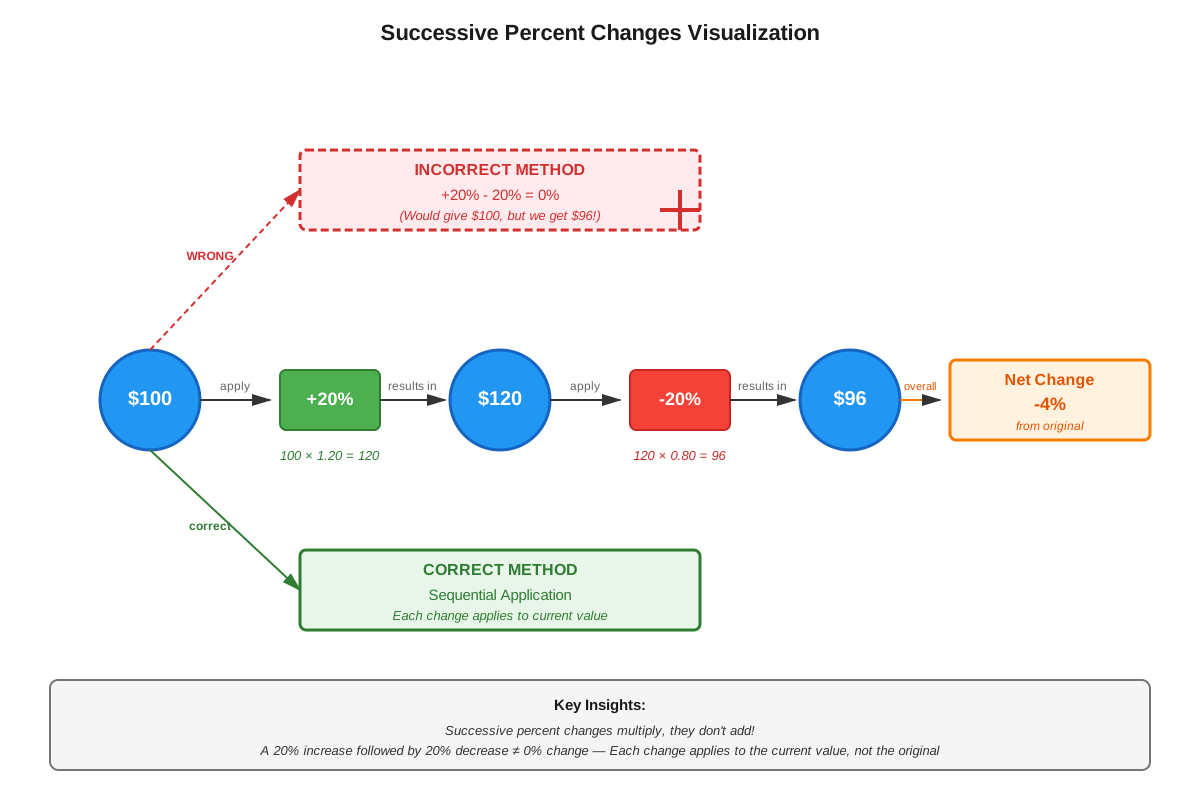
The SAT frequently tests whether students understand that successive percent changes do not simply add together. When two percent changes occur sequentially, each change applies to the result of the previous change, not to the original value.
For two successive changes of p₁% and p₂%, the combined effect is:
Final Value = Original Value × (1 ± p₁/100) × (1 ± p₂/100)The overall percent change is NOT p₁ + p₂. Instead, it must be calculated by comparing the final value to the original value using the standard percent change formula.
For example, a 20% increase followed by a 20% decrease does NOT return to the original value. If starting with 100: after +20% → 120; after -20% of 120 → 96. The net change is -4%, not 0%.
Identifying the Correct Reference Value
A critical skill for SAT success is identifying which value serves as the denominator (reference point) in the percent change formula. The reference value is always the original or starting value—the quantity before the change occurred. Common errors arise when students use the new value or an incorrect reference point.
Consider this distinction: If a price increases from $50 to $75, the percent increase is (75-50)/50 = 50%. However, if a price decreases from $75 to $50, the percent decrease is (75-50)/75 = 33.3%. The same absolute change ($25) produces different percent changes because the reference values differ.
Percent Change vs. Percentage Point Change
The SAT occasionally tests the distinction between percent change and percentage point change, particularly in data interpretation questions. These are fundamentally different concepts:
- Percentage point change is the arithmetic difference between two percentages
- Percent change is the relative change calculated using the percent change formula
For example, if unemployment rises from 4% to 6%, the percentage point change is 2 percentage points (6% - 4% = 2 percentage points), but the percent change is 50% [(6-4)/4 × 100% = 50%]. The SAT uses this distinction to create trap answers.
Concept Relationships
The concepts within percent change form a hierarchical structure where mastery of basic calculations enables understanding of more complex applications. The fundamental percent change formula → serves as the foundation for → both percent increase and percent decrease calculations → which then enable → reverse percent change problems (working backward from final to original values) → and ultimately → successive percent change problems that require multiple applications of the formula.
Percent change connects directly to prerequisite knowledge of basic percentages. Converting percentages to decimals (dividing by 100) is necessary for all calculations. Algebraic manipulation skills enable solving for unknown original values. Proportional reasoning provides the conceptual understanding that percent change measures relative rather than absolute differences.
This topic also connects forward to more advanced SAT math concepts. Understanding percent change is essential for exponential growth and decay problems, where repeated percent changes over time create exponential functions. Compound interest problems are applications of successive percent changes. Linear and exponential modeling questions often require interpreting rates of change as percentages. Data analysis questions involving tables and graphs frequently ask students to calculate and compare percent changes across different categories or time periods.
The relationship between absolute change and percent change is particularly important: Absolute Change (difference in values) → divided by → Original Value → yields → Relative Change → which when multiplied by 100 → becomes → Percent Change. This chain of reasoning helps students understand why the same absolute change can represent different percent changes depending on the reference value.
High-Yield Facts
⭐ The percent change formula is always: (New Value - Original Value) / Original Value × 100%
⭐ The denominator (reference value) in percent change calculations is ALWAYS the original value, never the new value
⭐ Successive percent changes do not add; a 20% increase followed by 20% decrease does NOT return to the original value
⭐ To find an original value after a p% increase: divide the new value by (1 + p/100)
⭐ To find an original value after a p% decrease: divide the new value by (1 - p/100)
- A 100% increase means the value doubled (new value = 2 × original value)
- A 50% decrease means the value is halved (new value = 0.5 × original value)
- Percent change can exceed 100% for increases but cannot exceed 100% for decreases (minimum is -100%, meaning the value reaches zero)
- Percentage point change and percent change are different concepts; the SAT uses this distinction to create trap answers
- When comparing percent changes, always ensure all calculations use the same reference point (typically the earliest time period or original value)
- The order of successive percent changes does not matter for the final value (multiplication is commutative), but each change must be calculated sequentially
- A discount followed by a tax is NOT the same as a tax followed by a discount when they're calculated on different base values
Quick check — test yourself on Percent change so far.
Try Flashcards →Common Misconceptions
Misconception: Successive percent changes can be added together to find the total percent change.
Correction: Each percent change applies to the result of the previous change, not the original value. A 10% increase followed by a 10% increase results in a 21% total increase (1.10 × 1.10 = 1.21), not 20%. Always calculate successive changes sequentially or use the formula: Final = Original × (1 + p₁/100) × (1 + p₂/100).
Misconception: The reference value for percent change can be either the original or new value, whichever is convenient.
Correction: The denominator must always be the original value (the starting point before the change). Using the new value as the reference produces an incorrect result. If a price increases from $50 to $100, the percent increase is 100% [(100-50)/50], not 50% [(100-50)/100].
Misconception: A 25% discount followed by an additional 25% discount equals a 50% total discount.
Correction: The second discount applies to the already-reduced price, not the original price. The combined effect is 1 - (0.75 × 0.75) = 1 - 0.5625 = 43.75% total discount, not 50%. This is a common SAT trap.
Misconception: Percent change and percentage point change are the same thing.
Correction: Percentage point change is the arithmetic difference between two percentages (6% - 4% = 2 percentage points), while percent change measures the relative change [(6-4)/4 × 100% = 50%]. The SAT specifically tests this distinction in data interpretation questions.
Misconception: If a value decreases by 20%, increasing the result by 20% returns to the original value.
Correction: The 20% increase applies to the reduced value, not the original. Starting with 100: after -20% → 80; after +20% of 80 → 96, not 100. To reverse a 20% decrease, you must increase by 25% (because 80 × 1.25 = 100).
Misconception: The absolute change (difference in values) is more important than the percent change for comparisons.
Correction: Percent change provides relative context that absolute change lacks. A $10 increase is a 100% increase from $10 but only a 10% increase from $100. The SAT frequently asks which scenario represents the greatest change, requiring percent change calculations for meaningful comparison.
Worked Examples
Example 1: Basic Percent Change with Multiple Steps
Problem: A store sells a jacket for $120. During a sale, the price is reduced by 30%. After the sale, the store increases the sale price by 20%. What is the final price of the jacket, and what is the overall percent change from the original price?
Solution:
Step 1: Calculate the price after the 30% reduction.
- A 30% decrease means the new price is 70% of the original (100% - 30% = 70%)
- Sale price = $120 × 0.70 = $84
Step 2: Calculate the price after the 20% increase on the sale price.
- A 20% increase means the new price is 120% of the sale price (100% + 20% = 120%)
- Final price = $84 × 1.20 = $100.80
Step 3: Calculate the overall percent change from the original price.
- Using the percent change formula: (New Value - Original Value) / Original Value × 100%
- Percent change = ($100.80 - $120) / $120 × 100%
- Percent change = (-$19.20) / $120 × 100%
- Percent change = -0.16 × 100% = -16%
Answer: The final price is $100.80, representing a 16% decrease from the original price.
Key Insights: This problem demonstrates that successive percent changes must be calculated sequentially, and the overall percent change is NOT simply -30% + 20% = -10%. The problem also shows how to work with both increases and decreases in the same scenario, a common SAT pattern. Notice that we could also calculate the combined multiplier directly: 0.70 × 1.20 = 0.84, meaning the final price is 84% of the original, confirming a 16% decrease.
Example 2: Reverse Percent Change Problem
Problem: After a 15% increase, the population of a town is 23,000 people. What was the population before the increase? Round to the nearest whole number.
Solution:
Step 1: Identify what we know and what we need to find.
- New value (after increase) = 23,000
- Percent increase = 15%
- Original value (before increase) = ?
Step 2: Set up the relationship between original and new values.
- A 15% increase means: New Value = Original Value × (1 + 15/100)
- 23,000 = Original Value × 1.15
Step 3: Solve for the original value.
- Original Value = 23,000 / 1.15
- Original Value = 20,000
Step 4: Verify the answer.
- Check: 20,000 × 1.15 = 23,000 ✓
Answer: The original population was 20,000 people.
Key Insights: This reverse percent change problem requires algebraic manipulation of the percent change relationship. The key insight is recognizing that after a 15% increase, the new value represents 115% of the original value. Therefore, dividing the new value by 1.15 yields the original value. This problem type appears frequently on the SAT, often in contexts involving prices after discounts, populations after growth, or measurements after changes. Students must resist the temptation to calculate 15% of 23,000 and subtract it—that would give an incorrect answer because 15% of 23,000 is not the same as 15% of the original value.
Exam Strategy
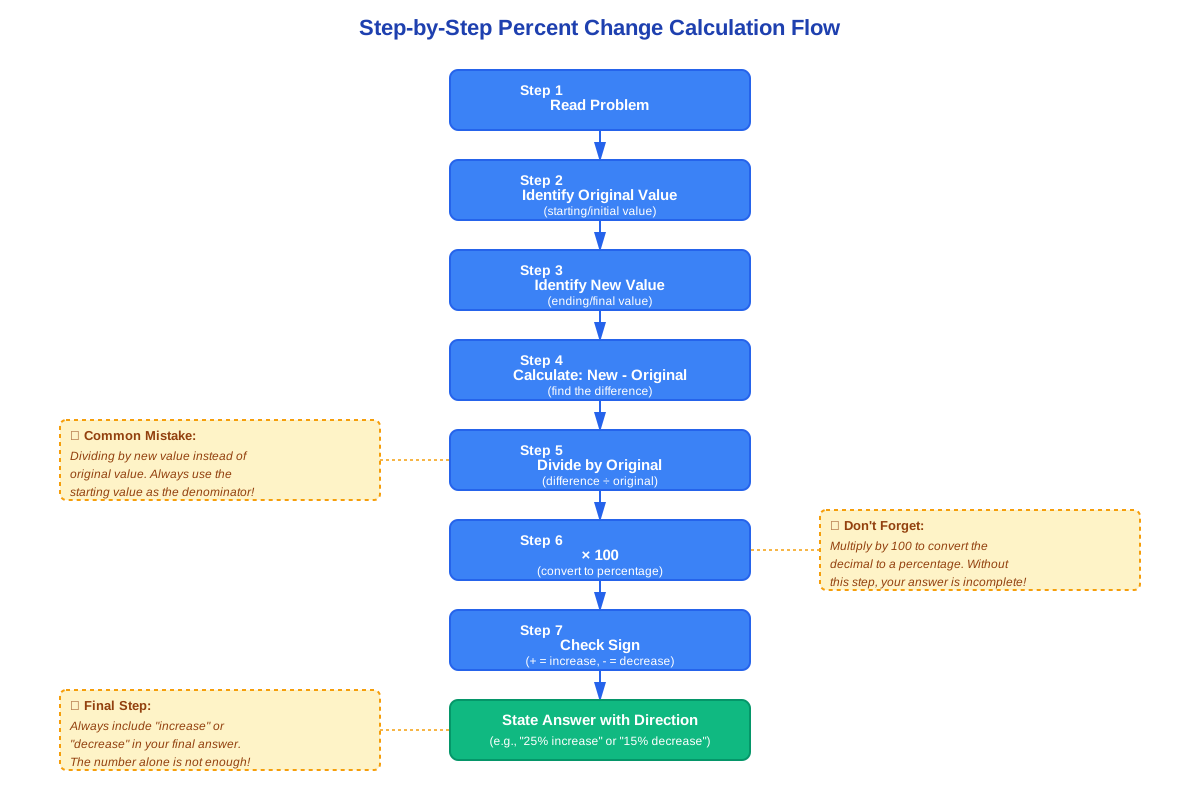
When approaching SAT percent change questions, begin by identifying the three key components: original value, new value, and the direction of change. Underline or circle these values in the problem to avoid confusion. Determine whether the question asks for a percent increase, percent decrease, or requires working backward to find an original value.
Trigger words and phrases to watch for include: "percent increase," "percent decrease," "percent change," "marked up," "marked down," "discounted," "reduced by," "increased by," "grew by," "declined by," "depreciated," "appreciated," "after a _% increase/decrease," and "what percent greater/less." Questions asking "what was the original price/value/amount" signal reverse percent change problems. Phrases like "then" or "followed by" indicate successive percent changes.
For multiple-choice questions, use the answer choices strategically. If asked to find a percent change, calculate it directly using the formula rather than testing each answer choice. However, for reverse percent change problems, working backward from answer choices can be efficient: multiply each choice by the given percent change factor and see which produces the stated final value. This approach often saves time and reduces algebraic errors.
Process of elimination is particularly effective when questions ask for comparisons (which scenario shows the greatest percent change). Calculate the percent change for each option systematically, but if one option clearly involves a small original value with a large absolute change, it likely represents the largest percent change. Eliminate answers that confuse absolute change with percent change—the SAT frequently includes trap answers showing the absolute difference rather than the percent change.
For successive percent change problems, immediately recognize that the changes cannot simply be added. Calculate each change sequentially, or use the combined multiplier approach: multiply (1 ± p₁/100) × (1 ± p₂/100) to find the overall factor. Be especially alert for questions asking about a discount followed by tax or vice versa—these test whether students understand that the order matters when the base values differ.
Time allocation: Simple one-step percent change calculations should take 30-45 seconds. Reverse percent change problems typically require 60-90 seconds. Multi-step problems involving successive changes or complex word problems may require 2-3 minutes. If a problem seems to require excessive calculation, look for a more efficient approach—the SAT rewards mathematical reasoning over brute-force computation.
Always verify that your answer makes logical sense. If calculating a percent decrease, the result should be positive (when expressed as a magnitude) and less than 100%. If finding an original value before an increase, it should be less than the final value. If finding an original value before a decrease, it should be greater than the final value. These quick sanity checks catch many calculation errors.
Memory Techniques
POND - Remember the percent change formula structure:
- Part (the change/difference)
- Over
- Numerator (original value)
- Divide (then multiply by 100)
Actually, correct this to POOD:
- Part (New - Original)
- Over
- Original
- Divide by original, then × 100
"Original is Always the Base" - Create a mental image of a baseball player standing on the original base (home plate). The denominator is always the original value, just as the runner always starts from home base.
The 1-Plus/1-Minus Rule - For reverse problems, remember:
- Increase problems: Divide by 1-Plus (1 + p/100)
- Decrease problems: Divide by 1-Minus (1 - p/100)
- Mnemonic: "Divide Differently" (both start with D)
Successive Changes: "No Simple Addition" - Visualize a snowball rolling downhill, getting bigger with each rotation. Each rotation (percent change) applies to the current size, not the original size. The changes compound; they don't just add.
The 100% Landmarks:
- 100% increase = Doubling (both start with consonants)
- 50% decrease = Halving (both start with consonants)
- These serve as mental benchmarks for estimating whether calculated answers are reasonable
Percentage Points vs. Percent Change: Remember "Points are Plain subtraction" (both start with P). Percentage point change is simple arithmetic difference. Percent change requires the formula with division.
Summary
Percent change is a fundamental SAT math concept that measures the relative increase or decrease of a quantity compared to its original value. The core formula—(New Value - Original Value) / Original Value × 100%—must be memorized and applied correctly, always using the original value as the denominator. The SAT tests this concept through direct calculation problems, reverse problems requiring students to find original values, and multi-step scenarios involving successive percent changes. Critical skills include distinguishing between percent increase and percent decrease, recognizing that successive percent changes multiply rather than add, identifying the correct reference value for calculations, and differentiating between percent change and percentage point change. Success requires both computational accuracy and conceptual understanding: students must recognize that percent change provides relative context that absolute change lacks, making it essential for meaningful comparisons. The topic appears consistently across SAT administrations in various contexts including retail pricing, population dynamics, financial calculations, and data interpretation, making it a high-yield area for focused study and practice.
Key Takeaways
- The percent change formula always uses the original value as the denominator: (New - Original) / Original × 100%
- Successive percent changes multiply, not add: calculate each change sequentially or use combined multipliers
- To reverse a percent change and find the original value, divide the new value by (1 ± p/100)
- Percent change and percentage point change are different concepts; the SAT uses this distinction to create trap answers
- The same absolute change produces different percent changes depending on the reference value—always identify the correct starting point
- A 100% increase doubles a value; a 50% decrease halves it; use these as mental benchmarks
- Verify answers logically: percent decreases cannot exceed 100%, and original values must be consistent with the direction of change
Related Topics
Exponential Growth and Decay: Percent change forms the foundation for understanding exponential functions where quantities change by a constant percentage over equal time intervals. Mastering percent change enables students to tackle compound interest problems and population modeling questions.
Ratios and Proportions: Percent change is fundamentally a proportional relationship, comparing the change to the original value. Understanding this connection helps with more complex ratio problems and scale factor questions.
Linear Functions and Slope: While percent change measures relative change, slope measures absolute rate of change. Understanding both concepts allows students to analyze and compare different types of growth patterns in function problems.
Data Analysis and Statistics: Many SAT data interpretation questions require calculating percent changes from tables, graphs, and charts. This topic enables students to analyze trends, compare categories, and draw conclusions from quantitative information.
Systems of Equations: Complex word problems may combine percent change with systems of equations, requiring students to set up and solve multiple equations involving percentage relationships.
Practice CTA
Now that you've mastered the concepts, formulas, and strategies for percent change, it's time to solidify your understanding through practice. Attempt the practice questions to apply these concepts to authentic SAT-style problems, and use the flashcards to reinforce the key formulas and facts. Remember: percent change appears on every SAT, and these questions are highly scorable when you have a systematic approach. Your investment in mastering this topic will pay dividends on test day—each percent change question you answer correctly brings you closer to your target score. Start practicing now to build the speed and confidence you need for SAT success!
Sign up free to keep reading
Create a free AnvayaPrep account to finish this SAT guide on Percent change — plus flashcards and practice questions.