Overview
Percent comparison is a fundamental mathematical skill that appears frequently on the SAT Math section, requiring students to analyze relationships between quantities expressed as percentages. This topic extends beyond simple percentage calculations to involve comparing two or more percentage values, determining relative changes, and understanding how percentages relate to different base values. Mastery of percent comparison enables students to tackle complex word problems, data interpretation questions, and real-world scenarios that form a significant portion of the SAT's problem-solving and data analysis domain.
The SAT consistently tests percent comparison through various question formats, including multiple-choice and grid-in questions. Students encounter scenarios where they must compare percentage increases or decreases across different contexts, determine which of several percentage changes is greatest, or analyze how the same percentage applied to different base values yields different results. These questions often appear in contexts involving business scenarios, population changes, scientific data, or financial calculations, making them both practical and academically rigorous.
Understanding sat percent comparison connects directly to broader mathematical concepts including ratios, proportions, and algebraic reasoning. This topic serves as a bridge between basic arithmetic operations and more sophisticated quantitative analysis, requiring students to think critically about relative versus absolute changes. Strong performance on percent comparison questions demonstrates mathematical maturity and the ability to navigate multi-step problems—skills that are essential not only for SAT success but also for college-level coursework in mathematics, economics, and the sciences.
Learning Objectives
- [ ] Identify key features of percent comparison
- [ ] Explain how percent comparison appears on the SAT
- [ ] Apply percent comparison to answer SAT-style questions
- [ ] Distinguish between percentage change and absolute change in comparative contexts
- [ ] Evaluate which of multiple percentage changes represents the greatest or least impact
- [ ] Solve multi-step problems involving sequential percentage changes across different scenarios
- [ ] Interpret data tables and graphs requiring percent comparison analysis
Prerequisites
- Basic percentage calculations: Understanding how to convert between decimals, fractions, and percentages is essential for performing the foundational operations required in comparison problems
- Proportional reasoning: The ability to set up and solve proportions enables students to establish relationships between percentages and their corresponding values
- Order of operations: Correctly sequencing mathematical operations ensures accurate calculations when working through multi-step percent comparison problems
- Algebraic manipulation: Basic equation-solving skills allow students to work with variables in percentage contexts and isolate unknown quantities
Why This Topic Matters
Percent comparison skills extend far beyond the SAT classroom into everyday decision-making and professional contexts. Consumers regularly compare percentage discounts across different products, investors analyze percentage returns on various investments, and professionals in healthcare, business, and science interpret percentage-based data to make informed decisions. The ability to accurately compare percentages while accounting for different base values prevents costly errors in financial planning, helps identify misleading statistics in media reports, and enables critical evaluation of quantitative claims.
On the SAT, percent comparison questions appear with notable frequency, typically comprising 3-5 questions per test administration. These questions most commonly appear in the Problem Solving and Data Analysis domain, which accounts for approximately 29% of the Math section. Students encounter percent comparison in various formats: word problems requiring multi-step calculations, data interpretation questions involving tables or graphs, and scenario-based problems that test conceptual understanding rather than mere computational ability. The College Board specifically designs these questions to assess whether students can apply percentage concepts flexibly rather than simply memorizing formulas.
The SAT presents percent comparison through several recurring contexts: retail scenarios involving discounts and markups, population or demographic changes over time, scientific experiments with percentage-based results, financial situations involving interest or investment returns, and survey data requiring comparative analysis. Questions often include distractors that test whether students understand the crucial distinction between comparing percentages themselves versus comparing the actual values those percentages represent—a conceptual nuance that separates high-scoring students from those who struggle with this topic.
Core Concepts
Understanding Percent Comparison Fundamentals
Percent comparison involves analyzing and contrasting two or more percentage values or percentage changes to determine relationships, relative magnitudes, or comparative impacts. Unlike simple percentage calculations that focus on finding a single percentage value, percent comparison requires evaluating multiple percentages simultaneously and understanding how context affects their meaning. The fundamental principle underlying all percent comparison problems is that percentages are relative measures—they express relationships rather than absolute quantities—and therefore must always be interpreted in relation to their base values.
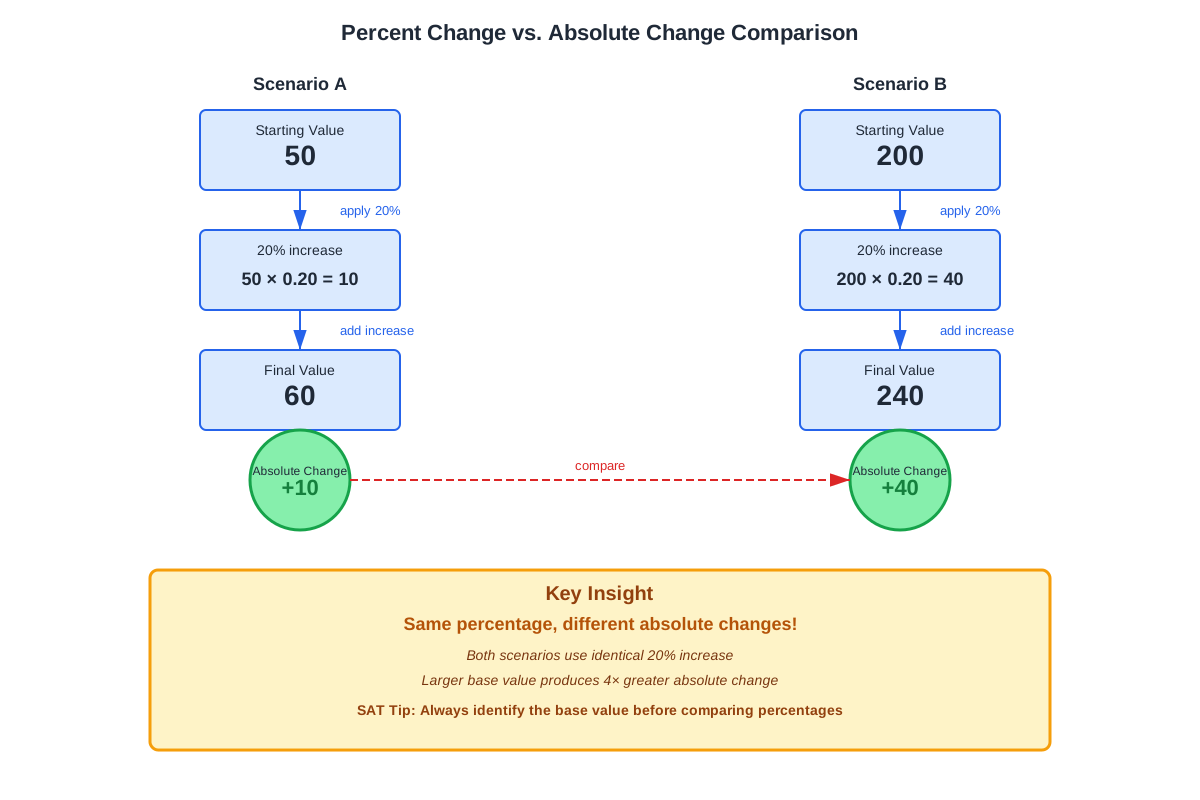
When comparing percentages, students must distinguish between three distinct scenarios: comparing percentage values themselves (e.g., 30% versus 40%), comparing the absolute changes represented by percentages (e.g., 30% of 200 versus 40% of 100), and comparing percentage changes (e.g., an increase from 50 to 75 versus an increase from 100 to 140). Each scenario requires different analytical approaches and can yield counterintuitive results when base values differ significantly.
The Base Value Principle
The base value principle states that the actual impact of a percentage depends entirely on the quantity to which it is applied. This principle is the source of most errors in percent comparison problems and represents the most critical concept for SAT success. Consider that 10% of $1,000 equals $100, while 50% of $100 equals only $50—despite 50% being five times larger as a percentage, it produces a smaller absolute result due to the different base values.
Actual Value = (Percentage ÷ 100) × Base ValueOn the SAT, questions frequently exploit this principle by presenting scenarios where a smaller percentage of a larger base produces a greater absolute result than a larger percentage of a smaller base. Students must consistently identify the base value for each percentage being compared and calculate the actual values before making comparisons. The test often includes answer choices that would be correct if students ignored base values and compared only the percentages themselves.
Percentage Change Comparison
Comparing percentage changes requires understanding both the magnitude and direction of change. A percentage increase represents growth from an original value, while a percentage decrease represents reduction. The formula for percentage change is:
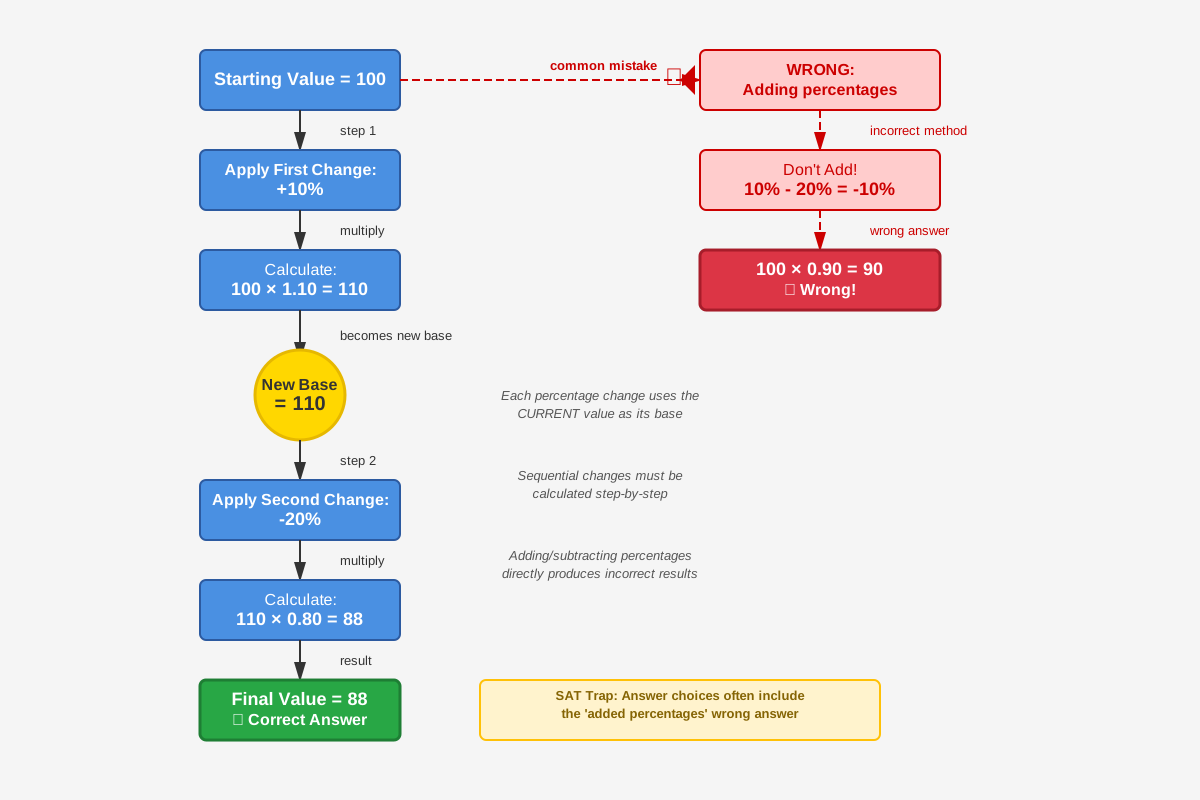
Percentage Change = [(New Value - Original Value) ÷ Original Value] × 100When comparing multiple percentage changes, students must recognize that equal percentage changes applied to different original values produce different absolute changes. Additionally, sequential percentage changes do not simply add together—a 20% increase followed by a 20% decrease does not return to the original value because the second percentage operates on a different base.
| Scenario | Original Value | Change | New Value | Percentage Change |
|---|---|---|---|---|
| A | 100 | +30 | 130 | +30% |
| B | 200 | +40 | 240 | +20% |
| C | 50 | +30 | 80 | +60% |
In this table, Scenario C shows the largest percentage change despite having the smallest absolute increase, while Scenario B shows the largest absolute increase despite having a moderate percentage change.
Comparing Percentage Increases and Decreases
A critical skill for SAT percent comparison involves determining which of several percentage changes represents the greatest or least impact. This requires calculating each percentage change and comparing the results numerically. Students must be particularly careful when comparing increases and decreases, as the direction of change affects interpretation.
When a value increases by a certain percentage and then decreases by the same percentage, the final value is always less than the original. For example, if a price increases by 25% and then decreases by 25%, the net result is a decrease from the original price. This occurs because the decrease operates on the larger increased value:
- Original: $100
- After 25% increase: $125
- After 25% decrease from $125: $93.75 (not $100)
Multi-Step Percent Comparison Problems
SAT questions frequently require multiple calculations before comparison becomes possible. These multi-step problems might involve:
- Calculating the actual values represented by given percentages
- Determining percentage changes from provided data
- Comparing the results to identify the greatest, least, or specific relationship
- Selecting the answer choice that correctly describes the comparison
The key strategy for multi-step problems is systematic organization: clearly label each calculation, identify what each percentage represents, and verify that comparisons use compatible units or bases. Students should resist the temptation to take shortcuts by comparing percentages directly without considering their contexts.
Percentage Points Versus Percent Change
A sophisticated distinction that occasionally appears on the SAT involves percentage points versus percent change. If a quantity increases from 20% to 30%, it has increased by 10 percentage points but by 50% as a percent change (since 10 is 50% of the original 20). This distinction matters when questions ask about the "change in percentage" versus the "percentage change"—these are not equivalent concepts.
Concept Relationships
The concepts within percent comparison form an interconnected hierarchy where understanding flows from foundational principles to complex applications. The base value principle serves as the foundation, establishing that all percentage comparisons must account for the quantities being measured. This principle directly enables percentage change comparison, which applies the base value concept to scenarios involving change over time or between conditions. Both of these concepts feed into multi-step percent comparison problems, which synthesize multiple calculations and require strategic thinking about which comparisons are meaningful.
Percent comparison connects backward to prerequisite topics through its reliance on proportional reasoning—every percentage represents a proportion of a whole, and comparing percentages often involves comparing ratios. The topic also builds on basic percentage calculations, extending them from single-value problems to comparative contexts. Moving forward, mastery of percent comparison enables progression to more advanced topics including exponential growth and decay, compound interest calculations, and statistical analysis involving percentage-based measures.
The relationship map for this topic flows as follows:
Basic Percentage Calculations → Base Value Principle → Percentage Change Calculation → Comparing Multiple Percentage Changes → Multi-Step Comparison Problems → Real-World Applications and Data Interpretation
Additionally, percentage points versus percent change represents a parallel concept that refines understanding of how to describe percentage-based comparisons accurately, connecting to both the base value principle and percentage change comparison.
Quick check — test yourself on Percent comparison so far.
Try Flashcards →High-Yield Facts
⭐ The same percentage applied to different base values produces different absolute results—always calculate actual values before comparing
⭐ A percentage increase followed by an equal percentage decrease does not return to the original value—the second percentage operates on a changed base
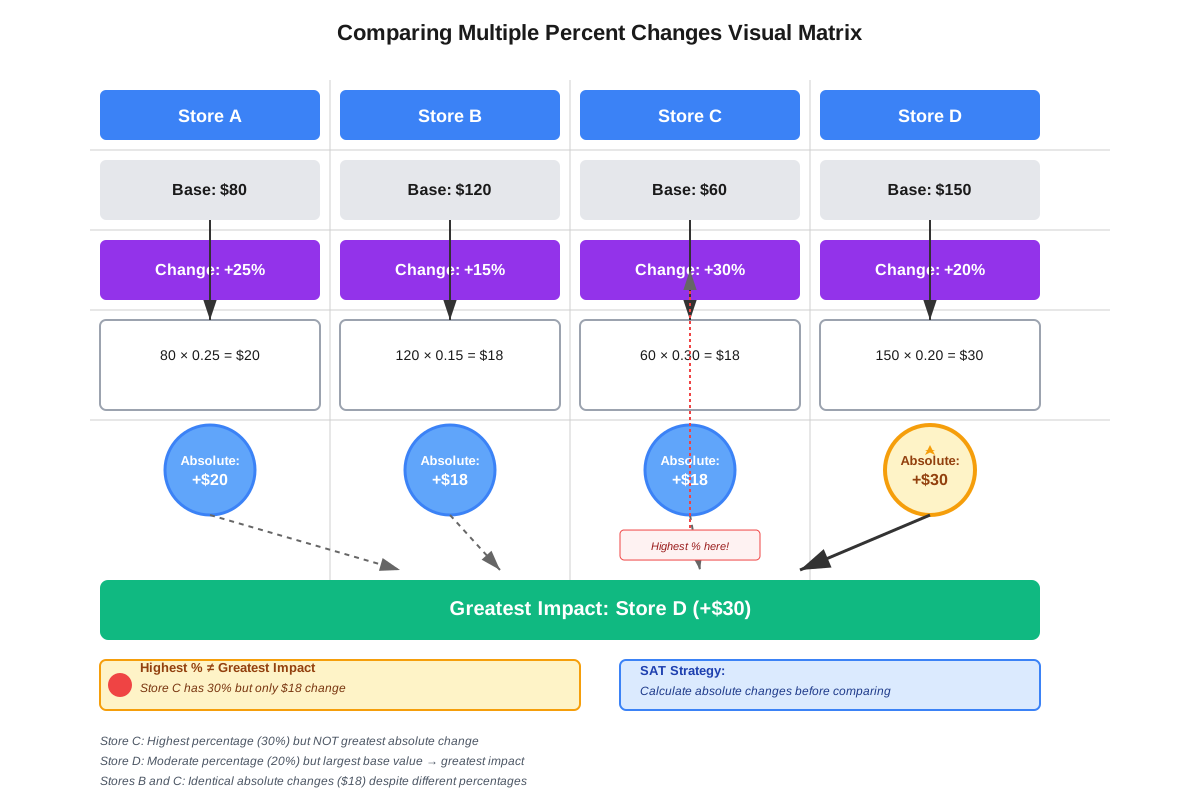
⭐ When comparing percentage changes, the largest percentage change does not necessarily represent the largest absolute change—context and base values determine actual impact
⭐ To compare percentages meaningfully, they must refer to the same base or be converted to comparable absolute values—percentages alone are insufficient for comparison
⭐ Percentage change equals (New Value - Original Value) ÷ Original Value × 100—the original value always serves as the denominator
- Percentage points measure absolute differences between percentages, while percent change measures relative differences
- Sequential percentage changes multiply rather than add: a 10% increase followed by a 10% increase yields a 21% total increase, not 20%
- Comparing percentages of percentages requires careful attention to what serves as the base for each calculation
- A 100% increase doubles a value, while a 100% decrease reduces it to zero
- When a question asks "how many times greater," it requires comparing absolute values, not percentages
Common Misconceptions
Misconception: Equal percentages always represent equal amounts regardless of context → Correction: Percentages are relative measures that depend entirely on their base values. 50% of 200 (which equals 100) is very different from 50% of 20 (which equals 10), even though both involve the same percentage.
Misconception: Comparing percentages directly without considering base values provides accurate comparisons → Correction: Direct percentage comparison only works when the base values are identical. When base values differ, students must calculate the actual values represented by each percentage before making meaningful comparisons.
Misconception: A 20% increase followed by a 20% decrease returns to the original value → Correction: Sequential percentage changes operate on different bases. If a value increases by 20% to 120, then decreases by 20%, the decrease is 20% of 120 (which is 24), resulting in 96—less than the original 100.
Misconception: The largest percentage change always produces the largest absolute change → Correction: A large percentage of a small base can produce a smaller absolute change than a small percentage of a large base. For example, 100% of 10 (equals 10) is less than 20% of 100 (equals 20).
Misconception: Percentage points and percent change are interchangeable terms → Correction: These represent different concepts. An increase from 25% to 35% is a 10 percentage point increase but a 40% increase (since 10 is 40% of 25). The SAT occasionally tests this distinction.
Misconception: When comparing two percentage increases, the one with the higher percentage is always "better" or "more" → Correction: The interpretation depends on context. A 50% increase in errors is worse than a 10% increase in errors, even though 50% is larger, because the direction of desirability matters.
Worked Examples
Example 1: Comparing Percentage Changes with Different Base Values
Problem: Store A had 200 customers in January and 260 customers in February. Store B had 150 customers in January and 195 customers in February. Which store had the greater percentage increase in customers?
Solution:
Step 1: Calculate the percentage increase for Store A.
- Change in customers: 260 - 200 = 60
- Percentage change: (60 ÷ 200) × 100 = 30%
Step 2: Calculate the percentage increase for Store B.
- Change in customers: 195 - 150 = 45
- Percentage change: (45 ÷ 150) × 100 = 30%
Step 3: Compare the results.
- Both stores experienced exactly 30% increases
Answer: Both stores had equal percentage increases of 30%, even though Store A gained more customers in absolute terms (60 versus 45). This example demonstrates that percentage change depends on the original value, not the absolute change.
Connection to Learning Objectives: This problem requires identifying that percent comparison must account for different base values and applying the percentage change formula to make accurate comparisons.
Example 2: Multi-Step Comparison with Sequential Changes
Problem: A stock's price increased by 25% in the first quarter and then decreased by 20% in the second quarter. A bond's value increased by 5% in the first quarter and remained unchanged in the second quarter. If both investments started at $1,000, which had the higher value at the end of the second quarter, and by how much?
Solution:
Step 1: Calculate the stock's value after the first quarter.
- Increase: 25% of $1,000 = 0.25 × $1,000 = $250
- Value after Q1: $1,000 + $250 = $1,250
Step 2: Calculate the stock's value after the second quarter.
- Decrease: 20% of $1,250 = 0.20 × $1,250 = $250
- Value after Q2: $1,250 - $250 = $1,000
Step 3: Calculate the bond's value after both quarters.
- Increase in Q1: 5% of $1,000 = 0.05 × $1,000 = $50
- Value after Q1: $1,000 + $50 = $1,050
- Change in Q2: $0
- Value after Q2: $1,050
Step 4: Compare the final values.
- Stock: $1,000
- Bond: $1,050
- Difference: $1,050 - $1,000 = $50
Answer: The bond had the higher value at the end of the second quarter by $50. This problem illustrates that a 25% increase followed by a 20% decrease does not preserve the original value, and that consistent smaller gains can outperform volatile larger changes.
Connection to Learning Objectives: This example demonstrates how to apply percent comparison to multi-step problems involving sequential changes and requires evaluating which of multiple percentage scenarios produces the greatest result.
Exam Strategy
When approaching SAT percent comparison questions, begin by carefully identifying what is being compared: percentages themselves, absolute values represented by percentages, or percentage changes. Circle or underline the base value for each percentage mentioned in the problem, as confusion about base values causes most errors. If the question involves multiple scenarios or time periods, create a simple table or organized list to track calculations systematically.
Trigger words and phrases that signal percent comparison questions include: "which is greater," "by how much more," "what is the difference," "compare the percentage change," "which had the largest increase," and "how many times as much." When you encounter these phrases, immediately recognize that direct calculation of percentages alone will be insufficient—you must calculate actual values or percentage changes before comparing.
For process-of-elimination strategies, first eliminate answer choices that compare percentages directly without accounting for different base values, as these are common distractors. If a problem involves sequential percentage changes, eliminate any answer that simply adds or subtracts the percentages. When comparing percentage increases and decreases, eliminate answers that ignore the direction of change. If you're unsure between two remaining choices, plug in simple numbers to test which approach yields logical results.
Time allocation for percent comparison questions should typically be 60-90 seconds for straightforward two-value comparisons and up to 2 minutes for complex multi-step problems. If a problem requires more than three distinct calculations, ensure you're not overcomplicating the approach—look for shortcuts such as recognizing that equal percentage changes of equal base values need not be calculated individually. Practice identifying when exact calculation is necessary versus when logical reasoning about relative magnitudes suffices.
Exam Tip: If a percent comparison question seems to have an obvious answer based on comparing percentages directly, that answer is almost certainly wrong. The SAT specifically designs these questions to punish students who ignore base values.
Memory Techniques
"BASE before COMPARE" - Always identify and calculate the BASE values before attempting to COMPARE percentages. This mnemonic reminds students that percentages are meaningless without their reference points.
The "Different Bases, Different Cases" rule - When base values differ, percentage comparisons require conversion to absolute values. Visualize percentages as fractions of different-sized pies—50% of a large pie is more than 75% of a tiny pie.
"Up then Down ≠ Same Ground" - This rhyme helps remember that equal percentage increases and decreases don't cancel out. Visualize climbing 20% up a mountain (reaching a higher elevation) and then descending 20% from that new height—you end up lower than where you started.
The "Percentage Points vs. Percent Change" distinction - Remember "Points are Plain, Percent is Proportional." Percentage points measure the plain arithmetic difference between two percentages, while percent change measures the proportional relationship.
Acronym for multi-step problems: CICO - Calculate, Identify, Compare, Output. First Calculate all necessary values, Identify what's being compared, Compare the results, and Output the answer the question actually asks for (not just the first value you calculate).
Summary
Percent comparison represents a critical SAT Math skill that extends basic percentage calculations into analytical contexts requiring students to evaluate relationships between multiple percentage values or changes. Success with this topic depends fundamentally on understanding the base value principle—that percentages are relative measures whose actual impact depends entirely on the quantities they describe. Students must distinguish between comparing percentages themselves, comparing the absolute values those percentages represent, and comparing percentage changes, as each scenario requires different analytical approaches. The SAT consistently tests whether students can navigate multi-step problems involving different base values, sequential percentage changes, and contextual interpretation of percentage-based data. Mastery requires systematic calculation, careful attention to what each percentage represents, and resistance to the temptation of comparing percentages directly without considering their contexts. By recognizing common question patterns, applying strategic calculation methods, and avoiding predictable misconceptions about how percentages combine and compare, students can confidently tackle the 3-5 percent comparison questions that typically appear on each SAT administration.
Key Takeaways
- Percentages must always be interpreted relative to their base values—the same percentage of different bases produces different absolute results
- Calculate actual values or percentage changes before making comparisons; direct percentage comparison only works when base values are identical
- Sequential percentage changes multiply rather than add, and equal increases followed by equal decreases do not return to the original value
- The largest percentage change does not necessarily represent the largest absolute change when base values differ
- Systematic organization of multi-step calculations prevents errors and ensures all necessary comparisons are completed
- Percentage points measure absolute differences between percentages, while percent change measures relative differences—these are distinct concepts
- SAT percent comparison questions specifically test whether students understand base value principles through carefully designed distractors
Related Topics
Ratio and Proportion: Percent comparison builds directly on proportional reasoning, as percentages represent specific types of ratios. Mastering this topic enables more sophisticated work with proportional relationships in geometric and algebraic contexts.
Exponential Growth and Decay: Understanding how percentage changes compound over time extends percent comparison into exponential functions, a topic that appears in both SAT Math sections and connects to real-world applications in finance and science.
Data Interpretation and Statistics: Many SAT data analysis questions require comparing percentage-based statistics across different populations or time periods, making percent comparison essential for success with tables, graphs, and survey data.
Financial Mathematics: Interest calculations, investment returns, and discount problems all rely on percent comparison principles, representing practical applications that frequently appear in SAT word problems.
Practice CTA
Now that you've mastered the core concepts of percent comparison, it's time to solidify your understanding through active practice. Attempt the practice questions designed specifically for this topic, focusing on applying the base value principle and systematic calculation strategies you've learned. Use the flashcards to reinforce high-yield facts and test your ability to quickly recall key formulas and concepts. Remember that percent comparison questions reward careful, methodical thinking—take your time to identify base values, organize your calculations, and verify that your comparisons make logical sense. Each practice problem you complete builds the pattern recognition and confidence you need to excel on test day. You've got this!
Sign up free to keep reading
Create a free AnvayaPrep account to finish this SAT guide on Percent comparison — plus flashcards and practice questions.