Overview
Percent points (also called percentage points) represent one of the most frequently misunderstood yet highly tested concepts in SAT math. While percentages measure relative change or proportion, percent points measure the absolute arithmetic difference between two percentages. For example, if unemployment rises from 5% to 8%, it has increased by 3 percentage points, not 3 percent. This distinction is critical because confusing these two concepts leads to incorrect answers on multiple SAT questions each test administration.
Understanding percent points is essential for the SAT because the exam regularly tests whether students can distinguish between relative and absolute changes in percentage-based data. These questions appear in both the calculator and no-calculator sections, often embedded within word problems, data interpretation questions, and real-world scenarios involving statistics, economics, polling data, and scientific measurements. The College Board specifically designs questions to exploit the common confusion between "percent" and "percent points," making this topic a high-yield area for score improvement.
This topic builds directly on foundational percentage concepts and connects to broader mathematical reasoning skills including ratio interpretation, data analysis, and quantitative literacy. Mastering percent points enhances performance not only on direct percentage questions but also on complex multi-step problems involving growth rates, survey analysis, and comparative statistics—all frequent question types on the SAT Math section.
Learning Objectives
- [ ] Identify key features of percent points and distinguish them from regular percentages
- [ ] Explain how percent points appears on the SAT in various question formats
- [ ] Apply percent points to answer SAT-style questions accurately and efficiently
- [ ] Calculate the difference between two percentages using percent points
- [ ] Convert between percent point changes and percentage changes
- [ ] Interpret graphs and tables that display data in percentage form and identify percent point differences
- [ ] Recognize trigger words and phrases that signal percent point calculations versus percentage calculations
Prerequisites
- Basic percentage calculations: Understanding how to convert between decimals, fractions, and percentages is fundamental since percent points measure differences between percentage values
- Arithmetic operations with decimals: Percent point calculations require accurate addition and subtraction of decimal values
- Reading and interpreting data tables and graphs: Many SAT percent point questions present information visually, requiring data extraction skills
- Understanding of absolute versus relative change: Distinguishing between these two types of change is the conceptual foundation for percent points
Why This Topic Matters
In real-world applications, percent points appear constantly in fields ranging from economics and finance to public health and political polling. When the Federal Reserve changes interest rates from 2.5% to 3.0%, economists describe this as a 0.5 percentage point increase (not a 20% increase, though that would be the relative change). Election analysts discuss candidates gaining or losing percentage points in polls. Medical researchers report changes in disease prevalence using percentage points to avoid ambiguity. This precise language prevents miscommunication in professional and academic contexts.
On the SAT, percent point questions appear with remarkable frequency—typically 1-3 questions per test administration. These questions span multiple formats: pure calculation problems, word problems requiring interpretation, data analysis questions with tables or graphs, and multi-step problems combining percent points with other mathematical concepts. The College Board favors this topic because it efficiently tests both computational skills and conceptual understanding while differentiating between students who have memorized formulas and those who truly understand percentage relationships.
Common SAT question formats include: comparing survey results across different time periods, analyzing changes in demographic statistics, interpreting scientific data showing percentage-based measurements, evaluating economic indicators, and solving problems involving market share or population statistics. Questions often present two percentages and ask for the difference (testing whether students report percent points) or describe a percent point change and ask students to determine original or final values.
Core Concepts
Definition of Percent Points
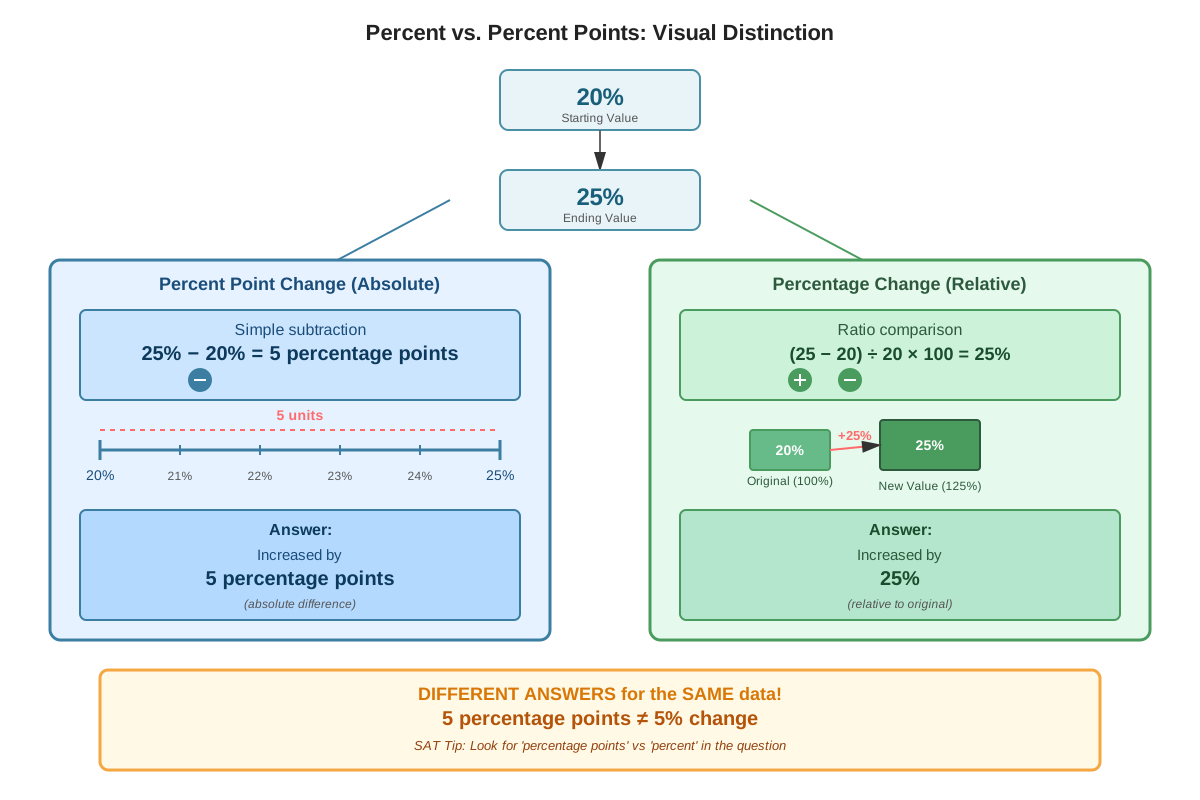
A percent point (or percentage point) is the unit for the arithmetic difference between two percentages. When comparing two percentage values, the percent point difference equals the simple subtraction of one percentage from another. If Value A is 45% and Value B is 52%, the difference is 7 percentage points (52% - 45% = 7 percentage points).
This differs fundamentally from a percentage change, which measures relative change. Using the same example, the percentage change from 45% to 52% would be calculated as: (52 - 45) / 45 × 100% = 15.56%. Notice that 7 percentage points and 15.56% are completely different values describing different aspects of the same change.
Percent Points vs. Percentage Change
Understanding the distinction between these two concepts is absolutely critical for SAT success:
| Concept | What It Measures | Formula | Example (20% to 25%) |
|---|---|---|---|
| Percent Points | Absolute arithmetic difference | New % - Old % | 25% - 20% = 5 percentage points |
| Percentage Change | Relative change | (New - Old) / Old × 100% | (25 - 20) / 20 × 100% = 25% increase |
The SAT deliberately creates questions where students must choose between these two interpretations. A question might state "the percentage increased by 5 percentage points" and ask for the new value, or it might state "the percentage increased by 25%" and ask for the percent point change. Reading carefully determines which calculation applies.
Calculating Percent Point Differences
The calculation process for percent point differences follows these steps:
- Identify the two percentage values being compared
- Ensure both values are expressed as percentages (not decimals or fractions)
- Subtract the earlier/smaller percentage from the later/larger percentage: Later % - Earlier %
- Report the answer with the unit "percentage points" to maintain precision
For example, if a company's market share decreased from 38% to 31%, the percent point change is 31% - 38% = -7 percentage points. The negative sign indicates a decrease.
Interpreting Percent Point Data
SAT questions frequently present data in tables or graphs showing percentages across different categories or time periods. To find percent point differences:
- For time series data: Subtract the percentage at the earlier time from the percentage at the later time
- For categorical comparisons: Subtract one category's percentage from another's
- For multiple comparisons: Calculate each pairwise difference separately
Consider a table showing voter support: Candidate A has 42% support in January and 47% in February, while Candidate B has 38% in January and 36% in February. The percent point changes are: Candidate A gained 5 percentage points (47% - 42%), while Candidate B lost 2 percentage points (36% - 38%).
Converting Between Percent Points and Percentage Change
Some advanced SAT questions require converting between these two measures:
From percent points to percentage change:
- Calculate the percent point difference: New % - Old %
- Divide by the original percentage: (New % - Old %) / Old %
- Multiply by 100% to express as a percentage
From percentage change to percent points:
- Convert the percentage change to decimal form
- Multiply by the original percentage: Original % × (Percentage Change as decimal)
- The result is the percent point change
Example: If a value increases from 40% to 50%, the percent point change is 10 percentage points. The percentage change is (50 - 40) / 40 × 100% = 25%. Conversely, if told that a 40% value increased by 25%, calculate: 40% × 0.25 = 10 percentage points, giving a new value of 50%.
Common SAT Contexts for Percent Points
The SAT embeds percent point questions in realistic scenarios:
- Survey and polling data: "Support for the policy increased from 34% to 41%. By how many percentage points did support increase?"
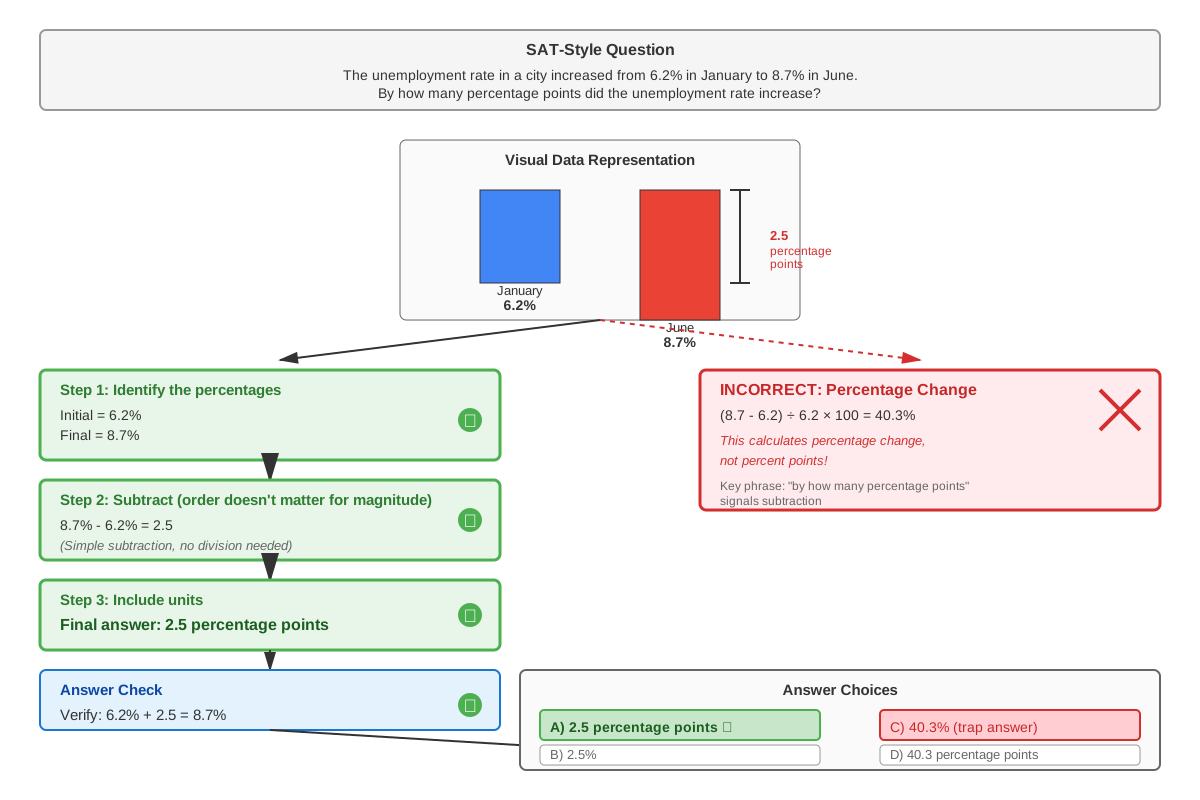
- Economic indicators: "The unemployment rate fell from 6.2% to 5.8%. What was the decrease in percentage points?"
- Scientific measurements: "The concentration of the solution changed from 15% to 22%. Find the percent point increase."
- Demographic statistics: "The proportion of the population aged 65+ rose from 12% to 18% over the decade."
- Academic performance: "The passing rate improved from 78% to 85% after the intervention."
Concept Relationships
Percent points build directly on fundamental percentage concepts. Understanding what percentages represent (parts per hundred) enables comprehension of how percent points measure the distance between two percentage values. The relationship flows: Basic Percentages → Comparing Percentages → Percent Points → Percentage Change Calculations.
Within this topic, the core concepts connect as follows: Definition of Percent Points → establishes the foundation → Percent Points vs. Percentage Change → clarifies the critical distinction → Calculating Percent Point Differences → provides the computational method → Interpreting Percent Point Data → applies the concept to SAT question formats → Converting Between Measures → enables advanced problem-solving.
Percent points also connect to related SAT math topics including ratio and proportion (percentages are ratios), data interpretation (reading tables and graphs), and word problem solving (translating verbal descriptions into mathematical operations). Mastery of percent points enhances performance on questions involving growth rates, probability expressed as percentages, and statistical analysis—all high-frequency SAT topics.
High-Yield Facts
- ⭐ Percent points measure the absolute arithmetic difference between two percentages, calculated by simple subtraction
- ⭐ A percent point change and a percentage change are different: 5 percentage points ≠ 5% change
- ⭐ To find percent point difference: subtract the earlier percentage from the later percentage
- ⭐ The SAT frequently tests whether students confuse percent points with percentage change
- ⭐ Always include the unit "percentage points" in answers to maintain precision and avoid ambiguity
- Percent point changes can be negative (indicating a decrease) or positive (indicating an increase)
- When two percentages are given, the percent point difference is always smaller than or equal to the percentage change (in absolute value terms)
- Percent point differences are additive: if a value goes from 20% to 30% to 40%, the total change is 20 percentage points (10 + 10)
- Converting from percent points to percentage change requires division by the original percentage
- SAT questions often present percentage data in tables or graphs requiring extraction before calculation
- The phrase "increased by X percentage points" means add X to the original percentage
- The phrase "increased by X percent" means multiply the original percentage by (1 + X/100)
Quick check — test yourself on Percent points so far.
Try Flashcards →Common Misconceptions
Misconception: Percent points and percentage change are the same thing and can be used interchangeably.
Correction: These are fundamentally different measures. Percent points measure absolute difference (simple subtraction), while percentage change measures relative change (difference divided by original). A change from 20% to 30% is 10 percentage points but a 50% increase.
Misconception: To find percent point change, you must divide by the original value.
Correction: Percent point change requires only subtraction. Division by the original value is used for percentage change, not percent points. If a value goes from 40% to 55%, the percent point change is simply 55% - 40% = 15 percentage points.
Misconception: Percent point changes should be expressed as percentages (e.g., "15%").
Correction: Percent point changes should be expressed with the unit "percentage points" (e.g., "15 percentage points"). Using "%" creates ambiguity about whether you mean percent points or percentage change.
Misconception: A larger percent point change always represents a more significant change than a smaller one.
Correction: The significance depends on context and the original values. A 5 percentage point increase from 2% to 7% (250% relative increase) is more dramatic than a 5 percentage point increase from 50% to 55% (10% relative increase).
Misconception: When a question asks "by how much did the percentage increase," it's asking for percentage change.
Correction: This phrasing typically asks for the percent point difference. The question "by how much" refers to the absolute difference. If it wanted percentage change, it would ask "by what percent did the value increase" or "what was the percent increase."
Misconception: Percent points can exceed 100.
Correction: Since percentages themselves cannot exceed 100% in most contexts (except when dealing with growth rates or returns), and percent points measure differences between percentages, the maximum possible percent point change is typically 100 percentage points (from 0% to 100% or vice versa).
Worked Examples
Example 1: Basic Percent Point Calculation
Question: In 2020, 34% of students at a high school participated in athletics. In 2021, 41% participated. By how many percentage points did participation increase?
Solution:
Step 1: Identify the two percentages being compared.
- 2020: 34%
- 2021: 41%
Step 2: Determine which is the earlier/later value.
- Earlier (2020): 34%
- Later (2021): 41%
Step 3: Calculate the percent point difference by subtracting earlier from later.
- Percent point change = 41% - 34% = 7 percentage points
Step 4: Verify the answer makes sense.
- The participation increased, so the answer should be positive ✓
- The magnitude (7 percentage points) is reasonable given the values ✓
Answer: Participation increased by 7 percentage points.
Connection to Learning Objectives: This example demonstrates the fundamental calculation of percent points (Objective 1) and applies the concept to a typical SAT-style scenario (Objective 3).
Example 2: Distinguishing Percent Points from Percentage Change
Question: A survey showed that support for a proposal was 40% in March. In April, support increased by 15 percentage points. What was the support level in April? If instead the support had increased by 15%, what would the April support level have been?
Solution:
Part A: 15 percentage point increase
Step 1: Understand that "increased by 15 percentage points" means add 15 to the original percentage.
- Original: 40%
- Increase: 15 percentage points
Step 2: Calculate the new percentage.
- New percentage = 40% + 15 percentage points = 55%
Part B: 15% increase
Step 1: Understand that "increased by 15%" means the value grew by 15% of its original amount.
- Original: 40%
- Percentage increase: 15%
Step 2: Calculate 15% of the original value.
- 15% of 40% = 0.15 × 40% = 6 percentage points
Step 3: Add this to the original percentage.
- New percentage = 40% + 6 percentage points = 46%
Answers:
- With a 15 percentage point increase: 55%
- With a 15% increase: 46%
Key Insight: Notice that a 15 percentage point increase (resulting in 55%) is very different from a 15% increase (resulting in 46%). This distinction is exactly what the SAT tests.
Connection to Learning Objectives: This example directly addresses the critical distinction between percent points and percentage change (Objective 2) and demonstrates conversion between these measures (Objective 5).
Exam Strategy
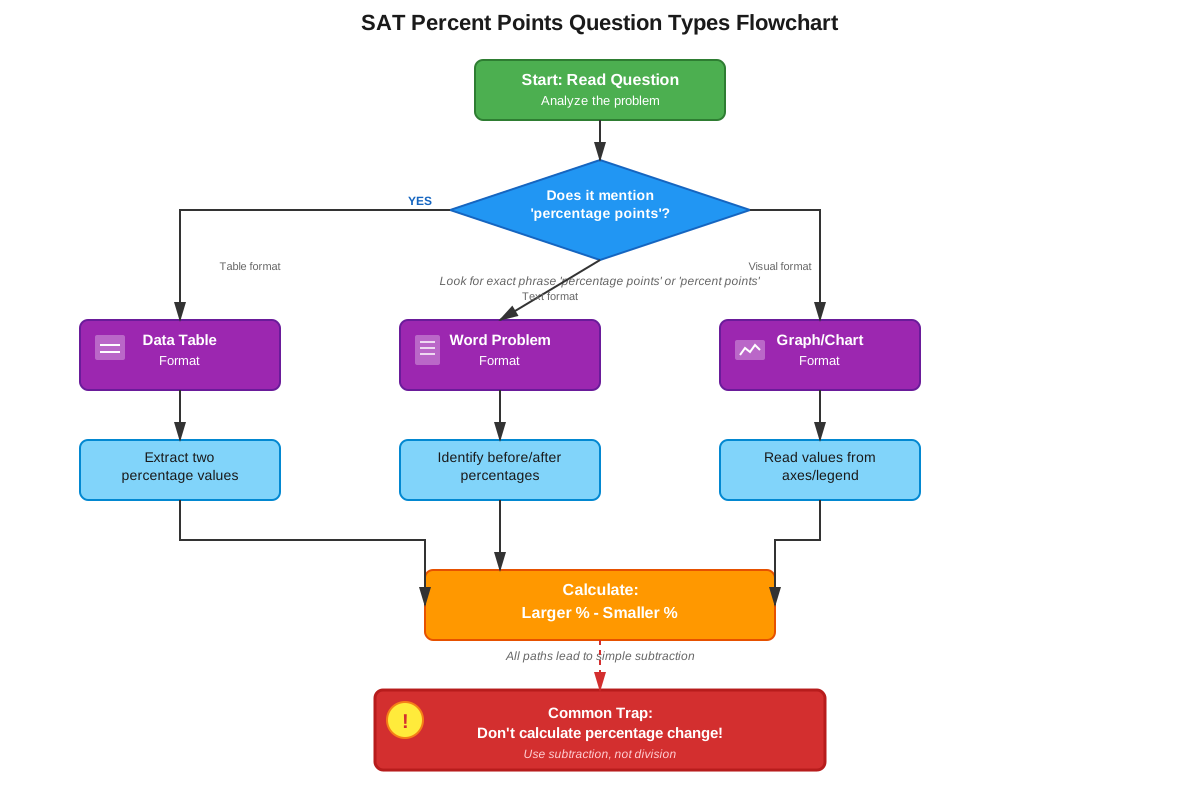
When approaching SAT questions involving percentages, follow this systematic process:
Step 1: Identify the question type
- Look for trigger phrases: "percentage points," "by how many percentage points," "percent point difference"
- Distinguish from percentage change phrases: "percent increase," "what percent," "by what percent"
Step 2: Extract the relevant data
- Identify the two percentages being compared
- Note which is the original/earlier value and which is the new/later value
- If data is in a table or graph, carefully extract the correct values
Step 3: Determine the required calculation
- For percent points: use simple subtraction (Later % - Earlier %)
- For percentage change: use the formula (New - Old) / Old × 100%
- For finding a new value after a percent point change: use addition or subtraction
Step 4: Perform the calculation carefully
- Double-check that you're subtracting in the correct order
- Verify that your answer is reasonable given the context
- Include appropriate units in your answer
Exam Tip: If a question gives you two percentages and asks "by how much" they differ, the answer is almost always in percentage points, not percentage change. The SAT uses this phrasing deliberately.
Trigger words for percent points:
- "percentage points"
- "percent points"
- "by how many percentage points"
- "the difference between [percentage] and [percentage]"
- "increased/decreased from X% to Y%"
Trigger words for percentage change:
- "percent increase/decrease"
- "by what percent"
- "what is the percent change"
- "increased/decreased by X%"
Time allocation advice: Percent point questions typically require 30-60 seconds once you understand the concept. Don't overthink—if you see two percentages and need their difference, subtract them. Save time by recognizing the question type quickly rather than second-guessing your approach.
Process of elimination tips:
- Eliminate answers that confuse percent points with percentage change
- If answer choices include both small values (likely percent points) and larger values (likely percentage change), determine which the question asks for
- Answers that exceed 100 percentage points are usually incorrect unless dealing with extreme scenarios
Memory Techniques
Mnemonic for the distinction: "Points are Plain subtraction, Percent needs Proportion"
- Points = Plain subtraction (just subtract the percentages)
- Percent change = Proportion (divide by original, then multiply by 100)
Visualization strategy: Picture percentages as positions on a number line from 0% to 100%. Percent points represent the physical distance between two points on this line. If you're at the 30% mark and move to the 45% mark, you've traveled 15 percentage points—you can literally count the distance.
Acronym for the calculation process: SILO
- Subtract the percentages
- Identify which is larger/later
- Label your answer with "percentage points"
- Order matters: later minus earlier
Memory aid for question interpretation: When you see "by how much," think "By How much = Basic How = subtract" (percent points). When you see "by what percent," think "By What Percent = Big Word Problem = divide" (percentage change).
Summary
Percent points represent the absolute arithmetic difference between two percentages, calculated through simple subtraction. This concept differs fundamentally from percentage change, which measures relative change and requires division. The SAT frequently tests whether students can distinguish between these two measures, making this a high-yield topic for score improvement. To find a percent point difference, subtract the earlier or smaller percentage from the later or larger percentage, and always label the answer with "percentage points" to maintain precision. Questions appear in various formats including word problems, data interpretation, and multi-step calculations, often embedded in realistic contexts like survey data, economic indicators, or scientific measurements. Success requires careful reading to identify trigger words, accurate calculation, and conceptual understanding of what percent points measure. Mastering this topic enhances performance not only on direct percentage questions but also on broader data analysis and quantitative reasoning problems throughout the SAT Math section.
Key Takeaways
- Percent points measure absolute difference between percentages using simple subtraction: Later % - Earlier %
- Percent points ≠ percentage change; these are fundamentally different measures that students must distinguish
- Always label answers with "percentage points" to avoid ambiguity and demonstrate understanding
- SAT questions deliberately test the distinction between percent points and percentage change through careful wording
- Trigger phrases like "by how many percentage points" signal percent point calculations, while "by what percent" signals percentage change
- Percent point questions appear frequently on the SAT in multiple formats including word problems, tables, and graphs
- Converting between percent points and percentage change requires understanding both the absolute difference and the relative change formulas
Related Topics
Percentage Increase and Decrease: Building on percent points, this topic explores how to calculate the relative change between values, using the formula (New - Old) / Old × 100%. Mastering percent points provides the foundation for understanding why percentage change differs from absolute change.
Ratios and Proportions: Since percentages are ratios expressed per hundred, understanding ratio relationships deepens comprehension of percentage concepts. Percent points connect to ratios by measuring how the relationship between parts and wholes changes.
Data Interpretation and Analysis: Many SAT questions combine percent points with table and graph reading. Advancing to complex data interpretation requires fluency with percent point calculations as a foundational skill.
Growth and Decay Problems: Exponential growth and decay problems often involve percentage changes over time. Understanding the distinction between percent points and percentage change prevents errors in multi-step growth calculations.
Statistics and Probability: Statistical measures often appear as percentages, and comparing statistical data across groups or time periods requires percent point analysis. This topic enables progression to more sophisticated statistical reasoning.
Practice CTA
Now that you've mastered the conceptual foundation of percent points, it's time to solidify your understanding through practice. Attempt the practice questions to test your ability to distinguish percent points from percentage change, calculate differences accurately, and apply these concepts to SAT-style scenarios. Use the flashcards to reinforce key definitions and trigger words. Remember: the difference between a good SAT Math score and a great one often comes down to mastering high-yield topics like percent points that the exam tests repeatedly. Every practice question you complete builds the pattern recognition and confidence you need to answer these questions quickly and correctly on test day. You've got this!
Sign up free to keep reading
Create a free AnvayaPrep account to finish this SAT guide on Percent points — plus flashcards and practice questions.