Overview
Ratio percent conversion is a fundamental mathematical skill that bridges two essential ways of expressing proportional relationships: ratios and percentages. On the SAT math section, this topic appears frequently across multiple question types, from straightforward computational problems to complex word problems involving real-world scenarios. Understanding how to seamlessly convert between ratios and percentages—and vice versa—is crucial for success on test day, as these conversions often serve as intermediate steps in solving more complex problems involving proportions, statistics, and data interpretation.
The SAT consistently tests students' ability to work flexibly with different representations of the same quantitative relationship. A ratio like 3:5 and a percentage like 37.5% might represent the same proportional relationship in different contexts, and recognizing this equivalence quickly can save valuable time during the exam. This skill becomes particularly important when analyzing charts, graphs, and tables, where data might be presented in one format but questions require answers in another.
Mastering sat ratio percent conversion connects directly to broader mathematical concepts including fractions, decimals, proportions, and algebraic reasoning. This topic serves as a gateway to more advanced percentage problems, including percent increase/decrease, compound interest, and probability. The ability to convert fluidly between these representations demonstrates mathematical flexibility—a quality the SAT specifically assesses—and provides multiple pathways to solve challenging problems when one approach becomes difficult.
Learning Objectives
- [ ] Identify key features of Ratio percent conversion
- [ ] Explain how Ratio percent conversion appears on the SAT
- [ ] Apply Ratio percent conversion to answer SAT-style questions
- [ ] Convert any given ratio to its equivalent percentage representation with accuracy
- [ ] Transform percentages into simplified ratio form in both part-to-part and part-to-whole contexts
- [ ] Distinguish between part-to-part ratios and part-to-whole ratios when working with percentages
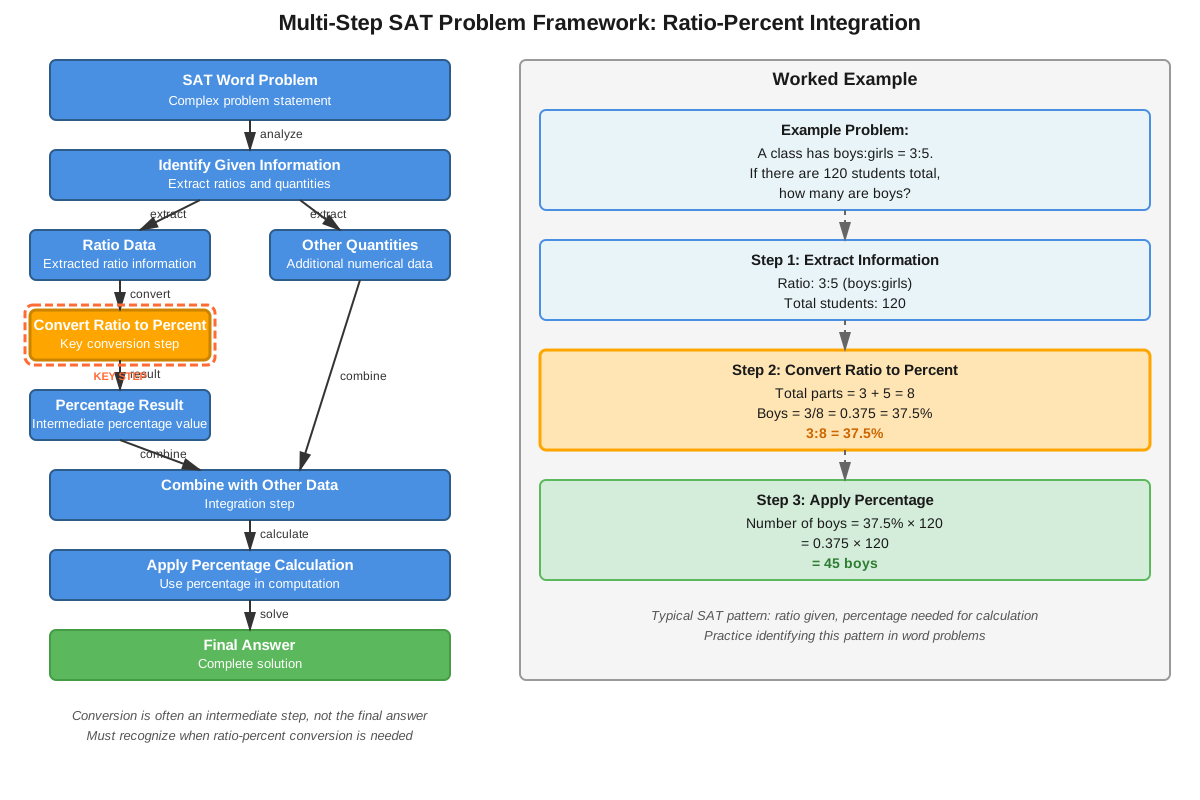
- [ ] Solve multi-step SAT problems that require ratio-to-percent conversion as an intermediate step
Prerequisites
- Basic fraction operations: Converting ratios to percentages requires understanding fractions as division and the ability to simplify fractions, which forms the foundation of ratio work
- Decimal multiplication and division: Percentages are fundamentally decimals multiplied by 100, so comfort with decimal operations is essential for accurate conversions
- Understanding of proportional relationships: Recognizing that ratios and percentages both express proportional relationships helps students understand why conversion methods work
- Basic ratio concepts: Familiarity with ratio notation (a:b), the difference between part-to-part and part-to-whole ratios, and ratio simplification enables meaningful conversion work
Why This Topic Matters
In real-world applications, ratio percent conversion appears constantly in contexts ranging from financial analysis (converting investment ratios to percentage returns) to scientific research (expressing experimental results as percentages rather than ratios) to everyday decision-making (comparing product concentrations or recipe proportions). Medical professionals convert ratios to percentages when discussing treatment success rates, while business analysts transform market share ratios into percentage points for clearer communication. This skill enables professionals to present data in the most accessible format for their audience.
On the SAT, ratio percent conversion questions appear with remarkable frequency—approximately 3-5 questions per test directly assess this skill, while another 5-8 questions require it as an intermediate step. These questions typically appear in both the calculator and no-calculator sections, with difficulty levels ranging from straightforward conversions to complex word problems. The College Board particularly favors questions that combine ratio percent conversion with data interpretation, requiring students to extract information from tables or graphs, perform conversions, and then apply the results to answer multi-step questions.
Common SAT question formats include: presenting survey data as ratios and asking for percentage representations; providing percentage information and requesting ratio comparisons; embedding conversion requirements within word problems about mixtures, populations, or financial scenarios; and asking students to identify equivalent representations across multiple formats. The test also frequently presents answer choices in mixed formats, requiring students to convert their calculated answer to match the requested form.
Core Concepts
Understanding Ratios and Their Components
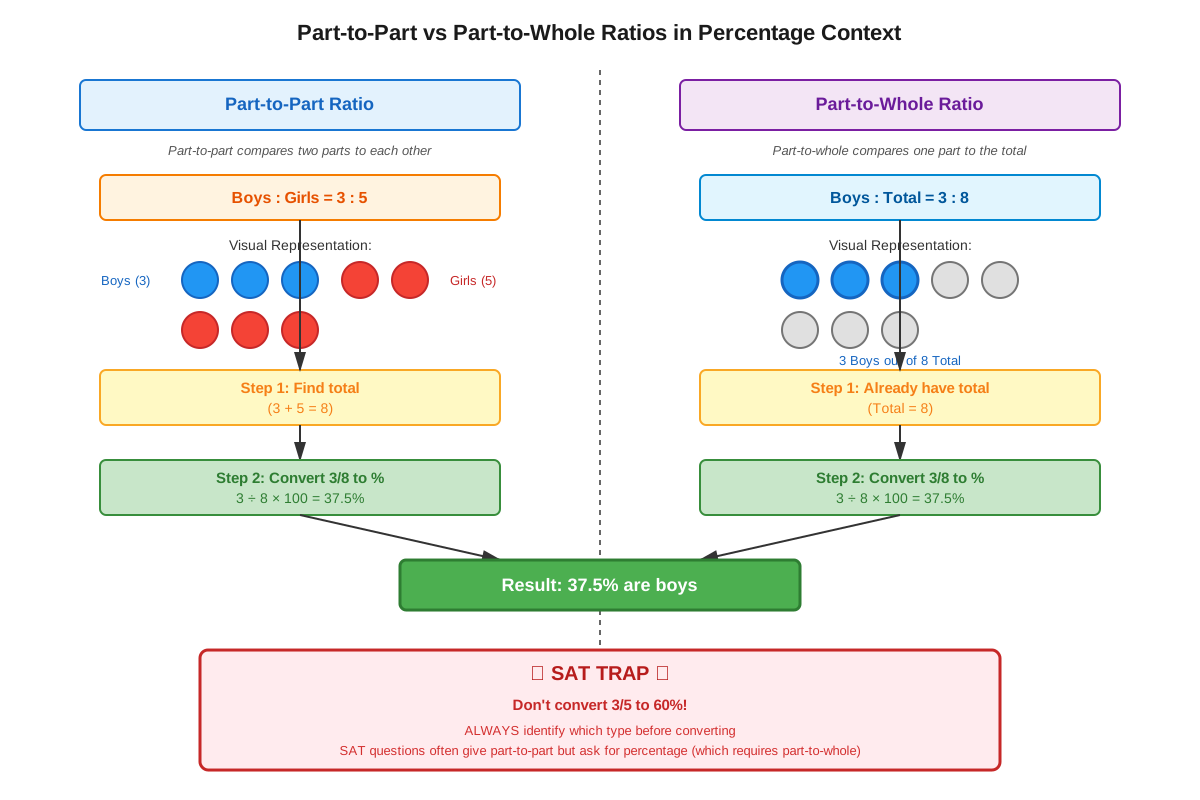
A ratio expresses the relationship between two or more quantities, showing how many times one value contains or is contained within another. Ratios can be written in three equivalent forms: using a colon (3:5), as a fraction (3/5), or using the word "to" (3 to 5). The critical distinction for conversion work lies in understanding part-to-part ratios versus part-to-whole ratios. A part-to-part ratio compares two distinct components (boys to girls = 3:5), while a part-to-whole ratio compares one component to the total (boys to all students = 3:8). This distinction becomes crucial when converting to percentages, as percentages inherently represent part-to-whole relationships.
Understanding Percentages as Special Ratios
A percentage is fundamentally a ratio with a denominator of 100. The word "percent" literally means "per hundred" (from Latin per centum). When we say 45%, we mean 45 out of 100, or the ratio 45:100, or the fraction 45/100. This understanding reveals why percentages are always part-to-whole comparisons—they express what portion of the whole (100) is represented by the part. Recognizing percentages as standardized ratios with a common denominator makes conversion between formats more intuitive and less mechanical.
Converting Part-to-Whole Ratios to Percentages
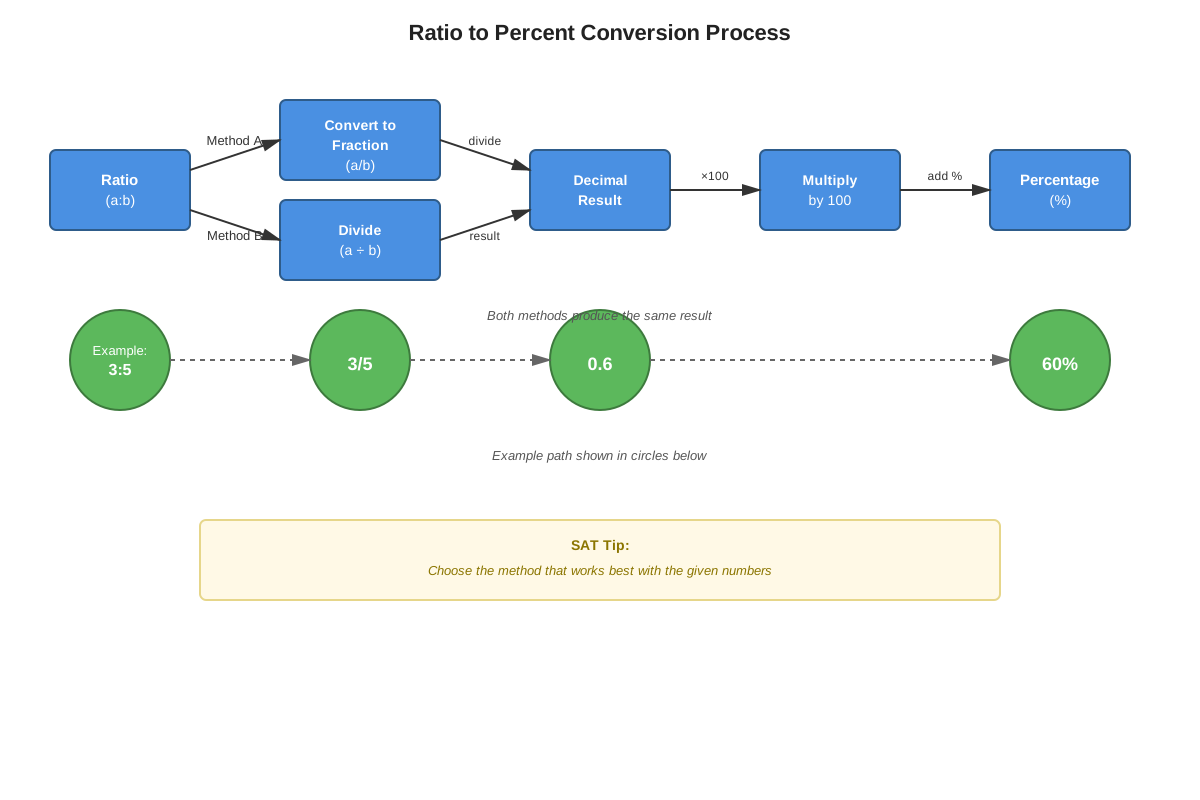
The most straightforward conversion involves part-to-whole ratios. The process follows these steps:
- Express the ratio as a fraction (part/whole)
- Divide the numerator by the denominator to get a decimal
- Multiply the decimal by 100 to convert to a percentage
- Add the percent symbol (%)
For example, if 15 out of 40 students prefer chocolate ice cream, the ratio is 15:40. Converting: 15/40 = 0.375, then 0.375 × 100 = 37.5%. Therefore, 37.5% of students prefer chocolate. This method works universally for any part-to-whole ratio.
Converting Part-to-Part Ratios to Percentages
Part-to-part ratios require an additional step because percentages need a whole to reference. Consider a ratio of boys to girls of 3:5. To convert either part to a percentage:
- Find the total by adding all parts (3 + 5 = 8)
- Express each part as a fraction of the total (boys: 3/8, girls: 5/8)
- Convert each fraction to a percentage (3/8 = 0.375 = 37.5%, 5/8 = 0.625 = 62.5%)
This reveals that boys represent 37.5% of the total, while girls represent 62.5%. Notice that these percentages sum to 100%, confirming the conversion is correct—a useful check for accuracy.
Converting Percentages to Ratios
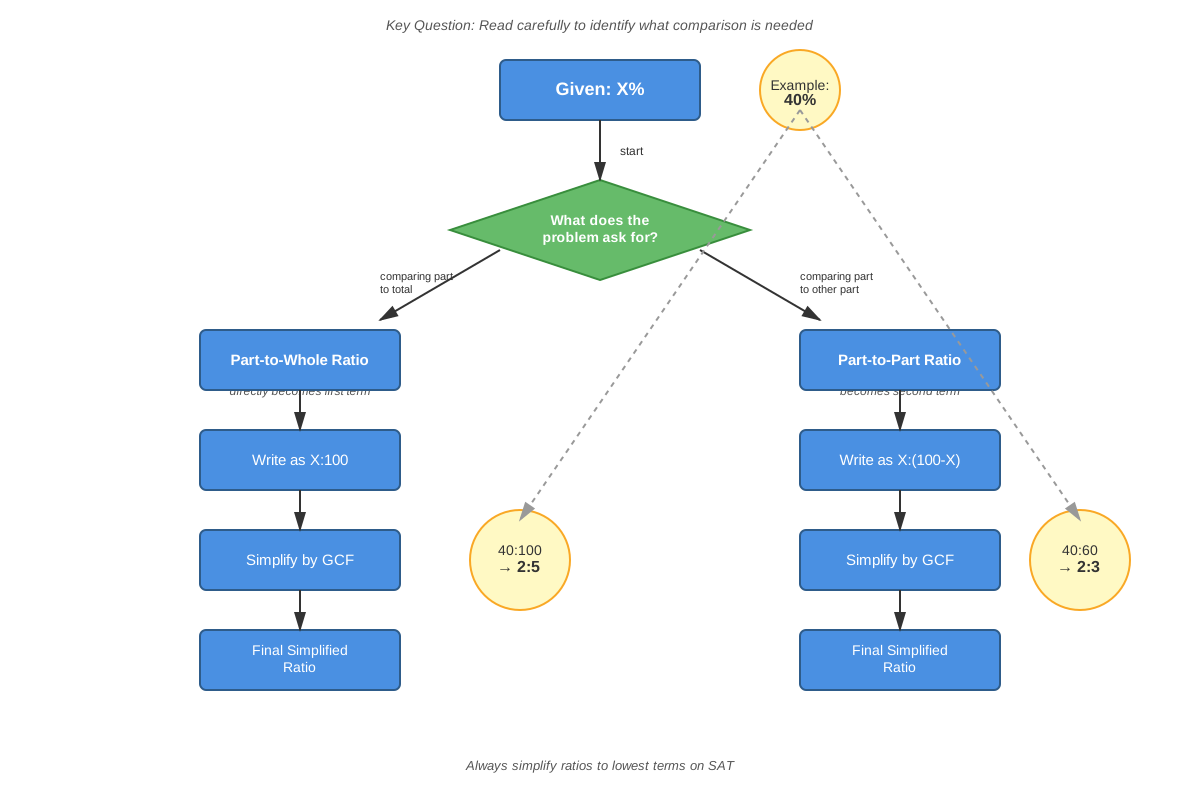
The reverse process—converting percentages to ratios—follows a systematic approach:
- Write the percentage as a fraction over 100 (45% = 45/100)
- Simplify the fraction to lowest terms (45/100 = 9/20)
- Express as a ratio using colon notation (9:20)
This produces a part-to-whole ratio. If a part-to-part ratio is needed, additional information about other components is required. For instance, if 60% are boys, then 40% are girls, yielding a boys-to-girls ratio of 60:40, which simplifies to 3:2.
Working with Ratio Tables for Complex Conversions
For problems involving multiple components or complex relationships, creating a ratio table organizes information effectively:
| Component | Ratio Parts | Calculation | Percentage |
|---|---|---|---|
| Red marbles | 4 | 4/12 | 33.33% |
| Blue marbles | 5 | 5/12 | 41.67% |
| Green marbles | 3 | 3/12 | 25% |
| Total | 12 | 12/12 | 100% |
This table format helps visualize the relationship between parts and whole, making conversion systematic and reducing errors. The total row serves as a verification check.
Special Cases and Shortcuts
Certain ratios convert to common percentages that appear frequently on the SAT:
- 1:2 = 50% (one part out of two total parts)
- 1:3 = 33.33% (one part out of three total parts)
- 1:4 = 25% (one part out of four total parts)
- 3:4 = 75% (three parts out of four total parts)
- 2:3 = 66.67% (two parts out of three total parts)
Memorizing these common conversions accelerates problem-solving and provides quick estimation tools for checking answers.
Concept Relationships
The core concepts within ratio percent conversion form a logical progression: understanding ratios as proportional relationships → recognizing percentages as standardized ratios → distinguishing part-to-part from part-to-whole ratios → applying systematic conversion procedures → verifying results through sum checks. Each concept builds directly on the previous one, creating a coherent framework for solving conversion problems.
This topic connects backward to prerequisite knowledge of fractions and decimals, as every conversion requires expressing ratios as fractions and performing decimal operations. The relationship flows: fractions → enable → ratio representation → converts to → decimal form → multiplies to → percentage form. Understanding this chain reveals why students who struggle with fractions often find ratio percent conversion challenging.
Looking forward, ratio percent conversion enables progression to more advanced topics including percent change (which requires converting ratios of change to percentages), probability (expressing favorable outcomes as percentages), and statistical analysis (converting frequency ratios to percentage distributions). The skill also underpins work with proportions, scale factors, and similarity in geometry. Mastering this foundational conversion skill unlocks access to these more complex mathematical applications that appear frequently in later SAT questions.
High-Yield Facts
⭐ A percentage always represents a part-to-whole relationship, never a part-to-part relationship without additional context
⭐ To convert any ratio to a percentage, express it as a fraction, divide, multiply by 100, and add the percent symbol
⭐ When converting part-to-part ratios to percentages, first find the total by adding all parts together
⭐ The percentages of all parts in a whole must sum to exactly 100%—use this as a verification check
⭐ To convert a percentage to a ratio, write it over 100 and simplify to lowest terms
- A ratio of 1:1 always equals 50% for each part (equal distribution)
- Ratios can be scaled up or down without changing the percentage they represent (3:5 = 6:10 = 30:50, all yielding the same percentages)
- When a problem gives percentages and asks for a ratio, convert each percentage to a fraction over 100, then compare numerators
- Part-to-part ratios can be converted to multiple percentages (one for each part), but each percentage references the same total
- The SAT frequently presents ratios in word form ("for every 3 boys there are 5 girls") requiring translation to numerical ratio notation before conversion
Quick check — test yourself on Ratio percent conversion so far.
Try Flashcards →Common Misconceptions
Misconception: A ratio of 3:5 means 3% and 5% → Correction: A ratio of 3:5 means 3 parts out of 8 total (37.5%) and 5 parts out of 8 total (62.5%). The ratio numbers are not percentages themselves; they must be converted by finding their relationship to the total.
Misconception: To convert a percentage to a ratio, simply remove the percent sign → Correction: Converting a percentage to a ratio requires writing it as a fraction over 100 and simplifying. For example, 45% becomes 45/100, which simplifies to 9/20 or 9:20, not simply "45."
Misconception: All ratios can be directly converted to a single percentage → Correction: Part-to-part ratios convert to multiple percentages (one for each part), while part-to-whole ratios convert to a single percentage. A ratio of boys to girls (3:5) yields two percentages: 37.5% boys and 62.5% girls.
Misconception: When percentages are given, the ratio is found by simply writing them with a colon → Correction: While 60% boys and 40% girls does yield a 60:40 ratio, this must be simplified to 3:2 for the final answer. The SAT expects ratios in simplest form unless otherwise specified.
Misconception: Percentages greater than 100% are impossible in ratio conversions → Correction: When comparing one part to another part (not to the whole), percentages can exceed 100%. If there are 150 boys and 100 girls, boys represent 150% of the number of girls, though boys represent only 60% of all students.
Misconception: The order of numbers in a ratio doesn't matter for percentage conversion → Correction: The order is crucial. A ratio of 3:5 (boys to girls) yields different percentages than 5:3 (girls to boys). Always identify what each number represents before converting.
Worked Examples
Example 1: Converting a Part-to-Part Ratio to Percentages
Problem: In a classroom, the ratio of students who prefer math to students who prefer science is 7:5. What percentage of students prefer math?
Solution:
Step 1: Identify this as a part-to-part ratio (math students : science students = 7:5)
Step 2: Find the total number of parts by adding: 7 + 5 = 12 total parts
Step 3: Express math students as a fraction of the total: 7/12
Step 4: Convert the fraction to a decimal: 7 ÷ 12 = 0.5833...
Step 5: Multiply by 100 to get the percentage: 0.5833... × 100 = 58.33%
Step 6: Verify by checking the science percentage: 5/12 = 0.4167 = 41.67%
Check: 58.33% + 41.67% = 100% ✓
Answer: 58.33% (or 58⅓%) of students prefer math.
Connection to Learning Objectives: This example demonstrates identifying the key feature of distinguishing part-to-part ratios, applying the systematic conversion process, and verifying results—all essential SAT skills.
Example 2: Converting Percentages to a Simplified Ratio
Problem: In a survey, 65% of respondents preferred Brand A and 35% preferred Brand B. What is the ratio of Brand A preference to Brand B preference in simplest form?
Solution:
Step 1: Write each percentage as a ratio to 100:
- Brand A: 65:100
- Brand B: 35:100
Step 2: Create the part-to-part ratio by comparing the numerators: 65:35
Step 3: Simplify by finding the greatest common factor (GCF):
- Factors of 65: 1, 5, 13, 65
- Factors of 35: 1, 5, 7, 35
- GCF = 5
Step 4: Divide both parts by the GCF: 65÷5 : 35÷5 = 13:7
Step 5: Verify the ratio is in simplest form (13 and 7 share no common factors other than 1) ✓
Answer: The ratio of Brand A to Brand B preference is 13:7.
Connection to Learning Objectives: This example shows how to transform percentages into ratio form, simplify ratios properly, and recognize that SAT questions often require simplified answers rather than initial calculations.
Example 3: Multi-Step Problem Combining Ratios and Percentages
Problem: A school has 480 students. The ratio of freshmen to sophomores to juniors is 5:4:3. What percentage of the school's students are sophomores?
Solution:
Step 1: Identify the total ratio parts: 5 + 4 + 3 = 12 parts
Step 2: Determine how many students each part represents: 480 ÷ 12 = 40 students per part
Step 3: Calculate the number of sophomores: 4 parts × 40 students/part = 160 sophomores
Step 4: Convert to percentage: (160/480) × 100 = 33.33%
Alternative approach (without finding actual numbers):
- Sophomores represent 4 out of 12 total parts
- 4/12 = 1/3 = 0.3333... = 33.33%
Answer: Sophomores represent 33.33% (or 33⅓%) of the school's students.
Connection to Learning Objectives: This problem demonstrates how ratio percent conversion appears in complex SAT word problems, requiring students to extract relevant information, apply conversion procedures, and recognize multiple solution pathways.
Exam Strategy
When approaching sat ratio percent conversion questions, begin by identifying whether the problem presents a ratio requiring conversion to a percentage or vice versa. Look for key phrases like "what percent," "what is the ratio," or "express as a percentage" to determine the required direction of conversion. Circle or underline these directive words to maintain focus on what the question actually asks, as the SAT often includes answer choices in multiple formats to trap students who convert in the wrong direction.
Trigger words and phrases that signal ratio percent conversion questions include: "ratio of," "for every," "out of," "what percent," "what percentage," "express as a ratio," "in simplest form," and "compared to." When you see these phrases, immediately identify whether you're working with part-to-part or part-to-whole relationships, as this distinction determines your conversion approach. Questions using "compared to" or "for every" typically indicate part-to-part ratios, while "out of" or "what percent of the total" signal part-to-whole relationships.
For process-of-elimination strategies, calculate the approximate percentage or ratio before looking at answer choices. If you determine that approximately 60% is correct, immediately eliminate choices near 40%, 30%, or other distant values. The SAT often includes answer choices representing common errors: the unconverted ratio numbers as percentages, percentages calculated using only one part of a ratio, or ratios that weren't simplified. Recognizing these trap answers helps eliminate options quickly.
Time-Saving Tip: For multiple-choice questions, if the answer choices are far apart (like 25%, 50%, 75%, 100%), estimate rather than calculating exact decimals. A ratio of 7:13 is clearly more than 50% (since 7 is more than half of 13), allowing you to eliminate choices below 50% immediately.
Allocate approximately 45-60 seconds for straightforward conversion questions and up to 90 seconds for multi-step problems involving ratio percent conversion. If a problem requires more time, mark it for review and return after completing easier questions. The SAT rewards efficient time management, and ratio percent conversion questions often appear early in sections, making them ideal for building confidence and momentum.
Memory Techniques
The "FRED" Method for converting ratios to percentages:
- Fraction form (write the ratio as a fraction)
- Reduce if needed (simplify before calculating)
- Evaluate (divide to get decimal)
- Decimal to percent (multiply by 100)
The "Part-Whole-Total" Visualization: Picture a pie chart whenever working with ratios. Each ratio part is a slice, and all slices together make the whole pie (100%). This mental image helps distinguish part-to-part ratios (comparing slices) from part-to-whole ratios (comparing one slice to the entire pie).
The "100 Rule": Remember that all percentages in a complete set must sum to exactly 100%. Use this as both a memory device and a verification tool. If your calculated percentages don't sum to 100%, you've made an error.
Common Conversion Anchors: Memorize these frequently-tested equivalents:
- "Half and Half": 1:1 = 50% each
- "Third Time's the Charm": 1:2 = 33.33% and 66.67%
- "Quarter Pounder": 1:3 = 25% and 75%
- "Three-Quarter Time": 3:1 = 75% and 25%
The "Simplify Last" Acronym (LAST):
- Locate the percentages
- Arrange as fractions over 100
- Set up the ratio
- Trim to simplest form
This reminds students to simplify ratios as the final step, not the first step, preventing premature simplification errors.
Summary
Ratio percent conversion represents a critical mathematical skill that bridges two fundamental ways of expressing proportional relationships. The conversion process requires understanding that percentages are standardized ratios with a denominator of 100, representing part-to-whole relationships. Converting ratios to percentages involves expressing the ratio as a fraction, dividing to obtain a decimal, and multiplying by 100. The reverse process—converting percentages to ratios—requires writing the percentage over 100 and simplifying to lowest terms. The crucial distinction between part-to-part and part-to-whole ratios determines the conversion approach: part-to-whole ratios convert directly to a single percentage, while part-to-part ratios require first finding the total of all parts before calculating individual percentages. On the SAT, these conversions appear both as standalone computational questions and as essential intermediate steps in complex word problems involving data interpretation, proportions, and real-world scenarios. Mastery requires recognizing conversion requirements quickly, applying systematic procedures accurately, and verifying results through sum checks and reasonableness tests.
Key Takeaways
- Ratio percent conversion requires understanding that percentages are ratios with a denominator of 100, representing part-to-whole relationships
- Part-to-part ratios must be converted to part-to-whole ratios before calculating percentages by finding the total of all parts
- The systematic conversion process (fraction → decimal → multiply by 100) works universally for any ratio-to-percentage conversion
- All percentages representing parts of a whole must sum to exactly 100%—use this as a verification check on every problem
- The SAT expects ratios in simplest form unless otherwise specified, requiring simplification as the final step in percentage-to-ratio conversions
- Common ratio-percentage equivalents (1:1 = 50%, 1:3 = 25%, 1:2 = 33.33%) accelerate problem-solving and provide estimation benchmarks
- Multi-step SAT problems frequently embed ratio percent conversion within larger contexts, requiring identification of when conversion is necessary
Related Topics
Percent Change and Percent Increase/Decrease: Building on ratio percent conversion, these topics involve calculating the percentage difference between two values, requiring conversion of the change ratio to a percentage. Mastering basic conversion enables tackling these more complex percentage applications.
Proportions and Cross-Multiplication: Ratios form the foundation of proportional relationships, and converting between ratios and percentages provides alternative solution methods for proportion problems. Understanding conversion flexibility strengthens proportional reasoning.
Probability as Percentages: Probability calculations often yield ratios (favorable outcomes to total outcomes) that must be converted to percentages for interpretation. The conversion skills learned here apply directly to probability problems.
Data Interpretation and Statistics: Charts, graphs, and tables frequently present data in ratio or percentage form, requiring conversion to answer questions. This topic enables sophisticated analysis of statistical information.
Mixture and Solution Problems: These advanced problems involve combining substances in specific ratios and calculating percentage concentrations, directly applying ratio percent conversion in complex scenarios.
Practice CTA
Now that you've mastered the core concepts of ratio percent conversion, it's time to solidify your understanding through active practice. The practice questions and flashcards designed for this topic will challenge you to apply these conversion skills in various SAT-style contexts, from straightforward calculations to complex multi-step problems. Each practice attempt strengthens your neural pathways for recognizing conversion requirements and executing procedures accurately under timed conditions. Remember, the difference between knowing how to convert and being able to convert quickly and accurately on test day comes from deliberate practice. Approach each practice question as an opportunity to refine your technique, identify your personal error patterns, and build the confidence that translates to points on the SAT. You've invested the time to understand the concepts—now invest the effort to make them automatic through practice!
Sign up free to keep reading
Create a free AnvayaPrep account to finish this SAT guide on Ratio percent conversion — plus flashcards and practice questions.