Overview
SAT percent traps represent one of the most frequently tested—and frequently missed—question types on the SAT math section. These questions are specifically designed to exploit common reasoning errors that students make when working with percentages, particularly when dealing with sequential percentage changes, percent increase and decrease, or comparing percentages across different base values. The College Board deliberately constructs these problems to appear straightforward while containing subtle complexities that catch unprepared test-takers off guard.
Understanding percent traps is essential for SAT success because these questions appear in both the calculator and no-calculator sections, often as medium-to-hard difficulty problems that separate average scorers from high achievers. Students who recognize the patterns in percent trap questions can avoid predictable errors and gain a significant competitive advantage. These questions typically involve real-world scenarios like sales discounts, population changes, investment returns, or survey data—contexts that make the mathematical relationships less obvious.
Percent traps connect to broader mathematical concepts including proportional reasoning, algebraic manipulation, and problem-solving strategies. Mastery of this topic strengthens foundational skills in working with ratios, fractions, and decimals while developing the critical thinking necessary to deconstruct multi-step word problems. The ability to identify and avoid percent traps demonstrates mathematical maturity that extends beyond memorized formulas to genuine conceptual understanding.
Learning Objectives
- [ ] Identify key features of SAT percent traps
- [ ] Explain how SAT percent traps appears on the SAT
- [ ] Apply SAT percent traps to answer SAT-style questions
- [ ] Distinguish between percentage points and percent change in comparative contexts
- [ ] Calculate the net effect of sequential percentage changes without falling into common traps
- [ ] Recognize when to use the original versus the modified base value in multi-step percentage problems
- [ ] Evaluate answer choices by identifying which ones represent typical trap answers
Prerequisites
- Basic percentage calculations: Converting between percentages, decimals, and fractions is fundamental to all percent trap problems
- Order of operations: Understanding which calculations to perform first prevents errors in multi-step percentage problems
- Algebraic thinking: Setting up equations and manipulating variables helps solve complex percentage scenarios
- Proportional reasoning: Recognizing equivalent ratios underlies the relationship between percentages and their base values
- Word problem interpretation: Translating verbal descriptions into mathematical operations is essential for contextual percentage questions
Why This Topic Matters
Percent traps appear on virtually every SAT administration, typically accounting for 2-4 questions across both math sections. These questions carry the same point value as easier problems but have significantly lower success rates among test-takers, making them high-value targets for score improvement. Students who master percent traps can reliably earn points that many competitors miss, directly impacting percentile rankings and college admissions outcomes.
In real-world applications, understanding percent traps prevents costly financial mistakes. Whether calculating compound interest, evaluating investment returns, comparing discount offers, or interpreting statistical claims in media, the ability to correctly reason about sequential and comparative percentages is invaluable. Many misleading advertisements and political claims exploit the same conceptual confusions that SAT percent traps test.
On the SAT, percent trap questions most commonly appear as word problems involving: sequential discounts or increases (applying one percentage change followed by another), comparing percentage changes across different base values, distinguishing between percentage points and percent change, calculating what percentage one quantity is of another after both have changed, and reverse percentage problems (finding an original value given a percentage change). These questions often appear in the middle-to-end of each math section, positioned as medium or hard difficulty problems.
Core Concepts
The Non-Commutative Nature of Sequential Percentage Changes
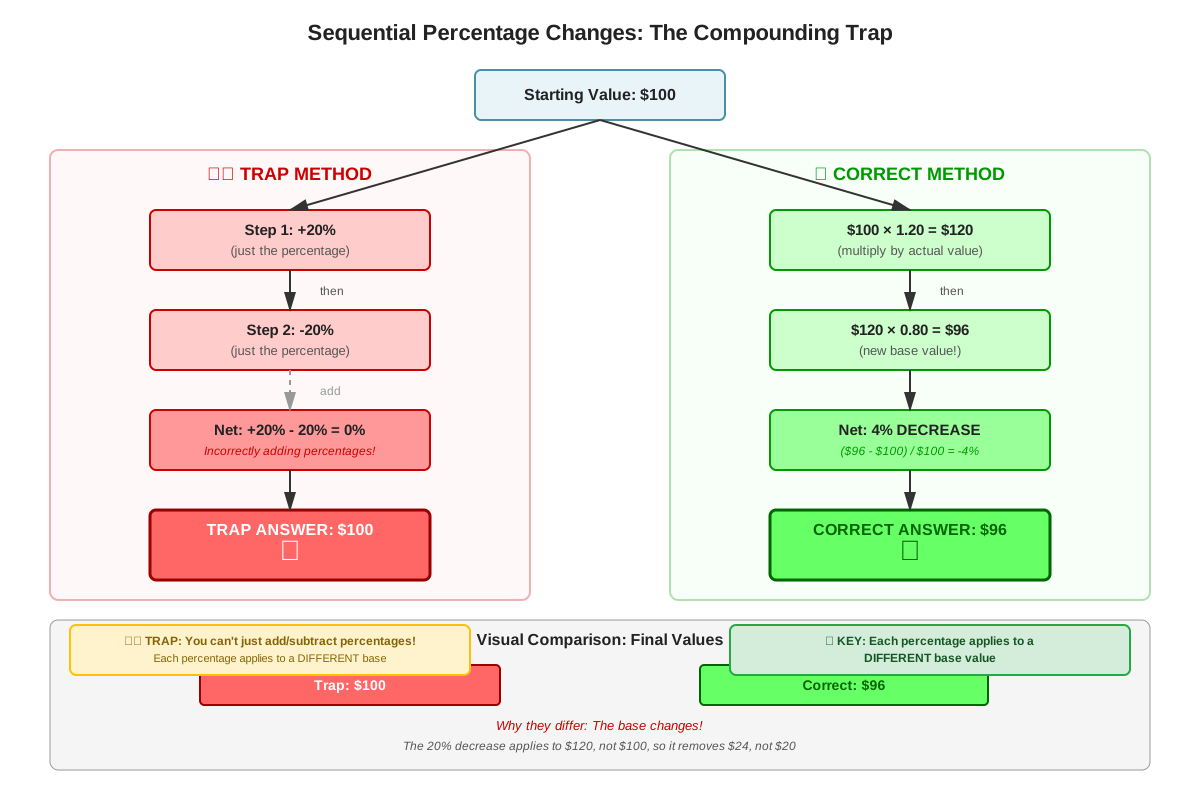
One of the most fundamental sat percent traps involves sequential percentage changes. When a quantity undergoes multiple percentage changes, the order matters, and the changes do not simply add together. If a price increases by 20% and then decreases by 20%, the final price is NOT the original price—it's actually 96% of the original.
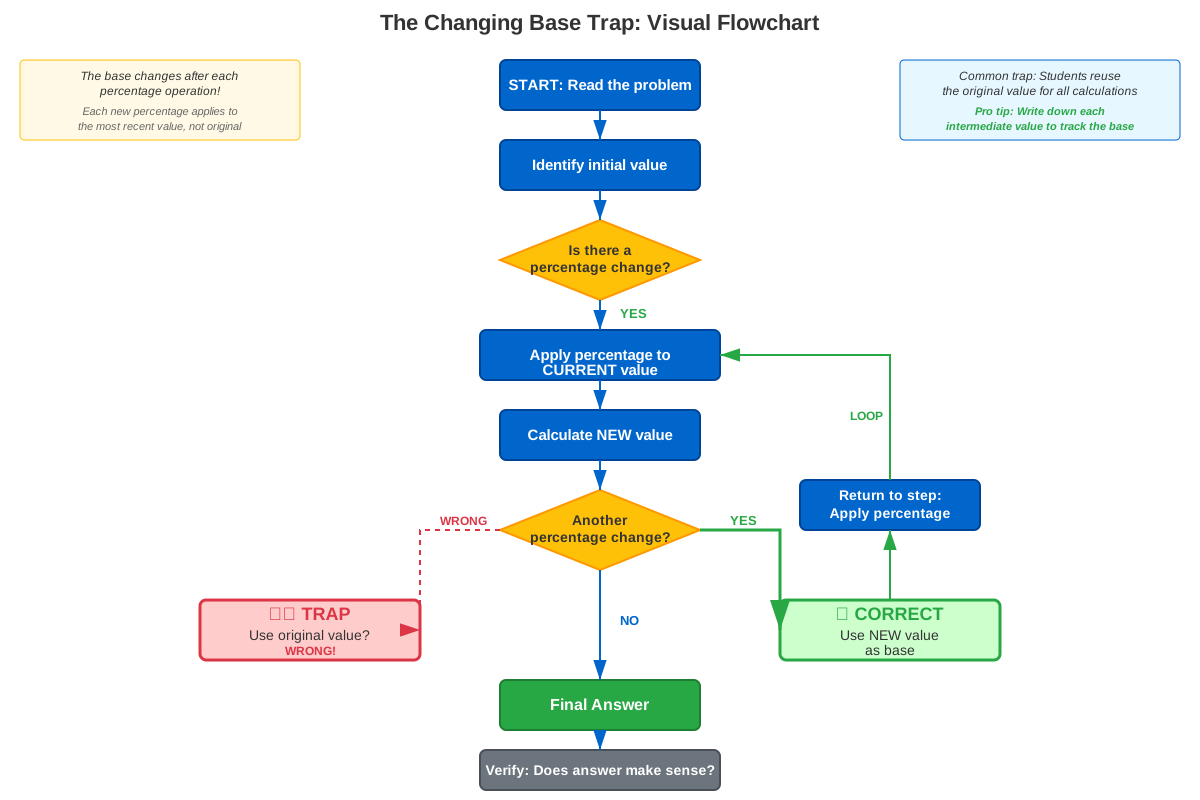
This occurs because each percentage change applies to a different base value. The 20% increase applies to the original value, creating a new, larger base. The subsequent 20% decrease then applies to this larger base, removing more absolute value than was originally added. Mathematically, if the original value is x:
After 20% increase: x × 1.20 = 1.20x
After 20% decrease: 1.20x × 0.80 = 0.96x
The net effect is a 4% decrease, not a return to the original value. This principle applies regardless of the order: a 20% decrease followed by a 20% increase also yields 96% of the original value.
Percentage Points vs. Percent Change
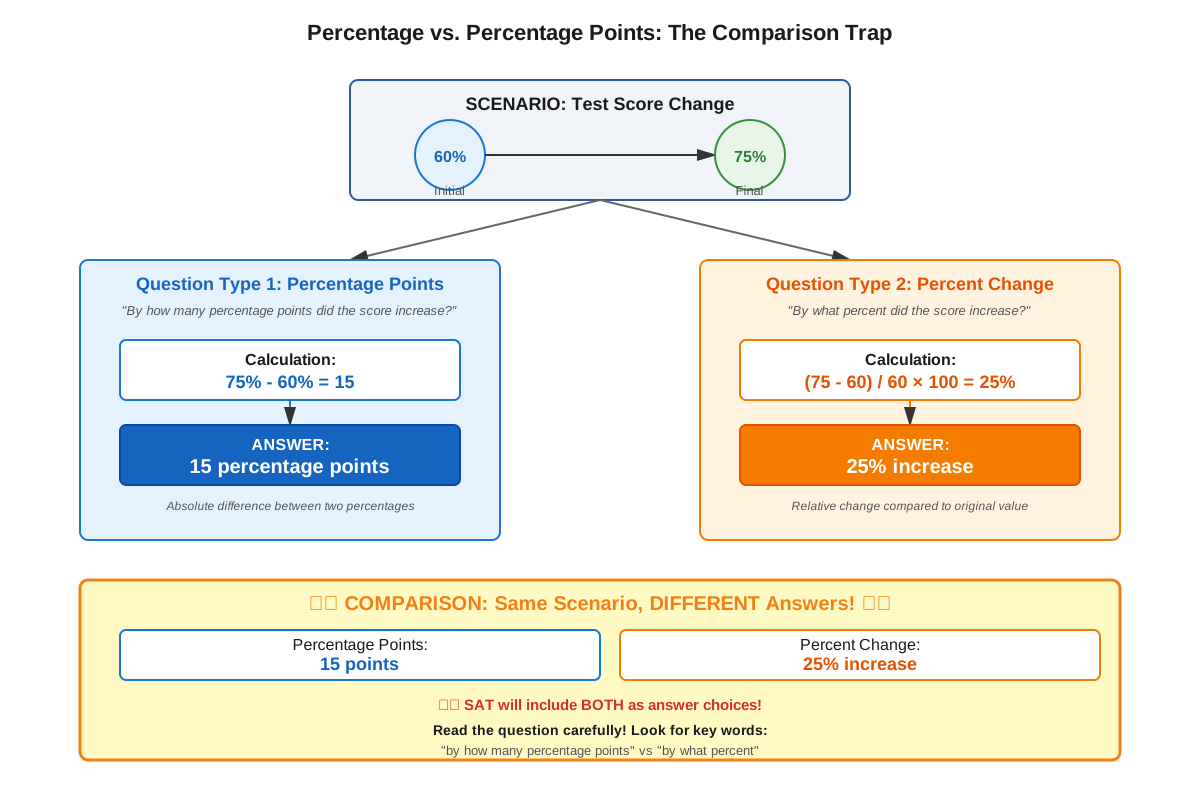
A critical distinction that creates numerous sat sat percent traps is the difference between percentage points and percent change. If a quantity increases from 40% to 50%, this represents:
- An increase of 10 percentage points (50 - 40 = 10)
- A 25% increase (10/40 = 0.25 = 25%)
The SAT frequently asks about one while students calculate the other. Percentage points measure absolute difference in percentages, while percent change measures relative change. Consider a political poll where support increases from 20% to 30%:
- Percentage point increase: 10 points
- Percent increase: 50% (because 10 is 50% of the original 20%)
| Original % | New % | Percentage Point Change | Percent Change |
|---|---|---|---|
| 25% | 50% | +25 points | +100% |
| 50% | 75% | +25 points | +50% |
| 60% | 80% | +20 points | +33.3% |
| 80% | 60% | -20 points | -25% |
The Base Value Problem
Many percent traps exploit confusion about which value serves as the base (denominator) in a percentage calculation. When comparing two quantities, "A is what percent of B?" requires B as the base, while "A is what percent more than B?" requires B as the base but involves calculating the difference first.
Consider: "If 60 is 150% of x, what is x?" Many students incorrectly calculate 60 × 1.5 = 90. The correct approach recognizes that x is the base value:
60 = 1.5x
x = 60/1.5 = 40
The trap answer (90) appears in the answer choices specifically to catch students who multiply instead of divide. This reverse percentage problem requires identifying that the given value is the result, not the base.
Percent of Percent Calculations
When calculating a percentage of a percentage, students often incorrectly add or use the wrong base. If a store offers 20% off, then an additional 10% off the sale price, the total discount is NOT 30%. The second discount applies to the already-reduced price:
Original price: P
After 20% off: 0.80P
After additional 10% off: 0.80P × 0.90 = 0.72P
Total discount: 28% (not 30%)
The SAT exploits this by including 30% as a trap answer choice. The correct approach multiplies the complementary percentages: (1 - 0.20)(1 - 0.10) = 0.80 × 0.90 = 0.72.
Comparing Percentages Across Different Bases
A sophisticated percent trap involves comparing percentage changes when the base values differ. If Company A's revenue increases by 50% from $200,000 to $300,000, while Company B's revenue increases by 40% from $500,000 to $700,000, which company had the larger dollar increase?
Students who focus only on percentages might incorrectly choose Company A (50% > 40%). However:
- Company A increase: $100,000
- Company B increase: $200,000
Company B's increase is larger in absolute terms despite the smaller percentage. The SAT tests whether students recognize that percentages alone don't determine magnitude—the base value matters critically.
The Percent Increase/Decrease Reversal Trap
If a quantity decreases by x%, the percentage increase needed to return to the original value is NOT x%. This asymmetry creates frequent traps. If a stock price decreases by 50% (from $100 to $50), it must increase by 100% (not 50%) to return to $100.
The general formula: if a value decreases by x%, it must increase by x/(1-x) × 100% to return to the original. For a 20% decrease, the required increase is 20/0.80 = 25%.
Concept Relationships
The core concepts of percent traps are deeply interconnected. The base value problem underlies virtually all other percent traps—whether dealing with sequential changes, percentage points versus percent change, or comparing percentages across different bases, identifying the correct base value is essential.
Sequential percentage changes → directly connects to → percent of percent calculations, as both involve applying one percentage operation to the result of another. The non-commutative nature of these operations stems from the changing base value after each step.
Percentage points vs. percent change → relates to → comparing percentages across different bases, as both require distinguishing between absolute and relative measures. A 10 percentage point change represents vastly different percent changes depending on the original base (10 points from 20% is 50% growth; 10 points from 80% is only 12.5% growth).
The percent increase/decrease reversal trap → builds upon → sequential percentage changes, representing a special case where the second change aims to undo the first. This reveals why percentage changes don't simply cancel out.
All these concepts connect back to prerequisite knowledge of proportional reasoning and algebraic manipulation. They extend forward to more advanced topics like exponential growth, compound interest, and statistical analysis—all of which involve sophisticated percentage reasoning.
Quick check — test yourself on SAT percent traps so far.
Try Flashcards →High-Yield Facts
⭐ Sequential percentage changes do not add: A 20% increase followed by a 20% decrease results in a 4% net decrease, not a return to the original value.
⭐ Percentage points ≠ percent change: An increase from 40% to 50% is 10 percentage points but a 25% increase.
⭐ The base value determines the percentage: Always identify whether you're calculating a percentage of the original value, the new value, or the difference.
⭐ Percent of percent requires multiplication: A 20% discount followed by 10% off the sale price equals 28% total discount (0.80 × 0.90 = 0.72).
⭐ Larger percentages don't always mean larger amounts: A 50% increase on a small base may be less than a 10% increase on a large base.
- To reverse a percentage decrease, you need a larger percentage increase: a 50% decrease requires a 100% increase to return to the original.
- When comparing "what percent more," calculate the difference first, then divide by the original value.
- The SAT includes trap answers that represent common calculation errors—these are often the result of adding percentages or using the wrong base.
- Percent increase formula: (New - Original)/Original × 100%
- Percent decrease formula: (Original - New)/Original × 100%
- Converting sequential percentage changes: multiply the multipliers (1 ± percentage as decimal) together.
Common Misconceptions
Misconception: Sequential percentage changes can be added together (e.g., +20% then -20% = 0% change).
Correction: Each percentage change applies to a different base value. You must multiply the multipliers: 1.20 × 0.80 = 0.96, representing a 4% net decrease.
Misconception: Percentage points and percent change are the same thing.
Correction: Percentage points measure absolute difference in percentages (50% - 40% = 10 points), while percent change measures relative change (10/40 = 25% increase).
Misconception: If a value decreases by x%, it increases by x% to return to the original.
Correction: The percentage increase needed is always larger than the original decrease. After a 20% decrease, you need a 25% increase to return to the original (20/0.80 = 25%).
Misconception: "A is 50% more than B" means the same as "B is 50% less than A."
Correction: These statements use different base values. If A is 50% more than B, then B is 33.3% less than A (not 50% less).
Misconception: Two successive discounts of 20% and 10% equal a 30% total discount.
Correction: The second discount applies to the already-reduced price. The total discount is 28% (calculated as 1 - 0.80 × 0.90 = 0.28).
Misconception: When a question asks "what percent of," you should multiply the given values.
Correction: "What percent of" requires division: (part/whole) × 100%. The word "of" indicates the base value (denominator).
Worked Examples
Example 1: Sequential Percentage Changes
Problem: A store marks up the wholesale price of a jacket by 60%, then offers a 25% discount during a sale. If the wholesale price was $80, what is the final sale price, and what is the net percentage change from the wholesale price?
Solution:
Step 1: Calculate the price after the 60% markup.
- Markup means multiply by 1.60
- Price after markup: $80 × 1.60 = $128
Step 2: Calculate the price after the 25% discount.
- Discount means multiply by 0.75 (keeping 75% of the price)
- Final price: $128 × 0.75 = $96
Step 3: Calculate the net percentage change from the original wholesale price.
- Change: $96 - $80 = $16
- Percentage change: ($16/$80) × 100% = 20%
Answer: The final sale price is $96, representing a 20% increase from the wholesale price.
Key insight: This problem demonstrates that sequential changes don't simply add (60% - 25% ≠ 35%). Instead, we multiply the multipliers: 1.60 × 0.75 = 1.20, confirming a 20% net increase. The trap answer of 35% increase would catch students who incorrectly subtract percentages.
Example 2: Percentage Points vs. Percent Change
Problem: In 2020, 35% of students at a school participated in sports. In 2021, 42% participated. The school newspaper reported this as a "7% increase in sports participation." What is wrong with this statement, and what is the correct percent increase?
Solution:
Step 1: Identify what the newspaper calculated.
- The newspaper calculated: 42% - 35% = 7%
- This is a 7 percentage point increase, not a 7% increase
Step 2: Calculate the actual percent increase.
- Percent increase formula: (New - Original)/Original × 100%
- Percent increase: (42 - 35)/35 × 100%
- Percent increase: 7/35 × 100% = 0.20 × 100% = 20%
Answer: The newspaper confused percentage points with percent change. The correct statement is that participation increased by 7 percentage points, which represents a 20% increase.
Key insight: This is one of the most common SAT percent traps. The question tests whether students understand that a change in percentages must be calculated relative to the original percentage. The trap answer (7%) appears in the problem statement itself, making it especially deceptive. This connects to our learning objective of distinguishing between percentage points and percent change in comparative contexts.
Exam Strategy
When approaching SAT percent trap questions, follow this systematic process:
- Identify the base value: Before calculating any percentage, determine what value serves as the base (denominator). Circle or underline this value in the problem.
- Watch for sequential changes: If a problem involves multiple percentage changes, resist the urge to add or subtract percentages. Instead, convert each percentage to a multiplier and multiply them together.
- Distinguish percentage points from percent change: When you see phrases like "increased from X% to Y%," immediately ask yourself whether the question wants the absolute difference (percentage points) or the relative change (percent change).
Exam Tip: Trigger phrases for percent traps include "then," "followed by," "additional," "increased from...to," "what percent more/less," and "original price/value."
- Check trap answers: The SAT deliberately includes wrong answers that represent common errors. If you see an answer that matches a simple addition or subtraction of percentages, be suspicious—it's likely a trap.
- Use the answer choices strategically: If you're unsure, plug answer choices back into the problem. Percent trap questions often have numerical answers that can be verified.
- Allocate time wisely: Percent trap questions typically appear in positions 10-20 (medium-hard difficulty). Budget 60-90 seconds per question, but don't hesitate to skip and return if you're stuck—these questions are designed to be time-consuming.
Process of elimination tips:
- Eliminate answers that result from simply adding/subtracting percentages in sequential change problems
- Eliminate answers that confuse percentage points with percent change
- Eliminate answers that use the wrong base value (often the new value instead of the original)
- Be wary of answers that seem "too clean" or obvious—percent trap answers often involve decimals or unexpected values
Memory Techniques
MNEMONIC for Sequential Changes - "MULTIPLY, Don't Add"
When you see "then" or "followed by" in a percentage problem, remember: Multipliers Unite, Leaving Traps Inactive. Convert each percentage to a multiplier (1 ± decimal) and multiply them together.
VISUALIZATION for Base Value
Picture a percentage as a fraction with the base value always on the bottom. When you see "what percent of," imagine the word "of" as a giant denominator line—whatever follows "of" goes underneath.
ACRONYM for Percentage Points - "PP vs PC"
Percentage Points = Plain difference (just subtract)
Percent Change = Proportion Calculation (divide by original)
RHYME for Reversal Trap
"When percentages fall, the climb back is tall"—remember that reversing a percentage decrease always requires a larger percentage increase.
FINGER TECHNIQUE for Sequential Discounts
Hold up fingers representing what you KEEP (not what you lose). For 20% off then 10% off: hold up 8 fingers (80%) then 9 fingers (90%). Multiply: 8 × 9 = 72, so you keep 72% (28% total discount).
Summary
SAT percent traps represent a high-yield question type that tests conceptual understanding rather than computational skill. The fundamental principle underlying all percent traps is that percentages are relative measures that depend critically on their base value. Sequential percentage changes don't add together because each change applies to a different base; percentage points measure absolute differences while percent change measures relative differences; and comparing percentages across different bases requires considering the absolute magnitudes involved. Success on these questions requires systematic identification of the base value, careful attention to whether the question asks for percentage points or percent change, and recognition that trap answers typically result from incorrectly adding percentages or using the wrong base. Students who master these concepts gain a significant advantage on the SAT, as percent trap questions consistently separate high scorers from average performers while appearing in predictable patterns across test administrations.
Key Takeaways
- Sequential percentage changes require multiplying multipliers, never adding percentages—a 20% increase followed by 20% decrease yields 96% of the original, not 100%
- Percentage points (absolute difference) and percent change (relative difference) are fundamentally different measures that the SAT deliberately conflates in trap questions
- Always identify the base value before calculating any percentage; the base is typically the original value or the value after the word "of"
- Reversing a percentage decrease requires a larger percentage increase—the asymmetry is proportional to the size of the original decrease
- Trap answers on the SAT represent predictable calculation errors; recognizing these patterns allows for effective process of elimination
- Percent of percent calculations (successive discounts or increases) require multiplication: two 20% discounts equal 36% total discount, not 40%
- When comparing percentages across different bases, the larger percentage doesn't necessarily represent the larger absolute amount
Related Topics
Ratio and Proportion: Percentages are special ratios (per hundred), and mastering percent traps strengthens proportional reasoning skills essential for ratio problems, scale factor questions, and direct/inverse variation.
Exponential Growth and Decay: Sequential percentage changes form the foundation for understanding exponential functions, compound interest, and population growth models that appear in advanced SAT questions.
Data Analysis and Statistics: Many SAT data interpretation questions involve percentage changes in graphs, tables, and surveys—percent trap concepts apply directly to these contexts.
Algebraic Word Problems: The problem-solving strategies for percent traps (identifying base values, translating verbal descriptions to equations) transfer to all algebraic word problems.
Financial Literacy: Understanding percent traps enables accurate analysis of loans, investments, discounts, and tax calculations—skills tested indirectly through SAT word problems.
Practice CTA
Now that you've mastered the concepts behind SAT percent traps, it's time to cement your understanding through active practice. The practice questions and flashcards are specifically designed to mirror actual SAT questions, including the trap answers that catch unprepared students. Each practice problem you complete strengthens your pattern recognition and builds the automaticity needed to handle these questions quickly and accurately on test day. Remember: percent trap questions are high-value targets—they're worth the same points as easier questions but have much lower success rates among test-takers. Your investment in mastering this topic will directly translate to score improvements and competitive advantage. Start practicing now to transform these traps into opportunities!
Sign up free to keep reading
Create a free AnvayaPrep account to finish this SAT guide on SAT percent traps — plus flashcards and practice questions.