Overview
Binomial expansion basics form a critical foundation in the SAT math section, appearing regularly in questions that test algebraic manipulation and pattern recognition. A binomial is simply an algebraic expression containing two terms, such as (x + y) or (2a - 3b), and expanding these expressions when raised to various powers is an essential skill that connects polynomial operations, coefficient patterns, and algebraic reasoning. Understanding how to systematically expand expressions like (x + 3)² or (2x - 1)³ without making computational errors can save valuable time on test day and unlock points in both the calculator and no-calculator sections.
The SAT frequently tests binomial expansion through direct computation questions, coefficient identification problems, and applications within larger algebraic contexts. Students who master sat binomial expansion basics gain confidence in handling polynomial multiplication, recognizing special patterns like perfect square trinomials, and working efficiently with expressions that initially appear complex. This topic bridges fundamental algebra with more advanced polynomial concepts, serving as a gateway to understanding how algebraic expressions behave under various operations.
Beyond isolated expansion problems, binomial expansion skills support success across multiple SAT math domains. These techniques appear in quadratic equation problems, function transformation questions, and even some word problems requiring algebraic modeling. The ability to quickly expand (x + h)² or recognize that (a - b)² equals a² - 2ab + b² (not a² - b²) distinguishes students who score in the upper percentiles from those who struggle with algebraic fluency. Mastering this topic builds the computational confidence and pattern recognition skills that characterize high-performing test-takers.
Learning Objectives
- [ ] Identify key features of binomial expansion basics
- [ ] Explain how binomial expansion basics appears on the SAT
- [ ] Apply binomial expansion basics to answer SAT-style questions
- [ ] Expand binomials raised to powers of 2 and 3 without errors
- [ ] Recognize and apply special binomial patterns (perfect squares and difference of squares)
- [ ] Determine specific coefficients in expanded binomial expressions
- [ ] Connect binomial expansion to polynomial operations and factoring
Prerequisites
- Basic polynomial operations: Students must understand how to multiply polynomials using the distributive property, as binomial expansion is fundamentally repeated multiplication
- Combining like terms: Expansion produces multiple terms that must be simplified by adding or subtracting coefficients of identical variable expressions
- Exponent rules: Understanding how to multiply powers with the same base (x² · x³ = x⁵) is essential for correctly handling variables during expansion
- Order of operations: Proper sequencing of multiplication and addition prevents common computational errors during the expansion process
- Negative number arithmetic: Many binomials contain subtraction, requiring careful attention to signs when multiplying negative terms
Why This Topic Matters
Binomial expansion represents one of the most practical algebraic skills tested on the SAT, appearing in approximately 3-5 questions per test across both math sections. These questions assess whether students can move beyond memorized formulas to demonstrate genuine algebraic fluency. Real-world applications include calculating compound interest with multiple variables, modeling area and volume problems with changing dimensions, and understanding how small changes in input values affect polynomial functions—skills relevant to fields ranging from engineering to economics.
On the SAT, binomial expansion appears in several distinct question formats. Direct expansion questions ask students to multiply out expressions like (3x - 2)² and identify coefficients or constant terms. Reverse engineering problems provide an expanded form and ask which binomial could have produced it. Application questions embed binomial expansion within geometry problems (finding areas of squares with sides of length x + 5) or function problems (determining f(x + h) when f(x) is given). The topic also appears in questions about equivalent expressions, where students must recognize that different-looking algebraic forms represent the same mathematical relationship.
The SAT particularly favors questions involving the square of a binomial because this pattern appears frequently in quadratic contexts. Test-makers know that many students incorrectly believe (x + 3)² equals x² + 9, omitting the crucial middle term. Questions are deliberately designed to catch this misconception, making mastery of proper expansion techniques a high-yield investment of study time. Additionally, recognizing expanded forms allows students to work backward to factor expressions, a skill tested extensively in equation-solving contexts.
Core Concepts
The Fundamental Principle of Binomial Expansion
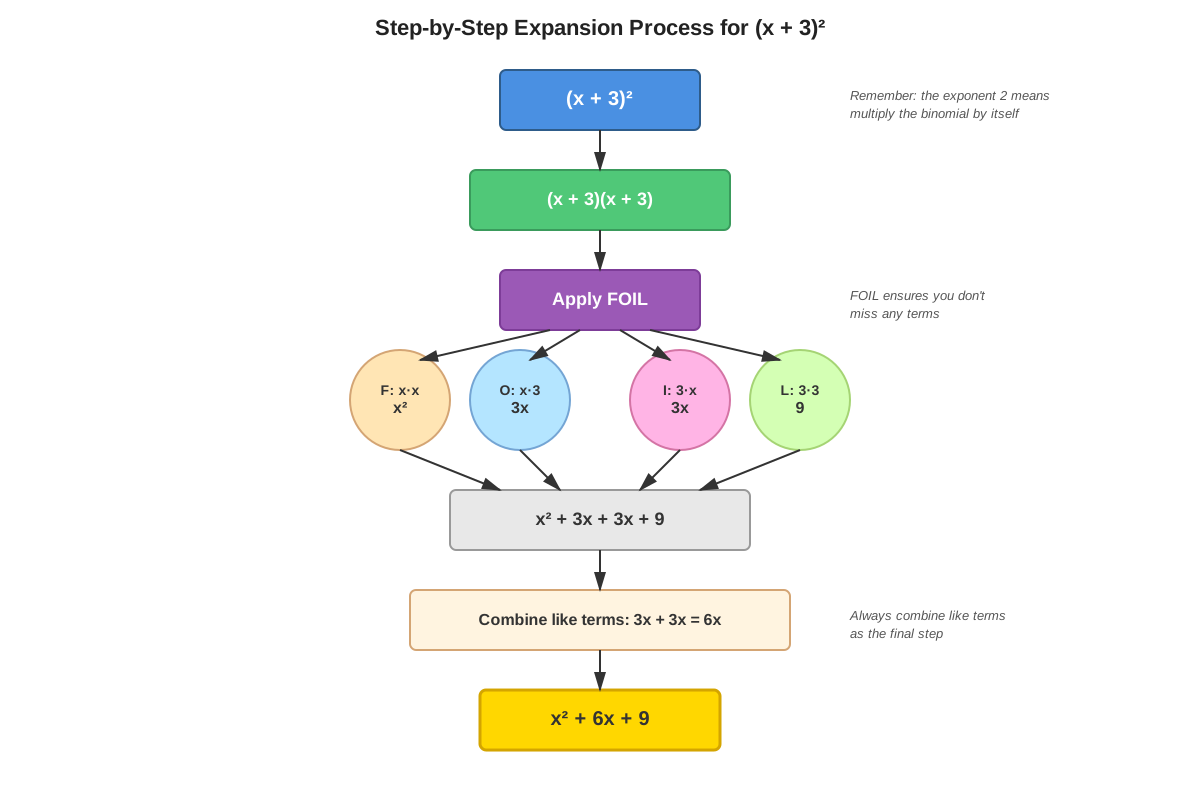
Binomial expansion refers to the process of multiplying out a binomial expression raised to a power, converting it from compact exponential form to an expanded polynomial. The most basic principle underlying all binomial expansion is the distributive property applied systematically. When expanding (a + b)², students are actually computing (a + b)(a + b), which requires distributing each term in the first binomial to each term in the second binomial.
The FOIL method (First, Outer, Inner, Last) provides a systematic approach for expanding the product of two binomials. For (a + b)(c + d):
- First: Multiply the first terms of each binomial (a · c)
- Outer: Multiply the outer terms (a · d)
- Inner: Multiply the inner terms (b · c)
- Last: Multiply the last terms of each binomial (b · d)
While FOIL works perfectly for two-term by two-term multiplication, understanding it as a special case of the distributive property helps students extend the technique to higher powers and more complex expressions.
Squaring a Binomial: The Most Common SAT Pattern
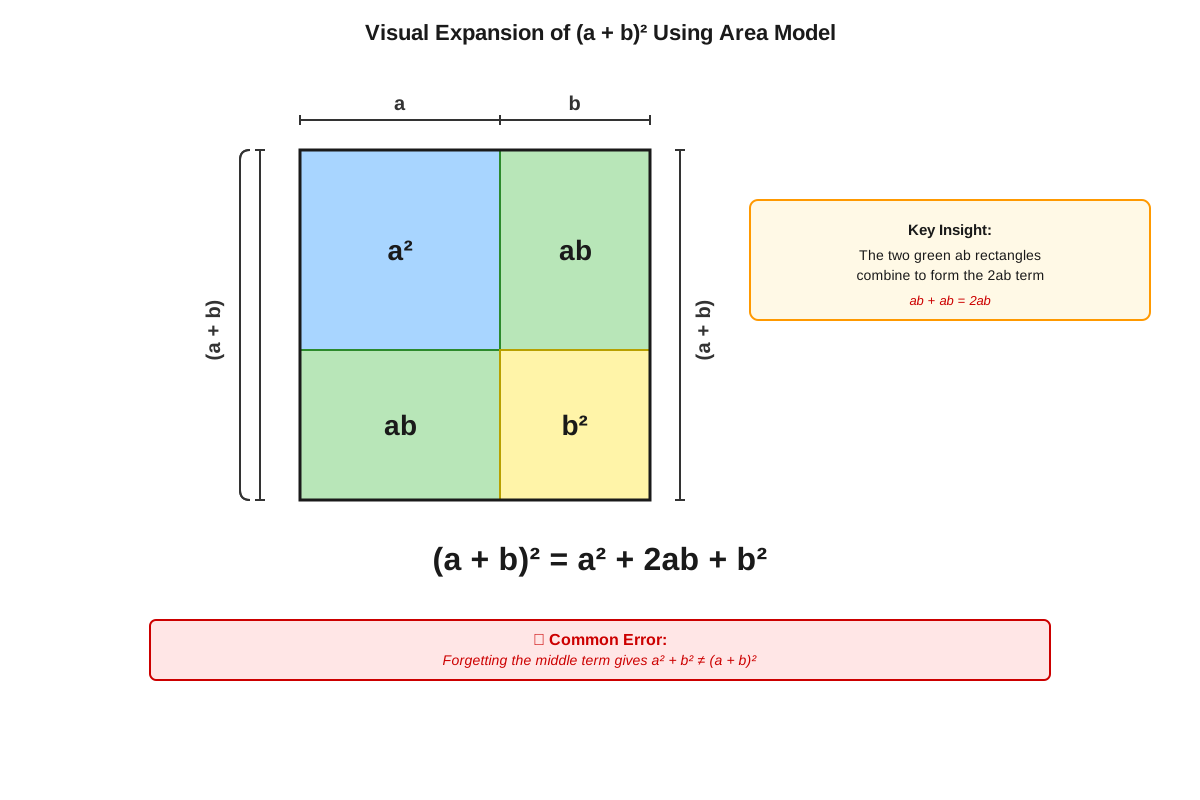
The expansion of (a + b)² represents the single most frequently tested binomial pattern on the SAT. The correct expansion follows this formula:
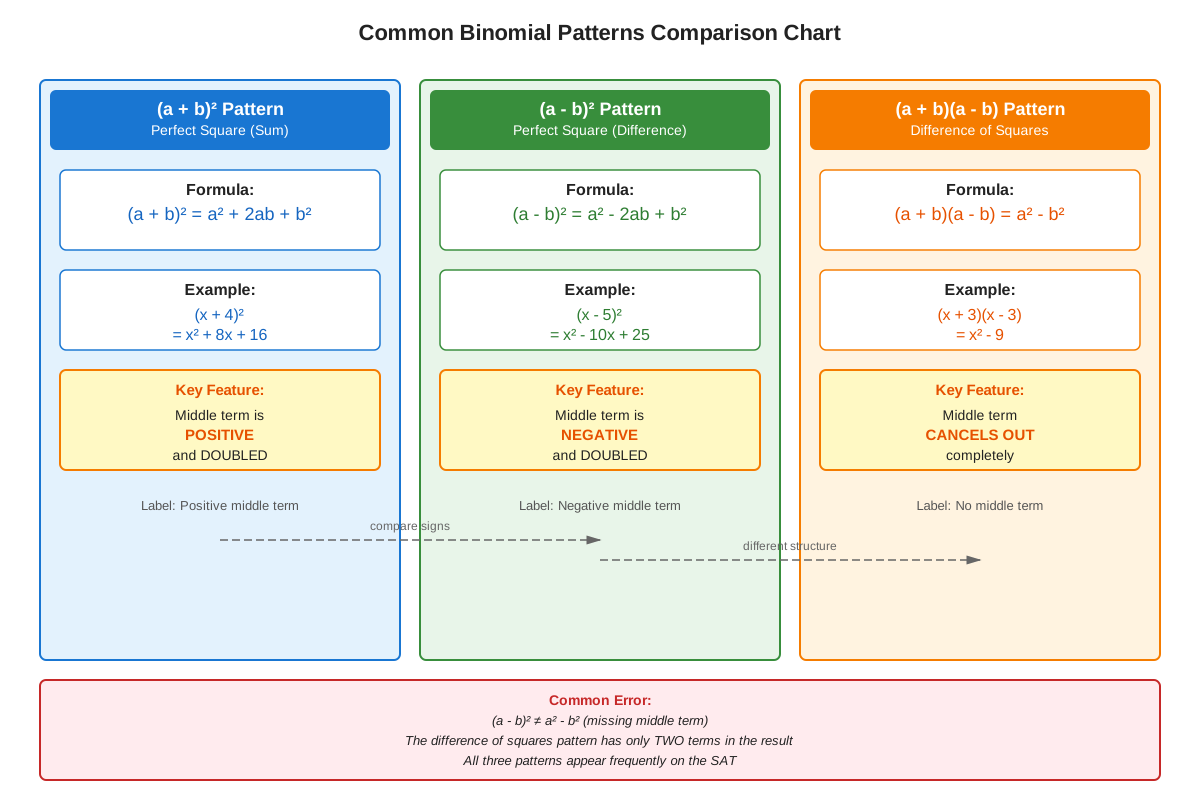
(a + b)² = a² + 2ab + b²This pattern produces three terms: the square of the first term, twice the product of both terms, and the square of the second term. The middle term (2ab) is where most errors occur. Students must remember that squaring a sum does NOT simply square each term individually.
For subtraction, the pattern adjusts to:
(a - b)² = a² - 2ab + b²Notice that the first and last terms remain positive (since squaring any real number yields a positive result), but the middle term becomes negative because it involves the product of a positive and negative value.
Expanding Binomials to the Third Power
While less common than squared binomials, the SAT occasionally tests cubed binomials, particularly in challenging questions. The expansion of (a + b)³ follows this pattern:
(a + b)³ = a³ + 3a²b + 3ab² + b³This can be derived by multiplying (a + b)² by (a + b):
(a + b)³ = (a + b)(a + b)² = (a + b)(a² + 2ab + b²)Distributing a to each term: a³ + 2a²b + ab²
Distributing b to each term: a²b + 2ab² + b³
Combining like terms: a³ + 3a²b + 3ab² + b³
For subtraction:
(a - b)³ = a³ - 3a²b + 3ab² - b³The signs alternate, with odd-powered terms of b being negative and even-powered terms being positive.
Coefficient Patterns and Pascal's Triangle
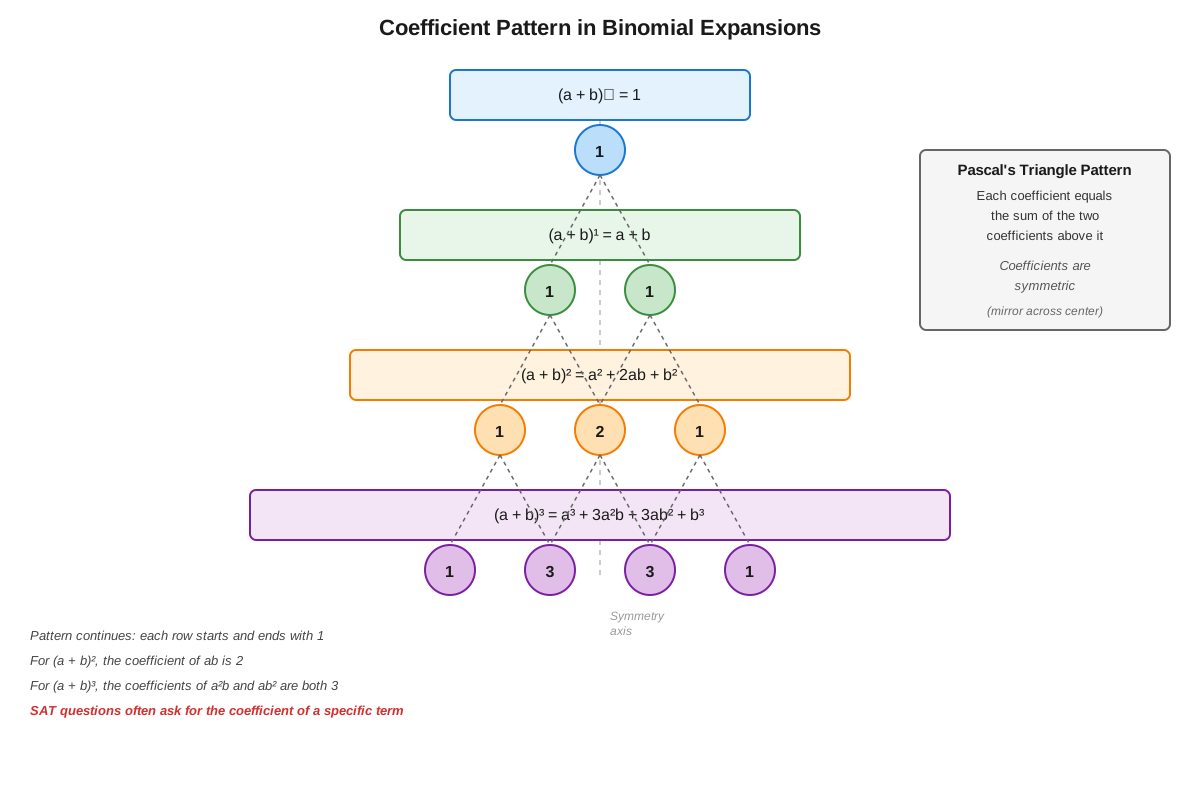
The coefficients in binomial expansions follow predictable patterns captured in Pascal's Triangle. Each row represents the coefficients for a specific power:
| Power | Expansion | Coefficients |
|---|---|---|
| (a + b)⁰ | 1 | 1 |
| (a + b)¹ | a + b | 1, 1 |
| (a + b)² | a² + 2ab + b² | 1, 2, 1 |
| (a + b)³ | a³ + 3a²b + 3ab² + b³ | 1, 3, 3, 1 |
| (a + b)⁴ | a⁴ + 4a³b + 6a²b² + 4ab³ + b⁴ | 1, 4, 6, 4, 1 |
Each number in Pascal's Triangle equals the sum of the two numbers directly above it. While the SAT rarely tests powers beyond 3, recognizing this pattern helps students verify their expansions and understand the underlying mathematical structure.
Special Products: Difference of Squares
A related pattern that frequently appears alongside binomial expansion is the difference of squares:
(a + b)(a - b) = a² - b²This special product occurs when multiplying conjugate binomials (binomials that differ only in the sign between terms). The middle terms cancel out:
- First: a · a = a²
- Outer: a · (-b) = -ab
- Inner: b · a = ab
- Last: b · (-b) = -b²
- Combined: a² - ab + ab - b² = a² - b²
Recognizing this pattern allows students to factor differences of squares quickly and to understand why certain expressions simplify dramatically.
Working with Numerical and Variable Coefficients
SAT questions often include binomials with numerical coefficients and constants, such as (2x + 3)² or (5 - 3x)². The expansion process remains identical, but students must carefully handle the arithmetic:
For (2x + 3)²:
- First term: (2x)² = 4x²
- Middle term: 2(2x)(3) = 12x
- Last term: (3)² = 9
- Result: 4x² + 12x + 9
For (5 - 3x)²:
- First term: (5)² = 25
- Middle term: 2(5)(-3x) = -30x
- Last term: (-3x)² = 9x²
- Result: 25 - 30x + 9x² or 9x² - 30x + 25 (standard form)
Attention to sign changes and proper order of operations prevents the majority of computational errors.
Concept Relationships
Binomial expansion basics connect directly to multiple foundational algebra concepts, forming a central node in the network of polynomial understanding. The distributive property serves as the underlying principle → which enables FOIL method application → which produces expanded polynomial forms → which can be simplified by combining like terms → resulting in standard form polynomials.
The relationship flows bidirectionally with factoring: binomial expansion converts factored form to expanded form, while factoring reverses this process. Recognizing that x² + 6x + 9 equals (x + 3)² demonstrates mastery of both directions. This connection proves essential for solving quadratic equations, where students must move fluidly between forms depending on the problem requirements.
Special products like the difference of squares connect binomial expansion to rational expressions and equation solving. Understanding that x² - 16 factors as (x + 4)(x - 4) relies on recognizing the reverse of the difference of squares pattern. Similarly, perfect square trinomials (the expanded form of squared binomials) appear frequently in completing the square techniques for solving quadratics.
Pascal's Triangle connects binomial expansion to combinatorics and probability, though these connections extend beyond typical SAT content. However, the coefficient patterns help students verify their work and develop number sense about how algebraic expressions behave. The symmetry in coefficient patterns also reinforces understanding of the commutative property in multiplication.
Quick check — test yourself on Binomial expansion basics so far.
Try Flashcards →High-Yield Facts
⭐ (a + b)² = a² + 2ab + b², NOT a² + b² — the middle term 2ab is essential and frequently omitted by students under time pressure
⭐ (a - b)² = a² - 2ab + b² — both squared terms remain positive; only the middle term is negative
⭐ The coefficient of the middle term when squaring a binomial is always 2 times the product of the two original terms
⭐ (a + b)(a - b) = a² - b² — conjugate binomials produce a difference of squares with no middle term
⭐ When expanding (ax + b)², the coefficient of x² is a², not a — students must square the entire coefficient
- The expansion of (a + b)³ produces four terms with coefficients 1, 3, 3, 1
- In any binomial expansion, the number of terms in the result equals the power plus one (squared gives 3 terms, cubed gives 4 terms)
- The exponents on the first term decrease while exponents on the second term increase across the expansion
- When a binomial contains subtraction, signs alternate in the expansion based on whether the power of the negative term is odd or even
- Binomial expansion is commutative: (a + b)² = (b + a)² — the order of terms doesn't affect the final expanded result
- The constant term in the expansion of (x + c)² is always c²
Common Misconceptions
Misconception: (x + 5)² = x² + 25 → Correction: This omits the middle term. The correct expansion is (x + 5)² = x² + 10x + 25. Squaring a binomial requires multiplying the entire expression by itself, not squaring each term independently. The middle term comes from the outer and inner products in FOIL.
Misconception: (x - 3)² = x² - 9 → Correction: This error combines two mistakes: omitting the middle term and incorrectly making the last term negative. The correct expansion is (x - 3)² = x² - 6x + 9. When squaring any real number (including -3), the result is positive, so the last term must be +9.
Misconception: The middle term coefficient in (2x + 3)² is 2 → Correction: The coefficient is 2(2x)(3) = 12, not 2. Students must multiply 2 (from the formula) by both the coefficient of x (which is 2) and the constant term (which is 3). The complete expansion is 4x² + 12x + 9.
Misconception: (a + b)³ = a³ + b³ → Correction: This drastically oversimplifies the expansion. The correct form is a³ + 3a²b + 3ab² + b³, which includes four terms with mixed powers. Cubing a binomial requires multiplying (a + b)(a + b)(a + b), not simply cubing each term separately.
Misconception: (x + y)(x - y) = x² + y² → Correction: This represents the difference of squares pattern, which produces x² - y², not x² + y². The middle terms (-xy and +xy) cancel each other out, leaving only the difference of the squared terms. The sign must be negative.
Misconception: In (3 - x)², the first term is 3² = 9 and the last term is x² → Correction: While these squared terms are correct, students often write 9 - x² and forget the middle term. The complete expansion is 9 - 6x + x², or in standard form: x² - 6x + 9. The middle term is 2(3)(-x) = -6x.
Worked Examples
Example 1: Expanding a Squared Binomial with Coefficients
Problem: Expand (3x - 4)² and write the result in standard form.
Solution:
Step 1: Identify the pattern. This is a squared binomial with subtraction, so we use (a - b)² = a² - 2ab + b², where a = 3x and b = 4.
Step 2: Calculate the first term (a²).
- (3x)² = 3² · x² = 9x²
Step 3: Calculate the middle term (-2ab).
- -2(3x)(4) = -2 · 3 · 4 · x = -24x
Step 4: Calculate the last term (b²).
- (4)² = 16
Step 5: Combine all terms.
- 9x² - 24x + 16
Step 6: Verify this is in standard form (descending powers of x).
- Yes, the expression is already in standard form.
Answer: 9x² - 24x + 16
Connection to Learning Objectives: This example demonstrates applying binomial expansion basics to a typical SAT question format, requiring careful attention to coefficients and signs. The problem tests whether students can identify the correct pattern and execute the expansion without computational errors.
Example 2: Identifying Coefficients in an Expansion
Problem: When (2x + k)² is expanded, the coefficient of x is 20. What is the value of k?
Solution:
Step 1: Write the general expansion formula for (2x + k)².
- (2x + k)² = (2x)² + 2(2x)(k) + k²
- = 4x² + 4kx + k²
Step 2: Identify which term contains x (the middle term).
- The coefficient of x is 4k
Step 3: Set up an equation using the given information.
- 4k = 20
Step 4: Solve for k.
- k = 20 ÷ 4
- k = 5
Step 5: Verify by expanding (2x + 5)².
- (2x + 5)² = 4x² + 20x + 25 ✓
Answer: k = 5
Connection to Learning Objectives: This problem requires students to explain how binomial expansion appears on the SAT through reverse-engineering questions. Rather than simply expanding, students must understand the structure of expanded forms to work backward and determine unknown values. This represents a higher-order application of binomial expansion basics.
Example 3: Applying Difference of Squares
Problem: Simplify (x + 7)(x - 7) without using FOIL.
Solution:
Step 1: Recognize the pattern. These are conjugate binomials (identical except for the sign), which produce a difference of squares.
Step 2: Apply the formula (a + b)(a - b) = a² - b², where a = x and b = 7.
Step 3: Calculate a².
- x² = x²
Step 4: Calculate b².
- 7² = 49
Step 5: Write the difference.
- x² - 49
Answer: x² - 49
Connection to Learning Objectives: This example shows how recognizing special binomial patterns allows students to work more efficiently on the SAT. Rather than performing four multiplications and combining terms, students who identify the difference of squares pattern can solve in seconds, saving valuable test time.
Exam Strategy
When approaching SAT questions involving binomial expansion, begin by identifying the specific pattern being tested. Look for squared binomials (most common), cubed binomials (less common), or conjugate pairs (difference of squares). The question stem often contains trigger words like "expanded form," "coefficient of," or "equivalent expression" that signal binomial expansion is required.
Trigger phrases to watch for:
- "When expanded..." or "The expanded form of..."
- "What is the coefficient of [variable term]..."
- "Which expression is equivalent to..."
- "If (expression)² = ..."
- "The constant term in the expansion..."
For multiple-choice questions, consider working backward by expanding the answer choices rather than solving algebraically. If asked which binomial produces a specific expanded form, expand each option until finding a match. This approach often proves faster than attempting to factor the expanded form, especially under time pressure.
Process of elimination strategies:
- Eliminate any answer choice where the degree (highest power) doesn't match expectations
- Check the constant term first—it's often the easiest to verify and can eliminate wrong answers quickly
- Verify the sign of the middle term, as this is where most errors occur
- For coefficient questions, eliminate answers that seem unreasonably large or small
Time allocation: Straightforward binomial expansion questions should take 30-60 seconds. If spending more than 90 seconds, mark the question and return later. These questions test execution rather than complex reasoning, so extended time usually indicates a computational error that will persist. Moving on and returning with fresh eyes often helps.
Calculator usage: For the calculator-permitted section, use the calculator to verify arithmetic (like 3² = 9 or 2 · 5 · 3 = 30) but not to perform the expansion itself. The calculator cannot expand algebraic expressions, and attempting to substitute numbers for variables introduces unnecessary complexity and error risk.
Memory Techniques
The "Square Dance" mnemonic for (a + b)²: "First Twice Last" — First term squared, Twice the product, Last term squared. This reminds students of the three components: a², 2ab, b².
The "Sign Keeper" rule: When squaring a binomial, both squared terms keep their signs (positive), but the middle term takes the sign from the original binomial. So (a + b)² has +2ab, while (a - b)² has -2ab.
The "Conjugate Cancellation" visualization: Picture (a + b)(a - b) as two terms fighting—the middle terms (+ab and -ab) cancel each other out completely, leaving only the squared terms standing. This reinforces why the difference of squares has no middle term.
The "2 is the magic number" reminder: In any squared binomial, the coefficient of the middle term always involves the number 2. If your expansion doesn't have a 2 somewhere in the middle term calculation, you've made an error.
The "Power Plus One" rule: The number of terms in a binomial expansion equals the power plus one. Squared (power 2) gives 3 terms, cubed (power 3) gives 4 terms. This helps students verify they haven't missed terms.
FOIL acronym: While not specific to binomial expansion, remembering First Outer Inner Last provides a systematic method that prevents skipped terms. Visualize drawing arrows from each term in the first binomial to each term in the second.
Summary
Binomial expansion basics represent essential algebraic fluency for SAT success, requiring students to systematically multiply out expressions like (a + b)² and (a + b)³ while maintaining accuracy with coefficients and signs. The most critical pattern is the squared binomial: (a + b)² = a² + 2ab + b², where the middle term 2ab is frequently omitted by students who incorrectly believe squaring distributes across addition. Related patterns include (a - b)² = a² - 2ab + b² and the difference of squares (a + b)(a - b) = a² - b². These expansions appear in 3-5 questions per SAT test, often embedded within larger algebraic problems involving quadratics, polynomials, or equivalent expressions. Mastery requires understanding the underlying distributive property, recognizing special patterns to work efficiently, and maintaining careful attention to arithmetic when coefficients and constants are involved. Students who can quickly and accurately expand binomials gain significant advantages in time management and scoring potential across multiple math question types.
Key Takeaways
- The expansion (a + b)² equals a² + 2ab + b², never a² + b²—the middle term is essential and the most common source of errors
- When squaring binomials with subtraction, both squared terms remain positive while only the middle term becomes negative: (a - b)² = a² - 2ab + b²
- Conjugate binomials (a + b)(a - b) produce the difference of squares a² - b² with no middle term due to cancellation
- Always square the entire coefficient when expanding expressions like (3x + 2)²—the first term is 9x², not 3x²
- Binomial expansion questions appear frequently on the SAT in forms ranging from direct expansion to coefficient identification to reverse-engineering problems
- Recognizing patterns allows for faster problem-solving than mechanically applying FOIL to every problem
- The number of terms in an expansion equals the power plus one, providing a quick verification check
Related Topics
Factoring Quadratic Expressions: Mastering binomial expansion enables students to recognize perfect square trinomials and factor them efficiently, the reverse process of expansion. Understanding that x² + 10x + 25 = (x + 5)² connects expansion to equation-solving strategies.
Completing the Square: This technique for solving quadratic equations relies heavily on recognizing and creating perfect square trinomials, which are the expanded forms of squared binomials. Students who understand binomial expansion can more easily manipulate equations into vertex form.
Polynomial Operations: Binomial expansion represents a specific case of polynomial multiplication. Mastering these basics prepares students for multiplying larger polynomials and understanding how polynomial degree and coefficients behave under multiplication.
Function Composition and Transformation: When finding f(x + h) given f(x), students often must expand binomials within function notation. This skill becomes essential for understanding how functions change with input transformations.
The Binomial Theorem: For advanced students, the patterns in binomial expansion extend to the general binomial theorem, which provides a formula for expanding (a + b)ⁿ for any positive integer n using combinations and Pascal's Triangle.
Practice CTA
Now that you've mastered the core concepts of binomial expansion basics, it's time to cement your understanding through active practice. Work through the practice questions to test your ability to expand binomials accurately under timed conditions, and use the flashcards to reinforce the key patterns and formulas until they become automatic. Remember, the difference between knowing these concepts and scoring points on test day lies in confident, error-free execution—and that comes only through deliberate practice. You've built the foundation; now strengthen it through application!
Sign up free to keep reading
Create a free AnvayaPrep account to finish this SAT guide on Binomial expansion basics — plus flashcards and practice questions.