Overview
Completing the square is a fundamental algebraic technique that transforms quadratic expressions into a form that reveals key properties of parabolas and enables efficient problem-solving. This method involves rewriting a quadratic expression from standard form (ax² + bx + c) into vertex form (a(x - h)² + k), where (h, k) represents the vertex of the parabola. On the SAT, this technique appears frequently in questions involving quadratic functions, circle equations, optimization problems, and coordinate geometry.
Mastering completing the square is essential for SAT success because it provides a powerful alternative to factoring and the quadratic formula. While the quadratic formula gives solutions directly, completing the square offers deeper insight into the structure of quadratic functions and their graphs. This technique is particularly valuable when questions ask about maximum or minimum values, vertex coordinates, or transformations of parabolas—all common SAT question types worth significant points.
The relationship between completing the square and other math concepts is extensive. It connects directly to factoring, the quadratic formula, graphing parabolas, and understanding function transformations. Additionally, this technique extends beyond simple quadratics to applications in conic sections (particularly circles), distance problems, and even calculus-level optimization. For the SAT, completing the square serves as a bridge between algebraic manipulation and geometric interpretation, making it one of the most versatile tools in a test-taker's arsenal.
Learning Objectives
- [ ] Identify key features of completing the square
- [ ] Explain how completing the square appears on the SAT
- [ ] Apply completing the square to answer SAT-style questions
- [ ] Convert quadratic expressions from standard form to vertex form using completing the square
- [ ] Determine the vertex, axis of symmetry, and maximum/minimum values of quadratic functions
- [ ] Solve quadratic equations by completing the square when other methods are inefficient
- [ ] Apply completing the square to rewrite circle equations in standard form
Prerequisites
- Basic algebraic manipulation: Expanding binomials, combining like terms, and isolating variables are essential for executing the steps of completing the square
- Understanding of quadratic expressions: Recognizing the standard form ax² + bx + c and knowing what coefficients represent enables proper application of the technique
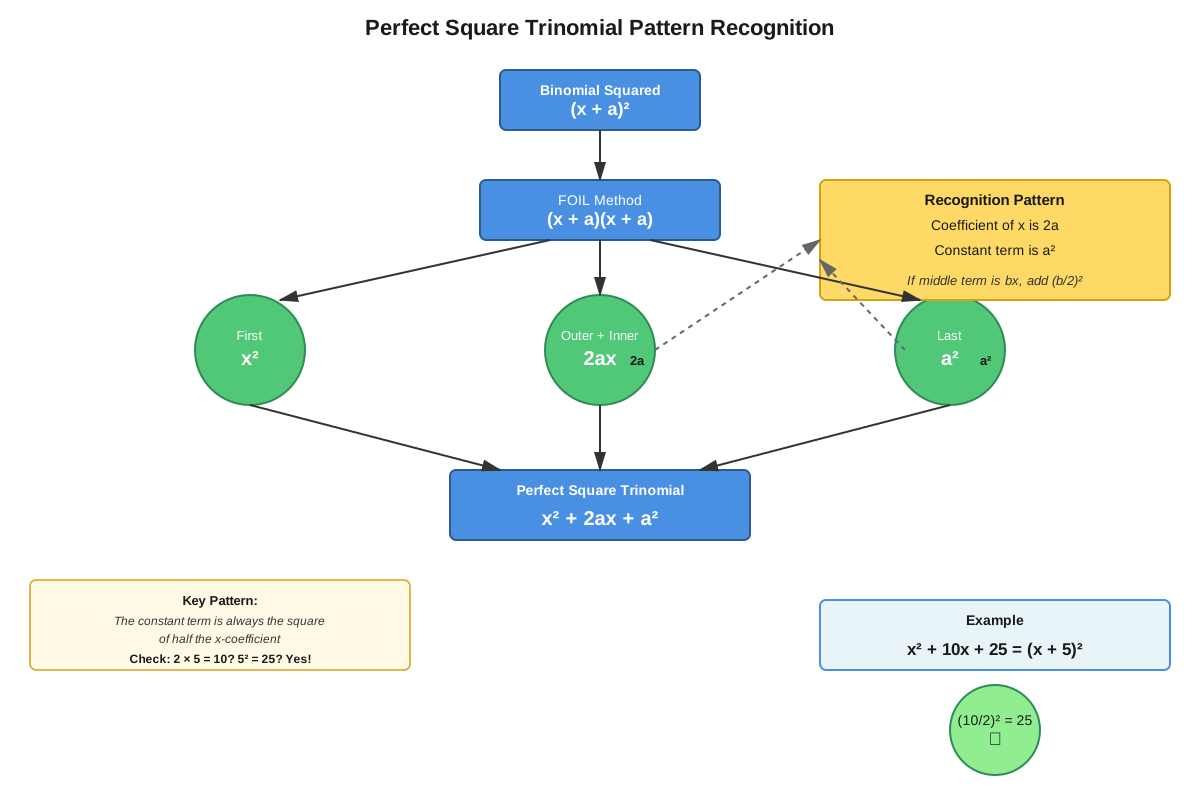
- Perfect square trinomials: Identifying expressions like (x + a)² = x² + 2ax + a² is fundamental to understanding why completing the square works
- Function notation and graphing: Understanding f(x) notation and basic parabola properties helps connect algebraic manipulation to geometric interpretation
- Square roots and solving equations: Extracting square roots and understanding inverse operations is necessary for solving equations after completing the square
Why This Topic Matters
Completing the square has significant real-world applications in physics, engineering, and economics. Engineers use this technique to optimize trajectories, economists apply it to maximize profit functions, and physicists employ it to analyze projectile motion. The vertex form obtained through completing the square immediately reveals the maximum or minimum value of a quadratic function—critical information for optimization problems in any field.
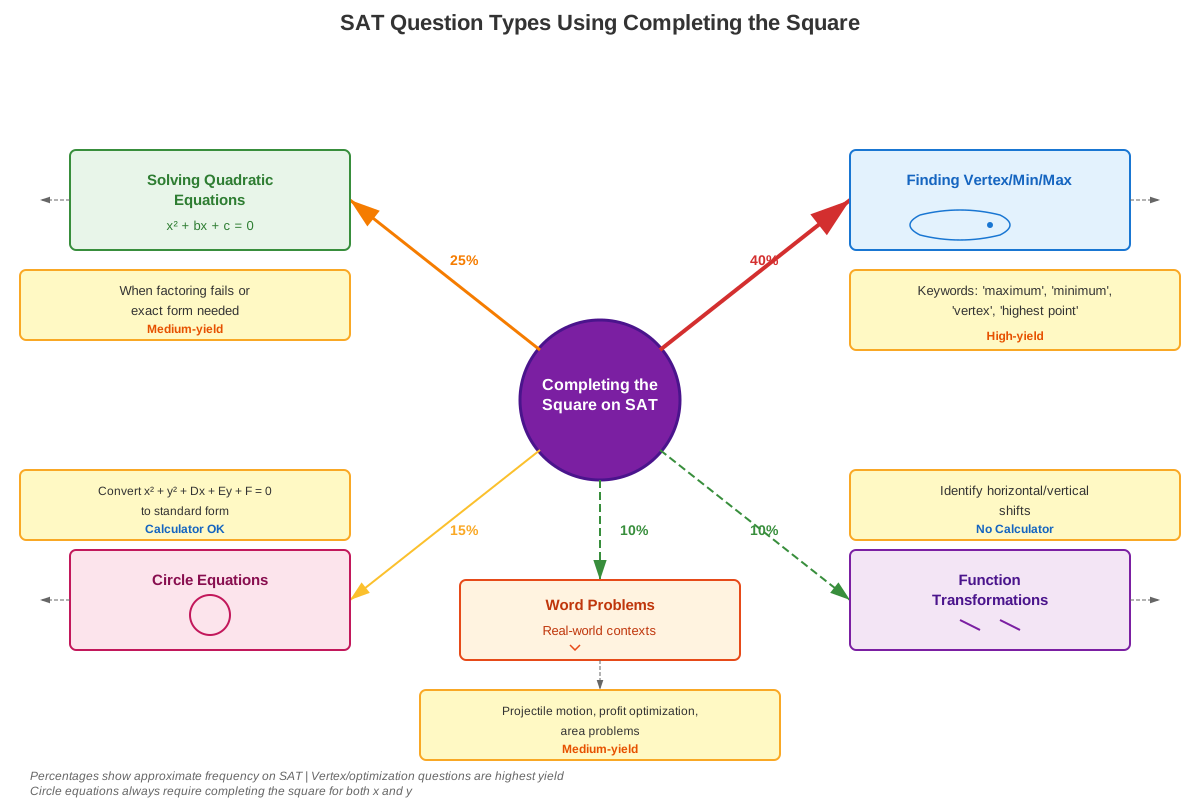
On the SAT, completing the square appears in approximately 3-5 questions per test, making it a high-yield topic worth mastering. These questions typically fall into several categories: finding vertex coordinates, determining maximum or minimum values, rewriting equations in different forms, and solving circle equations. The College Board frequently tests this concept in both the calculator and no-calculator sections, with questions ranging from straightforward algebraic manipulation to multi-step problems requiring conceptual understanding.
Common SAT question formats include: asking for the vertex of a parabola given in standard form, requiring students to identify which form reveals specific information most clearly, presenting word problems about maximum height or minimum cost, and providing circle equations that must be rewritten in standard form. Questions may also ask students to match graphs with equations or determine how many solutions exist for a system involving a quadratic function. Understanding completing the square enables efficient solutions to all these question types.
Core Concepts
The Fundamental Process
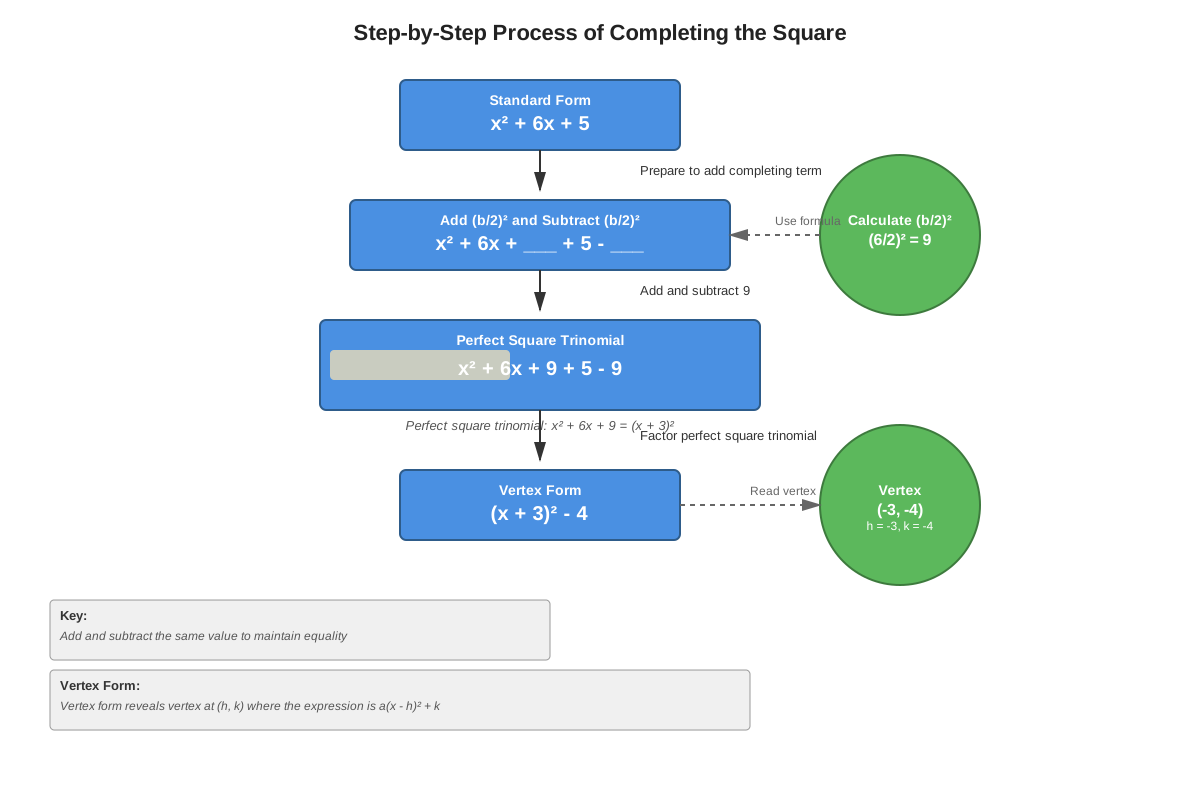
Completing the square is the process of adding and subtracting a specific constant to transform a quadratic expression into a perfect square trinomial plus a constant. The goal is to create an expression of the form (x + p)² + q, which immediately reveals important properties of the quadratic function.
The basic steps for completing the square on x² + bx are:
- Take half of the coefficient of x: b/2
- Square this value: (b/2)²
- Add and subtract this squared value to maintain equality
- Factor the perfect square trinomial
- Simplify the remaining constant terms
For example, to complete the square on x² + 6x:
- Half of 6 is 3
- 3² = 9
- x² + 6x + 9 - 9 = (x + 3)² - 9
This process works because (x + 3)² expands to x² + 6x + 9, creating the perfect square trinomial we need.
Converting Standard Form to Vertex Form
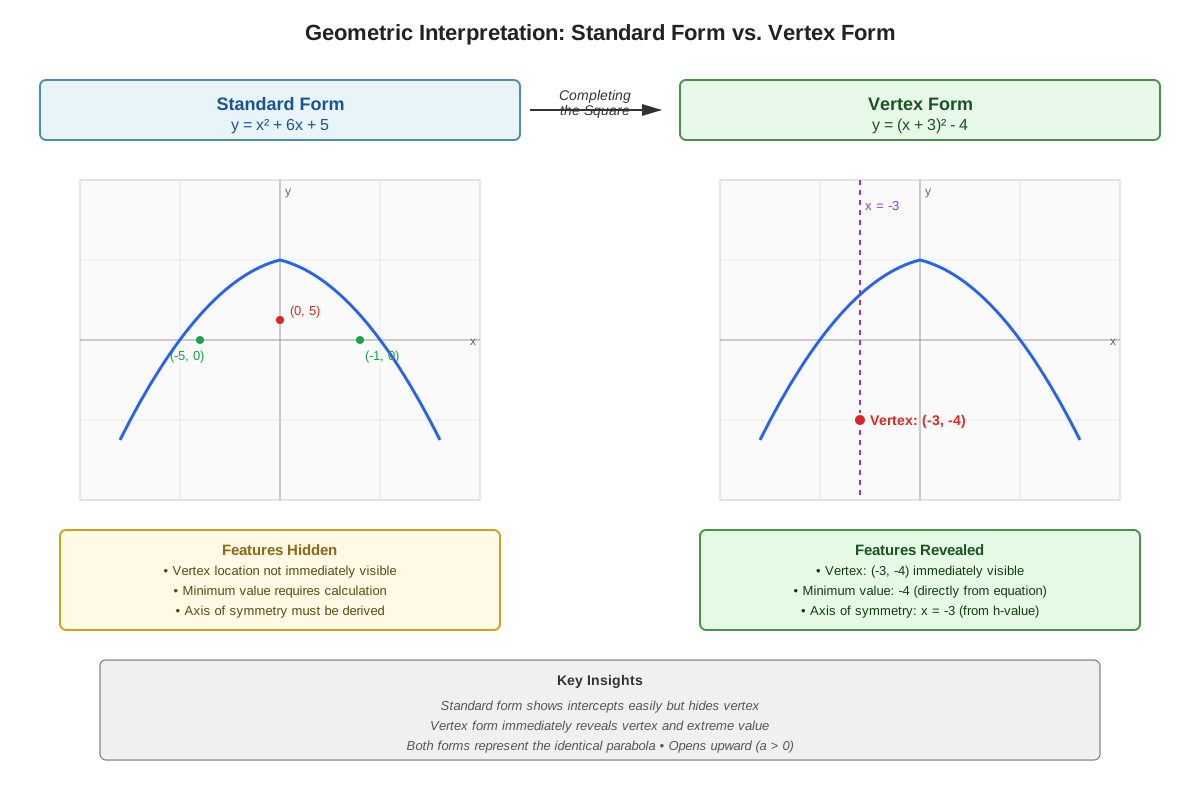
The vertex form of a quadratic function is f(x) = a(x - h)² + k, where (h, k) is the vertex of the parabola. This form is incredibly useful on the SAT because it immediately reveals:
- The vertex coordinates: (h, k)
- The axis of symmetry: x = h
- The maximum value (if a < 0) or minimum value (if a > 0): k
- The direction of opening: upward if a > 0, downward if a < 0
To convert f(x) = ax² + bx + c to vertex form:
- Factor out the leading coefficient 'a' from the x² and x terms only
- Complete the square inside the parentheses
- Distribute the 'a' back through
- Combine constant terms outside the squared expression
Example: Convert f(x) = 2x² + 12x + 7 to vertex form
f(x) = 2x² + 12x + 7
f(x) = 2(x² + 6x) + 7          [Factor out 2 from x terms]
f(x) = 2(x² + 6x + 9 - 9) + 7  [Complete the square: (6/2)² = 9]
f(x) = 2(x² + 6x + 9) - 18 + 7 [Distribute the 2 to the -9]
f(x) = 2(x + 3)² - 11          [Factor and simplify]
The vertex is (-3, -11), and since a = 2 > 0, this parabola opens upward with a minimum value of -11.
Solving Quadratic Equations
While the quadratic formula is often the go-to method for solving quadratic equations, completing the square can be more efficient in certain situations, particularly when:
- The coefficient of x is even
- The equation is already close to a perfect square
- The question asks for exact answers in simplified radical form
- You need to understand the derivation of the quadratic formula itself
To solve ax² + bx + c = 0 by completing the square:
- Move the constant to the right side: ax² + bx = -c
- Divide everything by 'a' (if a ≠ 1): x² + (b/a)x = -c/a
- Complete the square on the left side
- Take the square root of both sides (remember ±)
- Solve for x
Example: Solve x² + 8x + 7 = 0
x² + 8x + 7 = 0
x² + 8x = -7
x² + 8x + 16 = -7 + 16    [Add (8/2)² = 16 to both sides]
(x + 4)² = 9
x + 4 = ±3
x = -4 + 3 = -1  or  x = -4 - 3 = -7
Application to Circle Equations
On the SAT, completing the square frequently appears in questions about circles. The standard form of a circle equation is (x - h)² + (y - k)² = r², where (h, k) is the center and r is the radius. However, circle equations are often presented in general form: x² + y² + Dx + Ey + F = 0.
To convert from general form to standard form, complete the square for both x and y variables separately:
Example: Find the center and radius of x² + y² + 6x - 8y + 9 = 0
x² + y² + 6x - 8y + 9 = 0
(x² + 6x) + (y² - 8y) = -9
(x² + 6x + 9) + (y² - 8y + 16) = -9 + 9 + 16
(x + 3)² + (y - 4)² = 16
The center is (-3, 4) and the radius is √16 = 4.
The Perfect Square Trinomial Pattern
Understanding the pattern of perfect square trinomials is crucial for recognizing when completing the square has been done correctly. The general pattern is:
| Expression | Expanded Form | Middle Term Relationship |
|---|---|---|
| (x + a)² | x² + 2ax + a² | Middle coefficient = 2a |
| (x - a)² | x² - 2ax + a² | Middle coefficient = -2a |
This means that for any expression x² + bx, the constant needed to complete the square is always (b/2)², and the factored form will be (x + b/2)².
Strategic Coefficient Management
When the leading coefficient is not 1, careful attention to factoring is essential. The key principle is that you must factor out the leading coefficient from only the x² and x terms before completing the square inside the parentheses.
Critical Rule: When you complete the square inside parentheses with a coefficient factored out, the value you add inside gets multiplied by that coefficient when considering the overall equation.
Example: Complete the square for 3x² - 12x + 5
3x² - 12x + 5
= 3(x² - 4x) + 5           [Factor out 3]
= 3(x² - 4x + 4 - 4) + 5   [Complete square: (-4/2)² = 4]
= 3(x² - 4x + 4) - 12 + 5  [The -4 inside becomes -12 outside]
= 3(x - 2)² - 7
Concept Relationships
Completing the square serves as a central hub connecting multiple algebraic and geometric concepts. The technique builds directly on perfect square trinomials, which are themselves applications of the binomial expansion (x + a)². This connection to polynomial multiplication demonstrates how completing the square is essentially "reverse engineering" the expansion process.
The relationship flows as follows: Binomial expansion → creates → Perfect square trinomials → recognized through → Completing the square → produces → Vertex form → reveals → Parabola properties.
Completing the square connects to the quadratic formula in a fundamental way—the quadratic formula is actually derived by completing the square on the general equation ax² + bx + c = 0. Understanding this derivation provides deeper insight into why the formula works and when completing the square might be more efficient than applying the formula directly.
The technique also bridges algebra and geometry. Algebraically, completing the square is a manipulation of expressions; geometrically, it transforms equations to reveal visual properties like vertex location, axis of symmetry, and direction of opening. This dual nature makes it particularly powerful for SAT questions that require both computational and conceptual understanding.
For circle equations, completing the square extends the technique from one variable to two, demonstrating its versatility. The same fundamental process applies to both x and y terms independently, showing how algebraic techniques can scale to more complex situations.
Finally, completing the square connects to function transformations. The vertex form a(x - h)² + k directly corresponds to transformations of the parent function f(x) = x²: horizontal shift by h, vertical shift by k, and vertical stretch/compression by factor a.
Quick check — test yourself on Completing the square so far.
Try Flashcards →High-Yield Facts
⭐ The constant needed to complete the square for x² + bx is always (b/2)²
⭐ Vertex form f(x) = a(x - h)² + k immediately reveals the vertex at (h, k)
⭐ When a > 0, the parabola opens upward and k is the minimum value; when a < 0, it opens downward and k is the maximum value
⭐ To complete the square when the leading coefficient is not 1, factor it out from only the x² and x terms first
⭐ The axis of symmetry of a parabola in vertex form a(x - h)² + k is the vertical line x = h
- Perfect square trinomials follow the pattern (x ± a)² = x² ± 2ax + a²
- When completing the square inside parentheses with a factored coefficient, the added constant gets multiplied by that coefficient when distributed
- Circle equations in general form x² + y² + Dx + Ey + F = 0 require completing the square for both x and y separately
- The vertex form reveals the maximum or minimum value of a quadratic function without calculus
- Completing the square is the method used to derive the quadratic formula from ax² + bx + c = 0
- For even coefficients of x, completing the square is often faster than the quadratic formula
- The sign inside the vertex form (x - h)² is opposite to the sign of the x-coordinate of the vertex
Common Misconceptions
Misconception: The constant to complete the square is just the coefficient of x.
→ Correction: The constant is (b/2)², which means you must take half of the coefficient and then square it. For x² + 10x, the constant is (10/2)² = 25, not 10.
Misconception: When factoring out a leading coefficient, you must factor it from all terms including the constant.
→ Correction: Factor the leading coefficient only from the x² and x terms. The constant term stays outside the parentheses. For 2x² + 8x + 5, write 2(x² + 4x) + 5, not 2(x² + 4x + 2.5).
Misconception: In vertex form a(x - h)² + k, if the vertex is at (-3, 5), the form should be a(x + 3)² + 5.
→ Correction: This is actually correct! The form is (x - h)², so if h = -3, it becomes (x - (-3))² = (x + 3)². The sign in the equation is opposite to the sign of the coordinate.
Misconception: Completing the square changes the value of the expression.
→ Correction: Completing the square maintains equality by adding and subtracting the same value (net change of zero) or by adding the same amount to both sides of an equation. The expression or equation remains equivalent to the original.
Misconception: The vertex form only works for parabolas that open upward.
→ Correction: Vertex form works for all parabolas. The value of 'a' determines the direction: positive 'a' means opening upward, negative 'a' means opening downward. The form a(x - h)² + k applies universally.
Misconception: You can only complete the square when the coefficient of x is even.
→ Correction: You can complete the square with any coefficient, even or odd. Odd coefficients result in fractions: for x² + 5x, you add (5/2)² = 25/4. While even coefficients are simpler, the process works identically with odd coefficients.
Misconception: When solving by completing the square, you only take the positive square root.
→ Correction: When taking the square root of both sides, you must include ±. For (x + 3)² = 16, the solution is x + 3 = ±4, giving x = 1 or x = -7. Forgetting the negative root loses half the solutions.
Worked Examples
Example 1: Converting to Vertex Form and Finding Maximum Value
Problem: The function f(x) = -2x² + 16x - 27 models the profit (in thousands of dollars) of a company, where x represents the number of units produced (in hundreds). What is the maximum profit the company can achieve?
Solution:
Step 1: Recognize that this is a quadratic function with a = -2 < 0, so it opens downward and has a maximum value. We need to convert to vertex form to find this maximum.
Step 2: Factor out the leading coefficient from the x² and x terms:
f(x) = -2x² + 16x - 27
f(x) = -2(x² - 8x) - 27
Step 3: Complete the square inside the parentheses. Take half of -8, which is -4, then square it: (-4)² = 16.
f(x) = -2(x² - 8x + 16 - 16) - 27Step 4: Keep the +16 inside to form the perfect square, but account for the -16:
f(x) = -2(x² - 8x + 16) - 2(-16) - 27
f(x) = -2(x - 4)² + 32 - 27
f(x) = -2(x - 4)² + 5
Step 5: Identify the vertex form a(x - h)² + k where a = -2, h = 4, k = 5.
The vertex is (4, 5), and since the parabola opens downward, the maximum value is k = 5.
Answer: The maximum profit is 5 thousand dollars, or $5,000.
Connection to Learning Objectives: This example demonstrates applying completing the square to answer an SAT-style question, converting to vertex form, and determining maximum values—all key learning objectives.
Example 2: Circle Equation and Geometric Properties
Problem: The equation x² + y² - 10x + 4y + 13 = 0 represents a circle in the xy-plane. What is the radius of this circle?
Solution:
Step 1: Recognize this is a circle equation in general form. We need to complete the square for both x and y to convert to standard form (x - h)² + (y - k)² = r².
Step 2: Group x terms and y terms, move the constant to the right side:
(x² - 10x) + (y² + 4y) = -13Step 3: Complete the square for x terms. Half of -10 is -5, and (-5)² = 25:
(x² - 10x + 25) + (y² + 4y) = -13 + 25Step 4: Complete the square for y terms. Half of 4 is 2, and (2)² = 4:
(x² - 10x + 25) + (y² + 4y + 4) = -13 + 25 + 4Step 5: Factor the perfect squares and simplify:
(x - 5)² + (y + 2)² = 16Step 6: Identify the standard form where r² = 16, so r = 4.
Answer: The radius is 4.
Additional insight: The center is at (5, -2). Notice that we added 25 and 4 to the right side because we added them to the left side—maintaining equality is crucial.
Connection to Learning Objectives: This demonstrates how completing the square appears on the SAT beyond simple quadratics, applying the technique to coordinate geometry and circle equations.
Exam Strategy
When approaching SAT questions involving completing the square, first identify what the question is asking for. If it asks for a vertex, maximum/minimum value, or axis of symmetry, completing the square to get vertex form is likely the most efficient approach. If it asks to solve for x-values where the function equals zero, consider whether factoring or the quadratic formula might be faster.
Trigger words and phrases to watch for include: "vertex," "maximum value," "minimum value," "axis of symmetry," "rewrite in the form," "what is the value of k," and "standard form" (especially for circles). These phrases signal that completing the square is probably the intended method.
For process-of-elimination on multiple-choice questions, you can often eliminate answers by checking the vertex or by substituting the original x-value into both forms to verify they produce the same y-value. If a question provides answer choices in vertex form, you can expand them and compare to the original equation to eliminate incorrect options.
Time allocation is critical. A straightforward completing-the-square problem should take 1-2 minutes. If you find yourself spending more than 3 minutes, consider whether you've made an arithmetic error or if there's a simpler approach. Practice the mechanical steps until they become automatic, freeing mental energy for the conceptual aspects.
Exam Tip: When the leading coefficient is not 1, many students make errors. Write out the factoring step explicitly rather than doing it mentally. This small investment of time prevents costly mistakes.
For questions involving circles, remember that you must complete the square for both variables. Budget slightly more time for these problems—typically 2-3 minutes—and work systematically through x terms first, then y terms.
If a question asks which form of an equation "reveals" certain information, remember: standard form (ax² + bx + c) reveals the y-intercept (c), vertex form reveals the vertex and max/min, and factored form reveals the x-intercepts (zeros).
Memory Techniques
Mnemonic for the completing the square process: "Half, Square, Add-Subtract, Factor, Simplify" (HSAFS)
- Half the coefficient of x
- Square that result
- Add and Subtract this value
- Factor the perfect square trinomial
- Simplify remaining constants
Visualization strategy: Picture a literal square being "completed." If you have x² + 6x, imagine a square with side length x and a rectangle with dimensions x by 6. To complete the geometric square, you need to add a small square of area 9 (which is 3 × 3, where 3 is half of 6).
Acronym for vertex form properties: VAMOS
- Vertex at (h, k)
- Axis of symmetry at x = h
- Maximum or minimum value is k
- Opening direction determined by sign of a
- Shifts from parent function x²
Memory aid for the sign in vertex form: "Vertex form is opposite day"—if the vertex x-coordinate is positive, the sign in (x - h)² is negative, and vice versa. The vertex is at (3, 5) means the form is (x - 3)² + 5, not (x + 3)² + 5.
Pattern recognition: Remember (b/2)² as "half-square." Whenever you see a coefficient of x, automatically think "half-square" to find the completing value.
Summary
Completing the square is an essential algebraic technique that transforms quadratic expressions from standard form into vertex form, revealing critical properties of parabolas including vertex location, maximum or minimum values, and axis of symmetry. The process involves taking half the coefficient of x, squaring it, and strategically adding and subtracting this value to create a perfect square trinomial. When the leading coefficient is not 1, it must be factored out from only the x² and x terms before completing the square inside parentheses. This technique appears frequently on the SAT in various contexts: finding vertices and extreme values of parabolas, solving quadratic equations, and converting circle equations from general to standard form. Mastery requires understanding both the mechanical steps and the conceptual reasons behind them, enabling students to recognize when completing the square is the most efficient solution method and to execute it accurately under time pressure.
Key Takeaways
- The constant needed to complete the square for x² + bx is always (b/2)², found by taking half the coefficient of x and squaring it
- Vertex form a(x - h)² + k immediately reveals the vertex (h, k), axis of symmetry x = h, and maximum/minimum value k
- When the leading coefficient is not 1, factor it out from only the x² and x terms before completing the square
- The sign in vertex form (x - h)² is opposite to the sign of the vertex's x-coordinate
- Completing the square applies to both solving equations and transforming functions, making it versatile for multiple SAT question types
- For circle equations, complete the square separately for x and y variables to convert from general to standard form
- Understanding when to use completing the square versus other methods (factoring, quadratic formula) is crucial for efficient test-taking
Related Topics
Quadratic Formula: Derived directly from completing the square on the general equation ax² + bx + c = 0, understanding this connection deepens comprehension of both techniques and helps determine which method is more efficient for specific problems.
Function Transformations: Vertex form a(x - h)² + k represents transformations of the parent function f(x) = x², with h indicating horizontal shifts, k indicating vertical shifts, and a indicating vertical stretches or compressions.
Parabola Graphing: Completing the square provides the vertex and direction of opening, which are essential for accurately sketching parabolas and understanding their behavior.
Conic Sections: Beyond circles, completing the square extends to ellipses and hyperbolas, making it a foundational technique for advanced coordinate geometry.
Optimization Problems: Many real-world maximum and minimum problems involve quadratic functions, and completing the square provides an algebraic method for finding optimal values without calculus.
Practice CTA
Now that you've mastered the concepts and strategies for completing the square, it's time to solidify your understanding through practice. Attempt the practice questions to apply these techniques to SAT-style problems, and use the flashcards to reinforce the key facts and procedures. Remember, completing the square is a skill that improves dramatically with repetition—each problem you solve builds the automaticity and confidence you need to excel on test day. You've got this!
Sign up free to keep reading
Create a free AnvayaPrep account to finish this SAT guide on Completing the square — plus flashcards and practice questions.