Overview
Factoring polynomials is one of the most fundamental and frequently tested algebraic skills on the SAT math section. This technique involves breaking down a polynomial expression into a product of simpler expressions, much like finding the prime factors of a number. Mastery of factoring is essential because it serves as the foundation for solving quadratic equations, simplifying rational expressions, and analyzing function behavior—all of which appear regularly on the exam. Students who can quickly recognize factoring patterns and apply the appropriate technique gain a significant advantage in both time management and accuracy.
The SAT tests factoring polynomials both directly and indirectly across multiple question types. Direct questions may ask students to factor a given expression completely or identify equivalent factored forms. Indirect applications appear when solving equations, finding zeros of functions, or simplifying complex algebraic expressions. The College Board consistently includes 3-5 questions per test that require factoring as either the primary skill or a necessary intermediate step. Understanding when and how to factor can mean the difference between solving a problem in 30 seconds versus struggling for several minutes.
Within the broader landscape of algebra, factoring polynomials connects multiplication and division of expressions, serves as the inverse operation to expanding binomials, and provides the critical link between polynomial expressions and their graphical representations. This topic builds directly on knowledge of integer factorization, the distributive property, and polynomial operations, while simultaneously preparing students for more advanced concepts like rational expressions and polynomial division.
Learning Objectives
- [ ] Identify key features of factoring polynomials
- [ ] Explain how factoring polynomials appears on the SAT
- [ ] Apply factoring polynomials to answer SAT-style questions
- [ ] Factor quadratic expressions using multiple methods (GCF, grouping, special patterns)
- [ ] Recognize and apply special factoring patterns including difference of squares and perfect square trinomials
- [ ] Determine when a polynomial is prime (cannot be factored further)
- [ ] Use factoring to solve polynomial equations and find zeros of functions
Prerequisites
- Integer factorization: Understanding how to break numbers into prime factors provides the conceptual foundation for factoring algebraic expressions
- Distributive property: Factoring is essentially the reverse of distribution, so fluency with expanding expressions is essential
- Polynomial operations: Adding, subtracting, and multiplying polynomials must be automatic to verify factored forms
- FOIL method: Multiplying binomials helps students understand how factored forms expand and aids in checking work
- Basic equation solving: Students need to isolate variables and perform inverse operations to apply factoring to equation-solving
Why This Topic Matters
Factoring polynomials represents a critical intersection between pure algebraic manipulation and practical problem-solving. In real-world applications, factoring helps engineers determine when structures will fail (finding zeros of stress functions), allows economists to analyze break-even points (solving profit equations), and enables physicists to calculate projectile motion trajectories (solving quadratic position functions). The skill of recognizing patterns and breaking complex problems into simpler components extends far beyond mathematics into computer science, data analysis, and logical reasoning.
On the SAT specifically, factoring appears with remarkable consistency. Approximately 15-20% of algebra questions involve factoring either as the primary skill or as a necessary step toward the solution. The most common question types include: solving quadratic equations where factoring is faster than the quadratic formula, simplifying rational expressions by canceling common factors, finding x-intercepts of parabolas, and identifying equivalent algebraic expressions. The College Board particularly favors questions that test whether students can recognize when factoring is the most efficient approach versus other methods.
SAT factoring polynomials questions typically appear in both multiple-choice and student-produced response formats. They often combine factoring with other skills like substitution, function notation, or word problems involving area and geometry. The exam writers deliberately include answer choices that represent common factoring errors, making pattern recognition and verification skills essential for avoiding traps.
Core Concepts
Greatest Common Factor (GCF)
The first and most fundamental factoring technique involves identifying the greatest common factor—the largest expression that divides evenly into all terms of the polynomial. This method should always be the first step in any factoring problem, as it simplifies the expression and often reveals additional factoring opportunities.
To factor out the GCF:
- Identify the largest numerical coefficient that divides all terms
- Find the lowest power of each variable that appears in every term
- Factor out this common expression
- Write the remaining polynomial in parentheses
For example, in the expression 6x³ + 9x² - 15x, the GCF is 3x, yielding: 3x(2x² + 3x - 5).
Factoring Quadratic Trinomials
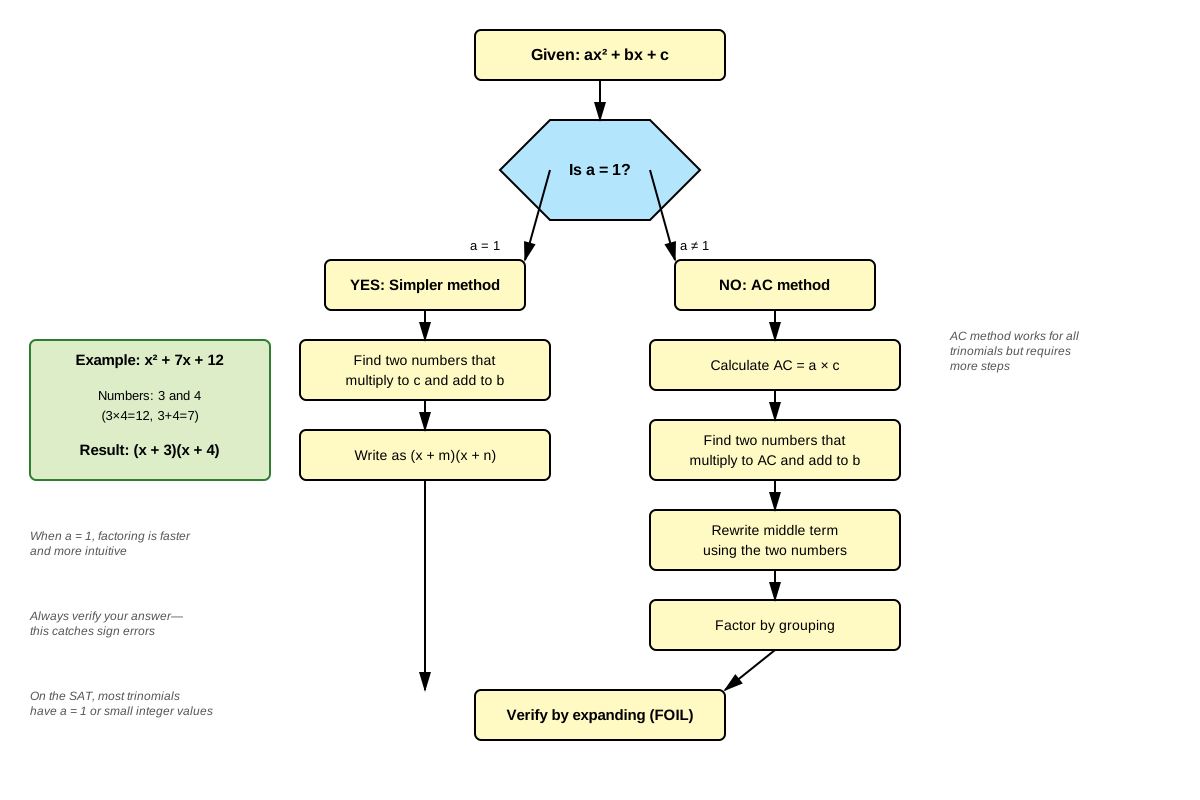
A quadratic trinomial takes the form ax² + bx + c, where a, b, and c are constants. When a = 1, the factoring process involves finding two numbers that multiply to c and add to b. These numbers become the constant terms in the binomial factors.
For x² + 7x + 12:
- Find two numbers that multiply to 12 and add to 7: (3 and 4)
- Write as (x + 3)(x + 4)
When a ≠ 1, the process becomes more complex. The AC method provides a systematic approach:
- Multiply a and c to get AC
- Find two numbers that multiply to AC and add to b
- Split the middle term using these numbers
- Factor by grouping
For 2x² + 7x + 3:
- AC = 2(3) = 6
- Numbers that multiply to 6 and add to 7: (6 and 1)
- Rewrite: 2x² + 6x + 1x + 3
- Group: (2x² + 6x) + (1x + 3)
- Factor each group: 2x(x + 3) + 1(x + 3)
- Final form: (2x + 1)(x + 3)
Difference of Squares
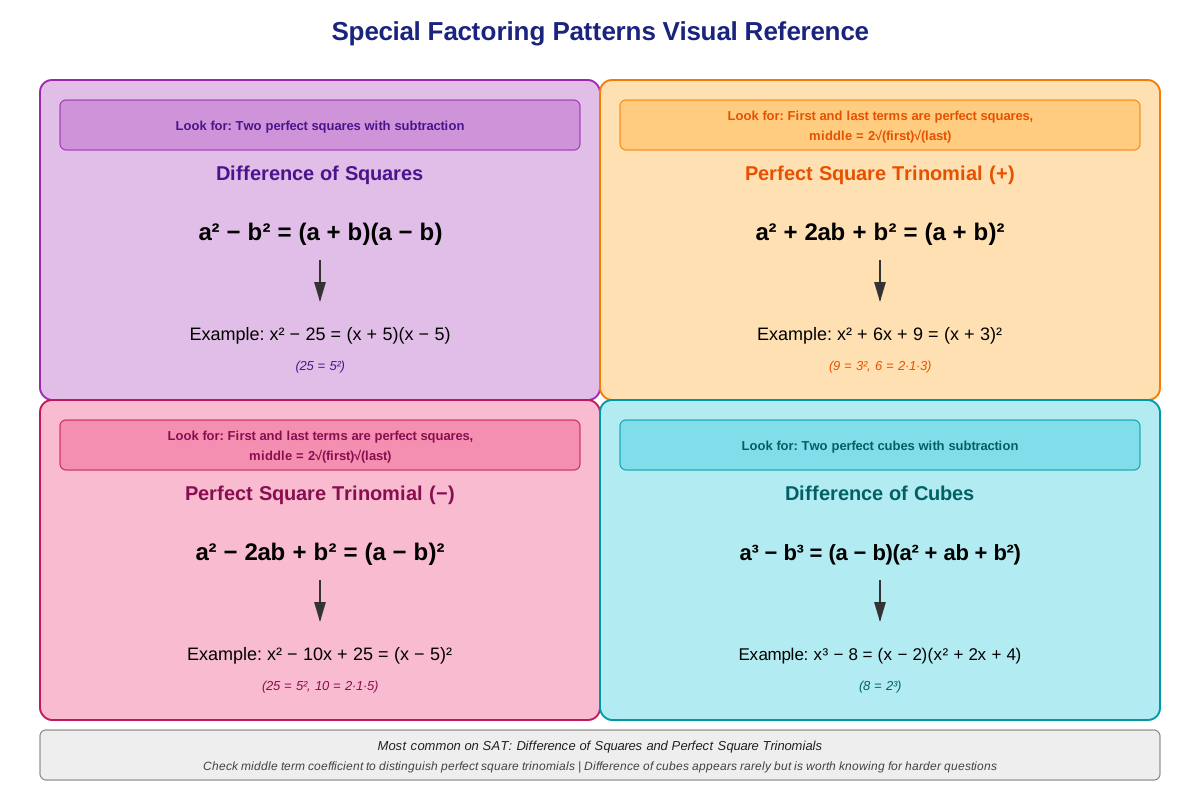
The difference of squares pattern is one of the most recognizable and frequently tested special factoring patterns on the SAT. Any expression in the form a² - b² factors as (a + b)(a - b). This pattern only works for subtraction; a sum of squares (a² + b²) cannot be factored using real numbers.
Common examples:
- x² - 25 = (x + 5)(x - 5)
- 4x² - 49 = (2x + 7)(2x - 7)
- 9x² - 16y² = (3x + 4y)(3x - 4y)
Exam Tip: The SAT often disguises difference of squares by using larger coefficients or including them within more complex expressions. Always check if both terms are perfect squares.
Perfect Square Trinomials
A perfect square trinomial results from squaring a binomial. These follow two patterns:
- a² + 2ab + b² = (a + b)²
- a² - 2ab + b² = (a - b)²
The key identifying feature is that the first and last terms are perfect squares, and the middle term equals twice the product of their square roots.
Examples:
- x² + 10x + 25 = (x + 5)²
- 4x² - 12x + 9 = (2x - 3)²
Factoring by Grouping
Factoring by grouping applies to polynomials with four or more terms. The strategy involves grouping terms in pairs, factoring out the GCF from each pair, and then factoring out the common binomial factor.
For x³ + 3x² + 2x + 6:
- Group: (x³ + 3x²) + (2x + 6)
- Factor each group: x²(x + 3) + 2(x + 3)
- Factor out common binomial: (x + 3)(x² + 2)
Sum and Difference of Cubes
While less common on the SAT, sum and difference of cubes patterns occasionally appear:
- a³ + b³ = (a + b)(a² - ab + b²)
- a³ - b³ = (a - b)(a² + ab + b²)
For example: x³ - 8 = (x - 2)(x² + 2x + 4)
Factoring Strategy Table
| Expression Type | Pattern | Factored Form | Example |
|---|---|---|---|
| GCF present | Common factor in all terms | GCF(remaining polynomial) | 6x² + 9x = 3x(2x + 3) |
| Simple trinomial | x² + bx + c | (x + m)(x + n) where mn = c, m+n = b | x² + 5x + 6 = (x + 2)(x + 3) |
| Difference of squares | a² - b² | (a + b)(a - b) | x² - 36 = (x + 6)(x - 6) |
| Perfect square trinomial | a² ± 2ab + b² | (a ± b)² | x² + 8x + 16 = (x + 4)² |
| Four terms | Groupable pairs | Factor by grouping | xy + 3x + 2y + 6 = (x + 2)(y + 3) |
Concept Relationships
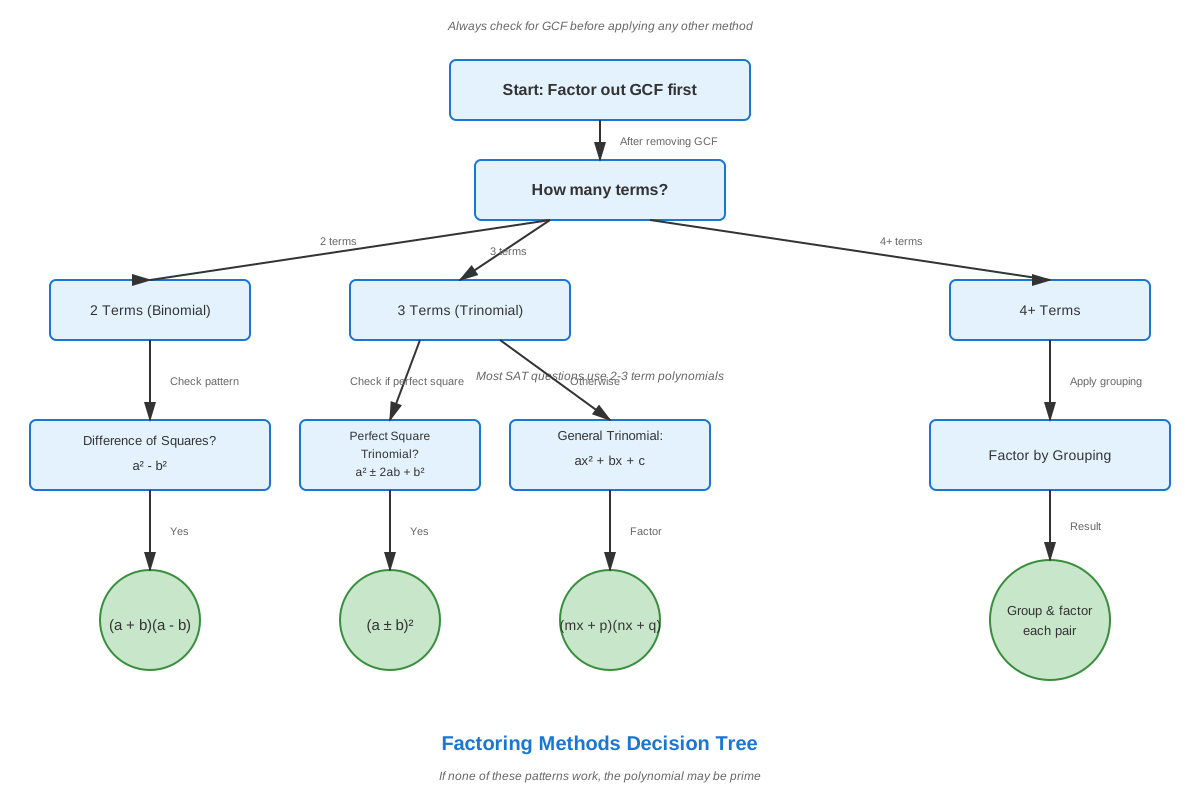
The various factoring techniques form a hierarchical decision tree where each method builds upon or complements the others. The process always begins with identifying the GCF, which simplifies the expression and may reveal additional patterns. Once the GCF is removed, the remaining polynomial's structure determines the next step.
GCF extraction → leads to → Pattern recognition (difference of squares, perfect square trinomial, or general trinomial) → leads to → Application of specific technique → leads to → Verification by expansion
Factoring connects backward to prerequisite knowledge of the distributive property (factoring reverses distribution) and polynomial multiplication (factoring reverses expansion). It connects forward to solving equations (factored form allows use of the zero product property), graphing functions (factored form reveals x-intercepts), and simplifying rational expressions (common factors can be canceled).
The relationship between factoring and solving equations is particularly important: Factoring → enables → Zero Product Property (if ab = 0, then a = 0 or b = 0) → enables → Finding solutions. This connection explains why the SAT frequently embeds factoring within equation-solving contexts rather than testing it in isolation.
Special factoring patterns (difference of squares, perfect square trinomials) represent shortcuts that bypass the general trinomial factoring process. Recognizing these patterns saves time and reduces errors, making them high-value skills for standardized testing.
High-Yield Facts
⭐ Always factor out the GCF first before attempting any other factoring technique—this simplifies the expression and often reveals hidden patterns.
⭐ The difference of squares pattern (a² - b²) = (a + b)(a - b) is one of the most frequently tested factoring patterns on the SAT.
⭐ To verify factoring is correct, multiply the factors back together using FOIL or the distributive property—the result should equal the original expression.
⭐ A sum of squares (a² + b²) cannot be factored using real numbers—this is a common trap on multiple-choice questions.
⭐ When solving equations by factoring, set each factor equal to zero separately to find all solutions (zero product property).
- Perfect square trinomials have the form a² ± 2ab + b² and factor as (a ± b)².
- The AC method works for all quadratic trinomials, even when the leading coefficient is not 1.
- Factoring by grouping requires four or more terms and works by creating common binomial factors.
- A polynomial is considered prime or irreducible if it cannot be factored into polynomials of lower degree with integer coefficients.
- The degree of the factored form equals the degree of the original polynomial—factoring doesn't change the degree.
- Difference of cubes and sum of cubes follow specific patterns but appear less frequently on the SAT than other factoring types.
- When factoring completely, continue factoring until all factors are prime polynomials.
- Negative signs can be factored out to make patterns more recognizable (e.g., -x² + 9 = -(x² - 9) = -(x + 3)(x - 3)).
Quick check — test yourself on Factoring polynomials so far.
Try Flashcards →Common Misconceptions
Misconception: A sum of squares like x² + 25 can be factored as (x + 5)(x + 5).
Correction: Expanding (x + 5)(x + 5) gives x² + 10x + 25, not x² + 25. A sum of squares cannot be factored using real numbers. Only a difference of squares factors: x² - 25 = (x + 5)(x - 5).
Misconception: When factoring x² + 7x + 12, any two numbers that relate to 7 and 12 will work.
Correction: The two numbers must specifically multiply to give the constant term (12) AND add to give the coefficient of the middle term (7). Only 3 and 4 satisfy both conditions: 3 × 4 = 12 and 3 + 4 = 7.
Misconception: After factoring out the GCF, the factoring process is complete.
Correction: Always check if the remaining polynomial can be factored further. For example, 2x³ - 8x = 2x(x² - 4) is not completely factored because x² - 4 is a difference of squares: 2x(x + 2)(x - 2).
Misconception: The signs in factored form don't matter much.
Correction: Signs are critical. For x² - 5x + 6, the factors are (x - 2)(x - 3), not (x + 2)(x + 3). The signs must produce the correct middle term and constant term when expanded.
Misconception: Factoring and expanding are the same operation.
Correction: Factoring and expanding are inverse operations. Factoring breaks an expression into factors (going from x² + 5x + 6 to (x + 2)(x + 3)), while expanding multiplies factors to create a polynomial (going from (x + 2)(x + 3) to x² + 5x + 6).
Misconception: The quadratic formula is always faster than factoring for solving equations.
Correction: When a quadratic factors easily (especially with integer solutions), factoring is significantly faster than applying the quadratic formula. The SAT often designs problems where factoring is the intended efficient method.
Misconception: In 2x² + 8x + 6, the numbers that multiply to 6 and add to 8 are the factors.
Correction: When the leading coefficient is not 1, you must first factor out the GCF (2) to get 2(x² + 4x + 3), then factor the trinomial inside: 2(x + 1)(x + 3). Alternatively, use the AC method with AC = 2(6) = 12.
Worked Examples
Example 1: Multi-Step Factoring with GCF and Difference of Squares
Problem: Factor completely: 3x³ - 75x
Solution:
Step 1: Identify and factor out the GCF.
Both terms contain 3x, so factor it out:
3x³ - 75x = 3x(x² - 25)
Step 2: Examine the remaining polynomial for additional patterns.
The expression x² - 25 is a difference of squares (x² - 5²).
Step 3: Apply the difference of squares pattern.
x² - 25 = (x + 5)(x - 5)
Step 4: Write the complete factored form.
3x³ - 75x = 3x(x + 5)(x - 5)
Step 5: Verify by expanding.
3x(x + 5)(x - 5) = 3x(x² - 25) = 3x³ - 75x ✓
Connection to Learning Objectives: This example demonstrates identifying key features (GCF and special patterns), applying multiple factoring techniques sequentially, and verifying the result—all essential SAT skills.
Example 2: Factoring to Solve an Equation
Problem: Solve for x: 2x² + 5x - 3 = 0
Solution:
Step 1: Recognize this as a quadratic equation that may factor.
The equation is in standard form ax² + bx + c = 0 with a = 2, b = 5, c = -3.
Step 2: Use the AC method since a ≠ 1.
AC = 2(-3) = -6
Find two numbers that multiply to -6 and add to 5: 6 and -1
Step 3: Split the middle term and factor by grouping.
2x² + 5x - 3 = 2x² + 6x - 1x - 3
= (2x² + 6x) + (-1x - 3)
= 2x(x + 3) - 1(x + 3)
= (2x - 1)(x + 3)
Step 4: Apply the zero product property.
If (2x - 1)(x + 3) = 0, then either:
2x - 1 = 0 or x + 3 = 0
Step 5: Solve each equation.
2x - 1 = 0 → 2x = 1 → x = 1/2
x + 3 = 0 → x = -3
Answer: x = 1/2 or x = -3
Step 6: Verify by substitution.
For x = 1/2: 2(1/2)² + 5(1/2) - 3 = 2(1/4) + 5/2 - 3 = 1/2 + 5/2 - 3 = 3 - 3 = 0 ✓
For x = -3: 2(-3)² + 5(-3) - 3 = 2(9) - 15 - 3 = 18 - 15 - 3 = 0 ✓
Connection to Learning Objectives: This example shows how factoring polynomials appears on the SAT in equation-solving contexts and demonstrates the complete problem-solving process from factoring through verification.
Exam Strategy
When approaching SAT factoring polynomials questions, begin by quickly scanning the expression to identify its structure. Look for the number of terms (two terms suggest difference of squares, three terms suggest trinomial factoring, four or more suggest grouping) and check whether all terms share a common factor. This initial assessment determines your factoring pathway and prevents wasted time on inefficient approaches.
Trigger words and phrases that signal factoring questions include: "factor completely," "which expression is equivalent to," "solve the equation," "find the zeros," "find the x-intercepts," and "simplify the expression." Questions asking for "equivalent expressions" often test whether students can recognize that a factored form and an expanded form represent the same polynomial.
For multiple-choice questions, use strategic expansion as a verification tool. If you factor an expression and your result matches an answer choice, quickly expand it mentally or on paper to confirm. This takes only seconds but prevents careless errors. Conversely, if you're unsure how to factor, you can expand each answer choice to see which matches the original expression—though this is slower, it's better than guessing.
Process of elimination works particularly well on factoring questions because wrong answers often represent common errors. Eliminate choices where:
- The expanded form would have a different leading coefficient
- The signs don't produce the correct middle term
- The constant term doesn't match when multiplied
- A sum of squares appears factored (impossible with real numbers)
Time allocation for factoring questions should average 45-60 seconds for straightforward problems and up to 90 seconds for multi-step problems involving equations or applications. If you don't see a factoring pattern within 20 seconds, consider whether the problem might be solved more efficiently using another method (like the quadratic formula) or whether you've missed factoring out a GCF first.
Exam Tip: On calculator-permitted sections, you can verify factoring by graphing. The x-intercepts of the original expression should match the zeros found from the factored form.
Memory Techniques
SOAP for the factoring process sequence:
- Scan for GCF first
- Observe the pattern (number of terms, special forms)
- Apply the appropriate technique
- Prove by expanding to verify
"Difference Dances, Sum Stays" reminds students that a difference of squares factors (the difference "dances" into two factors), but a sum of squares stays as is (cannot be factored).
"FOIL Backwards" for trinomial factoring: Think about what two binomials would FOIL to create the given trinomial. The First terms multiply to give the first term, the Outer and Inner terms combine to give the middle term, and the Last terms multiply to give the constant.
"Perfect Square Sandwich" for identifying perfect square trinomials: The first and last terms are the "bread" (perfect squares), and the middle term is the "filling" (twice the product of the square roots). If the sandwich is complete, it factors as a binomial squared.
Visualization strategy: Picture factoring as "un-distributing" or "reverse multiplication." Imagine the distributive property working backward, pulling common factors out of each term like extracting a common ingredient from different recipes.
Sign pattern acronym "PASS" for trinomial factoring:
- Positive constant, Positive middle term → both signs positive
- Add to middle, multiply to constant → find those two numbers
- Subtract when constant negative → signs differ
- Same signs when constant positive → both positive or both negative
Summary
Factoring polynomials represents a cornerstone algebraic skill that appears throughout the SAT math section, both as a direct testing objective and as an essential tool for solving more complex problems. The process involves recognizing patterns in polynomial expressions and rewriting them as products of simpler factors. Mastery requires understanding multiple techniques: extracting the greatest common factor, factoring quadratic trinomials through various methods, recognizing special patterns like difference of squares and perfect square trinomials, and applying factoring by grouping for expressions with four or more terms. Success on SAT factoring questions depends on systematic pattern recognition, beginning with GCF extraction and proceeding through increasingly specific techniques. Students must also understand the inverse relationship between factoring and expanding, use factoring to solve equations via the zero product property, and verify their work through expansion. The ability to quickly identify which factoring method applies to a given expression, execute that method accurately, and recognize when an expression cannot be factored further distinguishes high-scoring students from those who struggle with polynomial manipulation.
Key Takeaways
- Always begin factoring by identifying and extracting the greatest common factor (GCF) before applying any other technique
- The difference of squares pattern (a² - b²) = (a + b)(a - b) is among the most frequently tested factoring patterns on the SAT
- Verify all factoring by expanding the result—it should equal the original expression
- A sum of squares (a² + b²) cannot be factored using real numbers and often appears as a distractor in answer choices
- Factoring enables efficient equation solving through the zero product property: if ab = 0, then a = 0 or b = 0
- Pattern recognition is key: two terms suggest difference of squares, three terms suggest trinomial factoring, four or more terms suggest grouping
- Complete factoring means continuing until all factors are prime polynomials that cannot be factored further
Related Topics
Solving Quadratic Equations: Factoring provides the foundation for one of three primary methods for solving quadratics (along with the quadratic formula and completing the square). Mastering factoring makes quadratic equation solving faster and more intuitive.
Graphing Polynomial Functions: The factored form of a polynomial directly reveals its x-intercepts (zeros), making it essential for sketching graphs and understanding function behavior. Each factor of the form (x - a) indicates an x-intercept at x = a.
Rational Expressions: Simplifying, multiplying, and dividing rational expressions requires factoring both numerators and denominators to identify and cancel common factors. This topic builds directly on polynomial factoring skills.
Polynomial Division: Understanding factoring helps with both long division and synthetic division of polynomials, as factors of the dividend can be identified and divided out systematically.
Complex Numbers: While the SAT focuses primarily on real number factoring, understanding that some polynomials cannot be factored over the reals prepares students for more advanced mathematics involving complex solutions.
Practice CTA
Now that you've mastered the core concepts and strategies for factoring polynomials, it's time to solidify your understanding through active practice. Work through the practice questions to apply these techniques to authentic SAT-style problems, and use the flashcards to reinforce pattern recognition and key formulas. Remember, factoring is a skill that improves dramatically with deliberate practice—each problem you solve strengthens your pattern recognition and increases your speed. The investment you make in practicing factoring now will pay dividends across multiple question types on test day. You've got this!
Sign up free to keep reading
Create a free AnvayaPrep account to finish this SAT guide on Factoring polynomials — plus flashcards and practice questions.