Overview
Graphs of polynomials represent one of the most visually intuitive yet mathematically rich topics tested on the SAT. Understanding how polynomial functions behave graphically allows students to connect algebraic expressions with their geometric representations, a skill that appears frequently across multiple question types in the math section. Polynomial graphs encode critical information about zeros, end behavior, turning points, and symmetry—all features that the SAT tests both directly and indirectly.
The ability to analyze and interpret polynomial graphs is essential because these questions often appear in the calculator and no-calculator portions of the exam, sometimes requiring students to match equations to graphs, identify key features from visual representations, or determine properties of polynomials based on their graphical behavior. Mastery of this topic enables students to quickly eliminate incorrect answer choices and verify algebraic work through visual reasoning, making it a high-efficiency skill for test day.
This topic connects deeply to fundamental algebra concepts including factoring, zeros of functions, and function transformations. It also bridges to more advanced topics like systems of equations and optimization problems. Students who thoroughly understand polynomial graphs gain a powerful tool for solving complex problems efficiently, as graphical reasoning often provides shortcuts that purely algebraic approaches cannot match.
Learning Objectives
- [ ] Identify key features of graphs of polynomials including zeros, y-intercepts, end behavior, and turning points
- [ ] Explain how graphs of polynomials appears on the SAT in various question formats
- [ ] Apply graphs of polynomials to answer SAT-style questions efficiently and accurately
- [ ] Determine the degree and leading coefficient of a polynomial from its graph
- [ ] Match polynomial equations to their corresponding graphs based on structural features
- [ ] Analyze the multiplicity of zeros by examining how graphs interact with the x-axis
- [ ] Use graphical symmetry to identify even and odd polynomial functions
Prerequisites
- Factoring polynomials: Essential for finding zeros and understanding how factors relate to x-intercepts on graphs
- Function notation and evaluation: Required to interpret points on polynomial graphs and understand coordinate relationships
- Basic graphing skills: Necessary foundation for plotting points and understanding the Cartesian coordinate system
- Understanding of exponents: Critical for predicting end behavior and recognizing how degree affects graph shape
- Solving polynomial equations: Enables connection between algebraic solutions and graphical x-intercepts
Why This Topic Matters
Polynomial graphs appear in real-world contexts ranging from projectile motion in physics to profit optimization in economics. Engineers use polynomial models to design curves in roads and bridges, while data scientists employ polynomial regression to fit complex datasets. The visual nature of polynomial graphs makes them powerful tools for communicating mathematical relationships to non-technical audiences.
On the SAT, polynomial graph questions appear with remarkable consistency, typically comprising 2-4 questions per exam administration. These questions appear in both multiple-choice and student-produced response formats, often worth 3-5% of the total math score. The College Board frequently tests this topic through questions that require students to identify zeros from graphs, match equations to visual representations, or determine the number of real solutions to polynomial equations by analyzing where graphs intersect.
Common question formats include: presenting a polynomial graph and asking students to identify which equation could represent it; providing an equation and asking which graph matches; asking about the number of x-intercepts or turning points; requiring students to determine end behavior; and testing understanding of how transformations affect polynomial graphs. Questions often combine multiple concepts, such as asking students to identify both the degree and the sign of the leading coefficient from a single graph.
Core Concepts
Degree and Basic Shape
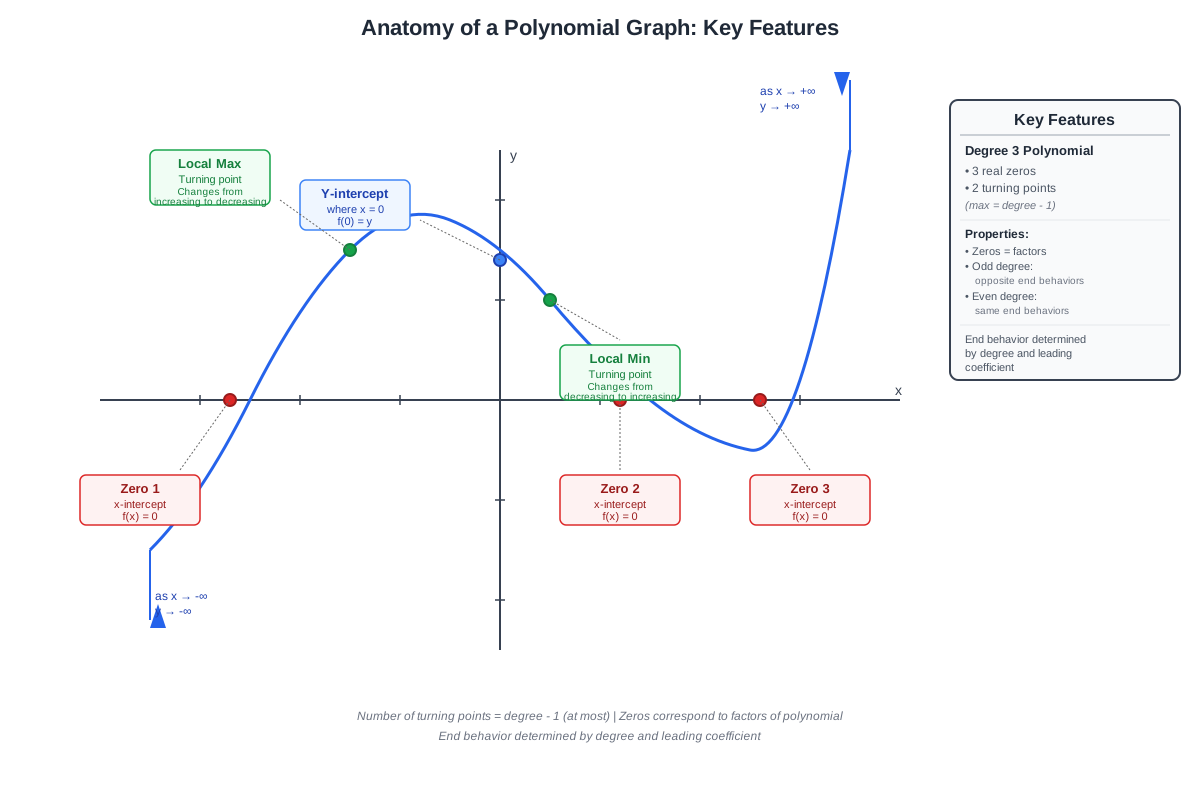
The degree of a polynomial is the highest power of the variable in the expression, and it fundamentally determines the graph's overall shape and behavior. A polynomial of degree n can have at most n real zeros and at most n - 1 turning points. Linear polynomials (degree 1) produce straight lines, quadratic polynomials (degree 2) create parabolas, cubic polynomials (degree 3) form S-shaped curves, and quartic polynomials (degree 4) can have W or M shapes.
The degree also determines the maximum number of times the graph can cross the x-axis. For example, a cubic polynomial can cross the x-axis up to three times, though it might cross fewer times if some zeros are complex (non-real) or if zeros have multiplicity greater than one.
End Behavior
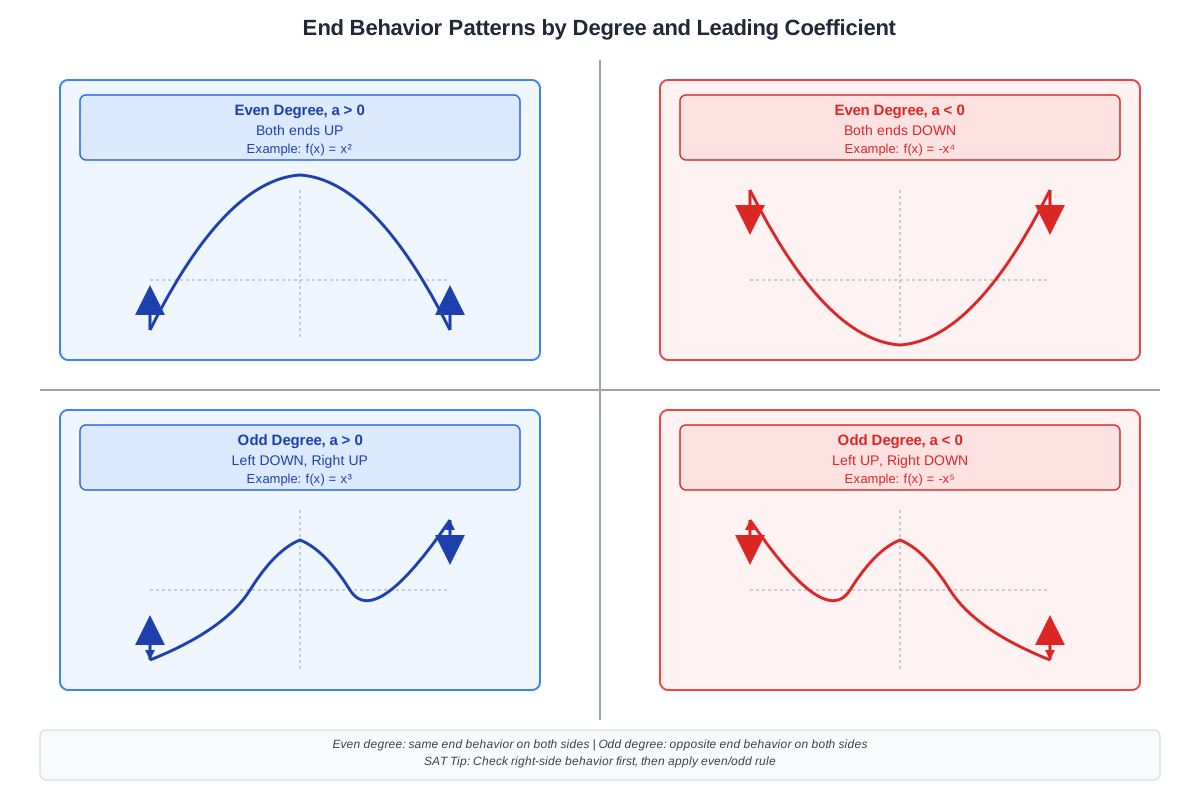
End behavior describes what happens to the y-values of a polynomial as x approaches positive infinity (x → +∞) or negative infinity (x → -∞). This behavior is determined entirely by the leading term—the term with the highest degree—specifically by the degree and the sign of the leading coefficient.
For polynomials with even degree:
- If the leading coefficient is positive, both ends of the graph point upward (as x → ±∞, y → +∞)
- If the leading coefficient is negative, both ends point downward (as x → ±∞, y → -∞)
For polynomials with odd degree:
- If the leading coefficient is positive, the left end points down and the right end points up (as x → -∞, y → -∞; as x → +∞, y → +∞)
- If the leading coefficient is negative, the left end points up and the right end points down (as x → -∞, y → +∞; as x → +∞, y → -∞)
| Degree | Leading Coefficient | Left End | Right End |
|---|---|---|---|
| Even | Positive (+) | Up | Up |
| Even | Negative (-) | Down | Down |
| Odd | Positive (+) | Down | Up |
| Odd | Negative (-) | Up | Down |
Zeros and X-Intercepts
The zeros (or roots) of a polynomial are the x-values where the function equals zero, corresponding to the x-intercepts on the graph. If a polynomial can be factored as f(x) = a(x - r₁)(x - r₂)...(x - rₙ), then r₁, r₂, ..., rₙ are the zeros, and the graph crosses or touches the x-axis at these points.
The y-intercept occurs where x = 0, and its value equals the constant term of the polynomial when written in standard form. Every polynomial has exactly one y-intercept, found by evaluating f(0).
Multiplicity of Zeros
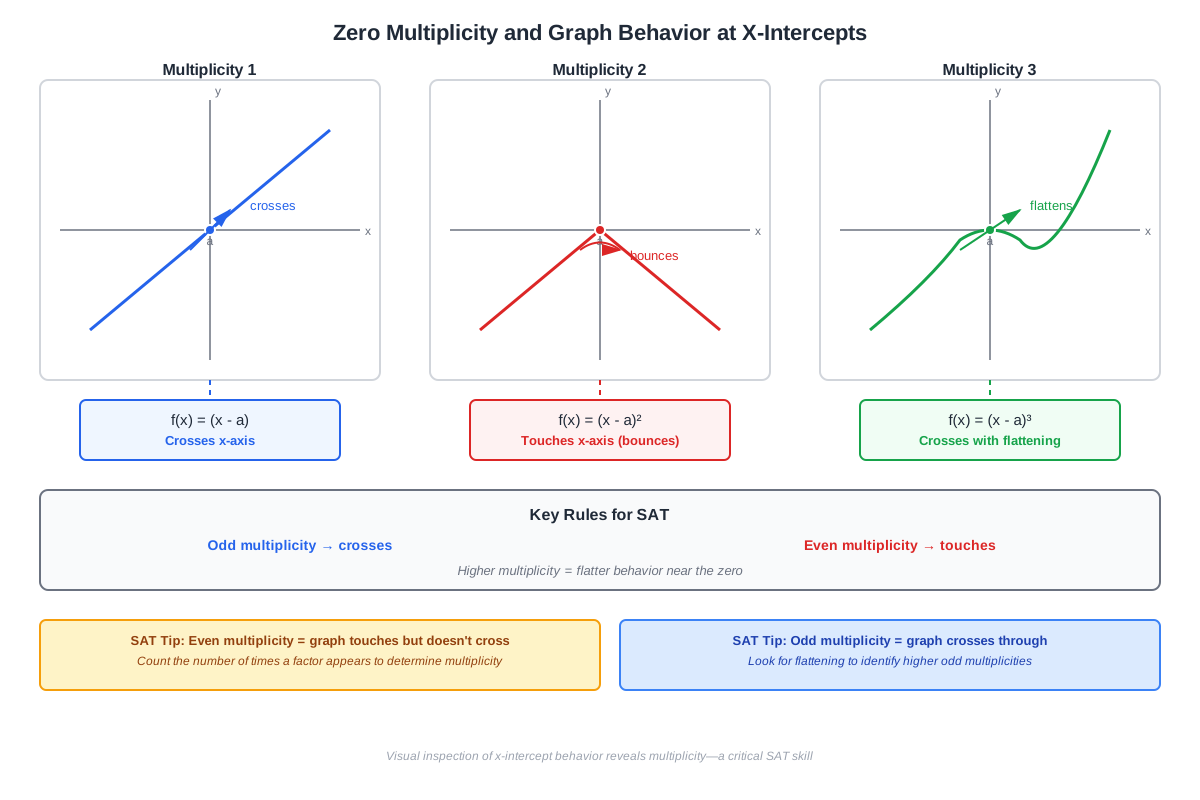
The multiplicity of a zero refers to how many times a particular factor appears in the polynomial's factored form. Multiplicity profoundly affects how the graph behaves at that zero:
- Odd multiplicity (1, 3, 5, ...): The graph crosses through the x-axis at this zero, changing sign from positive to negative or vice versa
- Even multiplicity (2, 4, 6, ...): The graph touches the x-axis at this zero but does not cross it, bouncing back in the same direction
For example, in f(x) = (x - 2)²(x + 1), the zero x = 2 has multiplicity 2 (even), so the graph touches but doesn't cross at x = 2. The zero x = -1 has multiplicity 1 (odd), so the graph crosses through at x = -1.
Higher multiplicities create flatter contact with the x-axis. A zero with multiplicity 3 crosses the x-axis but flattens out more than a zero with multiplicity 1.
Turning Points
A turning point (or local extremum) is a point where the graph changes from increasing to decreasing or vice versa. These points represent local maximum or minimum values. A polynomial of degree n has at most n - 1 turning points, though it may have fewer.
For SAT purposes, counting turning points helps determine the minimum possible degree of a polynomial. If a graph has 3 turning points, the polynomial must be at least degree 4. This relationship provides a quick verification tool when matching equations to graphs.
Symmetry Properties
Some polynomials exhibit special symmetry properties:
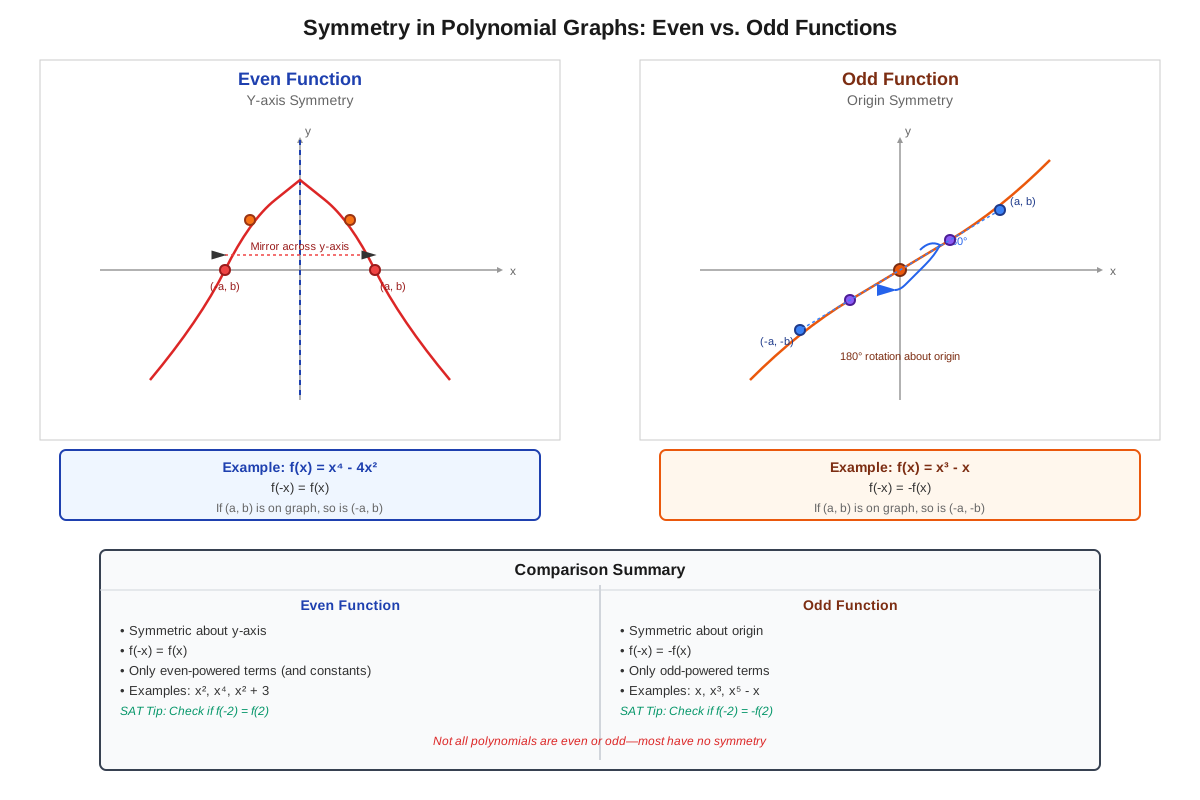
- Even functions: Polynomials containing only even-powered terms (including the constant) are symmetric about the y-axis. Mathematically, f(-x) = f(x). Example: f(x) = x⁴ - 3x² + 2
- Odd functions: Polynomials containing only odd-powered terms are symmetric about the origin (180° rotational symmetry). Mathematically, f(-x) = -f(x). Example: f(x) = x³ - 5x
Recognizing symmetry can help eliminate answer choices quickly on the SAT.
Graph Transformations
Understanding how algebraic changes affect polynomial graphs is crucial:
- Vertical shifts: f(x) + k shifts the graph up k units (or down if k is negative)
- Horizontal shifts: f(x - h) shifts the graph right h units (or left if h is negative)
- Vertical stretches/compressions: a·f(x) stretches vertically by factor |a| if |a| > 1, compresses if 0 < |a| < 1
- Reflections: -f(x) reflects across the x-axis; f(-x) reflects across the y-axis
Concept Relationships
The concepts within polynomial graphs form an interconnected web of relationships. The degree of a polynomial determines both the maximum number of zeros (x-intercepts) and the maximum number of turning points, creating a direct mathematical constraint. The leading coefficient and degree together determine end behavior, which provides the "frame" within which all other features must fit.
Zeros connect to multiplicity, which determines whether the graph crosses or touches the x-axis at each intercept. The sum of all multiplicities equals the degree of the polynomial, creating another verification relationship. Turning points must occur between consecutive zeros (or before the first zero or after the last zero), establishing a spatial relationship on the graph.
The relationship flow can be visualized as:
Factored Form → reveals Zeros → determines X-intercepts → combined with Multiplicity → shapes Local Behavior
Leading Term → determines End Behavior → constrains Overall Shape
Degree → limits Maximum Turning Points → limits Maximum Zeros
These concepts connect to prerequisite knowledge of factoring (which reveals zeros) and exponent rules (which explain end behavior). They extend forward to rational functions, where polynomial graphs form the numerator and denominator behaviors, and to calculus concepts like derivatives (which formally identify turning points).
High-Yield Facts
⭐ The degree of a polynomial equals the maximum number of x-intercepts and is one more than the maximum number of turning points
⭐ For even-degree polynomials, both ends of the graph point in the same direction; for odd-degree polynomials, the ends point in opposite directions
⭐ A zero with odd multiplicity causes the graph to cross the x-axis; a zero with even multiplicity causes the graph to touch but not cross
⭐ The sign of the leading coefficient determines whether the right end of the graph points up (positive) or down (negative)
⭐ The y-intercept of a polynomial equals the constant term when the polynomial is written in standard form
- A polynomial of degree n has exactly n zeros when counting complex zeros and multiplicity
- If a graph has k turning points, the polynomial must have degree at least k + 1
- The graph of a polynomial is a smooth, continuous curve with no breaks, holes, or sharp corners
- Polynomials with only even-powered terms are symmetric about the y-axis
- Polynomials with only odd-powered terms have 180° rotational symmetry about the origin
- Between any two consecutive zeros, a polynomial must have at least one turning point (unless the zeros are adjacent with no space between)
- The number of times a polynomial graph crosses the x-axis must have the same parity (odd/even) as the degree, or be less
- A polynomial cannot have more real zeros than its degree
- The behavior near a zero of multiplicity m resembles the graph of y = x^m near the origin
- Polynomial graphs never have vertical asymptotes or discontinuities
Quick check — test yourself on Graphs of polynomials so far.
Try Flashcards →Common Misconceptions
Misconception: A polynomial of degree n always has exactly n x-intercepts on its graph.
Correction: A polynomial of degree n has at most n real zeros. Some zeros may be complex (non-real) and therefore don't appear as x-intercepts. Additionally, zeros with multiplicity greater than 1 count multiple times toward the degree but appear as single x-intercepts.
Misconception: If a graph touches the x-axis at a point, that zero has multiplicity 2.
Correction: While multiplicity 2 causes the graph to touch without crossing, any even multiplicity (2, 4, 6, etc.) produces this behavior. Higher even multiplicities create flatter contact with the x-axis.
Misconception: The number of turning points equals the degree of the polynomial.
Correction: The number of turning points is at most n - 1 for a polynomial of degree n. A polynomial may have fewer turning points than this maximum. For example, f(x) = x³ has degree 3 but zero turning points.
Misconception: End behavior is determined by all terms in the polynomial.
Correction: Only the leading term (highest degree term) determines end behavior. As x approaches ±∞, the leading term dominates all other terms, making them negligible by comparison.
Misconception: A polynomial graph can cross the x-axis and then immediately cross back without a turning point.
Correction: Between any two x-intercepts, there must be at least one turning point where the graph changes direction. The graph cannot cross the x-axis twice in succession without changing from increasing to decreasing or vice versa.
Misconception: If both ends of a graph point upward, the leading coefficient must be positive.
Correction: While this indicates a positive leading coefficient, it also requires the degree to be even. Both conditions must be met: even degree AND positive leading coefficient.
Misconception: The y-intercept can be found by looking at where the graph crosses the y-axis, but this doesn't relate to the equation.
Correction: The y-intercept equals f(0), which is found by substituting x = 0 into the polynomial equation. This always equals the constant term in standard form.
Worked Examples
Example 1: Identifying Polynomial Features from a Graph
Problem: A polynomial function is graphed on a coordinate plane. The graph crosses the x-axis at x = -2 and x = 3, and touches but does not cross at x = 1. As x approaches negative infinity, y approaches negative infinity, and as x approaches positive infinity, y approaches positive infinity. The graph has exactly 2 turning points. What is the minimum degree of this polynomial, and what is the sign of the leading coefficient?
Solution:
Step 1: Analyze the zeros and their multiplicities.
- The graph crosses at x = -2, indicating odd multiplicity (minimum 1)
- The graph crosses at x = 3, indicating odd multiplicity (minimum 1)
- The graph touches but doesn't cross at x = 1, indicating even multiplicity (minimum 2)
Step 2: Calculate minimum degree.
- Minimum degree = sum of minimum multiplicities = 1 + 1 + 2 = 4
Step 3: Verify with turning points.
- The graph has 2 turning points
- A polynomial with 2 turning points must have degree at least 3
- Our degree of 4 satisfies this requirement (4 - 1 = 3 > 2) ✓
Step 4: Determine the sign of the leading coefficient from end behavior.
- As x → -∞, y → -∞ (left end points down)
- As x → +∞, y → +∞ (right end points up)
- This is characteristic of odd-degree polynomials with positive leading coefficients
Step 5: Check consistency.
- We determined the degree is 4 (even), but the end behavior suggests odd degree
- This means we need to increase multiplicities
- If we increase the multiplicity at x = 1 from 2 to 3 (now odd), the minimum degree becomes 1 + 1 + 3 = 5 (odd)
- Alternatively, we could have multiplicity 3 at x = -2 or x = 3
Reconsidering: With degree 4 (even) and opposite-pointing ends, this is impossible. The minimum degree must be odd. Using multiplicities 1, 1, and 3 gives degree 5.
Answer: The minimum degree is 5, and the leading coefficient is positive.
Example 2: Matching Equations to Graphs
Problem: Which of the following equations could represent a polynomial whose graph crosses the x-axis at x = -1 and x = 2, has a y-intercept of 4, and has both ends pointing downward?
A) f(x) = -(x + 1)(x - 2)
B) f(x) = -2(x + 1)(x - 2)
C) f(x) = (x + 1)²(x - 2)
D) f(x) = -(x + 1)²(x - 2)²
Solution:
Step 1: Check the zeros requirement.
- The graph crosses (not touches) at x = -1 and x = 2
- This means both zeros must have odd multiplicity
- Options A and B have multiplicity 1 at both zeros ✓
- Options C and D have even multiplicity at one or both zeros ✗
Step 2: Check end behavior.
- Both ends point downward indicates either:
- Even degree with negative leading coefficient, OR
- This is the only possibility since both ends go the same direction
- Options A and B have degree 2 (even)
- Option A: leading coefficient is -1 (negative) ✓
- Option B: leading coefficient is -2 (negative) ✓
Step 3: Check the y-intercept.
- y-intercept = f(0)
- Option A: f(0) = -(0 + 1)(0 - 2) = -1(-2) = 2 ✗
- Option B: f(0) = -2(0 + 1)(0 - 2) = -2(1)(-2) = 4 ✓
Answer: B) f(x) = -2(x + 1)(x - 2)
This example demonstrates the systematic approach of checking each requirement sequentially and eliminating options that fail any criterion.
Exam Strategy
When approaching SAT questions on polynomial graphs, begin by identifying what information the question provides and what it asks for. Questions typically fall into three categories: graph-to-equation matching, equation-to-graph matching, or feature identification from either representation.
Trigger words and phrases to watch for include:
- "crosses the x-axis" → odd multiplicity zero
- "touches the x-axis" → even multiplicity zero
- "as x increases without bound" → end behavior analysis
- "turning point" or "changes direction" → local extrema
- "y-intercept" → evaluate at x = 0
- "could represent" → multiple answers may seem correct; check all features
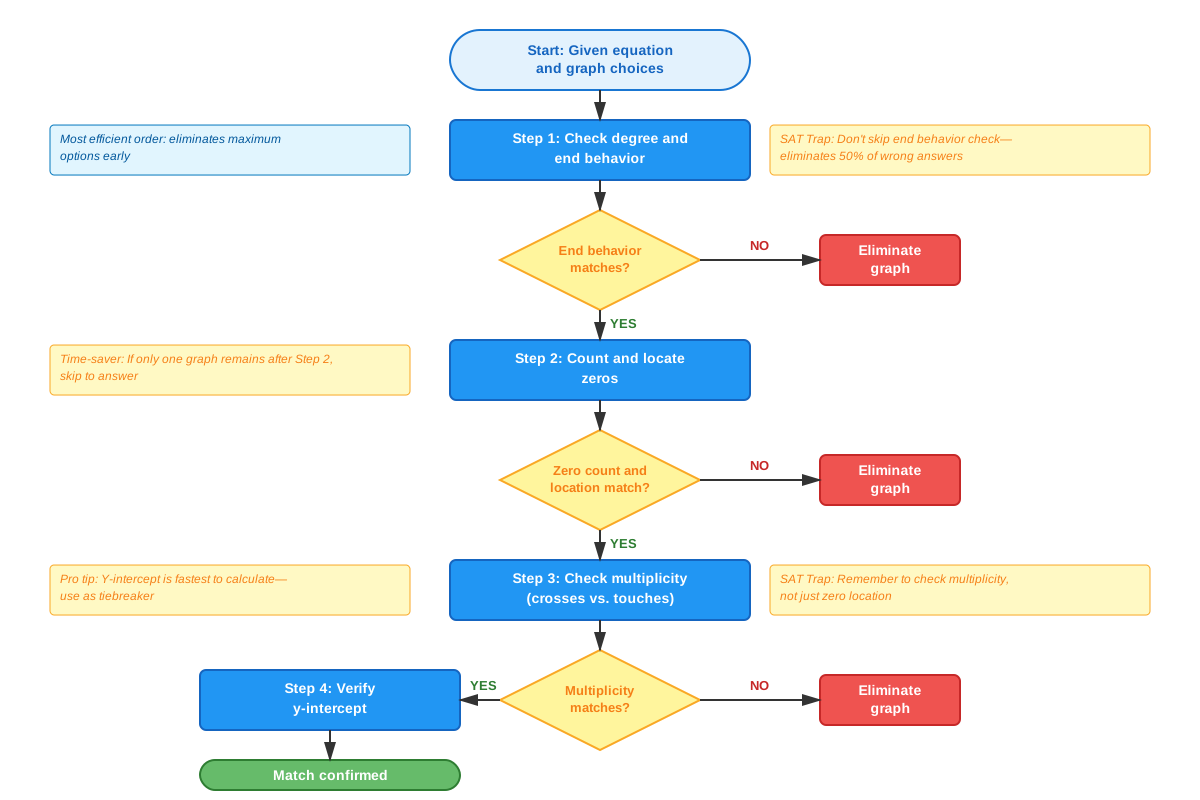
Process-of-elimination strategy:
- Start with end behavior—this eliminates options fastest since it's determined by just two features (degree parity and leading coefficient sign)
- Count x-intercepts and compare to degree constraints
- Check multiplicity at each zero by observing crossing vs. touching behavior
- Verify the y-intercept if given or calculable
- Count turning points as a final verification
For graph-to-equation questions, write down the zeros first, then determine multiplicities, then check end behavior to find the leading coefficient sign. For equation-to-graph questions, factor if possible to find zeros, determine multiplicity from exponents, and calculate end behavior from the leading term.
Time allocation: Spend 30-45 seconds analyzing the given information, 30-60 seconds eliminating obviously wrong answers, and 30-45 seconds verifying your choice. Don't spend more than 2 minutes total on any single polynomial graph question—if stuck, mark it and return later.
Exam Tip: When matching graphs to equations, the y-intercept provides the fastest verification. Calculate f(0) from the equation and check if it matches the graph's y-intercept. This single check often eliminates 2-3 answer choices immediately.
Memory Techniques
LEON - for end behavior of polynomials:
- Left and right Ends Opposite → Negative leading coefficient (for odd degree)
- Left and right Ends Opposite → Not even degree (must be odd)
"Even Steven, Odd Todd":
- Even degree → Same ends (both up or both down) - "Steven" has even letters and "same" reminds you
- Odd degree → Opposite ends (one up, one down) - "Todd" and "opposite" both start with consonants
"Cross or Bounce" for multiplicity:
- Odd multiplicity → Cross through (both words have one syllable with strong consonants)
- Even multiplicity → Bounce back (both words have softer sounds)
Degree Determines Destiny: Remember that the degree sets the maximum for everything—maximum zeros, maximum turning points (degree minus 1), and the end behavior pattern.
Y-intercept = "Why zero?": The y-intercept is found by asking "what happens when x = 0?" This reminds you to substitute zero for x.
Visualization technique: When analyzing end behavior, physically trace the graph with your finger from left to right, noting whether you start low or high and end low or high. This kinesthetic approach helps cement the pattern.
The "One Less" rule: Turning points are always one less than the degree (maximum). If you see 3 turning points, think "degree is one more = 4."
Summary
Graphs of polynomials encode essential information about polynomial functions through visual features including zeros, end behavior, turning points, and multiplicity. The degree of a polynomial determines the maximum number of x-intercepts and turning points, while the leading coefficient and degree together dictate end behavior. Zeros with odd multiplicity cause graphs to cross the x-axis, while even multiplicity causes touching without crossing. For SAT success, students must rapidly identify these features from graphs, match equations to their graphical representations, and use end behavior patterns to eliminate incorrect answers. The key to mastery lies in understanding the relationships between algebraic structure (factored form, degree, leading coefficient) and graphical behavior (crossing patterns, end direction, turning points). By systematically checking each feature—end behavior first, then zeros and multiplicity, then y-intercept—students can efficiently solve polynomial graph questions within the time constraints of the exam.
Key Takeaways
- The degree and leading coefficient completely determine end behavior: even degree means same-direction ends, odd degree means opposite-direction ends, with the leading coefficient sign determining up or down
- Multiplicity determines whether a graph crosses (odd) or touches (even) the x-axis at each zero
- A polynomial of degree n has at most n real zeros and at most n - 1 turning points
- The y-intercept equals the constant term and can be found by evaluating f(0)
- Systematic elimination using end behavior, then zeros, then y-intercept provides the most efficient path to correct answers
- Polynomial graphs are always smooth and continuous with no breaks, sharp corners, or asymptotes
- The sum of all zero multiplicities equals the degree of the polynomial
Related Topics
Rational Functions: Building on polynomial graphs, rational functions involve ratios of polynomials and introduce concepts like vertical and horizontal asymptotes. Understanding polynomial end behavior is essential for analyzing rational function behavior.
Polynomial Division and Remainders: The Factor Theorem and Remainder Theorem connect algebraic division to graphical zeros, extending the relationship between equations and graphs.
Systems of Polynomial Equations: Mastering single polynomial graphs enables analysis of where multiple polynomial graphs intersect, a common SAT question type.
Transformations of Functions: The principles learned with polynomial graphs apply broadly to all function transformations, making this a gateway to understanding how algebraic changes affect any graph.
Optimization Problems: Turning points on polynomial graphs represent maximum and minimum values, connecting to real-world optimization scenarios frequently tested on the SAT.
Practice CTA
Now that you've mastered the core concepts of polynomial graphs, it's time to solidify your understanding through practice. Attempt the practice questions to test your ability to identify key features, match equations to graphs, and analyze polynomial behavior under time pressure. Use the flashcards to reinforce the high-yield facts and relationships you'll need to recall instantly on test day. Remember: understanding the concepts is just the first step—fluency comes from repeated application. Each practice problem you solve builds the pattern recognition and speed essential for SAT success. You've got this!
Sign up free to keep reading
Create a free AnvayaPrep account to finish this SAT guide on Graphs of polynomials — plus flashcards and practice questions.